TECHNOLOGY AND MARKETwww.protekan.comSOLAR ENERGYwww.protekan.com
INTRODUCTIONSolar Energy can be defined as the utilization of the sun’s energy for space heating, lighting, water heating and electricity for homes, businesses and industry. www.protekan.com
TYPES OF SOLAR ENERGYPhotovoltaicSolar water heatingConcentrated Solar Power (CSP)Others – passive heating and lightingwww.protekan.com
PHOTOVOLTAICwww.protekan.com
TECHNOLOGYSemiconductor materials can transform solar energy into electricityMost commonly used material for photovoltaic is siliconSilicon by itself is resistant to electric currentProcess called doping makes it receptive to electrical chargeswww.protekan.com
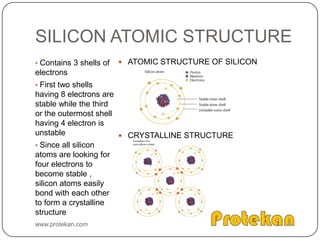
SILICON ATOMIC STRUCTUREATOMIC STRUCTURE OF SILICONCRYSTALLINE STRUCTUREContains 3 shells of electrons
First two shells having 8 electrons are stable while the third or the outermost shell having 4 electron is unstable
Since all silicon atoms are looking for four electrons to become stable , silicon atoms easily bond with each other to form a crystalline structurewww.protekan.com
DOPING PROCESSSilicon in its crystalline form is stable and is a poor conductor of electricityWhen materials containing extra electrons or materials lacking electrons are added, the silicon crystal becomes a semiconductor.This process is known as doping.www.protekan.com
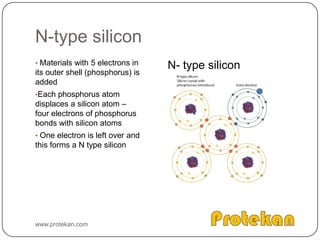
N-type silicon Materials with 5 electrons in its outer shell (phosphorus) is added
Each phosphorus atom displaces a silicon atom – four electrons of phosphorus bonds with silicon atoms
One electron is left over and this forms a N type siliconN- type siliconwww.protekan.com
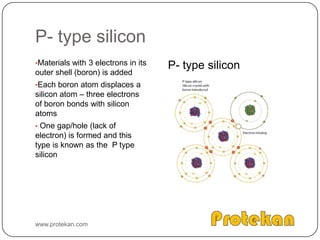
P- type siliconMaterials with 3 electrons in its outer shell (boron) is added
Each boron atom displaces a silicon atom – three electrons of boron bonds with silicon atoms
 One gap/hole (lack of electron) is formed and this type is known as the  P type siliconP- type siliconwww.protekan.com
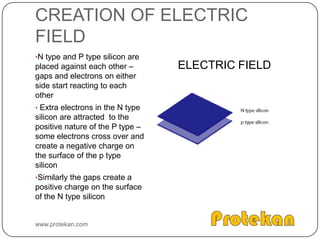
CREATION OF ELECTRIC FIELDN type and P type silicon are placed against each other – gaps and electrons on either side start reacting to each other
Extra electrons in the N type silicon are attracted  to the positive nature of the P type – some electrons cross over and create a negative charge on the surface of the p type silicon
Similarly the gaps create a positive charge on the surface of the N type siliconELECTRIC FIELDwww.protekan.com
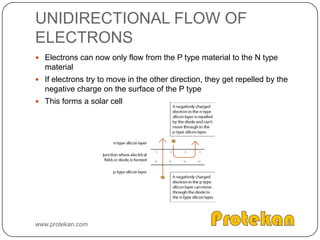
UNIDIRECTIONAL FLOW OF ELECTRONSElectrons can now only flow from the P type material to the N type materialIf electrons try to move in the other direction, they get repelled by the negative charge on the surface of the P typeThis forms a solar cellwww.protekan.com
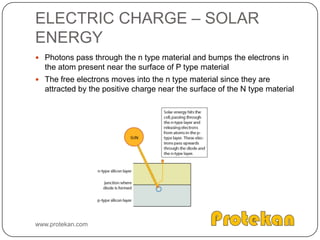
ELECTRIC CHARGE – SOLAR ENERGYPhotons pass through the n type material and bumps the electrons in the atom present near the surface of P type materialThe free electrons moves into the n type material since they are attracted by the positive charge near the surface of the N type materialwww.protekan.com
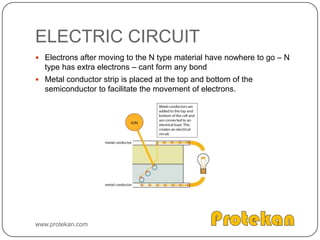
ELECTRIC CIRCUITElectrons after moving to the N type material have nowhere to go – N type has extra electrons – cant form any bondMetal conductor strip is placed at the top and bottom of the semiconductor to facilitate the movement of electrons.www.protekan.com
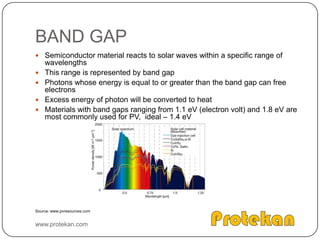
BAND GAPSemiconductor material reacts to solar waves within a specific range of wavelengthsThis range is represented by band gapPhotons whose energy is equal to or greater than the band gap can free electronsExcess energy of photon will be converted to heatMaterials with band gaps ranging from 1.1 eV (electron volt) and 1.8 eV are most commonly used for PV,  ideal – 1.4 eVSource: www.pvresources.com www.protekan.com
TYPES OF PV PANELS - COMMONMonocrystalline siliconMulticrystalline siliconThin film	www.protekan.com
Monocrystalline siliconCrystalline silicon is usedA silicon boule grown from a single crystal  - grown in one planeExpensive than multicrystalline15-18% efficientwww.protekan.com
Multicrystalline siliconA silicon boule grown from a multifaceted crystalline material – grown in several plane or directionsLess expensive12-14% efficiencywww.protekan.com
Thin filmNo crystalline structure
Applied as a thin semiconductor film
Amorphous silicon, cadmium telluride, Copper indium diselenide are examples of thin film
Low manufacturing cost
Versatile
Less time consuming to make
Efficiency 5-6%www.protekan.com
SOLAR WATER HEATINGwww.protekan.com
PARTS OF SOLAR WATER HEATING SYSTEMSolar thermal collectorsFluid system to carry the heat from the collector to the point of useOPTIONALPump – to move the fluidTank for storagewww.protekan.com
SYSTEM TYPESPassive systemActive systemwww.protekan.com
Passive systemRely on gravity to move the liquid from the collector to the storage tankTendency of water to circulate as it is heatedwww.protekan.com
Active systemRely on pump to move the fluid from the collector to the storage tankThe storage tank is usually well insulatedwww.protekan.com
TYPES OF SOLAR THERMAL COLLECTORSFlat plate collectorEvacuated tube collectorwww.protekan.com
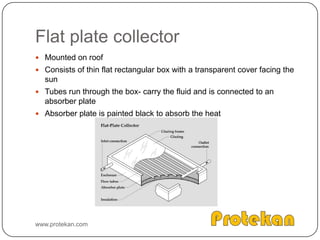
Flat plate collectorMounted on roofConsists of thin flat rectangular box with a transparent cover facing the sunTubes run through the box- carry the fluid and is connected to an absorber plateAbsorber plate is painted black to absorb the heatwww.protekan.com
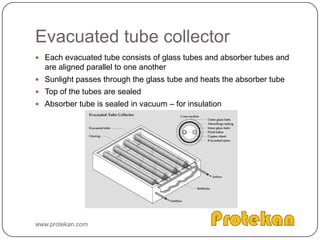
Evacuated tube collectorEach evacuated tube consists of glass tubes and absorber tubes and are aligned parallel to one anotherSunlight passes through the glass tube and heats the absorber tubeTop of the tubes are sealedAbsorber tube is sealed in vacuum – for insulationwww.protekan.com
CONCENTRATED SOLAR POWERwww.protekan.com
TYPES OF CSPParabolic troughLinear FresnelDish engineSolar chimneySolar power towerConcentrated photovoltaicwww.protekan.com
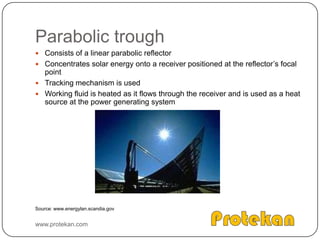
Parabolic troughConsists of a linear parabolic reflectorConcentrates solar energy onto a receiver positioned at the reflector’s focal pointTracking mechanism is usedWorking fluid is heated as it flows through the receiver and is used as a heat source at the power generating systemSource: www.energylan.scandia.govwww.protekan.com
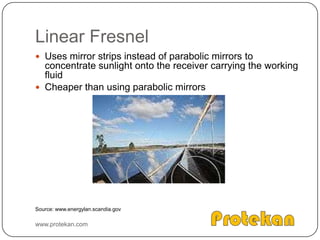
Linear FresnelUses mirror strips instead of parabolic mirrors to concentrate sunlight onto the receiver carrying the working fluidCheaper than using parabolic mirrorsSource: www.energylan.scandia.govwww.protekan.com
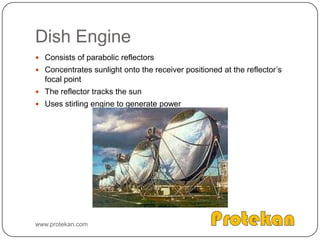
Dish EngineConsists of parabolic reflectorsConcentrates sunlight onto the receiver positioned at the reflector’s focal pointThe reflector tracks the sunUses stirling engine to generate powerwww.protekan.com
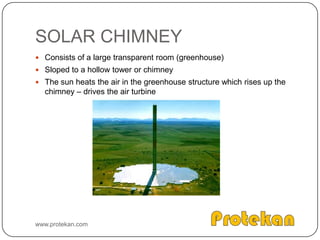
SOLAR CHIMNEYConsists of a large transparent room (greenhouse)Sloped to a hollow tower or chimneyThe sun heats the air in the greenhouse structure which rises up the chimney – drives the air turbinewww.protekan.com
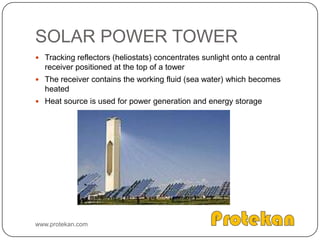
SOLAR POWER TOWERTracking reflectors (heliostats) concentrates sunlight onto a central receiver positioned at the top of a towerThe receiver contains the working fluid (sea water) which becomes heatedHeat source is used for power generation and energy storagewww.protekan.com
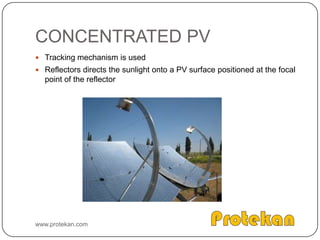
CONCENTRATED PVTracking mechanism is usedReflectors directs the sunlight onto a PV surface positioned at the focal point of the reflectorwww.protekan.com
PHOTOVOLTAICMARKET OVERVIEWwww.protekan.com

Overview of Solar Energy

  • 1.
  • 2.
    INTRODUCTIONSolar Energy canbe defined as the utilization of the sun’s energy for space heating, lighting, water heating and electricity for homes, businesses and industry. www.protekan.com
  • 3.
    TYPES OF SOLARENERGYPhotovoltaicSolar water heatingConcentrated Solar Power (CSP)Others – passive heating and lightingwww.protekan.com
  • 4.
  • 5.
    TECHNOLOGYSemiconductor materials cantransform solar energy into electricityMost commonly used material for photovoltaic is siliconSilicon by itself is resistant to electric currentProcess called doping makes it receptive to electrical chargeswww.protekan.com
  • 6.
    SILICON ATOMIC STRUCTUREATOMICSTRUCTURE OF SILICONCRYSTALLINE STRUCTUREContains 3 shells of electrons
  • 7.
    First two shellshaving 8 electrons are stable while the third or the outermost shell having 4 electron is unstable
  • 8.
    Since all siliconatoms are looking for four electrons to become stable , silicon atoms easily bond with each other to form a crystalline structurewww.protekan.com
  • 9.
    DOPING PROCESSSilicon inits crystalline form is stable and is a poor conductor of electricityWhen materials containing extra electrons or materials lacking electrons are added, the silicon crystal becomes a semiconductor.This process is known as doping.www.protekan.com
  • 10.
    N-type silicon Materialswith 5 electrons in its outer shell (phosphorus) is added
  • 11.
    Each phosphorus atomdisplaces a silicon atom – four electrons of phosphorus bonds with silicon atoms
  • 12.
    One electron isleft over and this forms a N type siliconN- type siliconwww.protekan.com
  • 13.
    P- type siliconMaterialswith 3 electrons in its outer shell (boron) is added
  • 14.
    Each boron atomdisplaces a silicon atom – three electrons of boron bonds with silicon atoms
  • 15.
    One gap/hole(lack of electron) is formed and this type is known as the P type siliconP- type siliconwww.protekan.com
  • 16.
    CREATION OF ELECTRICFIELDN type and P type silicon are placed against each other – gaps and electrons on either side start reacting to each other
  • 17.
    Extra electrons inthe N type silicon are attracted to the positive nature of the P type – some electrons cross over and create a negative charge on the surface of the p type silicon
  • 18.
    Similarly the gapscreate a positive charge on the surface of the N type siliconELECTRIC FIELDwww.protekan.com
  • 19.
    UNIDIRECTIONAL FLOW OFELECTRONSElectrons can now only flow from the P type material to the N type materialIf electrons try to move in the other direction, they get repelled by the negative charge on the surface of the P typeThis forms a solar cellwww.protekan.com
  • 20.
    ELECTRIC CHARGE –SOLAR ENERGYPhotons pass through the n type material and bumps the electrons in the atom present near the surface of P type materialThe free electrons moves into the n type material since they are attracted by the positive charge near the surface of the N type materialwww.protekan.com
  • 21.
    ELECTRIC CIRCUITElectrons aftermoving to the N type material have nowhere to go – N type has extra electrons – cant form any bondMetal conductor strip is placed at the top and bottom of the semiconductor to facilitate the movement of electrons.www.protekan.com
  • 22.
    BAND GAPSemiconductor materialreacts to solar waves within a specific range of wavelengthsThis range is represented by band gapPhotons whose energy is equal to or greater than the band gap can free electronsExcess energy of photon will be converted to heatMaterials with band gaps ranging from 1.1 eV (electron volt) and 1.8 eV are most commonly used for PV, ideal – 1.4 eVSource: www.pvresources.com www.protekan.com
  • 23.
    TYPES OF PVPANELS - COMMONMonocrystalline siliconMulticrystalline siliconThin film www.protekan.com
  • 24.
    Monocrystalline siliconCrystalline siliconis usedA silicon boule grown from a single crystal - grown in one planeExpensive than multicrystalline15-18% efficientwww.protekan.com
  • 25.
    Multicrystalline siliconA siliconboule grown from a multifaceted crystalline material – grown in several plane or directionsLess expensive12-14% efficiencywww.protekan.com
  • 26.
  • 27.
    Applied as athin semiconductor film
  • 28.
    Amorphous silicon, cadmiumtelluride, Copper indium diselenide are examples of thin film
  • 29.
  • 30.
  • 31.
  • 32.
  • 33.
  • 34.
    PARTS OF SOLARWATER HEATING SYSTEMSolar thermal collectorsFluid system to carry the heat from the collector to the point of useOPTIONALPump – to move the fluidTank for storagewww.protekan.com
  • 35.
    SYSTEM TYPESPassive systemActivesystemwww.protekan.com
  • 36.
    Passive systemRely ongravity to move the liquid from the collector to the storage tankTendency of water to circulate as it is heatedwww.protekan.com
  • 37.
    Active systemRely onpump to move the fluid from the collector to the storage tankThe storage tank is usually well insulatedwww.protekan.com
  • 38.
    TYPES OF SOLARTHERMAL COLLECTORSFlat plate collectorEvacuated tube collectorwww.protekan.com
  • 39.
    Flat plate collectorMountedon roofConsists of thin flat rectangular box with a transparent cover facing the sunTubes run through the box- carry the fluid and is connected to an absorber plateAbsorber plate is painted black to absorb the heatwww.protekan.com
  • 40.
    Evacuated tube collectorEachevacuated tube consists of glass tubes and absorber tubes and are aligned parallel to one anotherSunlight passes through the glass tube and heats the absorber tubeTop of the tubes are sealedAbsorber tube is sealed in vacuum – for insulationwww.protekan.com
  • 41.
  • 42.
    TYPES OF CSPParabolictroughLinear FresnelDish engineSolar chimneySolar power towerConcentrated photovoltaicwww.protekan.com
  • 43.
    Parabolic troughConsists ofa linear parabolic reflectorConcentrates solar energy onto a receiver positioned at the reflector’s focal pointTracking mechanism is usedWorking fluid is heated as it flows through the receiver and is used as a heat source at the power generating systemSource: www.energylan.scandia.govwww.protekan.com
  • 44.
    Linear FresnelUses mirrorstrips instead of parabolic mirrors to concentrate sunlight onto the receiver carrying the working fluidCheaper than using parabolic mirrorsSource: www.energylan.scandia.govwww.protekan.com
  • 45.
    Dish EngineConsists ofparabolic reflectorsConcentrates sunlight onto the receiver positioned at the reflector’s focal pointThe reflector tracks the sunUses stirling engine to generate powerwww.protekan.com
  • 46.
    SOLAR CHIMNEYConsists ofa large transparent room (greenhouse)Sloped to a hollow tower or chimneyThe sun heats the air in the greenhouse structure which rises up the chimney – drives the air turbinewww.protekan.com
  • 47.
    SOLAR POWER TOWERTrackingreflectors (heliostats) concentrates sunlight onto a central receiver positioned at the top of a towerThe receiver contains the working fluid (sea water) which becomes heatedHeat source is used for power generation and energy storagewww.protekan.com
  • 48.
    CONCENTRATED PVTracking mechanismis usedReflectors directs the sunlight onto a PV surface positioned at the focal point of the reflectorwww.protekan.com
  • 49.