Sports Nutrition
Source: Ann Litt, MS, RD
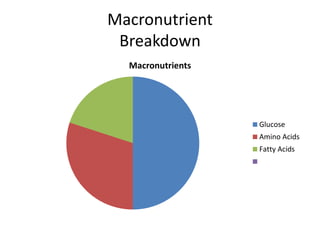
Macronutrient breakdown
MacroNutrients
Carbohydrate
Protein
Fats
Macronutrient
Breakdown
Macronutrients
Glucose
Amino Acids
Fatty Acids
Carbohydrates
• Carbohydrates are needed before, during and
after exercise.
• Supply immediate energy
• Essential for maintaining fuel reserves
• Help muscles recover from exercise
• Cut them out of your diet, you can cut yourself
out of competition!!!
Simple Carbohydrates
• Found in Fruits and Vegetables
• Also found in candy, soda and cookies –These
foods are called “empty calories” because
they provide calories without other nutrients.
Complex Carbohydrates
• Often called starch- found in foods such as
whole wheat bread, potatoes, pasta and rice.
• In addition to calories, they provide vitamins,
minerals, fiber, protein and fat.
Glycogen
• Regardless of the type of carbohydrate eaten, all
are converted to glucose in the body and used as
fuel.
• The body can store a limited amount of
carbohydrates, called glycogen (in liver and
muscle).
• This is a fuel reserve.
• When you eat more than
your body can store or use,
all carbs are converted to fat
and stored in the body.
Glycogen stores
• 150 lbs male has about 1800 calories of
carbohydrates stored in
• Muscle 1400 calories (78%)
• Liver 320 (18%)
• Blood 80 (4%)
Glycemic Index
• GI tells us something about the rate of
digestion and absorption of its carbohydrates
• High GI foods enter the bloodstream rapidly
and are readily available as glucose, making
them good choices during and after exercise.
• Low GI foods enter the blood more slowly, so
they are better choices for pre-exercise, when
you are looking for foods to sustain energy.
Protein
• Involved in building muscle and repairing muscle
tissue after injury or exercise
• Protein regulates body functions and keeps the
body healthy and strong by fighting infections.
• Involved in every chemical reaction in the body.
• Protein is an expensive
energy source
• Does eating extra
protein build bigger
muscles?
Fats: Not a Diet Demon
• Fats or Lipids are broken down in the body to
fatty acids.
• Necessary to absorb fat-soluble vitamins
(Vitamin A, D, E, K)
• Protects internal organs
• Keeps body warm by
providing insulation
Determining your Protein
Requirements
• Growing teen athletes need about 0.8 -0.9
grams of protein per pound of body weight.
• Ex. 16yr old Josh weighs 160 pounds
• 160 x 0.8 = 128 160 x 0.9 = 144
• Josh needs 128-144 grams of protein a day
• Calculate your protein requirements!!
Balanced diet
• The foods you eat for training is as important,
if not more important, than the diet for the
actual event.
• Some diets such as high-protein, low
carbohydrate diets are currently in vogue but
an athlete performing without carbohydrates
is like a car running without gas.
Dietary Supplements
• Is intended to supplement the diet
• Contains one or more dietary ingredient
(including vitamins, minerals, herbs or
botanicals, amino acids and other substances)
• Is intended to be taken by mouth as a pill,
capsule, tablet or liquid
• Is labeled on the front panel as being a dietary
supplement
5hr energy
• What is the main message?
• View small print
• Close-up camera shots
• Special sound effects
• Special lighting
• Music
• Excitement
• The advertisement was for?
Buyers Beware
• Dietary Supplements ($36B)such as Amino Acid
powders,Muscle Milk, Creatine, DHEA
(prohormones), Meal Replacements,5Hour
Energy, Caffeine, Vitamins and Minerals etc.
• Supplements are virturally unregulated.
• FDA doesn’t consider them food or drug so it
doesn’t regulate them.
• Once dietary supplement is marketed, FDA has to
prove that the product is not safe in order to
remove it from the market!!
Drugs vs. Supplements
Drugs Supplements
Have Risks and Side Effects Have Risks and Side Effects
Not self-prescribed Self-prescribed
FDA considers new drugs to be unsafe
until they are proven safe by clinical trials
Once FDA approves drug, it must be
manufactured under carefully monitored
conditions and packaged with complete
information on the best dose, route,
schedule.
Package information must include:
Conditions the drug has been proven to
treat
Known side effects
Unsafe interactions with other drug
FDA considers supplements safe until
proven otherwise.
Manufacturers are not required to test
new ingredients or supplements in clinical
trial
Manufacturers responsibility to see that
the supplements they make are
standardized, quality products that match
the descriptions on their labels.
USP-an independent organization
dedicated to quality control and purity of
pharmaceuticals established standards
Dehydration source:B. Mackenzie
• Sweating is the way in which your body maintains its
core temperature.
• When you sweat you are losing body fluid and
electrolytes (minerals such as chloride, calcium,
magnesium, sodium and potassium)
% body weight lost as sweat Effect
2% impaired performance
4% muscular work declines
5% heat exhaustion
7% hallucinations
10% circulatory collapse
Fluid absorption
• Two main factors affect the speed at which fluid
from a drink gets into the body:
• The speed at which it is emptied from the
stomach
• The rate at which it is absorbed through the walls
of the small intestine
• The higher the carbohydrate levels
in a drink, the slower the rate of
stomach emptying.
Sports Drinks
• 3 types of sports drinks all of which contain
various levels of fluid, electrolytes and
carbohydrates.
• Isotonic -Fluid, electrolytes and 6 -8% carb
• Hypotonic – Fluids, electrolytes
and low level of carb (marathoners)
• Hypertonic – high level of carbs
(gymnasts and jockeys)
Best Recovery Drink source: E. Magee RD
• Chocolate milk is an effective recovery beverage after
muscle-intensive workouts.
• Contains ideal carb to protein ratio (3 to 1) which
enhances glycogen replenishment into the muscles
post workout. Regular milk has 2:1 ratio
• Contains whey protein which is digested and absorbed
quickly, getting essential amino acids
circulating in the blood stream
soon after consumption.
• Contains casein which reduces the
amount of muscle breakdown.
Muscle Cramps
• Could be due to Dehydration
• Mineral Deficiencies – Magnesium, Potassium
and Calcium
• Good sources of Magnesium are soy-based foods,
whole-grain bread, almonds, cashews and Brazil
nuts
• Good sources of Potassium are orange juice,
potatoes and bananas
• Good sources of Calcium are milk and dairy based
foods, dark green leafy vegetables, sardines,
almonds
Water source: S. Morres RD
Important for five reasons:
1. Helps digest food
Importance of water
2. Helps remove waste
Importance of water
3. Lubricates muscles and joints
Importance of water
4. Regulates body temperature
Importance of water
5.Helps our cell communicate
Caffeine
• How much are you drinking ?
• When are you consuming it?
9839449.pptx

9839449.pptx

  • 1.
  • 2.
  • 3.
  • 4.
    Carbohydrates • Carbohydrates areneeded before, during and after exercise. • Supply immediate energy • Essential for maintaining fuel reserves • Help muscles recover from exercise • Cut them out of your diet, you can cut yourself out of competition!!!
  • 5.
    Simple Carbohydrates • Foundin Fruits and Vegetables • Also found in candy, soda and cookies –These foods are called “empty calories” because they provide calories without other nutrients.
  • 6.
    Complex Carbohydrates • Oftencalled starch- found in foods such as whole wheat bread, potatoes, pasta and rice. • In addition to calories, they provide vitamins, minerals, fiber, protein and fat.
  • 7.
    Glycogen • Regardless ofthe type of carbohydrate eaten, all are converted to glucose in the body and used as fuel. • The body can store a limited amount of carbohydrates, called glycogen (in liver and muscle). • This is a fuel reserve. • When you eat more than your body can store or use, all carbs are converted to fat and stored in the body.
  • 8.
    Glycogen stores • 150lbs male has about 1800 calories of carbohydrates stored in • Muscle 1400 calories (78%) • Liver 320 (18%) • Blood 80 (4%)
  • 9.
    Glycemic Index • GItells us something about the rate of digestion and absorption of its carbohydrates • High GI foods enter the bloodstream rapidly and are readily available as glucose, making them good choices during and after exercise. • Low GI foods enter the blood more slowly, so they are better choices for pre-exercise, when you are looking for foods to sustain energy.
  • 10.
    Protein • Involved inbuilding muscle and repairing muscle tissue after injury or exercise • Protein regulates body functions and keeps the body healthy and strong by fighting infections. • Involved in every chemical reaction in the body. • Protein is an expensive energy source • Does eating extra protein build bigger muscles?
  • 11.
    Fats: Not aDiet Demon • Fats or Lipids are broken down in the body to fatty acids. • Necessary to absorb fat-soluble vitamins (Vitamin A, D, E, K) • Protects internal organs • Keeps body warm by providing insulation
  • 12.
    Determining your Protein Requirements •Growing teen athletes need about 0.8 -0.9 grams of protein per pound of body weight. • Ex. 16yr old Josh weighs 160 pounds • 160 x 0.8 = 128 160 x 0.9 = 144 • Josh needs 128-144 grams of protein a day • Calculate your protein requirements!!
  • 13.
    Balanced diet • Thefoods you eat for training is as important, if not more important, than the diet for the actual event. • Some diets such as high-protein, low carbohydrate diets are currently in vogue but an athlete performing without carbohydrates is like a car running without gas.
  • 14.
    Dietary Supplements • Isintended to supplement the diet • Contains one or more dietary ingredient (including vitamins, minerals, herbs or botanicals, amino acids and other substances) • Is intended to be taken by mouth as a pill, capsule, tablet or liquid • Is labeled on the front panel as being a dietary supplement
  • 15.
    5hr energy • Whatis the main message? • View small print • Close-up camera shots • Special sound effects • Special lighting • Music • Excitement • The advertisement was for?
  • 16.
    Buyers Beware • DietarySupplements ($36B)such as Amino Acid powders,Muscle Milk, Creatine, DHEA (prohormones), Meal Replacements,5Hour Energy, Caffeine, Vitamins and Minerals etc. • Supplements are virturally unregulated. • FDA doesn’t consider them food or drug so it doesn’t regulate them. • Once dietary supplement is marketed, FDA has to prove that the product is not safe in order to remove it from the market!!
  • 17.
    Drugs vs. Supplements DrugsSupplements Have Risks and Side Effects Have Risks and Side Effects Not self-prescribed Self-prescribed FDA considers new drugs to be unsafe until they are proven safe by clinical trials Once FDA approves drug, it must be manufactured under carefully monitored conditions and packaged with complete information on the best dose, route, schedule. Package information must include: Conditions the drug has been proven to treat Known side effects Unsafe interactions with other drug FDA considers supplements safe until proven otherwise. Manufacturers are not required to test new ingredients or supplements in clinical trial Manufacturers responsibility to see that the supplements they make are standardized, quality products that match the descriptions on their labels. USP-an independent organization dedicated to quality control and purity of pharmaceuticals established standards
  • 18.
    Dehydration source:B. Mackenzie •Sweating is the way in which your body maintains its core temperature. • When you sweat you are losing body fluid and electrolytes (minerals such as chloride, calcium, magnesium, sodium and potassium) % body weight lost as sweat Effect 2% impaired performance 4% muscular work declines 5% heat exhaustion 7% hallucinations 10% circulatory collapse
  • 19.
    Fluid absorption • Twomain factors affect the speed at which fluid from a drink gets into the body: • The speed at which it is emptied from the stomach • The rate at which it is absorbed through the walls of the small intestine • The higher the carbohydrate levels in a drink, the slower the rate of stomach emptying.
  • 20.
    Sports Drinks • 3types of sports drinks all of which contain various levels of fluid, electrolytes and carbohydrates. • Isotonic -Fluid, electrolytes and 6 -8% carb • Hypotonic – Fluids, electrolytes and low level of carb (marathoners) • Hypertonic – high level of carbs (gymnasts and jockeys)
  • 21.
    Best Recovery Drinksource: E. Magee RD • Chocolate milk is an effective recovery beverage after muscle-intensive workouts. • Contains ideal carb to protein ratio (3 to 1) which enhances glycogen replenishment into the muscles post workout. Regular milk has 2:1 ratio • Contains whey protein which is digested and absorbed quickly, getting essential amino acids circulating in the blood stream soon after consumption. • Contains casein which reduces the amount of muscle breakdown.
  • 22.
    Muscle Cramps • Couldbe due to Dehydration • Mineral Deficiencies – Magnesium, Potassium and Calcium • Good sources of Magnesium are soy-based foods, whole-grain bread, almonds, cashews and Brazil nuts • Good sources of Potassium are orange juice, potatoes and bananas • Good sources of Calcium are milk and dairy based foods, dark green leafy vegetables, sardines, almonds
  • 23.
    Water source: S.Morres RD Important for five reasons: 1. Helps digest food
  • 24.
    Importance of water 2.Helps remove waste
  • 25.
    Importance of water 3.Lubricates muscles and joints
  • 26.
    Importance of water 4.Regulates body temperature
  • 27.
    Importance of water 5.Helpsour cell communicate
  • 28.
    Caffeine • How muchare you drinking ? • When are you consuming it?