PROTECTIVE PUT
TEAM MEMBERS:
ARAVIND A
GAYATHRI M
NIVEDHA T
PRAMOD KUMAR SAH
RAMACHANDRAN B
WHAT IS PROTECTIVE PUT?
■ A protective put is a risk-management strategy using options contracts that investors or
traders employ to guard against the loss of owning a stock or asset. The hedging strategy
involves an investor buying a put option for a fee, called a premium.
■ Put option is a bearish strategy where the investors or traders believes the price of the
asset or stock will decline in the future.
■ However, a protective put is typically used when an investors or traders is still bullish on
a stock but wishes to hedge against potential losses and uncertainty.
HOW A PROTECTIVE PUT WORKS?
■ The protective put sets a known floor price below which the investor will not continue to lose
any added money even as the underlying asset's price continues to fall.
■ A put option is a contract that gives the owner the ability to sell a specific amount of the
underlying security at a set price before or by a specified date.
■ Unlike futures contracts, the options contract does not obligate the holder to sell the asset and
only allows them to sell if they should choose to do so.
■ The set price of the contract is known as the strike price, and the specified date is the
expiration date or expiry. One option contract equates to 100 shares of the underlying asset.
EXAMPLE OF PROTECTIVE PUT
You own 100 shares in XYZ Corp, with each share valued at $100. You believe that the price of your shares
will increase in the future. However, you want to hedge against the risk of an unexpected price decline.
Therefore, you decide to purchase one protective put contract (one put contract contains 100 shares) with a
strike price of $100. The premium of the protective put is $5.
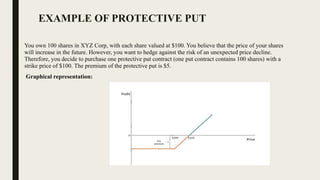
Graphical representation:
• Scenario 1: Share price above $105.If the share price goes beyond $105, you will
experience an unrealized gain. The profit can be calculated as Current Share Price –
$105 (it includes initial share price plus put premium). The put will not be exercised.
• Scenario 2: Share price between $100 and $105.In this scenario, the share price will
remain the same or slightly rise. However, you will still lose money or hit the breakeven
point in the best case. The small loss is caused by the premium you paid for the put
contract. Similar to the previous scenario, the put will not be exercised.
• Scenario 3: Share price below $100.In this case, you will exercise the protective put
option to limit the losses. After the put is exercised, you will sell your 100 shares at
$100. Thus, your loss will be limited to the premium paid for the protective put.
STRIKE PRICES AND PREMIUMS
A protective put option contract can be bought at any time. Some investors will buy these at the same
time and when they purchase the stock. Others may wait and buy the contract at a later date.
Whenever they buy the option, the relationship between the price of the underlying asset and the
strike price can place the contract into one of three categories;
– At-the-money (ATM) where strike and market are equal
– Out-of-the-money (OTM) where the strike is below the market
– In-the-money (ITM) where the strike is above the market
HOW DO YOU CALCULATE PROTECTIVE PUT?
The formula for calculating profit is given below:
■ Maximum Profit = Unlimited
■ Profit Achieved When Price of Underlying > Purchase Price of Underlying + Premium Paid
■ Profit = Price of Underlying - Purchase Price of Underlying - Premium Paid
The formula for calculating maximum loss is given below:
■ Max Loss = Premium Paid + Purchase Price of Underlying - Put Strike + Commissions Paid
■ Max Loss Occurs When Price of Underlying <= Strike Price of Long Put
The formula for Breakeven point is given below:
■ Breakeven Point = Purchase Price of Underlying + Premium Paid
WHAT IS A MARRIED PUT?
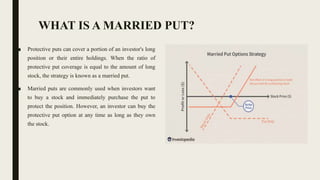
■ Protective puts can cover a portion of an investor's long
position or their entire holdings. When the ratio of
protective put coverage is equal to the amount of long
stock, the strategy is known as a married put.
■ Married puts are commonly used when investors want
to buy a stock and immediately purchase the put to
protect the position. However, an investor can buy the
protective put option at any time as long as they own
the stock.
PROS & CONS OF PROTECTIVE PUT?
PROS:
■ For the cost of the premium, protective
puts provide downside protection from an
asset's price declines.
■ Protective puts allow investors to remain
long a stock offering the potential for
gains.
CONS:
■ If an investor buys a put and the stock
price rises, the cost of the premium
reduces the profits on the trade.
■ If the stock declines in price and a put has
been purchased, the premium adds to the
losses on the trade.
THANKYOU!

Protective put

  • 1.
    PROTECTIVE PUT TEAM MEMBERS: ARAVINDA GAYATHRI M NIVEDHA T PRAMOD KUMAR SAH RAMACHANDRAN B
  • 2.
    WHAT IS PROTECTIVEPUT? ■ A protective put is a risk-management strategy using options contracts that investors or traders employ to guard against the loss of owning a stock or asset. The hedging strategy involves an investor buying a put option for a fee, called a premium. ■ Put option is a bearish strategy where the investors or traders believes the price of the asset or stock will decline in the future. ■ However, a protective put is typically used when an investors or traders is still bullish on a stock but wishes to hedge against potential losses and uncertainty.
  • 3.
    HOW A PROTECTIVEPUT WORKS? ■ The protective put sets a known floor price below which the investor will not continue to lose any added money even as the underlying asset's price continues to fall. ■ A put option is a contract that gives the owner the ability to sell a specific amount of the underlying security at a set price before or by a specified date. ■ Unlike futures contracts, the options contract does not obligate the holder to sell the asset and only allows them to sell if they should choose to do so. ■ The set price of the contract is known as the strike price, and the specified date is the expiration date or expiry. One option contract equates to 100 shares of the underlying asset.
  • 4.
    EXAMPLE OF PROTECTIVEPUT You own 100 shares in XYZ Corp, with each share valued at $100. You believe that the price of your shares will increase in the future. However, you want to hedge against the risk of an unexpected price decline. Therefore, you decide to purchase one protective put contract (one put contract contains 100 shares) with a strike price of $100. The premium of the protective put is $5. Graphical representation:
  • 5.
    • Scenario 1:Share price above $105.If the share price goes beyond $105, you will experience an unrealized gain. The profit can be calculated as Current Share Price – $105 (it includes initial share price plus put premium). The put will not be exercised. • Scenario 2: Share price between $100 and $105.In this scenario, the share price will remain the same or slightly rise. However, you will still lose money or hit the breakeven point in the best case. The small loss is caused by the premium you paid for the put contract. Similar to the previous scenario, the put will not be exercised. • Scenario 3: Share price below $100.In this case, you will exercise the protective put option to limit the losses. After the put is exercised, you will sell your 100 shares at $100. Thus, your loss will be limited to the premium paid for the protective put.
  • 6.
    STRIKE PRICES ANDPREMIUMS A protective put option contract can be bought at any time. Some investors will buy these at the same time and when they purchase the stock. Others may wait and buy the contract at a later date. Whenever they buy the option, the relationship between the price of the underlying asset and the strike price can place the contract into one of three categories; – At-the-money (ATM) where strike and market are equal – Out-of-the-money (OTM) where the strike is below the market – In-the-money (ITM) where the strike is above the market
  • 7.
    HOW DO YOUCALCULATE PROTECTIVE PUT? The formula for calculating profit is given below: ■ Maximum Profit = Unlimited ■ Profit Achieved When Price of Underlying > Purchase Price of Underlying + Premium Paid ■ Profit = Price of Underlying - Purchase Price of Underlying - Premium Paid The formula for calculating maximum loss is given below: ■ Max Loss = Premium Paid + Purchase Price of Underlying - Put Strike + Commissions Paid ■ Max Loss Occurs When Price of Underlying <= Strike Price of Long Put The formula for Breakeven point is given below: ■ Breakeven Point = Purchase Price of Underlying + Premium Paid
  • 8.
    WHAT IS AMARRIED PUT? ■ Protective puts can cover a portion of an investor's long position or their entire holdings. When the ratio of protective put coverage is equal to the amount of long stock, the strategy is known as a married put. ■ Married puts are commonly used when investors want to buy a stock and immediately purchase the put to protect the position. However, an investor can buy the protective put option at any time as long as they own the stock.
  • 9.
    PROS & CONSOF PROTECTIVE PUT? PROS: ■ For the cost of the premium, protective puts provide downside protection from an asset's price declines. ■ Protective puts allow investors to remain long a stock offering the potential for gains. CONS: ■ If an investor buys a put and the stock price rises, the cost of the premium reduces the profits on the trade. ■ If the stock declines in price and a put has been purchased, the premium adds to the losses on the trade.
  • 10.