PROTECTIVE DEVICE
                COORDINATION


Héctor Rivera
POYTECHNIC UNIVERSITY OF PUERTO RICO
 ELECTRICAL ENGINEERING DEPARTMENT
        HATO REY, PUERTO RICO


    PROTECTIVE DEVICE COORDINATION


               GROUP 28

            Rivera, Héctor J.


                                     Page 2 of 263
Table of Contents
Table of Pictures ............................................................................................................................. 5

Chapter 1: General Information ...................................................................................................... 8

   1.1 Abstracto ..................................................................................................................... 10
   1.2 Abstract ....................................................................................................................... 11
   1.3 Introduction ................................................................................................................. 12
   1.4 Objectives ................................................................................................................... 14
   1.5 Constraints .................................................................................................................. 15
Chapter 2: ETAP User Guide ....................................................................................................... 16

   2.1 Basic ETAP User Guide ............................................................................................. 18
       2.1.1 Creating a new ETAP Project. ............................................................................. 22
       2.1.2 Opening an ETAP existing Project. ..................................................................... 23
       2.1.3 Building New one-line Diagrams. ....................................................................... 25
       2.1.4 Connecting Elements. .......................................................................................... 28
       2.1.5 Adding a Protective Device to your One-Line. ................................................... 28
       2.1.6 Verify if the element is connected. ...................................................................... 29
   2.2 Advance ETAP User Guide ........................................................................................ 30
       2.2.1 How to configure the elements in the one-line diagram. ..................................... 34
       A)        Utility ................................................................................................................. 34
       B)        High Voltage Circuit Breakers ........................................................................ 36
       C)        Low Voltage Circuits Breakers ....................................................................... 39
       D)        Protective Relay ................................................................................................ 44
       E)        Fuses Ratings .................................................................................................... 49
       F)        Transformer Properties: .................................................................................. 54
       G)        Load Properties: ............................................................................................... 57
       H)        Bus ...................................................................................................................... 58
       2.2.2 Perform a Fault Analysis; .................................................................................... 59
Chapter 3: Transformer Case Study.............................................................................................. 61

   3.1 Diagrams ..................................................................................................................... 64
   3.2 Equipment Data .......................................................................................................... 66
   3.3 Calculations ................................................................................................................ 68
   3.4 Coordination Using ETAP Program ........................................................................... 73
   3.5 Fault Simulation .......................................................................................................... 77

                                                                                                                        Page 3 of 263
3.6 Settings and Results .................................................................................................... 81
Chapter 4: Bayamón WWTP Coordination Study........................................................................ 84

   4.1 Scope ........................................................................................................................... 88
   4.2 Electrical System Oneline Diagram ............................................................................ 90
   4.3 Imput Data Report ...................................................................................................... 94
   4.4 Calculations ................................................................................................................ 97
   4.5 Short Circuit Study ................................................................................................... 138
   4.6 Power Fuses Selection for Power Transformers T1, T2, T3, T4, T5, T6 and T7 ..... 160
   4.7 Protection Relay Settings for ................................................................................. 173
   Distribution Feeders ..................................................................................................... 173
   4.8 Relay Settings ........................................................................................................... 178
   4.9 Results ....................................................................................................................... 181
Chapter 5: Protective Device Coordination Project Results ....................................................... 186

   5.1 Alternatives Considered ............................................................................................ 188
   5.2 System Specifications ............................................................................................... 191
       Operation .................................................................................................................... 193
       Protective relay ........................................................................................................... 193
       Distance relay ............................................................................................................ 195
   Magazine Article............................................................................................................. 197
   5.4 Budget ....................................................................................................................... 198
   5.5 Bibliography ............................................................................................................. 199
   5.6 Conclusion ................................................................................................................ 201
Chapter 6: Administrative Section .............................................................................................. 202

   6.1 Protective Device Coordination Project Proposal..................................................... 205
       Work Schedule ............................................................................................................ 217
   Progress Report ............................................................................................................... 222
   Work Schedule ................................................................................................................ 241
Appendix ..................................................................................................................................... 246

   Tables and Curves ........................................................................................................... 247
   Protection Relay Settings for Generators ........................................................................ 252
   A.3 General Information ................................................................................................. 255


                                                                                                                      Page 4 of 263
Table of Pictures

Fig. 2.1: Create New Project Panel.................................................................................................... 22
Fig. 2.2: User Information Panel ....................................................................................................... 22
Fig. 2.3: Starting up window ............................................................................................................. 23
Fig. 2.4: Open Panel .......................................................................................................................... 24
Fig. 2.5: Selecting Project.................................................................................................................. 24
Fig. 2.6: Mode Toolbar ...................................................................................................................... 25
Fig.2.7: ETAP Elements .................................................................................................................... 27
Fig. 2.8: Connecting Elements .......................................................................................................... 28
Fig. 2.9: Open Panel .......................................................................................................................... 28
Fig. 2.10: Elements not connected..................................................................................................... 29
Fig. 2.11: Power Grid Editor Window .............................................................................................. 34
Fig. 2.12: High Voltage Circuit Breaker Editor Window .................................................................. 36
Fig. 2.13: Circuit Breaker Library ..................................................................................................... 37
Fig. 2.14: Low Voltage Circuit Breaker Window ............................................................................. 39
Fig. 2.15: Low Voltage Circuit Breaker library ................................................................................ 41
Fig. 2.16: Overcurent Relay Editor Window ..................................................................................... 44
Fig. 2.17: Overcurrent Settings Panel ................................................................................................ 45
Fig. 2.18: Instantaneus Settings Panel ............................................................................................... 46
Fig. 2.19: Fuse Editor Window ......................................................................................................... 49
Fig. 2.20: Fuse Library Window ....................................................................................................... 51
Fig. 2.21: Winding Transformer Editor Window .............................................................................. 54
Fig. 2.22: Transformer Rating Editor Window ................................................................................. 55
Fig. 2.23: Transformer Tap Editor Window ...................................................................................... 56
Fig. 2.24: Lumped Load Editor Window........................................................................................... 57
Fig. 2.25: Bus Editor Window ........................................................................................................... 58
Fig. 2.26: Fault Simulation ................................................................................................................ 59
Fig. 2.27: Select Sequence Viewer to find fault analysis results ....................................................... 60
Fig. 2.28: Results Window ................................................................................................................ 60
Fig. 3.1: Transformer Protection Diagram……………………………………………………....... 65
Fig. 3.2: Selected Fuse…………………………………………………………………………….. 67
Fig. 3.3: Selected Relay…………………………………………………………………………… 67
Fig. 3.4: Table of Current Transformer Specifications…………………………………………… 67
Fig. 3.5: Table of Power Fuse Rating……………………………………………………………... 71
Fig. 3.6: Overcurrent Relay Settings at Transformer……………………………………………... 74
Fig. 3.7: Overcurrent Relay Settings at Load 1,2…………………………………………………. 75
Fig. 3.8: Fuse Settings…………………………………………………………………………….. 76
Fig. 3.9: ETAP Simulation of Fault at Bus 1……………………………………………………… 78
Fig. 3.10: Sequence of Operation Events at Bus 1………………………………………………... 78
Fig. 3.11: ETAP Fault Simulation at Bus 2……………………………………………………….. 79
Fig. 3.12: Sequence of Operation Events at Bus 2………………………………………………... 79
Fig. 3.13: ETAP Fault Simulation at Load 1……………………………………………………… 80
Fig. 3.14: Sequence of Operation Events at Load 1………………………………………………. 80
Fig. 3.15: Relay and Fuse Settings………………………………………………………………... 83
Fig. 3.16: Results of Short Circuit Analysis………………………………………………………. 83
Fig. 4.1: Power Transformer Characteristics Table……………………………………………….. 89
Fig. 4.2: Generator Characteristics Table…………………………………………………………. 89
Fig. 4.3: Original Oneline Diagram of Bayamón WWTP………………………………………… 92
Fig. 4.4: Suggested Oneline Diagram of Bayamón WWTP………………………………………. 93
Fig. 4.5: Lines Cables……………………………………………………………………………... 95

                                                                                                                            Page 5 of 263
Fig. 4.6: Existing Transformer Line Cable. …………………………………………………….... 95
Fig. 4.7: Generator Cables………………………………………………………………………… 95
Fig. 4.8: Positive Sequence impedance Diagram at Bus 1……………………………………....... 99
Fig. 4.9: Three Phase Fault at Bus 1…………………………………………………………… 102
Fig. 4.10: Positive Sequence Impedance Diagram at Bus 2…………………………………… 103
Fig. 4.11: Three Phase Fault at Bus 2 …………………………………………………………… 104
Fig. 4.12: Positive Sequence Impedance Diagram at Load 1……………………………………. 105
Fig. 4.13: Three Phase Fault at Load 1…………………………………………………………... 106
Fig. 4.14: Positive Impedance Diagram at Load 5………………………………………………. 107
Fig. 4.15: Three Phase Fault at Load 6…………………………………………………………... 108
Fig. 4.16: Positive Sequence Impedance Diagram at Bus 1 for a Line to Ground Fault………... 109
Fig. 4.17: Cero Sequence Impedance Diagram at Bus 1……………………………………........ 109
Fig. 4.18: Line to Ground Fault at Bus 1………………………………………………………… 110
Fig. 4.19: Positive Sequence Impedance Diagram at Bus 2 for a Line to Ground Fault………... 111
Fig. 4.20: Cero Sequence Impedance Diagram at Bus 2………………………………………… 111
Fig. 4.21: Line to Ground Fault at Bus 2………………………………………………………… 112
Fig. 4.22: Positive Sequence Impedance Diagram at Load 1 for a Line to Ground Fault………. 113
Fig. 4.23: Cero Sequence Impedance Diagram at Load 1……………………………………….. 113
Fig. 4.24: Line to Ground Fault at Load 1……………………………………………………….. 114
Fig. 4.25: Positive Sequence Impedance Diagram at Load 5 for a Line to Ground Fault………. 115
Fig. 4.26: Cero Sequence Impedance Diagram at Load 5……………………………………….. 115
Fig. 4.27: Line to Ground Fault. At Load 5……………………………………………………... 116
Fig. 4.28: Positive Sequence Impedance Diagram at Generator Bus……………………………. 117
Fig. 4.29: Positive Sequence Impedance Diagram at Bus 2 using Generators………………….. 118
Fig. 4.30: Positive Sequence Impedance Diagram at Load 1 using Generators………………… 119
Fig. 4.31: Positive Sequence Impedance Diagram at Load 5 using Generators………………… 120
Fig. 4.32: Positive Sequence Impedance Diagram at Generators Bus for a Line to Ground Fault. 121
Fig. 4.33: Cero Sequence Impedance Diagram at Generators Bus………………………………. 121
Fig. 4.34: Positive Sequence Impedance Diagram at Bus 2 Using Generators for a Line to Ground
Fault……………………………………………………………………………………………… 122
Fig. 4.35: Cero Sequence Impedance Diagram at Bus 2 Using Generators……………………... 123
Fig. 4.36: Positive Sequence Impedance Diagram at Load 1 Using Generators for a Line to Ground
Fault……………………………………………………………………………………………… 124
Fig. 4.37: Cero Sequence Impedance Diagram at Load 1 Using Generators……………………. 124
Fig. 4.38: Positive Sequence Impedance Diagram at Load 5 Using Generators for a Line to Ground
Fault……………………………………………………………………………………………… 125
Fig. 4.39: Cero Sequence Impedance Diagram at Load 5 Using Generators……………………. 125
Fig. 4.40: Fault Simulation at Primary Side of 38KV/4.16KV Utility Transformer of BWWTP. 140
Fig. 4.41: Sequence of Operations Events at Primary Side of T1……………………………….. 141
Fig. 4.42: Fault Simulation at Bus 1 of BWWTP………………………………………………... 144
Fig. 4.43: Sequence of Operation Events at Bus 1………………………………………………. 145
Fig. 4.44: Fault Simulation at Bus 2 of BWWTP………………………………………………... 148
Fig. 4.45: Sequence of Operation Events at Bus 2………………………………………………. 149
Fig. 4.46: Fault Simulation at Load 1 of BWWTP……………………………………………… 152
Fig. 4.47: Sequence of Operations Events at Load 1……………………………………………. 153
Fig. 4.48: Fault Simulation at Load 6 of BWWTP……………………………………………… 156
Fig. 4.49: Sequence of Operation Events at Load 6……………………………………………... 157
Fig. 4.50: Recommendations to Fuse Protection………………………………………………… 161
Fig. 4.51: Time Fuse 1 and 5 Coordination……………………………………………………… 162
Fig. 4.52: Characteristics Curves for Fuse 1 and 5……………………………………………… 163
Fig. 4.53: Fuse 1 and 5 recommended…………………………………………………………… 164

                                                                                 Page 6 of 263
Fig. 4.54: Time Fuse 2 and 6 Coordination……………………………………………………… 165
Fig. 4.55: Characteristics Curves for fuse 2 and 6………………………………………………. 166
Fig. 4.56: Fuse 2 and 6 Recommended………………………………………………………….. 166
Fig. 4.57: Time Fuse 3, 4, 7 and 8 Coordination………………………………………………… 167
Fig. 4.58: Characteristics Curves for fuses 3, 4, 7 and 8………………………………………… 168
Fig. 4.59: Fuse 3, 4, 7 and 8 Recommended……………………………………………….......... 169
Fig. 4.60: Time Fuse 9 Coordination……………………………………………………………. 170
Fig. 4.61: Characteristics Curves for fuse 9……………………………………………………... 171
Fig. 4.62: Fuse 9 Recommended………………………………………………………………… 172
Fig. 4.63: Relay 351A Settings…………………………………………………………………... 179
Fig. 4.64: Overcurent Relay Settings for Generator……………………………………………... 180
Fig. 4.65: Undervoltage, Overvoltage, Frequency of Power Relay for Generator………………. 180
Fig. 4.66: Three Phase Fault Results…………………………………………………………….. 183
Fig. 4.67: Line to Ground Fault Results…………………………………………………………. 184
Fig. 4.68: Three Phase Fault Results Using Generators…………………………………………. 185
Fig. 4.69: Line to Ground Fault Results Using Generators…………………………………........ 185
Fig. 6.1: Protective Devices……………………………………………………………... 213
Fig. 6.2: Budget to Complete Design……………………………………………………. 218
Fig. 6.3: Salary Cap……………………………………………………………………… 218


                                                                          Page 7 of 263
Chapter 1: General Information


                          Page 8 of 263
Contents


1.1 Abstracto……………………………………………………………………………... 10
1.2 Abstract………………………………………………………………………………. 11
1.3 Introduction…………………………………………………………………………... 12
1.4 Objectives…………………………………………………………………………….. 14
1.5 Constraints…………………………………………………………………………..... 15


                                           Page 9 of 263
1.1 Abstracto

       La protección de los sistemas de potencia es uno de los campos más importantes
dentro del área de potencia en la ingeniería eléctrica. A través del tiempo se han creado
muchísimos programas de computadora con el fin de analizar diseños eléctricos. Nuestro
proyecto consiste en preparar una guía de usuario fácil de entender acerca de un programa
existente, llamado ETAP, diseñado para realizar análisis de protección de sistemas de
potencia. Esta guía de usuario debe incluir como crear un diagrama monolineal, como
configurar los equipos de protección, y también la forma correcta de hacer un análisis de
fallas y de corto circuito. Finalmente, nosotros preparamos una guía de usuario avanzada
con explicaciones detalladas sobre aplicaciones especiales y conceptos técnicos manejados
en el programa ETAP. También, como requisito de nuestro proyecto se analiza un caso
estudio de un sistema de potencia y se realiza la coordinación de protección del mismo.


                                                                            Page 10 of 263
1.2 Abstract

       Power Protection is one of the most important fields in Power Electrical
Engineering. Through time many software’s has been created to analyze electrical designs.
Our project consist of prepare a user guide easy to understand of how to use an existing
power protection analysis program calling ETAP. This user guide must include how to
create a one-line diagram, how to configure power system devises, and an explanation of
the right way to perform a short and fault analysis. Finally, we prepare an advance user
guide with detailed explanations of special features and technical concept of ETAP
program. Also, as a requirement of our project, we analyzed a case study of power system
and perform the protective device coordination of it.


                                                                          Page 11 of 263
1.3 Introduction


       Electricity has been a subject of scientific interest since at least the early 17th
century. Probably the first electrical engineer was William Gilbert who designed the
versorium: a device that detected the presence of statically charged objects. He was also the
first to draw a clear distinction between magnetism and static electricity and is credited
with establishing the term electricity. However it was not until the 19th century that
research into the subject started to intensify. Notable developments in this century include
the work of Georg Ohm, who in 1827 quantified the relationship between the electric
current and potential difference in a conductor, Michael Faraday, the discoverer of
electromagnetic induction in 1831, and James Clerk Maxwell, who in 1873 published a
unified theory of electricity and magnetism in his treatise on Electricity and Magnetism.
They are the fathers of electrical engineering and the electric systems.
       Today, power system protection is that part of electrical power engineering that
deals with protecting the electrical power system from faults by isolating the faulted part
from the rest of the network.
       Any electric power system involves a large amount of auxiliary equipment for the
protection of generators, transformers, and the transmission lines. Circuit breakers are
employed to protect all elements of a power system from short circuits and overloads, and
for normal switching operations.
       The principle of a protection scheme is to keep the power system stable by isolating
only the components that are under fault, even as leaving as much of the network as
possible still in operation. Thus, protection schemes must apply a very pragmatic and
pessimistic approach to clearing system faults. For this reason, the technology and
philosophies utilized in protection schemes are often old and well-established because they
must be very reliable.
       In much the same way as the early computers of the 1950s and 1960s were a
precursor to the computational capabilities of today’s computers. Specialized hardwire
systems were developed for locally monitoring the operation of power plants and for
remotely monitoring and controlling switches in transmission substation. The Remote
Terminal Units of these early monitoring systems were implemented with relay logic, while


                                                                             Page 12 of 263
the master station consisted primarily of large banks of annunciator panels with red and
green light indication the state of the points being monitored with flashing light indication a
change in state or an alarm condition.
           The impact of computers has nowhere been more revolutionary than in electrical
engineering. The design, analysis and operation of electrical and electronic systems has
become completely dominated by computers, a transformation that has been motivated by
the natural ease of interface between computers and electrical systems, and the promise of
spectacular improvements in speed and efficiency.
       Our project consists of develop a protective device coordination using a graphical
software program to add features and flexibility in the area of electrical system protection.
Also, this graphical software program it’s going to be using for all kind of element that
used these. We will select the software program, analyze all types of element protection
that are utilizing in electrical systems, and simulate the program using various management
studies.


                                                                               Page 13 of 263
1.4 Objectives


   •   To make a research about technical references of fuses, relays and breakers.
   •   Understand technical data format of protection devices.
   •   To learn how to use the protective device coordination program.
   •   Create a user guide easy to understand about how to use software program.
   •   Build an advance use guide to explain additional features of software program.
   •   Perform a case study with the software program.
   •   Establish the system coordination of a case study with the program.


                                                                             Page 14 of 263
1.5 Constraints

   •   How to install ETAP program.
   •   Ways to use library of ETAP program. Start by understanding.
   •   Interpret results in the program.
   •   Establish coordination of a protection system.
   •   Run the program with all kind of requisites.
   •   Find right protective devices for design coordination.
   •   Understand how to program protective devices settings of equipments to use.


                                                                          Page 15 of 263
Chapter 2: ETAP User Guide


                       Page 16 of 263
Contents


Basic ETAP User Guide………………………………………………………………………... 18
Creating a new ETAP Project………………………………………………………………….. 22
    Opening an ETAP existing Project..……… ………………………………………… 23
    Building New one-line Diagram. ……………………………………………………... 25
    Connecting Elements……………………………………………………………… 28
    Adding Protective Device to your One-Line………………………………………. 28
    Verify if the element is connected………………………………………………… 29
Advance ETAP User Guide…..…………………………………………………………... 30
    How to configure the elements in the one-line diagram…………………………… 34
         Utility……………………………………………………………………… 34
         High Voltage Circuit Breakers……………………………………………... 36
         Low Voltage Circuit Breaker………………………………………………. 39
         Protective Relay……………………………………………………………. 44
         Fuses Ratings………………………………………………………………. 49
         Transformer Properties………………………………………………..……. 54
         Load Properties…………………………………………………………….. 57
         Bus…………………………………………………………………………. 58
    Perform a Fault Analysis…………………………………………………………... 59


                                                           Page 17 of 263
2.1 Basic ETAP User Guide


                      Page 18 of 263
Page 19 of 263
Contents
Creating a new ETAP Project. ...................................................................................................... 22

Opening an ETAP existing Project. .............................................................................................. 23

Building New one-line Diagrams. ................................................................................................ 25

Connecting Elements. ................................................................................................................... 28

Adding a Protective Device to your One-Line. ............................................................................ 28

Verify if the element is connected. ............................................................................................... 29


                                                                                                             Page 20 of 263
Table of Figure
Fig. 2.1: Create New Project Panel .................................................................................................... 22
Fig. 2.2: User Information Panel ....................................................................................................... 22
Fig. 2.3: Starting up window ............................................................................................................. 23
Fig. 2.4: Open Panel .......................................................................................................................... 24
Fig. 2.5: Selecting Project.................................................................................................................. 24
Fig. 2.6: Mode Toolbar ...................................................................................................................... 25
Fig.2.7: ETAP Elements .................................................................................................................... 27
Fig. 2.8: Connecting Elements .......................................................................................................... 28
Fig. 2.9: Open Panel .......................................................................................................................... 28
Fig. 2.10: Elements not connected..................................................................................................... 29


                                                                                                                          Page 21 of 263
2.1.1 Creating a new ETAP Project.
Open the program and select new project. Write the name of the new project and select ok.


                                 Fig. 2.1: Create New Project Panel


Write the name of the project user and select the access level permissions.


                                 Fig. 2.2: User Information Panel


                                                                              Page 22 of 263
2.1.2 Opening an ETAP existing Project.
Select open on the ETAP screen.


                                Fig. 2.3: Starting up window


 To open an existing project must be selected the icon showed. Click the icon and select
the project that you want to run in program.


                                                                            Page 23 of 263
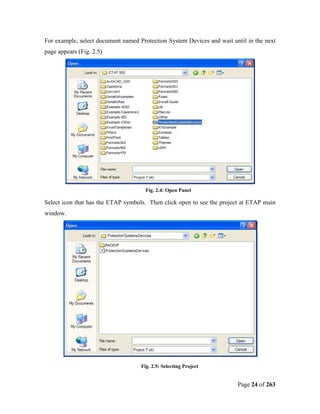
For example, select document named Protection System Devices and wait until in the next
page appears (Fig. 2.5)


                                      Fig. 2.4: Open Panel

Select icon that has the ETAP symbols. Then click open to see the project at ETAP main
window.


                                    Fig. 2.5: Selecting Project


                                                                        Page 24 of 263
2.1.3 Building New one-line Diagrams.
To build or edit a one-line diagram in ETAP, you must be in Edit Mode. Click the Edit
button on the Mode toolbar.


                                    Fig. 2.6: Mode Toolbar


AC Elements:


       =      Pointer                                        =   Bus

       =      2 winding transformers                         =   3 winding transformers

       =      cable                                          =   Transmission Line

       =      Reactors, Current-Limiting                     =   Impedance

       =      Power grid                                     =   Generator

       =      Wind turbine Generator                         =   Induction Machine

       =      Synchronous Motor                              =   Lumped Load

       =      MOV                                            =   Static Load

       =      Capacitor                                      =   Harmonic Filter

       =      Remote Connector                               =   Static Var Compensator

       =      HV DC Transmission Link                        =   AC Composite Motor

       =      Composite Network                              =   Fuse

       =      Contactor                                      =   High Voltage Circuit
                                                                 Breaker

       =      Low Voltage circuit Breaker                    =   Single Throw Switch

       =      Double Throw Switch                            =   Instrumentation

       =      Ground Grid                                    =   Display options

                                                                             Page 25 of 263
=     Schedule Report Manager       =   Current Transformer (CT)

     =     Potential Transformer (PT)    =   Voltmeter

     =     Ammeter                       =   Multi-meter

     =     Voltage Relay                 =   Reverse Power Relay

     =     Frequency Relay               =   MV solid State Trip
                                             Relay

     =     Motor Relay                   =   Overcurrent Relay

     =     Overload Heater               =   Multi-Function Relay

     =     Tag Link


DC Elements:


     =     Pointer                       =   Bus

     =     DC Cable                      =   DC Impedance

     =     DC-DC Converter               =   Battery

     =     DC Motor                      =   DC static Load

     =     DC Lumped Load                =   Composite CSD

     =     DC Composite Motor            =   Composite Network

     =     DC Circuit Breaker            =   DC Fuse

     =     DC Single Throw Switch        =   DC Double Throw
                                             Switch

     =     Un-Interrupted Power System   =   Variable Frequency Drive

     =     Charger                       =   Inverter


                                                         Page 26 of 263
You can select the element that your project requires for run the short circuit analysis. In
the columns you can see all the elements that ETAP program has. Select the elements and
drop to the board to complete your diagram.


                           Fig.2.7: ETAP Elements


                                                                            Page 27 of 263
2.1.4 Connecting Elements.
To connect the elements in the one-line. Use the mouse pointer over the connection pin of
an element, and it will turn red. Then click and drag to the connection pin of another
element. Follow this procedure to connect all the elements on the one-line. In the case of
buses, the entire element graphic functions as a connection point.


                                  Fig. 2.8: Connecting Elements


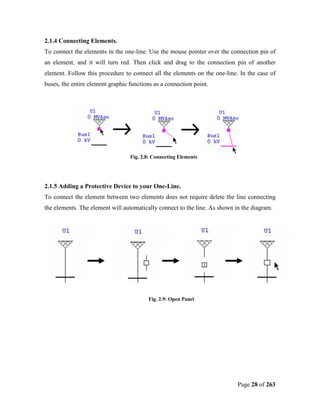
2.1.5 Adding a Protective Device to your One-Line.
To connect the element between two elements does not require delete the line connecting
the elements. The element will automatically connect to the line. As shown in the diagram.


                                         Fig. 2.9: Open Panel


                                                                            Page 28 of 263
2.1.6 Verify if the element is connected.

                              To check if an element is energized click on the continuity icon (     )
                              located in the project toolbar. All elements that are not energized will
                              be grayed out. For example, with the continuity check on, open CB4.
                              As shown in the figure to the right, CB4 and elements downstream
                              are grayed out.


Fig. 2.10: Elements not connected


                                                                                      Page 29 of 263
2.2 Advance ETAP User Guide


                       Page 30 of 263
Page 31 of 263
Contents
How to configure the elements in the one-line diagram. .............................................................. 34

   A)        Utility ............................................................................................................................. 34
   B) High Voltage Circuit Breakers ....................................................................................... 36
   C) Low Voltage Circuits Breakers ...................................................................................... 39
   D) Protective Relay ............................................................................................................... 44
   E) Fuses Ratings .................................................................................................................... 49
   F) Transformer Properties: ................................................................................................. 54
   G) Load Properties: .............................................................................................................. 57
   H) Bus ..................................................................................................................................... 58
Perform a Fault Analysis; ............................................................................................................. 59


                                                                                                                     Page 32 of 263
Table of Figures

Fig. 2.11: Power Grid Editor Window .............................................................................................. 34
Fig. 2.12: High Voltage Circuit Breaker Editor Window .................................................................. 36
Fig. 2.13: Circuit Breaker Library ..................................................................................................... 37
Fig. 2.14: Low Voltage Circuit Breaker Window ............................................................................. 39
Fig. 2.15: Low Voltage Circuit Breaker library ................................................................................ 41
Fig. 2.16: Overcurent Relay Editor Window ..................................................................................... 44
Fig. 2.17: Overcurrent Settings Panel ................................................................................................ 45
Fig. 2.18: Instantaneus Settings Panel ............................................................................................... 46
Fig. 2.19: Fuse Editor Window ......................................................................................................... 49
Fig. 2.20: Fuse Library Window ....................................................................................................... 51
Fig. 2.21: Winding Transformer Editor Window .............................................................................. 54
Fig. 2.22: Transformer Rating Editor Window ................................................................................. 55
Fig. 2.23: Transformer Tap Editor Window ...................................................................................... 56
Fig. 2.24: Lumped Load Editor Window........................................................................................... 57
Fig. 2.25: Bus Editor Window ........................................................................................................... 58
Fig. 2.26: Fault Simulation ................................................................................................................ 59
Fig. 2.27: Select Sequence Viewer to find fault analysis results ....................................................... 60
Fig. 2.28: Results Window ................................................................................................................ 60


                                                                                                                       Page 33 of 263
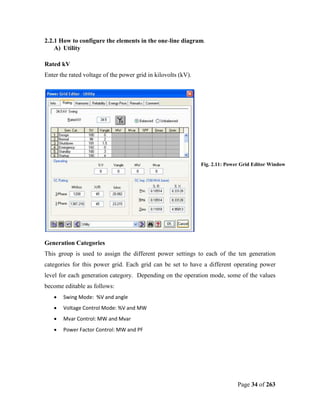
2.2.1 How to configure the elements in the one-line diagram.
    A) Utility

Rated kV
Enter the rated voltage of the power grid in kilovolts (kV).


                                                               Fig. 2.11: Power Grid Editor Window


Generation Categories
This group is used to assign the different power settings to each of the ten generation
categories for this power grid. Each grid can be set to have a different operating power
level for each generation category. Depending on the operation mode, some of the values
become editable as follows:
   •   Swing Mode: %V and angle
   •   Voltage Control Mode: %V and MW
   •   Mvar Control: MW and Mvar
   •   Power Factor Control: MW and PF


                                                                              Page 34 of 263
SC Rating MVAsc
Specify the short-circuit MVA for three-phase and single-phase (line-to-ground) faults. As
you enter or modify MVAsc or X/R, ETAP recalculates the corresponding short-circuit
impedance values.


                                                                           Page 35 of 263
B) High Voltage Circuit Breakers
How to change the Rating
   •   Click on either the ANSI or IEC option button to select that standard.


                 Fig. 2.12: High Voltage Circuit Breaker Editor Window


                                                                                Page 36 of 263
Library Info
To access ANSI standard library data, click on the ANSI selection and then click on the
Library button. Use the same procedure for accessing IEC standard library data. As you
change the standard from ANSI to IEC, the data fields change accordingly.


Rating, ANSI Standard
Click on ANSI to enter high voltage circuit breaker ratings according to the ANSI
standards. Select the manufacturer and breaker model.


                                 Fig. 2.13: Circuit Breaker Library


Max kV
Select the rated maximum kV of the high voltage circuit breaker in rms kV or select the
rating from the list box.


Continuous Amp
Select the continuous current rating of the high voltage circuit breaker in amperes or select
the rating from the list box.


Standard
Select the high voltage circuit breaker type as Symmetrical or Total rated from the list box.


                                                                              Page 37 of 263
Cycle
Select the rated interrupting time for AC high voltage circuit breakers in cycles from the list
box.
CB Cycle        Description
2       2-cycle ac high voltage circuit breakers with 1.5-cycle Minimum Contact Parting Time
3       3-cycle ac high voltage circuit breakers with 2-cycle Minimum Contact Parting Time
5       5-cycle ac high voltage circuit breakers with 3-cycle Minimum Contact Parting Time
8       8-cycle ac high voltage circuit breakers with 4-cycle Minimum Contact Parting Time


Rated Interrupting
Enter the rated short-circuit current (rated interrupting capability) at the rated maximum kV
in rms kA or select the rating from the list box.


Maximum Interrupting
Enter the maximum symmetrical interrupting capability in rms kA or select the rating from
the list box.


C & L RMS
Enter the closing and latching capability of the high voltage circuit breaker in asymmetrical
rms kA. This value is equal to 1.6 times the maximum interrupting capability.


C & L Crest
Enter the closing and latching capability of the high voltage circuit breaker in crest kA.
This value is equal to 2.7 times the maximum interrupting capability.


                                                                                 Page 38 of 263
C) Low Voltage Circuits Breakers

Standard
Click on either the ANSI or IEC option button to select that standard. Note: once the
breaker is selected from the breaker Library Quick Pick the standard is set based on the
library entry and is display only.


Type
Select a type from the drop-down list and display the type of breaker. Low voltage circuit
breakers include Molded Case, Power, and Insulated Case breakers. Once the breaker is
selected from the breaker Library Quick Pick, the LVCB type is set based on the library
entry and is display only.


                        Fig. 2.14: Low Voltage Circuit Breaker Window


                                                                           Page 39 of 263
CB and Trip Device library
The low voltage circuit breaker data for a selected standard and type can be selected by
clicking on the Library button.


Standard
Click on either the ANSI or IEC option to select that standard. Note that the Standard
selection in the breaker library Quick Pick (and hence the breaker models displayed) will be
defaulted to the selection.


AC/DC
Displays that the LV breaker is AC. This option is grayed out and is not available for
editing.


Type
Select from the drop down list and display the breaker type. The LV breaker types include
Molded Case, Power and Insulated Case breakers. Note that the Type selection in the
breaker library Quick Pick (and hence the breaker models displayed) will be defaulted to
the selection made for the breaker type on the Rating page. The breaker type selection can
be changed on the Quick Pick if desired.


                                                                            Page 40 of 263
Manufacturer Name
This displays a list of all AC LV breaker manufacturers included in the library for the
selected breaker standard and type. To choose one, just select the manufacturer name.


                                     Fig. 2.15: Low Voltage Circuit
                                             Breaker library

Reference
This displays the Manufacturer reference, if available. For example, Westinghouse is the
reference for Cutler Hammer.


                                                                           Page 41 of 263
Model Name
The Model section displays list of all models for the selected standard, breaker type and
breaker manufacturer. The models are displayed in the form of Model – Max kV – Pole,
which forms a unique record name in the breaker library. Select the Model – Max kV –
Pole by highlighting it.


ANSI Short-Circuit data
When ANSI standard is selected, the short-circuit data shows the applied voltage in kV,
short-circuit interrupting current for the applied voltage in kA, and test power factor in %,
for all breaker types. The short-circuit parameters are explained in more detail in the
Ratings section. Select a desired applied voltage and short-circuit data by highlighting it.


Size
This displays a list of all sizes available for the selected Model, Max. kV, and Pole record
for the breaker. To select a size from the Library Quick Pick, highlight the size.


Ratings, ANSI Standard
Click on ANSI standard button and choose the breaker type to enter the ratings for LV
circuit breaker in accordance with the ANSI/IEEE standards. When a breaker is selected
from Library Quick Pick, all parameters shown below will be set to their corresponding
values chosen from the Quick Pick. With the exception of Size, changing the values after
selecting a breaker from Library Quick Pick will turn the header blue to indicate that the
substituted library data has been modified.


Size
Select an item from the drop-down list to display the size in amperes for the selected
breaker.


                                                                               Page 42 of 263
Continuous Amp
Select an item from the drop-down list or enter the continuous current rating for the low
voltage circuit breaker in amperes. The Continuous Amp value will be set equal to the
breaker size when a breaker is selected from the breaker Library Quick Pick.


Rated kV
Select an item from the drop-down list or enter the rated kV rating for the low voltage
circuit breaker in kV. When a breaker is selected, the rated kV value will be set equal to
the applied kV selected from Library.


Test PF
This is the power factor of test equipment on which the rating of the circuit breaker has
been established. When a breaker is selected, the Test PF is set to the Test PF value
selected from Library.


Fused
For all breaker types, select fused or unfused by clicking on the provided selection box.
Note that when a breaker is selected from library, the Fused checkbox is set to the status as
selected from the Quick Pick.   The value of Test PF will change appropriately for fused or
unfused type, in case of Power breakers.


Interrupting kA
Select from drop down list or enter the Interrupting kA rating for the low voltage circuit
breaker in kA. Note that when a breaker is selected, the interrupting kA value will be set
equal to the kA value for selected applied kV from library Quick Pick.


                                                                               Page 43 of 263
D) Protective Relay


                            Fig. 2.16: Overcurent Relay Editor Window
Library
To access the Overcurrent relay library data, click on the Library button. Clicking the
Library button displays the relay library Quick Pick. From the Library, select the relay by
highlighting the Manufacturer name and Model name. Then click on the OK button to
retrieve the selected data from the library and transfer it to the editor.


OC level
Overcurrent relays can have multiple Time overcurrent (TOC) and/or Instantaneous
overcurrent (IOC) elements that can simultaneously and independently set in the relay
library. The OC level displays a drop down list of the maximum number of overcurrent
levels that are available for the selected relay.


                                                                             Page 44 of 263
Overcurrent (51) Settings
The Time overcurrent settings available for Phase, Neutral, Ground, Sensitive Ground and
Negative Sequence are described below.


                                                                              Fig. 2.17: Overcurrent Settings
                                                                                           Panel


Pickup Range
Select from drop down list and display the Time overcurrent Pickup range for the selected
curve. The pickup range can be specified in amperes of the secondary or primary current
rating. It can also be in multiples/percent of the CT secondary.


Pickup Setting
For the selected pickup range, select or enter the Time overcurrent pickup setting. The
pickup setting can be discrete values or continuously adjustable.


Relay Amps
This field displays the relay secondary current in amperes, for the selected pickup setting.


Prim. Amps
This field displays the relay primary current in amperes, for the selected pickup setting.


                                                                               Page 45 of 263
Time Dial
Select and display the Time Dial for the selected curve type. The time dial can be discrete
values or continuously adjustable.


Instantaneous (50) Settings
The Instantaneous settings available for Phase, Neutral, Ground, Sensitive Ground and
Negative Sequence are described below.


                                Fig. 2.18: Instantaneus Settings Panel


                                                                            Page 46 of 263
Curve Type
This field with a drop down list of curves is available only if the selected relay has Short
time feature and if the Short time is selected. Select from the drop down list and display
the Short time curve type for the selected model.


Pickup Range
Select from the drop down list and display the Instantaneous Pickup range (for the selected
curve in case of Short time).      The pickup range can be specified in amperes of the
secondary or primary current rating. It can also be in multiples/percent of the CT secondary
or 51 pickup.


Pickup Setting
For the selected pickup range, select or enter the Instantaneous pickup setting. The pickup
setting can be discrete values or continuously adjustable.


Relay Amps
This field displays the relay secondary current in amperes, for the selected pickup setting.


Prim. Amps
This field displays the relay primary current in amperes, for the selected pickup setting.


Delay Range
This field is available only if the relay has Instantaneous function. Select from the drop
down list and display the Instantaneous Delay range. The delay range could either be in
seconds or cycles.


Delay
Select or enter the intentional delay for the instantaneous. The Delay can be in seconds or
cycles, depending on the selection of relay. The delay can be in the form of discrete values
or continuously adjustable.


                                                                               Page 47 of 263
Time Dial
This field is available only if the selected relay has Short time feature and if the Short time
is selected. Select or enter the Time Dial for the selected curve type. The time dial can be
discrete values or continuously adjustable.


                                                                               Page 48 of 263
E) Fuses Ratings
Standard
Click either the ANSI or IEC button option to select that standard. Once the fuse is
selected from the Library Quick Pick - Fuse, the standard is set based on the library entry
and is display only.


Rating, ANSI Standard
Click on ANSI standard to enter the ratings for Fuse in accordance with the ANSI/IEEE
standards. When a Fuse is selected from library Quick Pick, all parameters shown below
will be set to their corresponding values chosen from the Quick Pick. With the exception of
Size, changing the value(s) after selecting a fuse from library Quick Pick will turn the
header to blue color indicating that the substituted library data has been modified.


                                   Fig. 2.19: Fuse Editor Window


                                                                               Page 49 of 263
kV
Select from drop down list or enter the rated kV rating for the Fuse in kV. When a Fuse is
selected, the Rated kV value will be set equal to the Max. kV selected from library Quick
Pick.


Size
Select from the drop-down list and display the size in amperes for the selected fuse. Note:
the Size field will be empty when no fuse is chosen from Library Quick Pick.


Continuous Amp
Select from drop down list or enter the continuous current rating for the Fuse in amperes.
The Continuous Amp value will be set equal to the fuse size when a fuse is selected from
library Quick Pick.


Interrupting
Select from the drop-down list or enter the Interrupting kA rating for the Fuse in kA. Note:
when a Fuse is selected, the interrupting kA value will be set equal to the kA value for
selected fuse size from Library Quick Pick.


Test PF
Enter the power factor of test equipment on which the rating of the fuse has been
established. When a fuse is selected, the Test PF is set to the Test PF value selected from
library Quick Pick.


                                                                            Page 50 of 263
Library (Quick Pick)
To select a fuse from the library, click the Library button and the Library Quick Pick – Fuse
dialog box will appear. From the dialog box, select a fuse by selecting the Manufacturer
name and the desired fuse Model, Max kV, and Speed. This represents a unique record.
Select the desired size and short circuit interrupting kA. Then click the OK button to
retrieve the selected data from the library and transfer it to the editor.


                                      Fig. 2.20: Fuse Library Window


Standard
Click on either the ANSI or IEC option to select that standard. Note that the Standard
selection in the Fuse library Quick Pick (and hence the fuse models displayed) will be
defaulted to the selection made for the standard on the Rating page. The standard selection
can be changed on the Quick Pick if desired.


                                                                             Page 51 of 263
Manufacturer
Manufacturer Name
Displays a list of all AC Fuse manufacturers included in the library for the selected
standard. Select the manufacturer by highlighting the manufacturer name.


Reference
Displays a manufacturer reference, if available, for selected manufacturer. For example,
Siemens is the reference manufacturer for ITE.


Model Name
The Model section displays list of all fuse models for the selected standard and fuse
manufacturer. The models are displayed in the form of Model – Max kV – Speed, which
forms a unique record name in the fuse library. Select the Model – Max kV – Speed by
highlighting it.


Cont. Amp
This displays the ampere value corresponding to each size for the selected fuse model.


Int. kA (ANSI Standard)
This displays the short-circuit interrupting rating in kA corresponding to each size for the
selected ANSI fuse model.


Model Info
Class
This displays the class (E-rated, for example) for the selected fuse model.


                                                                              Page 52 of 263
Type
This displays the type (Power Fuse, for example) for the selected fuse model.


Brand Name
It shows the brand name, if available, for the selected fuse model.


Reference
It demonstrates the reference, if available, for selected fuse model.


Application
Present the application for the selected fuse model.


                                                                            Page 53 of 263
F) Transformer Properties:
You can open the editor for T2 and go to the Rating page. On the rating page you can enter
the value of the primary kV, secondary kV, primary winding rating in kVA or MVA, and
the maximum transformer rating. Additionally, you can enter the impedance or substitute
typical values for the transformer.


                                      Fig. 2.21: Winding Transformer Editor Window


                                                                              Page 54 of 263
Transformer Ratings


                           Fig. 2.22: Transformer Rating Editor Window


Rating of Transformer:
Enter the rating of KV primary and secondary.
Enter the rating of MVA.
Enter the Typical X/R.
Enter the Z variation and Z Tolerance.
You may select the typical rating.


                                                                         Page 55 of 263
Transformer Tap
The Transformer Tap Optimization calculation optimizes a unit transformer tap, or
equivalently, its turn ratio, to ensure that the generator unit voltage remains within its upper
and lower variation range (typically 95% to 105%), while producing its full MW and Mvar
capability under the system voltage variation.


                     Fig. 2.23: Transformer Tap Editor Window


                                                                                Page 56 of 263
G) Load Properties:
In this part you can go to the Nameplate page. The available fields in the rating section depend
on the Model Type selected. In the Ratings section enter the lumped load rating in MVA or
MW. Furthermore, the % loading for various loading categories can be specified here.


                                       Fig. 2.24: Lumped Load Editor Window


                                                                                Page 57 of 263
H) Bus
Nominal kV
Enter the nominal voltage of the bus in kilovolts (kV).


In/Out of Service
The operating condition of a bus can be selected by choosing either the In Service or Out of
Service option.


                                 Fig. 2.25: Bus Editor Window


                                                                            Page 58 of 263
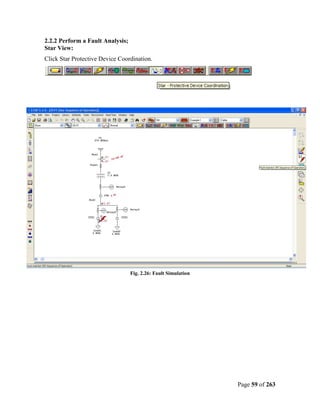
2.2.2 Perform a Fault Analysis;
Star View:
Click Star Protective Device Coordination.


                                  Fig. 2.26: Fault Simulation


                                                                Page 59 of 263
Select Sequence Viewer to find the result of the Protective Device Cordination.


                  Fig. 2.27: Select Sequence Viewer to
                        find fault analysis results


It will show the results to be show in the report. The sequence of operation is on order to
the parameters of the system.


                                  Fig. 2.28: Results Window


                                                                            Page 60 of 263
Chapter 3: Transformer Case
           Study


                       Page 61 of 263
Contents
Diagrams………………………………………………………………………………… ..64
Equipment Data……………………………………………………………………………66
Calculations………………………………………………………………………………..68
Coordination Using ETAP Program……………………………………………………….73
Fault Simulation……………………………………………………………………………77
Results………………...……………………………………………………………………81


                                              Page 62 of 263
Table of Figures

Fig. 3.1: Transformer Protection Diagram……………………………………………………....... 65
Fig. 3.2: Selected Fuse…………………………………………………………………………….. 67
Fig. 3.3: Selected Relay…………………………………………………………………………… 67
Fig. 3.4: Table of Current Transformer Specifications…………………………………………… 67
Fig. 3.5: Table of Power Fuse Rating……………………………………………………………... 71
Fig. 3.6: Overcurrent Relay Settings at Transformer……………………………………………... 74
Fig. 3.7: Overcurrent Relay Settings at Load 1,2…………………………………………………. 75
Fig. 3.8: Fuse Settings…………………………………………………………………………….. 76
Fig. 3.9: ETAP Simulation of Fault at Bus 1……………………………………………………… 78
Fig. 3.10: Sequence of Operation Events at Bus 1………………………………………………... 78
Fig. 3.11: ETAP Fault Simulation at Bus 2……………………………………………………….. 79
Fig. 3.12: Sequence of Operation Events at Bus 2………………………………………………... 79
Fig. 3.13: ETAP Fault Simulation at Load 1……………………………………………………… 80
Fig. 3.14: Sequence of Operation Events at Load 1………………………………………………. 80
Fig. 3.15: Relay and Fuse Settings………………………………………………………………... 83
Fig. 3.16: Results of Short Circuit Analysis………………………………………………………. 83


                                                              Page 63 of 263
3.1 Diagrams


               Page 64 of 263
3.1.1 Transformer Case Study Diagram:


                              Fig. 3.1: Transformer Protection Diagram


       Our Transformer Case Study has the following components:
             a) One transformer 38/4.16 KV of 7.5/11.3 MVA.
             b) Two feeders.


        Protection has to be able to extinguish faults that affect the system. It scheme consist of
protective relaying and fuses. Coordination criteria have 22 cycles between protection levels.
We considered selectivity, reliability and simplicity to accomplish with a scheme protection
safety.


                                                                             Page 65 of 263
3.2 Equipment Data


                     Page 66 of 263
Equipment Data:


Specification of electric fuse

                                                Fuse
                                           Continuous                             Maximum
           Fuse Name            Size                               Type
                                            Amperes                                 KV
         Cutler Hammer                                           Standard
                                150E           150                                  17
            BA-200                                                Speed
                                       Fig. 3.2: Selected Fuse


Relay settings

                                                 Relay
                                                                     TOU
                                                    IOU
                 Location      Relay Name                            51 &         Curve
                                                  50 & 50N
                                                                     51N
                                 ABB 51D
                                                   0.5-80;         0.5-80;    Extremely
                 Feeder           with 50
                                                  0.1 steps       0.1 steps    Inverse
                                  (60Hz)
                                 ABB 51D
                  Main                             0.5-80;         0.5-80;      Very
                                  with 50
                 Breaker                          0.1 steps       0.1 steps    Inverse
                                  (60Hz)
                                          Fig. 3.3: Selected Relay


Selected current transformer


                                       Current Transformer
                                  Location       CTR             Type
                                   Main
                                               2,500/5     MR C400
                                  Breaker
                                    Load        800/5      MR C400

                          Fig. 3.4: Table of Current Transformer Specifications


                                                                                          Page 67 of 263
3.3 Calculations


                   Page 68 of 263
Power System Coordination calculation:
1) Calculating the short circuit current:

                                375MVA
                      ISC = =              = 5, 697.53 A
                                 3(38 KV )


                                 7.5MVA
                      IBASE =              = 113.95 A
                                 3(38 KV )


                                5, 697.53
                      I pu =              = 50.0 pu
                                 113.95


                                 1
                      Z pu =         = 0.02 pu
                                50.0


           1∠00
ISC =               = 11.11 p
        0.02 + 0.07


                   38 
IBASE = (113.95)         = 11,564.3 A
                   4.16 


                                                           Page 69 of 263
2) Calculating the multiples of the relay in the load, to verify the necessary time dial in the
    curves:

               11, 565.3
        M=               = 13.6
                 850


3) Obtaining the pick-up current for the relay in the transformer:
       Pickup = (1568.28)(1.2) = 1881.93A


4) The multiples of the current transformer (CTM) in the transformer:

              11,565.3
      M=               = 6.14
              1,881.93


5) The calculation for choose the CTR:

    CTR = 2000/5
                11.3MVA
       IFL =                = 1, 568.28 A      ISC = 11,565.04
                3(4.16 KV )
       a) CTR > 1,568.28(1.2) = 1,881.93A
       b) ISC/CTR < 100 A
           11,565.04/400 < 100


                                                                               Page 70 of 263
6) Calculation for choosing fusible:
    Using the standard Speed curve

Step 1: Full load Current
                 11.3MVA                                          7.5MVA
         IFL =              = 171.68 A                   INM =              = 113.95 A
                  3(38 KV )                                       3(38 KV )


Data: 46 Kv Power Fuses (Show & Standard Speed)
             Rating                     Continuous Current               Operating Time
              100E                               165                       See curves…
              125E                               181                       See curves…

                                 Fig. 3.5: Table of Power Fuse Rating


         F1 ≥ 125E


Step 2: Inrush Current
IINRUSH = 113.95(12) = 1,367.48 A @ 6 cycles                       F1 ≥ 100E


Step 3: Short circuit current
        11,564.3
ISC =             = 1, 266.1A     @ 43.2 cycles                   F1 ≥ 175E
          38 
               
          4.16 


Step 4: Turning Ratio
      I NOMINAL 
FR =                    > 1.5 < 3
      I NOMINAL TRANS. 
     213 
   =         = 1.86                 1.5 < 1.86 < 3
     113.95 


The fuse chosen is 175E because it complied with the parameters of the design. Fuse will be
175E and can handle 213 Amps.


                                                                                  Page 71 of 263
Using the Slow Speed curve:
Step 1: Full load Current
                 11.3MVA
         IFL =              = 171.68 A
                  3(38 KV )


Data: 46 Kv Power Fuses (Slow & Standard Speed)
             Rating                     Continuous Current                   Operating Time
              100E                                165                         See curves…
              125E                                181                         See curves…

                                      Fig. 3.5: Table of Power Fuse Rating


         F1 ≥ 125E


Step 2: Inrush Current
IINRUSH = 113.95(12) = 1,367.48 @ 6 ciclos                        F1 ≥ 80E


Step 3: Short circuit current
        11,564.3
ISC =             = 1, 266.1A     @ 43.2 ciclos                  F1 ≥ 125E
          38 
               
          4.16 


Step 4: Turning Ratio
      I NOMINAL 
FR =                    > 1.5 < 3
      I NOMINAL TRANS. 
     181 
   =         = 1.58                  1.5 < 1.58 < 3
     113.95 


The fuse chosen is 125E because it complied with the parameters of the design.


                                                                                     Page 72 of 263
3.4 Coordination Using ETAP
          Program


                       Page 73 of 263
Overcurrent:


        To protect our transformer power system we choose a relay distributed by ABB
with overcurrent and instantaneous settings. This setting for overcurrent was given using a
Definite Time Curve. The pick range is specified by 5 amperes of the secondary or primary
rating. Using this setting the relay will operate when primary current exceed 2,500A. Time
dial of overcurrent relay is given by curve type and changing it by time required. In the
other side, to operate instantaneous relay is necessary select a pick up according to short
circuit current. These input settings are introduced at ETAP window showing below.

Overcurrent Relay settings in the transformer:


                       Fig. 3.6: Overcurrent Relay Settings at Transformer. In this
                                  case the curve selected was Definite Time.


                                                                                      Page 74 of 263
Another section of our power system that required protection are load 1 and 2
feeders. To protect these feeders we select an ABB instantaneous and overcurrent relay.
The overcurrent settings were chosen by a Definite Time Curve. The pick range is
specified by 5 amperes of the secondary side of relay. Using this setting the overcurrent
will operate when line current exceed 850A. Time dial is given by relay curve according to
time required for current magnitude. In the other side, to operate instantaneous relay is
necessary select a pick up according to short circuit current. When current reach 11,568;
instantaneous protection must operate. These input settings are introduced at ETAP
window showing below.


Overcurrent relay setting at load 1,2:


                            Fig. 3.7: Overcurrent Relay Settings at Load 1,2


                                                                               Page 75 of 263
Fuse Setting:

In order to perform good protective device coordination is necessary implement use of
almost one fuse. The fuse selected by us is S&C, SMU-20. It is modeling by an standard
speed curve with short circuit current of 10KA. Also it has a maximum rated voltage of
38KV. Finally, the size of fuse is 200E with a 200 continuous amperes.


                                 Fig. 3.8: Fuse Settings


                                                                       Page 76 of 263
3.5 Fault Simulation


                       Page 77 of 263
Short circuit results:


                                                 Fig. 3.10: Sequence of Operation
                                                          Events at Bus 1
 Fig. 3.9: ETAP Simulation of
         Fault at Bus 1


       Protection in the system can not protect for a fault at bus 1. It should be protected
by other protective device out of our system.


                                                                              Page 78 of 263
Figures below show short circuit results at bus 2 when operate the instantaneous
        relay 2. The instantaneous relay work to open the circuit and if it does not operate fuse 1
        operate to disconnect system. Relay 2 operates at 2.75 cycles after a fault occurs. If relay 1
        does not work, fuse 1 is going to operate at 52.56 cycles.


                                                           Fig. 3.12: Sequence of Operation Events at
Fig. 3.11: ETAP Fault Simulation at Bus 2                                    Bus 2


                                                                                        Page 79 of 263
In figures below you can see short circuit results at load 1. Instantaneous relay 3 will open
        first. If it does not operate, time overcurrent relay 2. But, if it also does not work, fuse 1
        must open with a time delay.


                                                            Fig. 3.14: Sequence of Operation Events at
                                                                              Load 1
Fig. 3.13: ETAP Fault Simulation at Load 1


               ETAP program gives results of short circuit. Short circuit current is 21,570 at load 1.
        With this current we choose settings for relay 3. Short circuit at load 1 is the same results
        at load 2.

               Sequence operation work with a sequence coordination of 22 cycles approximated.
        Relay 3 operates at 7.74 cycles covered by relay 2 witch operates at 28.86 cycles like
        primary protection.


                                                                                        Page 80 of 263
3.6 Settings and Results


                       Page 81 of 263
Settings and Results


       We perform protective device coordination for a transformer and two loads. In
order to express our results and recommendations clearly, we organized all data in tables.
These tables include devices and fuse settings. In the figure 3.15 you can find curves type,
pick-up and time dial to obtain better results with the protective device coordination. In the
other side, three phase fault table contents short circuits results in different section of
system.


         The figure 3.16 shows short circuit current magnitude in different parts of system.
First, the table presents a three phase fault at feeder #1. Short circuit current at this point is
11,564A. With this fault feeder relay will operates at 2.76 cycles like primary protection.
If the feeder relay does not operate, main breaker feeder will operate at 25.86 cycles.


       When system has a fault at primary side of transformer #1, the fuse will operate at
52.56 cycles.


        Relays in our system use definite time curve. It is use to chose time dial of relay
operation. In the other way, fuse 1 is modeling with a standard speed curve. Using these
settings the protection is complete according with coordination criteria.


                                                                                 Page 82 of 263
Equipment Settings


                                      Equipment Settings
                                                                      Time
                     Equipment            Curve         Pick-up
                                                                      Dial
                       Feeder            Definite
                                                         2,500        1.895
                        Relay             Time
                        Main
                                         Definite
                       Breaker                            850         1.895
                                          Time
                        Relay
                                        Standard
                        Fuse                               X              X
                                         Speed

                                 Fig. 3.15: Relay and Fuse Settings


Fault Results


                                       Three Phase Fault

                                Short          Operation Protection Devices
                Localization
                               Circuit       Feeder      Main
                   Fault
                               Current       Relay      Breaker        Fuse
                                              (51)     Relay (51)
                Feeder #1 or 11,564
                                               2.76          25.86            52.56
                    #2          A
                             11,566
                   Bus #2                       X              2.76           52.56
                                A
                             10,500
                 T1 Primary                     X               X             52.56
                                A
                T1 Secondary 9,950 A            X               X              X

                           Fig. 3.16: Results of Short Circuit Analysis


                                                                                      Page 83 of 263
Chapter 4: Bayamón WWTP
   Coordination Study


                    Page 84 of 263
Contents
Scope……………………………………………………………………………………….. 88
Electrical System Oneline Diagram……………………………………………………….... 90
Imput Data Report………………………………………………………………………… 94
Calculations………………………………………………………………………………... 97
Short Circuit Study………………………………………………………………………. 138
Power Fuse Selection for Power Transformer T1, T2, T3, T4, T5, T6 and T7………….. 160
Protection Relay Settings for Distrbution Feeders………………………………………. 173
Relay Settings……………………………………………………………………………. 178
Results……………………………………………………………………………………. 181


                                                                    Page 85 of 263
Table of Figure

Fig. 4.1: Power Transformer Characteristics Table………………………………………………... 89
Fig. 4.2: Generator Characteristics Table…………………………………………………………. 89
Fig. 4.3: Original Oneline Diagram of Bayamón WWTP………………………………………… 92
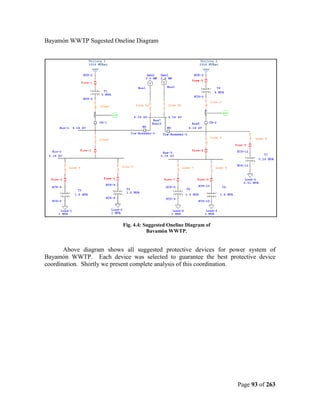
Fig. 4.4: Suggested Oneline Diagram of Bayamón WWTP………………………………………. 93
Fig. 4.5: Lines Cables……………………………………………………………………………... 95
Fig. 4.6: Existing Transformer Line Cable. ……………………………………………………… 95
Fig. 4.7: Generator Cables………………………………………………………………………… 95
Fig. 4.8: Positive Sequence impedance Diagram at Bus 1………………………………………... 99
Fig. 4.9: Three Phase Fault at Bus 1……………………………………………………………... 102
Fig. 4.10: Positive Sequence Impedance Diagram at Bus 2……………………………………... 103
Fig. 4.11: Three Phase Fault at Bus 2 …………………………………………………………… 104
Fig. 4.12: Positive Sequence Impedance Diagram at Load 1……………………………………. 105
Fig. 4.13: Three Phase Fault at Load 1…………………………………………………………... 106
Fig. 4.14: Positive Impedance Diagram at Load 5………………………………………………. 107
Fig. 4.15: Three Phase Fault at Load 6…………………………………………………………... 108
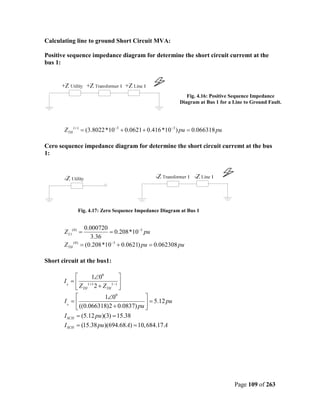
Fig. 4.16: Positive Sequence Impedance Diagram at Bus 1 for a Line to Ground Fault………... 109
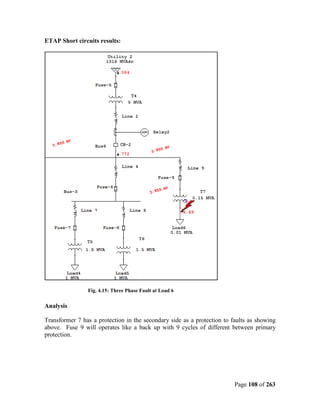
Fig. 4.17: Zero Sequence Impedance Diagram at Bus 1……………………………………........ 109
Fig. 4.18: Line to Ground Fault at Bus 1………………………………………………………… 110
Fig. 4.19: Positive Sequence Impedance Diagram at Bus 2 for a Line to Ground Fault………... 111
Fig. 4.20: Zero Sequence Impedance Diagram at Bus 2………………………………………… 111
Fig. 4.21: Line to Ground Fault at Bus 2………………………………………………………… 112
Fig. 4.22: Positive Sequence Impedance Diagram at Load 1 for a Line to Ground Fault………. 113
Fig. 4.23: Zero Sequence Impedance Diagram at Load 1……………………………………….. 113
Fig. 4.24: Line to Ground Fault at Load 1……………………………………………………….. 114
Fig. 4.25: Positive Sequence Impedance Diagram at Load 5 for a Line to Ground Fault………. 115
Fig. 4.26: Zero Sequence Impedance Diagram at Load 5……………………………………….. 115
Fig. 4.27: Line to Ground Fault. At Load 5……………………………………………………... 116
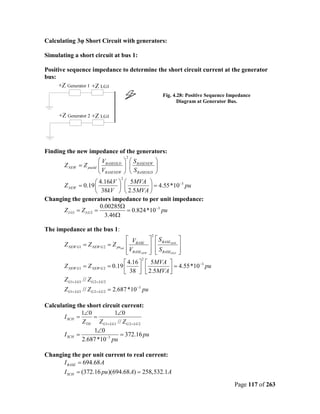
Fig. 4.28: Positive Sequence Impedance Diagram at Generator Bus……………………………. 117
Fig. 4.29: Positive Sequence Impedance Diagram at Bus 2 using Generators………………….. 118
Fig. 4.30: Positive Sequence Impedance Diagram at Load 1 using Generators………………… 119
Fig. 4.31: Positive Sequence Impedance Diagram at Load 5 using Generators………………… 120
Fig. 4.32: Positive Sequence Impedance Diagram at Generators Bus for a Line to Ground Fault 121
Fig. 4.33: Zero Sequence Impedance Diagram at Generators Bus……………………………… 121
Fig. 4.34: Positive Sequence Impedance Diagram at Bus 2 Using Generators for a Line to Ground
Fault……………………………………………………………………………………………… 122
Fig. 4.35: Zero Sequence Impedance Diagram at Bus 2 Using Generators……………………... 123
Fig. 4.36: Positive Sequence Impedance Diagram at Load 1 Using Generators for a Line to Ground
Fault……………………………………………………………………………………………… 124
Fig. 4.37: Zero Sequence Impedance Diagram at Load 1 Using Generators……………………. 124
Fig. 4.38: Positive Sequence Impedance Diagram at Load 5 Using Generators for a Line to Ground
Fault……………………………………………………………………………………………… 125
Fig. 4.39: Zero Sequence Impedance Diagram at Load 5 Using Generators……………………. 125
Fig. 4.40: Fault Simulation at Primary Side of 38KV/4.16KV Utility Transformer of BWWTP. 140
Fig. 4.41: Sequence of Operations Events at Primary Side of T1……………………………….. 141
Fig. 4.42: Fault Simulation at Bus 1 of BWWTP………………………………………………... 144
Fig. 4.43: Sequence of Operation Events at Bus 1………………………………………………. 145
Fig. 4.44: Fault Simulation at Bus 2 of BWWTP……………………………………………….. 148
Fig. 4.45: Sequence of Operation Events at Bus 2………………………………………………. 149
Fig. 4.46: Fault Simulation at Load 1 of BWWTP……………………………………………… 152

                                                                               Page 86 of 263
Fig. 4.47: Sequence of Operations Events at Load 1……………………………………………. 153
Fig. 4.48: Fault Simulation at Load 6 of BWWTP……………………………………………… 156
Fig. 4.49: Sequence of Operation Events at Load 6……………………………………………... 157
Fig. 4.50: Recommendations to Fuse Protection………………………………………………… 161
Fig. 4.51: Time Fuse 1 and 5 Coordination……………………………………………………… 162
Fig. 4.52: Characteristics Curves for Fuse 1 and 5……………………………………………… 163
Fig. 4.53: Fuse 1 and 5 recommended…………………………………………………………… 164
Fig. 4.54: Time Fuse 2 and 6 Coordination……………………………………………………… 165
Fig. 4.55: Characteristics Curves for fuse 2 and 6………………………………………………. 166
Fig. 4.56: Fuse 2 and 6 Recommended………………………………………………………….. 166
Fig. 4.57: Time Fuse 3, 4, 7 and 8 Coordination………………………………………………… 167
Fig. 4.58: Characteristics Curves for fuses 3, 4, 7 and 8………………………………………… 168
Fig. 4.59: Fuse 3, 4, 7 and 8 Recommended……………………………………………….......... 169
Fig. 4.60: Time Fuse 9 Coordination……………………………………………………………. 170
Fig. 4.61: Characteristics Curves for fuse 9……………………………………………………... 171
Fig. 4.62: Fuse 9 Recommended………………………………………………………………… 172
Fig. 4.63: Relay 351A Settings………………………………………………………………….. 179
Fig. 4.64: Overcurent Relay Settings for Generator……………………………………………... 180
Fig. 4.65: Undervoltage, Overvoltage, Frequency of Power Relay for Generator………………. 180
Fig. 4.66: Three Phase Fault Results…………………………………………………………….. 183
Fig. 4.67: Line to Ground Fault Results…………………………………………………………. 184
Fig. 4.68: Three Phase Fault Results Using Generators…………………………………………. 185
Fig. 4.69: Line to Ground Fault Results Using Generators…………………………………........ 185


                                                                         Page 87 of 263
4.1 Scope


            Page 88 of 263
Scope
                 Develop a short circuit study for Power Transformers and relay settings for a waste
                 water treatment plant and the protective devices associated.
                         The Bayamón Waste Water Treatment Plant has seven large power
                         transformers with their respective protective devices (power fuses or
                         protective relaying) in service. The intention of this short circuit study is to
                         verify the appropriated protective device coordination and recommended the
                         appropriated changes if any.

                        For this plant we will cover the relay coordination and settings for the
                        protective device associated.

                        The short circuit current available at Bayamón Waste Water Treatment
                        Plant, with 38 kV connection tap, is submitted by Puerto Rico Electric
                        Authority (PREPA). Three phase short circuit current is 20,000 A and
                        11,547 A for phase to ground.

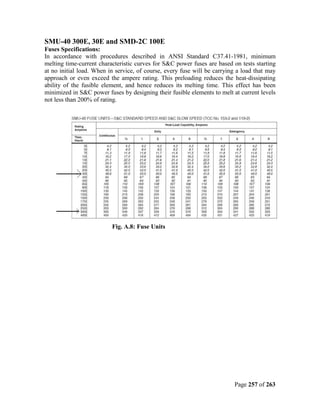
                        The ETAP Power Simulation computer program, version 5.5 from Operation
                        Technology, Inc was used for all the short circuit studies and simulations.
                        The following tables detail information available for the electrical
    Fig. 4.1: Power     equipment from the electrical drawings for Bayamón Waste Water
     Transformer        Treatment Plant. This information will be the data base for the short circuit
    Characteristics
         Table          study.

     Power Transformer
#                               T1          T2           T3          T4         T5           T6             T7
       Characteristics
1      Voltage in kV          38/4.16    4.16/0.48    4.16/0.48   38/4.16    4.16/0.48    4.16/0.48    4.16/0.48
2     Capacity in MVA            5          1.5          1.5         5          1.5          1.5          0.15
3     Impedance in %           6.21          3            3        6.21          3            3           2.5
4       Connection             D-Y         D-Y          D-Y        D-Y         D-Y          D-Y          D-Y


             #    Generator (1 to 2)                   Value        Units      SEL 300G
                  Characteristics
             1    Terminal Voltage                      4.16         kV
             2    Capacity                              2500         KW
             3    Power Factor                           0.8                                      Fig. 4.2: Generator
                                                                                                    Characteristics
             4    Full Load                            347.37       Amps                                 Table.
             5    Synchronous Reactance                 2.14
             6    Transient Reactance                   0.19
             7    Substransient Reactance               0.14
             8    Negative Sequence Reactance           0.19
             9    Zero Sequence Reactance               0.05


                                                                                         Page 89 of 263
4.2 Electrical System Oneline
           Diagram


                         Page 90 of 263
Diagrams


        We were required to perform an analysis for choose necessary equipment to protect
electric power system o Bayamón Waste Water Treatment Plant. After analizing the
system, we decided to use following coordination equation; t2 = 1.3t1 +15. Using it, we set
next coordination level between 23 to 25 cycles.


      In order to find the best devices to perform a good protective device coordination,
we analized a lot of different devices. The selected devices are commonly used in power
systems. It help very much to find devices information. Selected fuses were exclusive to
accomplish all requirements. Chosen devices and results are showed through next pages.


                                                                            Page 91 of 263
Bayamón WWTP Case Study


                              Fig. 4.3: Original Oneline Diagram of
                                        Bayamón WWTP.


        This is the original oneline diagram given to us with the objective of perform the
protective device coordination. It does not include any protective device.


                                                                           Page 92 of 263
Bayamón WWTP Sugested Oneline Diagram


                          Fig. 4.4: Suggested Oneline Diagram of
                                     Bayamón WWTP.


       Above diagram shows all suggested protective devices for power system of
Bayamón WWTP. Each device was selected to guarantee the best protective device
coordination. Shortly we present complete analysis of this coordination.


                                                                   Page 93 of 263
4.3 Input Data Report


                        Page 94 of 263
Data:

                              Lines cables 500 MCM TRXLPE
                        Z+ =(32+j36) µΩ/ft      Z0 =(104+j18) µΩ/ft
   Lines       Distance                  R+                 X+                  R0                 X0

        L1          120’              0.00384            0.00432             0.01248            0.00216

        L2          120’              0.00384            0.00432             0.01248            0.00216

        L3       1000’                 0.032               0.036              0.104               0.018

        L4           15’               0.032               0.036              0.104               0.018

        L5           15’              0.00048            0.00054             0.00156            0.00027

        L6           15’              0.00048            0.00054             0.00156            0.00027

        L7           15’              0.00048            0.00054             0.00156            0.00027

        L8           15’              0.00048            0.00054             0.00156            0.00027
                    Fig. 4.5: Lines Cables. This table includes power system feeders’
                                              parameters.

                            Line cable 2/0 AWG Cu TRXLPE
                    Z+ =(103+j44) µΩ/ft          Z0 =(400+j25) µΩ/ft
   Lines       Distance                  R+                 X+                  R0                 X0

        L9          100’              0.0103              0.0044               0.04              0.0025
              Fig. 4.6: Existing Transformer Line Cable. The figure presents cable
                              characteristics of an existing transformer.

                     Generators cables 350 MCM TRXLPE
                +
              Z =(42+j38) µΩ/ft               Z0 =(154+j20) µΩ/ft
   Lines       Distance                  R+                 X+                  R0                 X0

    LG1              75’              0.00315            0.00285             0.01155             0.0015

    LG2              75’              0.00315            0.00285             0.01155             0.0015

             Fig. 4.7: Generator Cables. Table above shows parameters of cables using
                                          for generators.


                                                                                        Page 95 of 263
Project:                                                           ETAP                                                            Page:          1
                                                                    5.5.0C
 Location:                                                                                                                          Date:          04-16-2007
 Contract:                                                                                                                          SN:            BETA-ELECT
 Engineer:                                                                                                                          Revision:      Base
                                                              Study Case: SM
 Filename:    JHD-CS                                                                                                                Config.:       Normal


                                                     2-Winding Transformer Input Data


       Transformer                        Rating                                 Z Variation                % Tap Setting            Adjusted                 Phase Shift
             ID        MVA     Prim. kV   Sec. kV    %Z       X/R       + 5%           - 5%    % Tol.       Prim.        Sec.             %Z                Type         Angle

T1                     5.000    38.000     4.160       6.21   12.14          0           0           0        0              0            6.2100        Std Pos. Seq.       -30.0

T2                     1.500     4.160     0.480       3.00    7.10          0           0           0        0              0            3.0000        Std Pos. Seq.       -30.0

T3                     1.500     4.160     0.480       3.00    7.10          0           0           0        0              0            3.0000        Std Pos. Seq.       -30.0

T4                     5.000    38.000     4.160       6.21   12.14          0           0           0        0              0            6.2100        Std Pos. Seq.       -30.0

T5                     1.500     4.160     0.480       3.00    7.10          0           0           0        0              0            3.0000        Std Pos. Seq.       -30.0

T6                     1.500     4.160     0.480       3.00    7.10          0           0           0        0              0            3.0000        Std Pos. Seq.       -30.0

T7                     0.150     4.160     0.480       2.50   20.00          0           0           0        0              0            2.5000        Std Pos. Seq.       -30.0


                                              2-Winding Transformer Grounding Input Data

                                                                                                         Grounding

       Transformer             Rating               Conn.                        Primary                                                       Secondary
             ID        MVA     Prim. kV   Sec. kV   Type       Type               kV           Amp         Ohm               Type                  kV              Amp      Ohm

T1                     5.000    38.000     4.160     D/Y                                                             Solid

T2                     1.500     4.160     0.480     D/Y                                                             Solid

T3                     1.500     4.160     0.480     D/Y                                                             Solid

T4                     5.000    38.000     4.160     D/Y                                                             Solid

T5                     1.500     4.160     0.480     D/Y                                                             Solid

T6                     1.500     4.160     0.480     D/Y                                                             Solid

T7                     0.150     4.160     0.480     D/Y                                                             Solid


                                                                                                                                 Page 96 of 263
4.4 Calculations


                   Page 97 of 263
Impedance:
Distance at lines.
Line1 = Line2 = 120 '             Line3 = Line4 = 1000 '   Line5−8 = 15'   Line9 = 100 '
LineG1 = LineG 2 = 75'
The cable used is TRXLPE 500 MCM.
                                 µΩ
       Z + LINE1−2 = (32 + j 36)     (120 ')
                                  ft
       Z + LINE1− 2 = (0.00384 + j 0.00432)Ω

                                     µΩ
        Z 0 LINE1−2 = (104 + j18)        (120 ')
                                      ft
        Z 0 LINE1− 2   = (0.01248 + j 0.00216)Ω
                                          Ω 
        Z 0 LINE1− 2 =  (1.04 + j 0.18)        
                                        1000 ' 
        Z 0 LINE1− 2 = (0.1248 + j 0.0216)Ω

                                     µΩ 
        Z + LINE 3− 4 =  (32 + j 36)      (1000 ')
                                      ft 
        Z + LINE 3− 4 = (0.032 + j 0.036)Ω

                                     µΩ 
        Z 0 LINE 3−4 =  (104 + j18)       (1000 ')
                                      ft 
        Z 0 LINE 3− 4 = (0.104 + j 0.018)Ω

                                     µΩ
        Z + LINE 5−8 = (32 + j 36)      (15')
                                    ft
        Z + LINE 5−8   = (0.00048 + j 0.00054)Ω

                                     µΩ
        Z 0 LINE 5−8 = (104 + j18)       (15')
                                      ft
        Z 0 LINE 5−8   = (0.00156 + j 0.00027)Ω

                                     µΩ
        Z + LINE 9 = (103 + j 44)       (100 ')
                                     ft
        Z + LINE 9   = (0.0103 + j 0.0044)Ω

                                     µΩ
        Z 0 LINE 9 = (400 + j 25)       (100 ')
                                     ft
        Z 0 LINE 9   = (0.04 + j 0.0025)Ω

                                                                             Page 98 of 263
Generators and Cable Equipment Electrical Specification:

The cable used is TRXLPE 350 MCM.

                                                    Ω
       Z + LINE −G1 = Z + LINE −G 2 = (42 + j 38)       (75')
                                                 1000 '
       Z + LINE −G1 = Z + LINE −G 2 = (0.00315 + j 0.00285)Ω
                                                     Ω
       Z 0 LINE −G1 = Z 0 LINE −G 2 = (154 + j 20)        (75')
                                                   1000 '
       Z 0 LINE −G1 = Z 0 LINE −G 2 = (0.01155 + j 0.0015)Ω


                                                                  Page 99 of 263
Calculating 3φ Short Circuit MVA with the utility:
Positive sequence impedance diagram for determine the fault current at the bus 1:


      Fig. 4.8: Positive Sequence impedance
                 Diagram at Bus 1


The shtort circuit current from utility:
ISCH = 20,000 A
        S SCH = 3(VL − L )( I SCH )
       S SCH = 3(38kv)(20, 000 A) = 1316MVA

Finding base current:
SBASE = 5 MVA         VBASE = 38 KV
                 S
        I BASE = BASE
                 3VBASE
                 5MVA
        I BASE =          = 76.05 A
                 3(38kV )

Converting short circuit current in per unit:
              I
      I pu = real
             I BASE
             20, 000 A
      I pu =           = 263 pu
              76.05 A


                                                                     Page 100 of 263
Calculating the per unit current to per unit impedance.
        1∠0
Z pu =        = 3.8022*10−3 pu
       263 pu

Simulating a short circuit at secondary side of transformer:
               (V ) 2
       Z BASE = BASE
                S BASE
                   (38Kv) 2
        Z BASE =            = 289Ω
                    5MVA

The base impedance at the other side of the transformer.
                 (289Ω)
      Z BASE =            2
                            = 3.46Ω
                38kV 
                       
                4.16kV 

Calculating the line one impedance in per unit:
                  Z
       Z L1 pu = real
                 Z BASE
                 0.00144Ω
       Z L1 pu =          = 0.416*10−3 pu
                   3.46Ω
Calculating short circuit current at the bus 1:

                              4.16
        I BASE = (76.05 A)(        ) = 698.68 A
                              0.48
                     1∠0o
        I SCH pu =
                     ZTH pu
                                      1∠0o
      I SCH =                                                     = 15.07 pu
               (3.8022*10−3 ) pu + (0.0621) pu + (0.416*10−3 ) pu
Changing per unit current to real current:
      I SCH p = (15.07 pu )(694.68 A) = 10, 468.83 A


                                                                               Page 101 of 263
Fig. 4.9: Three Phase Fault at Bus 1


Analysis

For the short circuit showed above, the device that operates are the instantaneous (50) and
back-up relay (51). If relay does not operate, fuse 1 will operate likes back up. This
coordination has approximately a 25 cycles different to the other coordination.

Transferring current to the other side of transformer 1:

                            I SCHprimary
       I SCH sec ondary =
                                a
                            (10, 468.83)
       I SCH sec ondary   =              = 1,146.06 A
                               38 
                                    
                               4.16 


                                                                          Page 102 of 263
Positive sequence impedance diagram for current fault at the bus 2:


     Fig. 4.10: Positive Sequence Impedance Diagram at Bus 2


Converting line three impedance to per unit:

                    0.012Ω
       Z L 3 pu =          = 0.003468 pu
                    3.46Ω

Doing a short circuit at the bus 2:

                                               1∠0o
       I SCH =                                                                      = 14.33 pu
                 (3.8022*10−3 ) pu + (0.0621) pu + (0.416*10−3 ) pu + (0.003468) pu

Changing the current in amperes:

       I BASE = 694.68) A
       I SCH = (14.33 pu )(694.68 A) = 9,954.76 A


                                                                              Page 103 of 263
ETAP Short circuit results:


               Fig. 4.11: Three Phase Fault at Bus 2


Analysis

For this short circuit the device that operates as primary protection is fuse 2. If fuse does
not operate, relay (51) will operate as back up with approximately 25 cycles of different to
the other coordination.


                                                                            Page 104 of 263
Doing a short circuit at load 1:

Positive sequence impedance diagram for current fault at the load 1:


                 Fig. 4.12: Positive Sequence Impedance Diagram at Load 1


Calculating line five per unit impedance:

                    0.00027Ω
       Z L 5 pu =            = 0.078*10 −3 pu
                      3.46Ω

Changing transformer impedance:

                               5MVA
       Z newT 3 = 0.03 pu (          ) = 0.1 pu
                              1.5MVA
                                                          1∠0o
       I SCH =                                                                                                = 5.89 pu
                 (3.8022*10 ) pu + (0.416*10 ) pu + (0.0621) pu + (0.003468) pu + (0.078*10−3 ) pu + (0.1) pu
                            −3                −3


Transferring current in secondary side of transformer:

                             4.16kV
       I BASE = (694.68 A)(          ) = 6014 A
                               480
       I SCH   = (6014 A)(5.89 pu ) = 35, 461.1A


                                                                                      Page 105 of 263
ETAP Short Circuits Results:


              Fig. 4.13: Three Phase Fault at Load 1


Analysis

A fault at transformer 2 or 3 has a protection in secondary side. Fuse 3 will operates like a
back up with 25 cycles of different between primary protection. If fuse 3 does not operate,
fuse 2 will operate with 25 cycles different between the fuse 3.


                                                                            Page 106 of 263
Doing a short circuit at load five:

Positive sequence impedance diagram for a short circuit current at the load 5:


                      Fig. 4.14: Positive Impedance Diagram at Load 5


Calculating new impedance of transformer 7:

                                5MVA
       Z newT 7 = 0.025 pu (           ) = 0.833 pu
                               0.15MVA

Changing line impedance to per unit impedance:

                   0.0044Ω
       Z Line9 =           = 0.001272 pu
                    3.46Ω
                                                      1∠0o
       I SCH =                                                                                   = 1.11 pu
                 (3.8022*10−3 ) pu + (0.416*10−3 ) pu + (0.0621) pu + (0.001272) pu + (0.833) pu


The real current in amperes:

       I SCH = (1.11 pu )(6020.56) = 6, 682.82 A


                                                                               Page 107 of 263
ETAP Short circuits results:


                Fig. 4.15: Three Phase Fault at Load 6


Analysis

Transformer 7 has a protection in the secondary side as a protection to faults as showing
above. Fuse 9 will operates like a back up with 9 cycles of different between primary
protection.


                                                                         Page 108 of 263
Calculating line to ground Short Circuit MVA:

Positive sequence impedance diagram for determine the short circuit curremt at the
bus 1:


                                                           Fig. 4.16: Positive Sequence Impedance
                                                        Diagram at Bus 1 for a Line to Ground Fault.


       ZTH ( + ) = (3.8022*10 −3 + 0.0621 + 0.416 *10−3 ) pu = 0.066318 pu

Cero sequence impedance diagram for determine the short circuit curremt at the bus
1:


             Fig. 4.17: Zero Sequence Impedance Diagram at Bus 1


                  0.000720
       Z L1(0) =           = 0.208*10−3 pu
                     3.36
       ZTH (0)   = (0.208*10−3 + 0.0621) pu = 0.062308 pu

Short circuit at the bus1:

                   1∠00       
       I0 =      (+)      (−) 
             ZTH 2 + ZTH 
                        1∠00           
       I0 =                             = 5.12 pu
             ((0.066318)2 + 0.0837) pu 
       I SCH = (5.12 pu )(3) = 15.38
       I SCH = (15.38 pu )(694.68 A) = 10, 684.17 A


                                                                               Page 109 of 263
ETAP Short circuits Results:


           Fig. 4.18: Line to Ground Fault at Bus 1


Analysis

When a line to ground fault occurs at bus 1 the instantaneous (50N) and back-up relay
(51N) must operate. If they do not operate, then fuse 1 will operate likes back up. This
coordination has approximately a 25 cycles different to other coordination.


                                                                        Page 110 of 263
Short circuit at the bus 2:

Positive sequence impedance diagram for determine the short circuit curremt at the
bus 2:


                                                                    Fig. 4.19: Positive Sequence Impedance
                                                                 Diagram at Bus 2 for a Line to Ground Fault.


Z ( + ) = (3.8022*10−3 + 0.0621 + 0.416*10−3 + 0.003468) pu = 0.06978 pu

Cero sequence impedance diagram for determine the short circuit curremt at the bus
2:


                          Fig. 4.20: Zero Sequence Impedance Diagram
                                             at Bus 2.


                   0.006
       Z L 3(0) =        = 0.001734 pu
                   3.46
       Z (0)   = (0.208*10−3 + 0.0621 + 0.001734) pu = 0.06404 pu


                      1∠00            
       I0 =                            = 4.9 pu
             (0.06978)2 + 0.06404) pu 

       I SCH = (4.9 pu )(3 A) = 14.7 A
       I SCH = (14.7 pu )(694.68) = 10, 211.79 A


                                                                              Page 111 of 263
ETAP Short Circuit Results:


            Fig. 4.21: Line to Ground Fault at Bus 2.


Analysis

For this short circuit the device that operates as primary protection is fuse 2. If fuse does
not operate, relay (51N) will operate as back up with approximately 25 cycles of diffe
                                                                                     different
to the other coordination.


                                                                             Page 112 of 263
Short circuit at the load 1:

Positive sequence impedance for determine the short circuit current at the load 1:
                                                                                 Fig. 4.22: Positive Sequence
                                                                                Impedance Diagram at Load 1
                                                                                 for a Line to Ground Fault.


Z ( + ) = (3.8022*10−3 + 0.0621 + 0.416*10−3 + 0.003468 + 0.27 *10−3 + 0.1) pu = 0.17005 pu

Cero sequence impedance for determine the short circuit current at the load 1:


                                             Fig. 4.23: Zero Sequence Impedance Diagram
                                                               at Load 1.


                   0.135*10−3
       Z L 5(0) =             = 0.039*10−3
                       3.46
       Z (0)   = 0.1 pu

The short circuit current:

                     1∠00           
       I0 =                          = 2.27 pu
              (0.17005)2 + 0.1) pu 
       I SCH = (2.27 pu )(3) = 6.81 pu
       I SCH = (6.81 pu )(6020.56 A) = 41, 039 A


                                                                              Page 113 of 263
ETAP Short Circuits Results:


            Fig. 4.24: Line to Ground Fault at Load 1.

Analysis

Transformer 2 has a protection in secondary side. The fuse 3 will operates like a back up
with 25 cycles of different in between primary protection. If fuse 3 does not operate, fuse 2
will operate with 25 cycles different between the fuse 3.


                                                                            Page 114 of 263
Short circuit at the load 5:

Positive sequence impedance for determine the short circuit current at the load 5:

                                                                                Fig. 4.25: Positive Sequence
                                                                                  Impedance Diagram at
                                                                                Load 5 for a Line to Ground
                                                                                            Fault.


Z ( + ) = (3.8022*10−3 + 0.0621 + 0.416*10−3 + 0.0044 + 0.833) pu = 0.9037 pu

Cero sequence impedance for determine the short circuit current at the load 5:


         0Z Transformer 7
                                             Fig. 4.26: Zero Sequence Impedance Diagram
                                                               at Load 5.


       Z (0) = 0.833 pu

The short circuit current:

                     1∠00           
       I0 =                          = 0.3787 pu
              (0.9037)2 + 0.833) pu 
       I SCH = (0.3787 pu )(3) = 1.13 pu
       I SCH = (6020.56)(1.13 pu ) = 6,803.23 A


                                                                             Page 115 of 263
ETAP Short Circuit Results:


           Fig. 4.27: Line to Ground Fault. At Load 5

Analysis

Transformer 7 has a protection in the secondary side against line to ground faults. If a fault
of this type happens, fuse 9 will operates like a back up with 9 cycles of different between
primary protection.


                                                                             Page 116 of 263
Calculating 3φ Short Circuit with generators:

Simulating a short circuit at bus 1:

Positive sequence impedance to determine the short circuit current at the generator
bus:

                                                             Fig. 4.28: Positive Sequence Impedance
                                                                    Diagram at Generator Bus.


Finding the new impedance of the generators:
                                            2
                          V          S          
        Z NEW   = Z puold  BASEOLD   BASENEW 
                           VBASENEW   S BASEOLD 
                                        2
                      4.16kV   5MVA              −3
      Z NEW = 0.19                      = 4.55*10 pu
                       38kV   2.5MVA 
Changing the generators impedance to per unit impedance:
                       0.00285Ω
      Z LG1 = Z LG 2 =            = 0.824*10−3 pu
                         3.46Ω

The impedance at the bus 1:
                                                        2
                                             VBASE   S BASENEW 
        Z NEW G1 = Z NEW G 2 = Z puold                            
                                             VBASENEW   S BASEOLD 
                                                                  
                                                   2
                                           4.16   5MVA             −3
        Z NEW G1 = Z NEW G 2       = 0.19         2.5MVA  = 4.55*10 pu
                                           38            
        Z G1+ LG1 // Z G 2+ LG 2
        Z G1+ LG1 // Z G 2 + LG 2 = 2.687 *10−3 pu

Calculating the short circuit current:
               1∠0          1∠0
       I SCH =     =
               ZTH Z G1+ LG1 // Z G 2 + LG 2
                   1∠0
       I SCH =                = 372.16 pu
               2.687 *10−3 pu

Changing the per unit current to real current:
      I BASE = 694.68 A
      I SCH = (372.16 pu )(694.68 A) = 258,532.1A
                                                                                            Page 117 of 263
Positive sequence impedance to determine the short circuit current at the bus 2:


                                                            Fig. 4.29: Positive Sequence Impedance
                                                             Diagram at Bus 2 using Generators.


Doing a short circuit at the bus 2:

                 1∠0          1∠0
       I SCH =        =
                 ZTH Z LG1 // Z LG 2 + Z L 3
                              1∠0
       I SCH   =                              = 162.46 pu
                 (2.687 *10 + 3.468*10−3 ) pu
                           −3


Changing the per unit current to real current:

       I SCH = (162.46 pu )(694 A) = 112,864.33 A


                                                                              Page 118 of 263
Positive sequence impedance to determine a short circuit current at the load 1:


                                                    Fig. 4.30: Positive Sequence Impedance
                                                     Diagram at Load 1 using Generators.


Doing a short circuit at the load 1:

                 1∠0                       1∠0
       I SCH =        =
                 ZTH Z G1+ LG1 // Z G 2 + LG 2 + Z L 3 + Z L 5 + ZT 2
                                            1∠0
       I SCH   =                                                      = 9.41 pu
                 (2.687 *10 + 3.468*10−3 + 0.078*10−3 + 0.1) pu
                           −3


Converting the per unit current to real current:

       I BASE = 6020.56 A
       I SCH = (9.41 pu )(6020.56 A) = 56, 673.16 A


                                                                                  Page 119 of 263
Positive sequence impedance to determine a short circuit current at load 5:


                                                     Fig. 4.31: Positive Sequence Impedance
                                                      Diagram at Load 5 using Generators.


Doing a short circuit at the secondary size of transformer 7:

                 1∠0                       1∠0
       I SCH =        =
                 ZTH Z G1+ LG1 // Z G 2 + LG 2 + Z L 4 + Z L 9 + ZT 7
                                 1∠0
       I SCH   =          −3
                                                                = 1.19 pu
                 (2.687*10 + 0.001272 + 0.833) pu

Changing the per unit current to real current:

       I SCH = (1.19 pu )(6020.56 A) = 7,193.37 A


                                                                                       Page 120 of 263
Fault line to ground using the generators:

Positive sequence impedance to determine a short circuit current at the generator
bus:


                                                                         Fig. 4.32: Positive Sequence Impedance
                                                                         Diagram at Generators Bus for a Line to
                                                                                      Ground Fault.


       ZTH + = 2.687 *10 −3 pu

Cero sequence impedance to determine a short circuit current at the generator bus:


                                                                            Fig. 4.33: Zero Sequence Impedance Diagram
                                                                                          at Generators Bus.


Finding the new impedance of the generators:

                                                   2
                                  VBASEOLD            S BASENEW   
                                                                  
           0
       Z             = Z puold
               NEW
                                  VBASE               S BASE      
                                        NEW                 OLD   

                                               2
                       4.16kV   5MVA 
       Z 0 NEW = 0.05          
                                                    −3
                                         = 1.198*10 pu
                       38kV   2.5MVA 


                                                                                                         Page 121 of 263
The impedance at the bus 1:

                 0.015Ω
        Z 0 LG1 =            = 4.34*10 −3 pu
                  3.45Ω
        Z G1+ LG1 = Z 0 G 2+ LG 2 = (1.198*10 −3 + 0.434 *10 −3 ) pu = 1.632*10−3 pu
         0


        Z 0TH = Z G1+ LG1 // Z G 2+ LG 2 = 0.816 *10−3 pu

Calculating the short circuit current:

                   1∠0
        I0 =
             2( Z TH ) + ZTH 0
                    +


                              1∠0
        I0 =                                     = (161.5 pu )3 = 484.65 pu
              2(2.687 *10 ) + 0.816 *10 −3  pu
             
                           −3
                                            

Changing the per unit current to real current:

        I SCH = (484.65 pu )(694.68 A) = 336, 678.51A

Positive sequence impedance to determine a short circuit current at the bus 2:


                                                                   Fig. 4.34: Positive Sequence Impedance
                                                                Diagram at Bus 2 Using Generators for a Line
                                                                               to Ground Fault.


Z +TH = Z G1+ LG1 // Z G 2 + LG 2 + Z L 3 + Z L 5 = (2.687 *10−3 + 3.468*10−3 ) pu = 6.155 pu


                                                                                         Page 122 of 263
Cero sequence impedance to determine a short circuit current at the bus 2:


                                                                 Fig. 4.35: Zero Sequence Impedance Diagram
                                                                           at Bus 2 Using Generators.


       Z 0TH = Z G1 // Z G 2 + Z L 3 + Z L 5 = (0.816*10−3 + 1.734 *10 −3 ) pu = 2.55*10 −3 pu

Doing a short circuit at the bus 2:

                         1∠0
       I0 =                               = 67.29 pu
              [ 2(0.006155) + 0.00255] pu
       I SCH = (67.29 pu )(3) = 201.88 pu

Changing the per unit current to real current:

       I SCH = (201.88 pu )(694.68 A) = 140, 244.95 A


                                                                                     Page 123 of 263
Positive sequence impedance to determine a short circuit current at the load 1:


                                                       Fig. 4.36: Positive Sequence Impedance
                                                      Diagram at Load 1 Using Generators for a
                                                                Line to Ground Fault.

ZTH + = (6.155*10−3 + 0.078*10−3 + 0.1) pu = 0.1062 pu

Cero sequence impedance to determine a short circuit current at the load 1:


                                               Fig. 4.37: Zero Sequence Impedance Diagram
                                                        at Load 1 Using Generators.


Doing a short circuit at the load 1:

       Z 0TH = ZT 2 = 0.1 pu

The short circuit current:

                      1∠0
       I0 =                         = 3.2 pu
              [ 2(0.1062) + 0.1] pu
       I SCH = (3.2 pu )(3) = 9.6 pu

Converting the per unit current to real current:

       I SCH = (9.6 pu )(6020.56 A) = 57,815.87 A


                                                                            Page 124 of 263
Positive sequence impedance to determine a short circuit current at the load 5:


                                                                           Fig. 4.38: Positive Sequence Impedance
                                                                          Diagram at Load 5 Using Generators for a
                                                                                    Line to Ground Fault.


       Z + TH = Z G1+ LG1 // Z G 2+ LG 2 + Z L 4 + Z L 9 + Z T 7 = (0.816 *10−3 + 1.272 *10−3 + 0.833) pu = 0.835 pu

Cero sequence impedance to determine a short circuit current at the load 5:


                                             Fig. 4.39: Zero Sequence Impedance Diagram
                                                      at Load 5 Using Generators.

       Z 0TH = ZT 7 = 0.833 pu

Doing a short circuit at the secondary side of the transformer 7:

                       1∠0
       I0 =                          = 0.39 pu
              [ 2(0.835) + 0.833] pu
       I SCH = (0.39 pu )(3) = 1.19 pu

Changing the per unit current to real current:

       I SCH = (1.19 pu )(6020.56 A) = 7,164.46 A


                                                                                       Page 125 of 263
Selecting the fuses:

Fuse at transformer 3:

Using the slow speed curve

1) Step 1: Nominal Current
                             1.5MVA
             I No min al =             = 208.4 A
                              3(38kV )
             F ≥ 300 E

2) Step2: Inrush current

             I Inrush = (208.42)(12) = 2,501A @ 6 cycles
             F ≥ 300 E            These fuses hold 9,546 A.

3) Step 3: Short circuit current
           I SCH = 4, 090 A Looking in the graph total clearing time.
     The fuse opens at 0.396s or 23.76 cycles.


Fuse at the bus 3:
Using the Time-delayed fuse
1) Step 1: Nominal current

                              3MVA
             I No min al =              = 416 A
                             3(4.16kV )
     F ≥ 600

2)   Step 2: Inrush current

             I Inrush = (208)(12) + 208 = 2, 704 A            @ 6 cycles
     F ≥ 600        These fuse hold 7,037 A at 6 cycles.

3) Step 3: Short circuit current
             I SCH = 9,950 A
     Using the graph total clearing time the fuse will open at 0.027s or 1.62 cycles.


                                                                           Page 126 of 263
The fuses at the transformer number 7.

   Using the standard speed curve

   1) Step 1: Nominal current

                               0.15MVA
               I No min al =              = 20.8 A
                               3(4.16kV )
               F ≥ 30 E

   2) Step 2: Inrush current

               I Inrush = (20.8)(12) = 250 A @ 6 cycles
               F ≥ 30 E           These fuse hold 1,015 A at 6 cycles.

   3) Step 3: Short circuit current

               I SCH = 772 A

       Finding the graph total clearing time the fuse will open at 0.133s or 7.98 cycles.

Fuse at the Utility:

   Using the very slow speed curve

   1) Step 1: Nominal current

                               5MVA
               I No min al =            = 75.97 A
                               3(38kV )
               F ≥ 100

   2) Step 2: Inrush current

               I Inrush = (76)(12) = 912 A @ 6 cycles
               F ≥ 100           These fuse hold 3,754 A at 6 cycles.

   3) Step 3: Short circuit current
               I SCH = 20, 000 A
       Finding the graph total clearing time the fuse will open at 0.025s or 1.5 cycles.


                                                                             Page 127 of 263
Calculating Relays:

Selecting the CTR for the transformers:

   a) The CTR has to comply with all the methods:

          I N = 695 A
                       695 A 
           CTR ≥ 1.2         
                       5 
        1200        695 A 
             ≥ 1.2        
          5         5 
        240 ≥ 167
        The CTR complied with the equation.

          I SC
   b)          ≤ 100 A
         CTR
          3, 460
                 ≤ 100 A
            240
         14.4 ≤ 100A
        The ratio between the short circuit and the CTR complied with the requirement.

                        CTRvoltage
   c) Burden( z ) =
                       20 I N
                        1200
        Burden( z ) =           = 0.086Ω
                      20(695 A)
        The burden could not exceed 0.086Ω.


                                                                          Page 128 of 263
Selecting the CTR for the generators:

   a) I N = 695 A

                      695 A 
         CTR ≥ 1.2          
                      5 
       7000         695 A 
             ≥ 1.2        
         5          5 
       1400 ≥ 167
       The CTR complied with the equation.

          I SC
     b)         ≤ 100 A
         CTR
        133, 248 A
                    ≤ 100 A
          7, 000
              5
        95 ≤ 100A
The ratio between the short circuit and the CTR complied with the requirement.

                         CTRvoltage
      c) Burden( z ) =
                        20 I N
                      7, 000
       Burden( z ) =           = 0.5Ω
                     20(695 A)
       The Burden could not exceed 0.5Ω.


                                                                          Page 129 of 263
Equation Curve:


Relay 351A: Three phase fault at the bus 1 using utility:
Setting Overcurrent Relay:
Element 50

      I SCH = 10,104 A
The multiple to use in the ETAP Program:
             I
      M = SCH
            CTR
            10,104 A
      M=              = 42.1          Instantaneous operation time
               1, 200
                  5
Element 51

       Pick − up = 1.2 I FL
       Pick − up = 1.2(695 A) = 834 A      Aproximated in ETAP program 816A .
               I SCH
       M=
            Pick − up
            9, 950
       M=            = 12.19
             816

Time Operation Equation

       TPRELAY = 0.344 s
                              5.67 
       TPR ELAY = TD 0.0352 + 2 
                             M −1
                               5.67 
       0.344 = TD 0.0352 +              
                             12.192 − 1 
       TD = 4.67              Using the Extremely Inverse Curve


                                                                      Page 130 of 263
Line to ground fault at the bus 1 using utility:

Setting for Overcurrent Relay.
Element 50N

        I SCH = 10,104 A
Multiple used in the ETAP program.
              I
        M = SCH
              CTR
              10,104 A
        M=             = 42.1
                1, 200
                   5
Instantaneous operation time

Element 51N

       I SCH = 10, 729 A
                               834 A
       Pick − up = 1.2(695 A) =      = 278 A
                                 3
The multiple used in the ETAP program.                   The multiple used in the
curves.
             I                                                 I SCH
        M = SCH                                          M=
            CTR                                             Pick − up
            278 A                                           10, 729
        M=         = 1.15   steps = 0.01                 M=          = 37.25
             1200                                            288
               5

Operation Time Equation:

       TPRELAY = 0.335s
                              5.67 
       TPR ELAY = TD 0.0352 + 2 
                             M −1
                               5.67 
       0.335 = TD 0.0352 +              
                             37.252 − 1 
       TD = 8.53              Using the Extremely Inverse Curve


                                                                        Page 131 of 263
Generation Operation Overcurrent Relay:

Relay 300G: Three phase fault at the bus G using generators:

Primary protection

3φ Short circuit at the bus of the each generator:

                  258,532.1A
        I SCH =              = 129, 266.05 A
                       2

The multiple to be used the relay curve.

             129, 266.05
        M=               = 310.10
               416.84

Element 51

The pick-up current for the relay.

        I FL = 347.37 A
        Pick − up = 1.2 I FL
        Pick − up = 1.2(347.37 A) = 416.84 A

Finding the operation time relay.

                                5.67 
       TPR ELAY = TD 0.0352 + 2 
                               M −1
                                   5.67 
       TPR ELAY = 8.48 0.0352 +               = 0.298s
                                310.10 2 − 1 
       TPR ELAY = 0.298s     Using extremely inverse curve.


                                                               Page 132 of 263
Element 50

Multiple used in ETAP program.

             100, 000
        M=            = 71.42
              7, 000
                 5

Element 51N
The pick-up current for the relay.

        I FL = 347.37 A
                     1.2 I FL
        Pick − up =
                        3
                     1.2(347.37 A)
        Pick − up =                = 130.95 A
                              3

Short circuit Line to ground at the bus of the generator:

                  336, 678.51A
        I SCH =                = 168,339.25 A
                        2

Finding the multiple to be used in the ETAP program:

             168, 339.25
        M=               = 1, 285.52
               130.95

Finding operation time relay.

       TD = 8.52
                                     5.67     
       TPR ELAY = 8.52 0.0352 +           2    = 0.299 s
                                1, 285.52 − 1 
       TPR ELAY = 0.299 s      Using extremely inverse curve

Element 50N

The multiple used in ETAP program.

        I SCH = 200, 000 A
              200, 000
        M=             = 142.85
               7, 000
                  5


                                                               Page 133 of 263
Generator Relay working as backup protection.

Doing a 3φ Fault at the bus 2:

Element 51
The pick-up current for the relay.

        Pick − up = 416.84 A

The short circuit current of each generator.

                  112,864.3
        I SCH =             = 54, 432.15
                      2

The multiple to be used in the Relay curve.

             54, 432.15
        M=              = 135.38
              416.84

Finding the operation time relay.

                                5.67 
       TPR ELAY = TD 0.0352 + 2 
                               M −1
                                   5.67 
       TPR ELAY = 8.48 0.0352 +              = 0.29 s
                                135.382 − 1 
       TPR ELAY = 0.29 s       Using extremely inverse curve


                                                               Page 134 of 263
Doing a Line to ground fault at the bus 2:

Element 51N
The pick-up current for the relay.

                     416.84 A
        Pick − up =           = 138.94 A
                        3
The schort circuit current .
               140, 244.95 A
       I SCH =               = 70,122.47 A
                      2

The multiple to be used in the Relay curve.

             70,122.47
       M=              = 504.67
              138.94

Finding the operation time relay.

                                5.67 
       TPR ELAY = TD 0.0352 + 2 
                               M −1
                                   5.67 
       TPR ELAY = 8.52 0.0352 +               = 0.30 s
                                504.67 2 − 1 
       TPR ELAY = 0.30 s       Using extremely inverse curve


                                                               Page 135 of 263
Doing a 3φ Fault at the load 1:

Element 51
Short circuit current at load 1.

        I SCH = 56, 673.16 A

Transferring short circuit current to generators side.

                  56, 673.16 A
        I SCH =                = 6,539.21A
                      4.16
                      0.48

Current contribution of each generator.

                  6, 539.21A
        I SCH =              = 3, 296.6 A
                       2

The pick-up current for the relay.

        Pick − up = 416.84 A

Multiple to be used in Relay curve.

             3, 296.6
        M=            = 7.84
             416.84

Finding operation time relay.

                                 5.67 
        TPR ELAY = TD 0.0352 + 2 
                                M −1
                                   5.67 
        TPR ELAY = 8.48 0.0352 +            = 1.093s
                                 7.842 − 1 
        TPR ELAY = 1.093s       Using extremely inverse curve


                                                                Page 136 of 263
Doing a Line to ground fault at the load 1:

Element 51N
The pick-up current for the relay.

                       416.84 A
        Pick − up =             = 138.94 A
                          3

The short circuit current .

                  57,815.87 A
        I SCH =               = 6, 671.06 A
                     4.16
                     0.48

The short circuit current of each generator.

                  6, 671.06
        I SCH =             = 3,335.53 A
                      2

The multiple to be used in the Relay curve.

             3, 335.53
        M=             = 24
              138.94

Finding the operation time relay.

                                5.67 
        TPR ELAY = TD 0.0352 + 2 
                                M −1
                                  5.67 
        TPR ELAY = 8.52 0.0352 + 2  = 0.38s
                                 24 − 1 
        TPR ELAY = 0.38s        Using extremely inverse curve


                                                                Page 137 of 263
4.5 Short Circuit Study


                     Page 138 of 263
Short Circuit Study
                 A. Single Line Short circuit SM Report - Short Circuit Study for the Power
                 Transformers T1, T2, T3, T4, T5, T6 and T7.

                 The section VI. A. contains the ETAP computer program output single line short
                 circuit cases and SM reports, detailing the short circuit current available in each
                 distribution voltage buses.
                 The following table contains the power transformer characteristics and short circuit
                 summary.

#      Power Transformers
                                    T1         T2          T3         T4         T5            T6           T7
         Characteristics
1          Voltage in kV          38/4.16   4.16/0.48   4.16/0.48   38/4.16   4.16/0.48     4.16/0.48    4.16/0.48
2        Capacity in MVA            5          1.5         1.5        5          1.5           1.5         0.15
3        Impedance in %            6.21        3           3         6.21         3            3            2.5
4            Connection            D-Y        D-Y         D-Y        D-Y        D-Y           D-Y          D-Y
     Secondary Winding Short
5   Circuit Three Phase Current   20,000     4,090       4,090      20,000      4,090        4,090         772
          (A) at High Side
     Secondary Winding Short
6   Circuit Three Phase Current   10,520     35,440      35,440     10,520     35,440        35,440       6,690
          (A) at Low Side
     Secondary Winding Short
7     Circuit Line to Ground        0          0           0          0           0            0            0
     Current (A) at High Side
     Secondary Winding Short
8     Circuit Line to Ground      10,730     41,060      41,060     10,730     41,060        41,060       6,850
      Current (A) at Low Side


          Each simulation page includes the incoming short circuit current magnitude from the 38 kV
          PREPA’S electric power system (20000 amps for three phase and 11547 amps for phase to
          ground) and the secondary current at distribution voltage busses at Bayamón Waste Water
          Treatment Plant.


                                                                                       Page 139 of 263
4.5.1: Three phase fault at utility


                             Fig. 4.40: Fault Simulation at Primary Side of
                            38KV/4.16KV Utility Transformer of BWWTP

*Note: The presented fault is the same at T4 primary side.


                                                                              Page 140 of 263
Fig. 4.41: Sequence of Operations Events at
                                   Primary Side of T1.


       When a three phase fault arise at primary side of 38KV/4.16KV transformer (T1)
the fuse 1 will operate at 1.50 cycles (24.9ms) as shown above.


                                                                     Page 141 of 263
Project:        Protective Device Coordination                                               ETAP                                            Page:           1
                                                                                             5.5.0C
Location:       WWTP, Bayamon                                                                                                                Date:           04-16-2007
Contract:                                                                                                                                    SN:             BETA-ELECT
Engineer:       Hector, Jose, Daniel                                                                                                         Revision:       Base
                                                                                       Study Case: SM
Filename:       JHD-CS                                                                                                                       Config.:        Normal


                                                                                SHORT- CIRCUIT REPORT

Fault at bus:      BTP-2

Prefault voltage = 38.000 kV               = 100.00 % of nominal bus kV ( 38.000 kV)
                 = 100.00 % of base kV ( 38.000 kV)

                                                                                                                                      Positive & Zero Sequence Impedances
                   Contribution                            3-Phase Fault                           Line-To-Ground Fault                     Looking into "From Bus"
        From Bus                     To Bus               %V            kA            % Voltage at From Bus         kA Symm. rms            % Impedance on 100 MVA base
            ID                         ID               From Bus     Symm. rms       Va        Vb         Vc        Ia        3I0      R1         X1           R0         X0

BTP-2                        Total                           0.00       20.000        0.00     173.21     173.21    0.000    0.000   3.79E-001   7.59E+000


BTS-2                        BTP-2                           0.00           0.000   100.00     100.00     100.00    0.000    0.000
Utility 1                    BTP-2                        100.00        20.000        0.00     173.21     173.21    0.000    0.000   3.79E-001   7.59E+000


Bus-1                        BTS-2                           0.00           0.000   100.00     100.00     100.00    0.000    0.000


Bus-2                        Bus-1                           0.00           0.000   100.00     100.00     100.00    0.000    0.000


Bus-1                        Bus7                            0.00           0.000   100.00     100.00     100.00    0.000    0.000


# Indicates fault current contribution is from three-winding transformers

* Indicates a zero sequence fault current contribution (3I0) from a grounded Delta-Y transformer


                                                                                                                                         Page 142 of 263
Analysis

When the system has a Three Phase Fault the impedance view is only the utility impedance.
The impedance is founded by Puerto Rico Electric Authority (PREPA). We can find the
short circuit current in the line asking to PREPA which is the short circuit current at that
point of the system. However when the system occur a Line to Ground Fault the
transformers configuration is Delta at the primary winding and the circuit impedance is
open by the configuration. For these reason the short circuit current is zero amperes.


                                                                            Page 143 of 263
4.5.2: Three phase fault at bus 1


                             Fig. 4.42: Fault Simulation at Bus 1 of
                                            BWWTP

*Note: The presented fault is the same at bus 6.


                                                                       Page 144 of 263
Fig. 4.43: Sequence of Operation Events at Bus 1


Analysis

For the short circuit showed above, the device that operates are the instantaneous (50) and
back-up relay (51). If relay does not operate, fuse 1 will operate likes back up. This
coordination has approximately a 25 cycles different to the other coordination.


                                                                            Page 145 of 263
Project:        Protective Device Coordination                                               ETAP                                                   Page:         1
                                                                                             5.5.0C
Location:       WWTP, Bayamon                                                                                                                       Date:         04-16-2007
Contract:                                                                                                                                           SN:           BETA-ELECT
Engineer:       Hector, Jose, Daniel                                                                                                                Revision:     Base
                                                                                       Study Case: SM
Filename:       JHD-CS                                                                                                                              Config.:      Normal


                                                                                SHORT- CIRCUIT REPORT

Fault at bus:      Bus-1

Prefault voltage = 4.160 kV                 = 100.00 % of nominal bus kV ( 4.160 kV)
                 = 100.00 % of base kV ( 4.160 kV)

                                                                                                                                         Positive & Zero Sequence Impedances
                    Contribution                           3-Phase Fault                           Line-To-Ground Fault                        Looking into "From Bus"
        From Bus                     To Bus               %V            kA            % Voltage at From Bus          kA Symm. rms              % Impedance on 100 MVA base
            ID                         ID               From Bus     Symm. rms       Va        Vb         Vc         Ia        3I0        R1         X1           R0                X0

Bus-1                        Total                           0.00       10.522        0.00         98.93    99.13   10.729   10.729     1.07E+001     1.31E+002       1.05E+001   1.24E+002


BTS-2                        Bus-1                           0.10       10.522        0.14         98.98    99.09   10.729   10.729     1.07E+001     1.31E+002       1.05E+001   1.24E+002
Bus-2                        Bus-1                           0.00           0.000     0.00         98.93    99.13    0.000    0.000


BTP-2                        BTS-2                         94.24        10.522       97.02     100.00       97.14   10.729   10.729 *   1.06E+001     1.31E+002       1.02E+001   1.24E+002
BTP-4                        Bus-2                           0.00           0.000     0.00         98.93    99.13    0.000    0.000
BTP-6                        Bus-2                           0.00           0.000     0.00         98.93    99.13    0.000    0.000


Utility 1                    BTP-2                        100.00            1.152   100.00     100.00      100.00    0.678    0.000     3.79E-001     7.59E+000
BTS-4                        BTP-4                           0.00           0.000    57.23         57.12   100.00    0.000    0.000
BTS-6                        BTP-6                           0.00           0.000    57.23         57.12   100.00    0.000    0.000


Bus-1                        Bus7                            0.00           0.000     0.00         98.93    99.13    0.000    0.000


# Indicates fault current contribution is from three-winding transformers

* Indicates a zero sequence fault current contribution (3I0) from a grounded Delta-Y transformer


                                                                                                                                             Page 146 of 263
Analysis

For this system occurred a Three Phase Fault at the bus-1. The systems see the utility
impedance, the transformer impedance and the line impedance. For this fault the short
circuit is 10,522 A at the bus-1. However when the system occur a Line to Ground Fault we
have to consider the zero sequence impedance. The connection for the transformer 1 is
Delta-Wye. For this configuration we have to open the second winding at the primary side.
The zero sequence is diagram is open by the configuration. For these reason the short
circuit current is 10,729 A at the bus-1.


                                                                         Page 147 of 263
4.5.3: Three phase fault at the bus 2


                               Fig. 4.44: Fault Simulation at Bus 2 of
                                              BWWTP

*Note: The presented fault is the same at bus 3.


                                                                         Page 148 of 263
Fig. 4.45: Sequence of Operation Events at Bus 2


Analysis

For this short circuit the device that operates as primary protection is fuse 2. If fuse does
not operate, relay (51) will operate as back up with approximately 25 cycles of different to
the other coordination.


                                                                             Page 149 of 263
Project:        Protective Device Coordination                                               ETAP                                                   Page:         1
                                                                                             5.5.0C
Location:       WWTP, Bayamon                                                                                                                       Date:         04-16-2007
Contract:                                                                                                                                           SN:           BETA-ELECT
Engineer:       Hector, Jose, Daniel                                                                                                                Revision:     Base
                                                                                       Study Case: SM
Filename:       JHD-CS                                                                                                                              Config.:      Normal


                                                                                SHORT- CIRCUIT REPORT

Fault at bus:      Bus-2

Prefault voltage = 4.160 kV                 = 100.00 % of nominal bus kV ( 4.160 kV)
                 = 100.00 % of base kV ( 4.160 kV)

                                                                                                                                         Positive & Zero Sequence Impedances
                    Contribution                           3-Phase Fault                           Line-To-Ground Fault                        Looking into "From Bus"
        From Bus                     To Bus               %V            kA            % Voltage at From Bus          kA Symm. rms              % Impedance on 100 MVA base
            ID                         ID               From Bus     Symm. rms       Va        Vb         Vc         Ia        3I0        R1         X1           R0                X0

Bus-2                        Total                           0.00           9.954     0.00         95.69   102.22   10.176   10.176     1.68E+001     1.38E+002       3.05E+001   1.27E+002


Bus-1                        Bus-2                           6.65           9.954     8.97         98.87    99.31   10.176   10.176     1.68E+001     1.38E+002       3.05E+001   1.27E+002
BTP-4                        Bus-2                           0.00           0.000     0.00         95.69   102.22    0.000    0.000
BTP-6                        Bus-2                           0.00           0.000     0.00         95.69   102.22    0.000    0.000


BTS-2                        Bus-1                           6.75           9.954     9.10         98.92    99.26   10.176   10.176     1.07E+001     1.31E+002       1.05E+001   1.24E+002
BTS-4                        BTP-4                           0.00           0.000    59.02         55.25   100.00    0.000    0.000
BTS-6                        BTP-6                           0.00           0.000    59.02         55.25   100.00    0.000    0.000


BTP-2                        BTS-2                         94.57            9.954    97.07     100.00       97.42   10.176   10.176 *   1.06E+001     1.31E+002       1.02E+001   1.24E+002


Bus-1                        Bus7                            6.65           0.000     8.97         98.87    99.31    0.000    0.000


# Indicates fault current contribution is from three-winding transformers

* Indicates a zero sequence fault current contribution (3I0) from a grounded Delta-Y transformer


                                                                                                                                             Page 150 of 263
Analysis

The Three Phase failure that occurred at the bus-2 is adding the line impedance three. The
short circuit current is 9.954A. When we compare the short circuit at the bus-1 is less
because the impedance magnitude has changed. For a Line to Ground Fault the system have
the same change in the zero sequence impedance. The systems consider the zero sequence
impedance at the line three at this fault. The short circuit current is 10,176 A at the bus-2.


                                                                               Page 151 of 263
4.5.4: Three phase fault at load 1


                              Fig. 4.46: Fault Simulation at Load 1 of
                                              BWWTP


*Note: The presented fault is the same at the Loads 2, 4, 5.


                                                                         Page 152 of 263
Fig. 4.47: Sequence of Operations Events at
                                              Load 1

Analysis

A fault at transformer 2 or 3 has a protection in secondary side. Fuse 3 will operates like a
back up with 25 cycles of different between primary protection. If fuse 3 does not operate,
fuse 2 will operate with 25 cycles different between the fuse 3.


                                                                            Page 153 of 263
Project:        Protective Device Coordination                                               ETAP                                                  Page:         1
                                                                                             5.5.0C
Location:       WWTP, Bayamon                                                                                                                      Date:         04-16-2007
Contract:                                                                                                                                          SN:           BETA-ELECT
Engineer:       Hector, Jose, Daniel                                                                                                               Revision:     Base
                                                                                       Study Case: SM
Filename:       JHD-CS                                                                                                                             Config.:      Normal


                                                                                SHORT- CIRCUIT REPORT

Fault at bus:      BTS-4

Prefault voltage = 0.480 kV                 = 100.00 % of nominal bus kV ( 0.480 kV)
                 = 100.00 % of base kV ( 0.480 kV)

                                                                                                                                        Positive & Zero Sequence Impedances
                   Contribution                            3-Phase Fault                           Line-To-Ground Fault                       Looking into "From Bus"
        From Bus                     To Bus               %V            kA            % Voltage at From Bus         kA Symm. rms              % Impedance on 100 MVA base
            ID                         ID               From Bus     Symm. rms       Va        Vb         Vc        Ia        3I0        R1         X1           R0                X0

BTS-4                        Total                           0.00       35.438        0.00         92.90   93.28   41.060   41.060     4.47E+001     3.36E+002       2.79E+001   1.98E+002


BTP-4                        BTS-4                         58.93        35.438       77.20     100.00      77.66   41.060   41.060 *   4.47E+001     3.36E+002       2.79E+001   1.98E+002


Bus-2                        BTP-4                         58.93            4.089    77.20     100.00      77.66    2.735    0.000     1.79E+002     7.10E+001


Bus-1                        Bus-2                         61.22            4.089    77.73     100.00      79.48    2.735    0.000     1.79E+002     7.10E+001
BTP-6                        Bus-2                         58.93            0.000    77.20     100.00      77.66    0.000    0.000


Bus-1                        Bus7                          61.22            0.000    77.73     100.00      79.48    0.000    0.000


# Indicates fault current contribution is from three-winding transformers

* Indicates a zero sequence fault current contribution (3I0) from a grounded Delta-Y transformer


                                                                                                                                            Page 154 of 263
Analysis

A Three Phase Fault is happened in the secondary side of the transformer 7 (BTS-12). The
transformer capacity is 0.15 MVA and the connection is Delta-Wye. The impedance
viewed at this point is by the utility, two transformers and lines. The short circuit current is
6,687A. When the Line to Ground Fault occur the zero sequence impedance is open by the
primary side of the transformer 7 (BTS-12). The short circuit current at the secondary side
of the transformer is 6,855A.


                                                                              Page 155 of 263
4.5.5: Three phase fault at Load 6


                              Fig. 4.48: Fault Simulation at Load 6 of
                                              BWWTP


                                                                         Page 156 of 263
Fig. 4.49: Sequence of Operation Events at
                                              Load 6


Analysis

Transformer 7 has a protection in the secondary side as a protection to faults as showing
above. Fuse 9 will operates like a back up with 9 cycles of different between primary
protection.


                                                                         Page 157 of 263
Project:        Protective Device Coordination                                               ETAP                                                  Page:         1
                                                                                             5.5.0C
Location:       WWTP, Bayamon                                                                                                                      Date:         04-16-2007
Contract:                                                                                                                                          SN:           BETA-ELECT
Engineer:       Hector, Jose, Daniel                                                                                                               Revision:     Base
                                                                                       Study Case: SM
Filename:       JHD-CS                                                                                                                             Config.:      Normal


                                                                                SHORT- CIRCUIT REPORT

Fault at bus:      BTS-12

Prefault voltage = 0.480 kV                 = 100.00 % of nominal bus kV ( 0.480 kV)
                 = 100.00 % of base kV ( 0.480 kV)

                                                                                                                                        Positive & Zero Sequence Impedances
                   Contribution                            3-Phase Fault                           Line-To-Ground Fault                       Looking into "From Bus"
        From Bus                     To Bus               %V            kA            % Voltage at From Bus         kA Symm. rms              % Impedance on 100 MVA base
            ID                         ID               From Bus     Symm. rms       Va        Vb         Vc        Ia        3I0        R1         X1           R0                X0

BTS-12                       Total                           0.00           6.687     0.00         98.84   98.70    6.855    6.855     9.45E+001     1.80E+003       8.32E+001   1.66E+003


BTP-12                       BTS-12                        92.65            6.687    96.34     100.00      96.18    6.855    6.855 *   9.45E+001     1.80E+003       8.32E+001   1.66E+003


Bus6                         BTP-12                        92.67            0.772    96.33     100.00      96.20    0.457    0.000     8.97E+002     1.56E+002


BTS-3                        Bus6                          92.68            0.772    96.34     100.00      96.21    0.457    0.000     8.96E+002     1.56E+002
Bus-3                        Bus6                          92.67            0.000    96.33     100.00      96.20    0.000    0.000


Bus10                        Bus6                          92.67            0.000    96.33     100.00      96.20    0.000    0.000


# Indicates fault current contribution is from three-winding transformers

* Indicates a zero sequence fault current contribution (3I0) from a grounded Delta-Y transformer


                                                                                                                                            Page 158 of 263
Analysis

A Three Phase Fault is happened in the secondary side of the transformer 7 (BTS-12). The
transformer capacity is 0.15 MVA and the connection is Delta-Wye. The impedance
viewed at this point is by the utility, two transformers and lines. The short circuit current is
6,687A. When the Line to Ground Fault occur the zero sequence impedance is open by the
primary side of the transformer 7 (BTS-12). The short circuit current at the secondary side
of the transformer is 6,855A.


                                                                              Page 159 of 263
4.6 Power Fuses Selection for
Power Transformers T1, T2,
    T3, T4, T5, T6 and T7


                        Page 160 of 263
V. Protective Device Selection
       A. Power Fuses Selection
       Power Transformers T1, T2, T3, T4, T5, T6 and T7
       The Power Fuse Time Coordination show the analysis for the short circuit
       simulations at the utility side and the power plant side for the T1, T2, T3, T4, T5,
       T6 and T7.
       The fuse coordination complies with time (12-30cycles) permitted by each
       coordination.
       The following table shows the power fuse summary for the transformers.


       #    Power Transformer         Recommended Power Fuse                  Curve
       1         T1 38/4.16                   SMD-2C-100E                  Slow Speed
       2        T2 4.16/0.48                  SMU-40-300E                  Slow Speed
       3        T3 4.16/0.48                  SMU-40-300E                  Slow Speed
       4         T4 38/4.16                   SMD-2C-100E                  Slow Speed
       5        T5 4.16/0.48                  SMU-40-300E                  Slow Speed
       6        T6 4.16/0.48                  SMU-40-300E                  Slow Speed
       7        T7 4.16/0.48                  SMU-40-30E                    STD Speed
       8        Main Feeder                   Fault Fiter-600              Time-delayed

                           Fig. 4.50: Recommendations to Fuse Protection


*Note: The fuse curves are in the appendix.


                                                                               Page 161 of 263
Treatment power Plant
                   Power Transformer 1-2 Time Fuse Coordination
Project: Bayamón Waste Water Treatment Plant
Voltage (kV): 38/4.16
Connection (Type): DELTA-WYE
Capacity (MVA): 5
Impedance (Z%): 6.21 @ 5 MVA
IFL (Amps High Side): 76.05 @ 5 MVA          IINRUSH CURRENT = (IFL *12): 912.16
 ISC (AEE): 20,000


                     Fig. 4.51: Time Fuse 1 and 5 Coordination


                                                                     Page 162 of 263
Fig. 4.52: Characteristics Curves for Fuse 1 and 5


The fuse chosen has the capacity to break the short circuit at 0.475 A or 28.5 cycles.


                                                                             Page 163 of 263
S&C      SMD-2C

The next figures show the operation of different fuses by ours recommendation and
alternatives options. The fuses are operating like a back up protection to accomplish to our
protection criteria.

 Curve Fuse         65E             80E            100E            125E              150E
 STD Speed
 Minimum            4.39            9.28           10.92           18.06             27.00
Melting Time
Total clearing      8.52            11.58          16.50           24.78             36.06
    Time


 Curve Fuse         65E             80E            100E            125E              150E
 Slow Speed
  Minimum           7.02            12.12          20.58           33.30             51.48
Melting Time
Total clearing     11.70            17.82          28.32           44.28             67.32
    Time


                   Curve            Fuse
Recommended      Slow Speed         100 E
    Fuse                                                   Fig. 4.53: Fuse 1 and 5 recommended
 Alternative     STD Speed          125 E
    Fuse


                                                                              Page 164 of 263
Treatment power Plant
                       Main Feeder Time Fuse Coordination
Project: Power Treatment Plant
Voltage (kV): 4.16
IFL (Amps High Side): 416.85


                     Fig. 4.54: Time Fuse 2 and 6 Coordination


                                                                 Page 165 of 263
Fig. 4.55: Characteristics Curves for fuse 2 and 6

The fuse chosen has the capacity to break the arch at 0.84s or 50.4 cycles.


Fault Fiter

The fault fiter fuse has the same curves for the other fusible. That makes the option to select
the best operation time in the case that has to operate the fuse

Curve Fuse          400               600
Time Delayed
  Minimum          22.62              43.8
Melting Time
Total clearing     26.34              50.4
    Time
      Fig. 4.56: Fuse 2 and 6 Recommended


                                                                                Page 166 of 263
Treatment power Plant
                 Power Transformer 2-3, 5-6 Time Fuse Coordination
Project: Power Treatment Plant
Voltage (kV): 4.16/0.48
Connection (Type): DELTA-WYE
Capacity (MVA): 1.5
Impedance (Z%): 3 @ 1.5 MVA
IFL (Amps High Side): 208.45 @ 1.5 MVA         IINRUSH CURRENT = (IFL *12): 2,501.45


                   Fig. 4.57: Time Fuse 3, 4, 7 and 8 Coordination


                                                                       Page 167 of 263
Fig. 4.58: Characteristics Curves for fuses 3, 4, 7 and 8

The fuse selected has the capacity to break the arch at 0.395s or 23.7 cycles.


                                                                                   Page 168 of 263
S&C      SMU-40

The next figures show the operation of different fuses by ours recommendation and
alternatives options. The fuses are operating like a back up protection to accomplish to our
protection criteria.

 Curve Fuse        200E             250E           300E          400E
 STD Speed
 Minimum            3.27            4.65           7.14          11.76
Melting Time
Total clearing      7.20            8.88           14.28         20.22
    Time


 Curve Fuse        200E             250E           300E          400E
 Slow Speed
  Minimum           6.72            10.20          14.94         24.96
Melting Time
Total clearing     11.40            15.54          23.76         33.36
    Time


                   Curve            Fuse
Recommended      Slow Speed         300 E
    Fuse
 Alternative     STD Speed          400 E             Fig. 4.59: Fuse 3, 4, 7 and 8 Recommended
    Fuse


                                                                             Page 169 of 263
Treatment power Plant
                    Power Transformer 7 Time Fuse Coordination
Project: Power Treatment Plant
Voltage (kV): 4.16/0.48
Connection (Type): DELTA-WYE
Capacity(MVA): 0.15
Impedance (Z%): 2,5 @ 0.15 MVA
IFL (Amps High Side): 20.84 @ 1.5 MVA        IINRUSH CURRENT = (IFL *12): 250.11


                     Fig. 4.60: Time Fuse 9 Coordination


                                                                     Page 170 of 263
Fig. 4.61: Characteristics Curves for fuse 9

The fuse chosen has the capacity to break the short circuit at 0.155s or 9.30 cycles.


                                                                             Page 171 of 263
S&C      SMU-40

The next figures show the operation of different fuses by ours recommendation and
alternatives options. The fuses are operating like a back up protection to accomplish to our
protection criteria.

 Curve Fuse         20E             25E             30E           40E             50E
 STD Speed
 Minimum            1.08            1.75            2.15          3.53            5.27
Melting Time
Total clearing      6.66            7.50            7.98          9.66           11.76
    Time


 Curve Fuse         20E             25E             30E           40E             50E
 Slow Speed
  Minimum           1.40            1.86            3.24          6.66           10.80
Melting Time
Total clearing      7.08            7.62            9.30          13.44          18.40
    Time


                   Curve            Fuse
Recommended      Slow Speed         30 E
    Fuse                                                   Fig. 4.60: Fuse 9 Recommended
 Alternative     STD Speed          40 E
    Fuse


                                                                             Page 172 of 263
4.7 Protection Relay
    Settings for
Distribution Feeders


                   Page 173 of 263
Page 174 of 263
Page 175 of 263
Page 176 of 263
Page 177 of 263
4.8 Relay Settings


                     Page 178 of 263
Relay 351A:

                                        Relay 351A

                                                Operation Protection Devices
               Element       Pick-up             Extremely Inverse Curve
                                                   M                 TD
                 51           816 A              12.19              4.67

                 50          10,104 A              X                  X

                                 Extremely Inverse Curve

                 51N          278 A              37.25              8.53

                 50N         10,104 A              X                  X

                                 Directional Power Relay

                                      Pick-up (pu)                  Time

                 32                      0.57                        0.5

                                 Fig. 4.63: Relay 351A Settings

        After finish all necessary calculations by hand to reach al requirements of
coordination using 23 to 25 cycles between coordinaion levels we found setings
specifications for Relay 351A. These setting are shown above. The coordination was
performed with ETAP software.

       Relay 351A is used for protect transformer 1 an 2. The elements in the relay are 50,
51, 50N, 51N, 32.


                                                                               Page 179 of 263
Relay 300G:


                                           Relay 300G

                                                  Operation Protection Devices
               Element           Pick-up           Extremely Inverse Curve
                                                     M                    TD
                  51            416.84 A           188.47                 8.48

                  50            80,000 A              X                    X

                                   Extremely Inverse Curve

                 51N            138.95 A           565.39                 8.52

                 50N            80,000 A              X                    X

                           Fig. 4.64: Overcurent Relay Settings for Generator


                                           Relay 300G

                                                Operation Protection Devices
               Element         Voltage
                                             Under voltage          Overvoltage
                27/59          4,160 V           4,035 V               4,285 V

                                        Frequency Relay

                              Frequency     Over Frequency        Under Frequency

                  81            60 Hz            61.2 Hz               58.8 Hz

                        Fig. 4.65: Undervoltage, Overvoltage, Frequency
                                  of Power Relay for Generator

        Relay 300G is used to protect generator. The relay components are overcurrent
protection (50, 51, 50N, 51N), overvoltage (59) and underoltage (27), frequency protection
(81). After finish calculations with necessary coordination levels and criteria we select the
settings presented in tables above.


                                                                                 Page 180 of 263
4.9 Results


              Page 181 of 263
Results

         We realized a three phase fault through BWWTP power system using PREPA
connection. Our evaluation criteria to all faults were 23 to 25 cycles of difference between
coordination levels. Figure 4.60 shows the short circuits magnitudes at the points analyzed.
It also includes operation time for each equipment.


                                                                           Page 182 of 263
Fault using the utility:

                                              Three Phase Fault

                 Operating      Short
Localization
                  Voltage      Circuit                  Operation Protection Devices Time (Cycles)
   Fault
                   (kV)        Current
                                         Fuse1/5      Fuse2/6      Fuse3/4/7/8    Fuse9      Relay(50)   Relay(51)
T1, T4 Primary       38       20,000A     1.44        --------        --------    --------    --------    --------
   T1, T4
                    4.16      10,504 A   44.70        --------        --------    --------    --------    --------
 Secondary
 Bus1, Bus 6        4.16      10,500 A   44.82        --------        --------    --------       0         19.5
 Bus2, Bus 3        4.16      9,950 A    49.62          1.62          --------    --------    --------    23.64
T2, T3, T5, T6
                    4.16      9,950 A    --------       1.62           5.88       --------    --------    23.64
  Primary
T2, T3, T5, T6
                    0.48      35,440 A   --------       50.4          23.76       --------    --------    75.78
 Secondary
 T7 Primary         4.16      9,950 A    49.62          1.62          --------    --------    --------    23.64
T7 Secondary        0.48      6,690 A    --------     --------        --------     7.98       --------    --------

                                           Fig. 4.66: Three Phase Fault Results


                                                                                      Page 183 of 263
The figure below shows line to ground fault at different areas of system. This kind of fault
           change operation time of devices. However, protective device coordination still working
           the same. All points reach coordination criteria of 23 to 25 cycles between coordination
           levels. Results was verified with manual calculations and using ETAP software.


                                             Line to ground Fault


                 Operating     Short
Localization
                  Voltage     Circuit                   Operation Protection Devices Time (Cycles)
   Fault
                   (kV)       Current
                                          Fuse 1/5     Fuse 2/6    Fuse 3/4/7/8     Fuse 9        Relay(50)    Relay(51)
T1, T4 Primary      38          0A         --------     --------       --------     --------        --------      --------
   T1, T4
                    4.16        0A         --------     --------       --------     --------        --------      --------
 Secondary
 Bus1, Bus 6        4.16     10,730 A      --------     --------       --------     --------           0          23.10

 Bus2, Bus 3        4.16     10,180 A      --------      1.62          --------     --------           0          23.10
T2, T3, T5, T6
                    4.16     10,180 A      --------      1.62            5.7        --------        --------      23.10
  Primary
T2, T3, T5, T6
                    0.48     41,060 A      --------     --------       48.78        --------        --------      --------
 Secondary
 T7 Primary         4.16     10,730 A      --------     --------       --------     --------           0          23.10

T7 Secondary        0.48      6,850 A      --------     --------       --------         14.34       --------      --------

                                              Fig. 4.67: Line to Ground Fault Results


                                                                                                Page 184 of 263
When Bayamón WWTP is working with generators is possible that faults could
               happen. For that reason we made protective device coordination for BWWTP using
               generators. For a three phase fault at generators the overcurrent relay operates. If a fault
               occurs in system far from generators, protective devices work faster than when using
               utility. It reduces time between coordination devices. Coordination results are showing in
               table below.

               Fault using the generators:

                                                      Three Phase Fault

                    Operated
 Localization                      Short Circuit
                    Voltage                                       Operation Protection Devices Time (Cycles)
    Fault                            Current
                     (kV)
                                                      Fuse       Fuse        Fuse
                                                                                         Fuse 9           RelayG(50)      RelayG(51)
                                                       1/5        2/6       3/4/7/8
  Bus1, Bus 6          4.16        258,532.1 A       --------   --------    --------          0                0            17.91
  Bus2, Bus 3          4.16        112,864.33 A      --------      0        --------     --------           --------        18.06
 T2, T3, T5, T6
                       0.48        56,673.16 A       --------    0.78         5.4        --------           --------        65.58
  Secondary
 T7 Secondary          0.48         7,193.37 A       --------   --------    --------       1.8              --------        --------

                                                 Fig. 4.68: Three Phase Fault Results Using
                                                                Generators.


                                                   Line to ground Fault


Localization       Operated      Short Circuit
   Fault           Voltage         Current                        Operation Protection Devices Time (Cycles)
                    (kV)
                                                   Fuse 1/5     Fuse 2/6      Fuse            Fuse 9          Relay(50)     Relay(51)
                                                                             3/4/7/8
                                 336,678,51 A       --------     --------    --------             0                0            18.0
 Bus1, Bus 6          4.16
                                 140,244.95 A       --------        0         --------        --------         --------         18.0
 Bus2, Bus 3          4.16
T2, T3, T5, T6                    57,815.87 A       --------      33.6         5.58           --------         --------         33.6
                      0.48
 Secondary
T7 Secondary                      7,164.46 A        --------     --------     --------            1.8          --------       --------
                      0.48

                                           Fig. 4.69: Line to Ground Fault Results Using
                                                             Generators

                                                                                                        Page 185 of 263
Chapter 5: Protective Device
Coordination Project Results


                        Page 186 of 263
Contents


Alternatives Considered…………………………………………………………………. 188
System Specification…………………………………………………………………….. 190

Magazine Article………………………………………………………………………… 195
Budget…………………………………………………………………………………… 196
Bibliography……………………………………………………………………………... 197
Conclusions……………………………………………………………………………… 199


                                           Page 187 of 263
5.1 Alternatives Considered

          Through the capstone project appears many questions with multiple solutions. That
moved us to realize brainstorming to find the best way of action. We analyzed each
possible solution as a great alternative and visualized their advantages and disadvantages.
Then, we chose the best answer. There is a summary of alternatives considered.


  I.      Protective Devices

          There are a lot of protective devices at market today. It gives us many alternatives
       to considered. However, to choose a protective device, first we have to look system
       capacity, localization and kind of charge connected to it.


 II.      Manufacturer Selection

          Every manufacturer offers different protective devices to perform the same thing in
       a power system. For that reason we have a lot of alternatives about which protective
       device should be used. Each device does not work at same way. According to this, we
   prefer to use most commonly used manufacturers and devices in Puerto Rico.


III.      Compatibility of Devices

          As part of protective device coordination each protective device has to work as a
       team with other devices. But, unfortunately, some devices are not compatible with
       devices produced by others manufacturers. It force us to considerate the alternative of
       use devices of same manufacturer of existing devices in power system. If we do not
       considered this alternative, protective device coordination will not be complete.


IV.       Fault Analysis

          There are many things that could make a system fault. In field of power system,
       these faults are classified in four categories. These are: phase to phase, single phase to
       ground, double phase to ground and, three phase fault. A fault can occur everywhere at
       any time. Also, is possible that occur more than once at in power system at the same

                                                                                Page 188 of 263
time. Is very important remember this detail. If we do it, then we could realize a better
     contingency, which means best protective device coordination.
        In our design the short circuit study give us the information to select the appropriate
 protective devices. With the faults magnitude in the different parts of the system our
     devices operates with our coordination criteria (23 to 25 cycles) and protect the
     equipments of damage.


V.      User Guide:
            a. One user guide.

                       The option of write only one user guide was very tempting.            It
                represents less work for us. But, write one manual with an explanation of all
                elements in program, data required, and possible mistakes made by user,
                could make it too long. A long user guide can make that people do not want
                to read it. Also, we thought in busy engineers who do not have time to read
                a long manual. They need something short and easy to read. For that reason
                we discard the idea.
            b. Two user guides.

                       We realized the idea of create two user guides, basic one and advance
                one. The basic user guide has the purpose of give an explanation step by
                step of how to use ETAP program. It covers from how to build a one-line
                diagram to how to perform a short circuit analysis. Also, this guide is
                written to be easy to read and understand. Busy engineers can perform a
                power system simulation fast and without problem.
                       At this time, we thought that some people may ask for more
                information. For them, we prepared a second user guide, an advance user
                guide. In this guide we give more specific details of some features of ETAP
                program. For example, we include a case study solution as a model of how
                made a simulation with program.          Also, it includes equipment data
                requirements, and technical terms uses by ETAP software.


                                                                              Page 189 of 263
We chosen this second alternative, because we understand it is more
practical for today’s engineers.


                                                          Page 190 of 263
5.2 System Specifications

Circuit Breaker
       A circuit breaker is an automatically-operated electrical switch designed to protect
an electrical circuit from damage caused by overload or short circuit. Unlike a fuse, which
operates once and then has to be replaced, a circuit breaker can be reset (either manually or
automatically) to resume normal operation. Circuit breakers are made in varying sizes, from
small devices that protect an individual household appliance up to large switchgear
designed to protect high voltage circuits feeding an entire city.


                                Fig. 5.1: Vacuum Circuit Breaker


Fuse

       In electronics and electrical engineering a fuse, short for 'fusible link', is a type of
overcurrent protection device. Its essential component is a metal wire or strip that melts
when too much current flows. When the metal strip melts, it opens the circuit of which it's a
part, and so protects the circuit from excessive current.

A practical fuse was one of the essential features of Edison's electrical power distribution
system. An early fuse was said to have successfully protected an Edison installation from
tampering by a rival gas-lighting concern.

Fuses (and other overcurrent devices) are an essential part of a power distribution system to
prevent fire or damage. When too much current flows through a wire, it may overheat and
be damaged or even start a fire. Wiring regulations give the maximum rating of a fuse for
protection of a particular circuit. Local authorities will incorporate national wiring


                                                                              Page 191 of 263
regulations as part of law. Fuses are selected to allow passage of normal currents, but to
quickly interrupt a short circuit or overload condition.


                                      Fig. 5.2: Power Fuse


Relay
        A relay is an electrical switch that opens and closes under the control of another
electrical circuit. In the original form, the switch is operated by an electromagnet to open or
close one or many sets of contacts. It was invented by Joseph Henry in 1835. Because a
relay is able to control an output circuit of higher power than the input circuit, it can be
considered to be, in a broad sense, a form of an electrical amplifier.


                                                                 Fig. 5.3: Protective Relay


                                                                               Page 192 of 263
Operation

       When a current flows through the coil, the resulting magnetic field attracts an
armature that is mechanically linked to a moving contact. The movement either makes or
breaks a connection with a fixed contact. When the current to the coil is switched off, the
armature is returned by a force approximately half as strong as the magnetic force to its
relaxed position. Usually this is a spring, but gravity is also used commonly in industrial
motor starters. Most relays are manufactured to operate quickly. In a low voltage
application, this is to reduce noise. In a high voltage or high current application, this is to
reduce arcing.

       If the coil is energized with DC, a diode is frequently installed across the coil, to
dissipate the energy from the collapsing magnetic field at deactivation, which would
otherwise generate a spike of voltage and might cause damage to circuit components. Some
automotive relays already include that diode inside the relay case. Alternatively a contact
protection network, consisting of a capacitor and resistor in series, may absorb the surge. If
the coil is designed to be energized with AC, a small copper ring can be crimped to the end
of the solenoid. This "shading ring" creates a small out-of-phase current, which increases
the minimum pull on the armature during the AC cycle.

       By analogy with the functions of the original electromagnetic device, a solid-state
relay is made with a thyristor or other solid-state switching device. To achieve electrical
isolation an optocoupler can be used which is a light-emitting diode (LED) coupled with a
photo transistor.


Protective relay

       A protective relay is a complex electromechanical apparatus, often with more than
one coil, designed to calculate operating conditions on an electrical circuit and trip circuit
breakers when a fault was found. Unlike switching type relays with fixed and usually ill-
defined operating voltage thresholds and operating times, protective relays had well-
established, selectable, time/current (or other operating parameter) curves. Such relays were
very elaborate, using arrays of induction disks, shaded-pole magnets, operating and

                                                                              Page 193 of 263
restraint coils, solenoid-type operators, telephone-relay style contacts, and phase-shifting
networks to allow the relay to respond to such conditions as over-current, over-voltage,
reverse power flow, over- and under- frequency, and even distance relays that would trip
for faults up to a certain distance away from a substation but not beyond that point. An
important transmission line or generator unit would have had cubicles dedicated to
protection, with a score of individual electromechanical devices. The various protective
functions available on a given relay are denoted by standard ANSI Device Numbers. For
example, a relay including function 51 would be a timed overcurrent protective relay.

       These protective relays provide various types of electrical protection by detecting
abnormal conditions and isolating them from the rest of the electrical system by circuit
breaker operation. Such relays may be located at the service entrance or at major load
centers.

       Design and theory of these protective devices is an important part of the education
of an electrical engineer who specializes in power systems. Today these devices are nearly
entirely replaced (in new designs) with microprocessor-based instruments (numerical
relays) that emulate their electromechanical ancestors with great precision and convenience
in application. By combining several functions in one case, numerical relays also save
capital cost and maintenance cost over electromechanical relays. However, due to their very
long life span, tens of thousands of these "silent sentinels" are still protecting transmission
lines and electrical apparatus all over the world.


Overcurrent relay

       An "Overcurrent Relay" is a type of protective relay which operates when the load
current exceeds a preset value. The ANSI Device Designation Number is 50 for an
Instantaneous OverCurrent (IOC), 51 for a Time OverCurrent (TOC). In a typical
application the overcurrent relay is used for overcurrent protection, connected to a current
transformer and calibrated to operate at or above a specific current level. When the relay


                                                                              Page 194 of 263
operates, one or more contacts will operate and energize a trip coil in a Circuit Breaker and
trip (open) the Circuit Breaker.


Distance relay

         It is a protective relay used to protect power transmission and distribution lines
against different fault types. The relay monitors line impedance by measuring line voltage
and current. Once a fault occurs, the voltage drops to zero and thus the measured
impedance become less than the setting value ``reach``. As a result the relay issues a trip
command.


Transformer

         A transformer is a device that transfers electrical energy from one circuit to
another through inductively coupled wires. A changing current in the first circuit (the
primary) creates a changing magnetic field; in turn, this magnetic field induces a changing
voltage in the second circuit (the secondary). By adding a load to the secondary circuit, one
can make current flow in the transformer, thus transferring energy from one circuit to the
other.

         The secondary induced voltage VS is scaled from the primary VP by a factor ideally
equal to the ratio of the number of turns of wire in their respective windings:


By appropriate selection of the numbers of turns, a transformer thus allows an alternating
voltage to be stepped up — by making NS more than NP — or stepped down, by making it
less.

         A key application of transformers is to reduce the current before transmitting
electrical energy over long distances through wires. Most wires have resistance and so
dissipate electrical energy at a rate proportional to the square of the current through the
wire. By transforming electrical power to a high-voltage, and therefore low-current form
for transmission and back again afterwards, transformers enable the economic transmission

                                                                              Page 195 of 263
of power over long distances. Consequently, transformers have shaped the electricity
supply industry, permitting generation to be located remotely from points of demand. All
but a fraction of the world's electrical power has passed through a series of transformers by
the time it reaches the consumer.

Transformers are some of the most efficient electrical 'machines', with some large units
able to transfer 99.75% of their input power to their output. Transformers come in a range
of sizes from a thumbnail-sized coupling transformer hidden inside a stage microphone to
huge units weighing hundreds of tones used to interconnect portions of national power
grids. All operate with the same basic principles, though a variety of designs exist to
perform specialized roles throughout home and industry.


ETAP Software
       This software is designed to perform power system simulations. It is a very advance
program capable to simulate most of power system analysis. Unfortunately, it is a little
hard to understand. To run the software you need at least 1 Mb RAM processor with
Windows XP or higher.


                                                                            Page 196 of 263
Magazine Article


                   Page 197 of 263
5.4 Budget

                Table A. Materials required developing the data base


      Amount               Description             Price p/u                Total
          1                  Laptop                $800.00                 $800.00
          1            ETAP software               $4000.00               $4000.00
          1                 Logbook                 $23.00                  $23.00
                                                       Total              $4823.00


                           Table B. Professional Service Cost


  Job Title    Number of       Salary per      Weekly           Monthly       6 Month
               Employers         Hour           Hours           Hours          Salary
 Research &
Development        3             $15.00           15              60           $16,200
   Team


                                                                          Page 198 of 263
5.5 Bibliography


   •   Power System Protection, [Online]. Available:
       http://en.wikipedia.org/wiki/Protection_and_monitoring_of_the_electrical_energy_t
       ransmission_networks
   •   Electrical Engineering History, [Online]. Available:
       http://www.history.com/encyclopedia.do?articleId=208367
   •   Electricity, [Online]. Available:
       http://www.eia.doe.gov/kids/history/timelines/electricity.html
   •   Short Circuit Analysis, [Online]. Available: http://www.answers.com/topic/short-
       circuit?cat=technology
   •   General Electric: (www.ge.com/products_services/electrical_distribution.html).
   •   ABB: (http://www.abb.com/ProductGuide/Alphabetical.aspx)
   •   Cutler Hammer:
       (http://www.eaton.com/EatonCom/Markets/Electrical/Products/SwitchingDevicesan
       dDisconnects/EnclosedCircuitBreakers/index.htm)
   •   Siemens: (http://w1.siemens.com/en/us/entry.html)
   •   Square D:
       (http://www.squared.com/us/squared/corporate_info.nsf/unid/ECA90110AB7098C
       A85256A3A007091D7/$file/productsa2zFrameset.htm)
   •   ETAP Program, [Online] Available: www.etap.com
   •   International Electric Power Encyclopedia, 1998 Per Wel, Publishing Company,
       Tulas, UK.
   •   International Electric Power Encyclopedia, 1999 Per Wel, Publishing Company,
       Tulas, UK.
   •   Zaberszky, John; Rittenhouse, Joseph W.; Electric Power Transmission, The Ronald
       Press Company, 1954.
   •   T. Davies C., Protection of Industrial Power Systems; Pergamon Press, 1984.
   •   Duncan Glober, J.; Sarma Mulukutla; Power System Analysis and Design; PWS-
       KENT Publishing Company, Boston.
   •   Anderson, P.M.; Power System Protection; McGraw Hill, 1998.
                                                                         Page 199 of 263
•   Circuit Breakers, suitehged, substations and fuses, Ed. 1995; IEEE standards
    Collection.


                                                                 Page 200 of 263
5.6 Conclusion


       In this project we work with computer software, called ETAP, to analyze the
protection coordination of an electrical design.    We started analyzing and searching
information about how to use the program. We prepared two User guides to help in the use
and comprehension of the program. Our purpose was preparing something easy for reading
and understanding. When the user guide was complete, we make an example design and
utilize the program to corroborate the protective device coordination of the power system.
In the final part, we analyzed a new design, a real develop. All the coordination of the
system was make manually and in the ETAP program.


                                                                          Page 201 of 263
Chapter 6: Administrative Section


                           Page 202 of 263
Contents


Protective Device Coordination Project Proposal……………………………………….. 203
Capstone Design 1 Proposal Presentation….…………………………………………..... 214
Progress Report………………………………………………………………………….. 220
Work Schedule…………………………………………………………………………... 239


                                                        Page 203 of 263
Table of Figures

Fig. 6.1: Protective Devices……………………………………………………………... 213
Fig. 6.2: Budget to Complete Design…………………………………………………… 218
Fig. 6.3: Salary Cap……………………………………………………………………... 218


                                                Page 204 of 263
6.1 Protective Device
Coordination Project
      Proposal


                    Page 205 of 263
POYTECHNIC UNIVERSITY OF PUERTO RICO
 ELECTRICAL ENGINEERING DEPARTMENT
        HATO REY, PUERTO RICO


       CAPSTONE DESIGN COURSE 1
              EE 5002 - 22

     PROF. ASDRUBAL MORALES COLÓN


                 PROPOSAL

    PROTECTIVE DEVICE COORDINATION


                 GROUP 28

      Laporte Plaza, Daniel J.    0108949
    Pagán Hernández, José A. A0000002020
      Rivera Alejandro, Héctor J. 0109470


            SEPTEMBER 25, 2007

                                            Page 206 of 263
Problem Definition

The power protection analysis is one of the main criteria’s in the electrical design. Different
kinds of programs have been created to analyze the coordination of protection in electrical
systems. Some of protection programs do not provide a database with sufficient
information about relays and others protection equipments.
In our project we will work to improve the database of an existent program. Searching
information about different power relays, fuses and other protection mechanism we will
work to analyze the behavior of these and improve the database of the program. The
equipments utilized in electric system are very expensive. The electrical systems must be
very reliable and the protection of these is one of the principle fields in electrical
engineering. Our projects talks about different topics in electrical engineering like
protection coordination, database for programs, power engineering, power relays,
protection equipment and others fields in power.


                                                                              Page 207 of 263
Introduction

Electricity has been a subject of scientific interest since at least the early 17th century.
Probably the first electrical engineer was William Gilbert who designed the versorium: a
device that detected the presence of statically charged objects. He was also the first to draw
a clear distinction between magnetism and static electricity and is credited with establishing
the term electricity. However it was not until the 19th century that research into the subject
started to intensify. Notable developments in this century include the work of Georg Ohm,
who in 1827 quantified the relationship between the electric current and potential difference
in a conductor, Michael Faraday, the discoverer of electromagnetic induction in 1831, and
James Clerk Maxwell, who in 1873 published a unified theory of electricity and magnetism
in his treatise on Electricity and Magnetism. They are the fathers of electrical engineering
and the electric systems.
Today, power system protection is that part of electrical power engineering that deals with
protecting the electrical power system from faults by isolating the faulted part from the rest
of the network.
Any electric-distribution system involves a large amount of supplementary equipment for
the protection of generators, transformers, and the transmission lines. Circuit breakers are
employed to protect all elements of a power system from short circuits and overloads, and
for normal switching operations.
The principle of a protection scheme is to keep the power system stable by isolating only
the components that are under fault, even as leaving as much of the network as possible still
in operation. Thus, protection schemes must apply a very pragmatic and pessimistic
approach to clearing system faults. For this reason, the technology and philosophies utilized
in protection schemes are often old and well-established because they must be very reliable.
In much the same way as the early computers of the 1950s and 1960s were a precursor to
the computational capabilities of today’s computers. Specialized hardwire systems were
developed for locally monitoring the operation of power plants and for remotely monitoring
and controlling switches in transmission substation. The Remote Terminal Units of these
early monitoring systems were implemented with relay logic, while the master station
consisted primarily of large banks of annunciator panels with red and green light indication


                                                                             Page 208 of 263
the state of the points being monitored with flashing light indication a change in state or an
alarm condition.
The impact of computers has nowhere been more revolutionary than in electrical
engineering. The design, analysis and operation of electrical and electronic systems has
become completely dominated by computers, a transformation that has been motivated by
the natural ease of interface between computers and electrical systems, and the promise of
spectacular improvements in speed and efficiency.
Our project consists of develop a protective device coordination using a graphical software
program to add features and flexibility in the area of electrical system protection. Also, this
graphical software program it’s going to be using for all kind of element that used these.
We will select the software program, analyze all types of element protection that are
utilizing in electrical systems, and simulate the program using various management studies.


                                                                              Page 209 of 263
Objectives


   •   To make a research about technical references of fuses, relays and breakers.

   •   Understand technical data format of protection devices.

   •   To learn how to use the protective device coordination program.

   •   Create the database of a graphical software program.

   •   Build a library to graphical system to represent every fuses, relay and breaker.

   •   Perform a case study with the improved software program.

   •   Establish the system coordination of a case study with the improved program.


                                                                            Page 210 of 263
Constraints

   •   Ways to use library of ETAP program. Start by understanding.

   •   How to create the monolineal diagram of the design in this program.

   •   Method on building the protection diagram of it design.

   •   Understand how to work a short circuit test in the program.

   •   Interpret results in the program to establish the coordination of a protection system.

   •   Run the program with all kind of requisites.


                                                                             Page 211 of 263
Expected Results

  •   Find the technical data of relays, fuses and breakers.

  •   Understand clearly the operation of the protection devices.

  •   Domain the use program to perform analyze of the system.

  •   Create a set of easy drawings to selection with the system protection symbols.

  •   Improve the graphic system with the greatest quantity of protective equipment.

  •   Develop a case study with the program completely improved.

  •   Expand database to allow user realize a simulation with the most parts of the

      equipment available in market.
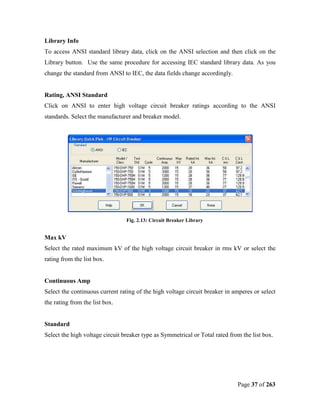
  •   Prepare the protection coordination of an electric design and test it, in the program.


                                                                            Page 212 of 263
Procedure


  1. Search information about relays.

  2. Make a research of breakers.

  3. Find information about fuses.

  4. Understand most of concepts of power system protection.

  5. Learn how to perform a short circuit analysis.

  6. Create a suppliers list.

  7. Understand technical data format of the operation mechanism of relays.

  8. Comprehend operation mechanism of breakers.

  9. Know how work fuses.

  10. Obtain program to work with the protection systems.

  11. Learn how to use the program.

  12. Discover the way to create a database.

  13. Develop a database with the available information.

  14. Create a library with the graphic system of protection equipment.

  15. Perform the mathematic justification of a case study.

  16. Make a drawing of an electrical design.

  17. Perform a short circuit analysis with the computer program.

  18. Realize the protection coordination justification of the design.

  19. Create protection coordination with the computer program.

  20. Prepare tables of coordinate studies.


                                                                    Page 213 of 263
Design Specifications

Improve an existing power system program to make these most efficient. The work will
consist in develop the database of the program and establish protection coordination of any
scheme protection. In addition, it will include a created electrical design to make a short
circuit test to prove it.


Relay Hardware
The relay hardware for electronic relays consists of both analog and digital devices. The
input signals are analog and require, at very minimum, a conversion to digital form.
Therefore, the relays design is often a mixture of analog electronic devices and digital
hardware. The relays may also contain transformers or other components that are also
found in electromagnetic and electromechanical protective devices.


Induction relays are available in many variations to provide accurate pickup and time-
current responses for a wide range of simple or complex system conditions. Induction
relays are basically induction motors. The moving element, or rotor, is usually a metal disk,
although it sometimes may be a metal cylinder or cup. Electronic relays require less power
to operate than their mechanical equivalents, producing a smaller load burden on the CT’s
and PT’s that supply them. The most frequently used relay is the over current relay,
combining both instantaneous and inverse-time tripping functions.


                                                                            Page 214 of 263
Over current Relays


                                  Fig. 6.1: Protective Devices

Protective Devices
The protective system device usually consists of several elements that are arranged to test
the system condition, make decision regarding the normally of observed variables, and take
action as required. Over current time unit have characteristics such that its operation time
vary inversely with the current flow in the relay. These characteristics are available
generally in three types of curves, Inverse, Very Inverse, and Extremely Inverse.


Other protective device is fuses. Fuses are designed for many different applications and
with variety of characteristics to meet the requirements both routine and special situations.
Fuses have different curves to realize these requirements. The minimum melting curve is an
average melting time measured in low voltage test where arcing does not occur. Other
curve is total clearing curve should be used in coordinating against the minimum melting
characteristics of a larger fuse, located toward the power source. Distribution fuses links are
given voltage ratings of 7.2, 14.4, and 17 KV nominal, or 7.8, 15, and 18 KV maximum for
use in open-link cutouts.


                                                                              Page 215 of 263
Computer Engineering
The Power-flow computer program is the basic tool for investigating power system
operation requirement. Power-flow programs compute the voltage magnitudes, phase
angles, and transmission- line power flows for a network under steady-state operating
conditions. The computers have sufficient networks for more than 200 buses and 2500
transmission lines. Short circuit programs are used to compute three-phase and line-to-
ground faults in power- systems network in order to select circuit breakers for fault
interruption, select relays that detect faults and control circuit breakers and determine the
relay settings. Short-circuit currents are computed for each relay and circuit breaker
location, and for various system-operation conditions such as lines or generating units out
of service, in order to determine minimum and maximum fault currents.


ETAP Program
ETAP seamlessly integrates the analysis of power control circuits within one electrical
analysis program. The control system diagram simulates the sequence of the operation
control devices such as solenoids, relays, controlled contacts multi-sequence contacts and
actuators including inrush conditions. The control system diagram has the capability of
determine pick-up and dropout voltage, losses and current flows at any time instance as
well as overall margin and critical alerts. A large library of equipment enables engineers to
quickly model and simulate the action of relays associate with the control interlocks after
given time delays.


                                                                            Page 216 of 263
Work Schedule


                Page 217 of 263
Page 218 of 263
Page 219 of 263
Budget
Table A. Materials required developing the data base

      Amount                 Description               Price p/u               Total
        1                      Laptop                   $800.00               $800.00
        1                   ETAP software              $4000.00              $4000.00
        1                     Logbook                   $23.00                $23.00
                                                         Total               $4823.00

                         Fig. 6.2: Budget to Complete Design

Table B. Professional Service Cost

  Job Title     Number of        Salary per      Weekly            Monthly       6 Month
                Employers          Hour          Hours              Hours         Salary
Research &
Development          3               $15.00           15             60           $16,200
   Team

                               Fig. 6.3: Salary Cap


                                                                             Page 220 of 263
References

  •   [Online]. Available:
      http://en.wikipedia.org/wiki/Protection_and_monitoring_of_the_electrical_energy_t
      ransmission_networks
  •   [Online]. Available: http://www.history.com/encyclopedia.do?articleId=208367
  •   [Online]. Available:
      http://www.eia.doe.gov/kids/history/timelines/electricity.html
  •   [Online]. Available: http://www.answers.com/topic/short-circuit?cat=technology
  •   General Electric: (www.ge.com/products_services/electrical_distribution.html).
  •   ABB: (http://www.abb.com/ProductGuide/Alphabetical.aspx)
  •   Cutler Hammer:
      (http://www.eaton.com/EatonCom/Markets/Electrical/Products/SwitchingDevicesan
      dDisconnects/EnclosedCircuitBreakers/index.htm)
  •   Siemens: (http://w1.siemens.com/en/us/entry.html)
  •   Square D:
      (http://www.squared.com/us/squared/corporate_info.nsf/unid/ECA90110AB7098C
      A85256A3A007091D7/$file/productsa2zFrameset.htm)


                                                                       Page 221 of 263
Progress Report


                  Page 222 of 263
Page 223 of 263
Page 224 of 263
Page 225 of 263
Page 226 of 263
Page 227 of 263
Page 228 of 263
Page 229 of 263
Page 230 of 263
Page 231 of 263
Page 232 of 263
Page 233 of 263
Page 234 of 263
Page 235 of 263
Page 236 of 263
Page 237 of 263
Page 238 of 263
Page 239 of 263
Page 240 of 263
Work Schedule


                Page 241 of 263
Page 242 of 263
Page 243 of 263
Page 244 of 263
Page 245 of 263
Appendix


           Page 246 of 263
Tables and Curves


                    Page 247 of 263
Fig. A.1: NEC Fuse Table


Our design was performed considering NEC requirements.


                                                         Page 248 of 263
Relays Setting Calculations:

Multiple Curve:


                         Fig. A.2: Relay Extremely Inverse Curve


                                                                   Page 249 of 263
Fig. A.3: Relay 300G Curves


                              Page 250 of 263
Fig. A.4: Connection Diagrams


                                Page 251 of 263
Protection Relay Settings for
         Generators


                        Page 252 of 263
VII. Protection Relay Settings for the Generators
The generator relay coordination and setting were selected following the IEEE Tutorial on
the Protection of Synchronous Generators. The selected relay settings are for the generator
capacity available for the loads.
For the maximum three phase fault cases the coordination relay setting selected is
approximated 24 cycles as a backup protection. Also there is an instantaneous overcurrent
protection adjusted to the maximum short circuit available at the generators bus. For a
ground fault the coordination relays has the approximated 24 cycles between as a backup
protection. The instantaneous over current protection adjusted to the maximum short circuit
at the generator bus.


                         Protective Relay settings for generators
                                     1. Generator 1
                                     2. Generator 2


                                                                          Page 253 of 263
IEEE Tutorial on the Protection of Synchronous Generators

Abstracting is permitted with credit to the source. For copying, reprint, or republication
permission, write to the IEEE Copyright Manager, IEEE Operation Center, 445 Hoes Lane,
Piscataway, NJ 08855-1331. All rights reserved. Copyright 1995 by The Institute of
Electrical and Electronics Engineers, Inc.

First Printing July 1995
Second Printing October 1995
Third Printing July 1997
Fourth Printing August 1999

IEEE Catalog Number:                         95TP102
Additional copies of this publication are available from

IEE Operations Center
P. O. Box 1331
455 Hoes Lane
Piscataway, NJ 08855-1331 USA

1-800-701-IEEE
1-732-981-0060
1-732-981-9667 (FAX)
Email: customer.service@ieee.org


                                                                          Page 254 of 263
A.3 General Information


                     Page 255 of 263
Fault Fiter Electronic Power Fuses:


        Fault Fiter® Electronic Power Fuses are a major advancement in
circuit-interruption technology. They integrate state-of-the-art electronics with
an advanced-design high-continuous-current fuse. The electronics provide
current sensing, time-current characteristics, and control power. No remote
relaying or external power is required. Fault Fiter provides unsurpassed high-
speed interruption of fault currents to 40,000 amperes RMS symmetrical. Fault
Fiters are maintenance-free, maintenance-proof.

    Fault Fiter Electronic Power Fuses offer superior coordination with source-side
overcurrent relays and load-side feeder fuses. They offer unmatched high-speed circuit-
interrupting performance without producing excessive voltage surges, and they respond
more quickly to high-current faults than conventional fuses. They're ideal for:

           •   Service-entrance protection and coordination,
           •   Transformer protection
           •   Overdutied device protection.


Fuse Protection


                                   Fig. A.7: Fault Fiter Fuse


                                                                            Page 256 of 263
SMU-40 300E, 30E and SMD-2C 100E
Fuses Specifications:
In accordance with procedures described in ANSI Standard C37.41-1981, minimum
melting time-current characteristic curves for S&C power fuses are based on tests starting
at no initial load. When in service, of course, every fuse will be carrying a load that may
approach or even exceed the ampere rating. This preloading reduces the heat-dissipating
ability of the fusible element, and hence reduces its melting time. This effect has been
minimized in S&C power fuses by designing their fusible elements to melt at current levels
not less than 200% of rating.


                          Fig. A.8: Fuse Units


                                                                          Page 257 of 263
Fault Interruption — SM-20, SML-20, and SMU-40 Power Fuses
Fast, positive fault interruption is achieved in the SMU Fuse Unit through high-speed
elongation of the arc in the solid-material-lined bore, and by the efficient deionizing action
of gases generated through thermal reaction of the solid material due to the heat of the
confined arc. Here's how it works:

       •   Overcurrent melts the silver fusible element. The strain wire severs, initiating
           arcing.
       •   Released force of drive spring accelerates arcing rod upward, causing rapid
           elongation      of    the      arc    in     the     solids-material-lined     bore.
           Under maximum fault conditions, heat from confined arc causes solid material
           in the large-diameter lower section of the arc-extinguishing chamber to undergo
           thermal reaction, generating turbulent gases and effectively enlarging the bore
           diameter so that the arc energy is released with a mild exhaust.
           Under low-to-moderate fault conditions, arc is extinguished in small-diameter
           up-per section of the arc-extinguishing chamber, where deionizing gases are
           effectively concentrated for efficient arc extinction.
       •   Continued upper travel of the arcing rod after arc extinction causes actuating pin
           to penetrate the upper seal, resulting in projection of the brilliant-red blown-fuse
           target from the upper end fitting.


                                                Fig. A.9: SMU-40 Fuse


                                                                              Page 258 of 263
SMD-2C


         Fig. A.10: SMD-2C Fuse Units


                                        Fig. A.11: SMD-2C Fuse


                                                     Page 259 of 263
Protection for Small- and Medium-Sized
              Generator Machines

Applications:                                           Fig. A.12: SEL 300G

   •   Connect the SEL-300G Relay across large generators for complete primary and
       backup protection. Adding the neutral voltage connection provides 100 percent
       stator ground protection for most machines, based on third-harmonic voltage
       measurements. Connecting the neutral current input provides protection for solidly
       grounded or resistance grounded machines.

   •   Apply sensitive percentage-restrained current differential elements and an
       unrestrained element, along with synchronism check and volts-per-hertz elements,
       across the entire unit to protect both the generator and the step-up transformer.

   •   Replace auxiliary meters at the generating station by taking advantage of accurate
       internal metering.

   •   Monitor and record generator utilization with internal hour meters that record
       stopped time, and full load hours.


Connecting Diagram


                   Fig. A.13: SEL 300G Installation


                                                                         Page 260 of 263
SEL-351A
                                                                                   Fig. A.14: SEL 351A
The SEL-351A includes a robust set of phase, negative sequence, residual, and neutral
overcurrent elements. Each element type has six levels of instantaneous protection (four of
these levels have definite-time functions). The relay provides directional control for each of
these overcurrent elements.


Overcurrent Elements for Phase Fault Detection
Phase and negative-sequence overcurrent elements detect phase faults. Negative sequence
current elements ignore three-phase load to provide more sensitive coverage of phase-to-
phase faults. Phase overcurrent elements detect three-phase faults that do not have
significant negativesequence quantities.

Directional Protection for Various System
Grounding Practices
Current channel IN, ordered with the optional 0.2 A secondary nominal rating, provides
directional ground protection for the following systems:
    • Ungrounded systems
    • High-impedance grounded systems
    • Petersen Coil grounded systems
    • Low-impedance grounded systems

Under- and Overfrequency Protection
Six levels of secure under- (81U) or overfrequency (81O) elements detect true frequency
disturbances. Use the independently time-delayed output of these elements to shed load or
trip local generation. Phase undervoltage supervision prevents undesired frequency element
operation during faults.


                                                                          Page 261 of 263
Functional Overview


                Fig. A.15: SEL 351A Overview


                                               Page 262 of 263
ABB vacuum circuit breakers

Ratings

ADVAC is available in the full range of ANSI ratings through
15 kV, with interrupting ratings to 1000 MVA and continuous currents through 3000 A
(self-cooled). The ADVAC series of vacuum circuit breakers is a complete line of ANSI-
rated circuit breakers offering power distribution system customers the advantages of the
latest vacuum circuit breaker technology.

Operating
Mechanism

ADVAC uses a simple, front-accessible stored-energy operating mechanism designed
specifically for use with vacuum technology. This provides the benefits of dependable
vacuum interrupters with advanced contact design and proven reliability, without the
complexity of mechanisms and linkages found in previous generation circuit breakers.

Ratings

 The switchgear shall be rated at (4.76, 8.25, 15) kV maximum continuous voltage, (250,
350, 500, 750, 1000) MVA nominal interrupting capacity, and (1200, 2000, 3000) amps
continuous current, as shown in the “Rating Structure” table (page 40), with required and
related capabilities in accordance with referenced ANSI standards.


             Fig. A.16: ABB Vacuum Circuit Breaker


                                                                         Page 263 of 263

Protective Device Coordination

  • 1.
    PROTECTIVE DEVICE COORDINATION Héctor Rivera
  • 2.
    POYTECHNIC UNIVERSITY OFPUERTO RICO ELECTRICAL ENGINEERING DEPARTMENT HATO REY, PUERTO RICO PROTECTIVE DEVICE COORDINATION GROUP 28 Rivera, Héctor J. Page 2 of 263
  • 3.
    Table of Contents Tableof Pictures ............................................................................................................................. 5 Chapter 1: General Information ...................................................................................................... 8 1.1 Abstracto ..................................................................................................................... 10 1.2 Abstract ....................................................................................................................... 11 1.3 Introduction ................................................................................................................. 12 1.4 Objectives ................................................................................................................... 14 1.5 Constraints .................................................................................................................. 15 Chapter 2: ETAP User Guide ....................................................................................................... 16 2.1 Basic ETAP User Guide ............................................................................................. 18 2.1.1 Creating a new ETAP Project. ............................................................................. 22 2.1.2 Opening an ETAP existing Project. ..................................................................... 23 2.1.3 Building New one-line Diagrams. ....................................................................... 25 2.1.4 Connecting Elements. .......................................................................................... 28 2.1.5 Adding a Protective Device to your One-Line. ................................................... 28 2.1.6 Verify if the element is connected. ...................................................................... 29 2.2 Advance ETAP User Guide ........................................................................................ 30 2.2.1 How to configure the elements in the one-line diagram. ..................................... 34 A) Utility ................................................................................................................. 34 B) High Voltage Circuit Breakers ........................................................................ 36 C) Low Voltage Circuits Breakers ....................................................................... 39 D) Protective Relay ................................................................................................ 44 E) Fuses Ratings .................................................................................................... 49 F) Transformer Properties: .................................................................................. 54 G) Load Properties: ............................................................................................... 57 H) Bus ...................................................................................................................... 58 2.2.2 Perform a Fault Analysis; .................................................................................... 59 Chapter 3: Transformer Case Study.............................................................................................. 61 3.1 Diagrams ..................................................................................................................... 64 3.2 Equipment Data .......................................................................................................... 66 3.3 Calculations ................................................................................................................ 68 3.4 Coordination Using ETAP Program ........................................................................... 73 3.5 Fault Simulation .......................................................................................................... 77 Page 3 of 263
  • 4.
    3.6 Settings andResults .................................................................................................... 81 Chapter 4: Bayamón WWTP Coordination Study........................................................................ 84 4.1 Scope ........................................................................................................................... 88 4.2 Electrical System Oneline Diagram ............................................................................ 90 4.3 Imput Data Report ...................................................................................................... 94 4.4 Calculations ................................................................................................................ 97 4.5 Short Circuit Study ................................................................................................... 138 4.6 Power Fuses Selection for Power Transformers T1, T2, T3, T4, T5, T6 and T7 ..... 160 4.7 Protection Relay Settings for ................................................................................. 173 Distribution Feeders ..................................................................................................... 173 4.8 Relay Settings ........................................................................................................... 178 4.9 Results ....................................................................................................................... 181 Chapter 5: Protective Device Coordination Project Results ....................................................... 186 5.1 Alternatives Considered ............................................................................................ 188 5.2 System Specifications ............................................................................................... 191 Operation .................................................................................................................... 193 Protective relay ........................................................................................................... 193 Distance relay ............................................................................................................ 195 Magazine Article............................................................................................................. 197 5.4 Budget ....................................................................................................................... 198 5.5 Bibliography ............................................................................................................. 199 5.6 Conclusion ................................................................................................................ 201 Chapter 6: Administrative Section .............................................................................................. 202 6.1 Protective Device Coordination Project Proposal..................................................... 205 Work Schedule ............................................................................................................ 217 Progress Report ............................................................................................................... 222 Work Schedule ................................................................................................................ 241 Appendix ..................................................................................................................................... 246 Tables and Curves ........................................................................................................... 247 Protection Relay Settings for Generators ........................................................................ 252 A.3 General Information ................................................................................................. 255 Page 4 of 263
  • 5.
    Table of Pictures Fig.2.1: Create New Project Panel.................................................................................................... 22 Fig. 2.2: User Information Panel ....................................................................................................... 22 Fig. 2.3: Starting up window ............................................................................................................. 23 Fig. 2.4: Open Panel .......................................................................................................................... 24 Fig. 2.5: Selecting Project.................................................................................................................. 24 Fig. 2.6: Mode Toolbar ...................................................................................................................... 25 Fig.2.7: ETAP Elements .................................................................................................................... 27 Fig. 2.8: Connecting Elements .......................................................................................................... 28 Fig. 2.9: Open Panel .......................................................................................................................... 28 Fig. 2.10: Elements not connected..................................................................................................... 29 Fig. 2.11: Power Grid Editor Window .............................................................................................. 34 Fig. 2.12: High Voltage Circuit Breaker Editor Window .................................................................. 36 Fig. 2.13: Circuit Breaker Library ..................................................................................................... 37 Fig. 2.14: Low Voltage Circuit Breaker Window ............................................................................. 39 Fig. 2.15: Low Voltage Circuit Breaker library ................................................................................ 41 Fig. 2.16: Overcurent Relay Editor Window ..................................................................................... 44 Fig. 2.17: Overcurrent Settings Panel ................................................................................................ 45 Fig. 2.18: Instantaneus Settings Panel ............................................................................................... 46 Fig. 2.19: Fuse Editor Window ......................................................................................................... 49 Fig. 2.20: Fuse Library Window ....................................................................................................... 51 Fig. 2.21: Winding Transformer Editor Window .............................................................................. 54 Fig. 2.22: Transformer Rating Editor Window ................................................................................. 55 Fig. 2.23: Transformer Tap Editor Window ...................................................................................... 56 Fig. 2.24: Lumped Load Editor Window........................................................................................... 57 Fig. 2.25: Bus Editor Window ........................................................................................................... 58 Fig. 2.26: Fault Simulation ................................................................................................................ 59 Fig. 2.27: Select Sequence Viewer to find fault analysis results ....................................................... 60 Fig. 2.28: Results Window ................................................................................................................ 60 Fig. 3.1: Transformer Protection Diagram……………………………………………………....... 65 Fig. 3.2: Selected Fuse…………………………………………………………………………….. 67 Fig. 3.3: Selected Relay…………………………………………………………………………… 67 Fig. 3.4: Table of Current Transformer Specifications…………………………………………… 67 Fig. 3.5: Table of Power Fuse Rating……………………………………………………………... 71 Fig. 3.6: Overcurrent Relay Settings at Transformer……………………………………………... 74 Fig. 3.7: Overcurrent Relay Settings at Load 1,2…………………………………………………. 75 Fig. 3.8: Fuse Settings…………………………………………………………………………….. 76 Fig. 3.9: ETAP Simulation of Fault at Bus 1……………………………………………………… 78 Fig. 3.10: Sequence of Operation Events at Bus 1………………………………………………... 78 Fig. 3.11: ETAP Fault Simulation at Bus 2……………………………………………………….. 79 Fig. 3.12: Sequence of Operation Events at Bus 2………………………………………………... 79 Fig. 3.13: ETAP Fault Simulation at Load 1……………………………………………………… 80 Fig. 3.14: Sequence of Operation Events at Load 1………………………………………………. 80 Fig. 3.15: Relay and Fuse Settings………………………………………………………………... 83 Fig. 3.16: Results of Short Circuit Analysis………………………………………………………. 83 Fig. 4.1: Power Transformer Characteristics Table……………………………………………….. 89 Fig. 4.2: Generator Characteristics Table…………………………………………………………. 89 Fig. 4.3: Original Oneline Diagram of Bayamón WWTP………………………………………… 92 Fig. 4.4: Suggested Oneline Diagram of Bayamón WWTP………………………………………. 93 Fig. 4.5: Lines Cables……………………………………………………………………………... 95 Page 5 of 263
  • 6.
    Fig. 4.6: ExistingTransformer Line Cable. …………………………………………………….... 95 Fig. 4.7: Generator Cables………………………………………………………………………… 95 Fig. 4.8: Positive Sequence impedance Diagram at Bus 1……………………………………....... 99 Fig. 4.9: Three Phase Fault at Bus 1…………………………………………………………… 102 Fig. 4.10: Positive Sequence Impedance Diagram at Bus 2…………………………………… 103 Fig. 4.11: Three Phase Fault at Bus 2 …………………………………………………………… 104 Fig. 4.12: Positive Sequence Impedance Diagram at Load 1……………………………………. 105 Fig. 4.13: Three Phase Fault at Load 1…………………………………………………………... 106 Fig. 4.14: Positive Impedance Diagram at Load 5………………………………………………. 107 Fig. 4.15: Three Phase Fault at Load 6…………………………………………………………... 108 Fig. 4.16: Positive Sequence Impedance Diagram at Bus 1 for a Line to Ground Fault………... 109 Fig. 4.17: Cero Sequence Impedance Diagram at Bus 1……………………………………........ 109 Fig. 4.18: Line to Ground Fault at Bus 1………………………………………………………… 110 Fig. 4.19: Positive Sequence Impedance Diagram at Bus 2 for a Line to Ground Fault………... 111 Fig. 4.20: Cero Sequence Impedance Diagram at Bus 2………………………………………… 111 Fig. 4.21: Line to Ground Fault at Bus 2………………………………………………………… 112 Fig. 4.22: Positive Sequence Impedance Diagram at Load 1 for a Line to Ground Fault………. 113 Fig. 4.23: Cero Sequence Impedance Diagram at Load 1……………………………………….. 113 Fig. 4.24: Line to Ground Fault at Load 1……………………………………………………….. 114 Fig. 4.25: Positive Sequence Impedance Diagram at Load 5 for a Line to Ground Fault………. 115 Fig. 4.26: Cero Sequence Impedance Diagram at Load 5……………………………………….. 115 Fig. 4.27: Line to Ground Fault. At Load 5……………………………………………………... 116 Fig. 4.28: Positive Sequence Impedance Diagram at Generator Bus……………………………. 117 Fig. 4.29: Positive Sequence Impedance Diagram at Bus 2 using Generators………………….. 118 Fig. 4.30: Positive Sequence Impedance Diagram at Load 1 using Generators………………… 119 Fig. 4.31: Positive Sequence Impedance Diagram at Load 5 using Generators………………… 120 Fig. 4.32: Positive Sequence Impedance Diagram at Generators Bus for a Line to Ground Fault. 121 Fig. 4.33: Cero Sequence Impedance Diagram at Generators Bus………………………………. 121 Fig. 4.34: Positive Sequence Impedance Diagram at Bus 2 Using Generators for a Line to Ground Fault……………………………………………………………………………………………… 122 Fig. 4.35: Cero Sequence Impedance Diagram at Bus 2 Using Generators……………………... 123 Fig. 4.36: Positive Sequence Impedance Diagram at Load 1 Using Generators for a Line to Ground Fault……………………………………………………………………………………………… 124 Fig. 4.37: Cero Sequence Impedance Diagram at Load 1 Using Generators……………………. 124 Fig. 4.38: Positive Sequence Impedance Diagram at Load 5 Using Generators for a Line to Ground Fault……………………………………………………………………………………………… 125 Fig. 4.39: Cero Sequence Impedance Diagram at Load 5 Using Generators……………………. 125 Fig. 4.40: Fault Simulation at Primary Side of 38KV/4.16KV Utility Transformer of BWWTP. 140 Fig. 4.41: Sequence of Operations Events at Primary Side of T1……………………………….. 141 Fig. 4.42: Fault Simulation at Bus 1 of BWWTP………………………………………………... 144 Fig. 4.43: Sequence of Operation Events at Bus 1………………………………………………. 145 Fig. 4.44: Fault Simulation at Bus 2 of BWWTP………………………………………………... 148 Fig. 4.45: Sequence of Operation Events at Bus 2………………………………………………. 149 Fig. 4.46: Fault Simulation at Load 1 of BWWTP……………………………………………… 152 Fig. 4.47: Sequence of Operations Events at Load 1……………………………………………. 153 Fig. 4.48: Fault Simulation at Load 6 of BWWTP……………………………………………… 156 Fig. 4.49: Sequence of Operation Events at Load 6……………………………………………... 157 Fig. 4.50: Recommendations to Fuse Protection………………………………………………… 161 Fig. 4.51: Time Fuse 1 and 5 Coordination……………………………………………………… 162 Fig. 4.52: Characteristics Curves for Fuse 1 and 5……………………………………………… 163 Fig. 4.53: Fuse 1 and 5 recommended…………………………………………………………… 164 Page 6 of 263
  • 7.
    Fig. 4.54: TimeFuse 2 and 6 Coordination……………………………………………………… 165 Fig. 4.55: Characteristics Curves for fuse 2 and 6………………………………………………. 166 Fig. 4.56: Fuse 2 and 6 Recommended………………………………………………………….. 166 Fig. 4.57: Time Fuse 3, 4, 7 and 8 Coordination………………………………………………… 167 Fig. 4.58: Characteristics Curves for fuses 3, 4, 7 and 8………………………………………… 168 Fig. 4.59: Fuse 3, 4, 7 and 8 Recommended……………………………………………….......... 169 Fig. 4.60: Time Fuse 9 Coordination……………………………………………………………. 170 Fig. 4.61: Characteristics Curves for fuse 9……………………………………………………... 171 Fig. 4.62: Fuse 9 Recommended………………………………………………………………… 172 Fig. 4.63: Relay 351A Settings…………………………………………………………………... 179 Fig. 4.64: Overcurent Relay Settings for Generator……………………………………………... 180 Fig. 4.65: Undervoltage, Overvoltage, Frequency of Power Relay for Generator………………. 180 Fig. 4.66: Three Phase Fault Results…………………………………………………………….. 183 Fig. 4.67: Line to Ground Fault Results…………………………………………………………. 184 Fig. 4.68: Three Phase Fault Results Using Generators…………………………………………. 185 Fig. 4.69: Line to Ground Fault Results Using Generators…………………………………........ 185 Fig. 6.1: Protective Devices……………………………………………………………... 213 Fig. 6.2: Budget to Complete Design……………………………………………………. 218 Fig. 6.3: Salary Cap……………………………………………………………………… 218 Page 7 of 263
  • 8.
    Chapter 1: GeneralInformation Page 8 of 263
  • 9.
    Contents 1.1 Abstracto……………………………………………………………………………... 10 1.2Abstract………………………………………………………………………………. 11 1.3 Introduction…………………………………………………………………………... 12 1.4 Objectives…………………………………………………………………………….. 14 1.5 Constraints…………………………………………………………………………..... 15 Page 9 of 263
  • 10.
    1.1 Abstracto La protección de los sistemas de potencia es uno de los campos más importantes dentro del área de potencia en la ingeniería eléctrica. A través del tiempo se han creado muchísimos programas de computadora con el fin de analizar diseños eléctricos. Nuestro proyecto consiste en preparar una guía de usuario fácil de entender acerca de un programa existente, llamado ETAP, diseñado para realizar análisis de protección de sistemas de potencia. Esta guía de usuario debe incluir como crear un diagrama monolineal, como configurar los equipos de protección, y también la forma correcta de hacer un análisis de fallas y de corto circuito. Finalmente, nosotros preparamos una guía de usuario avanzada con explicaciones detalladas sobre aplicaciones especiales y conceptos técnicos manejados en el programa ETAP. También, como requisito de nuestro proyecto se analiza un caso estudio de un sistema de potencia y se realiza la coordinación de protección del mismo. Page 10 of 263
  • 11.
    1.2 Abstract Power Protection is one of the most important fields in Power Electrical Engineering. Through time many software’s has been created to analyze electrical designs. Our project consist of prepare a user guide easy to understand of how to use an existing power protection analysis program calling ETAP. This user guide must include how to create a one-line diagram, how to configure power system devises, and an explanation of the right way to perform a short and fault analysis. Finally, we prepare an advance user guide with detailed explanations of special features and technical concept of ETAP program. Also, as a requirement of our project, we analyzed a case study of power system and perform the protective device coordination of it. Page 11 of 263
  • 12.
    1.3 Introduction Electricity has been a subject of scientific interest since at least the early 17th century. Probably the first electrical engineer was William Gilbert who designed the versorium: a device that detected the presence of statically charged objects. He was also the first to draw a clear distinction between magnetism and static electricity and is credited with establishing the term electricity. However it was not until the 19th century that research into the subject started to intensify. Notable developments in this century include the work of Georg Ohm, who in 1827 quantified the relationship between the electric current and potential difference in a conductor, Michael Faraday, the discoverer of electromagnetic induction in 1831, and James Clerk Maxwell, who in 1873 published a unified theory of electricity and magnetism in his treatise on Electricity and Magnetism. They are the fathers of electrical engineering and the electric systems. Today, power system protection is that part of electrical power engineering that deals with protecting the electrical power system from faults by isolating the faulted part from the rest of the network. Any electric power system involves a large amount of auxiliary equipment for the protection of generators, transformers, and the transmission lines. Circuit breakers are employed to protect all elements of a power system from short circuits and overloads, and for normal switching operations. The principle of a protection scheme is to keep the power system stable by isolating only the components that are under fault, even as leaving as much of the network as possible still in operation. Thus, protection schemes must apply a very pragmatic and pessimistic approach to clearing system faults. For this reason, the technology and philosophies utilized in protection schemes are often old and well-established because they must be very reliable. In much the same way as the early computers of the 1950s and 1960s were a precursor to the computational capabilities of today’s computers. Specialized hardwire systems were developed for locally monitoring the operation of power plants and for remotely monitoring and controlling switches in transmission substation. The Remote Terminal Units of these early monitoring systems were implemented with relay logic, while Page 12 of 263
  • 13.
    the master stationconsisted primarily of large banks of annunciator panels with red and green light indication the state of the points being monitored with flashing light indication a change in state or an alarm condition. The impact of computers has nowhere been more revolutionary than in electrical engineering. The design, analysis and operation of electrical and electronic systems has become completely dominated by computers, a transformation that has been motivated by the natural ease of interface between computers and electrical systems, and the promise of spectacular improvements in speed and efficiency. Our project consists of develop a protective device coordination using a graphical software program to add features and flexibility in the area of electrical system protection. Also, this graphical software program it’s going to be using for all kind of element that used these. We will select the software program, analyze all types of element protection that are utilizing in electrical systems, and simulate the program using various management studies. Page 13 of 263
  • 14.
    1.4 Objectives • To make a research about technical references of fuses, relays and breakers. • Understand technical data format of protection devices. • To learn how to use the protective device coordination program. • Create a user guide easy to understand about how to use software program. • Build an advance use guide to explain additional features of software program. • Perform a case study with the software program. • Establish the system coordination of a case study with the program. Page 14 of 263
  • 15.
    1.5 Constraints • How to install ETAP program. • Ways to use library of ETAP program. Start by understanding. • Interpret results in the program. • Establish coordination of a protection system. • Run the program with all kind of requisites. • Find right protective devices for design coordination. • Understand how to program protective devices settings of equipments to use. Page 15 of 263
  • 16.
    Chapter 2: ETAPUser Guide Page 16 of 263
  • 17.
    Contents Basic ETAP UserGuide………………………………………………………………………... 18 Creating a new ETAP Project………………………………………………………………….. 22 Opening an ETAP existing Project..……… ………………………………………… 23 Building New one-line Diagram. ……………………………………………………... 25 Connecting Elements……………………………………………………………… 28 Adding Protective Device to your One-Line………………………………………. 28 Verify if the element is connected………………………………………………… 29 Advance ETAP User Guide…..…………………………………………………………... 30 How to configure the elements in the one-line diagram…………………………… 34 Utility……………………………………………………………………… 34 High Voltage Circuit Breakers……………………………………………... 36 Low Voltage Circuit Breaker………………………………………………. 39 Protective Relay……………………………………………………………. 44 Fuses Ratings………………………………………………………………. 49 Transformer Properties………………………………………………..……. 54 Load Properties…………………………………………………………….. 57 Bus…………………………………………………………………………. 58 Perform a Fault Analysis…………………………………………………………... 59 Page 17 of 263
  • 18.
    2.1 Basic ETAPUser Guide Page 18 of 263
  • 19.
  • 20.
    Contents Creating a newETAP Project. ...................................................................................................... 22 Opening an ETAP existing Project. .............................................................................................. 23 Building New one-line Diagrams. ................................................................................................ 25 Connecting Elements. ................................................................................................................... 28 Adding a Protective Device to your One-Line. ............................................................................ 28 Verify if the element is connected. ............................................................................................... 29 Page 20 of 263
  • 21.
    Table of Figure Fig.2.1: Create New Project Panel .................................................................................................... 22 Fig. 2.2: User Information Panel ....................................................................................................... 22 Fig. 2.3: Starting up window ............................................................................................................. 23 Fig. 2.4: Open Panel .......................................................................................................................... 24 Fig. 2.5: Selecting Project.................................................................................................................. 24 Fig. 2.6: Mode Toolbar ...................................................................................................................... 25 Fig.2.7: ETAP Elements .................................................................................................................... 27 Fig. 2.8: Connecting Elements .......................................................................................................... 28 Fig. 2.9: Open Panel .......................................................................................................................... 28 Fig. 2.10: Elements not connected..................................................................................................... 29 Page 21 of 263
  • 22.
    2.1.1 Creating anew ETAP Project. Open the program and select new project. Write the name of the new project and select ok. Fig. 2.1: Create New Project Panel Write the name of the project user and select the access level permissions. Fig. 2.2: User Information Panel Page 22 of 263
  • 23.
    2.1.2 Opening anETAP existing Project. Select open on the ETAP screen. Fig. 2.3: Starting up window To open an existing project must be selected the icon showed. Click the icon and select the project that you want to run in program. Page 23 of 263
  • 24.
    For example, selectdocument named Protection System Devices and wait until in the next page appears (Fig. 2.5) Fig. 2.4: Open Panel Select icon that has the ETAP symbols. Then click open to see the project at ETAP main window. Fig. 2.5: Selecting Project Page 24 of 263
  • 25.
    2.1.3 Building Newone-line Diagrams. To build or edit a one-line diagram in ETAP, you must be in Edit Mode. Click the Edit button on the Mode toolbar. Fig. 2.6: Mode Toolbar AC Elements: = Pointer = Bus = 2 winding transformers = 3 winding transformers = cable = Transmission Line = Reactors, Current-Limiting = Impedance = Power grid = Generator = Wind turbine Generator = Induction Machine = Synchronous Motor = Lumped Load = MOV = Static Load = Capacitor = Harmonic Filter = Remote Connector = Static Var Compensator = HV DC Transmission Link = AC Composite Motor = Composite Network = Fuse = Contactor = High Voltage Circuit Breaker = Low Voltage circuit Breaker = Single Throw Switch = Double Throw Switch = Instrumentation = Ground Grid = Display options Page 25 of 263
  • 26.
    = Schedule Report Manager = Current Transformer (CT) = Potential Transformer (PT) = Voltmeter = Ammeter = Multi-meter = Voltage Relay = Reverse Power Relay = Frequency Relay = MV solid State Trip Relay = Motor Relay = Overcurrent Relay = Overload Heater = Multi-Function Relay = Tag Link DC Elements: = Pointer = Bus = DC Cable = DC Impedance = DC-DC Converter = Battery = DC Motor = DC static Load = DC Lumped Load = Composite CSD = DC Composite Motor = Composite Network = DC Circuit Breaker = DC Fuse = DC Single Throw Switch = DC Double Throw Switch = Un-Interrupted Power System = Variable Frequency Drive = Charger = Inverter Page 26 of 263
  • 27.
    You can selectthe element that your project requires for run the short circuit analysis. In the columns you can see all the elements that ETAP program has. Select the elements and drop to the board to complete your diagram. Fig.2.7: ETAP Elements Page 27 of 263
  • 28.
    2.1.4 Connecting Elements. Toconnect the elements in the one-line. Use the mouse pointer over the connection pin of an element, and it will turn red. Then click and drag to the connection pin of another element. Follow this procedure to connect all the elements on the one-line. In the case of buses, the entire element graphic functions as a connection point. Fig. 2.8: Connecting Elements 2.1.5 Adding a Protective Device to your One-Line. To connect the element between two elements does not require delete the line connecting the elements. The element will automatically connect to the line. As shown in the diagram. Fig. 2.9: Open Panel Page 28 of 263
  • 29.
    2.1.6 Verify ifthe element is connected. To check if an element is energized click on the continuity icon ( ) located in the project toolbar. All elements that are not energized will be grayed out. For example, with the continuity check on, open CB4. As shown in the figure to the right, CB4 and elements downstream are grayed out. Fig. 2.10: Elements not connected Page 29 of 263
  • 30.
    2.2 Advance ETAPUser Guide Page 30 of 263
  • 31.
  • 32.
    Contents How to configurethe elements in the one-line diagram. .............................................................. 34 A) Utility ............................................................................................................................. 34 B) High Voltage Circuit Breakers ....................................................................................... 36 C) Low Voltage Circuits Breakers ...................................................................................... 39 D) Protective Relay ............................................................................................................... 44 E) Fuses Ratings .................................................................................................................... 49 F) Transformer Properties: ................................................................................................. 54 G) Load Properties: .............................................................................................................. 57 H) Bus ..................................................................................................................................... 58 Perform a Fault Analysis; ............................................................................................................. 59 Page 32 of 263
  • 33.
    Table of Figures Fig.2.11: Power Grid Editor Window .............................................................................................. 34 Fig. 2.12: High Voltage Circuit Breaker Editor Window .................................................................. 36 Fig. 2.13: Circuit Breaker Library ..................................................................................................... 37 Fig. 2.14: Low Voltage Circuit Breaker Window ............................................................................. 39 Fig. 2.15: Low Voltage Circuit Breaker library ................................................................................ 41 Fig. 2.16: Overcurent Relay Editor Window ..................................................................................... 44 Fig. 2.17: Overcurrent Settings Panel ................................................................................................ 45 Fig. 2.18: Instantaneus Settings Panel ............................................................................................... 46 Fig. 2.19: Fuse Editor Window ......................................................................................................... 49 Fig. 2.20: Fuse Library Window ....................................................................................................... 51 Fig. 2.21: Winding Transformer Editor Window .............................................................................. 54 Fig. 2.22: Transformer Rating Editor Window ................................................................................. 55 Fig. 2.23: Transformer Tap Editor Window ...................................................................................... 56 Fig. 2.24: Lumped Load Editor Window........................................................................................... 57 Fig. 2.25: Bus Editor Window ........................................................................................................... 58 Fig. 2.26: Fault Simulation ................................................................................................................ 59 Fig. 2.27: Select Sequence Viewer to find fault analysis results ....................................................... 60 Fig. 2.28: Results Window ................................................................................................................ 60 Page 33 of 263
  • 34.
    2.2.1 How toconfigure the elements in the one-line diagram. A) Utility Rated kV Enter the rated voltage of the power grid in kilovolts (kV). Fig. 2.11: Power Grid Editor Window Generation Categories This group is used to assign the different power settings to each of the ten generation categories for this power grid. Each grid can be set to have a different operating power level for each generation category. Depending on the operation mode, some of the values become editable as follows: • Swing Mode: %V and angle • Voltage Control Mode: %V and MW • Mvar Control: MW and Mvar • Power Factor Control: MW and PF Page 34 of 263
  • 35.
    SC Rating MVAsc Specifythe short-circuit MVA for three-phase and single-phase (line-to-ground) faults. As you enter or modify MVAsc or X/R, ETAP recalculates the corresponding short-circuit impedance values. Page 35 of 263
  • 36.
    B) High VoltageCircuit Breakers How to change the Rating • Click on either the ANSI or IEC option button to select that standard. Fig. 2.12: High Voltage Circuit Breaker Editor Window Page 36 of 263
  • 37.
    Library Info To accessANSI standard library data, click on the ANSI selection and then click on the Library button. Use the same procedure for accessing IEC standard library data. As you change the standard from ANSI to IEC, the data fields change accordingly. Rating, ANSI Standard Click on ANSI to enter high voltage circuit breaker ratings according to the ANSI standards. Select the manufacturer and breaker model. Fig. 2.13: Circuit Breaker Library Max kV Select the rated maximum kV of the high voltage circuit breaker in rms kV or select the rating from the list box. Continuous Amp Select the continuous current rating of the high voltage circuit breaker in amperes or select the rating from the list box. Standard Select the high voltage circuit breaker type as Symmetrical or Total rated from the list box. Page 37 of 263
  • 38.
    Cycle Select the ratedinterrupting time for AC high voltage circuit breakers in cycles from the list box. CB Cycle Description 2 2-cycle ac high voltage circuit breakers with 1.5-cycle Minimum Contact Parting Time 3 3-cycle ac high voltage circuit breakers with 2-cycle Minimum Contact Parting Time 5 5-cycle ac high voltage circuit breakers with 3-cycle Minimum Contact Parting Time 8 8-cycle ac high voltage circuit breakers with 4-cycle Minimum Contact Parting Time Rated Interrupting Enter the rated short-circuit current (rated interrupting capability) at the rated maximum kV in rms kA or select the rating from the list box. Maximum Interrupting Enter the maximum symmetrical interrupting capability in rms kA or select the rating from the list box. C & L RMS Enter the closing and latching capability of the high voltage circuit breaker in asymmetrical rms kA. This value is equal to 1.6 times the maximum interrupting capability. C & L Crest Enter the closing and latching capability of the high voltage circuit breaker in crest kA. This value is equal to 2.7 times the maximum interrupting capability. Page 38 of 263
  • 39.
    C) Low VoltageCircuits Breakers Standard Click on either the ANSI or IEC option button to select that standard. Note: once the breaker is selected from the breaker Library Quick Pick the standard is set based on the library entry and is display only. Type Select a type from the drop-down list and display the type of breaker. Low voltage circuit breakers include Molded Case, Power, and Insulated Case breakers. Once the breaker is selected from the breaker Library Quick Pick, the LVCB type is set based on the library entry and is display only. Fig. 2.14: Low Voltage Circuit Breaker Window Page 39 of 263
  • 40.
    CB and TripDevice library The low voltage circuit breaker data for a selected standard and type can be selected by clicking on the Library button. Standard Click on either the ANSI or IEC option to select that standard. Note that the Standard selection in the breaker library Quick Pick (and hence the breaker models displayed) will be defaulted to the selection. AC/DC Displays that the LV breaker is AC. This option is grayed out and is not available for editing. Type Select from the drop down list and display the breaker type. The LV breaker types include Molded Case, Power and Insulated Case breakers. Note that the Type selection in the breaker library Quick Pick (and hence the breaker models displayed) will be defaulted to the selection made for the breaker type on the Rating page. The breaker type selection can be changed on the Quick Pick if desired. Page 40 of 263
  • 41.
    Manufacturer Name This displaysa list of all AC LV breaker manufacturers included in the library for the selected breaker standard and type. To choose one, just select the manufacturer name. Fig. 2.15: Low Voltage Circuit Breaker library Reference This displays the Manufacturer reference, if available. For example, Westinghouse is the reference for Cutler Hammer. Page 41 of 263
  • 42.
    Model Name The Modelsection displays list of all models for the selected standard, breaker type and breaker manufacturer. The models are displayed in the form of Model – Max kV – Pole, which forms a unique record name in the breaker library. Select the Model – Max kV – Pole by highlighting it. ANSI Short-Circuit data When ANSI standard is selected, the short-circuit data shows the applied voltage in kV, short-circuit interrupting current for the applied voltage in kA, and test power factor in %, for all breaker types. The short-circuit parameters are explained in more detail in the Ratings section. Select a desired applied voltage and short-circuit data by highlighting it. Size This displays a list of all sizes available for the selected Model, Max. kV, and Pole record for the breaker. To select a size from the Library Quick Pick, highlight the size. Ratings, ANSI Standard Click on ANSI standard button and choose the breaker type to enter the ratings for LV circuit breaker in accordance with the ANSI/IEEE standards. When a breaker is selected from Library Quick Pick, all parameters shown below will be set to their corresponding values chosen from the Quick Pick. With the exception of Size, changing the values after selecting a breaker from Library Quick Pick will turn the header blue to indicate that the substituted library data has been modified. Size Select an item from the drop-down list to display the size in amperes for the selected breaker. Page 42 of 263
  • 43.
    Continuous Amp Select anitem from the drop-down list or enter the continuous current rating for the low voltage circuit breaker in amperes. The Continuous Amp value will be set equal to the breaker size when a breaker is selected from the breaker Library Quick Pick. Rated kV Select an item from the drop-down list or enter the rated kV rating for the low voltage circuit breaker in kV. When a breaker is selected, the rated kV value will be set equal to the applied kV selected from Library. Test PF This is the power factor of test equipment on which the rating of the circuit breaker has been established. When a breaker is selected, the Test PF is set to the Test PF value selected from Library. Fused For all breaker types, select fused or unfused by clicking on the provided selection box. Note that when a breaker is selected from library, the Fused checkbox is set to the status as selected from the Quick Pick. The value of Test PF will change appropriately for fused or unfused type, in case of Power breakers. Interrupting kA Select from drop down list or enter the Interrupting kA rating for the low voltage circuit breaker in kA. Note that when a breaker is selected, the interrupting kA value will be set equal to the kA value for selected applied kV from library Quick Pick. Page 43 of 263
  • 44.
    D) Protective Relay Fig. 2.16: Overcurent Relay Editor Window Library To access the Overcurrent relay library data, click on the Library button. Clicking the Library button displays the relay library Quick Pick. From the Library, select the relay by highlighting the Manufacturer name and Model name. Then click on the OK button to retrieve the selected data from the library and transfer it to the editor. OC level Overcurrent relays can have multiple Time overcurrent (TOC) and/or Instantaneous overcurrent (IOC) elements that can simultaneously and independently set in the relay library. The OC level displays a drop down list of the maximum number of overcurrent levels that are available for the selected relay. Page 44 of 263
  • 45.
    Overcurrent (51) Settings TheTime overcurrent settings available for Phase, Neutral, Ground, Sensitive Ground and Negative Sequence are described below. Fig. 2.17: Overcurrent Settings Panel Pickup Range Select from drop down list and display the Time overcurrent Pickup range for the selected curve. The pickup range can be specified in amperes of the secondary or primary current rating. It can also be in multiples/percent of the CT secondary. Pickup Setting For the selected pickup range, select or enter the Time overcurrent pickup setting. The pickup setting can be discrete values or continuously adjustable. Relay Amps This field displays the relay secondary current in amperes, for the selected pickup setting. Prim. Amps This field displays the relay primary current in amperes, for the selected pickup setting. Page 45 of 263
  • 46.
    Time Dial Select anddisplay the Time Dial for the selected curve type. The time dial can be discrete values or continuously adjustable. Instantaneous (50) Settings The Instantaneous settings available for Phase, Neutral, Ground, Sensitive Ground and Negative Sequence are described below. Fig. 2.18: Instantaneus Settings Panel Page 46 of 263
  • 47.
    Curve Type This fieldwith a drop down list of curves is available only if the selected relay has Short time feature and if the Short time is selected. Select from the drop down list and display the Short time curve type for the selected model. Pickup Range Select from the drop down list and display the Instantaneous Pickup range (for the selected curve in case of Short time). The pickup range can be specified in amperes of the secondary or primary current rating. It can also be in multiples/percent of the CT secondary or 51 pickup. Pickup Setting For the selected pickup range, select or enter the Instantaneous pickup setting. The pickup setting can be discrete values or continuously adjustable. Relay Amps This field displays the relay secondary current in amperes, for the selected pickup setting. Prim. Amps This field displays the relay primary current in amperes, for the selected pickup setting. Delay Range This field is available only if the relay has Instantaneous function. Select from the drop down list and display the Instantaneous Delay range. The delay range could either be in seconds or cycles. Delay Select or enter the intentional delay for the instantaneous. The Delay can be in seconds or cycles, depending on the selection of relay. The delay can be in the form of discrete values or continuously adjustable. Page 47 of 263
  • 48.
    Time Dial This fieldis available only if the selected relay has Short time feature and if the Short time is selected. Select or enter the Time Dial for the selected curve type. The time dial can be discrete values or continuously adjustable. Page 48 of 263
  • 49.
    E) Fuses Ratings Standard Clickeither the ANSI or IEC button option to select that standard. Once the fuse is selected from the Library Quick Pick - Fuse, the standard is set based on the library entry and is display only. Rating, ANSI Standard Click on ANSI standard to enter the ratings for Fuse in accordance with the ANSI/IEEE standards. When a Fuse is selected from library Quick Pick, all parameters shown below will be set to their corresponding values chosen from the Quick Pick. With the exception of Size, changing the value(s) after selecting a fuse from library Quick Pick will turn the header to blue color indicating that the substituted library data has been modified. Fig. 2.19: Fuse Editor Window Page 49 of 263
  • 50.
    kV Select from dropdown list or enter the rated kV rating for the Fuse in kV. When a Fuse is selected, the Rated kV value will be set equal to the Max. kV selected from library Quick Pick. Size Select from the drop-down list and display the size in amperes for the selected fuse. Note: the Size field will be empty when no fuse is chosen from Library Quick Pick. Continuous Amp Select from drop down list or enter the continuous current rating for the Fuse in amperes. The Continuous Amp value will be set equal to the fuse size when a fuse is selected from library Quick Pick. Interrupting Select from the drop-down list or enter the Interrupting kA rating for the Fuse in kA. Note: when a Fuse is selected, the interrupting kA value will be set equal to the kA value for selected fuse size from Library Quick Pick. Test PF Enter the power factor of test equipment on which the rating of the fuse has been established. When a fuse is selected, the Test PF is set to the Test PF value selected from library Quick Pick. Page 50 of 263
  • 51.
    Library (Quick Pick) Toselect a fuse from the library, click the Library button and the Library Quick Pick – Fuse dialog box will appear. From the dialog box, select a fuse by selecting the Manufacturer name and the desired fuse Model, Max kV, and Speed. This represents a unique record. Select the desired size and short circuit interrupting kA. Then click the OK button to retrieve the selected data from the library and transfer it to the editor. Fig. 2.20: Fuse Library Window Standard Click on either the ANSI or IEC option to select that standard. Note that the Standard selection in the Fuse library Quick Pick (and hence the fuse models displayed) will be defaulted to the selection made for the standard on the Rating page. The standard selection can be changed on the Quick Pick if desired. Page 51 of 263
  • 52.
    Manufacturer Manufacturer Name Displays alist of all AC Fuse manufacturers included in the library for the selected standard. Select the manufacturer by highlighting the manufacturer name. Reference Displays a manufacturer reference, if available, for selected manufacturer. For example, Siemens is the reference manufacturer for ITE. Model Name The Model section displays list of all fuse models for the selected standard and fuse manufacturer. The models are displayed in the form of Model – Max kV – Speed, which forms a unique record name in the fuse library. Select the Model – Max kV – Speed by highlighting it. Cont. Amp This displays the ampere value corresponding to each size for the selected fuse model. Int. kA (ANSI Standard) This displays the short-circuit interrupting rating in kA corresponding to each size for the selected ANSI fuse model. Model Info Class This displays the class (E-rated, for example) for the selected fuse model. Page 52 of 263
  • 53.
    Type This displays thetype (Power Fuse, for example) for the selected fuse model. Brand Name It shows the brand name, if available, for the selected fuse model. Reference It demonstrates the reference, if available, for selected fuse model. Application Present the application for the selected fuse model. Page 53 of 263
  • 54.
    F) Transformer Properties: Youcan open the editor for T2 and go to the Rating page. On the rating page you can enter the value of the primary kV, secondary kV, primary winding rating in kVA or MVA, and the maximum transformer rating. Additionally, you can enter the impedance or substitute typical values for the transformer. Fig. 2.21: Winding Transformer Editor Window Page 54 of 263
  • 55.
    Transformer Ratings Fig. 2.22: Transformer Rating Editor Window Rating of Transformer: Enter the rating of KV primary and secondary. Enter the rating of MVA. Enter the Typical X/R. Enter the Z variation and Z Tolerance. You may select the typical rating. Page 55 of 263
  • 56.
    Transformer Tap The TransformerTap Optimization calculation optimizes a unit transformer tap, or equivalently, its turn ratio, to ensure that the generator unit voltage remains within its upper and lower variation range (typically 95% to 105%), while producing its full MW and Mvar capability under the system voltage variation. Fig. 2.23: Transformer Tap Editor Window Page 56 of 263
  • 57.
    G) Load Properties: Inthis part you can go to the Nameplate page. The available fields in the rating section depend on the Model Type selected. In the Ratings section enter the lumped load rating in MVA or MW. Furthermore, the % loading for various loading categories can be specified here. Fig. 2.24: Lumped Load Editor Window Page 57 of 263
  • 58.
    H) Bus Nominal kV Enterthe nominal voltage of the bus in kilovolts (kV). In/Out of Service The operating condition of a bus can be selected by choosing either the In Service or Out of Service option. Fig. 2.25: Bus Editor Window Page 58 of 263
  • 59.
    2.2.2 Perform aFault Analysis; Star View: Click Star Protective Device Coordination. Fig. 2.26: Fault Simulation Page 59 of 263
  • 60.
    Select Sequence Viewerto find the result of the Protective Device Cordination. Fig. 2.27: Select Sequence Viewer to find fault analysis results It will show the results to be show in the report. The sequence of operation is on order to the parameters of the system. Fig. 2.28: Results Window Page 60 of 263
  • 61.
    Chapter 3: TransformerCase Study Page 61 of 263
  • 62.
    Contents Diagrams………………………………………………………………………………… ..64 Equipment Data……………………………………………………………………………66 Calculations………………………………………………………………………………..68 CoordinationUsing ETAP Program……………………………………………………….73 Fault Simulation……………………………………………………………………………77 Results………………...……………………………………………………………………81 Page 62 of 263
  • 63.
    Table of Figures Fig.3.1: Transformer Protection Diagram……………………………………………………....... 65 Fig. 3.2: Selected Fuse…………………………………………………………………………….. 67 Fig. 3.3: Selected Relay…………………………………………………………………………… 67 Fig. 3.4: Table of Current Transformer Specifications…………………………………………… 67 Fig. 3.5: Table of Power Fuse Rating……………………………………………………………... 71 Fig. 3.6: Overcurrent Relay Settings at Transformer……………………………………………... 74 Fig. 3.7: Overcurrent Relay Settings at Load 1,2…………………………………………………. 75 Fig. 3.8: Fuse Settings…………………………………………………………………………….. 76 Fig. 3.9: ETAP Simulation of Fault at Bus 1……………………………………………………… 78 Fig. 3.10: Sequence of Operation Events at Bus 1………………………………………………... 78 Fig. 3.11: ETAP Fault Simulation at Bus 2……………………………………………………….. 79 Fig. 3.12: Sequence of Operation Events at Bus 2………………………………………………... 79 Fig. 3.13: ETAP Fault Simulation at Load 1……………………………………………………… 80 Fig. 3.14: Sequence of Operation Events at Load 1………………………………………………. 80 Fig. 3.15: Relay and Fuse Settings………………………………………………………………... 83 Fig. 3.16: Results of Short Circuit Analysis………………………………………………………. 83 Page 63 of 263
  • 64.
    3.1 Diagrams Page 64 of 263
  • 65.
    3.1.1 Transformer CaseStudy Diagram: Fig. 3.1: Transformer Protection Diagram Our Transformer Case Study has the following components: a) One transformer 38/4.16 KV of 7.5/11.3 MVA. b) Two feeders. Protection has to be able to extinguish faults that affect the system. It scheme consist of protective relaying and fuses. Coordination criteria have 22 cycles between protection levels. We considered selectivity, reliability and simplicity to accomplish with a scheme protection safety. Page 65 of 263
  • 66.
    3.2 Equipment Data Page 66 of 263
  • 67.
    Equipment Data: Specification ofelectric fuse Fuse Continuous Maximum Fuse Name Size Type Amperes KV Cutler Hammer Standard 150E 150 17 BA-200 Speed Fig. 3.2: Selected Fuse Relay settings Relay TOU IOU Location Relay Name 51 & Curve 50 & 50N 51N ABB 51D 0.5-80; 0.5-80; Extremely Feeder with 50 0.1 steps 0.1 steps Inverse (60Hz) ABB 51D Main 0.5-80; 0.5-80; Very with 50 Breaker 0.1 steps 0.1 steps Inverse (60Hz) Fig. 3.3: Selected Relay Selected current transformer Current Transformer Location CTR Type Main 2,500/5 MR C400 Breaker Load 800/5 MR C400 Fig. 3.4: Table of Current Transformer Specifications Page 67 of 263
  • 68.
    3.3 Calculations Page 68 of 263
  • 69.
    Power System Coordinationcalculation: 1) Calculating the short circuit current: 375MVA ISC = = = 5, 697.53 A 3(38 KV ) 7.5MVA IBASE = = 113.95 A 3(38 KV ) 5, 697.53 I pu = = 50.0 pu 113.95 1 Z pu = = 0.02 pu 50.0 1∠00 ISC = = 11.11 p 0.02 + 0.07  38  IBASE = (113.95)   = 11,564.3 A  4.16  Page 69 of 263
  • 70.
    2) Calculating themultiples of the relay in the load, to verify the necessary time dial in the curves: 11, 565.3 M= = 13.6 850 3) Obtaining the pick-up current for the relay in the transformer: Pickup = (1568.28)(1.2) = 1881.93A 4) The multiples of the current transformer (CTM) in the transformer: 11,565.3 M= = 6.14 1,881.93 5) The calculation for choose the CTR: CTR = 2000/5 11.3MVA IFL = = 1, 568.28 A ISC = 11,565.04 3(4.16 KV ) a) CTR > 1,568.28(1.2) = 1,881.93A b) ISC/CTR < 100 A 11,565.04/400 < 100 Page 70 of 263
  • 71.
    6) Calculation forchoosing fusible: Using the standard Speed curve Step 1: Full load Current 11.3MVA 7.5MVA IFL = = 171.68 A INM = = 113.95 A 3(38 KV ) 3(38 KV ) Data: 46 Kv Power Fuses (Show & Standard Speed) Rating Continuous Current Operating Time 100E 165 See curves… 125E 181 See curves… Fig. 3.5: Table of Power Fuse Rating F1 ≥ 125E Step 2: Inrush Current IINRUSH = 113.95(12) = 1,367.48 A @ 6 cycles F1 ≥ 100E Step 3: Short circuit current 11,564.3 ISC = = 1, 266.1A @ 43.2 cycles F1 ≥ 175E  38     4.16  Step 4: Turning Ratio  I NOMINAL  FR =   > 1.5 < 3  I NOMINAL TRANS.   213  =  = 1.86 1.5 < 1.86 < 3  113.95  The fuse chosen is 175E because it complied with the parameters of the design. Fuse will be 175E and can handle 213 Amps. Page 71 of 263
  • 72.
    Using the SlowSpeed curve: Step 1: Full load Current 11.3MVA IFL = = 171.68 A 3(38 KV ) Data: 46 Kv Power Fuses (Slow & Standard Speed) Rating Continuous Current Operating Time 100E 165 See curves… 125E 181 See curves… Fig. 3.5: Table of Power Fuse Rating F1 ≥ 125E Step 2: Inrush Current IINRUSH = 113.95(12) = 1,367.48 @ 6 ciclos F1 ≥ 80E Step 3: Short circuit current 11,564.3 ISC = = 1, 266.1A @ 43.2 ciclos F1 ≥ 125E  38     4.16  Step 4: Turning Ratio  I NOMINAL  FR =   > 1.5 < 3  I NOMINAL TRANS.   181  =  = 1.58 1.5 < 1.58 < 3  113.95  The fuse chosen is 125E because it complied with the parameters of the design. Page 72 of 263
  • 73.
    3.4 Coordination UsingETAP Program Page 73 of 263
  • 74.
    Overcurrent: To protect our transformer power system we choose a relay distributed by ABB with overcurrent and instantaneous settings. This setting for overcurrent was given using a Definite Time Curve. The pick range is specified by 5 amperes of the secondary or primary rating. Using this setting the relay will operate when primary current exceed 2,500A. Time dial of overcurrent relay is given by curve type and changing it by time required. In the other side, to operate instantaneous relay is necessary select a pick up according to short circuit current. These input settings are introduced at ETAP window showing below. Overcurrent Relay settings in the transformer: Fig. 3.6: Overcurrent Relay Settings at Transformer. In this case the curve selected was Definite Time. Page 74 of 263
  • 75.
    Another section ofour power system that required protection are load 1 and 2 feeders. To protect these feeders we select an ABB instantaneous and overcurrent relay. The overcurrent settings were chosen by a Definite Time Curve. The pick range is specified by 5 amperes of the secondary side of relay. Using this setting the overcurrent will operate when line current exceed 850A. Time dial is given by relay curve according to time required for current magnitude. In the other side, to operate instantaneous relay is necessary select a pick up according to short circuit current. When current reach 11,568; instantaneous protection must operate. These input settings are introduced at ETAP window showing below. Overcurrent relay setting at load 1,2: Fig. 3.7: Overcurrent Relay Settings at Load 1,2 Page 75 of 263
  • 76.
    Fuse Setting: In orderto perform good protective device coordination is necessary implement use of almost one fuse. The fuse selected by us is S&C, SMU-20. It is modeling by an standard speed curve with short circuit current of 10KA. Also it has a maximum rated voltage of 38KV. Finally, the size of fuse is 200E with a 200 continuous amperes. Fig. 3.8: Fuse Settings Page 76 of 263
  • 77.
    3.5 Fault Simulation Page 77 of 263
  • 78.
    Short circuit results: Fig. 3.10: Sequence of Operation Events at Bus 1 Fig. 3.9: ETAP Simulation of Fault at Bus 1 Protection in the system can not protect for a fault at bus 1. It should be protected by other protective device out of our system. Page 78 of 263
  • 79.
    Figures below showshort circuit results at bus 2 when operate the instantaneous relay 2. The instantaneous relay work to open the circuit and if it does not operate fuse 1 operate to disconnect system. Relay 2 operates at 2.75 cycles after a fault occurs. If relay 1 does not work, fuse 1 is going to operate at 52.56 cycles. Fig. 3.12: Sequence of Operation Events at Fig. 3.11: ETAP Fault Simulation at Bus 2 Bus 2 Page 79 of 263
  • 80.
    In figures belowyou can see short circuit results at load 1. Instantaneous relay 3 will open first. If it does not operate, time overcurrent relay 2. But, if it also does not work, fuse 1 must open with a time delay. Fig. 3.14: Sequence of Operation Events at Load 1 Fig. 3.13: ETAP Fault Simulation at Load 1 ETAP program gives results of short circuit. Short circuit current is 21,570 at load 1. With this current we choose settings for relay 3. Short circuit at load 1 is the same results at load 2. Sequence operation work with a sequence coordination of 22 cycles approximated. Relay 3 operates at 7.74 cycles covered by relay 2 witch operates at 28.86 cycles like primary protection. Page 80 of 263
  • 81.
    3.6 Settings andResults Page 81 of 263
  • 82.
    Settings and Results We perform protective device coordination for a transformer and two loads. In order to express our results and recommendations clearly, we organized all data in tables. These tables include devices and fuse settings. In the figure 3.15 you can find curves type, pick-up and time dial to obtain better results with the protective device coordination. In the other side, three phase fault table contents short circuits results in different section of system. The figure 3.16 shows short circuit current magnitude in different parts of system. First, the table presents a three phase fault at feeder #1. Short circuit current at this point is 11,564A. With this fault feeder relay will operates at 2.76 cycles like primary protection. If the feeder relay does not operate, main breaker feeder will operate at 25.86 cycles. When system has a fault at primary side of transformer #1, the fuse will operate at 52.56 cycles. Relays in our system use definite time curve. It is use to chose time dial of relay operation. In the other way, fuse 1 is modeling with a standard speed curve. Using these settings the protection is complete according with coordination criteria. Page 82 of 263
  • 83.
    Equipment Settings Equipment Settings Time Equipment Curve Pick-up Dial Feeder Definite 2,500 1.895 Relay Time Main Definite Breaker 850 1.895 Time Relay Standard Fuse X X Speed Fig. 3.15: Relay and Fuse Settings Fault Results Three Phase Fault Short Operation Protection Devices Localization Circuit Feeder Main Fault Current Relay Breaker Fuse (51) Relay (51) Feeder #1 or 11,564 2.76 25.86 52.56 #2 A 11,566 Bus #2 X 2.76 52.56 A 10,500 T1 Primary X X 52.56 A T1 Secondary 9,950 A X X X Fig. 3.16: Results of Short Circuit Analysis Page 83 of 263
  • 84.
    Chapter 4: BayamónWWTP Coordination Study Page 84 of 263
  • 85.
    Contents Scope……………………………………………………………………………………….. 88 Electrical SystemOneline Diagram……………………………………………………….... 90 Imput Data Report………………………………………………………………………… 94 Calculations………………………………………………………………………………... 97 Short Circuit Study………………………………………………………………………. 138 Power Fuse Selection for Power Transformer T1, T2, T3, T4, T5, T6 and T7………….. 160 Protection Relay Settings for Distrbution Feeders………………………………………. 173 Relay Settings……………………………………………………………………………. 178 Results……………………………………………………………………………………. 181 Page 85 of 263
  • 86.
    Table of Figure Fig.4.1: Power Transformer Characteristics Table………………………………………………... 89 Fig. 4.2: Generator Characteristics Table…………………………………………………………. 89 Fig. 4.3: Original Oneline Diagram of Bayamón WWTP………………………………………… 92 Fig. 4.4: Suggested Oneline Diagram of Bayamón WWTP………………………………………. 93 Fig. 4.5: Lines Cables……………………………………………………………………………... 95 Fig. 4.6: Existing Transformer Line Cable. ……………………………………………………… 95 Fig. 4.7: Generator Cables………………………………………………………………………… 95 Fig. 4.8: Positive Sequence impedance Diagram at Bus 1………………………………………... 99 Fig. 4.9: Three Phase Fault at Bus 1……………………………………………………………... 102 Fig. 4.10: Positive Sequence Impedance Diagram at Bus 2……………………………………... 103 Fig. 4.11: Three Phase Fault at Bus 2 …………………………………………………………… 104 Fig. 4.12: Positive Sequence Impedance Diagram at Load 1……………………………………. 105 Fig. 4.13: Three Phase Fault at Load 1…………………………………………………………... 106 Fig. 4.14: Positive Impedance Diagram at Load 5………………………………………………. 107 Fig. 4.15: Three Phase Fault at Load 6…………………………………………………………... 108 Fig. 4.16: Positive Sequence Impedance Diagram at Bus 1 for a Line to Ground Fault………... 109 Fig. 4.17: Zero Sequence Impedance Diagram at Bus 1……………………………………........ 109 Fig. 4.18: Line to Ground Fault at Bus 1………………………………………………………… 110 Fig. 4.19: Positive Sequence Impedance Diagram at Bus 2 for a Line to Ground Fault………... 111 Fig. 4.20: Zero Sequence Impedance Diagram at Bus 2………………………………………… 111 Fig. 4.21: Line to Ground Fault at Bus 2………………………………………………………… 112 Fig. 4.22: Positive Sequence Impedance Diagram at Load 1 for a Line to Ground Fault………. 113 Fig. 4.23: Zero Sequence Impedance Diagram at Load 1……………………………………….. 113 Fig. 4.24: Line to Ground Fault at Load 1……………………………………………………….. 114 Fig. 4.25: Positive Sequence Impedance Diagram at Load 5 for a Line to Ground Fault………. 115 Fig. 4.26: Zero Sequence Impedance Diagram at Load 5……………………………………….. 115 Fig. 4.27: Line to Ground Fault. At Load 5……………………………………………………... 116 Fig. 4.28: Positive Sequence Impedance Diagram at Generator Bus……………………………. 117 Fig. 4.29: Positive Sequence Impedance Diagram at Bus 2 using Generators………………….. 118 Fig. 4.30: Positive Sequence Impedance Diagram at Load 1 using Generators………………… 119 Fig. 4.31: Positive Sequence Impedance Diagram at Load 5 using Generators………………… 120 Fig. 4.32: Positive Sequence Impedance Diagram at Generators Bus for a Line to Ground Fault 121 Fig. 4.33: Zero Sequence Impedance Diagram at Generators Bus……………………………… 121 Fig. 4.34: Positive Sequence Impedance Diagram at Bus 2 Using Generators for a Line to Ground Fault……………………………………………………………………………………………… 122 Fig. 4.35: Zero Sequence Impedance Diagram at Bus 2 Using Generators……………………... 123 Fig. 4.36: Positive Sequence Impedance Diagram at Load 1 Using Generators for a Line to Ground Fault……………………………………………………………………………………………… 124 Fig. 4.37: Zero Sequence Impedance Diagram at Load 1 Using Generators……………………. 124 Fig. 4.38: Positive Sequence Impedance Diagram at Load 5 Using Generators for a Line to Ground Fault……………………………………………………………………………………………… 125 Fig. 4.39: Zero Sequence Impedance Diagram at Load 5 Using Generators……………………. 125 Fig. 4.40: Fault Simulation at Primary Side of 38KV/4.16KV Utility Transformer of BWWTP. 140 Fig. 4.41: Sequence of Operations Events at Primary Side of T1……………………………….. 141 Fig. 4.42: Fault Simulation at Bus 1 of BWWTP………………………………………………... 144 Fig. 4.43: Sequence of Operation Events at Bus 1………………………………………………. 145 Fig. 4.44: Fault Simulation at Bus 2 of BWWTP……………………………………………….. 148 Fig. 4.45: Sequence of Operation Events at Bus 2………………………………………………. 149 Fig. 4.46: Fault Simulation at Load 1 of BWWTP……………………………………………… 152 Page 86 of 263
  • 87.
    Fig. 4.47: Sequenceof Operations Events at Load 1……………………………………………. 153 Fig. 4.48: Fault Simulation at Load 6 of BWWTP……………………………………………… 156 Fig. 4.49: Sequence of Operation Events at Load 6……………………………………………... 157 Fig. 4.50: Recommendations to Fuse Protection………………………………………………… 161 Fig. 4.51: Time Fuse 1 and 5 Coordination……………………………………………………… 162 Fig. 4.52: Characteristics Curves for Fuse 1 and 5……………………………………………… 163 Fig. 4.53: Fuse 1 and 5 recommended…………………………………………………………… 164 Fig. 4.54: Time Fuse 2 and 6 Coordination……………………………………………………… 165 Fig. 4.55: Characteristics Curves for fuse 2 and 6………………………………………………. 166 Fig. 4.56: Fuse 2 and 6 Recommended………………………………………………………….. 166 Fig. 4.57: Time Fuse 3, 4, 7 and 8 Coordination………………………………………………… 167 Fig. 4.58: Characteristics Curves for fuses 3, 4, 7 and 8………………………………………… 168 Fig. 4.59: Fuse 3, 4, 7 and 8 Recommended……………………………………………….......... 169 Fig. 4.60: Time Fuse 9 Coordination……………………………………………………………. 170 Fig. 4.61: Characteristics Curves for fuse 9……………………………………………………... 171 Fig. 4.62: Fuse 9 Recommended………………………………………………………………… 172 Fig. 4.63: Relay 351A Settings………………………………………………………………….. 179 Fig. 4.64: Overcurent Relay Settings for Generator……………………………………………... 180 Fig. 4.65: Undervoltage, Overvoltage, Frequency of Power Relay for Generator………………. 180 Fig. 4.66: Three Phase Fault Results…………………………………………………………….. 183 Fig. 4.67: Line to Ground Fault Results…………………………………………………………. 184 Fig. 4.68: Three Phase Fault Results Using Generators…………………………………………. 185 Fig. 4.69: Line to Ground Fault Results Using Generators…………………………………........ 185 Page 87 of 263
  • 88.
    4.1 Scope Page 88 of 263
  • 89.
    Scope Develop a short circuit study for Power Transformers and relay settings for a waste water treatment plant and the protective devices associated. The Bayamón Waste Water Treatment Plant has seven large power transformers with their respective protective devices (power fuses or protective relaying) in service. The intention of this short circuit study is to verify the appropriated protective device coordination and recommended the appropriated changes if any. For this plant we will cover the relay coordination and settings for the protective device associated. The short circuit current available at Bayamón Waste Water Treatment Plant, with 38 kV connection tap, is submitted by Puerto Rico Electric Authority (PREPA). Three phase short circuit current is 20,000 A and 11,547 A for phase to ground. The ETAP Power Simulation computer program, version 5.5 from Operation Technology, Inc was used for all the short circuit studies and simulations. The following tables detail information available for the electrical Fig. 4.1: Power equipment from the electrical drawings for Bayamón Waste Water Transformer Treatment Plant. This information will be the data base for the short circuit Characteristics Table study. Power Transformer # T1 T2 T3 T4 T5 T6 T7 Characteristics 1 Voltage in kV 38/4.16 4.16/0.48 4.16/0.48 38/4.16 4.16/0.48 4.16/0.48 4.16/0.48 2 Capacity in MVA 5 1.5 1.5 5 1.5 1.5 0.15 3 Impedance in % 6.21 3 3 6.21 3 3 2.5 4 Connection D-Y D-Y D-Y D-Y D-Y D-Y D-Y # Generator (1 to 2) Value Units SEL 300G Characteristics 1 Terminal Voltage 4.16 kV 2 Capacity 2500 KW 3 Power Factor 0.8 Fig. 4.2: Generator Characteristics 4 Full Load 347.37 Amps Table. 5 Synchronous Reactance 2.14 6 Transient Reactance 0.19 7 Substransient Reactance 0.14 8 Negative Sequence Reactance 0.19 9 Zero Sequence Reactance 0.05 Page 89 of 263
  • 90.
    4.2 Electrical SystemOneline Diagram Page 90 of 263
  • 91.
    Diagrams We were required to perform an analysis for choose necessary equipment to protect electric power system o Bayamón Waste Water Treatment Plant. After analizing the system, we decided to use following coordination equation; t2 = 1.3t1 +15. Using it, we set next coordination level between 23 to 25 cycles. In order to find the best devices to perform a good protective device coordination, we analized a lot of different devices. The selected devices are commonly used in power systems. It help very much to find devices information. Selected fuses were exclusive to accomplish all requirements. Chosen devices and results are showed through next pages. Page 91 of 263
  • 92.
    Bayamón WWTP CaseStudy Fig. 4.3: Original Oneline Diagram of Bayamón WWTP. This is the original oneline diagram given to us with the objective of perform the protective device coordination. It does not include any protective device. Page 92 of 263
  • 93.
    Bayamón WWTP SugestedOneline Diagram Fig. 4.4: Suggested Oneline Diagram of Bayamón WWTP. Above diagram shows all suggested protective devices for power system of Bayamón WWTP. Each device was selected to guarantee the best protective device coordination. Shortly we present complete analysis of this coordination. Page 93 of 263
  • 94.
    4.3 Input DataReport Page 94 of 263
  • 95.
    Data: Lines cables 500 MCM TRXLPE Z+ =(32+j36) µΩ/ft Z0 =(104+j18) µΩ/ft Lines Distance R+ X+ R0 X0 L1 120’ 0.00384 0.00432 0.01248 0.00216 L2 120’ 0.00384 0.00432 0.01248 0.00216 L3 1000’ 0.032 0.036 0.104 0.018 L4 15’ 0.032 0.036 0.104 0.018 L5 15’ 0.00048 0.00054 0.00156 0.00027 L6 15’ 0.00048 0.00054 0.00156 0.00027 L7 15’ 0.00048 0.00054 0.00156 0.00027 L8 15’ 0.00048 0.00054 0.00156 0.00027 Fig. 4.5: Lines Cables. This table includes power system feeders’ parameters. Line cable 2/0 AWG Cu TRXLPE Z+ =(103+j44) µΩ/ft Z0 =(400+j25) µΩ/ft Lines Distance R+ X+ R0 X0 L9 100’ 0.0103 0.0044 0.04 0.0025 Fig. 4.6: Existing Transformer Line Cable. The figure presents cable characteristics of an existing transformer. Generators cables 350 MCM TRXLPE + Z =(42+j38) µΩ/ft Z0 =(154+j20) µΩ/ft Lines Distance R+ X+ R0 X0 LG1 75’ 0.00315 0.00285 0.01155 0.0015 LG2 75’ 0.00315 0.00285 0.01155 0.0015 Fig. 4.7: Generator Cables. Table above shows parameters of cables using for generators. Page 95 of 263
  • 96.
    Project: ETAP Page: 1 5.5.0C Location: Date: 04-16-2007 Contract: SN: BETA-ELECT Engineer: Revision: Base Study Case: SM Filename: JHD-CS Config.: Normal 2-Winding Transformer Input Data Transformer Rating Z Variation % Tap Setting Adjusted Phase Shift ID MVA Prim. kV Sec. kV %Z X/R + 5% - 5% % Tol. Prim. Sec. %Z Type Angle T1 5.000 38.000 4.160 6.21 12.14 0 0 0 0 0 6.2100 Std Pos. Seq. -30.0 T2 1.500 4.160 0.480 3.00 7.10 0 0 0 0 0 3.0000 Std Pos. Seq. -30.0 T3 1.500 4.160 0.480 3.00 7.10 0 0 0 0 0 3.0000 Std Pos. Seq. -30.0 T4 5.000 38.000 4.160 6.21 12.14 0 0 0 0 0 6.2100 Std Pos. Seq. -30.0 T5 1.500 4.160 0.480 3.00 7.10 0 0 0 0 0 3.0000 Std Pos. Seq. -30.0 T6 1.500 4.160 0.480 3.00 7.10 0 0 0 0 0 3.0000 Std Pos. Seq. -30.0 T7 0.150 4.160 0.480 2.50 20.00 0 0 0 0 0 2.5000 Std Pos. Seq. -30.0 2-Winding Transformer Grounding Input Data Grounding Transformer Rating Conn. Primary Secondary ID MVA Prim. kV Sec. kV Type Type kV Amp Ohm Type kV Amp Ohm T1 5.000 38.000 4.160 D/Y Solid T2 1.500 4.160 0.480 D/Y Solid T3 1.500 4.160 0.480 D/Y Solid T4 5.000 38.000 4.160 D/Y Solid T5 1.500 4.160 0.480 D/Y Solid T6 1.500 4.160 0.480 D/Y Solid T7 0.150 4.160 0.480 D/Y Solid Page 96 of 263
  • 97.
    4.4 Calculations Page 97 of 263
  • 98.
    Impedance: Distance at lines. Line1= Line2 = 120 ' Line3 = Line4 = 1000 ' Line5−8 = 15' Line9 = 100 ' LineG1 = LineG 2 = 75' The cable used is TRXLPE 500 MCM. µΩ Z + LINE1−2 = (32 + j 36) (120 ') ft Z + LINE1− 2 = (0.00384 + j 0.00432)Ω µΩ Z 0 LINE1−2 = (104 + j18) (120 ') ft Z 0 LINE1− 2 = (0.01248 + j 0.00216)Ω  Ω  Z 0 LINE1− 2 =  (1.04 + j 0.18)   1000 '  Z 0 LINE1− 2 = (0.1248 + j 0.0216)Ω  µΩ  Z + LINE 3− 4 =  (32 + j 36)  (1000 ')  ft  Z + LINE 3− 4 = (0.032 + j 0.036)Ω  µΩ  Z 0 LINE 3−4 =  (104 + j18)  (1000 ')  ft  Z 0 LINE 3− 4 = (0.104 + j 0.018)Ω µΩ Z + LINE 5−8 = (32 + j 36) (15') ft Z + LINE 5−8 = (0.00048 + j 0.00054)Ω µΩ Z 0 LINE 5−8 = (104 + j18) (15') ft Z 0 LINE 5−8 = (0.00156 + j 0.00027)Ω µΩ Z + LINE 9 = (103 + j 44) (100 ') ft Z + LINE 9 = (0.0103 + j 0.0044)Ω µΩ Z 0 LINE 9 = (400 + j 25) (100 ') ft Z 0 LINE 9 = (0.04 + j 0.0025)Ω Page 98 of 263
  • 99.
    Generators and CableEquipment Electrical Specification: The cable used is TRXLPE 350 MCM. Ω Z + LINE −G1 = Z + LINE −G 2 = (42 + j 38) (75') 1000 ' Z + LINE −G1 = Z + LINE −G 2 = (0.00315 + j 0.00285)Ω Ω Z 0 LINE −G1 = Z 0 LINE −G 2 = (154 + j 20) (75') 1000 ' Z 0 LINE −G1 = Z 0 LINE −G 2 = (0.01155 + j 0.0015)Ω Page 99 of 263
  • 100.
    Calculating 3φ ShortCircuit MVA with the utility: Positive sequence impedance diagram for determine the fault current at the bus 1: Fig. 4.8: Positive Sequence impedance Diagram at Bus 1 The shtort circuit current from utility: ISCH = 20,000 A S SCH = 3(VL − L )( I SCH ) S SCH = 3(38kv)(20, 000 A) = 1316MVA Finding base current: SBASE = 5 MVA VBASE = 38 KV S I BASE = BASE 3VBASE 5MVA I BASE = = 76.05 A 3(38kV ) Converting short circuit current in per unit: I I pu = real I BASE 20, 000 A I pu = = 263 pu 76.05 A Page 100 of 263
  • 101.
    Calculating the perunit current to per unit impedance. 1∠0 Z pu = = 3.8022*10−3 pu 263 pu Simulating a short circuit at secondary side of transformer: (V ) 2 Z BASE = BASE S BASE (38Kv) 2 Z BASE = = 289Ω 5MVA The base impedance at the other side of the transformer. (289Ω) Z BASE = 2 = 3.46Ω  38kV     4.16kV  Calculating the line one impedance in per unit: Z Z L1 pu = real Z BASE 0.00144Ω Z L1 pu = = 0.416*10−3 pu 3.46Ω Calculating short circuit current at the bus 1: 4.16 I BASE = (76.05 A)( ) = 698.68 A 0.48 1∠0o I SCH pu = ZTH pu 1∠0o I SCH = = 15.07 pu (3.8022*10−3 ) pu + (0.0621) pu + (0.416*10−3 ) pu Changing per unit current to real current: I SCH p = (15.07 pu )(694.68 A) = 10, 468.83 A Page 101 of 263
  • 102.
    Fig. 4.9: ThreePhase Fault at Bus 1 Analysis For the short circuit showed above, the device that operates are the instantaneous (50) and back-up relay (51). If relay does not operate, fuse 1 will operate likes back up. This coordination has approximately a 25 cycles different to the other coordination. Transferring current to the other side of transformer 1: I SCHprimary I SCH sec ondary = a (10, 468.83) I SCH sec ondary = = 1,146.06 A  38     4.16  Page 102 of 263
  • 103.
    Positive sequence impedancediagram for current fault at the bus 2: Fig. 4.10: Positive Sequence Impedance Diagram at Bus 2 Converting line three impedance to per unit: 0.012Ω Z L 3 pu = = 0.003468 pu 3.46Ω Doing a short circuit at the bus 2: 1∠0o I SCH = = 14.33 pu (3.8022*10−3 ) pu + (0.0621) pu + (0.416*10−3 ) pu + (0.003468) pu Changing the current in amperes: I BASE = 694.68) A I SCH = (14.33 pu )(694.68 A) = 9,954.76 A Page 103 of 263
  • 104.
    ETAP Short circuitresults: Fig. 4.11: Three Phase Fault at Bus 2 Analysis For this short circuit the device that operates as primary protection is fuse 2. If fuse does not operate, relay (51) will operate as back up with approximately 25 cycles of different to the other coordination. Page 104 of 263
  • 105.
    Doing a shortcircuit at load 1: Positive sequence impedance diagram for current fault at the load 1: Fig. 4.12: Positive Sequence Impedance Diagram at Load 1 Calculating line five per unit impedance: 0.00027Ω Z L 5 pu = = 0.078*10 −3 pu 3.46Ω Changing transformer impedance: 5MVA Z newT 3 = 0.03 pu ( ) = 0.1 pu 1.5MVA 1∠0o I SCH = = 5.89 pu (3.8022*10 ) pu + (0.416*10 ) pu + (0.0621) pu + (0.003468) pu + (0.078*10−3 ) pu + (0.1) pu −3 −3 Transferring current in secondary side of transformer: 4.16kV I BASE = (694.68 A)( ) = 6014 A 480 I SCH = (6014 A)(5.89 pu ) = 35, 461.1A Page 105 of 263
  • 106.
    ETAP Short CircuitsResults: Fig. 4.13: Three Phase Fault at Load 1 Analysis A fault at transformer 2 or 3 has a protection in secondary side. Fuse 3 will operates like a back up with 25 cycles of different between primary protection. If fuse 3 does not operate, fuse 2 will operate with 25 cycles different between the fuse 3. Page 106 of 263
  • 107.
    Doing a shortcircuit at load five: Positive sequence impedance diagram for a short circuit current at the load 5: Fig. 4.14: Positive Impedance Diagram at Load 5 Calculating new impedance of transformer 7: 5MVA Z newT 7 = 0.025 pu ( ) = 0.833 pu 0.15MVA Changing line impedance to per unit impedance: 0.0044Ω Z Line9 = = 0.001272 pu 3.46Ω 1∠0o I SCH = = 1.11 pu (3.8022*10−3 ) pu + (0.416*10−3 ) pu + (0.0621) pu + (0.001272) pu + (0.833) pu The real current in amperes: I SCH = (1.11 pu )(6020.56) = 6, 682.82 A Page 107 of 263
  • 108.
    ETAP Short circuitsresults: Fig. 4.15: Three Phase Fault at Load 6 Analysis Transformer 7 has a protection in the secondary side as a protection to faults as showing above. Fuse 9 will operates like a back up with 9 cycles of different between primary protection. Page 108 of 263
  • 109.
    Calculating line toground Short Circuit MVA: Positive sequence impedance diagram for determine the short circuit curremt at the bus 1: Fig. 4.16: Positive Sequence Impedance Diagram at Bus 1 for a Line to Ground Fault. ZTH ( + ) = (3.8022*10 −3 + 0.0621 + 0.416 *10−3 ) pu = 0.066318 pu Cero sequence impedance diagram for determine the short circuit curremt at the bus 1: Fig. 4.17: Zero Sequence Impedance Diagram at Bus 1 0.000720 Z L1(0) = = 0.208*10−3 pu 3.36 ZTH (0) = (0.208*10−3 + 0.0621) pu = 0.062308 pu Short circuit at the bus1:  1∠00  I0 =  (+) (−)   ZTH 2 + ZTH   1∠00  I0 =   = 5.12 pu  ((0.066318)2 + 0.0837) pu  I SCH = (5.12 pu )(3) = 15.38 I SCH = (15.38 pu )(694.68 A) = 10, 684.17 A Page 109 of 263
  • 110.
    ETAP Short circuitsResults: Fig. 4.18: Line to Ground Fault at Bus 1 Analysis When a line to ground fault occurs at bus 1 the instantaneous (50N) and back-up relay (51N) must operate. If they do not operate, then fuse 1 will operate likes back up. This coordination has approximately a 25 cycles different to other coordination. Page 110 of 263
  • 111.
    Short circuit atthe bus 2: Positive sequence impedance diagram for determine the short circuit curremt at the bus 2: Fig. 4.19: Positive Sequence Impedance Diagram at Bus 2 for a Line to Ground Fault. Z ( + ) = (3.8022*10−3 + 0.0621 + 0.416*10−3 + 0.003468) pu = 0.06978 pu Cero sequence impedance diagram for determine the short circuit curremt at the bus 2: Fig. 4.20: Zero Sequence Impedance Diagram at Bus 2. 0.006 Z L 3(0) = = 0.001734 pu 3.46 Z (0) = (0.208*10−3 + 0.0621 + 0.001734) pu = 0.06404 pu  1∠00  I0 =   = 4.9 pu  (0.06978)2 + 0.06404) pu  I SCH = (4.9 pu )(3 A) = 14.7 A I SCH = (14.7 pu )(694.68) = 10, 211.79 A Page 111 of 263
  • 112.
    ETAP Short CircuitResults: Fig. 4.21: Line to Ground Fault at Bus 2. Analysis For this short circuit the device that operates as primary protection is fuse 2. If fuse does not operate, relay (51N) will operate as back up with approximately 25 cycles of diffe different to the other coordination. Page 112 of 263
  • 113.
    Short circuit atthe load 1: Positive sequence impedance for determine the short circuit current at the load 1: Fig. 4.22: Positive Sequence Impedance Diagram at Load 1 for a Line to Ground Fault. Z ( + ) = (3.8022*10−3 + 0.0621 + 0.416*10−3 + 0.003468 + 0.27 *10−3 + 0.1) pu = 0.17005 pu Cero sequence impedance for determine the short circuit current at the load 1: Fig. 4.23: Zero Sequence Impedance Diagram at Load 1. 0.135*10−3 Z L 5(0) = = 0.039*10−3 3.46 Z (0) = 0.1 pu The short circuit current:  1∠00  I0 =   = 2.27 pu  (0.17005)2 + 0.1) pu  I SCH = (2.27 pu )(3) = 6.81 pu I SCH = (6.81 pu )(6020.56 A) = 41, 039 A Page 113 of 263
  • 114.
    ETAP Short CircuitsResults: Fig. 4.24: Line to Ground Fault at Load 1. Analysis Transformer 2 has a protection in secondary side. The fuse 3 will operates like a back up with 25 cycles of different in between primary protection. If fuse 3 does not operate, fuse 2 will operate with 25 cycles different between the fuse 3. Page 114 of 263
  • 115.
    Short circuit atthe load 5: Positive sequence impedance for determine the short circuit current at the load 5: Fig. 4.25: Positive Sequence Impedance Diagram at Load 5 for a Line to Ground Fault. Z ( + ) = (3.8022*10−3 + 0.0621 + 0.416*10−3 + 0.0044 + 0.833) pu = 0.9037 pu Cero sequence impedance for determine the short circuit current at the load 5: 0Z Transformer 7 Fig. 4.26: Zero Sequence Impedance Diagram at Load 5. Z (0) = 0.833 pu The short circuit current:  1∠00  I0 =   = 0.3787 pu  (0.9037)2 + 0.833) pu  I SCH = (0.3787 pu )(3) = 1.13 pu I SCH = (6020.56)(1.13 pu ) = 6,803.23 A Page 115 of 263
  • 116.
    ETAP Short CircuitResults: Fig. 4.27: Line to Ground Fault. At Load 5 Analysis Transformer 7 has a protection in the secondary side against line to ground faults. If a fault of this type happens, fuse 9 will operates like a back up with 9 cycles of different between primary protection. Page 116 of 263
  • 117.
    Calculating 3φ ShortCircuit with generators: Simulating a short circuit at bus 1: Positive sequence impedance to determine the short circuit current at the generator bus: Fig. 4.28: Positive Sequence Impedance Diagram at Generator Bus. Finding the new impedance of the generators: 2 V  S  Z NEW = Z puold  BASEOLD   BASENEW   VBASENEW   S BASEOLD  2  4.16kV   5MVA  −3 Z NEW = 0.19     = 4.55*10 pu  38kV   2.5MVA  Changing the generators impedance to per unit impedance: 0.00285Ω Z LG1 = Z LG 2 = = 0.824*10−3 pu 3.46Ω The impedance at the bus 1: 2  VBASE   S BASENEW  Z NEW G1 = Z NEW G 2 = Z puold      VBASENEW   S BASEOLD      2  4.16   5MVA  −3 Z NEW G1 = Z NEW G 2 = 0.19    2.5MVA  = 4.55*10 pu  38    Z G1+ LG1 // Z G 2+ LG 2 Z G1+ LG1 // Z G 2 + LG 2 = 2.687 *10−3 pu Calculating the short circuit current: 1∠0 1∠0 I SCH = = ZTH Z G1+ LG1 // Z G 2 + LG 2 1∠0 I SCH = = 372.16 pu 2.687 *10−3 pu Changing the per unit current to real current: I BASE = 694.68 A I SCH = (372.16 pu )(694.68 A) = 258,532.1A Page 117 of 263
  • 118.
    Positive sequence impedanceto determine the short circuit current at the bus 2: Fig. 4.29: Positive Sequence Impedance Diagram at Bus 2 using Generators. Doing a short circuit at the bus 2: 1∠0 1∠0 I SCH = = ZTH Z LG1 // Z LG 2 + Z L 3 1∠0 I SCH = = 162.46 pu (2.687 *10 + 3.468*10−3 ) pu −3 Changing the per unit current to real current: I SCH = (162.46 pu )(694 A) = 112,864.33 A Page 118 of 263
  • 119.
    Positive sequence impedanceto determine a short circuit current at the load 1: Fig. 4.30: Positive Sequence Impedance Diagram at Load 1 using Generators. Doing a short circuit at the load 1: 1∠0 1∠0 I SCH = = ZTH Z G1+ LG1 // Z G 2 + LG 2 + Z L 3 + Z L 5 + ZT 2 1∠0 I SCH = = 9.41 pu (2.687 *10 + 3.468*10−3 + 0.078*10−3 + 0.1) pu −3 Converting the per unit current to real current: I BASE = 6020.56 A I SCH = (9.41 pu )(6020.56 A) = 56, 673.16 A Page 119 of 263
  • 120.
    Positive sequence impedanceto determine a short circuit current at load 5: Fig. 4.31: Positive Sequence Impedance Diagram at Load 5 using Generators. Doing a short circuit at the secondary size of transformer 7: 1∠0 1∠0 I SCH = = ZTH Z G1+ LG1 // Z G 2 + LG 2 + Z L 4 + Z L 9 + ZT 7 1∠0 I SCH = −3 = 1.19 pu (2.687*10 + 0.001272 + 0.833) pu Changing the per unit current to real current: I SCH = (1.19 pu )(6020.56 A) = 7,193.37 A Page 120 of 263
  • 121.
    Fault line toground using the generators: Positive sequence impedance to determine a short circuit current at the generator bus: Fig. 4.32: Positive Sequence Impedance Diagram at Generators Bus for a Line to Ground Fault. ZTH + = 2.687 *10 −3 pu Cero sequence impedance to determine a short circuit current at the generator bus: Fig. 4.33: Zero Sequence Impedance Diagram at Generators Bus. Finding the new impedance of the generators: 2  VBASEOLD   S BASENEW      0 Z = Z puold NEW  VBASE   S BASE   NEW   OLD  2  4.16kV   5MVA  Z 0 NEW = 0.05    −3  = 1.198*10 pu  38kV   2.5MVA  Page 121 of 263
  • 122.
    The impedance atthe bus 1: 0.015Ω Z 0 LG1 = = 4.34*10 −3 pu 3.45Ω Z G1+ LG1 = Z 0 G 2+ LG 2 = (1.198*10 −3 + 0.434 *10 −3 ) pu = 1.632*10−3 pu 0 Z 0TH = Z G1+ LG1 // Z G 2+ LG 2 = 0.816 *10−3 pu Calculating the short circuit current: 1∠0 I0 = 2( Z TH ) + ZTH 0 + 1∠0 I0 = = (161.5 pu )3 = 484.65 pu  2(2.687 *10 ) + 0.816 *10 −3  pu  −3  Changing the per unit current to real current: I SCH = (484.65 pu )(694.68 A) = 336, 678.51A Positive sequence impedance to determine a short circuit current at the bus 2: Fig. 4.34: Positive Sequence Impedance Diagram at Bus 2 Using Generators for a Line to Ground Fault. Z +TH = Z G1+ LG1 // Z G 2 + LG 2 + Z L 3 + Z L 5 = (2.687 *10−3 + 3.468*10−3 ) pu = 6.155 pu Page 122 of 263
  • 123.
    Cero sequence impedanceto determine a short circuit current at the bus 2: Fig. 4.35: Zero Sequence Impedance Diagram at Bus 2 Using Generators. Z 0TH = Z G1 // Z G 2 + Z L 3 + Z L 5 = (0.816*10−3 + 1.734 *10 −3 ) pu = 2.55*10 −3 pu Doing a short circuit at the bus 2: 1∠0 I0 = = 67.29 pu [ 2(0.006155) + 0.00255] pu I SCH = (67.29 pu )(3) = 201.88 pu Changing the per unit current to real current: I SCH = (201.88 pu )(694.68 A) = 140, 244.95 A Page 123 of 263
  • 124.
    Positive sequence impedanceto determine a short circuit current at the load 1: Fig. 4.36: Positive Sequence Impedance Diagram at Load 1 Using Generators for a Line to Ground Fault. ZTH + = (6.155*10−3 + 0.078*10−3 + 0.1) pu = 0.1062 pu Cero sequence impedance to determine a short circuit current at the load 1: Fig. 4.37: Zero Sequence Impedance Diagram at Load 1 Using Generators. Doing a short circuit at the load 1: Z 0TH = ZT 2 = 0.1 pu The short circuit current: 1∠0 I0 = = 3.2 pu [ 2(0.1062) + 0.1] pu I SCH = (3.2 pu )(3) = 9.6 pu Converting the per unit current to real current: I SCH = (9.6 pu )(6020.56 A) = 57,815.87 A Page 124 of 263
  • 125.
    Positive sequence impedanceto determine a short circuit current at the load 5: Fig. 4.38: Positive Sequence Impedance Diagram at Load 5 Using Generators for a Line to Ground Fault. Z + TH = Z G1+ LG1 // Z G 2+ LG 2 + Z L 4 + Z L 9 + Z T 7 = (0.816 *10−3 + 1.272 *10−3 + 0.833) pu = 0.835 pu Cero sequence impedance to determine a short circuit current at the load 5: Fig. 4.39: Zero Sequence Impedance Diagram at Load 5 Using Generators. Z 0TH = ZT 7 = 0.833 pu Doing a short circuit at the secondary side of the transformer 7: 1∠0 I0 = = 0.39 pu [ 2(0.835) + 0.833] pu I SCH = (0.39 pu )(3) = 1.19 pu Changing the per unit current to real current: I SCH = (1.19 pu )(6020.56 A) = 7,164.46 A Page 125 of 263
  • 126.
    Selecting the fuses: Fuseat transformer 3: Using the slow speed curve 1) Step 1: Nominal Current 1.5MVA I No min al = = 208.4 A 3(38kV ) F ≥ 300 E 2) Step2: Inrush current I Inrush = (208.42)(12) = 2,501A @ 6 cycles F ≥ 300 E These fuses hold 9,546 A. 3) Step 3: Short circuit current I SCH = 4, 090 A Looking in the graph total clearing time. The fuse opens at 0.396s or 23.76 cycles. Fuse at the bus 3: Using the Time-delayed fuse 1) Step 1: Nominal current 3MVA I No min al = = 416 A 3(4.16kV ) F ≥ 600 2) Step 2: Inrush current I Inrush = (208)(12) + 208 = 2, 704 A @ 6 cycles F ≥ 600 These fuse hold 7,037 A at 6 cycles. 3) Step 3: Short circuit current I SCH = 9,950 A Using the graph total clearing time the fuse will open at 0.027s or 1.62 cycles. Page 126 of 263
  • 127.
    The fuses atthe transformer number 7. Using the standard speed curve 1) Step 1: Nominal current 0.15MVA I No min al = = 20.8 A 3(4.16kV ) F ≥ 30 E 2) Step 2: Inrush current I Inrush = (20.8)(12) = 250 A @ 6 cycles F ≥ 30 E These fuse hold 1,015 A at 6 cycles. 3) Step 3: Short circuit current I SCH = 772 A Finding the graph total clearing time the fuse will open at 0.133s or 7.98 cycles. Fuse at the Utility: Using the very slow speed curve 1) Step 1: Nominal current 5MVA I No min al = = 75.97 A 3(38kV ) F ≥ 100 2) Step 2: Inrush current I Inrush = (76)(12) = 912 A @ 6 cycles F ≥ 100 These fuse hold 3,754 A at 6 cycles. 3) Step 3: Short circuit current I SCH = 20, 000 A Finding the graph total clearing time the fuse will open at 0.025s or 1.5 cycles. Page 127 of 263
  • 128.
    Calculating Relays: Selecting theCTR for the transformers: a) The CTR has to comply with all the methods: I N = 695 A  695 A  CTR ≥ 1.2    5  1200  695 A  ≥ 1.2   5  5  240 ≥ 167 The CTR complied with the equation. I SC b) ≤ 100 A CTR 3, 460 ≤ 100 A 240 14.4 ≤ 100A The ratio between the short circuit and the CTR complied with the requirement. CTRvoltage c) Burden( z ) = 20 I N 1200 Burden( z ) = = 0.086Ω 20(695 A) The burden could not exceed 0.086Ω. Page 128 of 263
  • 129.
    Selecting the CTRfor the generators: a) I N = 695 A  695 A  CTR ≥ 1.2    5  7000  695 A  ≥ 1.2   5  5  1400 ≥ 167 The CTR complied with the equation. I SC b) ≤ 100 A CTR 133, 248 A ≤ 100 A 7, 000 5 95 ≤ 100A The ratio between the short circuit and the CTR complied with the requirement. CTRvoltage c) Burden( z ) = 20 I N 7, 000 Burden( z ) = = 0.5Ω 20(695 A) The Burden could not exceed 0.5Ω. Page 129 of 263
  • 130.
    Equation Curve: Relay 351A:Three phase fault at the bus 1 using utility: Setting Overcurrent Relay: Element 50 I SCH = 10,104 A The multiple to use in the ETAP Program: I M = SCH CTR 10,104 A M= = 42.1 Instantaneous operation time 1, 200 5 Element 51 Pick − up = 1.2 I FL Pick − up = 1.2(695 A) = 834 A Aproximated in ETAP program 816A . I SCH M= Pick − up 9, 950 M= = 12.19 816 Time Operation Equation TPRELAY = 0.344 s  5.67  TPR ELAY = TD 0.0352 + 2   M −1  5.67  0.344 = TD 0.0352 +   12.192 − 1  TD = 4.67 Using the Extremely Inverse Curve Page 130 of 263
  • 131.
    Line to groundfault at the bus 1 using utility: Setting for Overcurrent Relay. Element 50N I SCH = 10,104 A Multiple used in the ETAP program. I M = SCH CTR 10,104 A M= = 42.1 1, 200 5 Instantaneous operation time Element 51N I SCH = 10, 729 A 834 A Pick − up = 1.2(695 A) = = 278 A 3 The multiple used in the ETAP program. The multiple used in the curves. I I SCH M = SCH M= CTR Pick − up 278 A 10, 729 M= = 1.15 steps = 0.01 M= = 37.25 1200 288 5 Operation Time Equation: TPRELAY = 0.335s  5.67  TPR ELAY = TD 0.0352 + 2   M −1  5.67  0.335 = TD 0.0352 +   37.252 − 1  TD = 8.53 Using the Extremely Inverse Curve Page 131 of 263
  • 132.
    Generation Operation OvercurrentRelay: Relay 300G: Three phase fault at the bus G using generators: Primary protection 3φ Short circuit at the bus of the each generator: 258,532.1A I SCH = = 129, 266.05 A 2 The multiple to be used the relay curve. 129, 266.05 M= = 310.10 416.84 Element 51 The pick-up current for the relay. I FL = 347.37 A Pick − up = 1.2 I FL Pick − up = 1.2(347.37 A) = 416.84 A Finding the operation time relay.  5.67  TPR ELAY = TD 0.0352 + 2   M −1  5.67  TPR ELAY = 8.48 0.0352 +  = 0.298s  310.10 2 − 1  TPR ELAY = 0.298s Using extremely inverse curve. Page 132 of 263
  • 133.
    Element 50 Multiple usedin ETAP program. 100, 000 M= = 71.42 7, 000 5 Element 51N The pick-up current for the relay. I FL = 347.37 A 1.2 I FL Pick − up = 3 1.2(347.37 A) Pick − up = = 130.95 A 3 Short circuit Line to ground at the bus of the generator: 336, 678.51A I SCH = = 168,339.25 A 2 Finding the multiple to be used in the ETAP program: 168, 339.25 M= = 1, 285.52 130.95 Finding operation time relay. TD = 8.52  5.67  TPR ELAY = 8.52 0.0352 + 2  = 0.299 s  1, 285.52 − 1  TPR ELAY = 0.299 s Using extremely inverse curve Element 50N The multiple used in ETAP program. I SCH = 200, 000 A 200, 000 M= = 142.85 7, 000 5 Page 133 of 263
  • 134.
    Generator Relay workingas backup protection. Doing a 3φ Fault at the bus 2: Element 51 The pick-up current for the relay. Pick − up = 416.84 A The short circuit current of each generator. 112,864.3 I SCH = = 54, 432.15 2 The multiple to be used in the Relay curve. 54, 432.15 M= = 135.38 416.84 Finding the operation time relay.  5.67  TPR ELAY = TD 0.0352 + 2   M −1  5.67  TPR ELAY = 8.48 0.0352 +  = 0.29 s  135.382 − 1  TPR ELAY = 0.29 s Using extremely inverse curve Page 134 of 263
  • 135.
    Doing a Lineto ground fault at the bus 2: Element 51N The pick-up current for the relay. 416.84 A Pick − up = = 138.94 A 3 The schort circuit current . 140, 244.95 A I SCH = = 70,122.47 A 2 The multiple to be used in the Relay curve. 70,122.47 M= = 504.67 138.94 Finding the operation time relay.  5.67  TPR ELAY = TD 0.0352 + 2   M −1  5.67  TPR ELAY = 8.52 0.0352 +  = 0.30 s  504.67 2 − 1  TPR ELAY = 0.30 s Using extremely inverse curve Page 135 of 263
  • 136.
    Doing a 3φFault at the load 1: Element 51 Short circuit current at load 1. I SCH = 56, 673.16 A Transferring short circuit current to generators side. 56, 673.16 A I SCH = = 6,539.21A 4.16 0.48 Current contribution of each generator. 6, 539.21A I SCH = = 3, 296.6 A 2 The pick-up current for the relay. Pick − up = 416.84 A Multiple to be used in Relay curve. 3, 296.6 M= = 7.84 416.84 Finding operation time relay.  5.67  TPR ELAY = TD 0.0352 + 2   M −1  5.67  TPR ELAY = 8.48 0.0352 +  = 1.093s  7.842 − 1  TPR ELAY = 1.093s Using extremely inverse curve Page 136 of 263
  • 137.
    Doing a Lineto ground fault at the load 1: Element 51N The pick-up current for the relay. 416.84 A Pick − up = = 138.94 A 3 The short circuit current . 57,815.87 A I SCH = = 6, 671.06 A 4.16 0.48 The short circuit current of each generator. 6, 671.06 I SCH = = 3,335.53 A 2 The multiple to be used in the Relay curve. 3, 335.53 M= = 24 138.94 Finding the operation time relay.  5.67  TPR ELAY = TD 0.0352 + 2   M −1  5.67  TPR ELAY = 8.52 0.0352 + 2  = 0.38s  24 − 1  TPR ELAY = 0.38s Using extremely inverse curve Page 137 of 263
  • 138.
    4.5 Short CircuitStudy Page 138 of 263
  • 139.
    Short Circuit Study A. Single Line Short circuit SM Report - Short Circuit Study for the Power Transformers T1, T2, T3, T4, T5, T6 and T7. The section VI. A. contains the ETAP computer program output single line short circuit cases and SM reports, detailing the short circuit current available in each distribution voltage buses. The following table contains the power transformer characteristics and short circuit summary. # Power Transformers T1 T2 T3 T4 T5 T6 T7 Characteristics 1 Voltage in kV 38/4.16 4.16/0.48 4.16/0.48 38/4.16 4.16/0.48 4.16/0.48 4.16/0.48 2 Capacity in MVA 5 1.5 1.5 5 1.5 1.5 0.15 3 Impedance in % 6.21 3 3 6.21 3 3 2.5 4 Connection D-Y D-Y D-Y D-Y D-Y D-Y D-Y Secondary Winding Short 5 Circuit Three Phase Current 20,000 4,090 4,090 20,000 4,090 4,090 772 (A) at High Side Secondary Winding Short 6 Circuit Three Phase Current 10,520 35,440 35,440 10,520 35,440 35,440 6,690 (A) at Low Side Secondary Winding Short 7 Circuit Line to Ground 0 0 0 0 0 0 0 Current (A) at High Side Secondary Winding Short 8 Circuit Line to Ground 10,730 41,060 41,060 10,730 41,060 41,060 6,850 Current (A) at Low Side Each simulation page includes the incoming short circuit current magnitude from the 38 kV PREPA’S electric power system (20000 amps for three phase and 11547 amps for phase to ground) and the secondary current at distribution voltage busses at Bayamón Waste Water Treatment Plant. Page 139 of 263
  • 140.
    4.5.1: Three phasefault at utility Fig. 4.40: Fault Simulation at Primary Side of 38KV/4.16KV Utility Transformer of BWWTP *Note: The presented fault is the same at T4 primary side. Page 140 of 263
  • 141.
    Fig. 4.41: Sequenceof Operations Events at Primary Side of T1. When a three phase fault arise at primary side of 38KV/4.16KV transformer (T1) the fuse 1 will operate at 1.50 cycles (24.9ms) as shown above. Page 141 of 263
  • 142.
    Project: Protective Device Coordination ETAP Page: 1 5.5.0C Location: WWTP, Bayamon Date: 04-16-2007 Contract: SN: BETA-ELECT Engineer: Hector, Jose, Daniel Revision: Base Study Case: SM Filename: JHD-CS Config.: Normal SHORT- CIRCUIT REPORT Fault at bus: BTP-2 Prefault voltage = 38.000 kV = 100.00 % of nominal bus kV ( 38.000 kV) = 100.00 % of base kV ( 38.000 kV) Positive & Zero Sequence Impedances Contribution 3-Phase Fault Line-To-Ground Fault Looking into "From Bus" From Bus To Bus %V kA % Voltage at From Bus kA Symm. rms % Impedance on 100 MVA base ID ID From Bus Symm. rms Va Vb Vc Ia 3I0 R1 X1 R0 X0 BTP-2 Total 0.00 20.000 0.00 173.21 173.21 0.000 0.000 3.79E-001 7.59E+000 BTS-2 BTP-2 0.00 0.000 100.00 100.00 100.00 0.000 0.000 Utility 1 BTP-2 100.00 20.000 0.00 173.21 173.21 0.000 0.000 3.79E-001 7.59E+000 Bus-1 BTS-2 0.00 0.000 100.00 100.00 100.00 0.000 0.000 Bus-2 Bus-1 0.00 0.000 100.00 100.00 100.00 0.000 0.000 Bus-1 Bus7 0.00 0.000 100.00 100.00 100.00 0.000 0.000 # Indicates fault current contribution is from three-winding transformers * Indicates a zero sequence fault current contribution (3I0) from a grounded Delta-Y transformer Page 142 of 263
  • 143.
    Analysis When the systemhas a Three Phase Fault the impedance view is only the utility impedance. The impedance is founded by Puerto Rico Electric Authority (PREPA). We can find the short circuit current in the line asking to PREPA which is the short circuit current at that point of the system. However when the system occur a Line to Ground Fault the transformers configuration is Delta at the primary winding and the circuit impedance is open by the configuration. For these reason the short circuit current is zero amperes. Page 143 of 263
  • 144.
    4.5.2: Three phasefault at bus 1 Fig. 4.42: Fault Simulation at Bus 1 of BWWTP *Note: The presented fault is the same at bus 6. Page 144 of 263
  • 145.
    Fig. 4.43: Sequenceof Operation Events at Bus 1 Analysis For the short circuit showed above, the device that operates are the instantaneous (50) and back-up relay (51). If relay does not operate, fuse 1 will operate likes back up. This coordination has approximately a 25 cycles different to the other coordination. Page 145 of 263
  • 146.
    Project: Protective Device Coordination ETAP Page: 1 5.5.0C Location: WWTP, Bayamon Date: 04-16-2007 Contract: SN: BETA-ELECT Engineer: Hector, Jose, Daniel Revision: Base Study Case: SM Filename: JHD-CS Config.: Normal SHORT- CIRCUIT REPORT Fault at bus: Bus-1 Prefault voltage = 4.160 kV = 100.00 % of nominal bus kV ( 4.160 kV) = 100.00 % of base kV ( 4.160 kV) Positive & Zero Sequence Impedances Contribution 3-Phase Fault Line-To-Ground Fault Looking into "From Bus" From Bus To Bus %V kA % Voltage at From Bus kA Symm. rms % Impedance on 100 MVA base ID ID From Bus Symm. rms Va Vb Vc Ia 3I0 R1 X1 R0 X0 Bus-1 Total 0.00 10.522 0.00 98.93 99.13 10.729 10.729 1.07E+001 1.31E+002 1.05E+001 1.24E+002 BTS-2 Bus-1 0.10 10.522 0.14 98.98 99.09 10.729 10.729 1.07E+001 1.31E+002 1.05E+001 1.24E+002 Bus-2 Bus-1 0.00 0.000 0.00 98.93 99.13 0.000 0.000 BTP-2 BTS-2 94.24 10.522 97.02 100.00 97.14 10.729 10.729 * 1.06E+001 1.31E+002 1.02E+001 1.24E+002 BTP-4 Bus-2 0.00 0.000 0.00 98.93 99.13 0.000 0.000 BTP-6 Bus-2 0.00 0.000 0.00 98.93 99.13 0.000 0.000 Utility 1 BTP-2 100.00 1.152 100.00 100.00 100.00 0.678 0.000 3.79E-001 7.59E+000 BTS-4 BTP-4 0.00 0.000 57.23 57.12 100.00 0.000 0.000 BTS-6 BTP-6 0.00 0.000 57.23 57.12 100.00 0.000 0.000 Bus-1 Bus7 0.00 0.000 0.00 98.93 99.13 0.000 0.000 # Indicates fault current contribution is from three-winding transformers * Indicates a zero sequence fault current contribution (3I0) from a grounded Delta-Y transformer Page 146 of 263
  • 147.
    Analysis For this systemoccurred a Three Phase Fault at the bus-1. The systems see the utility impedance, the transformer impedance and the line impedance. For this fault the short circuit is 10,522 A at the bus-1. However when the system occur a Line to Ground Fault we have to consider the zero sequence impedance. The connection for the transformer 1 is Delta-Wye. For this configuration we have to open the second winding at the primary side. The zero sequence is diagram is open by the configuration. For these reason the short circuit current is 10,729 A at the bus-1. Page 147 of 263
  • 148.
    4.5.3: Three phasefault at the bus 2 Fig. 4.44: Fault Simulation at Bus 2 of BWWTP *Note: The presented fault is the same at bus 3. Page 148 of 263
  • 149.
    Fig. 4.45: Sequenceof Operation Events at Bus 2 Analysis For this short circuit the device that operates as primary protection is fuse 2. If fuse does not operate, relay (51) will operate as back up with approximately 25 cycles of different to the other coordination. Page 149 of 263
  • 150.
    Project: Protective Device Coordination ETAP Page: 1 5.5.0C Location: WWTP, Bayamon Date: 04-16-2007 Contract: SN: BETA-ELECT Engineer: Hector, Jose, Daniel Revision: Base Study Case: SM Filename: JHD-CS Config.: Normal SHORT- CIRCUIT REPORT Fault at bus: Bus-2 Prefault voltage = 4.160 kV = 100.00 % of nominal bus kV ( 4.160 kV) = 100.00 % of base kV ( 4.160 kV) Positive & Zero Sequence Impedances Contribution 3-Phase Fault Line-To-Ground Fault Looking into "From Bus" From Bus To Bus %V kA % Voltage at From Bus kA Symm. rms % Impedance on 100 MVA base ID ID From Bus Symm. rms Va Vb Vc Ia 3I0 R1 X1 R0 X0 Bus-2 Total 0.00 9.954 0.00 95.69 102.22 10.176 10.176 1.68E+001 1.38E+002 3.05E+001 1.27E+002 Bus-1 Bus-2 6.65 9.954 8.97 98.87 99.31 10.176 10.176 1.68E+001 1.38E+002 3.05E+001 1.27E+002 BTP-4 Bus-2 0.00 0.000 0.00 95.69 102.22 0.000 0.000 BTP-6 Bus-2 0.00 0.000 0.00 95.69 102.22 0.000 0.000 BTS-2 Bus-1 6.75 9.954 9.10 98.92 99.26 10.176 10.176 1.07E+001 1.31E+002 1.05E+001 1.24E+002 BTS-4 BTP-4 0.00 0.000 59.02 55.25 100.00 0.000 0.000 BTS-6 BTP-6 0.00 0.000 59.02 55.25 100.00 0.000 0.000 BTP-2 BTS-2 94.57 9.954 97.07 100.00 97.42 10.176 10.176 * 1.06E+001 1.31E+002 1.02E+001 1.24E+002 Bus-1 Bus7 6.65 0.000 8.97 98.87 99.31 0.000 0.000 # Indicates fault current contribution is from three-winding transformers * Indicates a zero sequence fault current contribution (3I0) from a grounded Delta-Y transformer Page 150 of 263
  • 151.
    Analysis The Three Phasefailure that occurred at the bus-2 is adding the line impedance three. The short circuit current is 9.954A. When we compare the short circuit at the bus-1 is less because the impedance magnitude has changed. For a Line to Ground Fault the system have the same change in the zero sequence impedance. The systems consider the zero sequence impedance at the line three at this fault. The short circuit current is 10,176 A at the bus-2. Page 151 of 263
  • 152.
    4.5.4: Three phasefault at load 1 Fig. 4.46: Fault Simulation at Load 1 of BWWTP *Note: The presented fault is the same at the Loads 2, 4, 5. Page 152 of 263
  • 153.
    Fig. 4.47: Sequenceof Operations Events at Load 1 Analysis A fault at transformer 2 or 3 has a protection in secondary side. Fuse 3 will operates like a back up with 25 cycles of different between primary protection. If fuse 3 does not operate, fuse 2 will operate with 25 cycles different between the fuse 3. Page 153 of 263
  • 154.
    Project: Protective Device Coordination ETAP Page: 1 5.5.0C Location: WWTP, Bayamon Date: 04-16-2007 Contract: SN: BETA-ELECT Engineer: Hector, Jose, Daniel Revision: Base Study Case: SM Filename: JHD-CS Config.: Normal SHORT- CIRCUIT REPORT Fault at bus: BTS-4 Prefault voltage = 0.480 kV = 100.00 % of nominal bus kV ( 0.480 kV) = 100.00 % of base kV ( 0.480 kV) Positive & Zero Sequence Impedances Contribution 3-Phase Fault Line-To-Ground Fault Looking into "From Bus" From Bus To Bus %V kA % Voltage at From Bus kA Symm. rms % Impedance on 100 MVA base ID ID From Bus Symm. rms Va Vb Vc Ia 3I0 R1 X1 R0 X0 BTS-4 Total 0.00 35.438 0.00 92.90 93.28 41.060 41.060 4.47E+001 3.36E+002 2.79E+001 1.98E+002 BTP-4 BTS-4 58.93 35.438 77.20 100.00 77.66 41.060 41.060 * 4.47E+001 3.36E+002 2.79E+001 1.98E+002 Bus-2 BTP-4 58.93 4.089 77.20 100.00 77.66 2.735 0.000 1.79E+002 7.10E+001 Bus-1 Bus-2 61.22 4.089 77.73 100.00 79.48 2.735 0.000 1.79E+002 7.10E+001 BTP-6 Bus-2 58.93 0.000 77.20 100.00 77.66 0.000 0.000 Bus-1 Bus7 61.22 0.000 77.73 100.00 79.48 0.000 0.000 # Indicates fault current contribution is from three-winding transformers * Indicates a zero sequence fault current contribution (3I0) from a grounded Delta-Y transformer Page 154 of 263
  • 155.
    Analysis A Three PhaseFault is happened in the secondary side of the transformer 7 (BTS-12). The transformer capacity is 0.15 MVA and the connection is Delta-Wye. The impedance viewed at this point is by the utility, two transformers and lines. The short circuit current is 6,687A. When the Line to Ground Fault occur the zero sequence impedance is open by the primary side of the transformer 7 (BTS-12). The short circuit current at the secondary side of the transformer is 6,855A. Page 155 of 263
  • 156.
    4.5.5: Three phasefault at Load 6 Fig. 4.48: Fault Simulation at Load 6 of BWWTP Page 156 of 263
  • 157.
    Fig. 4.49: Sequenceof Operation Events at Load 6 Analysis Transformer 7 has a protection in the secondary side as a protection to faults as showing above. Fuse 9 will operates like a back up with 9 cycles of different between primary protection. Page 157 of 263
  • 158.
    Project: Protective Device Coordination ETAP Page: 1 5.5.0C Location: WWTP, Bayamon Date: 04-16-2007 Contract: SN: BETA-ELECT Engineer: Hector, Jose, Daniel Revision: Base Study Case: SM Filename: JHD-CS Config.: Normal SHORT- CIRCUIT REPORT Fault at bus: BTS-12 Prefault voltage = 0.480 kV = 100.00 % of nominal bus kV ( 0.480 kV) = 100.00 % of base kV ( 0.480 kV) Positive & Zero Sequence Impedances Contribution 3-Phase Fault Line-To-Ground Fault Looking into "From Bus" From Bus To Bus %V kA % Voltage at From Bus kA Symm. rms % Impedance on 100 MVA base ID ID From Bus Symm. rms Va Vb Vc Ia 3I0 R1 X1 R0 X0 BTS-12 Total 0.00 6.687 0.00 98.84 98.70 6.855 6.855 9.45E+001 1.80E+003 8.32E+001 1.66E+003 BTP-12 BTS-12 92.65 6.687 96.34 100.00 96.18 6.855 6.855 * 9.45E+001 1.80E+003 8.32E+001 1.66E+003 Bus6 BTP-12 92.67 0.772 96.33 100.00 96.20 0.457 0.000 8.97E+002 1.56E+002 BTS-3 Bus6 92.68 0.772 96.34 100.00 96.21 0.457 0.000 8.96E+002 1.56E+002 Bus-3 Bus6 92.67 0.000 96.33 100.00 96.20 0.000 0.000 Bus10 Bus6 92.67 0.000 96.33 100.00 96.20 0.000 0.000 # Indicates fault current contribution is from three-winding transformers * Indicates a zero sequence fault current contribution (3I0) from a grounded Delta-Y transformer Page 158 of 263
  • 159.
    Analysis A Three PhaseFault is happened in the secondary side of the transformer 7 (BTS-12). The transformer capacity is 0.15 MVA and the connection is Delta-Wye. The impedance viewed at this point is by the utility, two transformers and lines. The short circuit current is 6,687A. When the Line to Ground Fault occur the zero sequence impedance is open by the primary side of the transformer 7 (BTS-12). The short circuit current at the secondary side of the transformer is 6,855A. Page 159 of 263
  • 160.
    4.6 Power FusesSelection for Power Transformers T1, T2, T3, T4, T5, T6 and T7 Page 160 of 263
  • 161.
    V. Protective DeviceSelection A. Power Fuses Selection Power Transformers T1, T2, T3, T4, T5, T6 and T7 The Power Fuse Time Coordination show the analysis for the short circuit simulations at the utility side and the power plant side for the T1, T2, T3, T4, T5, T6 and T7. The fuse coordination complies with time (12-30cycles) permitted by each coordination. The following table shows the power fuse summary for the transformers. # Power Transformer Recommended Power Fuse Curve 1 T1 38/4.16 SMD-2C-100E Slow Speed 2 T2 4.16/0.48 SMU-40-300E Slow Speed 3 T3 4.16/0.48 SMU-40-300E Slow Speed 4 T4 38/4.16 SMD-2C-100E Slow Speed 5 T5 4.16/0.48 SMU-40-300E Slow Speed 6 T6 4.16/0.48 SMU-40-300E Slow Speed 7 T7 4.16/0.48 SMU-40-30E STD Speed 8 Main Feeder Fault Fiter-600 Time-delayed Fig. 4.50: Recommendations to Fuse Protection *Note: The fuse curves are in the appendix. Page 161 of 263
  • 162.
    Treatment power Plant Power Transformer 1-2 Time Fuse Coordination Project: Bayamón Waste Water Treatment Plant Voltage (kV): 38/4.16 Connection (Type): DELTA-WYE Capacity (MVA): 5 Impedance (Z%): 6.21 @ 5 MVA IFL (Amps High Side): 76.05 @ 5 MVA IINRUSH CURRENT = (IFL *12): 912.16 ISC (AEE): 20,000 Fig. 4.51: Time Fuse 1 and 5 Coordination Page 162 of 263
  • 163.
    Fig. 4.52: CharacteristicsCurves for Fuse 1 and 5 The fuse chosen has the capacity to break the short circuit at 0.475 A or 28.5 cycles. Page 163 of 263
  • 164.
    S&C SMD-2C The next figures show the operation of different fuses by ours recommendation and alternatives options. The fuses are operating like a back up protection to accomplish to our protection criteria. Curve Fuse 65E 80E 100E 125E 150E STD Speed Minimum 4.39 9.28 10.92 18.06 27.00 Melting Time Total clearing 8.52 11.58 16.50 24.78 36.06 Time Curve Fuse 65E 80E 100E 125E 150E Slow Speed Minimum 7.02 12.12 20.58 33.30 51.48 Melting Time Total clearing 11.70 17.82 28.32 44.28 67.32 Time Curve Fuse Recommended Slow Speed 100 E Fuse Fig. 4.53: Fuse 1 and 5 recommended Alternative STD Speed 125 E Fuse Page 164 of 263
  • 165.
    Treatment power Plant Main Feeder Time Fuse Coordination Project: Power Treatment Plant Voltage (kV): 4.16 IFL (Amps High Side): 416.85 Fig. 4.54: Time Fuse 2 and 6 Coordination Page 165 of 263
  • 166.
    Fig. 4.55: CharacteristicsCurves for fuse 2 and 6 The fuse chosen has the capacity to break the arch at 0.84s or 50.4 cycles. Fault Fiter The fault fiter fuse has the same curves for the other fusible. That makes the option to select the best operation time in the case that has to operate the fuse Curve Fuse 400 600 Time Delayed Minimum 22.62 43.8 Melting Time Total clearing 26.34 50.4 Time Fig. 4.56: Fuse 2 and 6 Recommended Page 166 of 263
  • 167.
    Treatment power Plant Power Transformer 2-3, 5-6 Time Fuse Coordination Project: Power Treatment Plant Voltage (kV): 4.16/0.48 Connection (Type): DELTA-WYE Capacity (MVA): 1.5 Impedance (Z%): 3 @ 1.5 MVA IFL (Amps High Side): 208.45 @ 1.5 MVA IINRUSH CURRENT = (IFL *12): 2,501.45 Fig. 4.57: Time Fuse 3, 4, 7 and 8 Coordination Page 167 of 263
  • 168.
    Fig. 4.58: CharacteristicsCurves for fuses 3, 4, 7 and 8 The fuse selected has the capacity to break the arch at 0.395s or 23.7 cycles. Page 168 of 263
  • 169.
    S&C SMU-40 The next figures show the operation of different fuses by ours recommendation and alternatives options. The fuses are operating like a back up protection to accomplish to our protection criteria. Curve Fuse 200E 250E 300E 400E STD Speed Minimum 3.27 4.65 7.14 11.76 Melting Time Total clearing 7.20 8.88 14.28 20.22 Time Curve Fuse 200E 250E 300E 400E Slow Speed Minimum 6.72 10.20 14.94 24.96 Melting Time Total clearing 11.40 15.54 23.76 33.36 Time Curve Fuse Recommended Slow Speed 300 E Fuse Alternative STD Speed 400 E Fig. 4.59: Fuse 3, 4, 7 and 8 Recommended Fuse Page 169 of 263
  • 170.
    Treatment power Plant Power Transformer 7 Time Fuse Coordination Project: Power Treatment Plant Voltage (kV): 4.16/0.48 Connection (Type): DELTA-WYE Capacity(MVA): 0.15 Impedance (Z%): 2,5 @ 0.15 MVA IFL (Amps High Side): 20.84 @ 1.5 MVA IINRUSH CURRENT = (IFL *12): 250.11 Fig. 4.60: Time Fuse 9 Coordination Page 170 of 263
  • 171.
    Fig. 4.61: CharacteristicsCurves for fuse 9 The fuse chosen has the capacity to break the short circuit at 0.155s or 9.30 cycles. Page 171 of 263
  • 172.
    S&C SMU-40 The next figures show the operation of different fuses by ours recommendation and alternatives options. The fuses are operating like a back up protection to accomplish to our protection criteria. Curve Fuse 20E 25E 30E 40E 50E STD Speed Minimum 1.08 1.75 2.15 3.53 5.27 Melting Time Total clearing 6.66 7.50 7.98 9.66 11.76 Time Curve Fuse 20E 25E 30E 40E 50E Slow Speed Minimum 1.40 1.86 3.24 6.66 10.80 Melting Time Total clearing 7.08 7.62 9.30 13.44 18.40 Time Curve Fuse Recommended Slow Speed 30 E Fuse Fig. 4.60: Fuse 9 Recommended Alternative STD Speed 40 E Fuse Page 172 of 263
  • 173.
    4.7 Protection Relay Settings for Distribution Feeders Page 173 of 263
  • 174.
  • 175.
  • 176.
  • 177.
  • 178.
    4.8 Relay Settings Page 178 of 263
  • 179.
    Relay 351A: Relay 351A Operation Protection Devices Element Pick-up Extremely Inverse Curve M TD 51 816 A 12.19 4.67 50 10,104 A X X Extremely Inverse Curve 51N 278 A 37.25 8.53 50N 10,104 A X X Directional Power Relay Pick-up (pu) Time 32 0.57 0.5 Fig. 4.63: Relay 351A Settings After finish all necessary calculations by hand to reach al requirements of coordination using 23 to 25 cycles between coordinaion levels we found setings specifications for Relay 351A. These setting are shown above. The coordination was performed with ETAP software. Relay 351A is used for protect transformer 1 an 2. The elements in the relay are 50, 51, 50N, 51N, 32. Page 179 of 263
  • 180.
    Relay 300G: Relay 300G Operation Protection Devices Element Pick-up Extremely Inverse Curve M TD 51 416.84 A 188.47 8.48 50 80,000 A X X Extremely Inverse Curve 51N 138.95 A 565.39 8.52 50N 80,000 A X X Fig. 4.64: Overcurent Relay Settings for Generator Relay 300G Operation Protection Devices Element Voltage Under voltage Overvoltage 27/59 4,160 V 4,035 V 4,285 V Frequency Relay Frequency Over Frequency Under Frequency 81 60 Hz 61.2 Hz 58.8 Hz Fig. 4.65: Undervoltage, Overvoltage, Frequency of Power Relay for Generator Relay 300G is used to protect generator. The relay components are overcurrent protection (50, 51, 50N, 51N), overvoltage (59) and underoltage (27), frequency protection (81). After finish calculations with necessary coordination levels and criteria we select the settings presented in tables above. Page 180 of 263
  • 181.
    4.9 Results Page 181 of 263
  • 182.
    Results We realized a three phase fault through BWWTP power system using PREPA connection. Our evaluation criteria to all faults were 23 to 25 cycles of difference between coordination levels. Figure 4.60 shows the short circuits magnitudes at the points analyzed. It also includes operation time for each equipment. Page 182 of 263
  • 183.
    Fault using theutility: Three Phase Fault Operating Short Localization Voltage Circuit Operation Protection Devices Time (Cycles) Fault (kV) Current Fuse1/5 Fuse2/6 Fuse3/4/7/8 Fuse9 Relay(50) Relay(51) T1, T4 Primary 38 20,000A 1.44 -------- -------- -------- -------- -------- T1, T4 4.16 10,504 A 44.70 -------- -------- -------- -------- -------- Secondary Bus1, Bus 6 4.16 10,500 A 44.82 -------- -------- -------- 0 19.5 Bus2, Bus 3 4.16 9,950 A 49.62 1.62 -------- -------- -------- 23.64 T2, T3, T5, T6 4.16 9,950 A -------- 1.62 5.88 -------- -------- 23.64 Primary T2, T3, T5, T6 0.48 35,440 A -------- 50.4 23.76 -------- -------- 75.78 Secondary T7 Primary 4.16 9,950 A 49.62 1.62 -------- -------- -------- 23.64 T7 Secondary 0.48 6,690 A -------- -------- -------- 7.98 -------- -------- Fig. 4.66: Three Phase Fault Results Page 183 of 263
  • 184.
    The figure belowshows line to ground fault at different areas of system. This kind of fault change operation time of devices. However, protective device coordination still working the same. All points reach coordination criteria of 23 to 25 cycles between coordination levels. Results was verified with manual calculations and using ETAP software. Line to ground Fault Operating Short Localization Voltage Circuit Operation Protection Devices Time (Cycles) Fault (kV) Current Fuse 1/5 Fuse 2/6 Fuse 3/4/7/8 Fuse 9 Relay(50) Relay(51) T1, T4 Primary 38 0A -------- -------- -------- -------- -------- -------- T1, T4 4.16 0A -------- -------- -------- -------- -------- -------- Secondary Bus1, Bus 6 4.16 10,730 A -------- -------- -------- -------- 0 23.10 Bus2, Bus 3 4.16 10,180 A -------- 1.62 -------- -------- 0 23.10 T2, T3, T5, T6 4.16 10,180 A -------- 1.62 5.7 -------- -------- 23.10 Primary T2, T3, T5, T6 0.48 41,060 A -------- -------- 48.78 -------- -------- -------- Secondary T7 Primary 4.16 10,730 A -------- -------- -------- -------- 0 23.10 T7 Secondary 0.48 6,850 A -------- -------- -------- 14.34 -------- -------- Fig. 4.67: Line to Ground Fault Results Page 184 of 263
  • 185.
    When Bayamón WWTPis working with generators is possible that faults could happen. For that reason we made protective device coordination for BWWTP using generators. For a three phase fault at generators the overcurrent relay operates. If a fault occurs in system far from generators, protective devices work faster than when using utility. It reduces time between coordination devices. Coordination results are showing in table below. Fault using the generators: Three Phase Fault Operated Localization Short Circuit Voltage Operation Protection Devices Time (Cycles) Fault Current (kV) Fuse Fuse Fuse Fuse 9 RelayG(50) RelayG(51) 1/5 2/6 3/4/7/8 Bus1, Bus 6 4.16 258,532.1 A -------- -------- -------- 0 0 17.91 Bus2, Bus 3 4.16 112,864.33 A -------- 0 -------- -------- -------- 18.06 T2, T3, T5, T6 0.48 56,673.16 A -------- 0.78 5.4 -------- -------- 65.58 Secondary T7 Secondary 0.48 7,193.37 A -------- -------- -------- 1.8 -------- -------- Fig. 4.68: Three Phase Fault Results Using Generators. Line to ground Fault Localization Operated Short Circuit Fault Voltage Current Operation Protection Devices Time (Cycles) (kV) Fuse 1/5 Fuse 2/6 Fuse Fuse 9 Relay(50) Relay(51) 3/4/7/8 336,678,51 A -------- -------- -------- 0 0 18.0 Bus1, Bus 6 4.16 140,244.95 A -------- 0 -------- -------- -------- 18.0 Bus2, Bus 3 4.16 T2, T3, T5, T6 57,815.87 A -------- 33.6 5.58 -------- -------- 33.6 0.48 Secondary T7 Secondary 7,164.46 A -------- -------- -------- 1.8 -------- -------- 0.48 Fig. 4.69: Line to Ground Fault Results Using Generators Page 185 of 263
  • 186.
    Chapter 5: ProtectiveDevice Coordination Project Results Page 186 of 263
  • 187.
    Contents Alternatives Considered…………………………………………………………………. 188 SystemSpecification…………………………………………………………………….. 190 Magazine Article………………………………………………………………………… 195 Budget…………………………………………………………………………………… 196 Bibliography……………………………………………………………………………... 197 Conclusions……………………………………………………………………………… 199 Page 187 of 263
  • 188.
    5.1 Alternatives Considered Through the capstone project appears many questions with multiple solutions. That moved us to realize brainstorming to find the best way of action. We analyzed each possible solution as a great alternative and visualized their advantages and disadvantages. Then, we chose the best answer. There is a summary of alternatives considered. I. Protective Devices There are a lot of protective devices at market today. It gives us many alternatives to considered. However, to choose a protective device, first we have to look system capacity, localization and kind of charge connected to it. II. Manufacturer Selection Every manufacturer offers different protective devices to perform the same thing in a power system. For that reason we have a lot of alternatives about which protective device should be used. Each device does not work at same way. According to this, we prefer to use most commonly used manufacturers and devices in Puerto Rico. III. Compatibility of Devices As part of protective device coordination each protective device has to work as a team with other devices. But, unfortunately, some devices are not compatible with devices produced by others manufacturers. It force us to considerate the alternative of use devices of same manufacturer of existing devices in power system. If we do not considered this alternative, protective device coordination will not be complete. IV. Fault Analysis There are many things that could make a system fault. In field of power system, these faults are classified in four categories. These are: phase to phase, single phase to ground, double phase to ground and, three phase fault. A fault can occur everywhere at any time. Also, is possible that occur more than once at in power system at the same Page 188 of 263
  • 189.
    time. Is veryimportant remember this detail. If we do it, then we could realize a better contingency, which means best protective device coordination. In our design the short circuit study give us the information to select the appropriate protective devices. With the faults magnitude in the different parts of the system our devices operates with our coordination criteria (23 to 25 cycles) and protect the equipments of damage. V. User Guide: a. One user guide. The option of write only one user guide was very tempting. It represents less work for us. But, write one manual with an explanation of all elements in program, data required, and possible mistakes made by user, could make it too long. A long user guide can make that people do not want to read it. Also, we thought in busy engineers who do not have time to read a long manual. They need something short and easy to read. For that reason we discard the idea. b. Two user guides. We realized the idea of create two user guides, basic one and advance one. The basic user guide has the purpose of give an explanation step by step of how to use ETAP program. It covers from how to build a one-line diagram to how to perform a short circuit analysis. Also, this guide is written to be easy to read and understand. Busy engineers can perform a power system simulation fast and without problem. At this time, we thought that some people may ask for more information. For them, we prepared a second user guide, an advance user guide. In this guide we give more specific details of some features of ETAP program. For example, we include a case study solution as a model of how made a simulation with program. Also, it includes equipment data requirements, and technical terms uses by ETAP software. Page 189 of 263
  • 190.
    We chosen thissecond alternative, because we understand it is more practical for today’s engineers. Page 190 of 263
  • 191.
    5.2 System Specifications CircuitBreaker A circuit breaker is an automatically-operated electrical switch designed to protect an electrical circuit from damage caused by overload or short circuit. Unlike a fuse, which operates once and then has to be replaced, a circuit breaker can be reset (either manually or automatically) to resume normal operation. Circuit breakers are made in varying sizes, from small devices that protect an individual household appliance up to large switchgear designed to protect high voltage circuits feeding an entire city. Fig. 5.1: Vacuum Circuit Breaker Fuse In electronics and electrical engineering a fuse, short for 'fusible link', is a type of overcurrent protection device. Its essential component is a metal wire or strip that melts when too much current flows. When the metal strip melts, it opens the circuit of which it's a part, and so protects the circuit from excessive current. A practical fuse was one of the essential features of Edison's electrical power distribution system. An early fuse was said to have successfully protected an Edison installation from tampering by a rival gas-lighting concern. Fuses (and other overcurrent devices) are an essential part of a power distribution system to prevent fire or damage. When too much current flows through a wire, it may overheat and be damaged or even start a fire. Wiring regulations give the maximum rating of a fuse for protection of a particular circuit. Local authorities will incorporate national wiring Page 191 of 263
  • 192.
    regulations as partof law. Fuses are selected to allow passage of normal currents, but to quickly interrupt a short circuit or overload condition. Fig. 5.2: Power Fuse Relay A relay is an electrical switch that opens and closes under the control of another electrical circuit. In the original form, the switch is operated by an electromagnet to open or close one or many sets of contacts. It was invented by Joseph Henry in 1835. Because a relay is able to control an output circuit of higher power than the input circuit, it can be considered to be, in a broad sense, a form of an electrical amplifier. Fig. 5.3: Protective Relay Page 192 of 263
  • 193.
    Operation When a current flows through the coil, the resulting magnetic field attracts an armature that is mechanically linked to a moving contact. The movement either makes or breaks a connection with a fixed contact. When the current to the coil is switched off, the armature is returned by a force approximately half as strong as the magnetic force to its relaxed position. Usually this is a spring, but gravity is also used commonly in industrial motor starters. Most relays are manufactured to operate quickly. In a low voltage application, this is to reduce noise. In a high voltage or high current application, this is to reduce arcing. If the coil is energized with DC, a diode is frequently installed across the coil, to dissipate the energy from the collapsing magnetic field at deactivation, which would otherwise generate a spike of voltage and might cause damage to circuit components. Some automotive relays already include that diode inside the relay case. Alternatively a contact protection network, consisting of a capacitor and resistor in series, may absorb the surge. If the coil is designed to be energized with AC, a small copper ring can be crimped to the end of the solenoid. This "shading ring" creates a small out-of-phase current, which increases the minimum pull on the armature during the AC cycle. By analogy with the functions of the original electromagnetic device, a solid-state relay is made with a thyristor or other solid-state switching device. To achieve electrical isolation an optocoupler can be used which is a light-emitting diode (LED) coupled with a photo transistor. Protective relay A protective relay is a complex electromechanical apparatus, often with more than one coil, designed to calculate operating conditions on an electrical circuit and trip circuit breakers when a fault was found. Unlike switching type relays with fixed and usually ill- defined operating voltage thresholds and operating times, protective relays had well- established, selectable, time/current (or other operating parameter) curves. Such relays were very elaborate, using arrays of induction disks, shaded-pole magnets, operating and Page 193 of 263
  • 194.
    restraint coils, solenoid-typeoperators, telephone-relay style contacts, and phase-shifting networks to allow the relay to respond to such conditions as over-current, over-voltage, reverse power flow, over- and under- frequency, and even distance relays that would trip for faults up to a certain distance away from a substation but not beyond that point. An important transmission line or generator unit would have had cubicles dedicated to protection, with a score of individual electromechanical devices. The various protective functions available on a given relay are denoted by standard ANSI Device Numbers. For example, a relay including function 51 would be a timed overcurrent protective relay. These protective relays provide various types of electrical protection by detecting abnormal conditions and isolating them from the rest of the electrical system by circuit breaker operation. Such relays may be located at the service entrance or at major load centers. Design and theory of these protective devices is an important part of the education of an electrical engineer who specializes in power systems. Today these devices are nearly entirely replaced (in new designs) with microprocessor-based instruments (numerical relays) that emulate their electromechanical ancestors with great precision and convenience in application. By combining several functions in one case, numerical relays also save capital cost and maintenance cost over electromechanical relays. However, due to their very long life span, tens of thousands of these "silent sentinels" are still protecting transmission lines and electrical apparatus all over the world. Overcurrent relay An "Overcurrent Relay" is a type of protective relay which operates when the load current exceeds a preset value. The ANSI Device Designation Number is 50 for an Instantaneous OverCurrent (IOC), 51 for a Time OverCurrent (TOC). In a typical application the overcurrent relay is used for overcurrent protection, connected to a current transformer and calibrated to operate at or above a specific current level. When the relay Page 194 of 263
  • 195.
    operates, one ormore contacts will operate and energize a trip coil in a Circuit Breaker and trip (open) the Circuit Breaker. Distance relay It is a protective relay used to protect power transmission and distribution lines against different fault types. The relay monitors line impedance by measuring line voltage and current. Once a fault occurs, the voltage drops to zero and thus the measured impedance become less than the setting value ``reach``. As a result the relay issues a trip command. Transformer A transformer is a device that transfers electrical energy from one circuit to another through inductively coupled wires. A changing current in the first circuit (the primary) creates a changing magnetic field; in turn, this magnetic field induces a changing voltage in the second circuit (the secondary). By adding a load to the secondary circuit, one can make current flow in the transformer, thus transferring energy from one circuit to the other. The secondary induced voltage VS is scaled from the primary VP by a factor ideally equal to the ratio of the number of turns of wire in their respective windings: By appropriate selection of the numbers of turns, a transformer thus allows an alternating voltage to be stepped up — by making NS more than NP — or stepped down, by making it less. A key application of transformers is to reduce the current before transmitting electrical energy over long distances through wires. Most wires have resistance and so dissipate electrical energy at a rate proportional to the square of the current through the wire. By transforming electrical power to a high-voltage, and therefore low-current form for transmission and back again afterwards, transformers enable the economic transmission Page 195 of 263
  • 196.
    of power overlong distances. Consequently, transformers have shaped the electricity supply industry, permitting generation to be located remotely from points of demand. All but a fraction of the world's electrical power has passed through a series of transformers by the time it reaches the consumer. Transformers are some of the most efficient electrical 'machines', with some large units able to transfer 99.75% of their input power to their output. Transformers come in a range of sizes from a thumbnail-sized coupling transformer hidden inside a stage microphone to huge units weighing hundreds of tones used to interconnect portions of national power grids. All operate with the same basic principles, though a variety of designs exist to perform specialized roles throughout home and industry. ETAP Software This software is designed to perform power system simulations. It is a very advance program capable to simulate most of power system analysis. Unfortunately, it is a little hard to understand. To run the software you need at least 1 Mb RAM processor with Windows XP or higher. Page 196 of 263
  • 197.
    Magazine Article Page 197 of 263
  • 198.
    5.4 Budget Table A. Materials required developing the data base Amount Description Price p/u Total 1 Laptop $800.00 $800.00 1 ETAP software $4000.00 $4000.00 1 Logbook $23.00 $23.00 Total $4823.00 Table B. Professional Service Cost Job Title Number of Salary per Weekly Monthly 6 Month Employers Hour Hours Hours Salary Research & Development 3 $15.00 15 60 $16,200 Team Page 198 of 263
  • 199.
    5.5 Bibliography • Power System Protection, [Online]. Available: http://en.wikipedia.org/wiki/Protection_and_monitoring_of_the_electrical_energy_t ransmission_networks • Electrical Engineering History, [Online]. Available: http://www.history.com/encyclopedia.do?articleId=208367 • Electricity, [Online]. Available: http://www.eia.doe.gov/kids/history/timelines/electricity.html • Short Circuit Analysis, [Online]. Available: http://www.answers.com/topic/short- circuit?cat=technology • General Electric: (www.ge.com/products_services/electrical_distribution.html). • ABB: (http://www.abb.com/ProductGuide/Alphabetical.aspx) • Cutler Hammer: (http://www.eaton.com/EatonCom/Markets/Electrical/Products/SwitchingDevicesan dDisconnects/EnclosedCircuitBreakers/index.htm) • Siemens: (http://w1.siemens.com/en/us/entry.html) • Square D: (http://www.squared.com/us/squared/corporate_info.nsf/unid/ECA90110AB7098C A85256A3A007091D7/$file/productsa2zFrameset.htm) • ETAP Program, [Online] Available: www.etap.com • International Electric Power Encyclopedia, 1998 Per Wel, Publishing Company, Tulas, UK. • International Electric Power Encyclopedia, 1999 Per Wel, Publishing Company, Tulas, UK. • Zaberszky, John; Rittenhouse, Joseph W.; Electric Power Transmission, The Ronald Press Company, 1954. • T. Davies C., Protection of Industrial Power Systems; Pergamon Press, 1984. • Duncan Glober, J.; Sarma Mulukutla; Power System Analysis and Design; PWS- KENT Publishing Company, Boston. • Anderson, P.M.; Power System Protection; McGraw Hill, 1998. Page 199 of 263
  • 200.
    Circuit Breakers, suitehged, substations and fuses, Ed. 1995; IEEE standards Collection. Page 200 of 263
  • 201.
    5.6 Conclusion In this project we work with computer software, called ETAP, to analyze the protection coordination of an electrical design. We started analyzing and searching information about how to use the program. We prepared two User guides to help in the use and comprehension of the program. Our purpose was preparing something easy for reading and understanding. When the user guide was complete, we make an example design and utilize the program to corroborate the protective device coordination of the power system. In the final part, we analyzed a new design, a real develop. All the coordination of the system was make manually and in the ETAP program. Page 201 of 263
  • 202.
    Chapter 6: AdministrativeSection Page 202 of 263
  • 203.
    Contents Protective Device CoordinationProject Proposal……………………………………….. 203 Capstone Design 1 Proposal Presentation….…………………………………………..... 214 Progress Report………………………………………………………………………….. 220 Work Schedule…………………………………………………………………………... 239 Page 203 of 263
  • 204.
    Table of Figures Fig.6.1: Protective Devices……………………………………………………………... 213 Fig. 6.2: Budget to Complete Design…………………………………………………… 218 Fig. 6.3: Salary Cap……………………………………………………………………... 218 Page 204 of 263
  • 205.
    6.1 Protective Device CoordinationProject Proposal Page 205 of 263
  • 206.
    POYTECHNIC UNIVERSITY OFPUERTO RICO ELECTRICAL ENGINEERING DEPARTMENT HATO REY, PUERTO RICO CAPSTONE DESIGN COURSE 1 EE 5002 - 22 PROF. ASDRUBAL MORALES COLÓN PROPOSAL PROTECTIVE DEVICE COORDINATION GROUP 28 Laporte Plaza, Daniel J. 0108949 Pagán Hernández, José A. A0000002020 Rivera Alejandro, Héctor J. 0109470 SEPTEMBER 25, 2007 Page 206 of 263
  • 207.
    Problem Definition The powerprotection analysis is one of the main criteria’s in the electrical design. Different kinds of programs have been created to analyze the coordination of protection in electrical systems. Some of protection programs do not provide a database with sufficient information about relays and others protection equipments. In our project we will work to improve the database of an existent program. Searching information about different power relays, fuses and other protection mechanism we will work to analyze the behavior of these and improve the database of the program. The equipments utilized in electric system are very expensive. The electrical systems must be very reliable and the protection of these is one of the principle fields in electrical engineering. Our projects talks about different topics in electrical engineering like protection coordination, database for programs, power engineering, power relays, protection equipment and others fields in power. Page 207 of 263
  • 208.
    Introduction Electricity has beena subject of scientific interest since at least the early 17th century. Probably the first electrical engineer was William Gilbert who designed the versorium: a device that detected the presence of statically charged objects. He was also the first to draw a clear distinction between magnetism and static electricity and is credited with establishing the term electricity. However it was not until the 19th century that research into the subject started to intensify. Notable developments in this century include the work of Georg Ohm, who in 1827 quantified the relationship between the electric current and potential difference in a conductor, Michael Faraday, the discoverer of electromagnetic induction in 1831, and James Clerk Maxwell, who in 1873 published a unified theory of electricity and magnetism in his treatise on Electricity and Magnetism. They are the fathers of electrical engineering and the electric systems. Today, power system protection is that part of electrical power engineering that deals with protecting the electrical power system from faults by isolating the faulted part from the rest of the network. Any electric-distribution system involves a large amount of supplementary equipment for the protection of generators, transformers, and the transmission lines. Circuit breakers are employed to protect all elements of a power system from short circuits and overloads, and for normal switching operations. The principle of a protection scheme is to keep the power system stable by isolating only the components that are under fault, even as leaving as much of the network as possible still in operation. Thus, protection schemes must apply a very pragmatic and pessimistic approach to clearing system faults. For this reason, the technology and philosophies utilized in protection schemes are often old and well-established because they must be very reliable. In much the same way as the early computers of the 1950s and 1960s were a precursor to the computational capabilities of today’s computers. Specialized hardwire systems were developed for locally monitoring the operation of power plants and for remotely monitoring and controlling switches in transmission substation. The Remote Terminal Units of these early monitoring systems were implemented with relay logic, while the master station consisted primarily of large banks of annunciator panels with red and green light indication Page 208 of 263
  • 209.
    the state ofthe points being monitored with flashing light indication a change in state or an alarm condition. The impact of computers has nowhere been more revolutionary than in electrical engineering. The design, analysis and operation of electrical and electronic systems has become completely dominated by computers, a transformation that has been motivated by the natural ease of interface between computers and electrical systems, and the promise of spectacular improvements in speed and efficiency. Our project consists of develop a protective device coordination using a graphical software program to add features and flexibility in the area of electrical system protection. Also, this graphical software program it’s going to be using for all kind of element that used these. We will select the software program, analyze all types of element protection that are utilizing in electrical systems, and simulate the program using various management studies. Page 209 of 263
  • 210.
    Objectives • To make a research about technical references of fuses, relays and breakers. • Understand technical data format of protection devices. • To learn how to use the protective device coordination program. • Create the database of a graphical software program. • Build a library to graphical system to represent every fuses, relay and breaker. • Perform a case study with the improved software program. • Establish the system coordination of a case study with the improved program. Page 210 of 263
  • 211.
    Constraints • Ways to use library of ETAP program. Start by understanding. • How to create the monolineal diagram of the design in this program. • Method on building the protection diagram of it design. • Understand how to work a short circuit test in the program. • Interpret results in the program to establish the coordination of a protection system. • Run the program with all kind of requisites. Page 211 of 263
  • 212.
    Expected Results • Find the technical data of relays, fuses and breakers. • Understand clearly the operation of the protection devices. • Domain the use program to perform analyze of the system. • Create a set of easy drawings to selection with the system protection symbols. • Improve the graphic system with the greatest quantity of protective equipment. • Develop a case study with the program completely improved. • Expand database to allow user realize a simulation with the most parts of the equipment available in market. • Prepare the protection coordination of an electric design and test it, in the program. Page 212 of 263
  • 213.
    Procedure 1.Search information about relays. 2. Make a research of breakers. 3. Find information about fuses. 4. Understand most of concepts of power system protection. 5. Learn how to perform a short circuit analysis. 6. Create a suppliers list. 7. Understand technical data format of the operation mechanism of relays. 8. Comprehend operation mechanism of breakers. 9. Know how work fuses. 10. Obtain program to work with the protection systems. 11. Learn how to use the program. 12. Discover the way to create a database. 13. Develop a database with the available information. 14. Create a library with the graphic system of protection equipment. 15. Perform the mathematic justification of a case study. 16. Make a drawing of an electrical design. 17. Perform a short circuit analysis with the computer program. 18. Realize the protection coordination justification of the design. 19. Create protection coordination with the computer program. 20. Prepare tables of coordinate studies. Page 213 of 263
  • 214.
    Design Specifications Improve anexisting power system program to make these most efficient. The work will consist in develop the database of the program and establish protection coordination of any scheme protection. In addition, it will include a created electrical design to make a short circuit test to prove it. Relay Hardware The relay hardware for electronic relays consists of both analog and digital devices. The input signals are analog and require, at very minimum, a conversion to digital form. Therefore, the relays design is often a mixture of analog electronic devices and digital hardware. The relays may also contain transformers or other components that are also found in electromagnetic and electromechanical protective devices. Induction relays are available in many variations to provide accurate pickup and time- current responses for a wide range of simple or complex system conditions. Induction relays are basically induction motors. The moving element, or rotor, is usually a metal disk, although it sometimes may be a metal cylinder or cup. Electronic relays require less power to operate than their mechanical equivalents, producing a smaller load burden on the CT’s and PT’s that supply them. The most frequently used relay is the over current relay, combining both instantaneous and inverse-time tripping functions. Page 214 of 263
  • 215.
    Over current Relays Fig. 6.1: Protective Devices Protective Devices The protective system device usually consists of several elements that are arranged to test the system condition, make decision regarding the normally of observed variables, and take action as required. Over current time unit have characteristics such that its operation time vary inversely with the current flow in the relay. These characteristics are available generally in three types of curves, Inverse, Very Inverse, and Extremely Inverse. Other protective device is fuses. Fuses are designed for many different applications and with variety of characteristics to meet the requirements both routine and special situations. Fuses have different curves to realize these requirements. The minimum melting curve is an average melting time measured in low voltage test where arcing does not occur. Other curve is total clearing curve should be used in coordinating against the minimum melting characteristics of a larger fuse, located toward the power source. Distribution fuses links are given voltage ratings of 7.2, 14.4, and 17 KV nominal, or 7.8, 15, and 18 KV maximum for use in open-link cutouts. Page 215 of 263
  • 216.
    Computer Engineering The Power-flowcomputer program is the basic tool for investigating power system operation requirement. Power-flow programs compute the voltage magnitudes, phase angles, and transmission- line power flows for a network under steady-state operating conditions. The computers have sufficient networks for more than 200 buses and 2500 transmission lines. Short circuit programs are used to compute three-phase and line-to- ground faults in power- systems network in order to select circuit breakers for fault interruption, select relays that detect faults and control circuit breakers and determine the relay settings. Short-circuit currents are computed for each relay and circuit breaker location, and for various system-operation conditions such as lines or generating units out of service, in order to determine minimum and maximum fault currents. ETAP Program ETAP seamlessly integrates the analysis of power control circuits within one electrical analysis program. The control system diagram simulates the sequence of the operation control devices such as solenoids, relays, controlled contacts multi-sequence contacts and actuators including inrush conditions. The control system diagram has the capability of determine pick-up and dropout voltage, losses and current flows at any time instance as well as overall margin and critical alerts. A large library of equipment enables engineers to quickly model and simulate the action of relays associate with the control interlocks after given time delays. Page 216 of 263
  • 217.
    Work Schedule Page 217 of 263
  • 218.
  • 219.
  • 220.
    Budget Table A. Materialsrequired developing the data base Amount Description Price p/u Total 1 Laptop $800.00 $800.00 1 ETAP software $4000.00 $4000.00 1 Logbook $23.00 $23.00 Total $4823.00 Fig. 6.2: Budget to Complete Design Table B. Professional Service Cost Job Title Number of Salary per Weekly Monthly 6 Month Employers Hour Hours Hours Salary Research & Development 3 $15.00 15 60 $16,200 Team Fig. 6.3: Salary Cap Page 220 of 263
  • 221.
    References • [Online]. Available: http://en.wikipedia.org/wiki/Protection_and_monitoring_of_the_electrical_energy_t ransmission_networks • [Online]. Available: http://www.history.com/encyclopedia.do?articleId=208367 • [Online]. Available: http://www.eia.doe.gov/kids/history/timelines/electricity.html • [Online]. Available: http://www.answers.com/topic/short-circuit?cat=technology • General Electric: (www.ge.com/products_services/electrical_distribution.html). • ABB: (http://www.abb.com/ProductGuide/Alphabetical.aspx) • Cutler Hammer: (http://www.eaton.com/EatonCom/Markets/Electrical/Products/SwitchingDevicesan dDisconnects/EnclosedCircuitBreakers/index.htm) • Siemens: (http://w1.siemens.com/en/us/entry.html) • Square D: (http://www.squared.com/us/squared/corporate_info.nsf/unid/ECA90110AB7098C A85256A3A007091D7/$file/productsa2zFrameset.htm) Page 221 of 263
  • 222.
    Progress Report Page 222 of 263
  • 223.
  • 224.
  • 225.
  • 226.
  • 227.
  • 228.
  • 229.
  • 230.
  • 231.
  • 232.
  • 233.
  • 234.
  • 235.
  • 236.
  • 237.
  • 238.
  • 239.
  • 240.
  • 241.
    Work Schedule Page 241 of 263
  • 242.
  • 243.
  • 244.
  • 245.
  • 246.
    Appendix Page 246 of 263
  • 247.
    Tables and Curves Page 247 of 263
  • 248.
    Fig. A.1: NECFuse Table Our design was performed considering NEC requirements. Page 248 of 263
  • 249.
    Relays Setting Calculations: MultipleCurve: Fig. A.2: Relay Extremely Inverse Curve Page 249 of 263
  • 250.
    Fig. A.3: Relay300G Curves Page 250 of 263
  • 251.
    Fig. A.4: ConnectionDiagrams Page 251 of 263
  • 252.
    Protection Relay Settingsfor Generators Page 252 of 263
  • 253.
    VII. Protection RelaySettings for the Generators The generator relay coordination and setting were selected following the IEEE Tutorial on the Protection of Synchronous Generators. The selected relay settings are for the generator capacity available for the loads. For the maximum three phase fault cases the coordination relay setting selected is approximated 24 cycles as a backup protection. Also there is an instantaneous overcurrent protection adjusted to the maximum short circuit available at the generators bus. For a ground fault the coordination relays has the approximated 24 cycles between as a backup protection. The instantaneous over current protection adjusted to the maximum short circuit at the generator bus. Protective Relay settings for generators 1. Generator 1 2. Generator 2 Page 253 of 263
  • 254.
    IEEE Tutorial onthe Protection of Synchronous Generators Abstracting is permitted with credit to the source. For copying, reprint, or republication permission, write to the IEEE Copyright Manager, IEEE Operation Center, 445 Hoes Lane, Piscataway, NJ 08855-1331. All rights reserved. Copyright 1995 by The Institute of Electrical and Electronics Engineers, Inc. First Printing July 1995 Second Printing October 1995 Third Printing July 1997 Fourth Printing August 1999 IEEE Catalog Number: 95TP102 Additional copies of this publication are available from IEE Operations Center P. O. Box 1331 455 Hoes Lane Piscataway, NJ 08855-1331 USA 1-800-701-IEEE 1-732-981-0060 1-732-981-9667 (FAX) Email: customer.service@ieee.org Page 254 of 263
  • 255.
    A.3 General Information Page 255 of 263
  • 256.
    Fault Fiter ElectronicPower Fuses: Fault Fiter® Electronic Power Fuses are a major advancement in circuit-interruption technology. They integrate state-of-the-art electronics with an advanced-design high-continuous-current fuse. The electronics provide current sensing, time-current characteristics, and control power. No remote relaying or external power is required. Fault Fiter provides unsurpassed high- speed interruption of fault currents to 40,000 amperes RMS symmetrical. Fault Fiters are maintenance-free, maintenance-proof. Fault Fiter Electronic Power Fuses offer superior coordination with source-side overcurrent relays and load-side feeder fuses. They offer unmatched high-speed circuit- interrupting performance without producing excessive voltage surges, and they respond more quickly to high-current faults than conventional fuses. They're ideal for: • Service-entrance protection and coordination, • Transformer protection • Overdutied device protection. Fuse Protection Fig. A.7: Fault Fiter Fuse Page 256 of 263
  • 257.
    SMU-40 300E, 30Eand SMD-2C 100E Fuses Specifications: In accordance with procedures described in ANSI Standard C37.41-1981, minimum melting time-current characteristic curves for S&C power fuses are based on tests starting at no initial load. When in service, of course, every fuse will be carrying a load that may approach or even exceed the ampere rating. This preloading reduces the heat-dissipating ability of the fusible element, and hence reduces its melting time. This effect has been minimized in S&C power fuses by designing their fusible elements to melt at current levels not less than 200% of rating. Fig. A.8: Fuse Units Page 257 of 263
  • 258.
    Fault Interruption —SM-20, SML-20, and SMU-40 Power Fuses Fast, positive fault interruption is achieved in the SMU Fuse Unit through high-speed elongation of the arc in the solid-material-lined bore, and by the efficient deionizing action of gases generated through thermal reaction of the solid material due to the heat of the confined arc. Here's how it works: • Overcurrent melts the silver fusible element. The strain wire severs, initiating arcing. • Released force of drive spring accelerates arcing rod upward, causing rapid elongation of the arc in the solids-material-lined bore. Under maximum fault conditions, heat from confined arc causes solid material in the large-diameter lower section of the arc-extinguishing chamber to undergo thermal reaction, generating turbulent gases and effectively enlarging the bore diameter so that the arc energy is released with a mild exhaust. Under low-to-moderate fault conditions, arc is extinguished in small-diameter up-per section of the arc-extinguishing chamber, where deionizing gases are effectively concentrated for efficient arc extinction. • Continued upper travel of the arcing rod after arc extinction causes actuating pin to penetrate the upper seal, resulting in projection of the brilliant-red blown-fuse target from the upper end fitting. Fig. A.9: SMU-40 Fuse Page 258 of 263
  • 259.
    SMD-2C Fig. A.10: SMD-2C Fuse Units Fig. A.11: SMD-2C Fuse Page 259 of 263
  • 260.
    Protection for Small-and Medium-Sized Generator Machines Applications: Fig. A.12: SEL 300G • Connect the SEL-300G Relay across large generators for complete primary and backup protection. Adding the neutral voltage connection provides 100 percent stator ground protection for most machines, based on third-harmonic voltage measurements. Connecting the neutral current input provides protection for solidly grounded or resistance grounded machines. • Apply sensitive percentage-restrained current differential elements and an unrestrained element, along with synchronism check and volts-per-hertz elements, across the entire unit to protect both the generator and the step-up transformer. • Replace auxiliary meters at the generating station by taking advantage of accurate internal metering. • Monitor and record generator utilization with internal hour meters that record stopped time, and full load hours. Connecting Diagram Fig. A.13: SEL 300G Installation Page 260 of 263
  • 261.
    SEL-351A Fig. A.14: SEL 351A The SEL-351A includes a robust set of phase, negative sequence, residual, and neutral overcurrent elements. Each element type has six levels of instantaneous protection (four of these levels have definite-time functions). The relay provides directional control for each of these overcurrent elements. Overcurrent Elements for Phase Fault Detection Phase and negative-sequence overcurrent elements detect phase faults. Negative sequence current elements ignore three-phase load to provide more sensitive coverage of phase-to- phase faults. Phase overcurrent elements detect three-phase faults that do not have significant negativesequence quantities. Directional Protection for Various System Grounding Practices Current channel IN, ordered with the optional 0.2 A secondary nominal rating, provides directional ground protection for the following systems: • Ungrounded systems • High-impedance grounded systems • Petersen Coil grounded systems • Low-impedance grounded systems Under- and Overfrequency Protection Six levels of secure under- (81U) or overfrequency (81O) elements detect true frequency disturbances. Use the independently time-delayed output of these elements to shed load or trip local generation. Phase undervoltage supervision prevents undesired frequency element operation during faults. Page 261 of 263
  • 262.
    Functional Overview Fig. A.15: SEL 351A Overview Page 262 of 263
  • 263.
    ABB vacuum circuitbreakers Ratings ADVAC is available in the full range of ANSI ratings through 15 kV, with interrupting ratings to 1000 MVA and continuous currents through 3000 A (self-cooled). The ADVAC series of vacuum circuit breakers is a complete line of ANSI- rated circuit breakers offering power distribution system customers the advantages of the latest vacuum circuit breaker technology. Operating Mechanism ADVAC uses a simple, front-accessible stored-energy operating mechanism designed specifically for use with vacuum technology. This provides the benefits of dependable vacuum interrupters with advanced contact design and proven reliability, without the complexity of mechanisms and linkages found in previous generation circuit breakers. Ratings The switchgear shall be rated at (4.76, 8.25, 15) kV maximum continuous voltage, (250, 350, 500, 750, 1000) MVA nominal interrupting capacity, and (1200, 2000, 3000) amps continuous current, as shown in the “Rating Structure” table (page 40), with required and related capabilities in accordance with referenced ANSI standards. Fig. A.16: ABB Vacuum Circuit Breaker Page 263 of 263