Protection for All - vSphere Replication & SRM
Technical Update
Lee Dilworth, VMware
Ken Werneburg, VMware
BCO5129
#BCO5129
2
Disclaimer
 This presentation may contain product features that are currently
under development.
 This overview of new technology represents no commitment from
VMware to deliver these features in any generally available
product.
 Features are subject to change, and must not be included in
contracts, purchase orders, or sales agreements of any kind.
 Technical feasibility and market demand will affect final delivery.
 Pricing and packaging for any new technologies or features
discussed or presented have not been determined.
 This information is confidential
3
Regional Accent Disclaimer
 Ken and Lee have accents! Sorry 
 Terminology we will be using
• SRM (Site Recovery Manager)
• ABR (Array Based Replication)
• VR (vSphere Replication)
• VRMS (vSphere Replication Management Server)
• VRS (vSphere Replication Server)
• SVR (Standalone vSphere Replication i.e. NO SRM involved)
 For vSphere Replication internals see:
• BCO4977: VMware vSphere Replication - Technical walk-through with
engineering
4
Agenda for Today
 Introduction
 vSphere Replication (VR) Recap
 VR Use Cases
 Site Recovery Manager (SRM) Recap
 FAQ
 What’s New
 Wrap Up
5
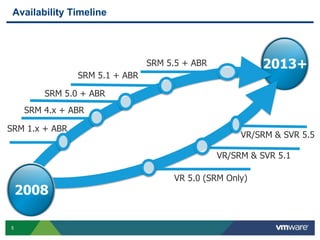
2013+
Availability Timeline
2008
SRM 4.x + ABR
SRM 5.0 + ABR
SRM 5.5 + ABR
VR 5.0 (SRM Only)
SRM 1.x + ABR
VR/SRM & SVR 5.1
VR/SRM & SVR 5.5
SRM 5.1 + ABR
6
vSphere Replication Recap
7
vSphere Replication
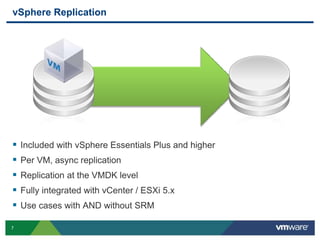
 Included with vSphere Essentials Plus and higher
 Per VM, async replication
 Replication at the VMDK level
 Fully integrated with vCenter / ESXi 5.x
 Use cases with AND without SRM
8
vSphere Replication Appliance
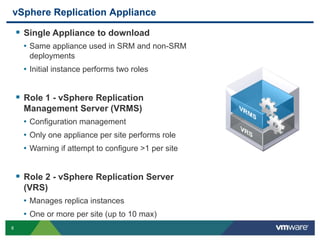
 Single Appliance to download
• Same appliance used in SRM and non-SRM
deployments
• Initial instance performs two roles
 Role 1 - vSphere Replication
Management Server (VRMS)
• Configuration management
• Only one appliance per site performs role
• Warning if attempt to configure >1 per site
 Role 2 - vSphere Replication Server
(VRS)
• Manages replica instances
• One or more per site (up to 10 max)
9
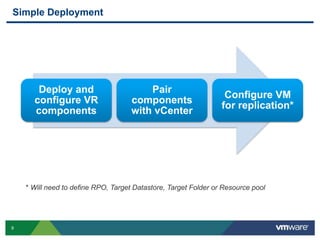
Simple Deployment
Deploy and
configure VR
components
Pair
components
with vCenter
Configure VM
for replication*
* Will need to define RPO, Target Datastore, Target Folder or Resource pool
10
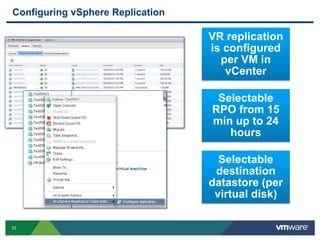
Configuring vSphere Replication
VR replication
is configured
per VM in
vCenter
Selectable
RPO from 15
min up to 24
hours
Selectable
destination
datastore (per
virtual disk)
11
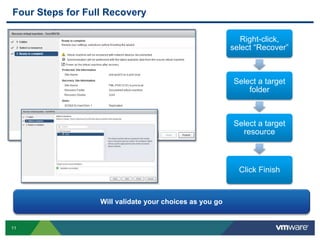
Four Steps for Full Recovery
Right-click,
select “Recover”
Select a target
folder
Select a target
resource
Click Finish
Will validate your choices as you go
12
vSphere Replication Use Cases
13
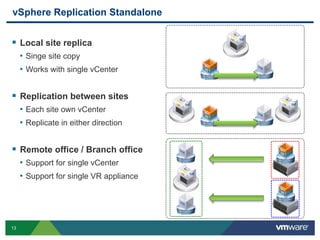
vSphere Replication Standalone
 Local site replica
• Singe site copy
• Works with single vCenter
 Remote office / Branch office
• Support for single vCenter
• Support for single VR appliance
 Replication between sites
• Each site own vCenter
• Replicate in either direction
14
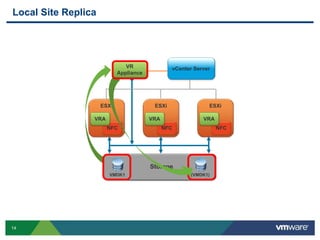
Local Site Replica
vCenter Server
ESXi
NFC
VRA
ESXi
NFC
VRA
ESXi
NFC
VRA
Storage
Storage
VMDK1 (VMDK1)
VR
Appliance
15
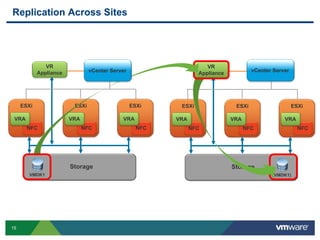
Replication Across Sites
ESXi
NFC
VRA
ESXi
NFC
VRA
ESXi
NFC
VRA
Storage
Storage
(VMDK1)
ESXi
NFC
VRA
ESXi
NFC
VRA
ESXi
NFC
VRA
VR
Appliance
VR
Appliance
Storage
Storage
VMDK1
vCenter Server vCenter Server
16
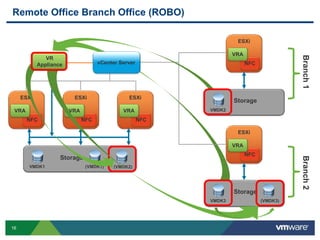
Remote Office Branch Office (ROBO)
Storage
Storage
VMDK1
ESXi
NFC
VRA
ESXi
NFC
VRA
ESXi
NFC
VRA
ESXi
NFC
VRA
Storage
VMDK3
(VMDK1)
Branch
1
Branch
2
(VMDK2)
(VMDK3)
ESXi
NFC
VRA
Storage
VMDK2
VR
Appliance vCenter Server
17
Site Recovery Manager (SRM) - Recap
18
Replication
SRM
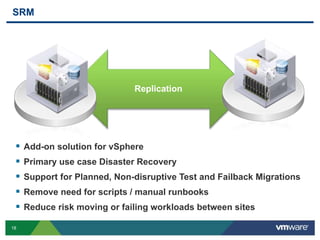
 Add-on solution for vSphere
 Primary use case Disaster Recovery
 Support for Planned, Non-disruptive Test and Failback Migrations
 Remove need for scripts / manual runbooks
 Reduce risk moving or failing workloads between sites
19
Key Components Of SRM
Replication
SRM Server
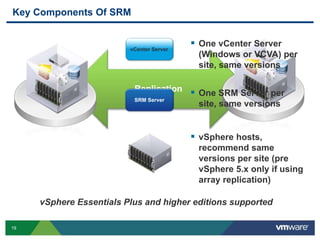
 One vCenter Server
(Windows or VCVA) per
site, same versions
 One SRM Server per
site, same versions
 vSphere hosts,
recommend same
versions per site (pre
vSphere 5.x only if using
array replication)
vSphere Essentials Plus and higher editions supported
vCenter Server
20
SRM Replication Options
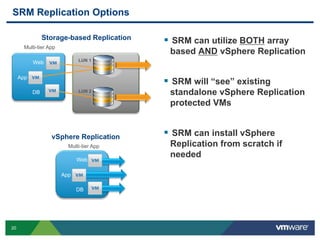
 SRM can utilize BOTH array
based AND vSphere Replication
 SRM will “see” existing
standalone vSphere Replication
protected VMs
 SRM can install vSphere
Replication from scratch if
needed
Hub
LUN 2
Web
Multi-tier App
DB
App
vSphere Replication
Storage-based Replication
LUN 1
Web
DB
App
Multi-tier App
21
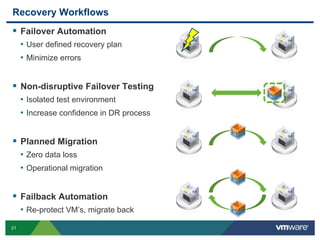
Recovery Workflows
 Failover Automation
• User defined recovery plan
• Minimize errors
 Non-disruptive Failover Testing
• Isolated test environment
• Increase confidence in DR process
 Planned Migration
• Zero data loss
• Operational migration
 Failback Automation
• Re-protect VM’s, migrate back
22
FAQ
23
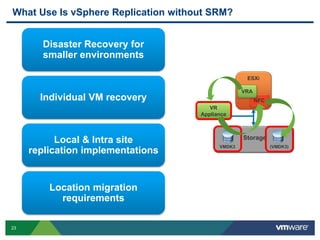
What Use Is vSphere Replication without SRM?
Disaster Recovery for
smaller environments
ESXi
NFC
VRA
Storage
VMDK3 (VMDK3)
VR
Appliance
Individual VM recovery
Local & Intra site
replication implementations
Location migration
requirements
24
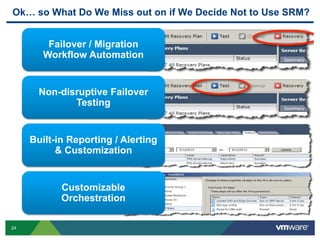
Ok… so What Do We Miss out on if We Decide Not to Use SRM?
Failover / Migration
Workflow Automation
Non-disruptive Failover
Testing
Customizable
Orchestration
Built-in Reporting / Alerting
& Customization
25
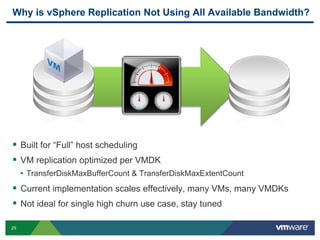
Why is vSphere Replication Not Using All Available Bandwidth?
 Built for “Full” host scheduling
 VM replication optimized per VMDK
• TransferDiskMaxBufferCount & TransferDiskMaxExtentCount
 Current implementation scales effectively, many VMs, many VMDKs
 Not ideal for single high churn use case, stay tuned
26
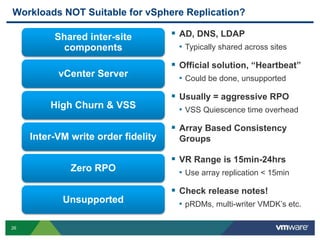
Workloads NOT Suitable for vSphere Replication?
Shared inter-site
components
vCenter Server
High Churn & VSS
Inter-VM write order fidelity
Zero RPO
Unsupported
 AD, DNS, LDAP
• Typically shared across sites
 Official solution, “Heartbeat”
• Could be done, unsupported
 Usually = aggressive RPO
• VSS Quiescence time overhead
 Array Based Consistency
Groups
 VR Range is 15min-24hrs
• Use array replication < 15min
 Check release notes!
• pRDMs, multi-writer VMDK’s etc.
27
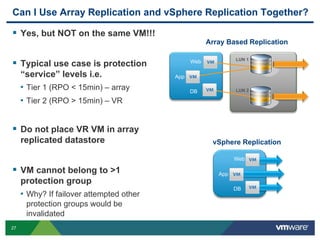
Can I Use Array Replication and vSphere Replication Together?
 Yes, but NOT on the same VM!!!
 Typical use case is protection
“service” levels i.e.
• Tier 1 (RPO < 15min) – array
• Tier 2 (RPO > 15min) – VR
 Do not place VR VM in array
replicated datastore
 VM cannot belong to >1
protection group
• Why? If failover attempted other
protection groups would be
invalidated
Hub
LUN 2
Web
DB
App
vSphere Replication
LUN 1
Web
DB
App
Array Based Replication
28
What’s New?
29
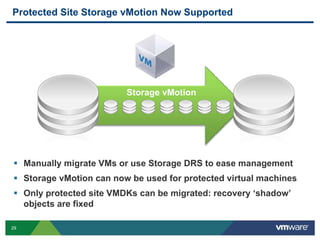
Protected Site Storage vMotion Now Supported
Storage vMotion
 Manually migrate VMs or use Storage DRS to ease management
 Storage vMotion can now be used for protected virtual machines
 Only protected site VMDKs can be migrated: recovery ‘shadow’
objects are fixed
30
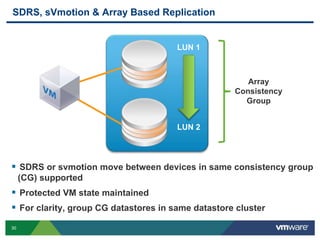
SDRS, sVmotion & Array Based Replication
LUN 1
LUN 2
 SDRS or svmotion move between devices in same consistency group
(CG) supported
 Protected VM state maintained
 For clarity, group CG datastores in same datastore cluster
Array
Consistency
Group
31
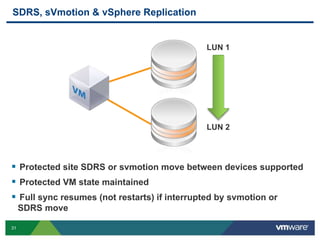
SDRS, sVmotion & vSphere Replication
LUN 1
LUN 2
 Protected site SDRS or svmotion move between devices supported
 Protected VM state maintained
 Full sync resumes (not restarts) if interrupted by svmotion or
SDRS move
32
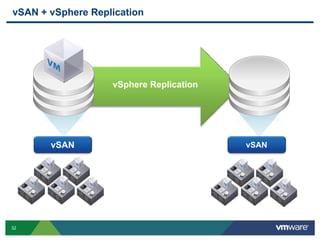
vSAN + vSphere Replication
vSAN vSAN
vSphere Replication
33
vSphere Replication Appliances
 vSphere 5.1
• vSphere Replication Standalone = 1 x VR Appliance per vCenter
• With SRM 5.1 user able to deploy up to 10 x VR Appliance per vCenter
 vSphere 5.5
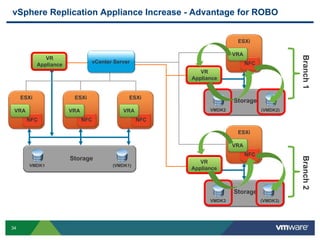
• vSphere Replication Standalone = Up to 10 VR Appliances per vCenter
• vSphere Replication Standalone, new topology support
• With SRM 5.5, limit still same, 10 x VR Appliance per vCenter
34
vSphere Replication Appliance Increase - Advantage for ROBO
Storage
Storage
VMDK1
ESXi
NFC
VRA
ESXi
NFC
VRA
ESXi
NFC
VRA
ESXi
NFC
VRA
Storage
VMDK3
(VMDK1)
Branch
1
Branch
2
(VMDK3)
ESXi
NFC
VRA
Storage
VMDK2
VR
Appliance
(VMDK2)
VR
Appliance
VR
Appliance
vCenter Server
35
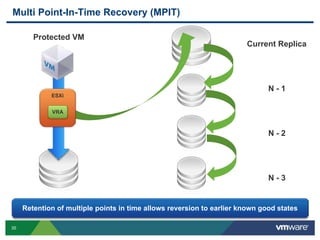
Multi Point-In-Time Recovery (MPIT)
ESXi
VRA
Protected VM
Current Replica
N - 1
N - 2
N - 3
Retention of multiple points in time allows reversion to earlier known good states
36
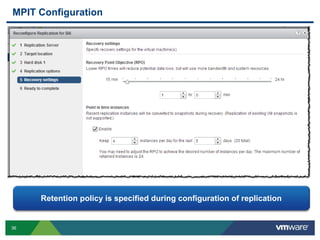
MPIT Configuration
Retention policy is specified during configuration of replication
37
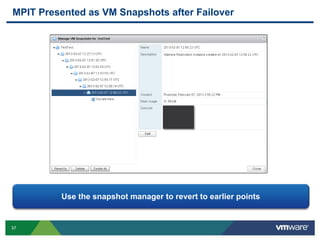
MPIT Presented as VM Snapshots after Failover
Use the snapshot manager to revert to earlier points
38
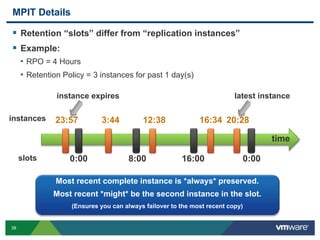
MPIT Details
 Retention “slots” differ from “replication instances”
 Example:
• RPO = 4 Hours
• Retention Policy = 3 instances for past 1 day(s)
time
0:00 8:00 16:00 0:00
slots
instances 23:57 3:44 12:38 16:34 20:28
instance expires latest instance
Most recent complete instance is *always* preserved.
Most recent *might* be the second instance in the slot.
(Ensures you can always failover to the most recent copy)
39
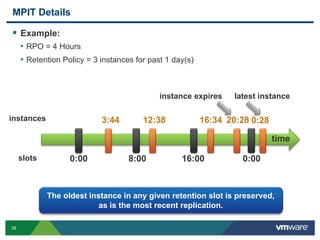
MPIT Details
 Example:
• RPO = 4 Hours
• Retention Policy = 3 instances for past 1 day(s)
time
0:00 8:00 16:00 0:00
slots
instances 3:44 12:38 16:34 20:28
instance expires latest instance
The oldest instance in any given retention slot is preserved,
as is the most recent replication.
0:28
40
Wrap Up
41
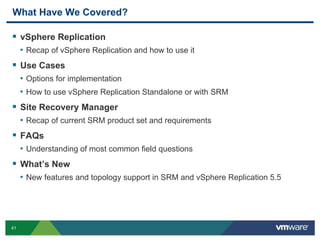
What Have We Covered?
 vSphere Replication
• Recap of vSphere Replication and how to use it
 Use Cases
• Options for implementation
• How to use vSphere Replication Standalone or with SRM
 Site Recovery Manager
• Recap of current SRM product set and requirements
 FAQs
• Understanding of most common field questions
 What’s New
• New features and topology support in SRM and vSphere Replication 5.5
42
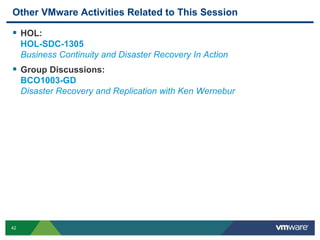
Other VMware Activities Related to This Session
 HOL:
HOL-SDC-1305
Business Continuity and Disaster Recovery In Action
 Group Discussions:
BCO1003-GD
Disaster Recovery and Replication with Ken Wernebur
THANK YOU
Protection for All - vSphere Replication & SRM
Technical Update
Lee Dilworth, VMware
Ken Werneburg, VMware
BCO5129
#BCO5129

VMworld 2013: Protection for All - VMware vSphere Replication & SRM Technical Update

  • 1.
    Protection for All- vSphere Replication & SRM Technical Update Lee Dilworth, VMware Ken Werneburg, VMware BCO5129 #BCO5129
  • 2.
    2 Disclaimer  This presentationmay contain product features that are currently under development.  This overview of new technology represents no commitment from VMware to deliver these features in any generally available product.  Features are subject to change, and must not be included in contracts, purchase orders, or sales agreements of any kind.  Technical feasibility and market demand will affect final delivery.  Pricing and packaging for any new technologies or features discussed or presented have not been determined.  This information is confidential
  • 3.
    3 Regional Accent Disclaimer Ken and Lee have accents! Sorry   Terminology we will be using • SRM (Site Recovery Manager) • ABR (Array Based Replication) • VR (vSphere Replication) • VRMS (vSphere Replication Management Server) • VRS (vSphere Replication Server) • SVR (Standalone vSphere Replication i.e. NO SRM involved)  For vSphere Replication internals see: • BCO4977: VMware vSphere Replication - Technical walk-through with engineering
  • 4.
    4 Agenda for Today Introduction  vSphere Replication (VR) Recap  VR Use Cases  Site Recovery Manager (SRM) Recap  FAQ  What’s New  Wrap Up
  • 5.
    5 2013+ Availability Timeline 2008 SRM 4.x+ ABR SRM 5.0 + ABR SRM 5.5 + ABR VR 5.0 (SRM Only) SRM 1.x + ABR VR/SRM & SVR 5.1 VR/SRM & SVR 5.5 SRM 5.1 + ABR
  • 6.
  • 7.
    7 vSphere Replication  Includedwith vSphere Essentials Plus and higher  Per VM, async replication  Replication at the VMDK level  Fully integrated with vCenter / ESXi 5.x  Use cases with AND without SRM
  • 8.
    8 vSphere Replication Appliance Single Appliance to download • Same appliance used in SRM and non-SRM deployments • Initial instance performs two roles  Role 1 - vSphere Replication Management Server (VRMS) • Configuration management • Only one appliance per site performs role • Warning if attempt to configure >1 per site  Role 2 - vSphere Replication Server (VRS) • Manages replica instances • One or more per site (up to 10 max)
  • 9.
    9 Simple Deployment Deploy and configureVR components Pair components with vCenter Configure VM for replication* * Will need to define RPO, Target Datastore, Target Folder or Resource pool
  • 10.
    10 Configuring vSphere Replication VRreplication is configured per VM in vCenter Selectable RPO from 15 min up to 24 hours Selectable destination datastore (per virtual disk)
  • 11.
    11 Four Steps forFull Recovery Right-click, select “Recover” Select a target folder Select a target resource Click Finish Will validate your choices as you go
  • 12.
  • 13.
    13 vSphere Replication Standalone Local site replica • Singe site copy • Works with single vCenter  Remote office / Branch office • Support for single vCenter • Support for single VR appliance  Replication between sites • Each site own vCenter • Replicate in either direction
  • 14.
    14 Local Site Replica vCenterServer ESXi NFC VRA ESXi NFC VRA ESXi NFC VRA Storage Storage VMDK1 (VMDK1) VR Appliance
  • 15.
  • 16.
    16 Remote Office BranchOffice (ROBO) Storage Storage VMDK1 ESXi NFC VRA ESXi NFC VRA ESXi NFC VRA ESXi NFC VRA Storage VMDK3 (VMDK1) Branch 1 Branch 2 (VMDK2) (VMDK3) ESXi NFC VRA Storage VMDK2 VR Appliance vCenter Server
  • 17.
  • 18.
    18 Replication SRM  Add-on solutionfor vSphere  Primary use case Disaster Recovery  Support for Planned, Non-disruptive Test and Failback Migrations  Remove need for scripts / manual runbooks  Reduce risk moving or failing workloads between sites
  • 19.
    19 Key Components OfSRM Replication SRM Server  One vCenter Server (Windows or VCVA) per site, same versions  One SRM Server per site, same versions  vSphere hosts, recommend same versions per site (pre vSphere 5.x only if using array replication) vSphere Essentials Plus and higher editions supported vCenter Server
  • 20.
    20 SRM Replication Options SRM can utilize BOTH array based AND vSphere Replication  SRM will “see” existing standalone vSphere Replication protected VMs  SRM can install vSphere Replication from scratch if needed Hub LUN 2 Web Multi-tier App DB App vSphere Replication Storage-based Replication LUN 1 Web DB App Multi-tier App
  • 21.
    21 Recovery Workflows  FailoverAutomation • User defined recovery plan • Minimize errors  Non-disruptive Failover Testing • Isolated test environment • Increase confidence in DR process  Planned Migration • Zero data loss • Operational migration  Failback Automation • Re-protect VM’s, migrate back
  • 22.
  • 23.
    23 What Use IsvSphere Replication without SRM? Disaster Recovery for smaller environments ESXi NFC VRA Storage VMDK3 (VMDK3) VR Appliance Individual VM recovery Local & Intra site replication implementations Location migration requirements
  • 24.
    24 Ok… so WhatDo We Miss out on if We Decide Not to Use SRM? Failover / Migration Workflow Automation Non-disruptive Failover Testing Customizable Orchestration Built-in Reporting / Alerting & Customization
  • 25.
    25 Why is vSphereReplication Not Using All Available Bandwidth?  Built for “Full” host scheduling  VM replication optimized per VMDK • TransferDiskMaxBufferCount & TransferDiskMaxExtentCount  Current implementation scales effectively, many VMs, many VMDKs  Not ideal for single high churn use case, stay tuned
  • 26.
    26 Workloads NOT Suitablefor vSphere Replication? Shared inter-site components vCenter Server High Churn & VSS Inter-VM write order fidelity Zero RPO Unsupported  AD, DNS, LDAP • Typically shared across sites  Official solution, “Heartbeat” • Could be done, unsupported  Usually = aggressive RPO • VSS Quiescence time overhead  Array Based Consistency Groups  VR Range is 15min-24hrs • Use array replication < 15min  Check release notes! • pRDMs, multi-writer VMDK’s etc.
  • 27.
    27 Can I UseArray Replication and vSphere Replication Together?  Yes, but NOT on the same VM!!!  Typical use case is protection “service” levels i.e. • Tier 1 (RPO < 15min) – array • Tier 2 (RPO > 15min) – VR  Do not place VR VM in array replicated datastore  VM cannot belong to >1 protection group • Why? If failover attempted other protection groups would be invalidated Hub LUN 2 Web DB App vSphere Replication LUN 1 Web DB App Array Based Replication
  • 28.
  • 29.
    29 Protected Site StoragevMotion Now Supported Storage vMotion  Manually migrate VMs or use Storage DRS to ease management  Storage vMotion can now be used for protected virtual machines  Only protected site VMDKs can be migrated: recovery ‘shadow’ objects are fixed
  • 30.
    30 SDRS, sVmotion &Array Based Replication LUN 1 LUN 2  SDRS or svmotion move between devices in same consistency group (CG) supported  Protected VM state maintained  For clarity, group CG datastores in same datastore cluster Array Consistency Group
  • 31.
    31 SDRS, sVmotion &vSphere Replication LUN 1 LUN 2  Protected site SDRS or svmotion move between devices supported  Protected VM state maintained  Full sync resumes (not restarts) if interrupted by svmotion or SDRS move
  • 32.
    32 vSAN + vSphereReplication vSAN vSAN vSphere Replication
  • 33.
    33 vSphere Replication Appliances vSphere 5.1 • vSphere Replication Standalone = 1 x VR Appliance per vCenter • With SRM 5.1 user able to deploy up to 10 x VR Appliance per vCenter  vSphere 5.5 • vSphere Replication Standalone = Up to 10 VR Appliances per vCenter • vSphere Replication Standalone, new topology support • With SRM 5.5, limit still same, 10 x VR Appliance per vCenter
  • 34.
    34 vSphere Replication ApplianceIncrease - Advantage for ROBO Storage Storage VMDK1 ESXi NFC VRA ESXi NFC VRA ESXi NFC VRA ESXi NFC VRA Storage VMDK3 (VMDK1) Branch 1 Branch 2 (VMDK3) ESXi NFC VRA Storage VMDK2 VR Appliance (VMDK2) VR Appliance VR Appliance vCenter Server
  • 35.
    35 Multi Point-In-Time Recovery(MPIT) ESXi VRA Protected VM Current Replica N - 1 N - 2 N - 3 Retention of multiple points in time allows reversion to earlier known good states
  • 36.
    36 MPIT Configuration Retention policyis specified during configuration of replication
  • 37.
    37 MPIT Presented asVM Snapshots after Failover Use the snapshot manager to revert to earlier points
  • 38.
    38 MPIT Details  Retention“slots” differ from “replication instances”  Example: • RPO = 4 Hours • Retention Policy = 3 instances for past 1 day(s) time 0:00 8:00 16:00 0:00 slots instances 23:57 3:44 12:38 16:34 20:28 instance expires latest instance Most recent complete instance is *always* preserved. Most recent *might* be the second instance in the slot. (Ensures you can always failover to the most recent copy)
  • 39.
    39 MPIT Details  Example: •RPO = 4 Hours • Retention Policy = 3 instances for past 1 day(s) time 0:00 8:00 16:00 0:00 slots instances 3:44 12:38 16:34 20:28 instance expires latest instance The oldest instance in any given retention slot is preserved, as is the most recent replication. 0:28
  • 40.
  • 41.
    41 What Have WeCovered?  vSphere Replication • Recap of vSphere Replication and how to use it  Use Cases • Options for implementation • How to use vSphere Replication Standalone or with SRM  Site Recovery Manager • Recap of current SRM product set and requirements  FAQs • Understanding of most common field questions  What’s New • New features and topology support in SRM and vSphere Replication 5.5
  • 42.
    42 Other VMware ActivitiesRelated to This Session  HOL: HOL-SDC-1305 Business Continuity and Disaster Recovery In Action  Group Discussions: BCO1003-GD Disaster Recovery and Replication with Ken Wernebur
  • 43.
  • 45.
    Protection for All- vSphere Replication & SRM Technical Update Lee Dilworth, VMware Ken Werneburg, VMware BCO5129 #BCO5129