1
Unit-3
INTELLECTUAL
PROPERTY
LEGISLATION
.
 WIPO ( World Intellectual Property
Organization ) was established by the
WIPO Convention in 1967
 The WIPO is a specialized agency of
the United Nations.
 It promote the protection of IP
throughout the world.
 Its headquarters are in Geneva,
Switzerland
3
4
What is intellectual property?
Intellectual property (IP) refers to the
ownership of an idea or design by the person
who came up with it.
It gives a person certain exclusive rights to a
distinct type of creative design, meaning that
nobody else can copy or reuse that creation
without the owner's permission.
5
 Intellectual Property is something produced
using human intellect which has commercial
value.
6
Definition of intellectual
property
 Intellectual property rights refers to the
general term for the assignment of
property rights through patents,
copyrights and trade marks. These
property rights allow the holder to
exercise a monopoly on the use of the
item for a specified period.
7
Types of intellectual properties
 Patents
 Copyrights
 Trademarks
 Industrial design
 Geographical indications, and
 Trade secret
8
Patents
• It is covered under the Act called the Patents Act,
1970 [Amended by Patents Act, 2005]
• It is a monopoly right granted to a person, who invented a
new product or process of making an article, for 20years
under the Indian Patens Act, 1970,
• It can be renewed after expiration of period.
• A patent has to be applied in each country by the
inventor, to claim his rights in that country.
 An exclusive right granted by a country to the
owner of an invention to make, use, manufacture
and market the invention
10
 Patent Offices are located at Kolkata,
Mumbai, Chennai and Delhi to deal with
the applications for patents.
 Patent Information System (PIS) &
Intellectual Property Training Institute
(IPTI) located at Nagpur.
11
 JAIPUR: Drawing
inspiration from
scientist Stephen
Hawking, a
wheelchair-bound
nine-year-old boy
here has invented a
game of six-player
circular chess. The
boy, Hridayeshwar
Singh Bhati has got
the game's design
patented in his name.
13
Copyright
• Copyright is a legal concept, enacted by most
governments, that grants the creator of an original
work exclusive rights to its use and distribution.
 A right, which is available for creating an original
literary or dramatic or musical or artistic work.
.
14
 Copyright refers to the legal right of the owner of
intellectual property.
 In simpler terms, copyright is the right to copy.
 This means that the original creator of a product
and anyone he gives authorization to are the
only ones with the exclusive right to reproduce
the work.
15
 Examples of unique creations include computer
software, art, poetry, graphic designs, musical
lyrics and compositions, novels, film, original
architectural designs, website content, etc.
 One safeguard that can be used to protect an
original creation is copyright.
16
 In India, The Copyright Act, 1957 as amended in
1983, 1984, 1992, 1994 and 1999 is available
 Registration can be done at the Office of the
Registrar of Copyrights in New Delhi.
 Protection for the expression of an idea and not
for the idea itself.
17
How Long Does Copyright
Last?
 In the U.S., an original owner is protected by
copyright laws all his life until 70 years after his
death.
 But copyright protection varies from country to
country, and can stand for 50 to 100 years after
the individual’s death, depending on the country.
18
Literary Films Dramatic
Musical Sound RecordingArtistic
Question
 Does copyright protect ideas,
discoveries, concepts and theories.
 Does Brand names, logos, slogans,
names can be protected under copyright
law
20
Case Studies
• Bangalore Aug 10, 2003: Banashankari police arrested three
software engineers for illegally copying software from a
company they were working for.
• Chennai, February 2000: Pirated software worth Rs.1.11 crore
(US$ 253,200) was seized by the Chennai police. A total of 6
employees were arrested which included the Managing
Director of one outlet and proprietors of each of the outlets.
Trademark
 Trademark can be a word, name, brand, symbol,
label etc., used by a company to create a unique
identity for their product.
 Trademark can be registered, and then use
™ ®.
 The registration validity is for 10 years and
renewable after expiry.
22
 It is covered under the Act called the
Trade Marks Act, 1999.
 The Act came into effect on September
15, 2003.
 It replaced the Trade and Merchandise
Marks Act, 1958.
 It extends to the whole of India.
23
 Different Symbols are :
 ™ - Intent to use application filed for
product
 SM - Intent to use application filed for
services
® -Registered trademark
24
 Trademark is valid for 10 years & it can
also be renewed.
 Service mark Rights are reserved exclusively
for owners for 17 year & it can also be
renewed.
 A trade mark is used as a marketing tool so that
customers can recognize the product of a particular
trader. 25
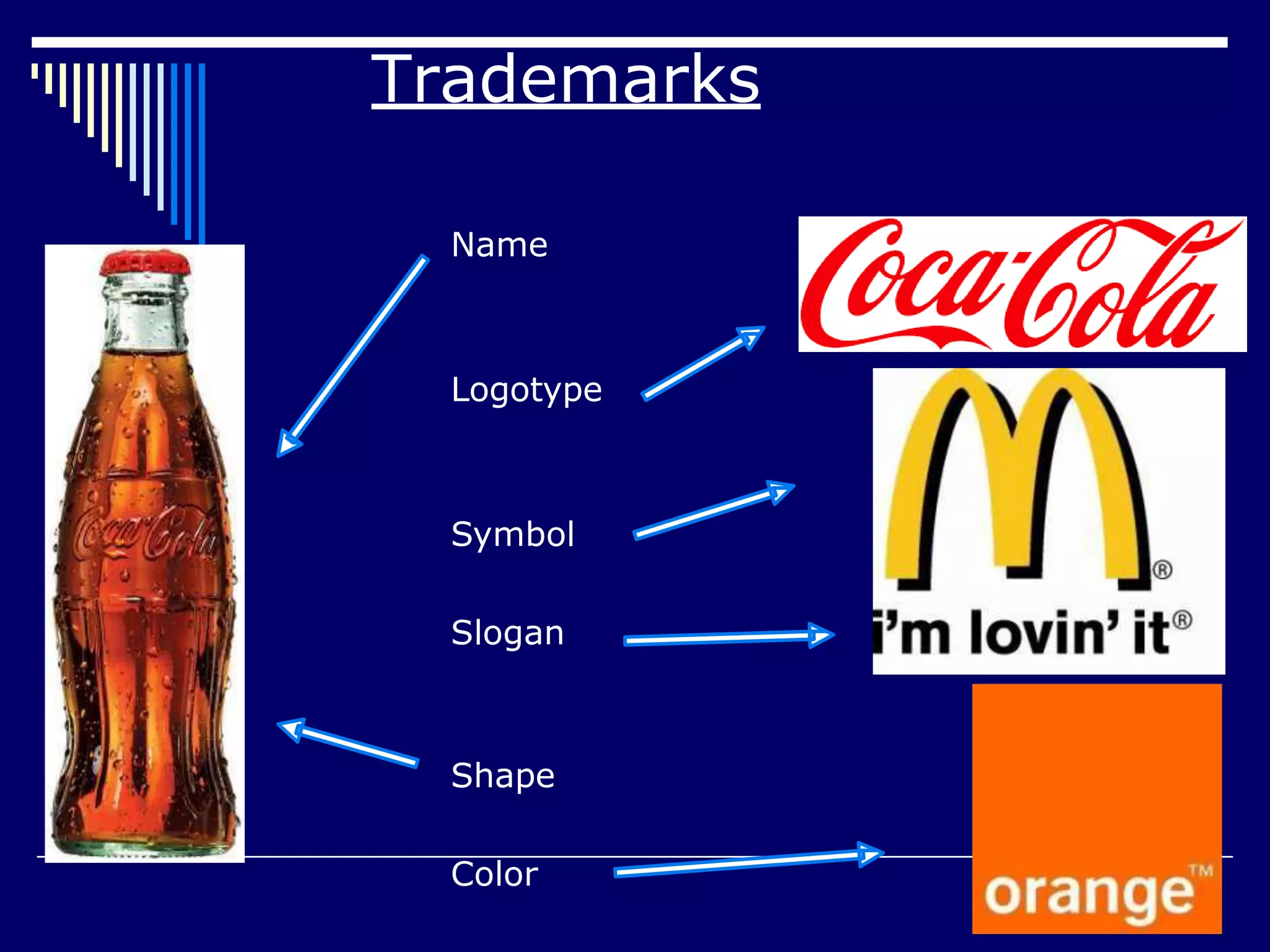
Trademarks
Name
Logotype
Symbol
Slogan
Shape
Color
Industrial design
 Design deals with features, shapes, patterns,
etc., applied to an article by an industrial
process, manual or mechanical.
 Designs can be registered based on its
originality, henceforth they can use ® or
registered, with registration number.
27
28
 It makes an article attractive and appealing;
hence, they add to the commercial value of a
product and increase its marketability
 Applicants can file a single international
application either with WIPO or the national or
regional office of a country.
29
 The design should be new or original, not
previously published or used in any country
before Registration.
 Total term of a registered design is 10 years + 5
years Extended Period.
30
Geographical Indication
 A sign used on goods that have a specific
geographical origin and possess qualities or a
reputation due to that place of origin.
 Registration of a GI: 10 years & renewable.
31
 The Geographical Indication of Goods
(Registration and Protection) Act came into being
in 2000.
 Imprisonment for a term between 6 months to 3
years and a fine between 50000 rupees to 2 lakh
rupees in Act.
32
 Geographical Indication of Goods (Registration and
Protection) Act1999.
 It is typically used for agricultural products, food
and wine, handicrafts.
 Eg : Mysore silk, Darjeeling tea etc
33
34
Trade secret
 It refers to any valuable information not known to
the society or the competitors.
 Eg: method of manufacturing, receipies
 It need not be anything unique or complex. But
must give a competitive advantage over others.
35
 There is no formalities required to get the trade
secrets rights.
 It is protected by contractual agreements between
the parties.
36
37
&
38
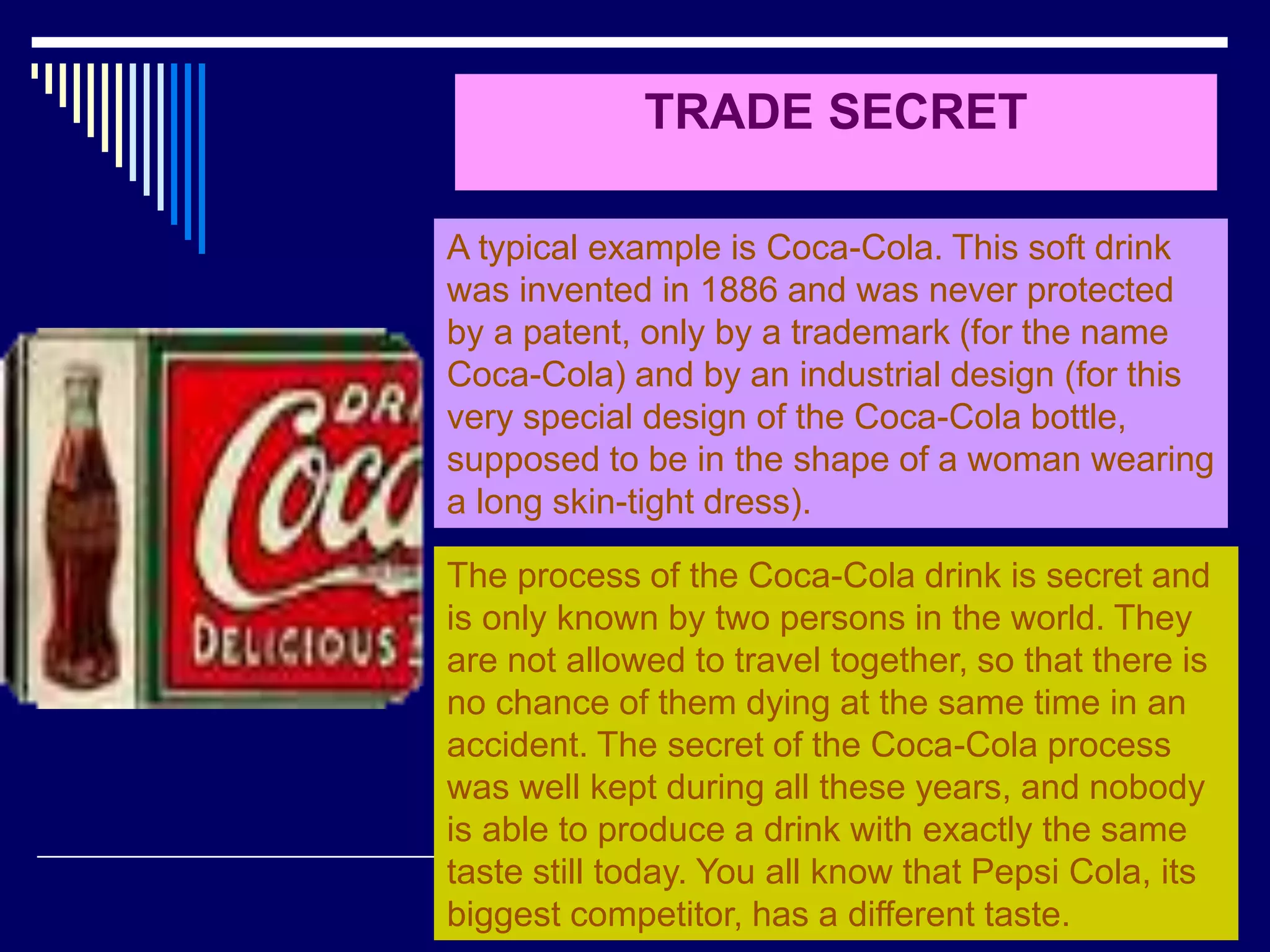
TRADE SECRET
A typical example is Coca-Cola. This soft drink
was invented in 1886 and was never protected
by a patent, only by a trademark (for the name
Coca-Cola) and by an industrial design (for this
very special design of the Coca-Cola bottle,
supposed to be in the shape of a woman wearing
a long skin-tight dress).
The process of the Coca-Cola drink is secret and
is only known by two persons in the world. They
are not allowed to travel together, so that there is
no chance of them dying at the same time in an
accident. The secret of the Coca-Cola process
was well kept during all these years, and nobody
is able to produce a drink with exactly the same
taste still today. You all know that Pepsi Cola, its
biggest competitor, has a different taste.
39
FOR MOST PRODUCTS EVERY
FORM OF
INTELLECTUAL PROPERTY
RIGHTS CAN BE OBTAINED
CAMERA
“PATENT”  For every individual improved mechanism
“DESIGN”  For outer shape & Contour / Configuration
“TRADE MARK” Brand name or Logo for goods denoted as ®
“Copy right” For Instruction / manual booklet denoted as ©
40
What is Intellectual Property
Right (IPR)?
Intellectual Property Right
 not to be confused with IP
 it is a right vested in the asset, not the asset itself
 e.g.
 an idea / invention is IP, a patent registration is an IPR
 a customer / price list is IP, a right of confidentiality is an IPR
 a secret production method is IP, a right to a trade secret is an IPR
 a particular way of representation is IP, copyright or a design registration
is an IPR
 a brand / trade name is IP, a trade mark registration is an IPR
41
THANKS

Intellectual property rights

  • 1.
  • 2.
     WIPO (World Intellectual Property Organization ) was established by the WIPO Convention in 1967  The WIPO is a specialized agency of the United Nations.
  • 3.
     It promotethe protection of IP throughout the world.  Its headquarters are in Geneva, Switzerland 3
  • 4.
    4 What is intellectualproperty? Intellectual property (IP) refers to the ownership of an idea or design by the person who came up with it. It gives a person certain exclusive rights to a distinct type of creative design, meaning that nobody else can copy or reuse that creation without the owner's permission.
  • 5.
  • 6.
     Intellectual Propertyis something produced using human intellect which has commercial value. 6
  • 7.
    Definition of intellectual property Intellectual property rights refers to the general term for the assignment of property rights through patents, copyrights and trade marks. These property rights allow the holder to exercise a monopoly on the use of the item for a specified period. 7
  • 8.
    Types of intellectualproperties  Patents  Copyrights  Trademarks  Industrial design  Geographical indications, and  Trade secret 8
  • 9.
    Patents • It iscovered under the Act called the Patents Act, 1970 [Amended by Patents Act, 2005] • It is a monopoly right granted to a person, who invented a new product or process of making an article, for 20years under the Indian Patens Act, 1970, • It can be renewed after expiration of period.
  • 10.
    • A patenthas to be applied in each country by the inventor, to claim his rights in that country.  An exclusive right granted by a country to the owner of an invention to make, use, manufacture and market the invention 10
  • 11.
     Patent Officesare located at Kolkata, Mumbai, Chennai and Delhi to deal with the applications for patents.  Patent Information System (PIS) & Intellectual Property Training Institute (IPTI) located at Nagpur. 11
  • 12.
     JAIPUR: Drawing inspirationfrom scientist Stephen Hawking, a wheelchair-bound nine-year-old boy here has invented a game of six-player circular chess. The boy, Hridayeshwar Singh Bhati has got the game's design patented in his name.
  • 13.
  • 14.
    Copyright • Copyright isa legal concept, enacted by most governments, that grants the creator of an original work exclusive rights to its use and distribution.  A right, which is available for creating an original literary or dramatic or musical or artistic work. . 14
  • 15.
     Copyright refersto the legal right of the owner of intellectual property.  In simpler terms, copyright is the right to copy.  This means that the original creator of a product and anyone he gives authorization to are the only ones with the exclusive right to reproduce the work. 15
  • 16.
     Examples ofunique creations include computer software, art, poetry, graphic designs, musical lyrics and compositions, novels, film, original architectural designs, website content, etc.  One safeguard that can be used to protect an original creation is copyright. 16
  • 17.
     In India,The Copyright Act, 1957 as amended in 1983, 1984, 1992, 1994 and 1999 is available  Registration can be done at the Office of the Registrar of Copyrights in New Delhi.  Protection for the expression of an idea and not for the idea itself. 17
  • 18.
    How Long DoesCopyright Last?  In the U.S., an original owner is protected by copyright laws all his life until 70 years after his death.  But copyright protection varies from country to country, and can stand for 50 to 100 years after the individual’s death, depending on the country. 18
  • 19.
    Literary Films Dramatic MusicalSound RecordingArtistic
  • 20.
    Question  Does copyrightprotect ideas, discoveries, concepts and theories.  Does Brand names, logos, slogans, names can be protected under copyright law 20
  • 21.
    Case Studies • BangaloreAug 10, 2003: Banashankari police arrested three software engineers for illegally copying software from a company they were working for. • Chennai, February 2000: Pirated software worth Rs.1.11 crore (US$ 253,200) was seized by the Chennai police. A total of 6 employees were arrested which included the Managing Director of one outlet and proprietors of each of the outlets.
  • 22.
    Trademark  Trademark canbe a word, name, brand, symbol, label etc., used by a company to create a unique identity for their product.  Trademark can be registered, and then use ™ ®.  The registration validity is for 10 years and renewable after expiry. 22
  • 23.
     It iscovered under the Act called the Trade Marks Act, 1999.  The Act came into effect on September 15, 2003.  It replaced the Trade and Merchandise Marks Act, 1958.  It extends to the whole of India. 23
  • 24.
     Different Symbolsare :  ™ - Intent to use application filed for product  SM - Intent to use application filed for services ® -Registered trademark 24
  • 25.
     Trademark isvalid for 10 years & it can also be renewed.  Service mark Rights are reserved exclusively for owners for 17 year & it can also be renewed.  A trade mark is used as a marketing tool so that customers can recognize the product of a particular trader. 25
  • 26.
  • 27.
    Industrial design  Designdeals with features, shapes, patterns, etc., applied to an article by an industrial process, manual or mechanical.  Designs can be registered based on its originality, henceforth they can use ® or registered, with registration number. 27
  • 28.
  • 29.
     It makesan article attractive and appealing; hence, they add to the commercial value of a product and increase its marketability  Applicants can file a single international application either with WIPO or the national or regional office of a country. 29
  • 30.
     The designshould be new or original, not previously published or used in any country before Registration.  Total term of a registered design is 10 years + 5 years Extended Period. 30
  • 31.
    Geographical Indication  Asign used on goods that have a specific geographical origin and possess qualities or a reputation due to that place of origin.  Registration of a GI: 10 years & renewable. 31
  • 32.
     The GeographicalIndication of Goods (Registration and Protection) Act came into being in 2000.  Imprisonment for a term between 6 months to 3 years and a fine between 50000 rupees to 2 lakh rupees in Act. 32
  • 33.
     Geographical Indicationof Goods (Registration and Protection) Act1999.  It is typically used for agricultural products, food and wine, handicrafts.  Eg : Mysore silk, Darjeeling tea etc 33
  • 34.
  • 35.
    Trade secret  Itrefers to any valuable information not known to the society or the competitors.  Eg: method of manufacturing, receipies  It need not be anything unique or complex. But must give a competitive advantage over others. 35
  • 36.
     There isno formalities required to get the trade secrets rights.  It is protected by contractual agreements between the parties. 36
  • 37.
  • 38.
    38 TRADE SECRET A typicalexample is Coca-Cola. This soft drink was invented in 1886 and was never protected by a patent, only by a trademark (for the name Coca-Cola) and by an industrial design (for this very special design of the Coca-Cola bottle, supposed to be in the shape of a woman wearing a long skin-tight dress). The process of the Coca-Cola drink is secret and is only known by two persons in the world. They are not allowed to travel together, so that there is no chance of them dying at the same time in an accident. The secret of the Coca-Cola process was well kept during all these years, and nobody is able to produce a drink with exactly the same taste still today. You all know that Pepsi Cola, its biggest competitor, has a different taste.
  • 39.
    39 FOR MOST PRODUCTSEVERY FORM OF INTELLECTUAL PROPERTY RIGHTS CAN BE OBTAINED CAMERA “PATENT”  For every individual improved mechanism “DESIGN”  For outer shape & Contour / Configuration “TRADE MARK” Brand name or Logo for goods denoted as ® “Copy right” For Instruction / manual booklet denoted as ©
  • 40.
    40 What is IntellectualProperty Right (IPR)? Intellectual Property Right  not to be confused with IP  it is a right vested in the asset, not the asset itself  e.g.  an idea / invention is IP, a patent registration is an IPR  a customer / price list is IP, a right of confidentiality is an IPR  a secret production method is IP, a right to a trade secret is an IPR  a particular way of representation is IP, copyright or a design registration is an IPR  a brand / trade name is IP, a trade mark registration is an IPR
  • 41.