Intellectual Property Strategy
Dr. Elijah Ezendu
FIMC, FCCM, FIIAN, FBDI, FAAFM, FSSM, MIMIS, MIAP, MITD, ACIArb, ACIPM,
PhD, DocM, MBA, CWM, CBDA, CMA, MPM, PME, CSOL, CCIP, CMC, CMgr
“Skills and knowledge have become the
only source of sustainable long-term
competitive advantage”
- Lester Thurow
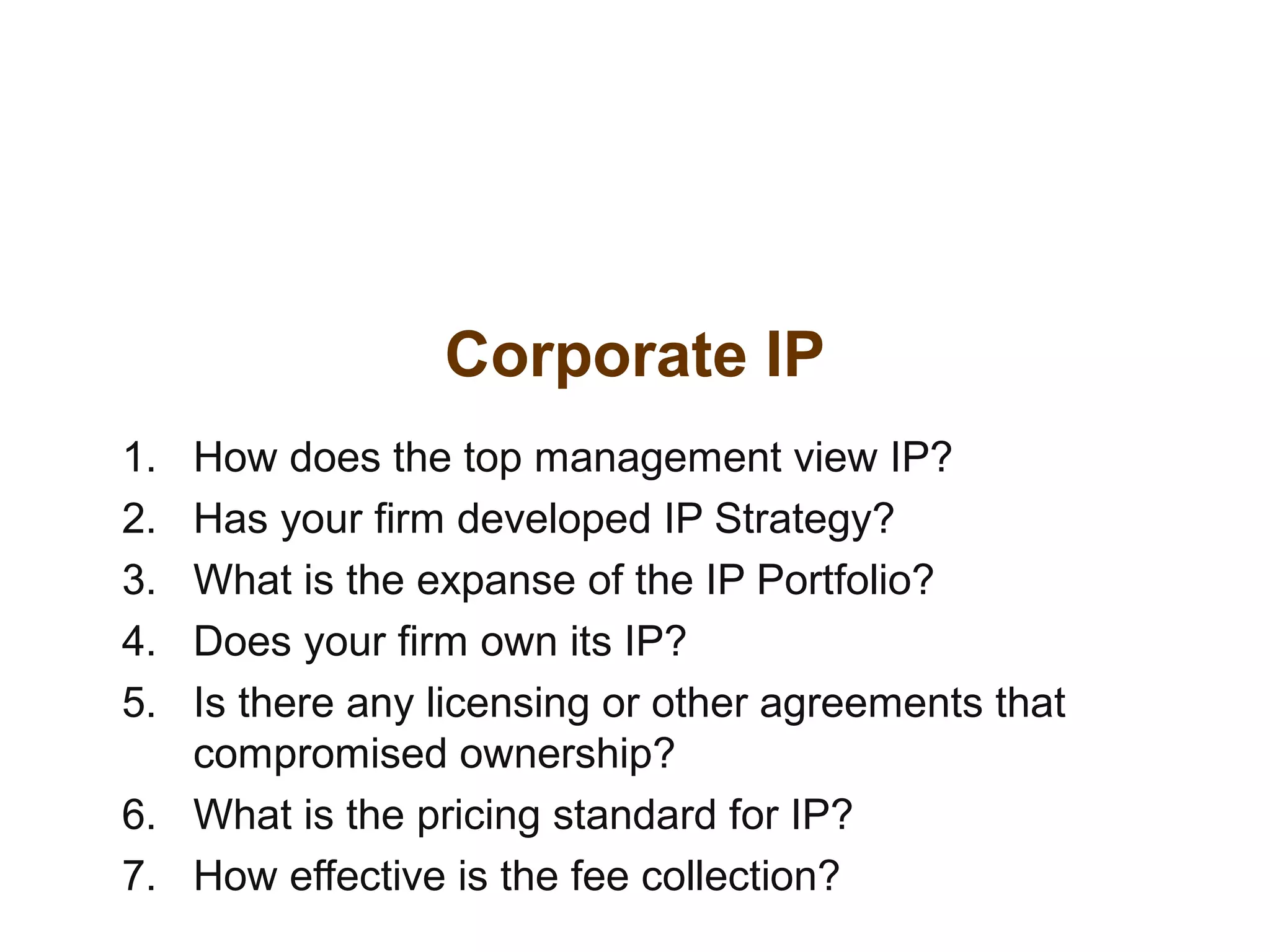
Corporate IP
1. How does the top management view IP?
2. Has your firm developed IP Strategy?
3. What is the expanse of the IP Portfolio?
4. Does your firm own its IP?
5. Is there any licensing or other agreements that
compromised ownership?
6. What is the pricing standard for IP?
7. How effective is the fee collection?
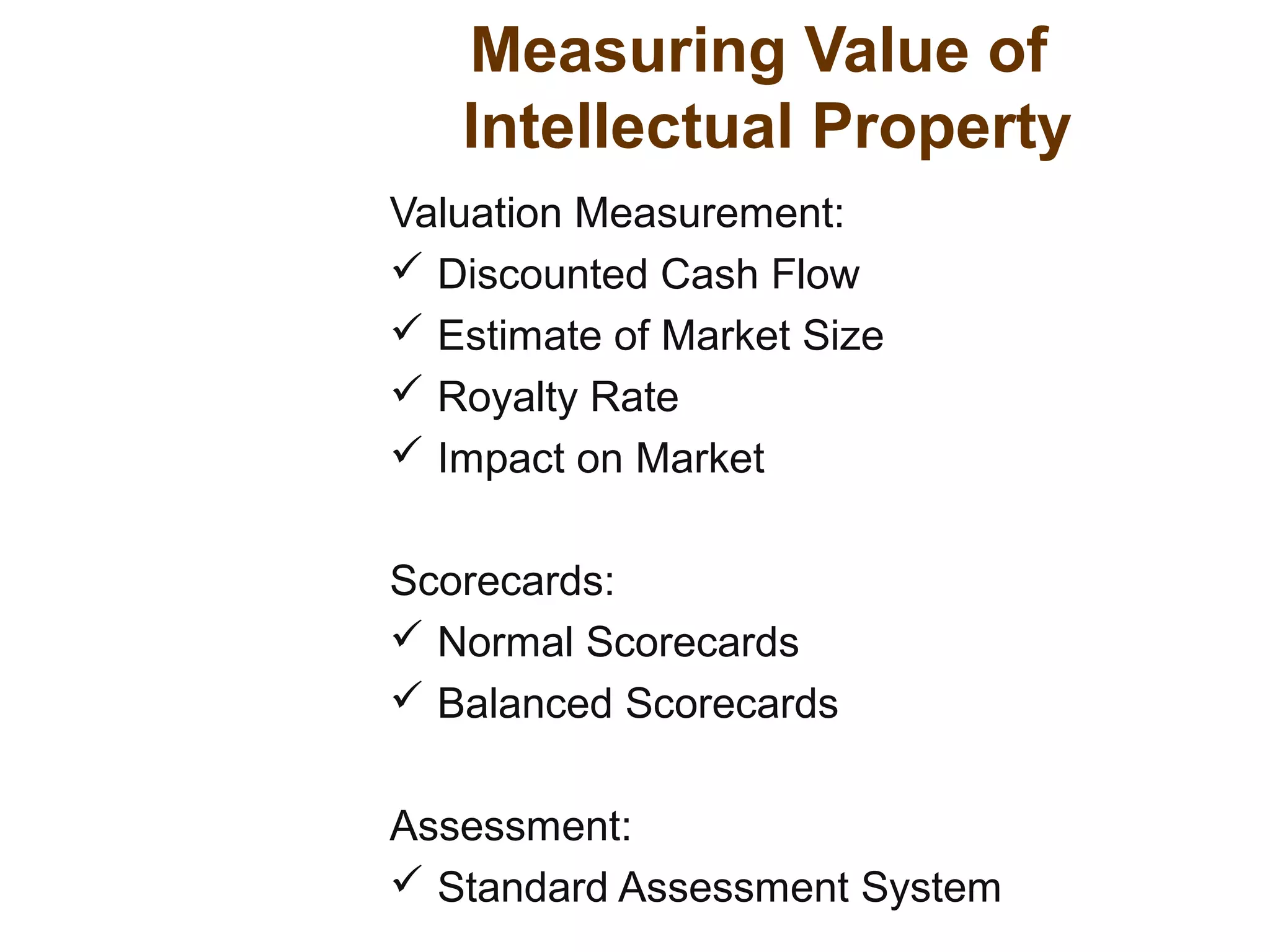
Valuation Measurement:
 Discounted Cash Flow
 Estimate of Market Size
 Royalty Rate
 Impact on Market
Scorecards:
 Normal Scorecards
 Balanced Scorecards
Assessment:
 Standard Assessment System
Measuring Value of
Intellectual Property
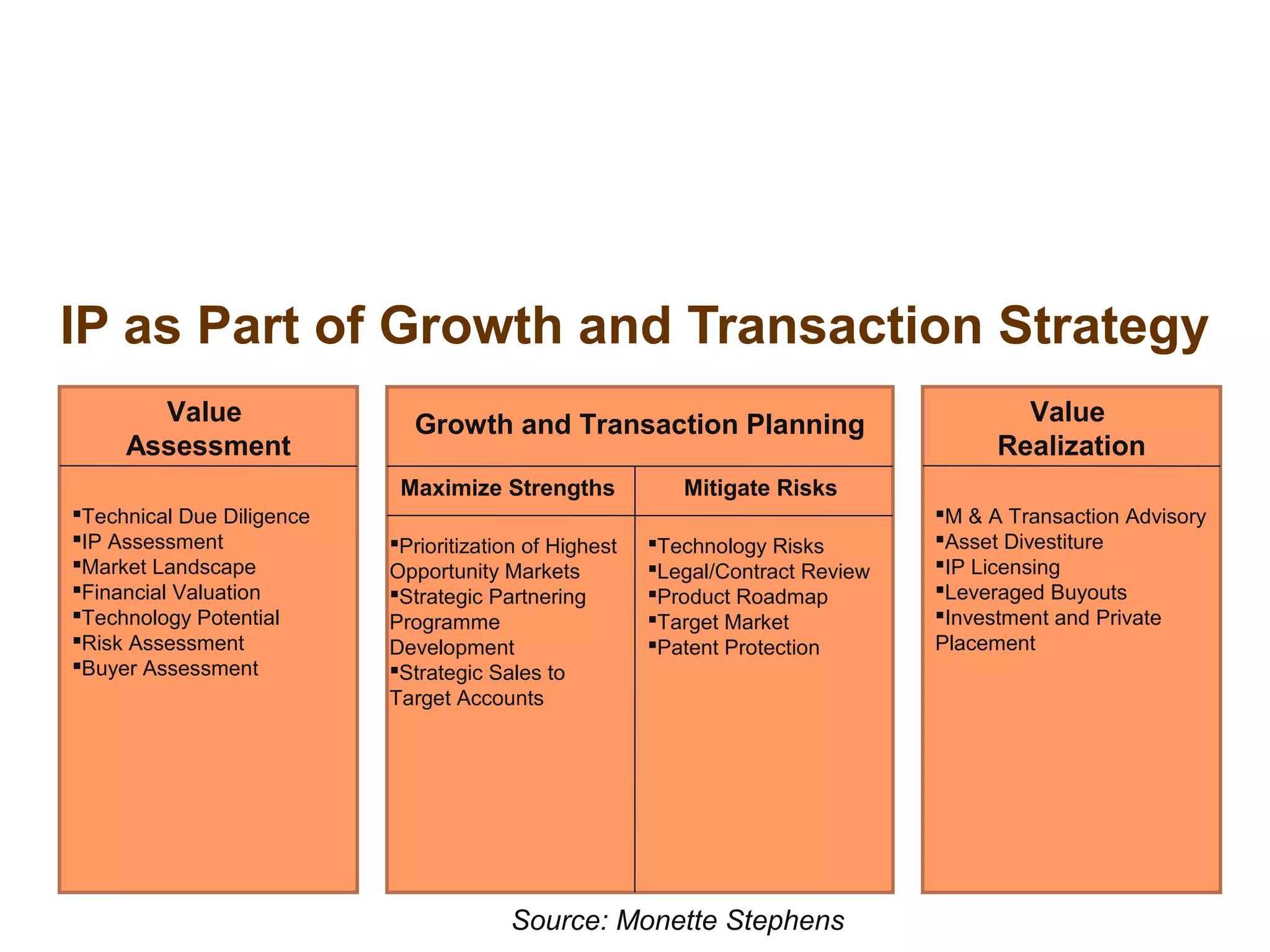
IP as Part of Growth and Transaction Strategy
Source: Monette Stephens
Value
Assessment
Value
Realization
Growth and Transaction Planning
Maximize Strengths Mitigate Risks
Technical Due Diligence
IP Assessment
Market Landscape
Financial Valuation
Technology Potential
Risk Assessment
Buyer Assessment
M & A Transaction Advisory
Asset Divestiture
IP Licensing
Leveraged Buyouts
Investment and Private
Placement
Prioritization of Highest
Opportunity Markets
Strategic Partnering
Programme
Development
Strategic Sales to
Target Accounts
Technology Risks
Legal/Contract Review
Product Roadmap
Target Market
Patent Protection
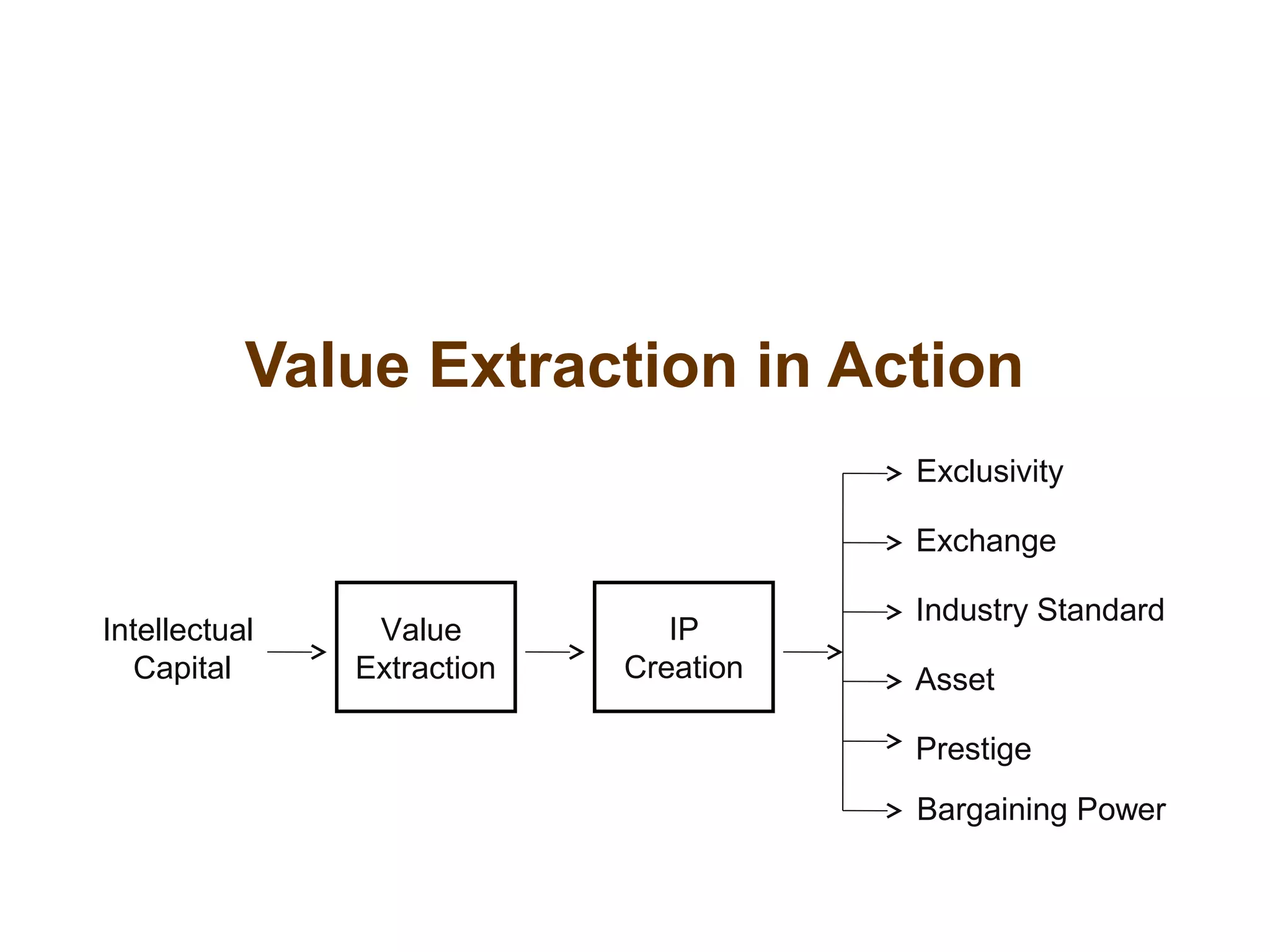
Value Extraction in Action
Intellectual
Capital
Value
Extraction
IP
Creation
Exclusivity
Exchange
Industry Standard
Asset
Prestige
Bargaining Power
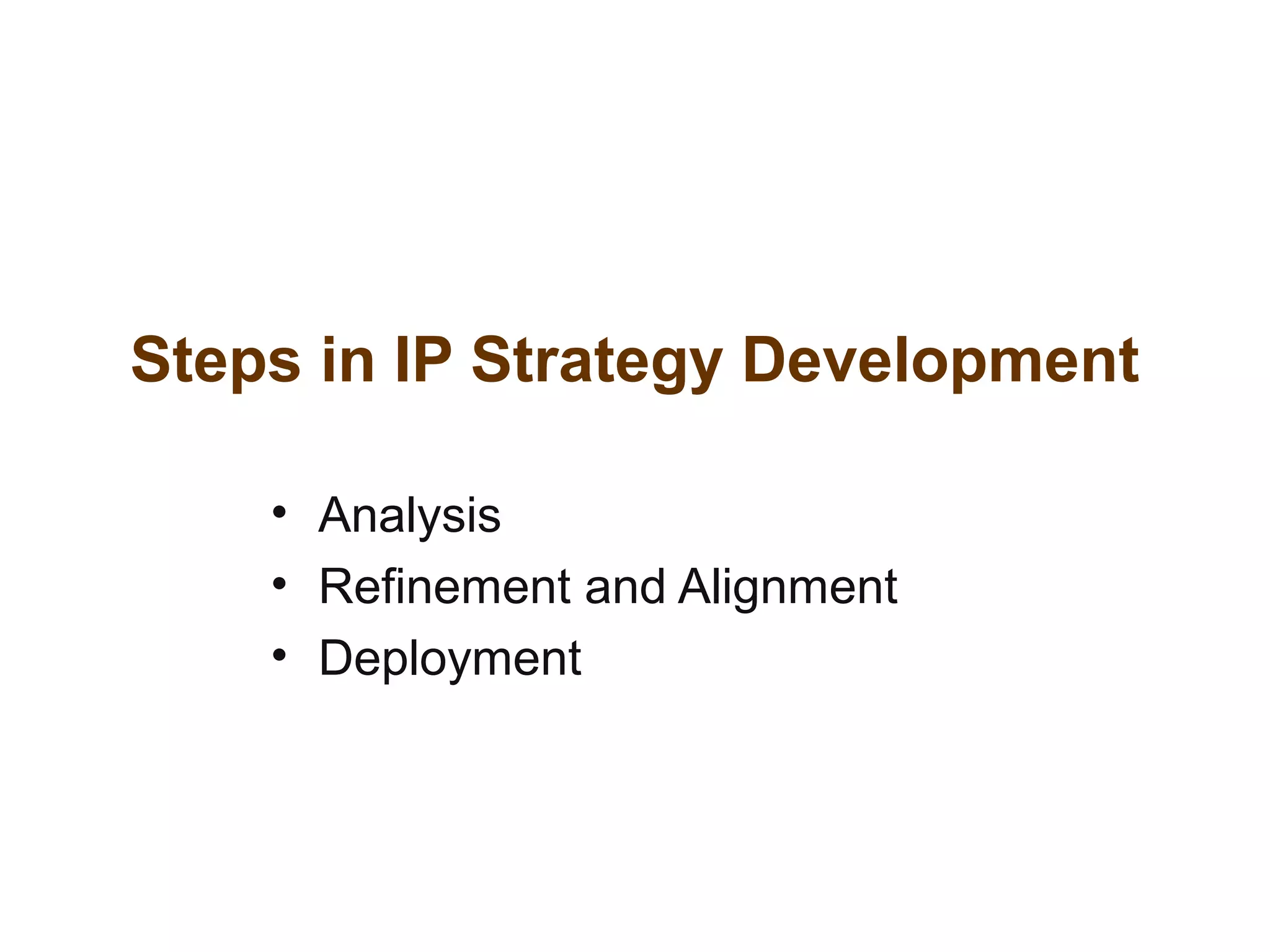
Steps in IP Strategy Development
• Analysis
• Refinement and Alignment
• Deployment
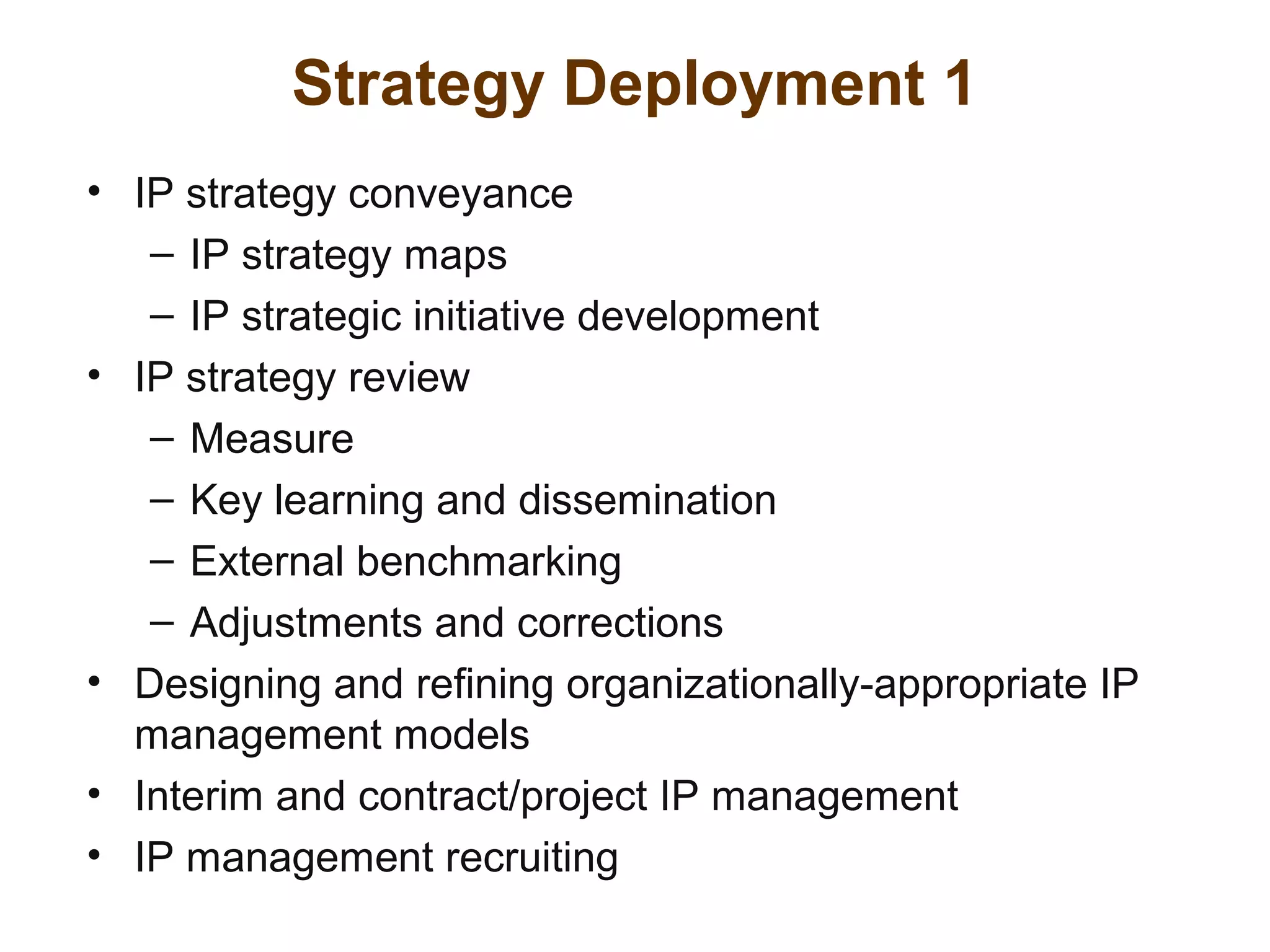
Strategy Deployment 1
• IP strategy conveyance
– IP strategy maps
– IP strategic initiative development
• IP strategy review
– Measure
– Key learning and dissemination
– External benchmarking
– Adjustments and corrections
• Designing and refining organizationally-appropriate IP
management models
• Interim and contract/project IP management
• IP management recruiting
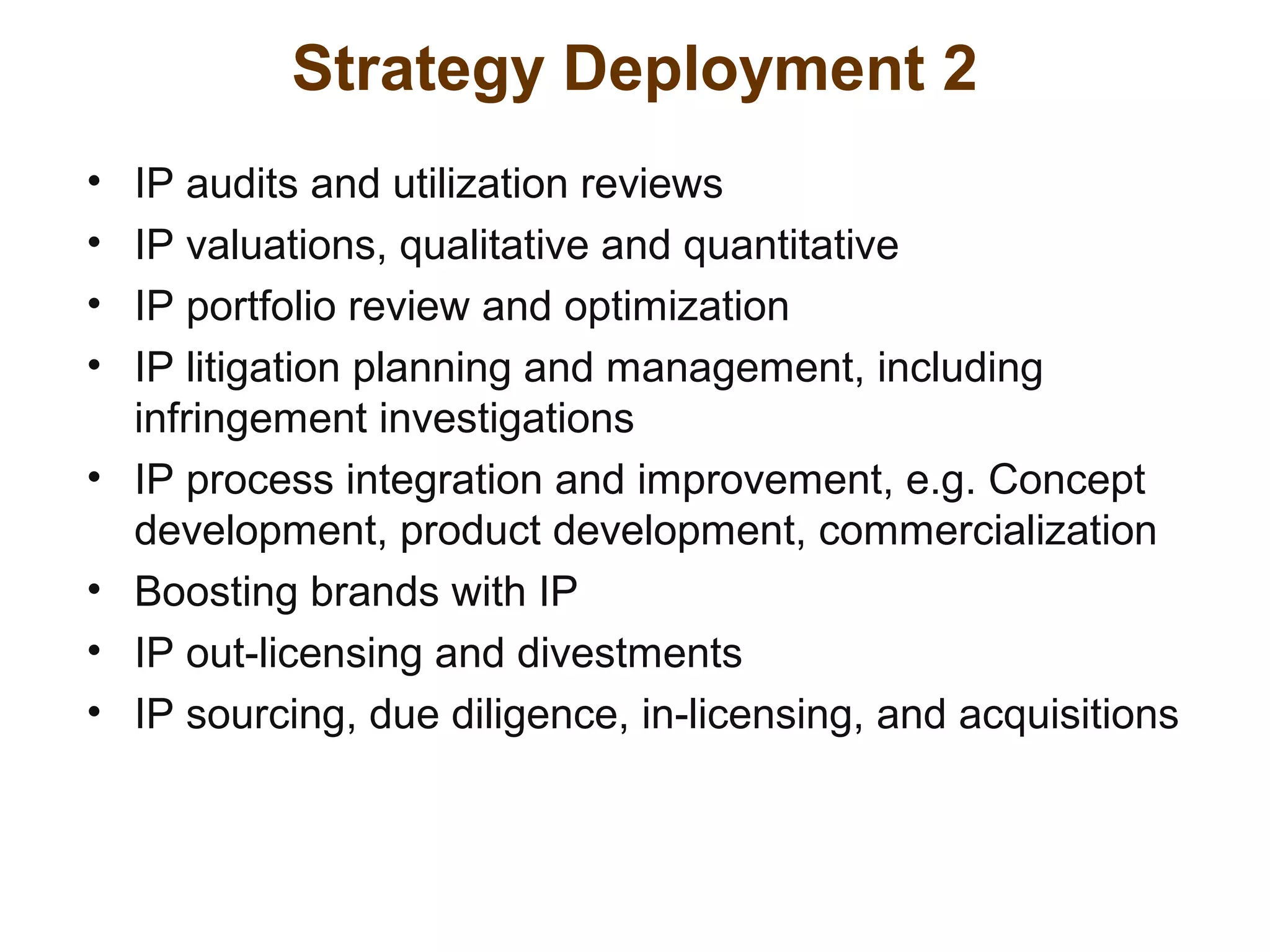
Strategy Deployment 2
• IP audits and utilization reviews
• IP valuations, qualitative and quantitative
• IP portfolio review and optimization
• IP litigation planning and management, including
infringement investigations
• IP process integration and improvement, e.g. Concept
development, product development, commercialization
• Boosting brands with IP
• IP out-licensing and divestments
• IP sourcing, due diligence, in-licensing, and acquisitions
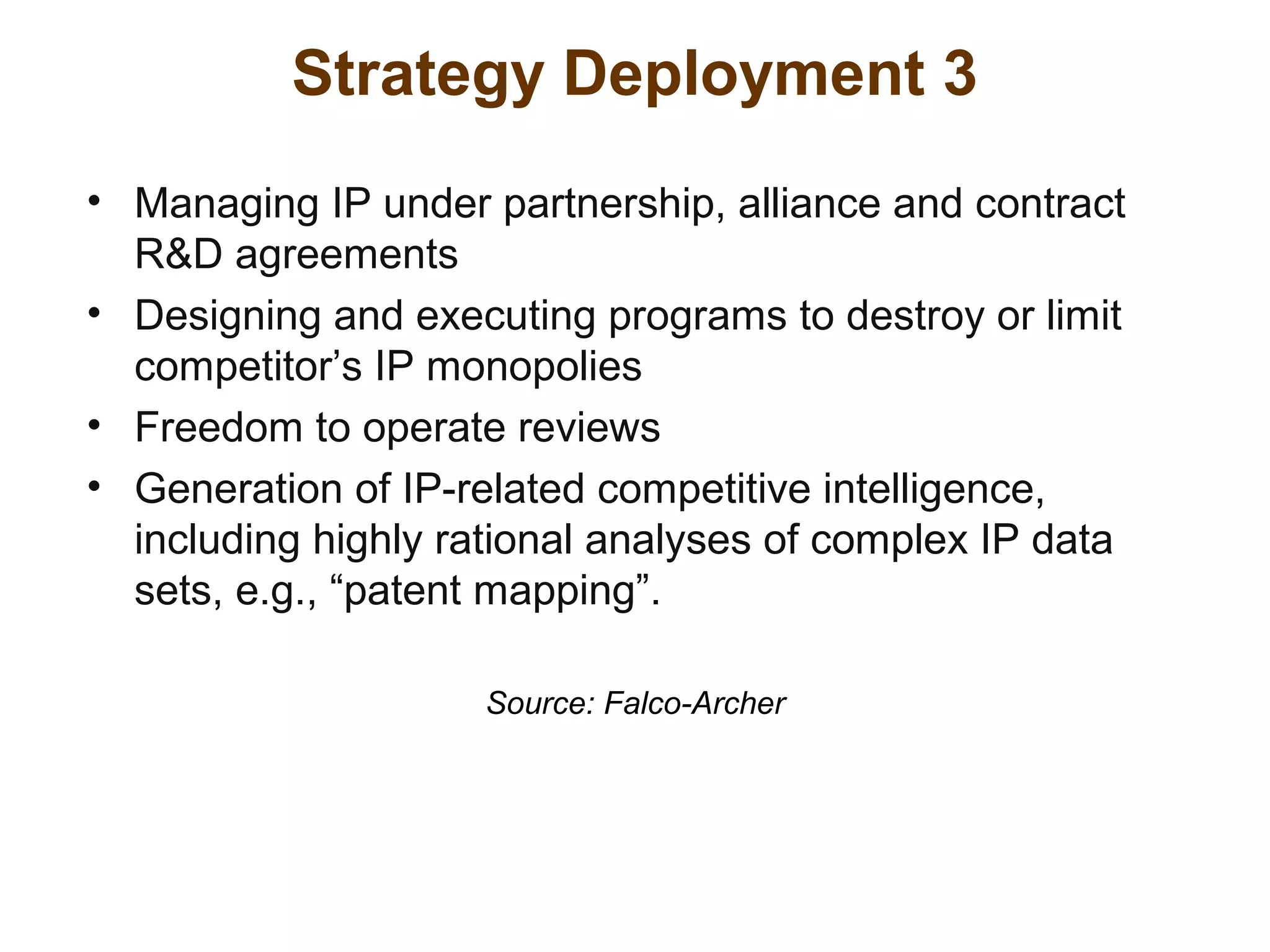
Strategy Deployment 3
• Managing IP under partnership, alliance and contract
R&D agreements
• Designing and executing programs to destroy or limit
competitor’s IP monopolies
• Freedom to operate reviews
• Generation of IP-related competitive intelligence,
including highly rational analyses of complex IP data
sets, e.g., “patent mapping”.
Source: Falco-Archer
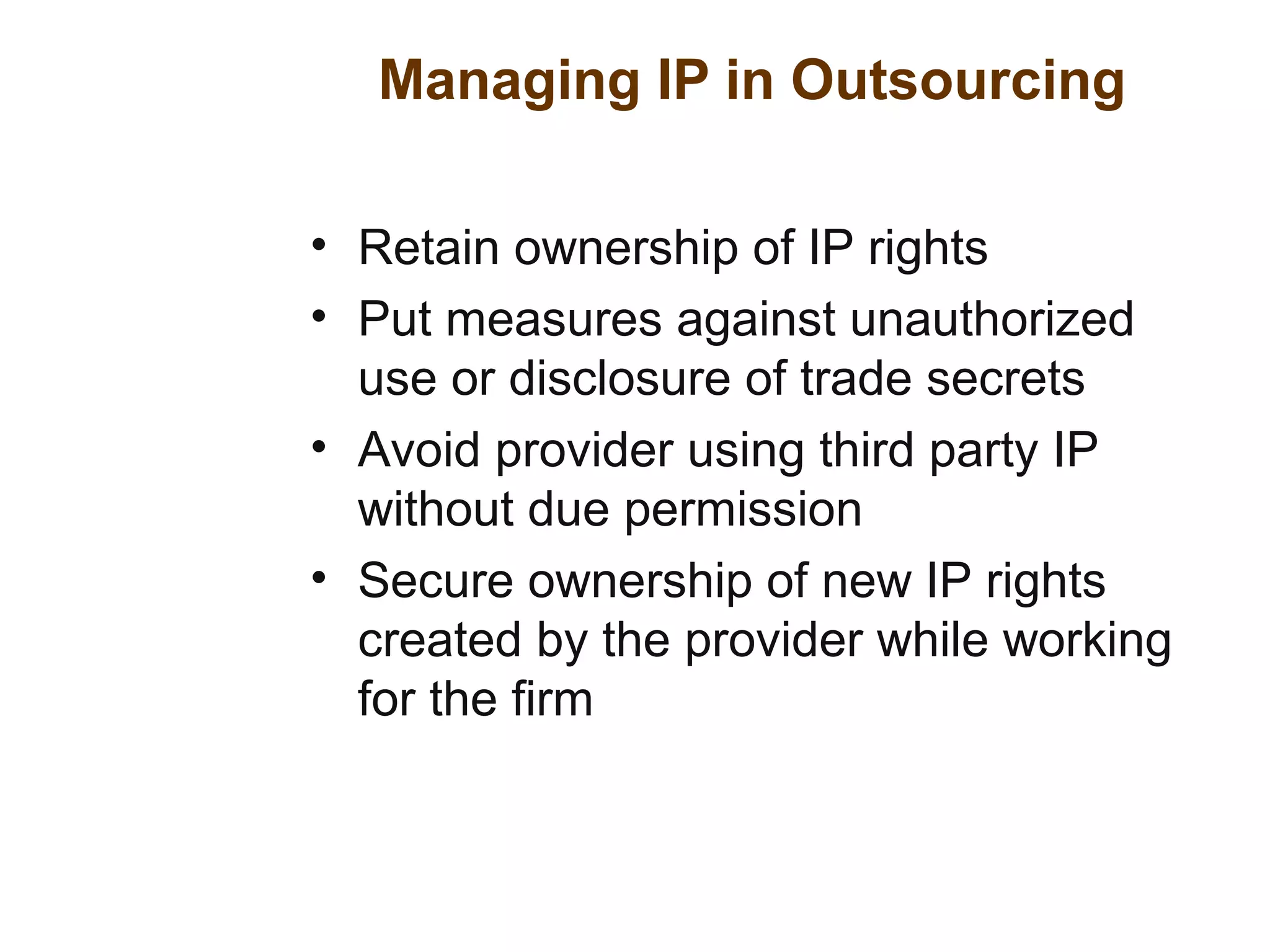
Managing IP in Outsourcing
• Retain ownership of IP rights
• Put measures against unauthorized
use or disclosure of trade secrets
• Avoid provider using third party IP
without due permission
• Secure ownership of new IP rights
created by the provider while working
for the firm
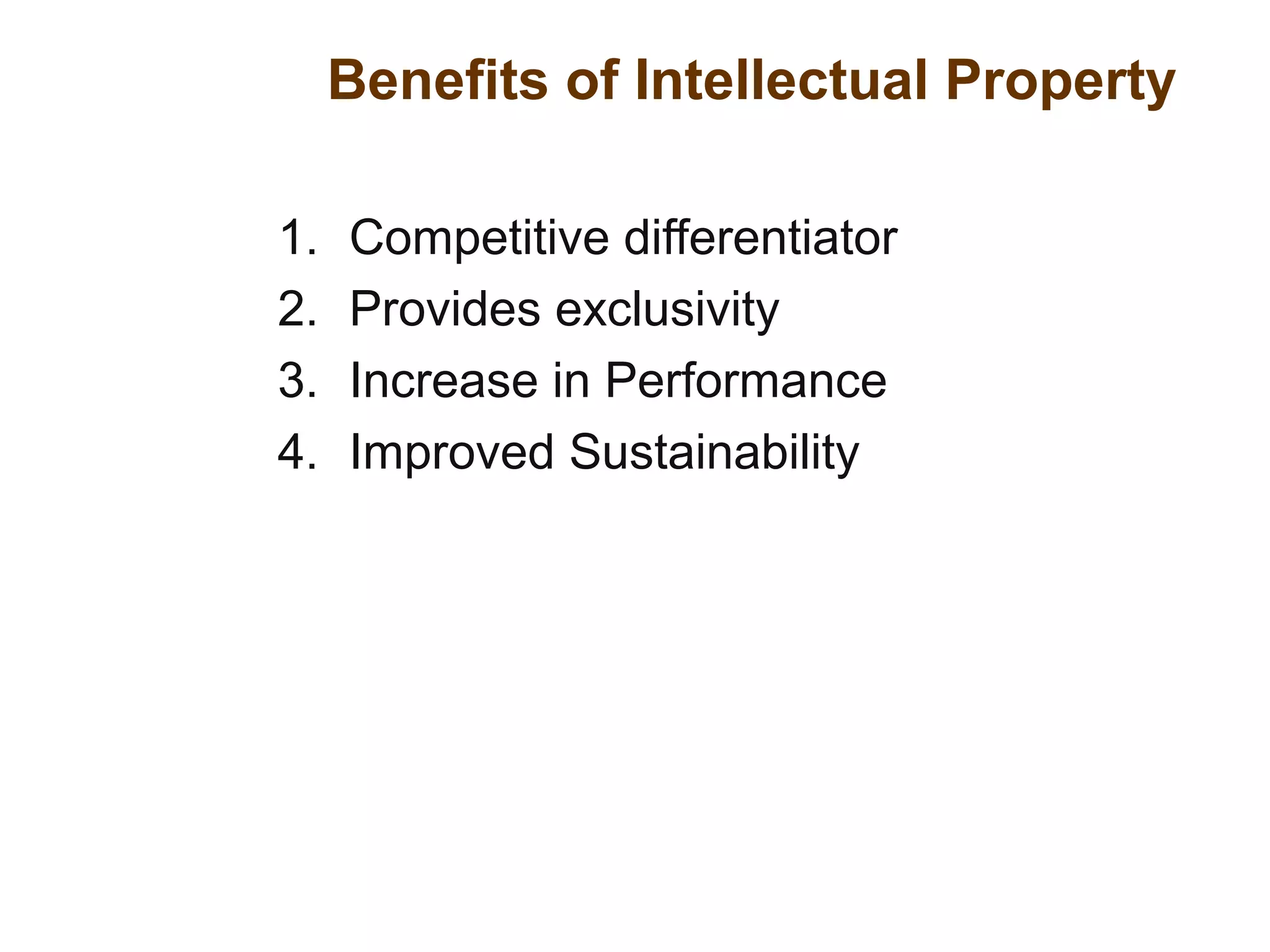
Benefits of Intellectual Property
1. Competitive differentiator
2. Provides exclusivity
3. Increase in Performance
4. Improved Sustainability
Types of Intellectual Property
1. Patents
2. Trademarks
3. Copyrights
4. Trade Secrets
5. Industrial Designs
6. Geographical Indication
Patent
“A patent is an exclusive right granted for an invention, which
is a product or a process that provides a new way of doing
something, or offers a new technical solution to a problem.
A patent provides protection for the invention to the owner
of the patent for a limited period, generally 20 years.”
- World Intellectual Property Organization
Features of Patent
• It’s a statutory monopoly for a particular invention
• It provides exclusive rights to use, sell, manufacture and
license that invention
• Its scope depends on claims
• protection occurs on issuance
• The rights are only in countries of issues
What is an Invention?
It’s a process, machine, art or
composition of matter which is new and
useful or fresh improvement.
Non-Patentable Things
i. General Information
ii. Mathematical Methods
iii. Things that are not useful
iv. Scientific Principles
v. Works of Authorship
vi. Procedure of Medical Treatment
vii. Discovery of new element or substance
Three Patent Approaches
i. Pioneering Patents: It’s usually short, broad and
general in focus due to absence of previous work.
ii. Improvement Patents: This is very detailed and
specific but still shorter than a product patent.
iii. Product Patents: This is a long and very detailed
patent that pertains to a specific product.
Types of Patents
• Provisional
• Utility
– Machine
– Process
– Article of Manufacture
– Composition of Matter
• Design
• Plant
Structure of a Patent
Abstract: General overview of the invention.
Specification:
• Description of the invention
• The manner and process of making and using it,
• The precise invention
• Describe completely specific embodiment of the process,
machine, manufacture, composition of matter, or
improvement invented, and must explain the mode of
operation or principle whenever applicable.
• Prior art
• Drawings
Claims:
• Defines the way that the patent will be used
• The claims are either independent or dependent on other
claims
Invalidity and Infringement
Invalidity:
• Prior Art
• General Knowledge
Infringement:
• This is attributable to excessively or
insufficiently broad claims
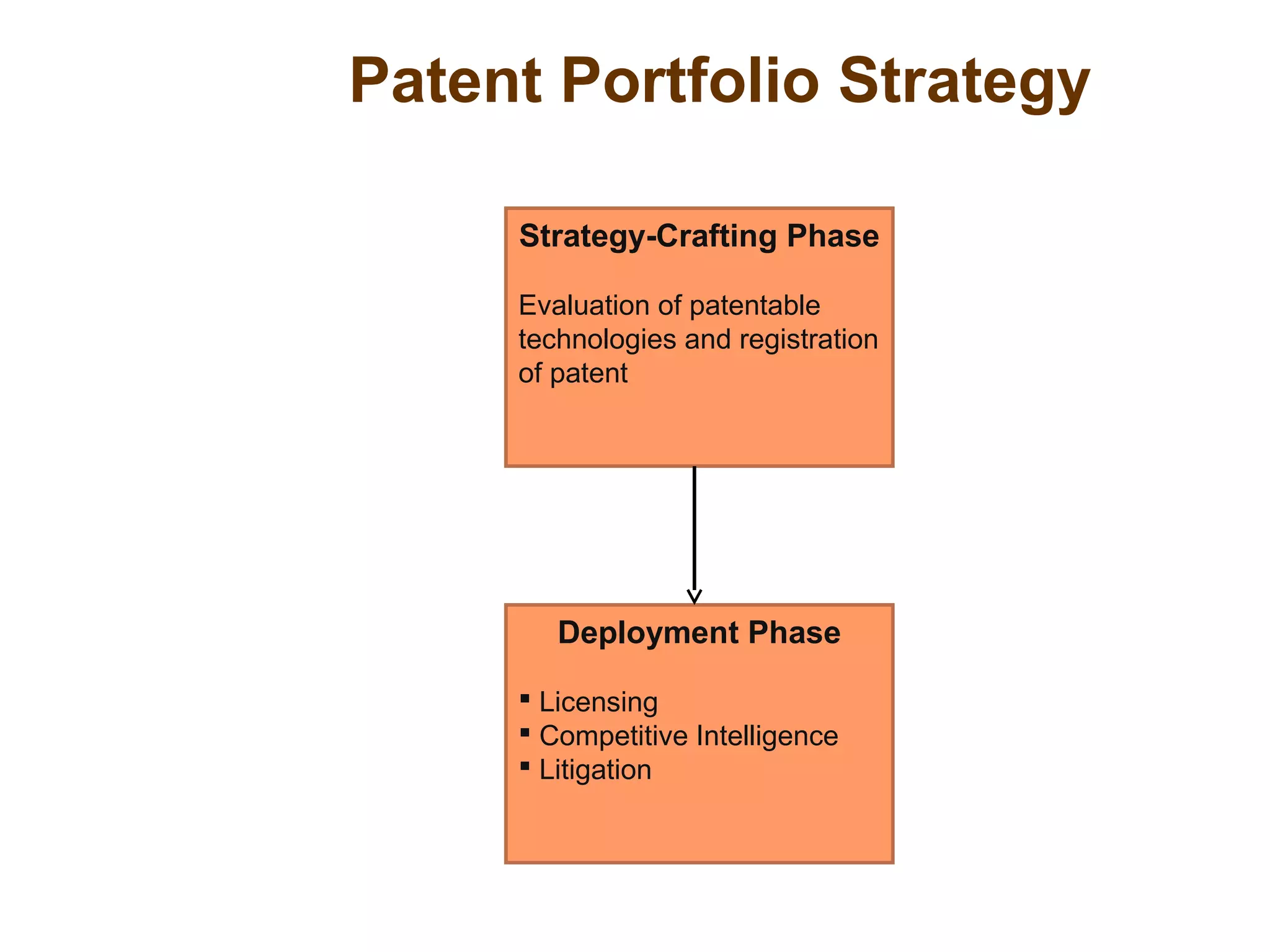
Strategy-Crafting Phase
Evaluation of patentable
technologies and registration
of patent
Deployment Phase
 Licensing
 Competitive Intelligence
 Litigation
Patent Portfolio Strategy
Patent Objectives
• Increase the firm’s market value
• Provide leverage for growth
• Protection of process/technology/patent
knowledge
• Facilitate protection of future business
Patent Portfolio Range
• Core patents: Used for protecting key
product innovations
• Camouflage Patents: Used for deceiving
competitors
• Minefield Patents: Used for inhibiting
competitors
• Application Patents: Used for protecting
methodology, equipment and parts
Patent Portfolio Analysis
• Relationship of Specified Technology
with Business Objectives
• Legal Status of Claim, Highlighting
Scope of Technology and Expanse of
draft
• Geographical Distribution
• Availability of Blocking-off Patent
• Average Life-Cycle of Technology
• Current Financial Performance
• Future Financial Performance
International Regulations
 Patent Cooperation Treaty (PCT)
http://www.wipo.int/treaties/en/registration/pct/
The PCT makes it possible to seek patent protection for an
invention simultaneously in each of a large number of
countries by filing an “international” patent application.
Such an application may be filed by anyone who is a
national or resident of a PCT contracting State. It may
generally be filed with the national patent office of the
contracting State of which the applicant is a national or
resident or, at the applicant’s option, with the International
Bureau of WIPO in Geneva.
 Trade-Related Aspect of Intellectual Property Rights
(TRIPS)
http://www.wto.org/english/tratop_e/TRIPS_e/trips_e.htm
The TRIPS Agreement is normally enforced by WTO
Inventorship and Assignment
Inventors within the organization should
be appropriately identified, rewarded
and harnessed.
Inventors should be obligated to assign
their rights to the firm. This can be
structured such that at the point of entry
into the firm, workers would be
mandated to assign rights of every
invention within the firm.
Patent Protection in Strategic Alliances
Patent strategy must drive a firm to apportion patent
rights within governing agreements of strategic
alliances. In this case, grounds for assignment are as
follows:
• Technology
• Inventorship
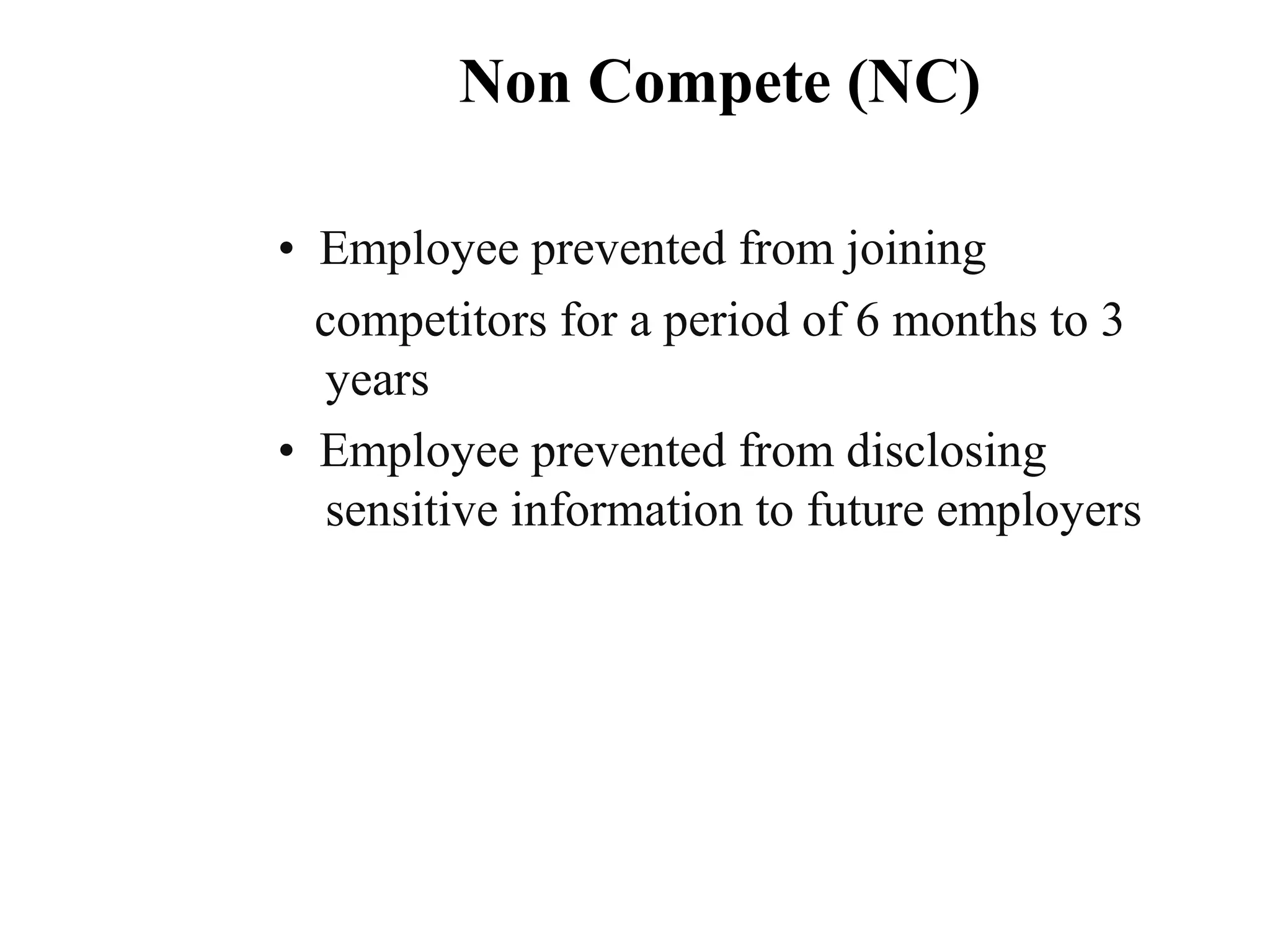
• Employee prevented from joining
competitors for a period of 6 months to 3
years
• Employee prevented from disclosing
sensitive information to future employers
Non Compete (NC)
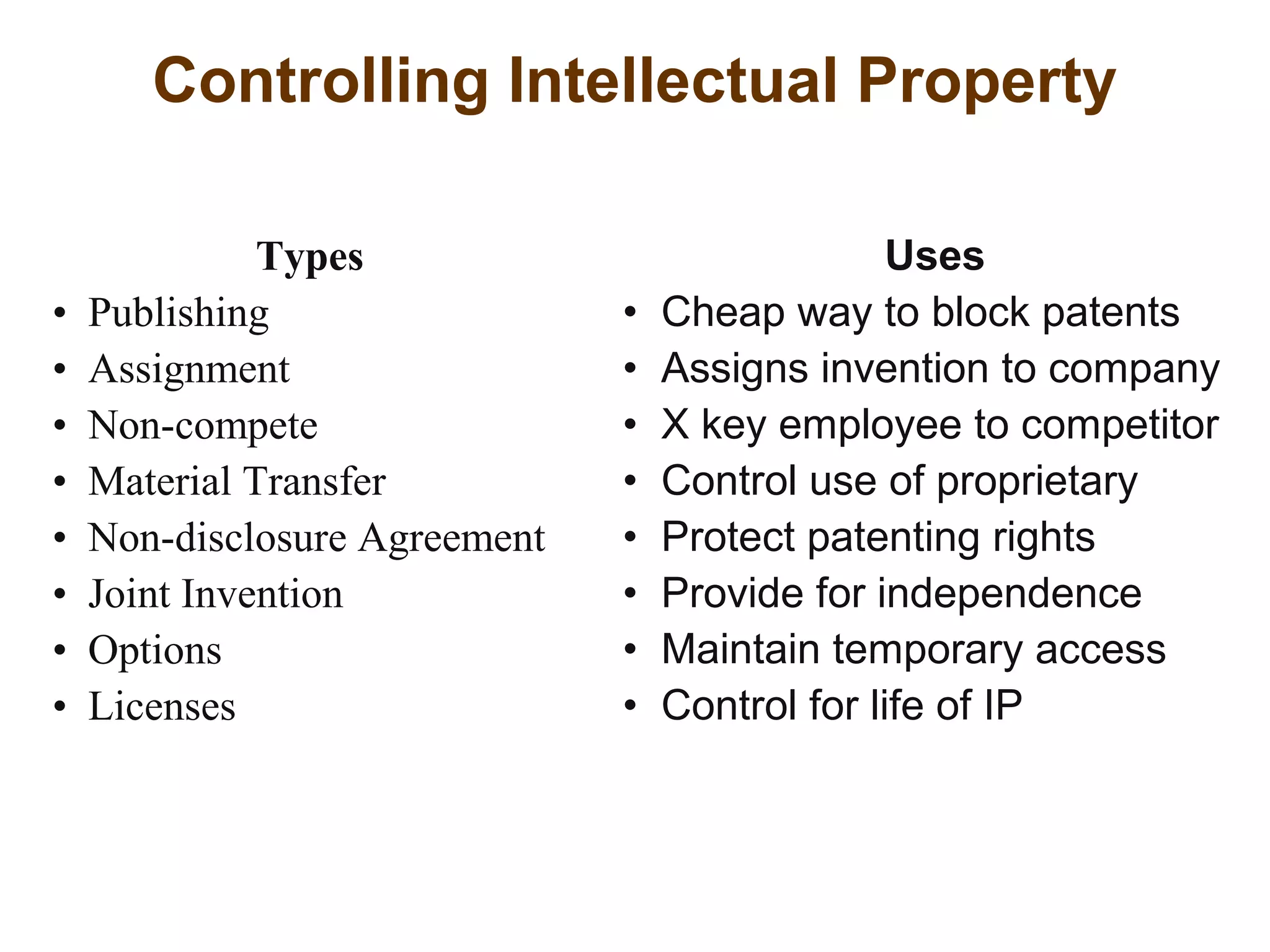
Controlling Intellectual Property
Uses
• Cheap way to block patents
• Assigns invention to company
• X key employee to competitor
• Control use of proprietary
• Protect patenting rights
• Provide for independence
• Maintain temporary access
• Control for life of IP
Types
• Publishing
• Assignment
• Non-compete
• Material Transfer
• Non-disclosure Agreement
• Joint Invention
• Options
• Licenses
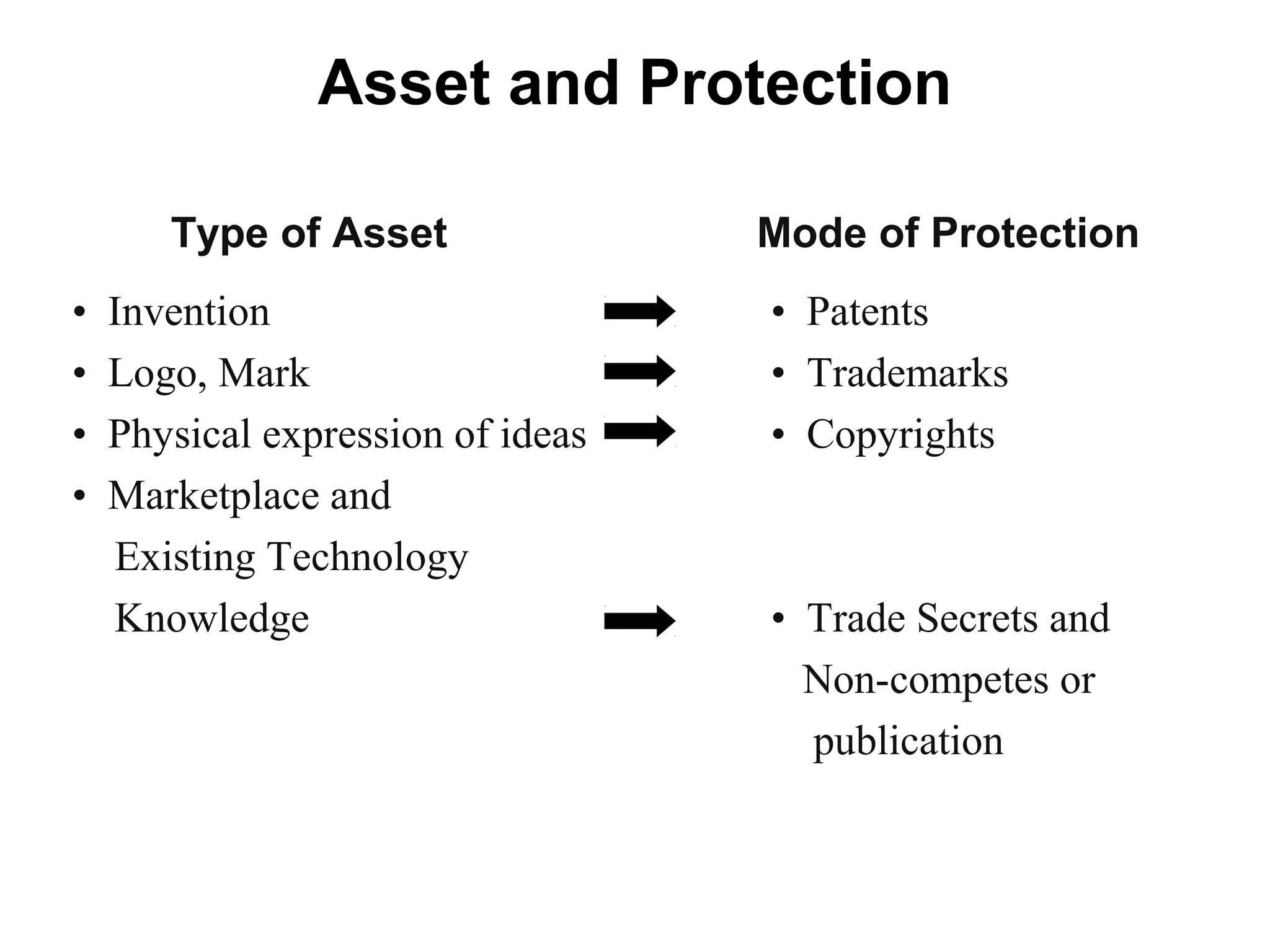
Asset and Protection
• Invention
• Logo, Mark
• Physical expression of ideas
• Marketplace and
Existing Technology
Knowledge
• Patents
• Trademarks
• Copyrights
• Trade Secrets and
Non-competes or
publication
Type of Asset Mode of Protection
Dr Elijah Ezendu is Award-Winning Business Expert & Certified Management Consultant with
expertise in Interim Management, Strategy, Competitive Intelligence, Transformation,
Restructuring, Turnaround Management, Business Development, Marketing, Project & Cost
Management, Leadership, HR, CSR, e-Business & Software Architecture. He had functioned as
Founder, Initiative for Sustainable Business Equity; Chairman of Board, Charisma Broadcast
Film Academy; Group Chief Operating Officer, Idova Group; CEO, Rubiini (UAE); Special
Advisor, RTEAN; Director, MMNA Investments; Chair, Int’l Board of GCC Business Council
(UAE); Senior Partner, Shevach Consulting; Chairman (Certification & Training), Coordinator
(Board of Fellows), Lead Assessor & Governing Council Member, Institute of Management
Consultants, Nigeria; Lead Resource, Centre for Competitive Intelligence Development; Lead
Consultant/ Partner, JK Michaels; Turnaround Project Director, Consolidated Business Holdings
Limited; Technical Director, Gestalt; Chief Operating Officer, Rohan Group; Executive Director
(Various Roles), Fortuna, Gambia & Malta; Chief Advisor/ Partner, D & E; Vice Chairman of
Board, Refined Shipping; Director of Programmes & Governing Council Member, Institute of
Business Development, Nigeria; Member of TDD Committee, International Association of
Software Architects, USA; Member of Strategic Planning and Implementation Committee,
Chartered Institute of Personnel Management of Nigeria; Country Manager (Nigeria) & Adjunct
Faculty (MBA Programme), Regent Business School, South Africa; Adjunct Faculty (MBA
Programme), Ladoke Akintola University of Technology; Editor-in-Chief, Cost Management
Journal; Council Member, Institute of Internal Auditors of Nigeria; Member, Board of Directors
(Several Organizations). He holds Doctoral Degree in Management, Master of Business
Administration and Fellow of Professional Institutes in North America, UK & Nigeria. He is
Innovator of Corporate Investment Structure Based on Financials and Intangibles, for valuation
highlighting intangible contributions of host communities and ecological environment: A model
celebrated globally as remedy for unmitigated depreciation of ecological capital and
developmental deprivation of host communities. He had served as Examiner to Professional
Thank You

Intellectual Property Strategy

  • 1.
    Intellectual Property Strategy Dr.Elijah Ezendu FIMC, FCCM, FIIAN, FBDI, FAAFM, FSSM, MIMIS, MIAP, MITD, ACIArb, ACIPM, PhD, DocM, MBA, CWM, CBDA, CMA, MPM, PME, CSOL, CCIP, CMC, CMgr
  • 2.
    “Skills and knowledgehave become the only source of sustainable long-term competitive advantage” - Lester Thurow
  • 3.
    Corporate IP 1. Howdoes the top management view IP? 2. Has your firm developed IP Strategy? 3. What is the expanse of the IP Portfolio? 4. Does your firm own its IP? 5. Is there any licensing or other agreements that compromised ownership? 6. What is the pricing standard for IP? 7. How effective is the fee collection?
  • 4.
    Valuation Measurement:  DiscountedCash Flow  Estimate of Market Size  Royalty Rate  Impact on Market Scorecards:  Normal Scorecards  Balanced Scorecards Assessment:  Standard Assessment System Measuring Value of Intellectual Property
  • 5.
    IP as Partof Growth and Transaction Strategy Source: Monette Stephens Value Assessment Value Realization Growth and Transaction Planning Maximize Strengths Mitigate Risks Technical Due Diligence IP Assessment Market Landscape Financial Valuation Technology Potential Risk Assessment Buyer Assessment M & A Transaction Advisory Asset Divestiture IP Licensing Leveraged Buyouts Investment and Private Placement Prioritization of Highest Opportunity Markets Strategic Partnering Programme Development Strategic Sales to Target Accounts Technology Risks Legal/Contract Review Product Roadmap Target Market Patent Protection
  • 6.
    Value Extraction inAction Intellectual Capital Value Extraction IP Creation Exclusivity Exchange Industry Standard Asset Prestige Bargaining Power
  • 7.
    Steps in IPStrategy Development • Analysis • Refinement and Alignment • Deployment
  • 8.
    Strategy Deployment 1 •IP strategy conveyance – IP strategy maps – IP strategic initiative development • IP strategy review – Measure – Key learning and dissemination – External benchmarking – Adjustments and corrections • Designing and refining organizationally-appropriate IP management models • Interim and contract/project IP management • IP management recruiting
  • 9.
    Strategy Deployment 2 •IP audits and utilization reviews • IP valuations, qualitative and quantitative • IP portfolio review and optimization • IP litigation planning and management, including infringement investigations • IP process integration and improvement, e.g. Concept development, product development, commercialization • Boosting brands with IP • IP out-licensing and divestments • IP sourcing, due diligence, in-licensing, and acquisitions
  • 10.
    Strategy Deployment 3 •Managing IP under partnership, alliance and contract R&D agreements • Designing and executing programs to destroy or limit competitor’s IP monopolies • Freedom to operate reviews • Generation of IP-related competitive intelligence, including highly rational analyses of complex IP data sets, e.g., “patent mapping”. Source: Falco-Archer
  • 11.
    Managing IP inOutsourcing • Retain ownership of IP rights • Put measures against unauthorized use or disclosure of trade secrets • Avoid provider using third party IP without due permission • Secure ownership of new IP rights created by the provider while working for the firm
  • 12.
    Benefits of IntellectualProperty 1. Competitive differentiator 2. Provides exclusivity 3. Increase in Performance 4. Improved Sustainability
  • 13.
    Types of IntellectualProperty 1. Patents 2. Trademarks 3. Copyrights 4. Trade Secrets 5. Industrial Designs 6. Geographical Indication
  • 14.
    Patent “A patent isan exclusive right granted for an invention, which is a product or a process that provides a new way of doing something, or offers a new technical solution to a problem. A patent provides protection for the invention to the owner of the patent for a limited period, generally 20 years.” - World Intellectual Property Organization
  • 15.
    Features of Patent •It’s a statutory monopoly for a particular invention • It provides exclusive rights to use, sell, manufacture and license that invention • Its scope depends on claims • protection occurs on issuance • The rights are only in countries of issues
  • 16.
    What is anInvention? It’s a process, machine, art or composition of matter which is new and useful or fresh improvement.
  • 17.
    Non-Patentable Things i. GeneralInformation ii. Mathematical Methods iii. Things that are not useful iv. Scientific Principles v. Works of Authorship vi. Procedure of Medical Treatment vii. Discovery of new element or substance
  • 18.
    Three Patent Approaches i.Pioneering Patents: It’s usually short, broad and general in focus due to absence of previous work. ii. Improvement Patents: This is very detailed and specific but still shorter than a product patent. iii. Product Patents: This is a long and very detailed patent that pertains to a specific product.
  • 19.
    Types of Patents •Provisional • Utility – Machine – Process – Article of Manufacture – Composition of Matter • Design • Plant
  • 20.
    Structure of aPatent Abstract: General overview of the invention. Specification: • Description of the invention • The manner and process of making and using it, • The precise invention • Describe completely specific embodiment of the process, machine, manufacture, composition of matter, or improvement invented, and must explain the mode of operation or principle whenever applicable. • Prior art • Drawings Claims: • Defines the way that the patent will be used • The claims are either independent or dependent on other claims
  • 21.
    Invalidity and Infringement Invalidity: •Prior Art • General Knowledge Infringement: • This is attributable to excessively or insufficiently broad claims
  • 22.
    Strategy-Crafting Phase Evaluation ofpatentable technologies and registration of patent Deployment Phase  Licensing  Competitive Intelligence  Litigation Patent Portfolio Strategy
  • 23.
    Patent Objectives • Increasethe firm’s market value • Provide leverage for growth • Protection of process/technology/patent knowledge • Facilitate protection of future business
  • 24.
    Patent Portfolio Range •Core patents: Used for protecting key product innovations • Camouflage Patents: Used for deceiving competitors • Minefield Patents: Used for inhibiting competitors • Application Patents: Used for protecting methodology, equipment and parts
  • 25.
    Patent Portfolio Analysis •Relationship of Specified Technology with Business Objectives • Legal Status of Claim, Highlighting Scope of Technology and Expanse of draft • Geographical Distribution • Availability of Blocking-off Patent • Average Life-Cycle of Technology • Current Financial Performance • Future Financial Performance
  • 26.
    International Regulations  PatentCooperation Treaty (PCT) http://www.wipo.int/treaties/en/registration/pct/ The PCT makes it possible to seek patent protection for an invention simultaneously in each of a large number of countries by filing an “international” patent application. Such an application may be filed by anyone who is a national or resident of a PCT contracting State. It may generally be filed with the national patent office of the contracting State of which the applicant is a national or resident or, at the applicant’s option, with the International Bureau of WIPO in Geneva.  Trade-Related Aspect of Intellectual Property Rights (TRIPS) http://www.wto.org/english/tratop_e/TRIPS_e/trips_e.htm The TRIPS Agreement is normally enforced by WTO
  • 27.
    Inventorship and Assignment Inventorswithin the organization should be appropriately identified, rewarded and harnessed. Inventors should be obligated to assign their rights to the firm. This can be structured such that at the point of entry into the firm, workers would be mandated to assign rights of every invention within the firm.
  • 28.
    Patent Protection inStrategic Alliances Patent strategy must drive a firm to apportion patent rights within governing agreements of strategic alliances. In this case, grounds for assignment are as follows: • Technology • Inventorship
  • 29.
    • Employee preventedfrom joining competitors for a period of 6 months to 3 years • Employee prevented from disclosing sensitive information to future employers Non Compete (NC)
  • 30.
    Controlling Intellectual Property Uses •Cheap way to block patents • Assigns invention to company • X key employee to competitor • Control use of proprietary • Protect patenting rights • Provide for independence • Maintain temporary access • Control for life of IP Types • Publishing • Assignment • Non-compete • Material Transfer • Non-disclosure Agreement • Joint Invention • Options • Licenses
  • 31.
    Asset and Protection •Invention • Logo, Mark • Physical expression of ideas • Marketplace and Existing Technology Knowledge • Patents • Trademarks • Copyrights • Trade Secrets and Non-competes or publication Type of Asset Mode of Protection
  • 32.
    Dr Elijah Ezenduis Award-Winning Business Expert & Certified Management Consultant with expertise in Interim Management, Strategy, Competitive Intelligence, Transformation, Restructuring, Turnaround Management, Business Development, Marketing, Project & Cost Management, Leadership, HR, CSR, e-Business & Software Architecture. He had functioned as Founder, Initiative for Sustainable Business Equity; Chairman of Board, Charisma Broadcast Film Academy; Group Chief Operating Officer, Idova Group; CEO, Rubiini (UAE); Special Advisor, RTEAN; Director, MMNA Investments; Chair, Int’l Board of GCC Business Council (UAE); Senior Partner, Shevach Consulting; Chairman (Certification & Training), Coordinator (Board of Fellows), Lead Assessor & Governing Council Member, Institute of Management Consultants, Nigeria; Lead Resource, Centre for Competitive Intelligence Development; Lead Consultant/ Partner, JK Michaels; Turnaround Project Director, Consolidated Business Holdings Limited; Technical Director, Gestalt; Chief Operating Officer, Rohan Group; Executive Director (Various Roles), Fortuna, Gambia & Malta; Chief Advisor/ Partner, D & E; Vice Chairman of Board, Refined Shipping; Director of Programmes & Governing Council Member, Institute of Business Development, Nigeria; Member of TDD Committee, International Association of Software Architects, USA; Member of Strategic Planning and Implementation Committee, Chartered Institute of Personnel Management of Nigeria; Country Manager (Nigeria) & Adjunct Faculty (MBA Programme), Regent Business School, South Africa; Adjunct Faculty (MBA Programme), Ladoke Akintola University of Technology; Editor-in-Chief, Cost Management Journal; Council Member, Institute of Internal Auditors of Nigeria; Member, Board of Directors (Several Organizations). He holds Doctoral Degree in Management, Master of Business Administration and Fellow of Professional Institutes in North America, UK & Nigeria. He is Innovator of Corporate Investment Structure Based on Financials and Intangibles, for valuation highlighting intangible contributions of host communities and ecological environment: A model celebrated globally as remedy for unmitigated depreciation of ecological capital and developmental deprivation of host communities. He had served as Examiner to Professional
  • 33.