Intellectual Property Overview


Obtaining protection and scope of protection:


Protecting your company’s intangible assets

Wouter Pors
Subject of protection - overview

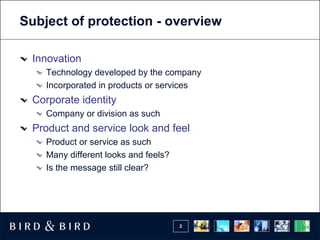
 Innovation
    Technology developed by the company
    Incorporated in products or services
 Corporate identity
    Company or division as such
 Product and service look and feel
    Product or service as such
    Many different looks and feels?
    Is the message still clear?


                                      2
Protecting innovation


                        3
Subject of protection

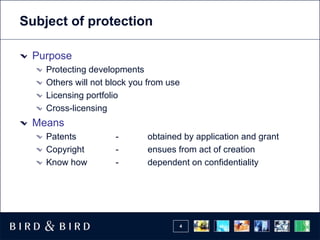
 Purpose
    Protecting developments
    Others will not block you from use
    Licensing portfolio
    Cross-licensing
 Means
    Patents          -       obtained by application and grant
    Copyright        -       ensues from act of creation
    Know how         -       dependent on confidentiality


                                     4
Scope of protection

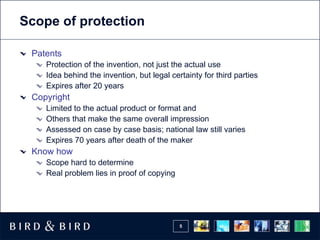
 Patents
    Protection of the invention, not just the actual use
    Idea behind the invention, but legal certainty for third parties
    Expires after 20 years
 Copyright
    Limited to the actual product or format and
    Others that make the same overall impression
    Assessed on case by case basis; national law still varies
    Expires 70 years after death of the maker
 Know how
    Scope hard to determine
    Real problem lies in proof of copying


                                            5
The company, the services


                       6
Subject of protection

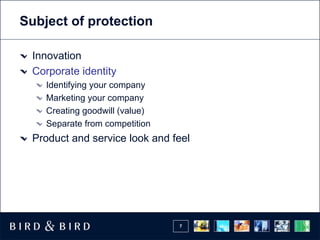
 Innovation
 Corporate identity
    Identifying your company
    Marketing your company
    Creating goodwill (value)
    Separate from competition
 Product and service look and feel


                                7
Subject of protection

 Innovation
 Corporate identity
 Product and service look and feel
    Identifying your company’s products and services
    Marketing your company’s products and services
    Creating goodwill (value)
    Separate from competition


                                    8
Means of protection

 Innovation
 Corporate identity
   Indication of origin   - collectively, granted by law
   Trade name             - through use in the course of trade
   Trade mark             - application and registration
   Copyright              - ensues from act of creation
 Product and service look and feel


                                  9
Means of protection

 Innovation
 Corporate identity
 Product and service look and feel
   Indication of origin   - collectively, granted by law
   Trade mark             - application and registration
   Design right           - application and registration
                          - unregistered design rights
   Copyright              - ensues from act of creation


                                  10
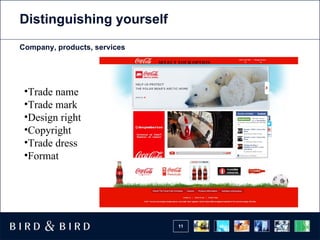
Distinguishing yourself
Company, products, services


 •Trade name
 •Trade mark
 •Design right
 •Copyright
 •Trade dress
 •Format


                              11
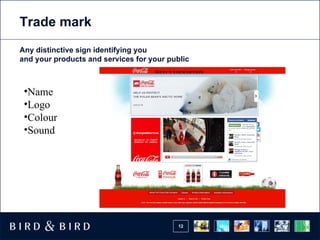
Trade mark
Any distinctive sign identifying you
and your products and services for your public


 •Name
 •Logo
 •Colour
 •Sound


                                           12
Trade marks


   Monopoly on distinctive sign for products or services
   Harmonised European law
   Acquired by registration (first come)
   Choice between National and European Community
   International: bundle of national rights
   Must have distinctiveness (not descriptive)
   Words, logo’s, shapes, colours, sounds
   Perpetual, if renewed regularly
   Works against confusingly similar younger signs


                                    13
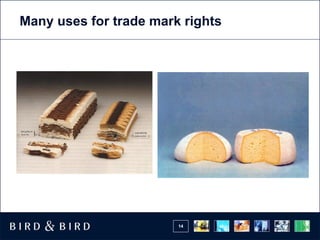
Many uses for trade mark rights


                        14
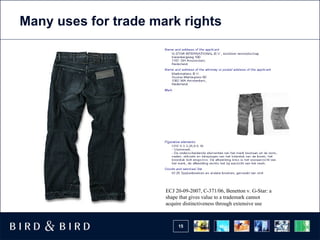
Many uses for trade mark rights


                      ECJ 20-09-2007, C-371/06, Benetton v. G-Star: a
                      shape that gives value to a trademark cannot
                      acquire distinctiveness through extensive use


                           15
Baby-dry is distinctive

 Not valid are signs which may serve in normal usage from a
 consumer's point of view to designate, either directly or by reference
 to one of their essential characteristics, goods or services such as

 those in respect of which registration is sought. Furthermore, a
 mark composed of signs or indications satisfying that definition
 should not be refused registration unless it comprises no other
 signs or indications and, in addition, the purely descriptive signs or
 indications of which it is composed are not presented or configured
 in a manner that distinguishes the resultant whole from the usual
 way of designating the goods or services concerned or their
 essential characteristics. (ECJ 20 September 2001, C 383/99 P)


                                       16
But Postkantoor is not!

 A mark consisting of a word composed of
 elements, each of which is descriptive of characteristics of the goods or
 services in respect of which registration is sought, is itself descriptive of the
 characteristics of those goods or services for the purposes of that provision,
 unless there is a perceptible difference between the word and the mere sum
 of its parts: that assumes either that
 because of the unusual nature of the combination in relation to the goods or
 services the word creates an impression which is sufficiently far removed
 from that produced by the mere combination of meanings lent by the
 elements of which it is composed, with the result that the word is more than
 the sum of its parts, or that
 the word has become part of everyday language and has acquired its own
 meaning, with the result that it is now independent of its components.
 In the latter case, it is necessary to ascertain whether a word which has
 acquired its own meaning is not itself descriptive for the purposes of the
 same provision. (ECJ 12 February 2004, C-363/99)


                                             17
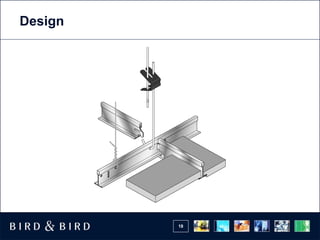
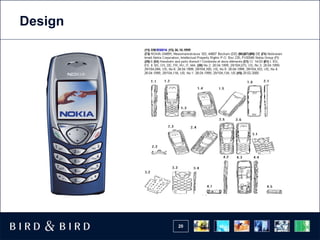
Design


         18
Design


   Monopoly on shape of product or pattern on product
   Harmonised European law
   Acquired by registration (first come)
   Choice between National and European Community
   Must be novel
   Maximum protection 25 years
   Works against confusingly similar designs
   Unregistered design right
      Protection for 3 years
      Less certainty
      Fall-back where no copyright can be invoked


                                     19
Design


         20
Design


   Scope of protection
       Multiple design registration to protect all features
   Limitations on design rights: pitfalls
      Registering new version of product only protects the changes
      Technical features are not protected (trademark case before the
      ECJ: Philips v. Remington)
      Must fit exception for parts
   Way out: copyright
       On the design as a whole
       On specific elements of the design


                                          21
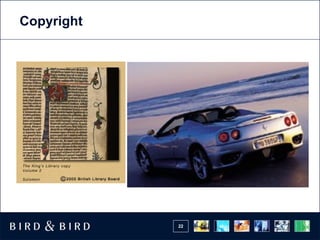
Copyright


            22
Copyright

   Monopoly on “a work”: text, design, lay-out, format
   National law, partly European and world-wide harmonisation
      Copyrights for non-artistic works not accepted everywhere
      Same goes for technical works
   Automatic creation by making “a work” (proof of priority needed!)
   Must be original and bearing the mark of it’s maker
   World-wide protection if recognised (creative level)
   Protection 70 years after death of the maker
   Very broad possibilities
   Works against copies and look-alikes


                                      23
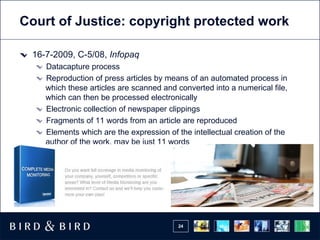
Court of Justice: copyright protected work

 16-7-2009, C-5/08, Infopaq
    Datacapture process
    Reproduction of press articles by means of an automated process in
    which these articles are scanned and converted into a numerical file,
    which can then be processed electronically
    Electronic collection of newspaper clippings
    Fragments of 11 words from an article are reproduced
    Elements which are the expression of the intellectual creation of the
    author of the work, may be just 11 words


                                         24
Application of copyright

 Traditional: text, music, theatre, film
 New application

    Trade dress
    Software, designs, objects for everyday use
    TV programme formats
    Business method formats


                                    25
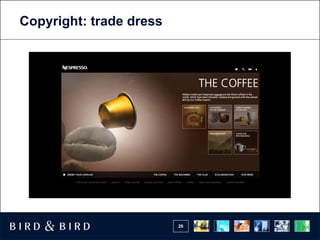
Copyright: trade dress


                         26
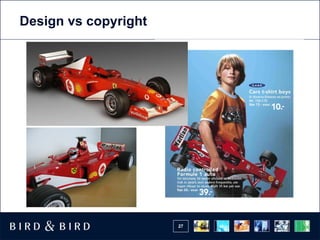
Design vs copyright


                      27
Patents vs copyright: technology


                          28
Patents vs copyright: technology

 Exception for technology as such
 Dutch Supreme Court 24-2-2006 Technip
   Kinetic scheme of chemical equations as part of computer
   simulation program for petrochemical industry
   Selection relates to objective scientific data and laws of nature,
   scientific or technical purpose
   Original and expression of intellectual creation of the maker
   Selection base on scientific or technical knowledge of the
   maker, insights and experience
   Court of Appeal: protection
 Scope of exception is limited


                                      29
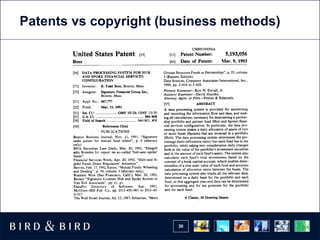
Patents vs copyright (business methods)


                       30
Patents vs copyright


 US: anything under the sun made by man is patentable
    But: in re Bilski, 30 October 2008
 Europe: only technical inventions, no business methods
 Copyright: once again the solution to provide equality of
 investment protection between US and Europe?
 However: does not protect the purely technical solution,
 “look and feel” have to be added


                                         31
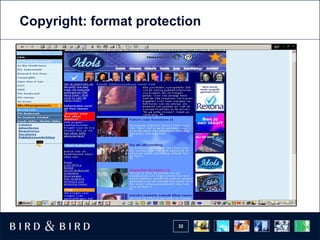
Copyright: format protection


                        32
Copyright: format protection

 Well established: TV-programmes
    Dutch Supreme Court: Una voce particolare
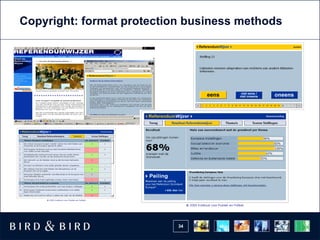
 New: business methods
    District Court The Hague 27 April 2005 Referendumwijzer
 What is the strategy?
    Situation unclear
    Case law still developing
    Completely accepted in business in media sector
    Might fill the gap for investors
    Prepare in case this confirmed in the courts
    File evidence of the creation of the format and its priority


                                           33
Copyright: format protection business methods


                           34
Develop a strategy

 What exactly are your assets?
 What are their distinctive features?
 Which rights should you invoke to protect those?
 What actions need to be taken for protection?
 What is your market and where will it go?
 Don’t take a national approach, rights may vary!
 Which competing rights are surrounding your assets?
 What can you afford to invest?
 How can you postpone investments?


                              35
Exploiting your protection

 Building a licensing strategy
 What about transfer pricing and taxation of royalties?
 Which legal entity should be the right owner and where
 should it be?
 Allocate the investments to the right owner!
 Beware of competition law issues


                               36
Defending your investment

 Are you prepared to litigate?
 Pro-active, aggressive or defensive approach?


                                    37
Participation of licensees

  License agreements
  Involving licensees in your business strategy
  Non-circumvention
  Sub-licensing authority
  Active monitoring of infringements
  Common approach towards infringements


                                 38
Wouter Pors
   Bird & Bird The Hague
   Van Alkemadelaan 700
       PO Box 30311
    2500 GH The Hague
   T: +31 (0)70 353 8825
   F: +31 (0)70 353 8882
   M: +31 (0)653 293 896
E: wouter.pors@twobirds.com


                 39

2011 11 14 Les Licensing Course

  • 1.
    Intellectual Property Overview Obtainingprotection and scope of protection: Protecting your company’s intangible assets Wouter Pors
  • 2.
    Subject of protection- overview Innovation Technology developed by the company Incorporated in products or services Corporate identity Company or division as such Product and service look and feel Product or service as such Many different looks and feels? Is the message still clear? 2
  • 3.
  • 4.
    Subject of protection Purpose Protecting developments Others will not block you from use Licensing portfolio Cross-licensing Means Patents - obtained by application and grant Copyright - ensues from act of creation Know how - dependent on confidentiality 4
  • 5.
    Scope of protection Patents Protection of the invention, not just the actual use Idea behind the invention, but legal certainty for third parties Expires after 20 years Copyright Limited to the actual product or format and Others that make the same overall impression Assessed on case by case basis; national law still varies Expires 70 years after death of the maker Know how Scope hard to determine Real problem lies in proof of copying 5
  • 6.
    The company, theservices 6
  • 7.
    Subject of protection Innovation Corporate identity Identifying your company Marketing your company Creating goodwill (value) Separate from competition Product and service look and feel 7
  • 8.
    Subject of protection Innovation Corporate identity Product and service look and feel Identifying your company’s products and services Marketing your company’s products and services Creating goodwill (value) Separate from competition 8
  • 9.
    Means of protection Innovation Corporate identity Indication of origin - collectively, granted by law Trade name - through use in the course of trade Trade mark - application and registration Copyright - ensues from act of creation Product and service look and feel 9
  • 10.
    Means of protection Innovation Corporate identity Product and service look and feel Indication of origin - collectively, granted by law Trade mark - application and registration Design right - application and registration - unregistered design rights Copyright - ensues from act of creation 10
  • 11.
    Distinguishing yourself Company, products,services •Trade name •Trade mark •Design right •Copyright •Trade dress •Format 11
  • 12.
    Trade mark Any distinctivesign identifying you and your products and services for your public •Name •Logo •Colour •Sound 12
  • 13.
    Trade marks Monopoly on distinctive sign for products or services Harmonised European law Acquired by registration (first come) Choice between National and European Community International: bundle of national rights Must have distinctiveness (not descriptive) Words, logo’s, shapes, colours, sounds Perpetual, if renewed regularly Works against confusingly similar younger signs 13
  • 14.
    Many uses fortrade mark rights 14
  • 15.
    Many uses fortrade mark rights ECJ 20-09-2007, C-371/06, Benetton v. G-Star: a shape that gives value to a trademark cannot acquire distinctiveness through extensive use 15
  • 16.
    Baby-dry is distinctive Not valid are signs which may serve in normal usage from a consumer's point of view to designate, either directly or by reference to one of their essential characteristics, goods or services such as those in respect of which registration is sought. Furthermore, a mark composed of signs or indications satisfying that definition should not be refused registration unless it comprises no other signs or indications and, in addition, the purely descriptive signs or indications of which it is composed are not presented or configured in a manner that distinguishes the resultant whole from the usual way of designating the goods or services concerned or their essential characteristics. (ECJ 20 September 2001, C 383/99 P) 16
  • 17.
    But Postkantoor isnot! A mark consisting of a word composed of elements, each of which is descriptive of characteristics of the goods or services in respect of which registration is sought, is itself descriptive of the characteristics of those goods or services for the purposes of that provision, unless there is a perceptible difference between the word and the mere sum of its parts: that assumes either that because of the unusual nature of the combination in relation to the goods or services the word creates an impression which is sufficiently far removed from that produced by the mere combination of meanings lent by the elements of which it is composed, with the result that the word is more than the sum of its parts, or that the word has become part of everyday language and has acquired its own meaning, with the result that it is now independent of its components. In the latter case, it is necessary to ascertain whether a word which has acquired its own meaning is not itself descriptive for the purposes of the same provision. (ECJ 12 February 2004, C-363/99) 17
  • 18.
  • 19.
    Design Monopoly on shape of product or pattern on product Harmonised European law Acquired by registration (first come) Choice between National and European Community Must be novel Maximum protection 25 years Works against confusingly similar designs Unregistered design right Protection for 3 years Less certainty Fall-back where no copyright can be invoked 19
  • 20.
  • 21.
    Design Scope of protection Multiple design registration to protect all features Limitations on design rights: pitfalls Registering new version of product only protects the changes Technical features are not protected (trademark case before the ECJ: Philips v. Remington) Must fit exception for parts Way out: copyright On the design as a whole On specific elements of the design 21
  • 22.
  • 23.
    Copyright Monopoly on “a work”: text, design, lay-out, format National law, partly European and world-wide harmonisation Copyrights for non-artistic works not accepted everywhere Same goes for technical works Automatic creation by making “a work” (proof of priority needed!) Must be original and bearing the mark of it’s maker World-wide protection if recognised (creative level) Protection 70 years after death of the maker Very broad possibilities Works against copies and look-alikes 23
  • 24.
    Court of Justice:copyright protected work 16-7-2009, C-5/08, Infopaq Datacapture process Reproduction of press articles by means of an automated process in which these articles are scanned and converted into a numerical file, which can then be processed electronically Electronic collection of newspaper clippings Fragments of 11 words from an article are reproduced Elements which are the expression of the intellectual creation of the author of the work, may be just 11 words 24
  • 25.
    Application of copyright Traditional: text, music, theatre, film New application Trade dress Software, designs, objects for everyday use TV programme formats Business method formats 25
  • 26.
  • 27.
  • 28.
    Patents vs copyright:technology 28
  • 29.
    Patents vs copyright:technology Exception for technology as such Dutch Supreme Court 24-2-2006 Technip Kinetic scheme of chemical equations as part of computer simulation program for petrochemical industry Selection relates to objective scientific data and laws of nature, scientific or technical purpose Original and expression of intellectual creation of the maker Selection base on scientific or technical knowledge of the maker, insights and experience Court of Appeal: protection Scope of exception is limited 29
  • 30.
    Patents vs copyright(business methods) 30
  • 31.
    Patents vs copyright US: anything under the sun made by man is patentable But: in re Bilski, 30 October 2008 Europe: only technical inventions, no business methods Copyright: once again the solution to provide equality of investment protection between US and Europe? However: does not protect the purely technical solution, “look and feel” have to be added 31
  • 32.
  • 33.
    Copyright: format protection Well established: TV-programmes Dutch Supreme Court: Una voce particolare New: business methods District Court The Hague 27 April 2005 Referendumwijzer What is the strategy? Situation unclear Case law still developing Completely accepted in business in media sector Might fill the gap for investors Prepare in case this confirmed in the courts File evidence of the creation of the format and its priority 33
  • 34.
    Copyright: format protectionbusiness methods 34
  • 35.
    Develop a strategy What exactly are your assets? What are their distinctive features? Which rights should you invoke to protect those? What actions need to be taken for protection? What is your market and where will it go? Don’t take a national approach, rights may vary! Which competing rights are surrounding your assets? What can you afford to invest? How can you postpone investments? 35
  • 36.
    Exploiting your protection Building a licensing strategy What about transfer pricing and taxation of royalties? Which legal entity should be the right owner and where should it be? Allocate the investments to the right owner! Beware of competition law issues 36
  • 37.
    Defending your investment Are you prepared to litigate? Pro-active, aggressive or defensive approach? 37
  • 38.
    Participation of licensees License agreements Involving licensees in your business strategy Non-circumvention Sub-licensing authority Active monitoring of infringements Common approach towards infringements 38
  • 39.
    Wouter Pors Bird & Bird The Hague Van Alkemadelaan 700 PO Box 30311 2500 GH The Hague T: +31 (0)70 353 8825 F: +31 (0)70 353 8882 M: +31 (0)653 293 896 E: wouter.pors@twobirds.com 39