BRANDING 
WORKBOOK
BRANDING 
A brand is not your logo. A brand is not your identity. A brand is not a product. 
A brand is a person’s gut feeling about a product, service, or organization. Brands 
are now defined by individuals, not companies or markets. It’s a gut feeling because 
people are emotional, intuitive beings and make decisions based upon those 
feelings. So, it’s not what you say it is, it’s what they say it is.
SO WHY ARE WE HERE? 
Branding can evoke trust, reliability, and delight.
THE PACKAGE 
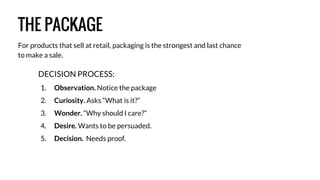
For products that sell at retail, packaging is the strongest and last chance 
to make a sale. 
DECISION PROCESS: 
1. Observation. Notice the package 
2. Curiosity. Asks “What is it?” 
3. Wonder. “Why should I care?” 
4. Desire. Wants to be persuaded. 
5. Decision. Needs proof.
EFFECTIVENESS 
By presenting information to match this 
sequence a package can sell a product more 
effectively.
WHAT ABOUT ONLINE?
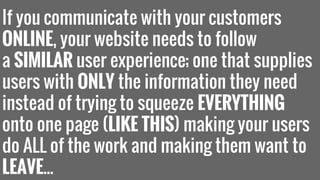
If you communicate with your customers 
ONLINE, your website needs to follow 
a SIMILAR user experience; one that supplies 
users with ONLY the information they need 
instead of trying to squeeze EVERYTHING 
onto one page (LIKE THIS) making your users 
do ALL of the work and making them want to 
LEAVE...
INTERNAL ANALYSIS
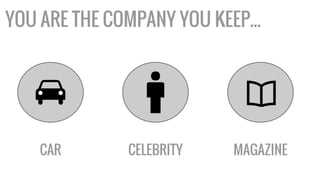
YOU ARE THE COMPANY YOU KEEP... 
CAR CELEBRITY MAGAZINE
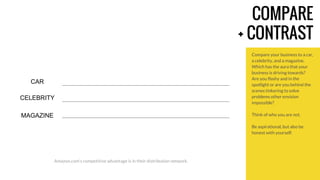
COMPARE 
+ CONTRAST 
Compare your business to a car, 
a celebrity, and a magazine. 
Which has the aura that your 
business is driving towards? 
Are you flashy and in the 
spotlight or are you behind the 
scenes tinkering to solve 
problems other envision 
impossible? 
Think of who you are not. 
Be aspirational, but also be 
honest with yourself. 
Amazon.com’s competitive advantage is in their distribution network. 
CAR 
CELEBRITY 
MAGAZINE
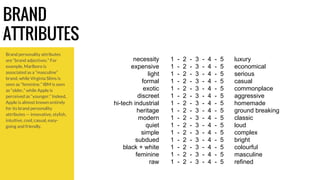
BRAND 
ATTRIBUTES 
Brand personality attributes 
are “brand adjectives.” For 
example, Marlboro is 
associated as a “masculine” 
brand, while Virginia Slims is 
seen as “feminine.” IBM is seen 
as “older,” while Apple is 
perceived as “younger.” Indeed, 
Apple is almost known entirely 
for its brand personality 
attributes — innovative, stylish, 
intuitive, cool, casual, easy-going 
and friendly. 
necessity 
expensive 
light 
formal 
exotic 
discreet 
hi-tech industrial 
heritage 
modern 
quiet 
simple 
subdued 
black + white 
feminine 
raw 
luxury 
economical 
serious 
casual 
commonplace 
aggressive 
homemade 
ground breaking 
classic 
loud 
complex 
bright 
colourful 
masculine 
refined 
1 - 2 - 3 - 4 - 5 
1 - 2 - 3 - 4 - 5 
1 - 2 - 3 - 4 - 5 
1 - 2 - 3 - 4 - 5 
1 - 2 - 3 - 4 - 5 
1 - 2 - 3 - 4 - 5 
1 - 2 - 3 - 4 - 5 
1 - 2 - 3 - 4 - 5 
1 - 2 - 3 - 4 - 5 
1 - 2 - 3 - 4 - 5 
1 - 2 - 3 - 4 - 5 
1 - 2 - 3 - 4 - 5 
1 - 2 - 3 - 4 - 5 
1 - 2 - 3 - 4 - 5 
1 - 2 - 3 - 4 - 5
BRAND 
ATTRIBUTES 
TOP 3
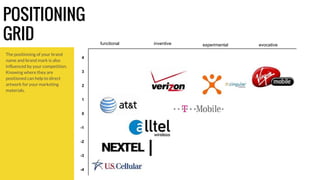
POSITIONING 
GRID 
The positioning of your brand 
name and brand mark is also 
influenced by your competition. 
Knowing where they are 
positioned can help to direct 
artwork for your marketing 
materials. 
functional inventive experimental evocative 
4 
3 
2 
1 
0 
-1 
-2 
-3 
-4
functional inventive experimental evocative 
4 
3 
2 
1 
0 
-1 
-2 
-3 
-4 
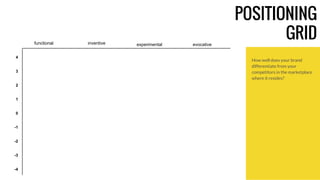
POSITIONING 
GRID 
How well does your brand 
differentiate from your 
competitors in the marketplace 
where it resides?
DEMOGRAPHICS
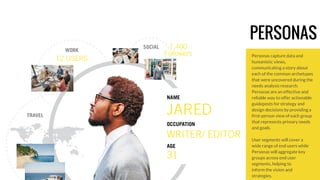
PERSONAS 
Personas capture data and 
humanistic views, 
communicating a story about 
each of the common archetypes 
that were uncovered during the 
needs analysis research. 
Personas are an effective and 
reliable way to offer actionable 
guideposts for strategy and 
design decisions by providing a 
first-person view of each group 
that represents primary needs 
and goals. 
User segments will cover a 
wide range of end users while 
Personas will aggregate key 
groups across end user 
segments, helping to 
inform the vision and 
strategies.
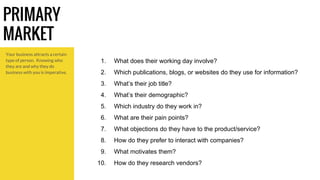
PRIMARY 
MARKET 
Your business attracts a certain 
type of person. Knowing who 
they are and why they do 
business with you is imperative. 
1. What does their working day involve? 
2. Which publications, blogs, or websites do they use for information? 
3. What’s their job title? 
4. What’s their demographic? 
5. Which industry do they work in? 
6. What are their pain points? 
7. What objections do they have to the product/service? 
8. How do they prefer to interact with companies? 
9. What motivates them? 
10. How do they research vendors?
PRIMARY 
MARKET
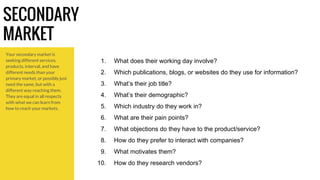
SECONDARY 
MARKET 
1. What does their working day involve? 
2. Which publications, blogs, or websites do they use for information? 
3. What’s their job title? 
4. What’s their demographic? 
5. Which industry do they work in? 
6. What are their pain points? 
7. What objections do they have to the product/service? 
8. How do they prefer to interact with companies? 
9. What motivates them? 
10. How do they research vendors? 
Your secondary market is 
seeking different services, 
products, interval, and have 
different needs than your 
primary market, or possibly just 
need the same, but with a 
different way reaching them. 
They are equal in all respects 
with what we can learn from 
how to reach your markets.
SECONDARY 
MARKET
TERTIARY 
MARKET 
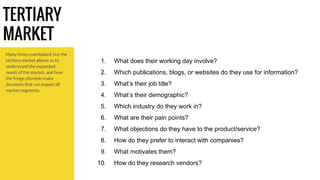
1. What does their working day involve? 
2. Which publications, blogs, or websites do they use for information? 
3. What’s their job title? 
4. What’s their demographic? 
5. Which industry do they work in? 
6. What are their pain points? 
7. What objections do they have to the product/service? 
8. How do they prefer to interact with companies? 
9. What motivates them? 
10. How do they research vendors? 
Many times overlooked, but the 
tertiary market allows us to 
understand the expanded 
needs of the market, and how 
the fringe clientele make 
decisions that can impact all 
market segments.
TERTIARY 
MARKET
WHY YOU? 
Your business cannot be all 
things to all people, so you have 
to decide what it is about your 
business that will make people 
want to do business with you. 
Who are you? 
What do you do? 
Why does it matter?
COMPETITIVE 
ADVANTAGE 
An advantage that a firm has 
over its competitors, allowing it 
to generate greater sales or 
margins and/or retain more 
customers than its competition. 
There can be many types of 
competitive advantages 
including the firm's cost 
structure, product offerings, 
distribution network and 
customer support. 
Amazon.com’s competitive advantage is in their distribution network.
CLIENT ACQUISITION
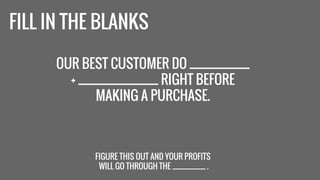
FILL IN THE BLANKS 
OUR BEST CUSTOMER DO ____________ 
+ ________________ RIGHT BEFORE 
MAKING A PURCHASE. 
FIGURE THIS OUT AND YOUR PROFITS 
WILL GO THROUGH THE ___________ .
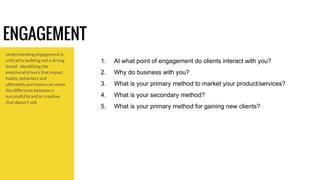
ENGAGEMENT 
Understanding engagement is 
critical to building out a strong 
brand. Identifying the 
emotional drivers that impact 
habits, behaviors and 
ultimately purchases can mean 
the difference between a 
successful brand or creative 
that doesn’t sell. 
1. At what point of engagement do clients interact with you? 
2. Why do business with you? 
3. What is your primary method to market your product/services? 
4. What is your secondary method? 
5. What is your primary method for gaining new clients?
ENGAGEMENT
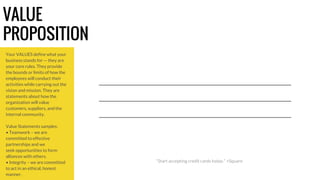
VALUE 
PROPOSITION 
Your VALUES define what your 
business stands for — they are 
your core rules. They provide 
the bounds or limits of how the 
employees will conduct their 
activities while carrying out the 
vision and mission. They are 
statements about how the 
organization will value 
customers, suppliers, and the 
internal community. 
Value Statements samples: 
• Teamwork – we are 
committed to effective 
partnerships and we 
seek opportunities to form 
alliances with others. 
• Integrity – we are committed 
to act in an ethical, honest 
manner. 
“Start accepting credit cards today.” +Square
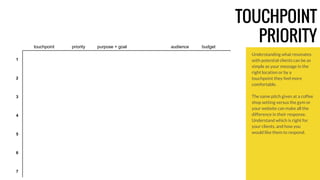
TOUCHPOINT 
PRIORITY 
Understanding what resonates 
with potential clients can be as 
simple as your message in the 
right location or by a 
touchpoint they feel more 
comfortable. 
The same pitch given at a coffee 
shop setting versus the gym or 
your website can make all the 
difference in their response. 
Understand which is right for 
your clients, and how you 
would like them to respond. 
touchpoint priority purpose + goal audience 
1 
2 
3 
4 
5 
6 
7 
budget
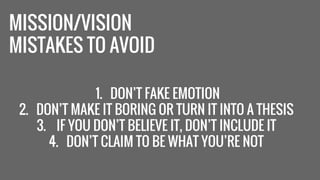
MISSION/VISION 
MISTAKES TO AVOID 
1. DON’T FAKE EMOTION 
2. DON’T MAKE IT BORING OR TURN IT INTO A THESIS 
3. IF YOU DON’T BELIEVE IT, DON’T INCLUDE IT 
4. DON’T CLAIM TO BE WHAT YOU’RE NOT
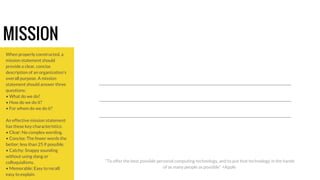
MISSION 
When properly constructed, a 
mission statement should 
provide a clear, concise 
description of an organization's 
overall purpose. A mission 
statement should answer three 
questions: 
• What do we do? 
• How do we do it? 
• For whom do we do it? 
An effective mission statement 
has these key characteristics: 
• Clear: No complex wording. 
• Concise: The fewer words the 
better; less than 25 if possible. 
• Catchy: Snappy sounding 
without using slang or 
colloquialisms. 
• Memorable: Easy to recall; 
easy to explain. 
“To offer the best possible personal computing technology, and to put that technology in the hands 
of as many people as possible” +Apple
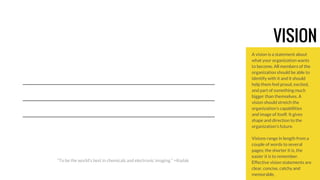
VISION 
A vision is a statement about 
what your organization wants 
to become. All members of the 
organization should be able to 
identify with it and it should 
help them feel proud, excited, 
and part of something much 
bigger than themselves. A 
vision should stretch the 
organization’s capabilities 
and image of itself. It gives 
shape and direction to the 
organization’s future. 
Visions range in length from a 
couple of words to several 
pages; the shorter it is, the 
easier it is to remember. 
Effective vision statements are 
clear, concise, catchy and 
memorable. 
“To be the world's best in chemicals and electronic imaging.” +Kodak
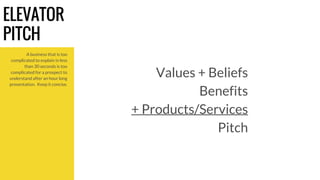
ELEVATOR 
PITCH 
A business that is too 
complicated to explain in less 
than 30 seconds is too 
complicated for a prospect to 
understand after an hour long 
presentation. Keep it concise. 
Values + Beliefs 
Benefits 
+ Products/Services 
Pitch
ELEVATOR 
PITCH
lionandpanda.com
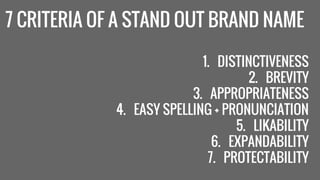
7 CRITERIA OF A STAND OUT BRAND NAME 
1. DISTINCTIVENESS 
2. BREVITY 
3. APPROPRIATENESS 
4. EASY SPELLING + PRONUNCIATION 
5. LIKABILITY 
6. EXPANDABILITY 
7. PROTECTABILITY

Lion + Panda Branding Workshop

  • 1.
  • 3.
    BRANDING A brandis not your logo. A brand is not your identity. A brand is not a product. A brand is a person’s gut feeling about a product, service, or organization. Brands are now defined by individuals, not companies or markets. It’s a gut feeling because people are emotional, intuitive beings and make decisions based upon those feelings. So, it’s not what you say it is, it’s what they say it is.
  • 5.
    SO WHY AREWE HERE? Branding can evoke trust, reliability, and delight.
  • 6.
    THE PACKAGE Forproducts that sell at retail, packaging is the strongest and last chance to make a sale. DECISION PROCESS: 1. Observation. Notice the package 2. Curiosity. Asks “What is it?” 3. Wonder. “Why should I care?” 4. Desire. Wants to be persuaded. 5. Decision. Needs proof.
  • 7.
    EFFECTIVENESS By presentinginformation to match this sequence a package can sell a product more effectively.
  • 9.
  • 11.
    If you communicatewith your customers ONLINE, your website needs to follow a SIMILAR user experience; one that supplies users with ONLY the information they need instead of trying to squeeze EVERYTHING onto one page (LIKE THIS) making your users do ALL of the work and making them want to LEAVE...
  • 13.
  • 14.
    YOU ARE THECOMPANY YOU KEEP... CAR CELEBRITY MAGAZINE
  • 15.
    COMPARE + CONTRAST Compare your business to a car, a celebrity, and a magazine. Which has the aura that your business is driving towards? Are you flashy and in the spotlight or are you behind the scenes tinkering to solve problems other envision impossible? Think of who you are not. Be aspirational, but also be honest with yourself. Amazon.com’s competitive advantage is in their distribution network. CAR CELEBRITY MAGAZINE
  • 16.
    BRAND ATTRIBUTES Brandpersonality attributes are “brand adjectives.” For example, Marlboro is associated as a “masculine” brand, while Virginia Slims is seen as “feminine.” IBM is seen as “older,” while Apple is perceived as “younger.” Indeed, Apple is almost known entirely for its brand personality attributes — innovative, stylish, intuitive, cool, casual, easy-going and friendly. necessity expensive light formal exotic discreet hi-tech industrial heritage modern quiet simple subdued black + white feminine raw luxury economical serious casual commonplace aggressive homemade ground breaking classic loud complex bright colourful masculine refined 1 - 2 - 3 - 4 - 5 1 - 2 - 3 - 4 - 5 1 - 2 - 3 - 4 - 5 1 - 2 - 3 - 4 - 5 1 - 2 - 3 - 4 - 5 1 - 2 - 3 - 4 - 5 1 - 2 - 3 - 4 - 5 1 - 2 - 3 - 4 - 5 1 - 2 - 3 - 4 - 5 1 - 2 - 3 - 4 - 5 1 - 2 - 3 - 4 - 5 1 - 2 - 3 - 4 - 5 1 - 2 - 3 - 4 - 5 1 - 2 - 3 - 4 - 5 1 - 2 - 3 - 4 - 5
  • 17.
  • 18.
    POSITIONING GRID Thepositioning of your brand name and brand mark is also influenced by your competition. Knowing where they are positioned can help to direct artwork for your marketing materials. functional inventive experimental evocative 4 3 2 1 0 -1 -2 -3 -4
  • 19.
    functional inventive experimentalevocative 4 3 2 1 0 -1 -2 -3 -4 POSITIONING GRID How well does your brand differentiate from your competitors in the marketplace where it resides?
  • 21.
  • 23.
    PERSONAS Personas capturedata and humanistic views, communicating a story about each of the common archetypes that were uncovered during the needs analysis research. Personas are an effective and reliable way to offer actionable guideposts for strategy and design decisions by providing a first-person view of each group that represents primary needs and goals. User segments will cover a wide range of end users while Personas will aggregate key groups across end user segments, helping to inform the vision and strategies.
  • 24.
    PRIMARY MARKET Yourbusiness attracts a certain type of person. Knowing who they are and why they do business with you is imperative. 1. What does their working day involve? 2. Which publications, blogs, or websites do they use for information? 3. What’s their job title? 4. What’s their demographic? 5. Which industry do they work in? 6. What are their pain points? 7. What objections do they have to the product/service? 8. How do they prefer to interact with companies? 9. What motivates them? 10. How do they research vendors?
  • 25.
  • 26.
    SECONDARY MARKET 1.What does their working day involve? 2. Which publications, blogs, or websites do they use for information? 3. What’s their job title? 4. What’s their demographic? 5. Which industry do they work in? 6. What are their pain points? 7. What objections do they have to the product/service? 8. How do they prefer to interact with companies? 9. What motivates them? 10. How do they research vendors? Your secondary market is seeking different services, products, interval, and have different needs than your primary market, or possibly just need the same, but with a different way reaching them. They are equal in all respects with what we can learn from how to reach your markets.
  • 27.
  • 28.
    TERTIARY MARKET 1.What does their working day involve? 2. Which publications, blogs, or websites do they use for information? 3. What’s their job title? 4. What’s their demographic? 5. Which industry do they work in? 6. What are their pain points? 7. What objections do they have to the product/service? 8. How do they prefer to interact with companies? 9. What motivates them? 10. How do they research vendors? Many times overlooked, but the tertiary market allows us to understand the expanded needs of the market, and how the fringe clientele make decisions that can impact all market segments.
  • 29.
  • 30.
    WHY YOU? Yourbusiness cannot be all things to all people, so you have to decide what it is about your business that will make people want to do business with you. Who are you? What do you do? Why does it matter?
  • 31.
    COMPETITIVE ADVANTAGE Anadvantage that a firm has over its competitors, allowing it to generate greater sales or margins and/or retain more customers than its competition. There can be many types of competitive advantages including the firm's cost structure, product offerings, distribution network and customer support. Amazon.com’s competitive advantage is in their distribution network.
  • 33.
  • 35.
    FILL IN THEBLANKS OUR BEST CUSTOMER DO ____________ + ________________ RIGHT BEFORE MAKING A PURCHASE. FIGURE THIS OUT AND YOUR PROFITS WILL GO THROUGH THE ___________ .
  • 36.
    ENGAGEMENT Understanding engagementis critical to building out a strong brand. Identifying the emotional drivers that impact habits, behaviors and ultimately purchases can mean the difference between a successful brand or creative that doesn’t sell. 1. At what point of engagement do clients interact with you? 2. Why do business with you? 3. What is your primary method to market your product/services? 4. What is your secondary method? 5. What is your primary method for gaining new clients?
  • 37.
  • 38.
    VALUE PROPOSITION YourVALUES define what your business stands for — they are your core rules. They provide the bounds or limits of how the employees will conduct their activities while carrying out the vision and mission. They are statements about how the organization will value customers, suppliers, and the internal community. Value Statements samples: • Teamwork – we are committed to effective partnerships and we seek opportunities to form alliances with others. • Integrity – we are committed to act in an ethical, honest manner. “Start accepting credit cards today.” +Square
  • 39.
    TOUCHPOINT PRIORITY Understandingwhat resonates with potential clients can be as simple as your message in the right location or by a touchpoint they feel more comfortable. The same pitch given at a coffee shop setting versus the gym or your website can make all the difference in their response. Understand which is right for your clients, and how you would like them to respond. touchpoint priority purpose + goal audience 1 2 3 4 5 6 7 budget
  • 41.
    MISSION/VISION MISTAKES TOAVOID 1. DON’T FAKE EMOTION 2. DON’T MAKE IT BORING OR TURN IT INTO A THESIS 3. IF YOU DON’T BELIEVE IT, DON’T INCLUDE IT 4. DON’T CLAIM TO BE WHAT YOU’RE NOT
  • 42.
    MISSION When properlyconstructed, a mission statement should provide a clear, concise description of an organization's overall purpose. A mission statement should answer three questions: • What do we do? • How do we do it? • For whom do we do it? An effective mission statement has these key characteristics: • Clear: No complex wording. • Concise: The fewer words the better; less than 25 if possible. • Catchy: Snappy sounding without using slang or colloquialisms. • Memorable: Easy to recall; easy to explain. “To offer the best possible personal computing technology, and to put that technology in the hands of as many people as possible” +Apple
  • 43.
    VISION A visionis a statement about what your organization wants to become. All members of the organization should be able to identify with it and it should help them feel proud, excited, and part of something much bigger than themselves. A vision should stretch the organization’s capabilities and image of itself. It gives shape and direction to the organization’s future. Visions range in length from a couple of words to several pages; the shorter it is, the easier it is to remember. Effective vision statements are clear, concise, catchy and memorable. “To be the world's best in chemicals and electronic imaging.” +Kodak
  • 44.
    ELEVATOR PITCH Abusiness that is too complicated to explain in less than 30 seconds is too complicated for a prospect to understand after an hour long presentation. Keep it concise. Values + Beliefs Benefits + Products/Services Pitch
  • 45.
  • 46.
  • 47.
    7 CRITERIA OFA STAND OUT BRAND NAME 1. DISTINCTIVENESS 2. BREVITY 3. APPROPRIATENESS 4. EASY SPELLING + PRONUNCIATION 5. LIKABILITY 6. EXPANDABILITY 7. PROTECTABILITY