planningness 2011
meet the makers.
preface
here’s a smattering of highlights and insights from
planningness 2011. wish I could sum up (and have
attended) all the sessions, but it’s just not possible in
one measly deck. I assure you, all were full of
awesome this year.

also, a big thank you to all the people who made this
year amazing and to all the new (and old) friends in
this warm, generous little planningness community.
our ethos (at planningness)
get excited and make stuff.
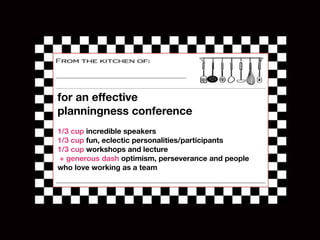
the secret recipe.
for an effective
planningness conference
1/3 cup incredible speakers
1/3 cup fun, eclectic personalities/participants
1/3 cup workshops and lecture
 + generous dash optimism, perseverance and people
who love working as a team
themes.
empathy. generosity.
make > say.
you know this.
so more specifically...
start thinking like/with a producer
 put the user in the middle of
business design
 work lean
 “brief” for behavior change
start thinking like/with a
producer
producers are vital partners to making.
working closely and quickly with our
producer counterparts help us optimize
our work in real-time.


                                        @adrianho
                              production as strategy
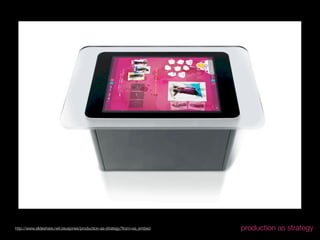
products and experiences
often reveal new
opportunities for usage after
they’re built.
- adrian ho, zeus jones


http://www.slideshare.net/zeusjones/production-as-strategy?from=ss_embed   production as strategy
we don’t work in a vacuum.
  optimization shouldn’t be reserved for
  retrospect -- we have to build with the
  intention to change.

  we must plan with the assumption of
  unpredictability and create an
  environment where adaptive change is
  not only possible, but required.
http://www.slideshare.net/zeusjones/production-as-strategy?from=ss_embed   production as strategy
designing a business
for awhile now, planner folks have said
“it’s not what you say, it’s what you
do...” but putting to practice is not
always easy (particularly in the ad biz).


                                        @colincolin
                                designing a business
best case scenario: think
about how to design the
business from the inside out,
putting the user in the middle.


                        designing a business
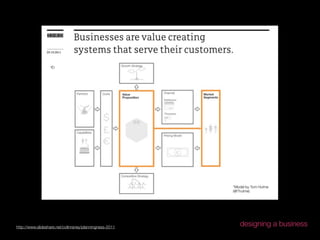
“when we “design a business” we
create a platform for an experience.

by putting the experience first, we’re
creating a user-centered business,
(because the business is the vehicle to
deliver the experience)”
- colin raney, IDEO


http://www.slideshare.net/colinraney/planningness-2011
                                                         designing a business
http://www.slideshare.net/colinraney/planningness-2011
                                                         designing a business
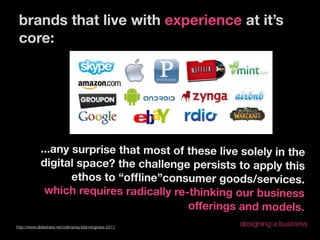
brands that live with experience at it’s
 core:


             ...any surprise that most of these live solely in the
             digital space? the challenge persists to apply this
                    ethos to “offline”consumer goods/services.
              which requires radically re-thinking our business
                                          offerings and models.
http://www.slideshare.net/colinraney/planningness-2011
                                                         designing a business
lean strategy.
    start-ups, design firms and many other
    “makers” have lean processes
    ingrained into their DNA. time and
    money are often scarce (sound
    familiar?) so it’s about faster learning.
    key to making it work is letting go of
    our traditional long-winded, waterfall
    processes and learning to be a bit more
    more flexible.
                                                            @farrahbostic
http://www.slideshare.net/flbostic/how-to-do-lean-planning    lean strategy
why lean? why now?.
      expectations have shifted:
      client’s have less money, less
      patience. couple this with consumer’s
      expecting more utility and usefulness
      from brands than ever before.


http://www.slideshare.net/flbostic/how-to-do-lean-planning   lean strategy
“you need to add value in
      people’s lives. not just
      expect them to participate
      because you goddamn
      asked them to.”
                                                            - mel exon, bbh labs


http://www.slideshare.net/flbostic/how-to-do-lean-planning                lean strategy
this is a messy process.
   it’s intentionally not linear. it’s a web of
   ideas, mapped against central pain
   points and behaviors. it’s about solving
   problems. fast.


http://www.slideshare.net/flbostic/how-to-do-lean-planning   lean strategy
key tenants
  i. generate the pain points/problems
  your audience encounters, formulate
  hypotheses to solve
  ii. test hypotheses on a small number of
  individuals
  iii. you should be proven wrong a few
  times. rinse, repeat.
  iv. get involved in building prototypes for
  the solve(s) that bubble to the top
http://www.slideshare.net/flbostic/how-to-do-lean-planning   lean strategy
“we become so obsessed
with being noticed that we
forget to be useful”
                - ed cotton, bssp


                                    @cotton
                              behavioral briefs
brief for behavior change.
framing/finding the question is often
the hardest part.
i. determine the pain points.
ii. understand the behaviors that
contribute and act in tandem with the
pain to get to useful solutions
iii. determine barriers
iv. frame up the opportunities
                               behavioral briefs
the founders of instagram on solving the “right” problem
                                               behavioral briefs
sounds simple.
it’s not.
...but it’s certainly not impossible.


                              behavioral briefs
we were tasked with one of
the hardest problems any of
us had.

going home.

                       behavioral briefs
planningness has become a safe haven
for open thinking and idealistic dreams.
we love our jobs, but it can be hard to
leave the cocoon...

so we wrote the brief to re-position
planning in 2015


                                 behavioral briefs
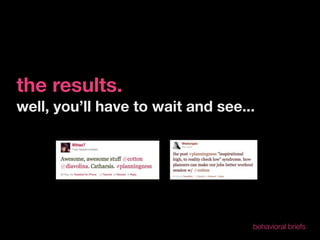
the results.
well, you’ll have to wait and see...


                                   behavioral briefs
stop trying to own things
and start making them
instead.
the presentations:
since i’ve done (maybe) a mediocre
job summing up some great
presentations, please do yourself a
favor and check them and more out
here:
http://planningness.com/planning-ness-2011-presentations/
http://www.slideshare.net/zeusjones/production-as-strategy?from=ss_embed
http://www.slideshare.net/jmarshallroberts/how-to-overcome-cynicism-with-scientific-psychobabble
http://www.slideshare.net/flbostic/how-to-do-lean-planning
http://www.slideshare.net/colinraney/planningness-2011
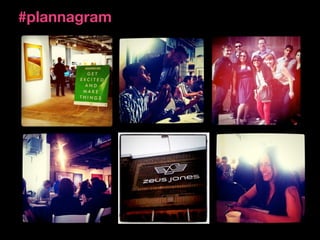
#plannagram
...because every presentation should
end with a horse wearing a monocle.
#hellyeah

Planningness 2011

  • 1.
  • 2.
    preface here’s a smatteringof highlights and insights from planningness 2011. wish I could sum up (and have attended) all the sessions, but it’s just not possible in one measly deck. I assure you, all were full of awesome this year. also, a big thank you to all the people who made this year amazing and to all the new (and old) friends in this warm, generous little planningness community.
  • 3.
    our ethos (atplanningness) get excited and make stuff.
  • 4.
  • 5.
    for an effective planningnessconference 1/3 cup incredible speakers 1/3 cup fun, eclectic personalities/participants 1/3 cup workshops and lecture + generous dash optimism, perseverance and people who love working as a team
  • 7.
  • 8.
    empathy. generosity. make >say. you know this. so more specifically...
  • 9.
    start thinking like/witha producer put the user in the middle of business design work lean “brief” for behavior change
  • 10.
    start thinking like/witha producer producers are vital partners to making. working closely and quickly with our producer counterparts help us optimize our work in real-time. @adrianho production as strategy
  • 11.
    products and experiences oftenreveal new opportunities for usage after they’re built. - adrian ho, zeus jones http://www.slideshare.net/zeusjones/production-as-strategy?from=ss_embed production as strategy
  • 12.
  • 13.
    we don’t workin a vacuum. optimization shouldn’t be reserved for retrospect -- we have to build with the intention to change. we must plan with the assumption of unpredictability and create an environment where adaptive change is not only possible, but required. http://www.slideshare.net/zeusjones/production-as-strategy?from=ss_embed production as strategy
  • 14.
    designing a business forawhile now, planner folks have said “it’s not what you say, it’s what you do...” but putting to practice is not always easy (particularly in the ad biz). @colincolin designing a business
  • 15.
    best case scenario:think about how to design the business from the inside out, putting the user in the middle. designing a business
  • 16.
    “when we “designa business” we create a platform for an experience. by putting the experience first, we’re creating a user-centered business, (because the business is the vehicle to deliver the experience)” - colin raney, IDEO http://www.slideshare.net/colinraney/planningness-2011 designing a business
  • 17.
  • 18.
    brands that livewith experience at it’s core: ...any surprise that most of these live solely in the digital space? the challenge persists to apply this ethos to “offline”consumer goods/services. which requires radically re-thinking our business offerings and models. http://www.slideshare.net/colinraney/planningness-2011 designing a business
  • 19.
    lean strategy. start-ups, design firms and many other “makers” have lean processes ingrained into their DNA. time and money are often scarce (sound familiar?) so it’s about faster learning. key to making it work is letting go of our traditional long-winded, waterfall processes and learning to be a bit more more flexible. @farrahbostic http://www.slideshare.net/flbostic/how-to-do-lean-planning lean strategy
  • 20.
    why lean? whynow?. expectations have shifted: client’s have less money, less patience. couple this with consumer’s expecting more utility and usefulness from brands than ever before. http://www.slideshare.net/flbostic/how-to-do-lean-planning lean strategy
  • 21.
    “you need toadd value in people’s lives. not just expect them to participate because you goddamn asked them to.” - mel exon, bbh labs http://www.slideshare.net/flbostic/how-to-do-lean-planning lean strategy
  • 22.
    this is amessy process. it’s intentionally not linear. it’s a web of ideas, mapped against central pain points and behaviors. it’s about solving problems. fast. http://www.slideshare.net/flbostic/how-to-do-lean-planning lean strategy
  • 23.
    key tenants i. generate the pain points/problems your audience encounters, formulate hypotheses to solve ii. test hypotheses on a small number of individuals iii. you should be proven wrong a few times. rinse, repeat. iv. get involved in building prototypes for the solve(s) that bubble to the top http://www.slideshare.net/flbostic/how-to-do-lean-planning lean strategy
  • 24.
    “we become soobsessed with being noticed that we forget to be useful” - ed cotton, bssp @cotton behavioral briefs
  • 25.
    brief for behaviorchange. framing/finding the question is often the hardest part. i. determine the pain points. ii. understand the behaviors that contribute and act in tandem with the pain to get to useful solutions iii. determine barriers iv. frame up the opportunities behavioral briefs
  • 26.
    the founders ofinstagram on solving the “right” problem behavioral briefs
  • 27.
    sounds simple. it’s not. ...butit’s certainly not impossible. behavioral briefs
  • 28.
    we were taskedwith one of the hardest problems any of us had. going home. behavioral briefs
  • 29.
    planningness has becomea safe haven for open thinking and idealistic dreams. we love our jobs, but it can be hard to leave the cocoon... so we wrote the brief to re-position planning in 2015 behavioral briefs
  • 30.
    the results. well, you’llhave to wait and see... behavioral briefs
  • 31.
    stop trying toown things and start making them instead.
  • 32.
    the presentations: since i’vedone (maybe) a mediocre job summing up some great presentations, please do yourself a favor and check them and more out here: http://planningness.com/planning-ness-2011-presentations/ http://www.slideshare.net/zeusjones/production-as-strategy?from=ss_embed http://www.slideshare.net/jmarshallroberts/how-to-overcome-cynicism-with-scientific-psychobabble http://www.slideshare.net/flbostic/how-to-do-lean-planning http://www.slideshare.net/colinraney/planningness-2011
  • 33.
  • 35.
    ...because every presentationshould end with a horse wearing a monocle. #hellyeah