THE EDELMAN MASTER NARRATIVE
“THE MOST IMPORTANT STORY YOU HAVE TO TELL”
Lead the Dialogue: The Master Narrative
2
People have always communicated through stories. Companies, however, continue to focus on key
messages as their primary communication vehicles. Today’s stakeholders are becoming
suspicious of corporate messages that are increasingly generic and poor at capturing imagination
or inspiring action.
By contrast, a well crafted narrative helps a company stand out in a cluttered environment and
encourages stakeholders to care about the outcome. Even an unfinished story acts as a force for
dialogue with stakeholders and brings audiences along on your journey.
Relevant in Japan?
IN JAPAN, MAJORITY NEEDS TO HEAR COMPANY INFORMATION MORE THAN 3 TIMES
TO BELIEVE MESSAGES
2% ONCE (1)
10% TWICE (2)
89% MORE THAN THREE TIMES
(GLOBAL: 82%)
15%
TEN OR MORE TIMES (10+)
1%
SIX TO NINE TIMES (6-9)
27%
FOUR OR FIVE TIMES (4-5)
46% THREE TIMES (3)
Q165. [TRACKING] Think about everything you see or hear every day about companies, whether it is positive or negative. How many times in general do you need to be exposed
to something about a specific company to believe that the information is likely to be true? (Provide Space to Insert Number) Informed Publics Ages 25-64 in Japan (excludes
Don’t Know Responses)
What is a Master Narrative?
• The master narrative is YOUR STORY – who you are, what makes you
different, why that’s important.
• It is based on evidence, facts, and measurable results – but it’s told in
HUMAN TERMS.
• It's a key tool for BUILDING CONSENSUS for an organization that has
many moving parts.
• It’s an efficiency engine that makes everything you say work
harder…because all the instruments are PLAYING THE SAME TUNE.
THE MASTER NARRATIVE IS THE MOST IMPORTANT STORY YOU HAVE TO TELL
Why a Narrative?
• People don’t remember facts; they remember stories.
• Stories and metaphors help people grasp complicated
issues.
• Storytelling is the most convincing way to make a
point; people see themselves in stories.
• A story isn’t static; it continues and begins a dialogue.
Answers three fundamental questions:
1. What do you stand for?
2. How are you different?
3. Why does that matter?
CAPTURES WHAT YOU ARE DOING, WHERE YOU ARE GOING, WHAT YOU VALUE, AND WHY
How Do You Tell Your Story?
BACKSTORY
• How does your past shape what you are today?
COMPLICATIONS
• What obstacles stand in the way of your
success?
STAKES
• What’s at risk, for all of us, if you fail? Why do
you MATTER?
PROMISE
• What are you DOING about it? What do you
have to deliver to make your strategy succeed?
PAYOFF
• What’s in it for me? How do you convert your
activities into BENEFITS
GETTING THE RIGHT STORY AND CONTEXT TO STAND OUT
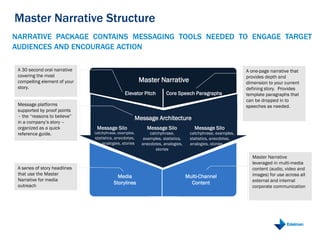
Master Narrative Structure
Media
Storylines
Multi-Channel
Content
Message Architecture
catchphrase, examples,
statistics, anecdotes,
analogies, stories
Message Silo
catchphrase, examples,
statistics, anecdotes,
analogies, stories
Message Silo
catchphrase,
examples, statistics,
anecdotes, analogies,
stories
Message Silo
Master Narrative
Elevator Pitch Core Speech Paragraphs
A 30 second oral narrative
covering the most
compelling element of your
story.
Message platforms
supported by proof points
– the “reasons to believe”
in a company’s story –
organized as a quick
reference guide.
A series of story headlines
that use the Master
Narrative for media
outreach
A one-page narrative that
provides depth and
dimension to your current
defining story. Provides
template paragraphs that
can be dropped in to
speeches as needed.
Master Narrative
leveraged in multi-media
content (audio, video and
images) for use across all
external and internal
corporate communication
NARRATIVE PACKAGE CONTAINS MESSAGING TOOLS NEEDED TO ENGAGE TARGET
AUDIENCES AND ENCOURAGE ACTION
Review of existing
communications
materials
Narrative Development
Review research findings and interviews.
Develop first draft
Narrative Refinement
Present Narrative to client and
refine based on feedback
1 Discovery 2 Discourse Development
Desktop research covering media
and other
stakeholder perceptions
Master Narrative
Workshop /
Interviews with
client
Present research
and work through
the five
communication
bridges
The Master Narrative Process
3
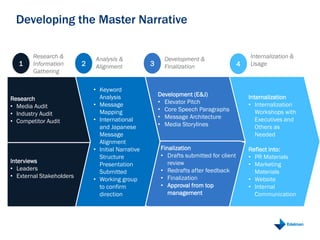
Developing the Master Narrative
Development (E&J)
• Elevator Pitch
• Core Speech Paragraphs
• Message Architecture
• Media Storylines
Finalization
• Drafts submitted for client
review
• Redrafts after feedback
• Finalization
• Approval from top
management
1
Research &
Information
Gathering
2
Analysis &
Alignment 3
Development &
Finalization
Research
• Media Audit
• Industry Audit
• Competitor Audit
Interviews
• Leaders
• External Stakeholders
• Keyword
Analysis
• Message
Mapping
• International
and Japanese
Message
Alignment
• Initial Narrative
Structure
Presentation
Submitted
• Working group
to confirm
direction
Internalization
• Internalization
Workshops with
Executives and
Others as
Needed
Reflect into:
• PR Materials
• Marketing
Materials
• Website
• Internal
Communication
4
Internalization &
Usage
Migrated across All Communication Channels
Master
Narrative
Marketing
Materials
Company
Website
Internal
Comns
Boilerplate
Media
Pitching
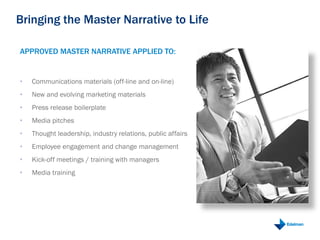
Bringing the Master Narrative to Life
APPROVED MASTER NARRATIVE APPLIED TO:
• Communications materials (off-line and on-line)
• New and evolving marketing materials
• Press release boilerplate
• Media pitches
• Thought leadership, industry relations, public affairs
• Employee engagement and change management
• Kick-off meetings / training with managers
• Media training
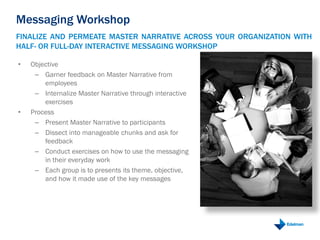
Messaging Workshop
FINALIZE AND PERMEATE MASTER NARRATIVE ACROSS YOUR ORGANIZATION WITH
HALF- OR FULL-DAY INTERACTIVE MESSAGING WORKSHOP
• Objective
– Garner feedback on Master Narrative from
employees
– Internalize Master Narrative through interactive
exercises
• Process
– Present Master Narrative to participants
– Dissect into manageable chunks and ask for
feedback
– Conduct exercises on how to use the messaging
in their everyday work
– Each group is to presents its theme, objective,
and how it made use of the key messages
THE EDELMAN MASTER NARRATIVE
“The most important story you have to tell”
Copyright ©2013 Daniel J. Edelman, Inc. All rights reserved.
All information contained herein is confidential and proprietary to Daniel J. Edelman, Inc. (“Edelman”).
Thank You.
Edelman Japan KK
7th Floor, Toranomon Kotohira Tower
1-2-8 Toranomon, Minato-ku,
Tokyo 105-0001
Tel: +81 (3) 6858-7711
Fax: +81 (3) 6858-7712
www.edelman.jp
japan@edelman.com

The Edelman Master Narrative

  • 1.
    THE EDELMAN MASTERNARRATIVE “THE MOST IMPORTANT STORY YOU HAVE TO TELL”
  • 2.
    Lead the Dialogue:The Master Narrative 2 People have always communicated through stories. Companies, however, continue to focus on key messages as their primary communication vehicles. Today’s stakeholders are becoming suspicious of corporate messages that are increasingly generic and poor at capturing imagination or inspiring action. By contrast, a well crafted narrative helps a company stand out in a cluttered environment and encourages stakeholders to care about the outcome. Even an unfinished story acts as a force for dialogue with stakeholders and brings audiences along on your journey.
  • 3.
    Relevant in Japan? INJAPAN, MAJORITY NEEDS TO HEAR COMPANY INFORMATION MORE THAN 3 TIMES TO BELIEVE MESSAGES 2% ONCE (1) 10% TWICE (2) 89% MORE THAN THREE TIMES (GLOBAL: 82%) 15% TEN OR MORE TIMES (10+) 1% SIX TO NINE TIMES (6-9) 27% FOUR OR FIVE TIMES (4-5) 46% THREE TIMES (3) Q165. [TRACKING] Think about everything you see or hear every day about companies, whether it is positive or negative. How many times in general do you need to be exposed to something about a specific company to believe that the information is likely to be true? (Provide Space to Insert Number) Informed Publics Ages 25-64 in Japan (excludes Don’t Know Responses)
  • 4.
    What is aMaster Narrative? • The master narrative is YOUR STORY – who you are, what makes you different, why that’s important. • It is based on evidence, facts, and measurable results – but it’s told in HUMAN TERMS. • It's a key tool for BUILDING CONSENSUS for an organization that has many moving parts. • It’s an efficiency engine that makes everything you say work harder…because all the instruments are PLAYING THE SAME TUNE. THE MASTER NARRATIVE IS THE MOST IMPORTANT STORY YOU HAVE TO TELL
  • 5.
    Why a Narrative? •People don’t remember facts; they remember stories. • Stories and metaphors help people grasp complicated issues. • Storytelling is the most convincing way to make a point; people see themselves in stories. • A story isn’t static; it continues and begins a dialogue. Answers three fundamental questions: 1. What do you stand for? 2. How are you different? 3. Why does that matter? CAPTURES WHAT YOU ARE DOING, WHERE YOU ARE GOING, WHAT YOU VALUE, AND WHY
  • 6.
    How Do YouTell Your Story? BACKSTORY • How does your past shape what you are today? COMPLICATIONS • What obstacles stand in the way of your success? STAKES • What’s at risk, for all of us, if you fail? Why do you MATTER? PROMISE • What are you DOING about it? What do you have to deliver to make your strategy succeed? PAYOFF • What’s in it for me? How do you convert your activities into BENEFITS GETTING THE RIGHT STORY AND CONTEXT TO STAND OUT
  • 7.
    Master Narrative Structure Media Storylines Multi-Channel Content MessageArchitecture catchphrase, examples, statistics, anecdotes, analogies, stories Message Silo catchphrase, examples, statistics, anecdotes, analogies, stories Message Silo catchphrase, examples, statistics, anecdotes, analogies, stories Message Silo Master Narrative Elevator Pitch Core Speech Paragraphs A 30 second oral narrative covering the most compelling element of your story. Message platforms supported by proof points – the “reasons to believe” in a company’s story – organized as a quick reference guide. A series of story headlines that use the Master Narrative for media outreach A one-page narrative that provides depth and dimension to your current defining story. Provides template paragraphs that can be dropped in to speeches as needed. Master Narrative leveraged in multi-media content (audio, video and images) for use across all external and internal corporate communication NARRATIVE PACKAGE CONTAINS MESSAGING TOOLS NEEDED TO ENGAGE TARGET AUDIENCES AND ENCOURAGE ACTION
  • 8.
    Review of existing communications materials NarrativeDevelopment Review research findings and interviews. Develop first draft Narrative Refinement Present Narrative to client and refine based on feedback 1 Discovery 2 Discourse Development Desktop research covering media and other stakeholder perceptions Master Narrative Workshop / Interviews with client Present research and work through the five communication bridges The Master Narrative Process 3
  • 9.
    Developing the MasterNarrative Development (E&J) • Elevator Pitch • Core Speech Paragraphs • Message Architecture • Media Storylines Finalization • Drafts submitted for client review • Redrafts after feedback • Finalization • Approval from top management 1 Research & Information Gathering 2 Analysis & Alignment 3 Development & Finalization Research • Media Audit • Industry Audit • Competitor Audit Interviews • Leaders • External Stakeholders • Keyword Analysis • Message Mapping • International and Japanese Message Alignment • Initial Narrative Structure Presentation Submitted • Working group to confirm direction Internalization • Internalization Workshops with Executives and Others as Needed Reflect into: • PR Materials • Marketing Materials • Website • Internal Communication 4 Internalization & Usage
  • 10.
    Migrated across AllCommunication Channels Master Narrative Marketing Materials Company Website Internal Comns Boilerplate Media Pitching
  • 11.
    Bringing the MasterNarrative to Life APPROVED MASTER NARRATIVE APPLIED TO: • Communications materials (off-line and on-line) • New and evolving marketing materials • Press release boilerplate • Media pitches • Thought leadership, industry relations, public affairs • Employee engagement and change management • Kick-off meetings / training with managers • Media training
  • 12.
    Messaging Workshop FINALIZE ANDPERMEATE MASTER NARRATIVE ACROSS YOUR ORGANIZATION WITH HALF- OR FULL-DAY INTERACTIVE MESSAGING WORKSHOP • Objective – Garner feedback on Master Narrative from employees – Internalize Master Narrative through interactive exercises • Process – Present Master Narrative to participants – Dissect into manageable chunks and ask for feedback – Conduct exercises on how to use the messaging in their everyday work – Each group is to presents its theme, objective, and how it made use of the key messages
  • 13.
    THE EDELMAN MASTERNARRATIVE “The most important story you have to tell” Copyright ©2013 Daniel J. Edelman, Inc. All rights reserved. All information contained herein is confidential and proprietary to Daniel J. Edelman, Inc. (“Edelman”). Thank You. Edelman Japan KK 7th Floor, Toranomon Kotohira Tower 1-2-8 Toranomon, Minato-ku, Tokyo 105-0001 Tel: +81 (3) 6858-7711 Fax: +81 (3) 6858-7712 www.edelman.jp japan@edelman.com