WorldCat  via FirstSearch Catalogues of the World Unite!!!
What is it? WorldCat via FirstSearch (a.k.a..World Cat, World Catalog) is the OCLC Online Union Catalog and contains more than 35 million records describing items owned by libraries around the world. WorldCat has only  a   few  individual articles from magazines, newspapers, or book chapters.
What can you find in WorldCat? Books Magazine/Journal series  Archives Computer files: programs, e-texts, limited websites. Images and films Maps Sound Recordings Music Articles
The Most Important Buttons Got Help? When in doubt, press the  . General Help. Specific Help.
Basic Search Features Keyword Author Title ISBN Year
Basic Search
Example   Basic Search Title: Harry Potter Author: Rowling, JK Keyword: Askaban Year: 2000-2004
Need something specific? Advanced search lets you find almost exactly what you seek… Limit your results by format, year, audience and even by  library . If Basic Search isn’t helping or brings up trillions of results go here...
Advanced Search
Example   Advanced Search Title: Harry Potter Keyword: review Audience: Non-juvenile Type: Article Type: Internet Type: Computer file
Truncation Truncation allows you to search for a term and its variations by entering a minimum of the first three letters of the term followed by an asterisk  * .   For example,  securit *  retrieves records that contain  securit y ,  securit ies ,  securit ization , etc.
Wildcards  A pound sign ( # ) within a term represents a single character.   Example:  wom # n  searches for records containing  wom a n  and  wom e n .
Wildcards  (Cont.) A question mark ( ? ) within a term represents from zero to nine additional characters .  Example:  colo ? r  searches for  color ,  colo u r ,  colo nize r , and  colo rimete r
Example   Advanced Search   Keyword (subject): cancer* Keyword (subject): prevent* Keyword (subject): wom#n Year: 2000-2004 Type: ? Availability: (find local library codes)
After a search... Choose your display...
Refine your results Sort : title, author, date, number of libraries Related Subjects:  lists related subject words Related Authors:  gives links to works by the authors in the results Limit  by : Author • Subject Headings • Year • Document Type • Language • Number of Libraries
Found Something? Preserve your records with: Email  them to your self Print Export   to another program
Send it. Email Options:
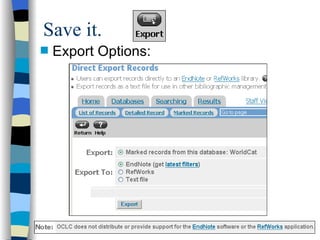
Save it. Export Options:
Print it. Displays the  citations   for records in the search. either  marked  or  all Print gives  brief records  only.
Tip sheet

How to Use WorldCat

  • 1.
    WorldCat viaFirstSearch Catalogues of the World Unite!!!
  • 2.
    What is it?WorldCat via FirstSearch (a.k.a..World Cat, World Catalog) is the OCLC Online Union Catalog and contains more than 35 million records describing items owned by libraries around the world. WorldCat has only a few individual articles from magazines, newspapers, or book chapters.
  • 3.
    What can youfind in WorldCat? Books Magazine/Journal series Archives Computer files: programs, e-texts, limited websites. Images and films Maps Sound Recordings Music Articles
  • 4.
    The Most ImportantButtons Got Help? When in doubt, press the . General Help. Specific Help.
  • 5.
    Basic Search FeaturesKeyword Author Title ISBN Year
  • 6.
  • 7.
    Example Basic Search Title: Harry Potter Author: Rowling, JK Keyword: Askaban Year: 2000-2004
  • 8.
    Need something specific?Advanced search lets you find almost exactly what you seek… Limit your results by format, year, audience and even by library . If Basic Search isn’t helping or brings up trillions of results go here...
  • 9.
  • 10.
    Example Advanced Search Title: Harry Potter Keyword: review Audience: Non-juvenile Type: Article Type: Internet Type: Computer file
  • 11.
    Truncation Truncation allowsyou to search for a term and its variations by entering a minimum of the first three letters of the term followed by an asterisk * . For example, securit * retrieves records that contain securit y , securit ies , securit ization , etc.
  • 12.
    Wildcards Apound sign ( # ) within a term represents a single character. Example: wom # n searches for records containing wom a n and wom e n .
  • 13.
    Wildcards (Cont.)A question mark ( ? ) within a term represents from zero to nine additional characters . Example: colo ? r searches for color , colo u r , colo nize r , and colo rimete r
  • 14.
    Example Advanced Search Keyword (subject): cancer* Keyword (subject): prevent* Keyword (subject): wom#n Year: 2000-2004 Type: ? Availability: (find local library codes)
  • 15.
    After a search...Choose your display...
  • 16.
    Refine your resultsSort : title, author, date, number of libraries Related Subjects: lists related subject words Related Authors: gives links to works by the authors in the results Limit by : Author • Subject Headings • Year • Document Type • Language • Number of Libraries
  • 17.
    Found Something? Preserveyour records with: Email them to your self Print Export to another program
  • 18.
  • 19.
  • 20.
    Print it. Displaysthe citations for records in the search. either marked or all Print gives brief records only.
  • 21.

Editor's Notes

  • #2 Written for a 045-100 class presentation to Junior Literature majors at University of Dallas for work on their “junior poet/senior novel” thesis assignments. Audience: 19-21 years old. College Juniors at a 4 year intensive core curriculum college who are familiar with research methods--self-taught but not self-sufficient or skilled in a particular database. Some have used WorldCat or FirstSearch ERIC, but most prefer to “let the librarian do it.” A.D.A.Compensations: 1)Blind students should be granted a guide-volunteer who accompanies them through the library, screen-reader programs can be used where applicable. 2) Deaf students should be served by a sign language translator or a librarian who speaks sign. Remember to face the audience and not alter your speech pattern or speak overly slowly, as this makes lip-reading more difficult. Deaf students may be able to read lips, but can also be supplied with a print out of the lecture. 3) Students in wheel chairs or similar limited mobility should be provided with computer stations that they can reach comfortably and should be moved to the front of standing groups so that they can see. 4) All materials given to patrons use italics as well as color incase a person is color blind. Main points of this lecture are in black font for the same reason.