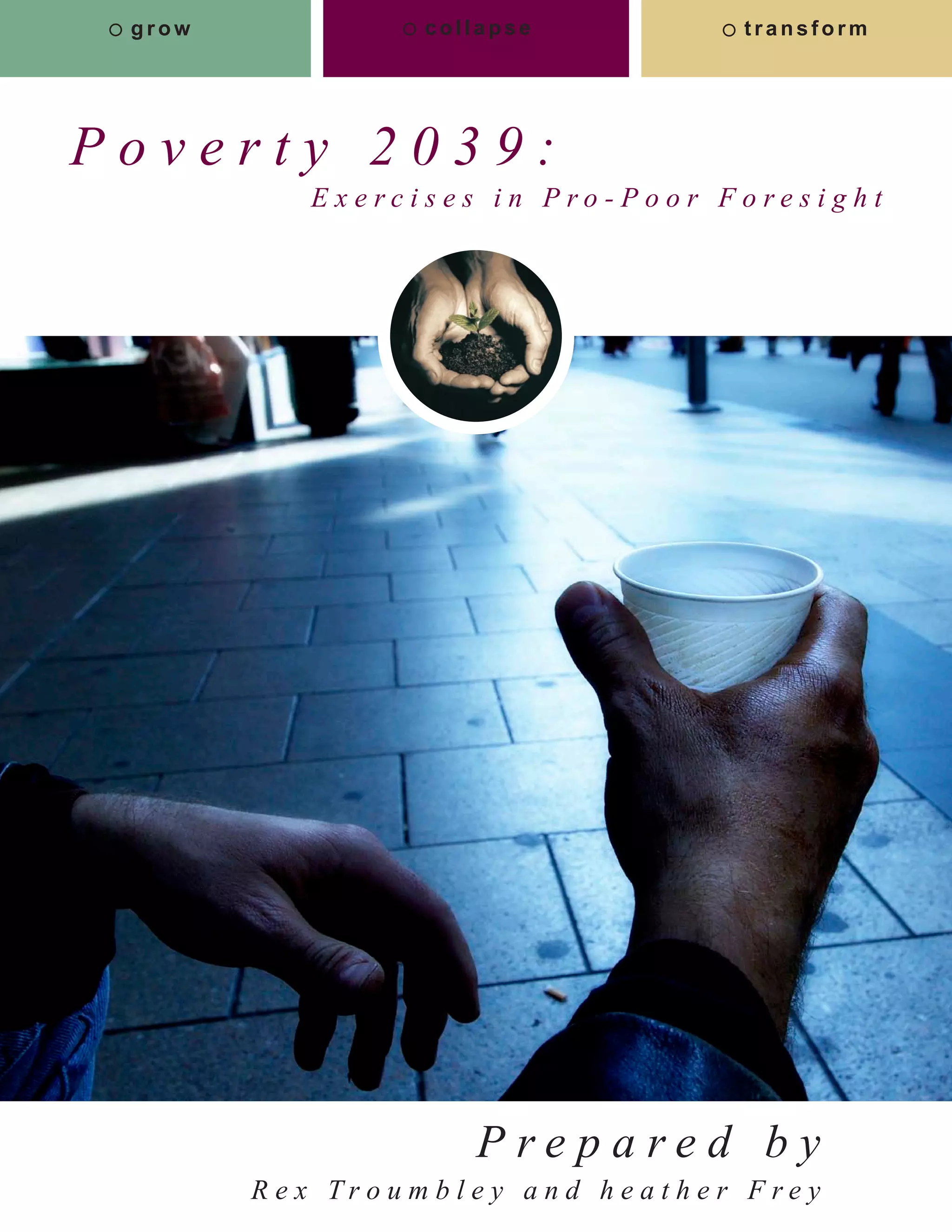
P o v e r t y 2 0 3 9 :
E x e r c i s e s i n P r o - P o o r F o r e s i g h t
t ra nsfor mc o l l ap s egrow
P r e p a r e d b y
R e x T r o u m b l e y a n d h e a t h e r F r e y
Table of Contents
Introduction..........................................................1
History..................................................................2
Continued Growth (alpha)....................................3
Collapse (beta).....................................................5
Transform (delta)..................................................7
These scenarios were prepared in response to
the Institution for Alternative Futures (IAF) call for
pro-poor foresight. Using our access to students
at the University of Hawai’i at Manoa who come
from a diverse background, including some of the
wealthiest and poorest regions of the world, we
presented 30 students with three basic images
of the future. Using the Manoa School futures
methodology and the IAF workshop toolkit, we
asked students to imagine the world in a state
of continued growth (alpha), collapse (beta) and
transformation (delta) in the year 2039.
Students identified six dominant drivers effecting
the futures of poverty. The identified drivers were:
Education
Government
Security
Social Identity
Global Economy
Technology
After collecting the workshop results, we
conducted an environmental scan for macro
trends in poverty and marginalized populations.
Combining the workshop results and the product
of our scan, we developed three detailed
scenarios which consider each of the drivers
impact on the poor. The most challenging barriers
when thinking about poor populations are the
tendencies of historians to ignore the poor for
most of early history, the focus on Eurocentric
histories, and the lack of a clear definition of
poverty within the global discourse. For this
project, we define poverty as a relative condition
measured on both a global and local scale.
Poor populations are typically distinguishable
based upon their vulnerability to disease, natural
disaster, conflict, crime and other dangers. The
higher the vulnerability, the more likely the group
is among the poorest in a particular region.
The project regards poverty to be a symptom of
multiple factors of social, political and economic
deprivations including:
Lack of mobility (both temporary and permanent
physical mobility and social mobility)
Inability to meet nutrition requirements
Inability to escape avoidable diseases
Difficulty or lack of safe shelter
Insufficient clothing
Inability to be free from public shame for failure
to satisfy conventions (largely due to inability to
afford those conventions)
Lack of access to contraceptives
Lack of access to education and information
Introduction
PolicyRecommendations......................................9
Workshop Results...............................................11
AcademicSources..............................................12
Page 1
The history of poverty and poor communities is
difficult to uncover as historians typically focus
on the narratives of the wealthy and powerful.
Prior to the 1500s, there was no conception
of poverty we might recognize today. The vast
majority of people lived in conditions we would
consider as poor. Accumulation of wealth was
not an object of desire and most of the wealth or
access was controlled by nobility. However, the
disparity between those with wealth or access and
the rest greatly increased after the discovery, and
subsequent plundering, of the New World and the
Industrial Revolution.
The emergence of bourgers and the use of the
New World rescources being invested in the form
of captial in Europe encouraged a paradigm shift
in favor of enclosing land, displacing the previous
inhabitants, and grazing sheep for wool production
or growing cotton. The 19th century was the first
time the history of the poor was recorded. During
that same time, the Victorian belief in self-help
(everyone can be successful if they work hard
and practice), promoted the belief that if you were
poor it was your fault. The advent of the industrial
revolution again changed the way people began
to consider the poor. This new classification was
not considered derogatory, but was merely a
condition of life. For the first time, poverty was
made distinct from other forms of social conditions
and historians began considering the narratives of
the poor.
One clear example of this shift was with the failure
of the Speenhamland laws in England, which
legislated a minimum wage for all citizens and
guaranteed access to basic food requirements.
The laws cased the condition of poverty to carry a
social stigma of laziness, undeserving freeloading.
Perpetuating this rising stigma against being
poor, around the same time, England introduced
vagabond laws which outlawed begging without
an official license from the state. Along with these
laws came the development of poorhouses and
the notion of churches being responsible for alms
for the poor.
After WWI, government support of disabled
soldiers, widows, and orphans demonstrates
the extending reaches of the State into the
condition of the poor; children especially being
unambiguously not responsible for their condition.
The Great Depression did a lot to further
de-stigmatize poverty showing individuals alone
were not necessarily to blame for their economic
condition. Since then there has been a greater
recognition of poverty as a global condition. Which
has lead to comparing and gauging poverty on a
macro-scale; dividing the world into a Global North
and Global South.
A few historical trends in poverty are the
prevalence of poor among young singles,
aboriginal and native peoples, the disabled,
children, and seniors. The poor have tended
to be the first to suffer in times of war, natural
disasters, and epidemics such as malaria, HIV,
and tuberculosis.
They also tend to be the highest portion of the
population to struggle with substance abuse,
mental illnesses, domestic violence, and are more
likely to go to jail in their lifetime. Impoverished
populations tend to have a lack of access to
contraceptives and family planning. It is important
to note that three quarters of the world poor today
are rural farmers.
History of the Poor
Page 2
A L P H A
After a decade of consecutive, record-breaking hurricane
seasons and unprecedented natural disasters, a group
of delegates representing every country on the globe
gather with the intent to make a true and lasting global
climate initiative. The Climate Stabilization Inititive (CSI)
2027, became known for being the most aggressive
and proactive climate change agreement signed by all
countries on the globe. Due to CSI 2027 regulations
and intergovernmental cooperation among all states,
the devastating effects of climate change began to
level off around 2035. Education had shifted away from
fact-based learning by the early 2020s. The focus of
education is more on creativity and innovation. In a turn
away from prestigious university degrees, as had been
the gauge for quality of education in the past, by 2018
attention was given to those who took the available
material and utilized it in a “new” manner. Because all
universities were required to stream classes online and
provide supplemental reading material via the Internet,
access to information was no longer an economic or
academic parameter.
CONTINUED
GROWTH
In the world of 2039, migration of the masses to
urban centers has reached its peak. The difficulties
and benefits of mass urbanization are finally being
realized. Concentration of population in urban areas
greatly reduces the unit costs of electricity, transport,
healthcare, schools, piped water, sewers, drains,
garbage collection and roads. The array of early 21st
century concerns regarding the mass movement
towards cities has proven to be more of a benefit
than harm for both the environment and humanity.
During the first two decades of the 21st century, the
effect of global warming such as rising water levels,
increasing salinity and pollution of drinkable water
and extreme violent weather patterns, continued to
grow exponentially.
Page 3
GLOBAL GOVERNANCE
A gradual shift towards global governance began in
2022, as a potential way to allow for technology to
become increasingly ubiquitous and oriented toward
data collection and mining. Local governments became
solely concerned with humanitarian issues, concerning
themselves with the collective as well as individual needs
of the citizens in their specific region. On demand mass-
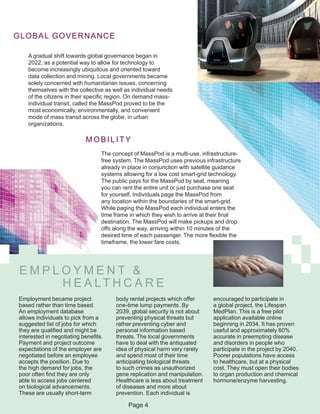
individual transit, called the MassPod proved to be the
most economically, environmentally, and convenient
mode of mass transit across the globe, in urban
organizations.
The concept of MassPod is a multi-use, infrastructure-
free system. The MassPod uses previous infrastructure
already in place in conjunction with satellite guidance
systems allowing for a low cost smart-grid technology.
The public pays for the MassPod by seat, meaning
you can rent the entire unit or just purchase one seat
for yourself. Individuals page the MassPod from
any location within the boundaries of the smart-grid.
While paging the MassPod each individual enters the
time frame in which they wish to arrive at their final
destination. The MassPod will make pickups and drop
offs along the way, arriving within 10 minutes of the
desired time of each passenger. The more flexible the
timeframe, the lower fare costs.
MOBILITY
E M P L O Y M E N T &
H E A LT H C A R E
Employment became project
based rather than time based.
An employment database
allows individuals to pick from a
suggested list of jobs for which
they are qualified and might be
interested in negotiating benefits.
Payment and project outcome
expectations of the employer are
negotiated before an employee
accepts the position. Due to
the high demand for jobs, the
poor often find they are only
able to access jobs centered
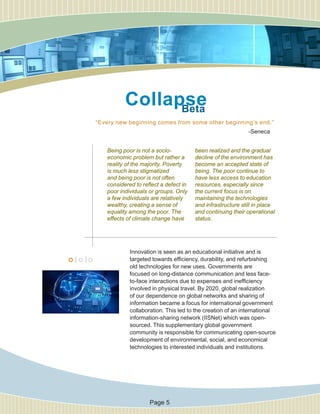
on biological advancements.
These are usually short-term
body rental projects which offer
one-time lump payments. By
2039, global security is not about
preventing physical threats but
rather preventing cyber and
personal information based
threats. The local governments
have to deal with the antiquated
idea of physical harm very rarely
and spend most of their time
anticipating biological threats
to such crimes as unauthorized
gene replication and manipulation.
Healthcare is less about treatment
of diseases and more about
prevention. Each individual is
encouraged to participate in
a global project, the Lifespan
MedPlan. This is a free pilot
application available online
beginning in 2034. It has proven
useful and approximately 60%
accurate in preempting disease
and disorders in people who
participate in the project by 2040.
Poorer populations have access
to healthcare, but at a physical
cost. They must open their bodies
to organ production and chemical
hormone/enzyme harvesting.
Page 4
“Every new beginning comes from some other beginning’s end.”
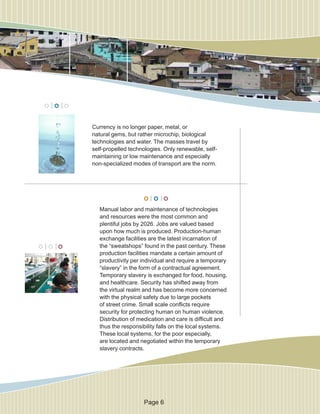
Innovation is seen as an educational initiative and is
targeted towards efficiency, durability, and refurbishing
old technologies for new uses. Governments are
focused on long-distance communication and less face-
to-face interactions due to expenses and inefficiency
involved in physical travel. By 2020, global realization
of our dependence on global networks and sharing of
information became a focus for international government
collaboration. This led to the creation of an international
information-sharing network (IISNet) which was open-
sourced. This supplementary global government
community is responsible for communicating open-source
development of environmental, social, and economical
technologies to interested individuals and institutions.
-Seneca
Being poor is not a socio-
economic problem but rather a
reality of the majority. Poverty
is much less stigmatized
and being poor is not often
considered to reflect a defect in
poor individuals or groups. Only
a few individuals are relatively
wealthy, creating a sense of
equality among the poor. The
effects of climate change have
been realized and the gradual
decline of the environment has
become an accepted state of
being. The poor continue to
have less access to education
resources, especially since
the current focus is on
maintaining the technologies
and infrastructure still in place
and continuing their operational
status.
CollapseBeta
Page 5
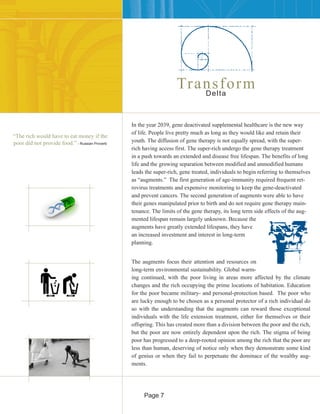
Currency is no longer paper, metal, or
natural gems, but rather microchip, biological
technologies and water. The masses travel by
self-propelled technologies. Only renewable, self-
maintaining or low maintenance and especially
non-specialized modes of transport are the norm.
Manual labor and maintenance of technologies
and resources were the most common and
plentiful jobs by 2026. Jobs are valued based
upon how much is produced. Production-human
exchange facilities are the latest incarnation of
the “sweatshops” found in the past century. These
production facilities mandate a certain amount of
productivity per individual and require a temporary
“slavery” in the form of a contractual agreement.
Temporary slavery is exchanged for food, housing,
and healthcare. Security has shifted away from
the virtual realm and has become more concerned
with the physical safety due to large pockets
of street crime. Small scale conflicts require
security for protecting human on human violence.
Distribution of medication and care is difficult and
thus the responsibility falls on the local systems.
These local systems, for the poor especially,
are located and negotiated within the temporary
slavery contracts.
Page 6
In the year 2039, gene deactivated supplemental healthcare is the new way
of life. People live pretty much as long as they would like and retain their
youth. The diffusion of gene therapy is not equally spread, with the super-
rich having access first. The super-rich undergo the gene therapy treatment
in a push towards an extended and disease free lifespan. The benefits of long
life and the growing separation between modified and unmodified humans
leads the super-rich, gene treated, individuals to begin referring to themselves
as “augments.” The first generation of age-immunity required frequent ret-
rovirus treatments and expensive monitoring to keep the gene-deactivated
and prevent cancers. The second generation of augments were able to have
their genes manipulated prior to birth and do not require gene therapy main-
tenance. The limits of the gene therapy, its long term side effects of the aug-
mented lifespan remain largely unknown. Because the
augments have greatly extended lifespans, they have
an increased investment and interest in long-term
planning.
“The rich would have to eat money if the
poor did not provide food.” - Russian Proverb
TransformDelta
The augments focus their attention and resources on
long-term environmental sustainability. Global warm-
ing continued, with the poor living in areas more affected by the climate
changes and the rich occupying the prime locations of habitation. Education
for the poor became military- and personal-protection based. The poor who
are lucky enough to be chosen as a personal protector of a rich individual do
so with the understanding that the augments can reward those exceptional
individuals with the life extension treatment, either for themselves or their
offspring. This has created more than a division between the poor and the rich,
but the poor are now entirely dependent upon the rich. The stigma of being
poor has progressed to a deep-rooted opinion among the rich that the poor are
less than human, deserving of notice only when they demonstrate some kind
of genius or when they fail to perpetuate the dominace of the wealthy aug-
ments.
Page 7
“The rich will do anything for the poor but get off their backs.” - Karl Marx
Governance in general is oriented toward improving and maintaining the life-
styles of the augments, with the poor and marginalized communities having
diminished access to government. Governance is less about the enfranchise-
ment of people and more about encouraging the docility of the poor masses.
In 2034, the Department of Workforce Efficiency (DWE) was mandated as
the body to determine the minimal nutrition and sleep required for maximum
output of work by the poor workforce. This department, then as now, is also
required to determine whether an injured or ill worker should be rehabilitated
or replaced. The focus on a global economy reinforces the hegemony of the
augments, with an emphasis on sustainability and minimizing economic fluc-
tuations. The augments desire a fast and convenient transportation system
and it is reserved for them alone. The poor utilize slower forms of transport
such as self-propelled modes, beasts of burden and older gas-based machines.
Mobility is seen as a luxury for which the poor populations’ use of is greatly
diminished. The augments maintain a complicated apparatus of professionals
and servants to maintain their lifestyle. The poor largely work in the service
industries and protective services, with labor being valued as a function of
time. Security among the augments is highly valued with the death or injury
of an augment being considered a serious crime against humanity. However,
the vaue of life ascribed to the poor is not so great and they enjoy very little
personal security unless the augments consider them a serious investment.
Much of the security energies are also directed toward protecting uncontami-
nated gene therapy drugs and the augments’ gene banks. Healthcare is largely
consumed by the augments, but there is a concern for the health of the poor
so long as at least a small number are available for healthy reproduction and
wild gene stock. The health of the poor is maintained to allow some useful
mutations and potential immunities to diseases for which the static genetic
makeup of the augments may be susceptible.
Page 8
Policy Recommendations
Overall, the policy recommendations we propose treat poverty as
a social condition and these policies intend to increase interaction
between rich and poor, both to encourage awareness of the other
group’s humanity, as well as to destigmatize the condition of being
poor.
> Communities
Large apartment complexes built with the wealthier living on the outside
facing sides of the building, the poor facing the inner building spaces, and
all apartment entrances being inside the complex
would encourage the rich and poor to cohabitate.
Similar designs will encourage interaction and vis-
ibility of the poor and the rich to each other and pro-
vide a nice community presence from the outside.
Communities encourage children to play together
and attend the same schools. This does not actively
encourage rural populations to move into cities,
rather it provides for existing demands of safe and affordable living environ-
ments adaptable to handle increased movement into cities, which is already
occuring. Living in these communities, the rich get tax breaks, prime location,
and the ability to increase property values. The poor in these communities
enjoy better security and easy access to urban amenities.
> Revised Precautionary Principle
Poor and susceptible populations are more strongly influenced by the
Precautionary Principle than are other groups. Physicist Freeman Dyson
summarizes, “The Precautionary Principle says that if some course of
action carries even a remote chance of irreparable damage to the ecol-
ogy, then you shouldn’t do it, no matter how great the possible advan-
tages of the action may be.” In situations, such as emergency or famine,
we recommend flexibility when applying The Principle in the shortterm
and a recognition that The Principle, strictly applied, would allow for no
introduction of genetically modified foods, medications, or technolo-
gies. Generally, we recommend reduced restrictions on the use and
distribution of genetically modified foods, specifically staple foods
such as rice, wheat, potatoes, and beans. We recommend that
farmers be permitted, and encouraged, to keep and replant modi-
fied seed.Page 9
> Medicine and Medication
We recommend that the length of drug patents be reduced, allowing for
a generic version to be produced globally and
cheaply. In place of four years of residency for
physicians, we would require them to spend two
consecutive years in poor communities (inter-
national or domestic). We encourage increased
research and distribution of mobile devices and
software for diagnosing symptoms and which
would give suggestions for how to improvise until you can reach a trained
professional. Via access to the global free Internet, we encourage free dis-
tribution of medical information concerning preventive methods, STDs, diar-
rhea, and other easily avoidable diseases.
> New Energy and Water Subsidy Model
We recommend research into water reclamation and alternative, local, energy
generation. Creation of local water distribution centers dispersed around
urban areas to exchange urine and once-used water for filtered water. We
recommend increased regulation in exchange for better subsidies to energy
manufacturers. We encourage a subsidization
model which allows countries to continue subsidiz-
ing companies who move outside country board-
ers. This would allow companies to profit from
subsidies and benefit from low cost production in
cheaper environments and allow for a percentage
of their material and energy to be retained in the
community where it was produced.
> Free Internet
In a recent address to the former Egyptian government, President
Obama said “I also call upon the Egyptian government to reverse the
actions that they’ve taken to interfere with access to the Internet, to cell
phone service, and to social networks that do so much to connect peo-
ple in the 21st Century.” We recommend access to the Internet being
considered a basic human right. We recommend a global free Internet
based on wireless access and using an open-source, shared respon-
sibility model similar to file-sharing BitTorrent protocols; an Internet
which cannot be disabled, censored or monitored, and would pro-
vide the option for individuals to use the service anonymously.
Page 10
Delta
economy: free trade encourages cheaper products
and provides jobs which nearly erases the social
condition of being poor.
security: increased cooperation across boarders and
increased surveillance leads to the poor enjoying
greater security from threats and increased invest-
ment in poor areas.
government: decrease in military spending leads to
more funding available for social programs for the
poor.
education: greater emphasis on quality of educa-
tion based on reversed socio-economic background
where the poor receive first priority for better insti-
tutions.
Workshop Results
References
Alpha
social identity: poor more defined as a social group
because of lack of access to global communities.
security: populations growth leads to increased
number of poor and exploitation of the poor; more
populations and less resources.
education: increases in cheap communications and
information technology creates greater accessibil-
ity educational sources for poor communities.
government: a unified international government
focuses on policies in favor of human rights which
ensure basic living standards for all global citizens,
poor and wealthy alike.
Beta
economy: corporations begin enslaving poor popu-
lations.
security: increased separation between rich and
poor with poor living in slums separated from the
rich by walls where crime runs rampant.
education: education becomes less valuable, prac-
tically and socially, as an increased demand for
manual labor discourages liberal arts or humanities
education.
government: global foundations and GNOs be-
come the reigning power creating an illusion of
charity which fosters an increased separation be-
tween the rich and the poor further ignoring the
needs and necessities of the poor.
Page 11
Academic Sources
BitTorrent Based DNS To Counter US Domain Seizures.
TorrentFreak. (n.d.). http://torrentfreak.com/bittor-
rent-based-dns-to-counter-us-domain-seizures-101130/
Brand, S. (2009). Whole Earth Discipline : an ecopragma-
tist manifesto. New York: Viking.
Chang, H. (2009). Bad Samaritans : the myth of free trade
and the secret history of capitalism (Pbk. ed.). New York:
Bloomsbury Press.
The Long Now. (n.d.)., from http://longnow.org/
Gizmodo, the Gadget Guide. (n.d.). , from http://gizmodo.
com/
Krishna, S. (2009). Globalization and Postcolonialism :
hegemony and resistance in the twenty-first century.
Lanham Md.: Rowman & Littlefield.
Kurzweil Accelerating Intelligence. (n.d.)., from http://
www.kurzweilai.net/
Kurzweil, R. (2006). The Singularity is Near : when
humans transcend biology. New York: Penguin.
Long Life Gene: Science Videos - Science News -
ScienCentral. (n.d.)., from http://www.sciencentral.com/
articles/view.php3?article_id=218391382
Polanyi, K. (2001). The Great Transformation : the politi-
cal and economic origins of our time (2nd ed.). Boston
MA: Beacon Press.
Wired.com. (n.d.)., from http://www.wired.com/
Rex Troumbley (rexlt@hawaii.edu)
Heather Frey (hfrey@hawaii.edu)
Page 12
ProPoor_Poverty2039Scenarios (1)

ProPoor_Poverty2039Scenarios (1)

  • 1.
    P o ve r t y 2 0 3 9 : E x e r c i s e s i n P r o - P o o r F o r e s i g h t t ra nsfor mc o l l ap s egrow P r e p a r e d b y R e x T r o u m b l e y a n d h e a t h e r F r e y
  • 2.
    Table of Contents Introduction..........................................................1 History..................................................................2 ContinuedGrowth (alpha)....................................3 Collapse (beta).....................................................5 Transform (delta)..................................................7 These scenarios were prepared in response to the Institution for Alternative Futures (IAF) call for pro-poor foresight. Using our access to students at the University of Hawai’i at Manoa who come from a diverse background, including some of the wealthiest and poorest regions of the world, we presented 30 students with three basic images of the future. Using the Manoa School futures methodology and the IAF workshop toolkit, we asked students to imagine the world in a state of continued growth (alpha), collapse (beta) and transformation (delta) in the year 2039. Students identified six dominant drivers effecting the futures of poverty. The identified drivers were: Education Government Security Social Identity Global Economy Technology After collecting the workshop results, we conducted an environmental scan for macro trends in poverty and marginalized populations. Combining the workshop results and the product of our scan, we developed three detailed scenarios which consider each of the drivers impact on the poor. The most challenging barriers when thinking about poor populations are the tendencies of historians to ignore the poor for most of early history, the focus on Eurocentric histories, and the lack of a clear definition of poverty within the global discourse. For this project, we define poverty as a relative condition measured on both a global and local scale. Poor populations are typically distinguishable based upon their vulnerability to disease, natural disaster, conflict, crime and other dangers. The higher the vulnerability, the more likely the group is among the poorest in a particular region. The project regards poverty to be a symptom of multiple factors of social, political and economic deprivations including: Lack of mobility (both temporary and permanent physical mobility and social mobility) Inability to meet nutrition requirements Inability to escape avoidable diseases Difficulty or lack of safe shelter Insufficient clothing Inability to be free from public shame for failure to satisfy conventions (largely due to inability to afford those conventions) Lack of access to contraceptives Lack of access to education and information Introduction PolicyRecommendations......................................9 Workshop Results...............................................11 AcademicSources..............................................12 Page 1
  • 3.
    The history ofpoverty and poor communities is difficult to uncover as historians typically focus on the narratives of the wealthy and powerful. Prior to the 1500s, there was no conception of poverty we might recognize today. The vast majority of people lived in conditions we would consider as poor. Accumulation of wealth was not an object of desire and most of the wealth or access was controlled by nobility. However, the disparity between those with wealth or access and the rest greatly increased after the discovery, and subsequent plundering, of the New World and the Industrial Revolution. The emergence of bourgers and the use of the New World rescources being invested in the form of captial in Europe encouraged a paradigm shift in favor of enclosing land, displacing the previous inhabitants, and grazing sheep for wool production or growing cotton. The 19th century was the first time the history of the poor was recorded. During that same time, the Victorian belief in self-help (everyone can be successful if they work hard and practice), promoted the belief that if you were poor it was your fault. The advent of the industrial revolution again changed the way people began to consider the poor. This new classification was not considered derogatory, but was merely a condition of life. For the first time, poverty was made distinct from other forms of social conditions and historians began considering the narratives of the poor. One clear example of this shift was with the failure of the Speenhamland laws in England, which legislated a minimum wage for all citizens and guaranteed access to basic food requirements. The laws cased the condition of poverty to carry a social stigma of laziness, undeserving freeloading. Perpetuating this rising stigma against being poor, around the same time, England introduced vagabond laws which outlawed begging without an official license from the state. Along with these laws came the development of poorhouses and the notion of churches being responsible for alms for the poor. After WWI, government support of disabled soldiers, widows, and orphans demonstrates the extending reaches of the State into the condition of the poor; children especially being unambiguously not responsible for their condition. The Great Depression did a lot to further de-stigmatize poverty showing individuals alone were not necessarily to blame for their economic condition. Since then there has been a greater recognition of poverty as a global condition. Which has lead to comparing and gauging poverty on a macro-scale; dividing the world into a Global North and Global South. A few historical trends in poverty are the prevalence of poor among young singles, aboriginal and native peoples, the disabled, children, and seniors. The poor have tended to be the first to suffer in times of war, natural disasters, and epidemics such as malaria, HIV, and tuberculosis. They also tend to be the highest portion of the population to struggle with substance abuse, mental illnesses, domestic violence, and are more likely to go to jail in their lifetime. Impoverished populations tend to have a lack of access to contraceptives and family planning. It is important to note that three quarters of the world poor today are rural farmers. History of the Poor Page 2
  • 4.
    A L PH A After a decade of consecutive, record-breaking hurricane seasons and unprecedented natural disasters, a group of delegates representing every country on the globe gather with the intent to make a true and lasting global climate initiative. The Climate Stabilization Inititive (CSI) 2027, became known for being the most aggressive and proactive climate change agreement signed by all countries on the globe. Due to CSI 2027 regulations and intergovernmental cooperation among all states, the devastating effects of climate change began to level off around 2035. Education had shifted away from fact-based learning by the early 2020s. The focus of education is more on creativity and innovation. In a turn away from prestigious university degrees, as had been the gauge for quality of education in the past, by 2018 attention was given to those who took the available material and utilized it in a “new” manner. Because all universities were required to stream classes online and provide supplemental reading material via the Internet, access to information was no longer an economic or academic parameter. CONTINUED GROWTH In the world of 2039, migration of the masses to urban centers has reached its peak. The difficulties and benefits of mass urbanization are finally being realized. Concentration of population in urban areas greatly reduces the unit costs of electricity, transport, healthcare, schools, piped water, sewers, drains, garbage collection and roads. The array of early 21st century concerns regarding the mass movement towards cities has proven to be more of a benefit than harm for both the environment and humanity. During the first two decades of the 21st century, the effect of global warming such as rising water levels, increasing salinity and pollution of drinkable water and extreme violent weather patterns, continued to grow exponentially. Page 3
  • 5.
    GLOBAL GOVERNANCE A gradualshift towards global governance began in 2022, as a potential way to allow for technology to become increasingly ubiquitous and oriented toward data collection and mining. Local governments became solely concerned with humanitarian issues, concerning themselves with the collective as well as individual needs of the citizens in their specific region. On demand mass- individual transit, called the MassPod proved to be the most economically, environmentally, and convenient mode of mass transit across the globe, in urban organizations. The concept of MassPod is a multi-use, infrastructure- free system. The MassPod uses previous infrastructure already in place in conjunction with satellite guidance systems allowing for a low cost smart-grid technology. The public pays for the MassPod by seat, meaning you can rent the entire unit or just purchase one seat for yourself. Individuals page the MassPod from any location within the boundaries of the smart-grid. While paging the MassPod each individual enters the time frame in which they wish to arrive at their final destination. The MassPod will make pickups and drop offs along the way, arriving within 10 minutes of the desired time of each passenger. The more flexible the timeframe, the lower fare costs. MOBILITY E M P L O Y M E N T & H E A LT H C A R E Employment became project based rather than time based. An employment database allows individuals to pick from a suggested list of jobs for which they are qualified and might be interested in negotiating benefits. Payment and project outcome expectations of the employer are negotiated before an employee accepts the position. Due to the high demand for jobs, the poor often find they are only able to access jobs centered on biological advancements. These are usually short-term body rental projects which offer one-time lump payments. By 2039, global security is not about preventing physical threats but rather preventing cyber and personal information based threats. The local governments have to deal with the antiquated idea of physical harm very rarely and spend most of their time anticipating biological threats to such crimes as unauthorized gene replication and manipulation. Healthcare is less about treatment of diseases and more about prevention. Each individual is encouraged to participate in a global project, the Lifespan MedPlan. This is a free pilot application available online beginning in 2034. It has proven useful and approximately 60% accurate in preempting disease and disorders in people who participate in the project by 2040. Poorer populations have access to healthcare, but at a physical cost. They must open their bodies to organ production and chemical hormone/enzyme harvesting. Page 4
  • 6.
    “Every new beginningcomes from some other beginning’s end.” Innovation is seen as an educational initiative and is targeted towards efficiency, durability, and refurbishing old technologies for new uses. Governments are focused on long-distance communication and less face- to-face interactions due to expenses and inefficiency involved in physical travel. By 2020, global realization of our dependence on global networks and sharing of information became a focus for international government collaboration. This led to the creation of an international information-sharing network (IISNet) which was open- sourced. This supplementary global government community is responsible for communicating open-source development of environmental, social, and economical technologies to interested individuals and institutions. -Seneca Being poor is not a socio- economic problem but rather a reality of the majority. Poverty is much less stigmatized and being poor is not often considered to reflect a defect in poor individuals or groups. Only a few individuals are relatively wealthy, creating a sense of equality among the poor. The effects of climate change have been realized and the gradual decline of the environment has become an accepted state of being. The poor continue to have less access to education resources, especially since the current focus is on maintaining the technologies and infrastructure still in place and continuing their operational status. CollapseBeta Page 5
  • 7.
    Currency is nolonger paper, metal, or natural gems, but rather microchip, biological technologies and water. The masses travel by self-propelled technologies. Only renewable, self- maintaining or low maintenance and especially non-specialized modes of transport are the norm. Manual labor and maintenance of technologies and resources were the most common and plentiful jobs by 2026. Jobs are valued based upon how much is produced. Production-human exchange facilities are the latest incarnation of the “sweatshops” found in the past century. These production facilities mandate a certain amount of productivity per individual and require a temporary “slavery” in the form of a contractual agreement. Temporary slavery is exchanged for food, housing, and healthcare. Security has shifted away from the virtual realm and has become more concerned with the physical safety due to large pockets of street crime. Small scale conflicts require security for protecting human on human violence. Distribution of medication and care is difficult and thus the responsibility falls on the local systems. These local systems, for the poor especially, are located and negotiated within the temporary slavery contracts. Page 6
  • 8.
    In the year2039, gene deactivated supplemental healthcare is the new way of life. People live pretty much as long as they would like and retain their youth. The diffusion of gene therapy is not equally spread, with the super- rich having access first. The super-rich undergo the gene therapy treatment in a push towards an extended and disease free lifespan. The benefits of long life and the growing separation between modified and unmodified humans leads the super-rich, gene treated, individuals to begin referring to themselves as “augments.” The first generation of age-immunity required frequent ret- rovirus treatments and expensive monitoring to keep the gene-deactivated and prevent cancers. The second generation of augments were able to have their genes manipulated prior to birth and do not require gene therapy main- tenance. The limits of the gene therapy, its long term side effects of the aug- mented lifespan remain largely unknown. Because the augments have greatly extended lifespans, they have an increased investment and interest in long-term planning. “The rich would have to eat money if the poor did not provide food.” - Russian Proverb TransformDelta The augments focus their attention and resources on long-term environmental sustainability. Global warm- ing continued, with the poor living in areas more affected by the climate changes and the rich occupying the prime locations of habitation. Education for the poor became military- and personal-protection based. The poor who are lucky enough to be chosen as a personal protector of a rich individual do so with the understanding that the augments can reward those exceptional individuals with the life extension treatment, either for themselves or their offspring. This has created more than a division between the poor and the rich, but the poor are now entirely dependent upon the rich. The stigma of being poor has progressed to a deep-rooted opinion among the rich that the poor are less than human, deserving of notice only when they demonstrate some kind of genius or when they fail to perpetuate the dominace of the wealthy aug- ments. Page 7
  • 9.
    “The rich willdo anything for the poor but get off their backs.” - Karl Marx Governance in general is oriented toward improving and maintaining the life- styles of the augments, with the poor and marginalized communities having diminished access to government. Governance is less about the enfranchise- ment of people and more about encouraging the docility of the poor masses. In 2034, the Department of Workforce Efficiency (DWE) was mandated as the body to determine the minimal nutrition and sleep required for maximum output of work by the poor workforce. This department, then as now, is also required to determine whether an injured or ill worker should be rehabilitated or replaced. The focus on a global economy reinforces the hegemony of the augments, with an emphasis on sustainability and minimizing economic fluc- tuations. The augments desire a fast and convenient transportation system and it is reserved for them alone. The poor utilize slower forms of transport such as self-propelled modes, beasts of burden and older gas-based machines. Mobility is seen as a luxury for which the poor populations’ use of is greatly diminished. The augments maintain a complicated apparatus of professionals and servants to maintain their lifestyle. The poor largely work in the service industries and protective services, with labor being valued as a function of time. Security among the augments is highly valued with the death or injury of an augment being considered a serious crime against humanity. However, the vaue of life ascribed to the poor is not so great and they enjoy very little personal security unless the augments consider them a serious investment. Much of the security energies are also directed toward protecting uncontami- nated gene therapy drugs and the augments’ gene banks. Healthcare is largely consumed by the augments, but there is a concern for the health of the poor so long as at least a small number are available for healthy reproduction and wild gene stock. The health of the poor is maintained to allow some useful mutations and potential immunities to diseases for which the static genetic makeup of the augments may be susceptible. Page 8
  • 10.
    Policy Recommendations Overall, thepolicy recommendations we propose treat poverty as a social condition and these policies intend to increase interaction between rich and poor, both to encourage awareness of the other group’s humanity, as well as to destigmatize the condition of being poor. > Communities Large apartment complexes built with the wealthier living on the outside facing sides of the building, the poor facing the inner building spaces, and all apartment entrances being inside the complex would encourage the rich and poor to cohabitate. Similar designs will encourage interaction and vis- ibility of the poor and the rich to each other and pro- vide a nice community presence from the outside. Communities encourage children to play together and attend the same schools. This does not actively encourage rural populations to move into cities, rather it provides for existing demands of safe and affordable living environ- ments adaptable to handle increased movement into cities, which is already occuring. Living in these communities, the rich get tax breaks, prime location, and the ability to increase property values. The poor in these communities enjoy better security and easy access to urban amenities. > Revised Precautionary Principle Poor and susceptible populations are more strongly influenced by the Precautionary Principle than are other groups. Physicist Freeman Dyson summarizes, “The Precautionary Principle says that if some course of action carries even a remote chance of irreparable damage to the ecol- ogy, then you shouldn’t do it, no matter how great the possible advan- tages of the action may be.” In situations, such as emergency or famine, we recommend flexibility when applying The Principle in the shortterm and a recognition that The Principle, strictly applied, would allow for no introduction of genetically modified foods, medications, or technolo- gies. Generally, we recommend reduced restrictions on the use and distribution of genetically modified foods, specifically staple foods such as rice, wheat, potatoes, and beans. We recommend that farmers be permitted, and encouraged, to keep and replant modi- fied seed.Page 9
  • 11.
    > Medicine andMedication We recommend that the length of drug patents be reduced, allowing for a generic version to be produced globally and cheaply. In place of four years of residency for physicians, we would require them to spend two consecutive years in poor communities (inter- national or domestic). We encourage increased research and distribution of mobile devices and software for diagnosing symptoms and which would give suggestions for how to improvise until you can reach a trained professional. Via access to the global free Internet, we encourage free dis- tribution of medical information concerning preventive methods, STDs, diar- rhea, and other easily avoidable diseases. > New Energy and Water Subsidy Model We recommend research into water reclamation and alternative, local, energy generation. Creation of local water distribution centers dispersed around urban areas to exchange urine and once-used water for filtered water. We recommend increased regulation in exchange for better subsidies to energy manufacturers. We encourage a subsidization model which allows countries to continue subsidiz- ing companies who move outside country board- ers. This would allow companies to profit from subsidies and benefit from low cost production in cheaper environments and allow for a percentage of their material and energy to be retained in the community where it was produced. > Free Internet In a recent address to the former Egyptian government, President Obama said “I also call upon the Egyptian government to reverse the actions that they’ve taken to interfere with access to the Internet, to cell phone service, and to social networks that do so much to connect peo- ple in the 21st Century.” We recommend access to the Internet being considered a basic human right. We recommend a global free Internet based on wireless access and using an open-source, shared respon- sibility model similar to file-sharing BitTorrent protocols; an Internet which cannot be disabled, censored or monitored, and would pro- vide the option for individuals to use the service anonymously. Page 10
  • 12.
    Delta economy: free tradeencourages cheaper products and provides jobs which nearly erases the social condition of being poor. security: increased cooperation across boarders and increased surveillance leads to the poor enjoying greater security from threats and increased invest- ment in poor areas. government: decrease in military spending leads to more funding available for social programs for the poor. education: greater emphasis on quality of educa- tion based on reversed socio-economic background where the poor receive first priority for better insti- tutions. Workshop Results References Alpha social identity: poor more defined as a social group because of lack of access to global communities. security: populations growth leads to increased number of poor and exploitation of the poor; more populations and less resources. education: increases in cheap communications and information technology creates greater accessibil- ity educational sources for poor communities. government: a unified international government focuses on policies in favor of human rights which ensure basic living standards for all global citizens, poor and wealthy alike. Beta economy: corporations begin enslaving poor popu- lations. security: increased separation between rich and poor with poor living in slums separated from the rich by walls where crime runs rampant. education: education becomes less valuable, prac- tically and socially, as an increased demand for manual labor discourages liberal arts or humanities education. government: global foundations and GNOs be- come the reigning power creating an illusion of charity which fosters an increased separation be- tween the rich and the poor further ignoring the needs and necessities of the poor. Page 11
  • 13.
    Academic Sources BitTorrent BasedDNS To Counter US Domain Seizures. TorrentFreak. (n.d.). http://torrentfreak.com/bittor- rent-based-dns-to-counter-us-domain-seizures-101130/ Brand, S. (2009). Whole Earth Discipline : an ecopragma- tist manifesto. New York: Viking. Chang, H. (2009). Bad Samaritans : the myth of free trade and the secret history of capitalism (Pbk. ed.). New York: Bloomsbury Press. The Long Now. (n.d.)., from http://longnow.org/ Gizmodo, the Gadget Guide. (n.d.). , from http://gizmodo. com/ Krishna, S. (2009). Globalization and Postcolonialism : hegemony and resistance in the twenty-first century. Lanham Md.: Rowman & Littlefield. Kurzweil Accelerating Intelligence. (n.d.)., from http:// www.kurzweilai.net/ Kurzweil, R. (2006). The Singularity is Near : when humans transcend biology. New York: Penguin. Long Life Gene: Science Videos - Science News - ScienCentral. (n.d.)., from http://www.sciencentral.com/ articles/view.php3?article_id=218391382 Polanyi, K. (2001). The Great Transformation : the politi- cal and economic origins of our time (2nd ed.). Boston MA: Beacon Press. Wired.com. (n.d.)., from http://www.wired.com/ Rex Troumbley (rexlt@hawaii.edu) Heather Frey (hfrey@hawaii.edu) Page 12