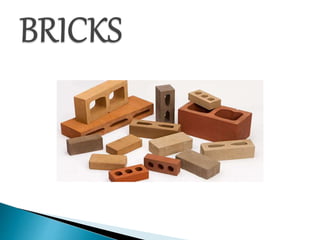
 A brick is building material used to make walls,
pavements and other elements
in masonry construction. Traditionally, the term brick
referred to a unit composed of clay, but it is now used
to denote any rectangular units laid in mortar. A brick
can be composed of clay-bearing soil, sand, and lime,
or concrete materials. Bricks are produced in
numerous classes, types, materials, and sizes which
vary with region and time period, and are produced in
bulk quantities.
 A History of Brick-Making. One of the first building materials were
mud bricks, molded by hand and dried in the sun for days.
Later, bricks were made of clay and fired in kilns to create a strong, lasting
material. ... Throughout history, bricks have been used in every culture,
from the Ancient Chinese to the Romans.
 South –East Aisa before 7500 BC, were found at Tell Aswad, in the
upper Tigris region and in southeast Anatolia close to Diyarbakir.
 Egypt 7,000 and 6,395 BC, come from Jericho, Catal Hüyük, the ancient
Egyptian fortress of Buhen.
 India the ancient Indus Valley cities of Mohenjo-
daro, Harappa,[2] and Mehrgarh.[3] Ceramic, or fired brick was used as early
as 3000 BC in early Indus Valley cities like Kalibangan.[4]
 China By the Qujialing period (3300 BC), fired bricks were being used to
pave roads and as building foundations at Chengtoushan.
According to Raw Materials
 Burnt clay brick
 Fly ash clay brick
 Concrete brick
 Sand-lime brick
 Fire brick
Burnt clay brick
It is obtained by pressing clay in molds and fried
and dried in kilns. It is the most used bricks.
It requires plastering when used in construction
works.
TYPES OF BRICKS
Fly ash clay brick
It is manufactured when fly
ash and clay are molded in
1000 degree Celsius. It
contains a high volume of
calcium oxide in fly ash. That
is why usually described as
self-cementing. It usually
expands when coming into
contact with moisture. It is
less porous than clay bricks.
It proved smooth surface so it
doesn’t need plastering.
TYPES OF BRICKS
Concrete brick
It is made of concrete. It is the
least used bricks. It has low
compression strength and is of
low quality. These bricks are used
above and below the damp proof
course. These bricks are used can
be used for facades, fences and
internal brickworks because of
their sound reductions and heat
resistance qualities. It is also
called mortar brick. It can be of
different colors if the pigment is
added during manufacturing. It
should not be used below ground.
TYPES OF BRICKS
Sand-lime Brick
Sand, fly ash and lime are mixed
and molded under pressure.
During wet mixing, a chemical
reaction takes place to bond the
mixtures. Then they are placed in
the molds. The color is greyish
as it offers something of an
aesthetic view. It offers a
smoother finish and uniform
appearance than the clay bricks.
As a result, it also doesn’t
require plastering. It is used
as load bearing members as it is
immensely strong.
TYPES OF BRICKS
Fire brick
It is also known as refractory
bricks. It is manufactured from
special designed earth. After
burning, it can withstand very
high temperature without
affecting its shape, size, and
strength. It is used for the lining
of chimney and furnaces where
the usual temperature is
expected to be very high.
TYPES OF BRICKS
According to Manufacturing Method
 Extruded Brick
 Molded Brick
 Dry Pressed Brick
Extruded Brick
It is created by forcing clay and
water into a steel die, with a very
regular shape and size, then
cutting the resulting column into
shorter units with wires before
firing. It is used in constructions
with limited budgets. It has three
or four holes constituting up to
25% volume of the brick.
TYPES OF BRICKS
Molded Brick
It is shaped in molds by hand
rather being in the machine.
Molded bricks between 50-
65mm are available instantly.
Other size and shapes are
available in 6-8 weeks after the
order.
TYPES OF BRICKS
Dry pressed Brick
It is the traditional types of
bricks which are made by
compressing clay into molds. It
has a deep frog in one bedding
surface and shallow frog in
another.
TYPES OF BRICKS
According to Shape
 Bull Nose Brick
 Cow nose Bricks
 Air Bricks
 Channel Bricks
 Coping Bricks
 Capping Bricks
 Brick Veneers
 Curved Sector Bricks
 Hollow Brick
 Paving Bricks
 Perforated Bricks
 Purpose made Bricks
 Modular Bricks
 Splay, Cant or Plinth Bricks
 Coping Bricks
 Gutter or Channel Bricks
 Brunt Clay Sewer bricks
Perforated bricks
These bricks have cylindrical
holes through their thickness.
It is done by pushing iron bars
through the brick at the time of
molding.
TYPES OF BRICKS
Hollow bricks or Cavity bricks.
Volume of solid material in them
should not be less than one-half of its
gross overall volume. No web should
be less than 1.5 cm thick.
TYPES OF BRICKS
Splay, Cant or Plinth bricks.
These have a bevel taken off on one side.
These are used in door and window jambs
and in plinths. The splay should be on the
header or on the stretcher as shown.
TYPES OF BRICKS
Coping bricks
These are of different shapes and sizes to suit various conditions
of use. These are used as topmost course on parapets and their
shapes are so made as to expeditiously drain off rain water from
the top of parapets. When projecting the undersides of the
projecting portions are provided with throats so as to throw the
rain water off the faces of walls.
TYPES OF BRICKS
Bull-nosed bricks
These are used to round off sharp corners
TYPES OF BRICKS
Cow-nosed bricks
These are used to round off sharp corners
TYPES OF BRICKS
Paving bricks
Clay used for their manufacture contains more iron than the brick-
earth used to manufacture ordinary bricks. Excessive iron causes
the vitrification of bricks while burning. It gives them natural glaze
as a result of which they can resist abrasion better.
These bricks are mechanically shaped and not hand moulded. Their
compressive strength is not to be less than 400 kg/cm2 and
dimensions are 19.5×9.5×9 cm and 19.5×9.5×4 cm. these should
not absorb water more than 5% of their weight on 24 hours of
immersion in water.
TYPES OF BRICKS
Gutter or channel bricks
These are moulded to the shape.
Very often these are glazed and are used for laying drains
TYPES OF BRICKS
Burnt clay sewer bricks
These are bricks used in construction of sewers for domestic
sewage. These bricks should be free from cracks, flaws and
nodules of lime. These should have rectangular faces with sharp
edges and corners. Their sizes are 19×9×9 cm and 19×9×4 cm.
Their average compressive strength is not less than 175
kg/cm2and these should not absorb more than 10% of their weight
of water.
TYPES OF BRICKS
 Full Brick
 Half Bat
 Three Quarter Bat
 King Closer
 Queen Closer
 Bevelled Closer
 Bevelled Bat
 Mitred Closer
Full Brick
TYPES OF BRICKS
Half Brick or
Half Bat or Queen closer
TYPES OF BRICKS
Three Quarter Bat
TYPES OF BRICKS
King Closer
TYPES OF BRICKS
Queen Closer
TYPES OF BRICKS
Bevelled Closer Bevelled Bat
TYPES OF BRICKS
Mitred Closer
TYPES OF BRICKS
 First Class Brick
 Second Class Brick
 Third Class Brick
 Un burnt Bricks
 Burnt Bricks
 Over Burnt Brick
First Class Brick
The size is standard. The color of these
bricks is uniform yellow or red. It is well
burnt, regular texture, uniform shape. The
absorption capacity is less than 10%,
crushing strength is, 280kg/cm2 (mean)
where it is 245 kg/cm2 (minimum). It
doesn’t have efflorescence. It emits a
metallic sound when struck by another
similar brick or struck by a hammer. It is
hard enough to resist any fingernail
expression on the brick surface if one tries
to do with a thumbnail. It is free from
pebbles, gravels or organic matters. It is
generally used-
in a building of long durability, say 100
years
for building exposes to a corrosive
environment;
for making coarse aggregates of concrete.
TYPES OF BRICKS
Second Class Brick
The size is standard, color is uniform yellow
or red. It is well burnt, slightly over burnt is
acceptable. It has regular shape;
efflorescence is not appreciable. The
absorption capacity is more than 10% but
less than 15%. Crushing strength is
175kg/cm2(mean) where the minimum is
154 kg/cm2. It emits a metallic sound when
struck by another similar brick or struck by
a hammer. It is hard enough to resist any
fingernail expression on the brick surface if
one tries to do with a thumbnail. It is used
for the construction of one-storied
buildings, temporary shed when intended
durability is not more than 15 years.
TYPES OF BRICKS
Third Class Brick
The shape and size are not regular. The
color is soft and light red colored. It is under
burnt, slightly over burnt is acceptable. It
has extensive efflorescence. The texture is
non-uniform. The absorption capacity is
more than 15% but less than 20%. The
crushing strength is 140kg/cm2(mean)
where the minimum crushing strength is
105kg/cm2. It emits a dull or blunt sound
when struck by another similar brick or
struck by a hammer. It leaves fingernail
expression when one tries to do with the
thumbnail.
TYPES OF BRICKS
Unburnt Bricks
These are half burnt bricks. The color is
yellow. The strength is low. They are used as
surki in lime terracing. They are used as
soiling under RCC footing or basement.
Such bricks should not be exposed to
rainwater.
TYPES OF BRICKS
Burnt Bricks
Burnt bricks are made by burning them in
the kiln. First class, Second Class, Third
Class bricks are burnt bricks.
TYPES OF BRICKS
Over Burnt
It is often known as the vitrified brick as it is fired at high temperature and
for a longer period of time than conventional bricks. As a result, the shape is
distorted. The absorption capacity is high. The strength is higher or
equivalent to first class bricks. It is used as lime concrete for the foundation.
It is also used as coarse aggregate in the concrete of slab and beam which will
not come in contact with water.
TYPES OF BRICKS
 Bricks should be uniform in color, size and shape.
Standard size of brick should be maintained.
 They should be sound and compact.
 They should be free from cracks and other flaws
such as air bubbles, stone nodules etc. with sharp
and square edges.
 Bricks should not absorb more than 1⁄5 of their own
weight of water when immersed in water for 24
hours (15% to 20% of dry weight).
 The compressive strength of bricks should be in
range of 2000 to 5000 psi (15 to 35 MPa).
 Salt attack hampers the durability of brick. The
presence of excess soluble salts in brick also causes
efflorescence. The percentage of soluble salts
(sulphates of calcium, magnesium, sodium and
potassium) should not exceed 2.5% in brunt bricks.
 Brick should not change in volume when wetted.
 Bricks should neither overburnt nor under-brunt.
 Generally, the weight per brick should be 6 lbs. and
the unit weight should be less than 125 lbs. per
cubic ft.
 The thermal conductivity of bricks should be low as
it is desirable that the building built with them
should be cool in summer and warm in winter.
 Bricks should be sound proof.
 Bricks should be non-inflammable and
incombustible.
 Bricks should be free from lime pitting
 Colour: Colour should be uniform and bright.
 Shape: Bricks should have plane faces. They should have
sharp and true right angled corners.
 Size: Bricks should be of standard sizes as prescribed by
codes.
 Texture: They should possess fine, dense and uniform
texture. They should not possess fissures, cavities, loose grit
and unburnt lime.
 Soundness: When struck with hammer or with another brick,
it should produce metallic sound. (vi) Hardness: Finger
scratching should not produce any impression on the brick.
(vii) Strength: Crushing strength of brick should not be less
than 3.5 N/mm2. A field test for strength is that when
dropped from a height of 0.9 m to 1.0 mm on a hard ground,
the brick should not break into pieces.
 Water Absorption: After immercing the brick in water for 24
hours, water absorption should not be more than 20 per cent
by weight. For class-I works this limit is 15 per cent.
 Efflorescence: Bricks should not show white patches when
soaked in water for 24 hours and then allowed to dry in
shade. White patches are due to the presence of sulphate of
calcium, magnesium and potassium. They keep the masonry
permanently in damp and wet conditions.
 Thermal Conductivity: Bricks should have low thermal
conductivity, so that buildings built with them are cool in
summer and warm in winter.
 Sound Insulation: Heavier bricks are poor insulators of sound
while light weight and hollow bricks provide good sound
insulation.
 Fire Resistance: Fire resistance of bricks is usually good. In
fact bricks are used to encase steel columns to protect them
from fire.
1. As a Structural Unit
Since the clay bricks or burnt bricks are strong, hard,
durable, resistive to abrasion and fire, therefore, they
are used as a structural material in different
structures.
Buildings, Bridges, Foundations, Arches,
Pavement(Footpath, Streets)
2. As an Aesthetic Unit/Surface Finish
Bricks can be used in different colors, sizes and
orientations to get different surface designs. As an
aesthetic material bricks can be used:
In Pavements, As Facing Brick,For Architectural Purposes
3. As a Fire Resistant Material
 Stretcher Bond
 Header bond
 English bond
 Flemish bond
 Facing bond
 Dutch bond
 English cross bond
 Raking bond
 Zigzag bond
 Garden wall bond
 Economical (Raw material is easily available)
 Hard and durable
 Compressive strength is good enough for ordinary
construction
 Different orientations and sizes give different surface
textures
 Very low maintenance cost is required
 Demolishing of brick structures is very easy, less time
consuming and hence economic
 Reusable and Recyclable
 Highly fire resistant
 Produces less environmental pollution during manufacturing
process
 Time consuming construction
 Cannot be used in high seismic zones
 Since bricks absorb water easily, therefore, it causes
fluorescence when not exposed to air
 Very Less tensile strength
 Rough surfaces of bricks may cause mold growth if not
properly cleaned
 Cleaning brick surfaces is a hard job
 Color of low quality brick changes when exposed to sun for a
long period of time
 Masonry boasts an impressive compressive strength but is
much lower in tensile strength unless reinforced.
 Brick masonry increases the thermal mass of a building and
thereby resists fire.
 Masonry tends to be heavy and must be built upon a strong
foundation, such as reinforced concrete, to avoid settling and
cracking.
 1St class 4” Brick Rs 6/- 1St class 6” Brick Rs 12/-
 2nd class 4” Brick Rs 4.5/- 2ndclass 6” Brick Rs 10/-

Bricks

  • 2.
     A brickis building material used to make walls, pavements and other elements in masonry construction. Traditionally, the term brick referred to a unit composed of clay, but it is now used to denote any rectangular units laid in mortar. A brick can be composed of clay-bearing soil, sand, and lime, or concrete materials. Bricks are produced in numerous classes, types, materials, and sizes which vary with region and time period, and are produced in bulk quantities.
  • 3.
     A Historyof Brick-Making. One of the first building materials were mud bricks, molded by hand and dried in the sun for days. Later, bricks were made of clay and fired in kilns to create a strong, lasting material. ... Throughout history, bricks have been used in every culture, from the Ancient Chinese to the Romans.  South –East Aisa before 7500 BC, were found at Tell Aswad, in the upper Tigris region and in southeast Anatolia close to Diyarbakir.  Egypt 7,000 and 6,395 BC, come from Jericho, Catal Hüyük, the ancient Egyptian fortress of Buhen.  India the ancient Indus Valley cities of Mohenjo- daro, Harappa,[2] and Mehrgarh.[3] Ceramic, or fired brick was used as early as 3000 BC in early Indus Valley cities like Kalibangan.[4]  China By the Qujialing period (3300 BC), fired bricks were being used to pave roads and as building foundations at Chengtoushan.
  • 5.
    According to RawMaterials  Burnt clay brick  Fly ash clay brick  Concrete brick  Sand-lime brick  Fire brick
  • 6.
    Burnt clay brick Itis obtained by pressing clay in molds and fried and dried in kilns. It is the most used bricks. It requires plastering when used in construction works. TYPES OF BRICKS
  • 7.
    Fly ash claybrick It is manufactured when fly ash and clay are molded in 1000 degree Celsius. It contains a high volume of calcium oxide in fly ash. That is why usually described as self-cementing. It usually expands when coming into contact with moisture. It is less porous than clay bricks. It proved smooth surface so it doesn’t need plastering. TYPES OF BRICKS
  • 8.
    Concrete brick It ismade of concrete. It is the least used bricks. It has low compression strength and is of low quality. These bricks are used above and below the damp proof course. These bricks are used can be used for facades, fences and internal brickworks because of their sound reductions and heat resistance qualities. It is also called mortar brick. It can be of different colors if the pigment is added during manufacturing. It should not be used below ground. TYPES OF BRICKS
  • 9.
    Sand-lime Brick Sand, flyash and lime are mixed and molded under pressure. During wet mixing, a chemical reaction takes place to bond the mixtures. Then they are placed in the molds. The color is greyish as it offers something of an aesthetic view. It offers a smoother finish and uniform appearance than the clay bricks. As a result, it also doesn’t require plastering. It is used as load bearing members as it is immensely strong. TYPES OF BRICKS
  • 10.
    Fire brick It isalso known as refractory bricks. It is manufactured from special designed earth. After burning, it can withstand very high temperature without affecting its shape, size, and strength. It is used for the lining of chimney and furnaces where the usual temperature is expected to be very high. TYPES OF BRICKS
  • 11.
    According to ManufacturingMethod  Extruded Brick  Molded Brick  Dry Pressed Brick
  • 12.
    Extruded Brick It iscreated by forcing clay and water into a steel die, with a very regular shape and size, then cutting the resulting column into shorter units with wires before firing. It is used in constructions with limited budgets. It has three or four holes constituting up to 25% volume of the brick. TYPES OF BRICKS
  • 13.
    Molded Brick It isshaped in molds by hand rather being in the machine. Molded bricks between 50- 65mm are available instantly. Other size and shapes are available in 6-8 weeks after the order. TYPES OF BRICKS
  • 14.
    Dry pressed Brick Itis the traditional types of bricks which are made by compressing clay into molds. It has a deep frog in one bedding surface and shallow frog in another. TYPES OF BRICKS
  • 15.
    According to Shape Bull Nose Brick  Cow nose Bricks  Air Bricks  Channel Bricks  Coping Bricks  Capping Bricks  Brick Veneers  Curved Sector Bricks  Hollow Brick  Paving Bricks  Perforated Bricks  Purpose made Bricks  Modular Bricks  Splay, Cant or Plinth Bricks  Coping Bricks  Gutter or Channel Bricks  Brunt Clay Sewer bricks
  • 16.
    Perforated bricks These brickshave cylindrical holes through their thickness. It is done by pushing iron bars through the brick at the time of molding. TYPES OF BRICKS
  • 17.
    Hollow bricks orCavity bricks. Volume of solid material in them should not be less than one-half of its gross overall volume. No web should be less than 1.5 cm thick. TYPES OF BRICKS
  • 18.
    Splay, Cant orPlinth bricks. These have a bevel taken off on one side. These are used in door and window jambs and in plinths. The splay should be on the header or on the stretcher as shown. TYPES OF BRICKS
  • 19.
    Coping bricks These areof different shapes and sizes to suit various conditions of use. These are used as topmost course on parapets and their shapes are so made as to expeditiously drain off rain water from the top of parapets. When projecting the undersides of the projecting portions are provided with throats so as to throw the rain water off the faces of walls. TYPES OF BRICKS
  • 20.
    Bull-nosed bricks These areused to round off sharp corners TYPES OF BRICKS
  • 21.
    Cow-nosed bricks These areused to round off sharp corners TYPES OF BRICKS
  • 22.
    Paving bricks Clay usedfor their manufacture contains more iron than the brick- earth used to manufacture ordinary bricks. Excessive iron causes the vitrification of bricks while burning. It gives them natural glaze as a result of which they can resist abrasion better. These bricks are mechanically shaped and not hand moulded. Their compressive strength is not to be less than 400 kg/cm2 and dimensions are 19.5×9.5×9 cm and 19.5×9.5×4 cm. these should not absorb water more than 5% of their weight on 24 hours of immersion in water. TYPES OF BRICKS
  • 23.
    Gutter or channelbricks These are moulded to the shape. Very often these are glazed and are used for laying drains TYPES OF BRICKS
  • 24.
    Burnt clay sewerbricks These are bricks used in construction of sewers for domestic sewage. These bricks should be free from cracks, flaws and nodules of lime. These should have rectangular faces with sharp edges and corners. Their sizes are 19×9×9 cm and 19×9×4 cm. Their average compressive strength is not less than 175 kg/cm2and these should not absorb more than 10% of their weight of water. TYPES OF BRICKS
  • 25.
     Full Brick Half Bat  Three Quarter Bat  King Closer  Queen Closer  Bevelled Closer  Bevelled Bat  Mitred Closer
  • 26.
  • 27.
    Half Brick or HalfBat or Queen closer TYPES OF BRICKS
  • 28.
  • 29.
  • 30.
  • 31.
    Bevelled Closer BevelledBat TYPES OF BRICKS
  • 32.
  • 33.
     First ClassBrick  Second Class Brick  Third Class Brick  Un burnt Bricks  Burnt Bricks  Over Burnt Brick
  • 34.
    First Class Brick Thesize is standard. The color of these bricks is uniform yellow or red. It is well burnt, regular texture, uniform shape. The absorption capacity is less than 10%, crushing strength is, 280kg/cm2 (mean) where it is 245 kg/cm2 (minimum). It doesn’t have efflorescence. It emits a metallic sound when struck by another similar brick or struck by a hammer. It is hard enough to resist any fingernail expression on the brick surface if one tries to do with a thumbnail. It is free from pebbles, gravels or organic matters. It is generally used- in a building of long durability, say 100 years for building exposes to a corrosive environment; for making coarse aggregates of concrete. TYPES OF BRICKS
  • 35.
    Second Class Brick Thesize is standard, color is uniform yellow or red. It is well burnt, slightly over burnt is acceptable. It has regular shape; efflorescence is not appreciable. The absorption capacity is more than 10% but less than 15%. Crushing strength is 175kg/cm2(mean) where the minimum is 154 kg/cm2. It emits a metallic sound when struck by another similar brick or struck by a hammer. It is hard enough to resist any fingernail expression on the brick surface if one tries to do with a thumbnail. It is used for the construction of one-storied buildings, temporary shed when intended durability is not more than 15 years. TYPES OF BRICKS
  • 36.
    Third Class Brick Theshape and size are not regular. The color is soft and light red colored. It is under burnt, slightly over burnt is acceptable. It has extensive efflorescence. The texture is non-uniform. The absorption capacity is more than 15% but less than 20%. The crushing strength is 140kg/cm2(mean) where the minimum crushing strength is 105kg/cm2. It emits a dull or blunt sound when struck by another similar brick or struck by a hammer. It leaves fingernail expression when one tries to do with the thumbnail. TYPES OF BRICKS
  • 37.
    Unburnt Bricks These arehalf burnt bricks. The color is yellow. The strength is low. They are used as surki in lime terracing. They are used as soiling under RCC footing or basement. Such bricks should not be exposed to rainwater. TYPES OF BRICKS
  • 38.
    Burnt Bricks Burnt bricksare made by burning them in the kiln. First class, Second Class, Third Class bricks are burnt bricks. TYPES OF BRICKS
  • 39.
    Over Burnt It isoften known as the vitrified brick as it is fired at high temperature and for a longer period of time than conventional bricks. As a result, the shape is distorted. The absorption capacity is high. The strength is higher or equivalent to first class bricks. It is used as lime concrete for the foundation. It is also used as coarse aggregate in the concrete of slab and beam which will not come in contact with water. TYPES OF BRICKS
  • 41.
     Bricks shouldbe uniform in color, size and shape. Standard size of brick should be maintained.  They should be sound and compact.  They should be free from cracks and other flaws such as air bubbles, stone nodules etc. with sharp and square edges.  Bricks should not absorb more than 1⁄5 of their own weight of water when immersed in water for 24 hours (15% to 20% of dry weight).  The compressive strength of bricks should be in range of 2000 to 5000 psi (15 to 35 MPa).
  • 42.
     Salt attackhampers the durability of brick. The presence of excess soluble salts in brick also causes efflorescence. The percentage of soluble salts (sulphates of calcium, magnesium, sodium and potassium) should not exceed 2.5% in brunt bricks.  Brick should not change in volume when wetted.  Bricks should neither overburnt nor under-brunt.  Generally, the weight per brick should be 6 lbs. and the unit weight should be less than 125 lbs. per cubic ft.  The thermal conductivity of bricks should be low as it is desirable that the building built with them should be cool in summer and warm in winter.  Bricks should be sound proof.  Bricks should be non-inflammable and incombustible.  Bricks should be free from lime pitting
  • 43.
     Colour: Colourshould be uniform and bright.  Shape: Bricks should have plane faces. They should have sharp and true right angled corners.  Size: Bricks should be of standard sizes as prescribed by codes.  Texture: They should possess fine, dense and uniform texture. They should not possess fissures, cavities, loose grit and unburnt lime.  Soundness: When struck with hammer or with another brick, it should produce metallic sound. (vi) Hardness: Finger scratching should not produce any impression on the brick. (vii) Strength: Crushing strength of brick should not be less than 3.5 N/mm2. A field test for strength is that when dropped from a height of 0.9 m to 1.0 mm on a hard ground, the brick should not break into pieces.
  • 44.
     Water Absorption:After immercing the brick in water for 24 hours, water absorption should not be more than 20 per cent by weight. For class-I works this limit is 15 per cent.  Efflorescence: Bricks should not show white patches when soaked in water for 24 hours and then allowed to dry in shade. White patches are due to the presence of sulphate of calcium, magnesium and potassium. They keep the masonry permanently in damp and wet conditions.  Thermal Conductivity: Bricks should have low thermal conductivity, so that buildings built with them are cool in summer and warm in winter.  Sound Insulation: Heavier bricks are poor insulators of sound while light weight and hollow bricks provide good sound insulation.  Fire Resistance: Fire resistance of bricks is usually good. In fact bricks are used to encase steel columns to protect them from fire.
  • 46.
    1. As aStructural Unit Since the clay bricks or burnt bricks are strong, hard, durable, resistive to abrasion and fire, therefore, they are used as a structural material in different structures. Buildings, Bridges, Foundations, Arches, Pavement(Footpath, Streets) 2. As an Aesthetic Unit/Surface Finish Bricks can be used in different colors, sizes and orientations to get different surface designs. As an aesthetic material bricks can be used: In Pavements, As Facing Brick,For Architectural Purposes 3. As a Fire Resistant Material
  • 47.
     Stretcher Bond Header bond  English bond  Flemish bond  Facing bond  Dutch bond  English cross bond  Raking bond  Zigzag bond  Garden wall bond
  • 48.
     Economical (Rawmaterial is easily available)  Hard and durable  Compressive strength is good enough for ordinary construction  Different orientations and sizes give different surface textures  Very low maintenance cost is required  Demolishing of brick structures is very easy, less time consuming and hence economic  Reusable and Recyclable  Highly fire resistant  Produces less environmental pollution during manufacturing process
  • 49.
     Time consumingconstruction  Cannot be used in high seismic zones  Since bricks absorb water easily, therefore, it causes fluorescence when not exposed to air  Very Less tensile strength  Rough surfaces of bricks may cause mold growth if not properly cleaned  Cleaning brick surfaces is a hard job  Color of low quality brick changes when exposed to sun for a long period of time
  • 50.
     Masonry boastsan impressive compressive strength but is much lower in tensile strength unless reinforced.  Brick masonry increases the thermal mass of a building and thereby resists fire.  Masonry tends to be heavy and must be built upon a strong foundation, such as reinforced concrete, to avoid settling and cracking.
  • 51.
     1St class4” Brick Rs 6/- 1St class 6” Brick Rs 12/-  2nd class 4” Brick Rs 4.5/- 2ndclass 6” Brick Rs 10/-