PROPERTIES OF WAVES Word of the Day: Controls
Amplitude Is the max distance that a wave will travel away from the rest position Example, p. 12 In transverse waves the amplitude is measured by the up and down motion (crest and trough) In longitudinal waves the amplitude is measured by how compressed or rarefied the medium is (more compressions, the stronger the wave)
Wavelength The distance between two corresponding parts of a wave is its wavelength Transverse waves are measured from crest to crest or trough to trough Longitudinal are measured by the length of the compressions
Frequency Is the number of complete waves that pass a given point in an amount of time Frequency can be increased and decreased Frequency is measured in hertz Hertz are measured by waves per second Example, if a wave passes through a point on a rope 2 times in one second, it would have a frequency of 2 Hz
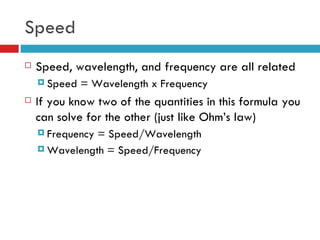
Speed Speed, wavelength, and frequency are all related Speed = Wavelength x Frequency If you know two of the quantities in this formula you can solve for the other (just like Ohm’s law) Frequency = Speed/Wavelength Wavelength = Speed/Frequency
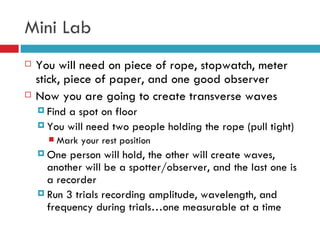
Mini Lab You will need on piece of rope, stopwatch, meter stick, piece of paper, and one good observer Now you are going to create transverse waves Find a spot on floor You will need two people holding the rope (pull tight) Mark your rest position One person will hold, the other will create waves, another will be a spotter/observer, and the last one is a recorder Run 3 trials recording amplitude, wavelength, and frequency during trials…one measurable at a time

Properties Of Waves

  • 1.
    PROPERTIES OF WAVESWord of the Day: Controls
  • 2.
    Amplitude Is themax distance that a wave will travel away from the rest position Example, p. 12 In transverse waves the amplitude is measured by the up and down motion (crest and trough) In longitudinal waves the amplitude is measured by how compressed or rarefied the medium is (more compressions, the stronger the wave)
  • 3.
    Wavelength The distancebetween two corresponding parts of a wave is its wavelength Transverse waves are measured from crest to crest or trough to trough Longitudinal are measured by the length of the compressions
  • 4.
    Frequency Is thenumber of complete waves that pass a given point in an amount of time Frequency can be increased and decreased Frequency is measured in hertz Hertz are measured by waves per second Example, if a wave passes through a point on a rope 2 times in one second, it would have a frequency of 2 Hz
  • 5.
    Speed Speed, wavelength,and frequency are all related Speed = Wavelength x Frequency If you know two of the quantities in this formula you can solve for the other (just like Ohm’s law) Frequency = Speed/Wavelength Wavelength = Speed/Frequency
  • 6.
    Mini Lab Youwill need on piece of rope, stopwatch, meter stick, piece of paper, and one good observer Now you are going to create transverse waves Find a spot on floor You will need two people holding the rope (pull tight) Mark your rest position One person will hold, the other will create waves, another will be a spotter/observer, and the last one is a recorder Run 3 trials recording amplitude, wavelength, and frequency during trials…one measurable at a time