SOUND WAVES IN
INSTRUMENTS
BY SAMANTHA YANG
LET’S START WITH THE BASICS…
• A wave is the motion of a disturbance, sometimes with a medium, sometimes without
• A mechanical wave travels through a medium, or physical material
• Sound waves are a form of mechanical wave that may travel through mediums such as water or air
• Sound waves are a longitudinal wave, which means the direction of the particles of the medium is parallel to
the energy transport
• A sound wave is introduced by a vibrating object such as a violin string or a tuning fork
A WAVE TRAVELING THROUGH A MEDIUM
PITCH AND
FREQUENCY
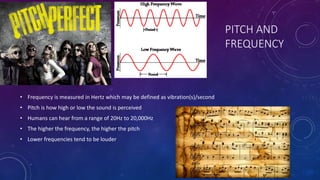
• Frequency is measured in Hertz which may be defined as vibration(s)/second
• Pitch is how high or low the sound is perceived
• Humans can hear from a range of 20Hz to 20,000Hz
• The higher the frequency, the higher the pitch
• Lower frequencies tend to be louder
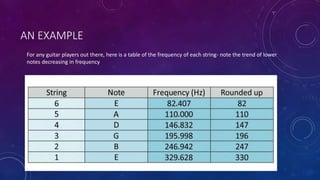
AN EXAMPLE
For any guitar players out there, here is a table of the frequency of each string- note the trend of lower
notes decreasing in frequency
CHECK FOR UNDERSTANDING
John built a frequency counter that measures frequency. Testing it out, he found that the highest note of his
favorite song is 24,000Hz. Is this reasonable? Explain why or why not.
• No it is not because humans can only hear from 20 to 20,000 Hz of frequencies
What causes a mechanical wave?
• A disturbance or vibration
Is it possible for a wave to travel without a medium? List an example
• Yes, electromagnetic waves may travel in a vacuum or through space
INTENSITY
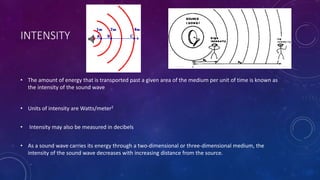
• The amount of energy that is transported past a given area of the medium per unit of time is known as
the intensity of the sound wave
• Units of intensity are Watts/meter2
• Intensity may also be measured in decibels
• As a sound wave carries its energy through a two-dimensional or three-dimensional medium, the
intensity of the sound wave decreases with increasing distance from the source.
INTENSITY OF INSTRUMENTS
• Piano – 60 to 70 decibels
• Cello – 82 to 93 decibels
• Violin – 80 to 103 decibels
• Flute – 93 to 111 decibels
• Trombone – 85 to 114 decibels
SOME USEFUL FORMULAS…
• Speed = Wavelength/ Period = Wavelength(Frequency) => v = f • λ
• Linear mass density = Total Mass of string / Length of string => μ = M/L
• Intensity = Power/Area => I = P/A
CITATIONS
• Linden, Joshua. "Pitch and Frequency." Pitch and Frequency. The Physics Classroom, 3 Dec. 2013. Web.
11 Feb. 2015.
• Marshall, Chase. "H.E.A.R. Are You At Risk?" H.E.A.R. | Are You At Risk? | Hearing Education and
Awareness for Rockers. H.E.A.R Net, 14 Jan. 1998. Web. 18 Feb. 2015.
• Wolfe, Joe. "Strings, Standing Waves and Harmonics." Strings, Standing Waves and Harmonics.
University of New South Wales, 11 Oct. 2011. Web. 13 Feb. 2015.

Sound waves

  • 1.
  • 2.
    LET’S START WITHTHE BASICS… • A wave is the motion of a disturbance, sometimes with a medium, sometimes without • A mechanical wave travels through a medium, or physical material • Sound waves are a form of mechanical wave that may travel through mediums such as water or air • Sound waves are a longitudinal wave, which means the direction of the particles of the medium is parallel to the energy transport • A sound wave is introduced by a vibrating object such as a violin string or a tuning fork
  • 3.
    A WAVE TRAVELINGTHROUGH A MEDIUM
  • 4.
    PITCH AND FREQUENCY • Frequencyis measured in Hertz which may be defined as vibration(s)/second • Pitch is how high or low the sound is perceived • Humans can hear from a range of 20Hz to 20,000Hz • The higher the frequency, the higher the pitch • Lower frequencies tend to be louder
  • 5.
    AN EXAMPLE For anyguitar players out there, here is a table of the frequency of each string- note the trend of lower notes decreasing in frequency
  • 6.
    CHECK FOR UNDERSTANDING Johnbuilt a frequency counter that measures frequency. Testing it out, he found that the highest note of his favorite song is 24,000Hz. Is this reasonable? Explain why or why not. • No it is not because humans can only hear from 20 to 20,000 Hz of frequencies What causes a mechanical wave? • A disturbance or vibration Is it possible for a wave to travel without a medium? List an example • Yes, electromagnetic waves may travel in a vacuum or through space
  • 7.
    INTENSITY • The amountof energy that is transported past a given area of the medium per unit of time is known as the intensity of the sound wave • Units of intensity are Watts/meter2 • Intensity may also be measured in decibels • As a sound wave carries its energy through a two-dimensional or three-dimensional medium, the intensity of the sound wave decreases with increasing distance from the source.
  • 8.
    INTENSITY OF INSTRUMENTS •Piano – 60 to 70 decibels • Cello – 82 to 93 decibels • Violin – 80 to 103 decibels • Flute – 93 to 111 decibels • Trombone – 85 to 114 decibels
  • 9.
    SOME USEFUL FORMULAS… •Speed = Wavelength/ Period = Wavelength(Frequency) => v = f • λ • Linear mass density = Total Mass of string / Length of string => μ = M/L • Intensity = Power/Area => I = P/A
  • 10.
    CITATIONS • Linden, Joshua."Pitch and Frequency." Pitch and Frequency. The Physics Classroom, 3 Dec. 2013. Web. 11 Feb. 2015. • Marshall, Chase. "H.E.A.R. Are You At Risk?" H.E.A.R. | Are You At Risk? | Hearing Education and Awareness for Rockers. H.E.A.R Net, 14 Jan. 1998. Web. 18 Feb. 2015. • Wolfe, Joe. "Strings, Standing Waves and Harmonics." Strings, Standing Waves and Harmonics. University of New South Wales, 11 Oct. 2011. Web. 13 Feb. 2015.