Pronouns
Used as
Adjectives
START!
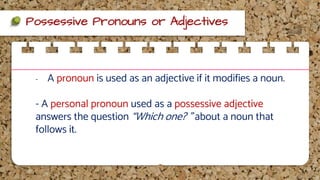
Possessive Pronouns or Adjectives
- A pronoun is used as an adjective if it modifies a noun.
- A personal pronoun used as a possessive adjective
answers the question “Which one? ” about a noun that
follows it.
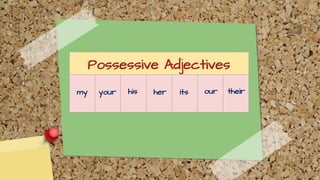
Possessive Adjectives
my your his her its our their
Examples:
1. Our parents told us not to quarrel with anyone.
Examples:
1. Our parents told us not to quarrel with anyone.
2. My computer is not working as fast as it worked
in the beginning.
Examples:
1. Our parents told us not to quarrel with anyone.
2. My computer is not working as fast as it worked
in the beginning.
3. The students of class seven submitted their
assignment.
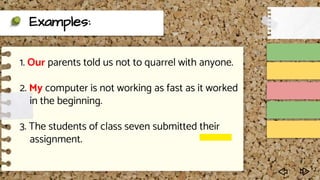
Examples:
1. Our parents told us not to quarrel with anyone.
2. My computer is not working as fast as it worked
in the beginning.
3. The students of class seven submitted their
assignment.
Demonstrative Adjectives
- special adjectives or determiners used to identify or
express the relative position of a noun in time or space. .
- A demonstrative adjective comes before all other
adjectives in the noun phrase.
Demonstrative Pronouns and Adjectives
Near Far
Singular this that
Plural these those
Examples:
1. Did you grow those vegetables in your garden?
Examples:
1. Did you grow those vegetables in your garden?
2. I like this coat better than that one.
Examples:
1. Did you grow those vegetables in your garden?
2. I like this coat better than that one.
3. For homework, I must read this book, do 30
math problems, and make a collage.
Examples:
1. Did you grow those vegetables in your garden?
2. I like this coat better than that one.
3. For homework, I must read this book, do 30
math problems, and make a collage.
Interrogative Adjectives
- An interrogative adjective is a word that modifies a noun
by asking a question.
- Interrogative adjectives are also known as interrogative
determiners.
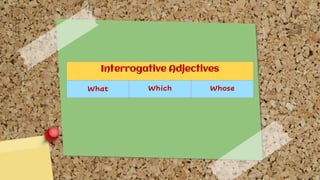
Interrogative Adjectives
What Which Whose
Examples:
1. What books are you buying today?
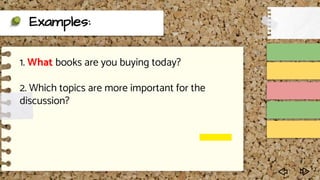
Examples:
1. What books are you buying today?
2. Which topics are more important for the
discussion?
Examples:
1. What books are you buying today?
2. Which topics are more important for the
discussion?
3. Whose phone did you use when you talked to
me?
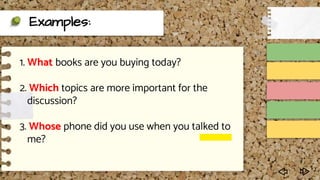
Examples:
1. What books are you buying today?
2. Which topics are more important for the
discussion?
3. Whose phone did you use when you talked to
me?
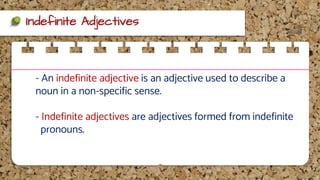
Indefinite Adjectives
- An indefinite adjective is an adjective used to describe a
noun in a non-specific sense.
- Indefinite adjectives are adjectives formed from indefinite
pronouns.
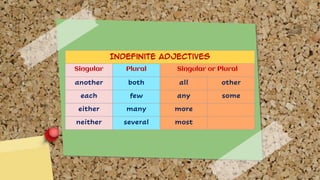
Indefinite Adjectives
Singular Plural Singular or Plural
another both all other
each few any some
either many more
neither several most
Examples:
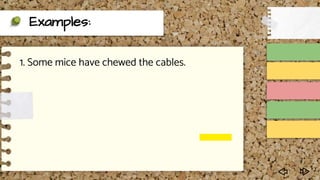
1. Some mice have chewed the cables.
Examples:
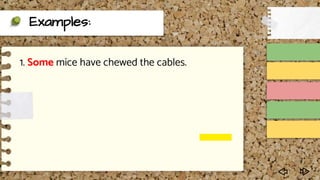
1. Some mice have chewed the cables.
Examples:
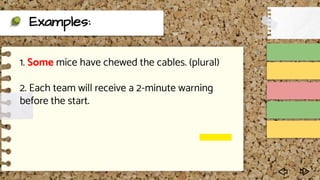
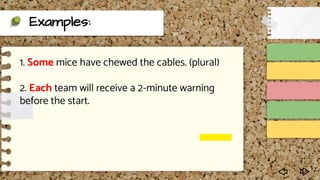
1. Some mice have chewed the cables. (plural)
2. Each team will receive a 2-minute warning
before the start.
Examples:
1. Some mice have chewed the cables. (plural)
2. Each team will receive a 2-minute warning
before the start.
Examples:
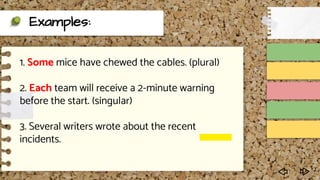
1. Some mice have chewed the cables. (plural)
2. Each team will receive a 2-minute warning
before the start. (singular)
3. Several writers wrote about the recent
incidents.
Examples:
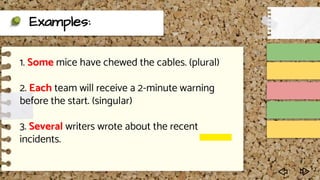
1. Some mice have chewed the cables. (plural)
2. Each team will receive a 2-minute warning
before the start. (singular)
3. Several writers wrote about the recent
incidents.
Examples:
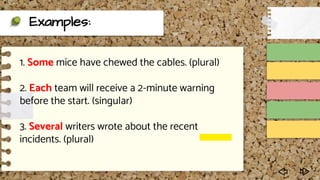
1. Some mice have chewed the cables. (plural)
2. Each team will receive a 2-minute warning
before the start. (singular)
3. Several writers wrote about the recent
incidents. (plural)
Let’s practice!
You are
Awesome!
START!

Pronouns Used as Adjectives

  • 1.
  • 2.
    Possessive Pronouns orAdjectives - A pronoun is used as an adjective if it modifies a noun. - A personal pronoun used as a possessive adjective answers the question “Which one? ” about a noun that follows it.
  • 3.
    Possessive Adjectives my yourhis her its our their
  • 4.
    Examples: 1. Our parentstold us not to quarrel with anyone.
  • 5.
    Examples: 1. Our parentstold us not to quarrel with anyone. 2. My computer is not working as fast as it worked in the beginning.
  • 6.
    Examples: 1. Our parentstold us not to quarrel with anyone. 2. My computer is not working as fast as it worked in the beginning. 3. The students of class seven submitted their assignment.
  • 7.
    Examples: 1. Our parentstold us not to quarrel with anyone. 2. My computer is not working as fast as it worked in the beginning. 3. The students of class seven submitted their assignment.
  • 8.
    Demonstrative Adjectives - specialadjectives or determiners used to identify or express the relative position of a noun in time or space. . - A demonstrative adjective comes before all other adjectives in the noun phrase.
  • 9.
    Demonstrative Pronouns andAdjectives Near Far Singular this that Plural these those
  • 10.
    Examples: 1. Did yougrow those vegetables in your garden?
  • 11.
    Examples: 1. Did yougrow those vegetables in your garden? 2. I like this coat better than that one.
  • 12.
    Examples: 1. Did yougrow those vegetables in your garden? 2. I like this coat better than that one. 3. For homework, I must read this book, do 30 math problems, and make a collage.
  • 13.
    Examples: 1. Did yougrow those vegetables in your garden? 2. I like this coat better than that one. 3. For homework, I must read this book, do 30 math problems, and make a collage.
  • 14.
    Interrogative Adjectives - Aninterrogative adjective is a word that modifies a noun by asking a question. - Interrogative adjectives are also known as interrogative determiners.
  • 15.
  • 16.
    Examples: 1. What booksare you buying today?
  • 17.
    Examples: 1. What booksare you buying today? 2. Which topics are more important for the discussion?
  • 18.
    Examples: 1. What booksare you buying today? 2. Which topics are more important for the discussion? 3. Whose phone did you use when you talked to me?
  • 19.
    Examples: 1. What booksare you buying today? 2. Which topics are more important for the discussion? 3. Whose phone did you use when you talked to me?
  • 20.
    Indefinite Adjectives - Anindefinite adjective is an adjective used to describe a noun in a non-specific sense. - Indefinite adjectives are adjectives formed from indefinite pronouns.
  • 21.
    Indefinite Adjectives Singular PluralSingular or Plural another both all other each few any some either many more neither several most
  • 22.
    Examples: 1. Some micehave chewed the cables.
  • 23.
    Examples: 1. Some micehave chewed the cables.
  • 24.
    Examples: 1. Some micehave chewed the cables. (plural) 2. Each team will receive a 2-minute warning before the start.
  • 25.
    Examples: 1. Some micehave chewed the cables. (plural) 2. Each team will receive a 2-minute warning before the start.
  • 26.
    Examples: 1. Some micehave chewed the cables. (plural) 2. Each team will receive a 2-minute warning before the start. (singular) 3. Several writers wrote about the recent incidents.
  • 27.
    Examples: 1. Some micehave chewed the cables. (plural) 2. Each team will receive a 2-minute warning before the start. (singular) 3. Several writers wrote about the recent incidents.
  • 28.
    Examples: 1. Some micehave chewed the cables. (plural) 2. Each team will receive a 2-minute warning before the start. (singular) 3. Several writers wrote about the recent incidents. (plural)
  • 29.
  • 30.