What are Adjectives?
•Adjectives are modifiers. They modify nouns or
pronouns. This means they change the image
of a noun or pronoun.
• Adjectives can be located by asking the
questions:
What kind?
Which one?
How many?
How much?
What is anAdjective?
Adjectives change the meaning of a noun
by somehow changing the image of it.
That’s why they are called modifiers.
There are two kinds of adjectives:
descriptive
and
limiting.
9.
Descriptive Adjectives
• Descriptiveadjectives
DESCRIBE!
• The add some sensory image to your sentence which allows the
reader to see, smell, hear, touch, or taste something in the
sentence.
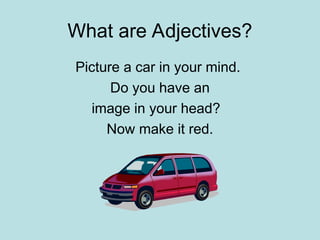
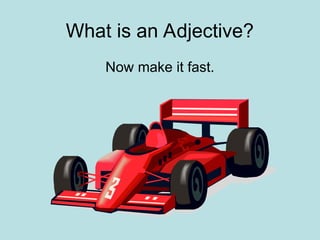
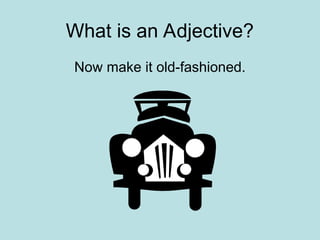
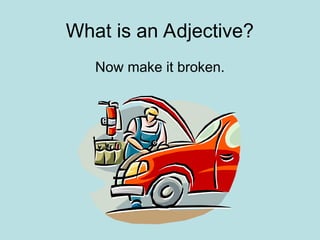
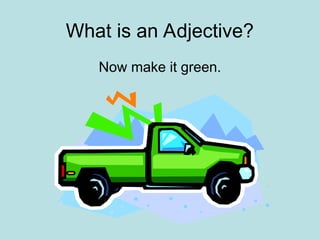
• All of the modifiers in the earlier section of the slide show
concerning the car were descriptive adjectives. They made the car
red, fast, old-fashioned, broken, and green. Those words are all
adjectives!
• Descriptive adjectives make writing much better!
10.
Proper Adjectives
• Onetype of descriptive adjective is called
the proper adjective.
• Proper adjectives are derived from, or
come from, proper nouns. This means
that they must always be capitalized.
• Proper adjectives sometimes are formed
by adding a suffix to the proper noun.
11.
Proper Adjectives
Examples ofProper Adjectives
Proper Noun Proper Adjective
America American
France French
China Chinese
Pennsylvania Pennsylvanian
12.
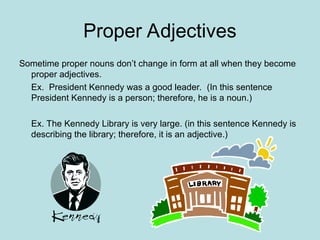
Proper Adjectives
Sometime propernouns don’t change in form at all when they become
proper adjectives.
Ex. President Kennedy was a good leader. (In this sentence
President Kennedy is a person; therefore, he is a noun.)
Ex. The Kennedy Library is very large. (in this sentence Kennedy is
describing the library; therefore, it is an adjective.)
13.
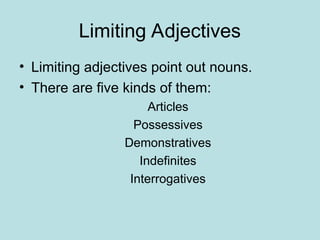
Limiting Adjectives
• Limitingadjectives point out nouns.
• There are five kinds of them:
Articles
Possessives
Demonstratives
Indefinites
Interrogatives
14.
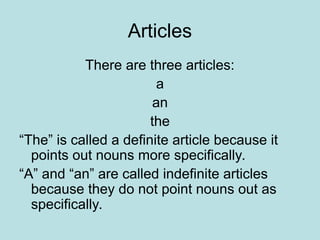
Articles
There are threearticles:
a
an
the
“The” is called a definite article because it
points out nouns more specifically.
“A” and “an” are called indefinite articles
because they do not point nouns out as
specifically.
15.
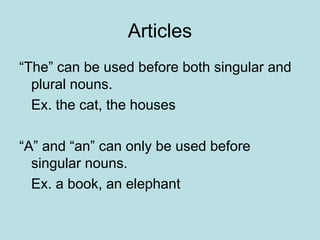
Articles
“The” can beused before both singular and
plural nouns.
Ex. the cat, the houses
“A” and “an” can only be used before
singular nouns.
Ex. a book, an elephant
16.
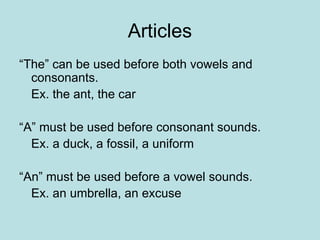
Articles
“The” can beused before both vowels and
consonants.
Ex. the ant, the car
“A” must be used before consonant sounds.
Ex. a duck, a fossil, a uniform
“An” must be used before a vowel sounds.
Ex. an umbrella, an excuse
17.
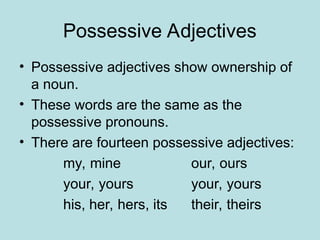
Possessive Adjectives
• Possessiveadjectives show ownership of
a noun.
• These words are the same as the
possessive pronouns.
• There are fourteen possessive adjectives:
my, mine our, ours
your, yours your, yours
his, her, hers, its their, theirs
18.
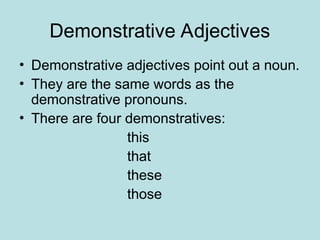
Demonstrative Adjectives
• Demonstrativeadjectives point out a noun.
• They are the same words as the
demonstrative pronouns.
• There are four demonstratives:
this
that
these
those
19.
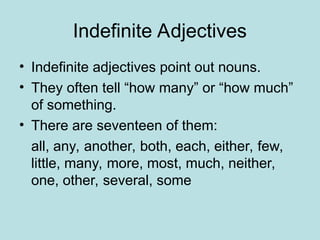
Indefinite Adjectives
• Indefiniteadjectives point out nouns.
• They often tell “how many” or “how much”
of something.
• There are seventeen of them:
all, any, another, both, each, either, few,
little, many, more, most, much, neither,
one, other, several, some
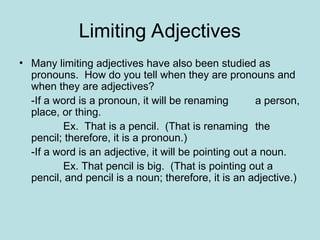
Limiting Adjectives
• Manylimiting adjectives have also been studied as
pronouns. How do you tell when they are pronouns and
when they are adjectives?
-If a word is a pronoun, it will be renaming a person,
place, or thing.
Ex. That is a pencil. (That is renaming the
pencil; therefore, it is a pronoun.)
-If a word is an adjective, it will be pointing out a noun.
Ex. That pencil is big. (That is pointing out a
pencil, and pencil is a noun; therefore, it is an adjective.)
22.
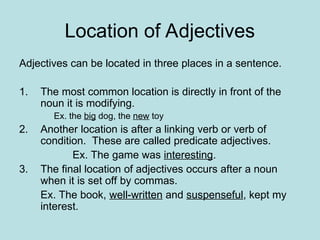
Location of Adjectives
Adjectivescan be located in three places in a sentence.
1. The most common location is directly in front of the
noun it is modifying.
Ex. the big dog, the new toy
2. Another location is after a linking verb or verb of
condition. These are called predicate adjectives.
Ex. The game was interesting.
3. The final location of adjectives occurs after a noun
when it is set off by commas.
Ex. The book, well-written and suspenseful, kept my
interest.