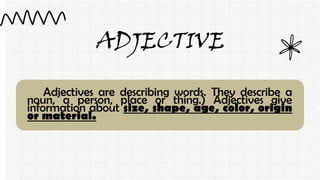
ADJECTIVE
Adjectives are describingwords. They describe a
noun, a person, place or thing.) Adjectives give
information about size, shape, age, color, origin
or material.
3.
Ex. Some architectsare skillful and imaginative.
The adjectives skillful and imaginative follow the linking verb, are,
and modify the subject, architects
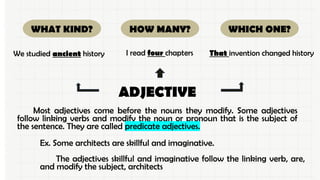
WHICH ONE?
WHAT KIND? HOW MANY?
ADJECTIVE
We studied ancient history I read four chapters That invention changed history
Most adjectives come before the nouns they modify. Some adjectives
follow linking verbs and modify the noun or pronoun that is the subject of
the sentence. They are called predicate adjectives.
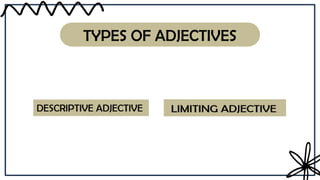
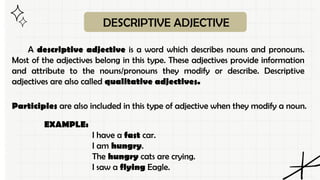
DESCRIPTIVE ADJECTIVE
A descriptiveadjective is a word which describes nouns and pronouns.
Most of the adjectives belong in this type. These adjectives provide information
and attribute to the nouns/pronouns they modify or describe. Descriptive
adjectives are also called qualitative adjectives.
Participles are also included in this type of adjective when they modify a noun.
EXAMPLE:
I have a fast car.
I am hungry.
The hungry cats are crying.
I saw a flying Eagle.
6.
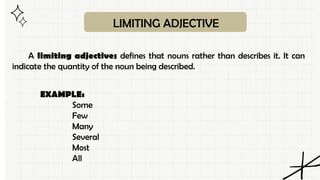
LIMITING ADJECTIVE
A limitingadjectives defines that nouns rather than describes it. It can
indicate the quantity of the noun being described.
EXAMPLE:
Some
Few
Many
Several
Most
All
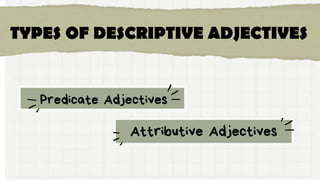
Predicate Adjectives
Follows alinking verb and modifies the subject of a sentence.
Two verb forms are often used as adjectives and predicate adjectives.
They are the present participle and the past participle.
Example:
The architect drew a surprising design. [present participle]
Visitors seemed impressed. [past participle]
.
9.
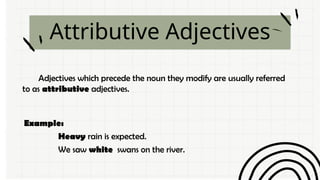
Attributive Adjectives
Adjectives whichprecede the noun they modify are usually referred
to as attributive adjectives.
Example:
Heavy rain is expected.
We saw white swans on the river.
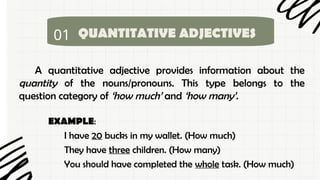
01 QUANTITATIVE ADJECTIVES
Aquantitative adjective provides information about the
quantity of the nouns/pronouns. This type belongs to the
question category of ‘how much’ and ‘how many’.
EXAMPLE:
I have 20 bucks in my wallet. (How much)
They have three children. (How many)
You should have completed the whole task. (How much)
12.
02 PROPER ADJECTIVES
ProperAdjectives are the adjective form of proper nouns. When proper
nouns modify or describe other nouns/pronouns, they become proper adjectives.
‘Proper’ means ‘specific’ rather than ‘formal’ or ‘polite’. Proper adjectives are
usually capitalized as proper noun are.
EXAMPLE:
American cars are very strong.
Chinese people are hard workers.
Marxist philosophers despise capitalism.
13.
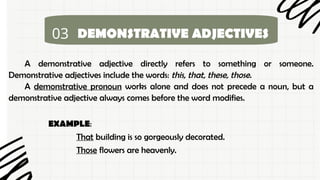
03 DEMONSTRATIVE ADJECTIVES
Ademonstrative adjective directly refers to something or someone.
Demonstrative adjectives include the words: this, that, these, those.
A demonstrative pronoun works alone and does not precede a noun, but a
demonstrative adjective always comes before the word modifies.
EXAMPLE:
That building is so gorgeously decorated.
Those flowers are heavenly.
14.
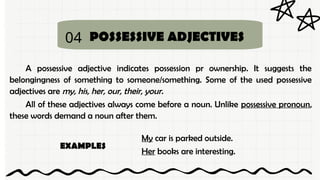
04 POSSESSIVE ADJECTIVES
Apossessive adjective indicates possession pr ownership. It suggests the
belongingness of something to someone/something. Some of the used possessive
adjectives are my, his, her, our, their, your.
All of these adjectives always come before a noun. Unlike possessive pronoun,
these words demand a noun after them.
My car is parked outside.
Her books are interesting.
EXAMPLES
15.
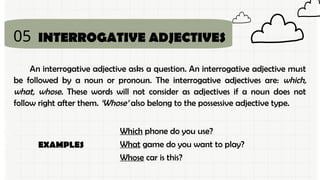
05
An interrogative adjectiveasks a question. An interrogative adjective must
be followed by a noun or pronoun. The interrogative adjectives are: which,
what, whose. These words will not consider as adjectives if a noun does not
follow right after them. ‘Whose’ also belong to the possessive adjective type.
INTERROGATIVE ADJECTIVES
Which phone do you use?
What game do you want to play?
Whose car is this?
EXAMPLES
16.
01
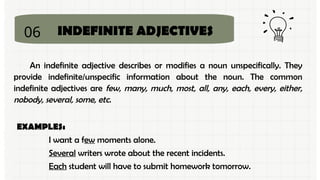
06 INDEFINITE ADJECTIVES
Anindefinite adjective describes or modifies a noun unspecifically. They
provide indefinite/unspecific information about the noun. The common
indefinite adjectives are few, many, much, most, all, any, each, every, either,
nobody, several, some, etc.
EXAMPLES:
I want a few moments alone.
Several writers wrote about the recent incidents.
Each student will have to submit homework tomorrow.
17.
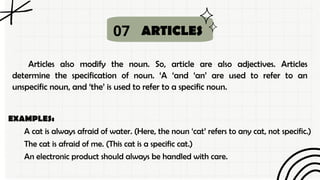
ARTICLES
07
Articles also modifythe noun. So, article are also adjectives. Articles
determine the specification of noun. ‘A ‘and ‘an’ are used to refer to an
unspecific noun, and ‘the’ is used to refer to a specific noun.
EXAMPLES:
A cat is always afraid of water. (Here, the noun ‘cat’ refers to any cat, not specific.)
The cat is afraid of me. (This cat is a specific cat.)
An electronic product should always be handled with care.
18.
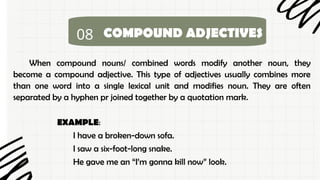
08 COMPOUND ADJECTIVES
Whencompound nouns/ combined words modify another noun, they
become a compound adjective. This type of adjectives usually combines more
than one word into a single lexical unit and modifies noun. They are often
separated by a hyphen pr joined together by a quotation mark.
EXAMPLE:
I have a broken-down sofa.
I saw a six-foot-long snake.
He gave me an “I’m gonna kill now” look.
19.
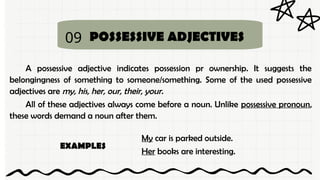
09 POSSESSIVE ADJECTIVES
Apossessive adjective indicates possession pr ownership. It suggests the
belongingness of something to someone/something. Some of the used possessive
adjectives are my, his, her, our, their, your.
All of these adjectives always come before a noun. Unlike possessive pronoun,
these words demand a noun after them.
My car is parked outside.
Her books are interesting.
EXAMPLES


![Predicate Adjectives
Follows a linking verb and modifies the subject of a sentence.
Two verb forms are often used as adjectives and predicate adjectives.
They are the present participle and the past participle.
Example:
The architect drew a surprising design. [present participle]
Visitors seemed impressed. [past participle]
.](https://image.slidesharecdn.com/types-of-adjectives-250511061652-b35d1934/85/TYPES-OF-ADJECTIVES-PowerPoint-Presentation-8-320.jpg)