THE PRONOUN
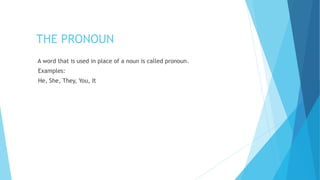
A word that is used in place of a noun is called pronoun.
Examples:
He, She, They, You, It
KINDS OF PRONOUNS
 • Personal
 • Possessive
 • Demonstrative
 • Relative
 • Indefinite
 • Reflexive
 • Reciprocal
 • Interrogative
 • distributive
 • intensive
PERSONAL PRONOUN
 A personal pronoun is used in the place of the name of a person or a thing.
 Examples: he, they, I, it, we, you
 We can distinguish two types of personal pronouns:
 “Personal Subject Pronouns” and “Personal Object Pronouns”
 Personal Subject Pronouns
 A subjective personal pronoun indicates that the pronoun is acting as the
subject of the sentence.
 He listens to me.
 They play cricket daily.
 I read a book.
 Personal Object Pronouns
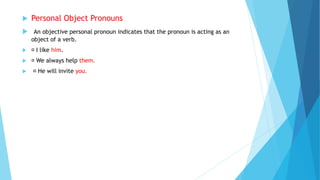
 An objective personal pronoun indicates that the pronoun is acting as an
object of a verb.
 I like him.
 We always help them.
 He will invite you.
POSSESSIVE PRONOUN
 A pronoun that is used to show possession over something is called possessive
pronoun.
 Examples: My, His, Their, our
 Certain pronouns called possessive pronouns show ownership. Some are used
alone; some describe a noun.
 Used alone:
 mine, yours, his, hers, ours, theirs, whose
 That computer is hers.
 This computer is mine.
 Modify noun:
 my, your, his, her, its, our, their, whose
 That is her computer.
 This is my computer.
DEMONSTRATIVE PRONOUN
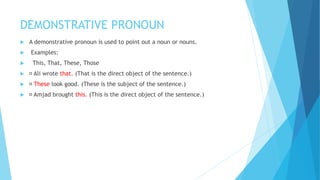
 A demonstrative pronoun is used to point out a noun or nouns.
 Examples:
 This, That, These, Those
 Ali wrote that. (That is the direct object of the sentence.)
 These look good. (These is the subject of the sentence.)
 Amjad brought this. (This is the direct object of the sentence.)
RELATIVE PRONOUN
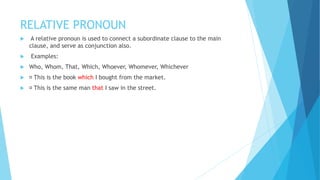
 A relative pronoun is used to connect a subordinate clause to the main
clause, and serve as conjunction also.
 Examples:
 Who, Whom, That, Which, Whoever, Whomever, Whichever
 This is the book which I bought from the market.
 This is the same man that I saw in the street.
INDEFINITE PRONOUN
 A pronoun that does not refer to any person, amount, or thing in particular
.But refers to an unspecified noun or nouns.
 or (We use indefinite pronouns to refer to people or things without saying
exactly who or what they are.)
 Examples:
 Few, Some, Any, some one
 Everyone reads a part of the novel. (singular)
 –Several enjoy it very much. (plural)
 –Most of the story takes place in England. (singular)
 –Most of the characteristics are memorable. (plural)
Reflexive Pronoun
 A reflexive pronoun is used when the subject and the object of the sentence
are the same or the action passes back to the subject.
 Examples:
 myself, ourselves, yourselves, themselves
 I have done it myself.
 I talk to myself when I am nervous or excited.
 You cut yourself while cutting tomatoes.
 He hurt himself playing hockey.
 She enjoyed herself at the party.
RECIPROCAL PRONOUN
 A reciprocal pronoun is used in order to indicate persons or things mutually
affected.
 There are two reciprocal pronouns:
 each other,
 one another
 The students in this classroom cooperate with one another.
 Both the friends like each other.
 They care a lot for one another.
INTERROGATIVE PRONOUN
 An interrogative pronoun is used to ask a question
 . Examples:
 who, whose, whom, what, which
 Who is this man?
 What is this?
 Whom have you seen?
DISTRIBUTIVE PRONOUN
 The pronouns each, either and neither are called ‘Destributive
Pronouns’(because they refer to persons or things one at a time) as they
denote all of of a class taken separately.
 Examples:
 Each of them has performed satisfactorily.
 Either of the two pencils will do.
 Neither of them came
INTENSIVE/ EMPHATIC PRONOUN
 An intensive pronoun is used to intensify or emphasize the proceeding noun
or pronoun.
 Examples:
 himself, myself, herself
 She herself wanted to join the company.
 We ourselves believe that is true.
 She went to the door herself.

The pronoun

  • 1.
    THE PRONOUN A wordthat is used in place of a noun is called pronoun. Examples: He, She, They, You, It
  • 2.
    KINDS OF PRONOUNS • Personal  • Possessive  • Demonstrative  • Relative  • Indefinite  • Reflexive  • Reciprocal  • Interrogative  • distributive  • intensive
  • 3.
    PERSONAL PRONOUN  Apersonal pronoun is used in the place of the name of a person or a thing.  Examples: he, they, I, it, we, you  We can distinguish two types of personal pronouns:  “Personal Subject Pronouns” and “Personal Object Pronouns”  Personal Subject Pronouns  A subjective personal pronoun indicates that the pronoun is acting as the subject of the sentence.  He listens to me.  They play cricket daily.  I read a book.
  • 4.
     Personal ObjectPronouns  An objective personal pronoun indicates that the pronoun is acting as an object of a verb.  I like him.  We always help them.  He will invite you.
  • 5.
    POSSESSIVE PRONOUN  Apronoun that is used to show possession over something is called possessive pronoun.  Examples: My, His, Their, our  Certain pronouns called possessive pronouns show ownership. Some are used alone; some describe a noun.  Used alone:  mine, yours, his, hers, ours, theirs, whose  That computer is hers.  This computer is mine.  Modify noun:  my, your, his, her, its, our, their, whose
  • 6.
     That isher computer.  This is my computer.
  • 7.
    DEMONSTRATIVE PRONOUN  Ademonstrative pronoun is used to point out a noun or nouns.  Examples:  This, That, These, Those  Ali wrote that. (That is the direct object of the sentence.)  These look good. (These is the subject of the sentence.)  Amjad brought this. (This is the direct object of the sentence.)
  • 8.
    RELATIVE PRONOUN  Arelative pronoun is used to connect a subordinate clause to the main clause, and serve as conjunction also.  Examples:  Who, Whom, That, Which, Whoever, Whomever, Whichever  This is the book which I bought from the market.  This is the same man that I saw in the street.
  • 9.
    INDEFINITE PRONOUN  Apronoun that does not refer to any person, amount, or thing in particular .But refers to an unspecified noun or nouns.  or (We use indefinite pronouns to refer to people or things without saying exactly who or what they are.)  Examples:  Few, Some, Any, some one  Everyone reads a part of the novel. (singular)  –Several enjoy it very much. (plural)  –Most of the story takes place in England. (singular)  –Most of the characteristics are memorable. (plural)
  • 10.
    Reflexive Pronoun  Areflexive pronoun is used when the subject and the object of the sentence are the same or the action passes back to the subject.  Examples:  myself, ourselves, yourselves, themselves  I have done it myself.  I talk to myself when I am nervous or excited.  You cut yourself while cutting tomatoes.  He hurt himself playing hockey.  She enjoyed herself at the party.
  • 11.
    RECIPROCAL PRONOUN  Areciprocal pronoun is used in order to indicate persons or things mutually affected.  There are two reciprocal pronouns:  each other,  one another  The students in this classroom cooperate with one another.  Both the friends like each other.  They care a lot for one another.
  • 12.
    INTERROGATIVE PRONOUN  Aninterrogative pronoun is used to ask a question  . Examples:  who, whose, whom, what, which  Who is this man?  What is this?  Whom have you seen?
  • 13.
    DISTRIBUTIVE PRONOUN  Thepronouns each, either and neither are called ‘Destributive Pronouns’(because they refer to persons or things one at a time) as they denote all of of a class taken separately.  Examples:  Each of them has performed satisfactorily.  Either of the two pencils will do.  Neither of them came
  • 14.
    INTENSIVE/ EMPHATIC PRONOUN An intensive pronoun is used to intensify or emphasize the proceeding noun or pronoun.  Examples:  himself, myself, herself  She herself wanted to join the company.  We ourselves believe that is true.  She went to the door herself.