Possible errors
in projects and
methods of
avoiding and
eliminating
Engineering Project- Zad 9
Ahmet Sefa Kocakalay
• Most businesses are probably familiar with
their projects getting derailed or delayed for so
many different reasons. Every company
probably has at least one story about a project
taking longer than planned or going over
budget, even when using project management
software. Why is that the case? There are a
number of common mistakes that even
experienced project managers go through. I'll
detect the 13 most common here and give
advice on how to avoid, eliminate them.
1. Employing a Project Manager Lacking Experience
• A common problem that happens is when
businesses focus all of their efforts on identifying the
right resources for the project and don’t spend
enough time finding the right person to manage the
project. It happens more times than we can count
that a business chooses a project manager based on
their availability as opposed to having the necessary
skills.
• Selecting a project manager that’s inexperienced or
not a right fit for the position can actually derail a
project before it even starts, so to avoid this mistake,
simply take the time to choose the project manager
whose skills match the job required.
2. Poor Resource Matching
• Are you selecting people for your project based on
availability or skill set? All too often, people are selected
simply because they are available. This could put the
project at risk if the skills and experience needed are not
present in the team.
• It's important to employ the right project manager and
team members to deliver on the customer's
requirements and expectations.
• Build a team based on skill set and experience, not on
availability. Consider whether it's worth paying a
premium for a small team of highly proficient and
experienced people.
3. Poor Project Initiation
• Is it worth having a project kick-off meeting? Many
projects drift into action without a clear start point.
Everyone knows what he or she is doing; it's obvious,
right? Not always.
• There's a tendency to forget who has been involved
in what conversations before the project starts. I
overheard this gem from a project team member
speaking at the end of a particularly fraught project: I
was never quite sure what I was supposed to be
doing.
• It's important that everyone on the project team is
clear about the project goal, aims and objectives.
4. Too Broad A Scope
• Anyone who’s been in the business long enough has
experienced a project with a scope that appears to
increase continually, while the price remains
stagnant. Although this kind of scope creep where the
project focus changes continuously over the length of
the project should be in no way viewed as an
inevitable part of the project process.
• Scope creep often happens when the real outcome of
the project is misunderstood by or is not consistent
with the client, management, and the project team.
This is why developing a clear scope statement at the
outset of your project is so important.
5. Poor Requirements Gathering
• Many projects start with the barest headline list
of requirements, only to find later the
customers' needs have not been clearly
understood. Often, there are gaps in the
requirements, dead-ends or requests that
simply don't make sense without additional
clarification.
• One way to avoid this problem is by writing a
statement of requirements.
• This document is a guide to the requirements of
the project. Once you create your statement of
requirements, ensure the customer and other
stakeholders sign-up to it and understand that
this is what you have agreed to deliver.
6. Lack of Clear Objective
and Success Measures
• The cause of many project failures is
not poor planning or lack of appropriate skills. It is
quite simply the absence of a clear objective
and measures with which to identify success or
failure.
• Ask yourself what the project is in the business of
delivering? This is a difficult question to answer
because it needs more thought than you might
expect.
• Think long and hard about why you are doing what
you are doing. Ask your customer to help you
define success measures for the project.
7. Unrealistic Timelines.
• Project managers naturally want to keep the
executives and clients happy, but the wrong
way to go about doing this is by giving
optimistic or unrealistic timelines. What will
end up happening ’s you’ll miss all your
deadlines or cause your employees to burnout
by working overtime, leading to a lack of trust
between the client and project manager.
Instead, use project management tools to
manage your timeline, and be sure to add a
time and money buffer to your project.
8. Bad Communication with
Stakeholders and Project Team
• It can be immensely annoying when people on a
project fail to communicate properly and then
lay the blame at your door for errors caused by
their lack of communication. If you don't keep
everyone on the project informed
of decisions, exceptions, changes, team
structures and so on, you can't be surprised
when they inadvertently make mistakes.
• Communication is the lifeblood of a project, so
keep all communication channels open. Keep
everyone updated with the latest project
status, risks, issues and developments.
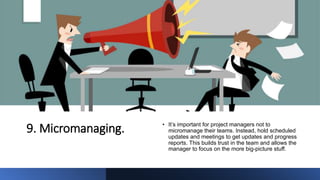
9. Micromanaging. • It’s important for project managers not to
micromanage their teams. Instead, hold scheduled
updates and meetings to get updates and progress
reports. This builds trust in the team and allows the
manager to focus on the more big-picture stuff.
10. Relying too much on
software.
• While you want to have a good project
management software, it can’t fix all issues.
Choose software wisely that the whole team will
be able to use properly, then make sure they all
receive training on tracking different steps. Also,
don’t prioritize software over getting the right
team members for the job.
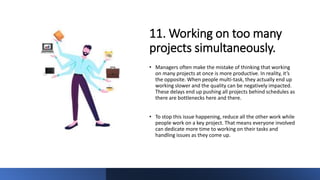
11. Working on too many
projects simultaneously.
• Managers often make the mistake of thinking that working
on many projects at once is more productive. In reality, it’s
the opposite. When people multi-task, they actually end up
working slower and the quality can be negatively impacted.
These delays end up pushing all projects behind schedules as
there are bottlenecks here and there.
• To stop this issue happening, reduce all the other work while
people work on a key project. That means everyone involved
can dedicate more time to working on their tasks and
handling issues as they come up.
12.Not getting buy-in
from the executives.
• This one is pretty straight-forward but it surprisingly
happens quite often. Someone near the top of the
organization must own the project and champion it.
If there is no guidance from the upper echelons, it
will soon fail or flounder.
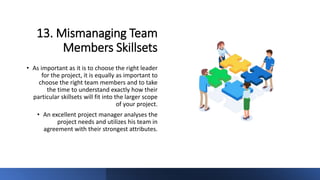
13. Mismanaging Team
Members Skillsets
• As important as it is to choose the right leader
for the project, it is equally as important to
choose the right team members and to take
the time to understand exactly how their
particular skillsets will fit into the larger scope
of your project.
• An excellent project manager analyses the
project needs and utilizes his team in
agreement with their strongest attributes.
Summary
• These are 13 common mistakes that affect
projects. They're all mistakes that are easily
avoided by vigilance, good planning and clear
communication.
• Don't assume they won't impact your project.
Anecdotal evidence suggests that at least one
or two of these mistakes affect most projects.
THANK YOU !

Possible errors in projects and methods of avoiding and eliminating

  • 1.
    Possible errors in projectsand methods of avoiding and eliminating Engineering Project- Zad 9 Ahmet Sefa Kocakalay
  • 2.
    • Most businessesare probably familiar with their projects getting derailed or delayed for so many different reasons. Every company probably has at least one story about a project taking longer than planned or going over budget, even when using project management software. Why is that the case? There are a number of common mistakes that even experienced project managers go through. I'll detect the 13 most common here and give advice on how to avoid, eliminate them.
  • 3.
    1. Employing aProject Manager Lacking Experience • A common problem that happens is when businesses focus all of their efforts on identifying the right resources for the project and don’t spend enough time finding the right person to manage the project. It happens more times than we can count that a business chooses a project manager based on their availability as opposed to having the necessary skills. • Selecting a project manager that’s inexperienced or not a right fit for the position can actually derail a project before it even starts, so to avoid this mistake, simply take the time to choose the project manager whose skills match the job required.
  • 4.
    2. Poor ResourceMatching • Are you selecting people for your project based on availability or skill set? All too often, people are selected simply because they are available. This could put the project at risk if the skills and experience needed are not present in the team. • It's important to employ the right project manager and team members to deliver on the customer's requirements and expectations. • Build a team based on skill set and experience, not on availability. Consider whether it's worth paying a premium for a small team of highly proficient and experienced people.
  • 5.
    3. Poor ProjectInitiation • Is it worth having a project kick-off meeting? Many projects drift into action without a clear start point. Everyone knows what he or she is doing; it's obvious, right? Not always. • There's a tendency to forget who has been involved in what conversations before the project starts. I overheard this gem from a project team member speaking at the end of a particularly fraught project: I was never quite sure what I was supposed to be doing. • It's important that everyone on the project team is clear about the project goal, aims and objectives.
  • 6.
    4. Too BroadA Scope • Anyone who’s been in the business long enough has experienced a project with a scope that appears to increase continually, while the price remains stagnant. Although this kind of scope creep where the project focus changes continuously over the length of the project should be in no way viewed as an inevitable part of the project process. • Scope creep often happens when the real outcome of the project is misunderstood by or is not consistent with the client, management, and the project team. This is why developing a clear scope statement at the outset of your project is so important.
  • 7.
    5. Poor RequirementsGathering • Many projects start with the barest headline list of requirements, only to find later the customers' needs have not been clearly understood. Often, there are gaps in the requirements, dead-ends or requests that simply don't make sense without additional clarification. • One way to avoid this problem is by writing a statement of requirements. • This document is a guide to the requirements of the project. Once you create your statement of requirements, ensure the customer and other stakeholders sign-up to it and understand that this is what you have agreed to deliver.
  • 8.
    6. Lack ofClear Objective and Success Measures • The cause of many project failures is not poor planning or lack of appropriate skills. It is quite simply the absence of a clear objective and measures with which to identify success or failure. • Ask yourself what the project is in the business of delivering? This is a difficult question to answer because it needs more thought than you might expect. • Think long and hard about why you are doing what you are doing. Ask your customer to help you define success measures for the project.
  • 9.
    7. Unrealistic Timelines. •Project managers naturally want to keep the executives and clients happy, but the wrong way to go about doing this is by giving optimistic or unrealistic timelines. What will end up happening ’s you’ll miss all your deadlines or cause your employees to burnout by working overtime, leading to a lack of trust between the client and project manager. Instead, use project management tools to manage your timeline, and be sure to add a time and money buffer to your project.
  • 10.
    8. Bad Communicationwith Stakeholders and Project Team • It can be immensely annoying when people on a project fail to communicate properly and then lay the blame at your door for errors caused by their lack of communication. If you don't keep everyone on the project informed of decisions, exceptions, changes, team structures and so on, you can't be surprised when they inadvertently make mistakes. • Communication is the lifeblood of a project, so keep all communication channels open. Keep everyone updated with the latest project status, risks, issues and developments.
  • 11.
    9. Micromanaging. •It’s important for project managers not to micromanage their teams. Instead, hold scheduled updates and meetings to get updates and progress reports. This builds trust in the team and allows the manager to focus on the more big-picture stuff.
  • 12.
    10. Relying toomuch on software. • While you want to have a good project management software, it can’t fix all issues. Choose software wisely that the whole team will be able to use properly, then make sure they all receive training on tracking different steps. Also, don’t prioritize software over getting the right team members for the job.
  • 13.
    11. Working ontoo many projects simultaneously. • Managers often make the mistake of thinking that working on many projects at once is more productive. In reality, it’s the opposite. When people multi-task, they actually end up working slower and the quality can be negatively impacted. These delays end up pushing all projects behind schedules as there are bottlenecks here and there. • To stop this issue happening, reduce all the other work while people work on a key project. That means everyone involved can dedicate more time to working on their tasks and handling issues as they come up.
  • 14.
    12.Not getting buy-in fromthe executives. • This one is pretty straight-forward but it surprisingly happens quite often. Someone near the top of the organization must own the project and champion it. If there is no guidance from the upper echelons, it will soon fail or flounder.
  • 15.
    13. Mismanaging Team MembersSkillsets • As important as it is to choose the right leader for the project, it is equally as important to choose the right team members and to take the time to understand exactly how their particular skillsets will fit into the larger scope of your project. • An excellent project manager analyses the project needs and utilizes his team in agreement with their strongest attributes.
  • 16.
    Summary • These are13 common mistakes that affect projects. They're all mistakes that are easily avoided by vigilance, good planning and clear communication. • Don't assume they won't impact your project. Anecdotal evidence suggests that at least one or two of these mistakes affect most projects.
  • 17.