Definition of carbonsteel
Effect of alloying element on steel
Low Carbon Steel
Medium Carbon Steel
High Carbon Steel
The advantage and disadvantage
OUTLINE
Istilah steel/baja biasanya diartikan sebagai paduan
yang mengandung karbon dalam jumlah sekitar
kurang dari 2%. Carbon steel dapat didefinisikan
sebagai baja yang tersusun atas sedikit unsur selain
karbon, seperti sulfur dan mangan.
Unsur paduan utama bahan-bahan ironbased
adalah karbon. Karena karbon adalah suatu unsur
paduan yang kuat. Terdapat perbedaan yang
signifikan dalam kekuatan, kekerasan, dan
daktilitas yang dicapai dengan adanya variasi yang
di tingkat komposisi karbon dalam baja.
Electric power research institute
EPRI Project Manager D. Gandy
Carbon Steel Making
Electric power research institute
EPRI Project Manager D. Gandy
In the steel making process, compounds
such as silicon, nitrogen, sulfur,
phosphorus and excess crude carbon is
taken away from the iron so that the iron
bacomes purer and the bond between
atoms in the iron will increased. Blended
elements such as nickel, chromium,
manganese and vanadium are added to
the iron producing different grades of
steel.
Residual Elements Affect The
Carbon Steel
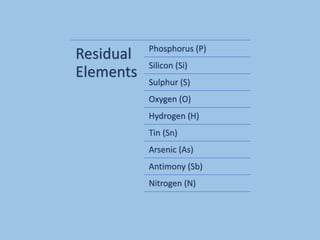
Residual
Elements
Phosphorus (P)
Silicon (Si)
Sulphur (S)
Oxygen (O)
Hydrogen (H)
Tin (Sn)
Arsenic (As)
Antimony (Sb)
Nitrogen (N)
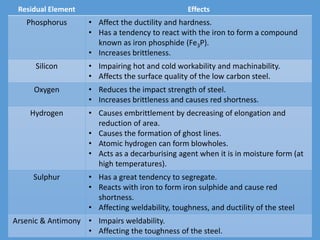
Residual Element Effects
Phosphorus • Affect the ductility and hardness.
• Has a tendency to react with the iron to form a compound
known as iron phosphide (Fe3P).
• Increases brittleness.
Silicon • Impairing hot and cold workability and machinability.
• Affects the surface quality of the low carbon steel.
Oxygen • Reduces the impact strength of steel.
• Increases brittleness and causes red shortness.
Hydrogen • Causes embrittlement by decreasing of elongation and
reduction of area.
• Causes the formation of ghost lines.
• Atomic hydrogen can form blowholes.
• Acts as a decarburising agent when it is in moisture form (at
high temperatures).
Sulphur • Has a great tendency to segregate.
• Reacts with iron to form iron sulphide and cause red
shortness.
• Affecting weldability, toughness, and ductility of the steel
Arsenic & Antimony • Impairs weldability.
• Affecting the toughness of the steel.
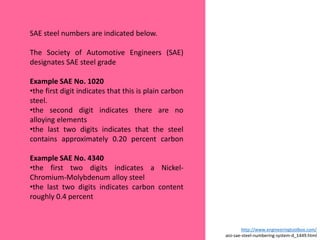
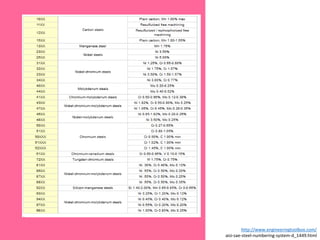
SAE steel numbers are indicated below.
The Society of Automotive Engineers (SAE)
designates SAE steel grade
Example SAE No. 1020
•the first digit indicates that this is plain carbon
steel.
•the second digit indicates there are no
alloying elements
•the last two digits indicates that the steel
contains approximately 0.20 percent carbon
Example SAE No. 4340
•the first two digits indicates a Nickel-
Chromium-Molybdenum alloy steel
•the last two digits indicates carbon content
roughly 0.4 percent
http://www.engineeringtoolbox.com/
aisi-sae-steel-numbering-system-d_1449.html
http://www.engineeringtoolbox.com/
aisi-sae-steel-numbering-system-d_1449.html
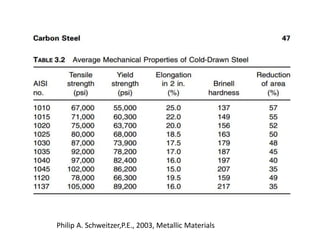
Philip A. Schweitzer,P.E., 2003, Metallic Materials
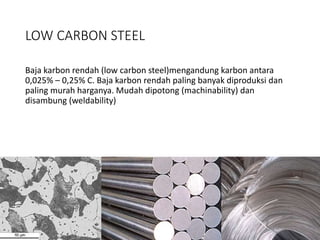
LOW CARBON STEEL
Baja karbon rendah (low carbon steel)mengandung karbon antara
0,025% – 0,25% C. Baja karbon rendah paling banyak diproduksi dan
paling murah harganya. Mudah dipotong (machinability) dan
disambung (weldability)
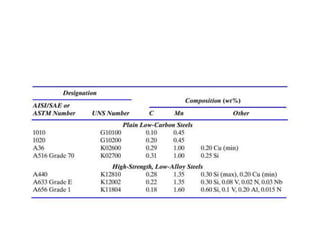
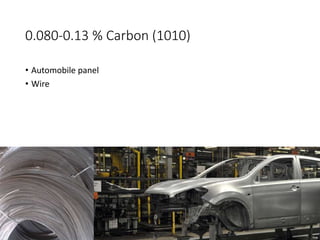
0.080-0.13 % Carbon (1010)
• Automobile panel
• Wire
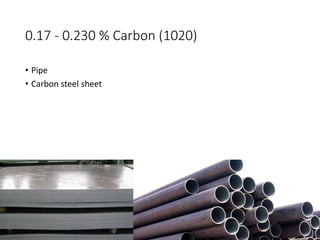
0.17 - 0.230 % Carbon (1020)
• Pipe
• Carbon steel sheet
0.25 - 0.290 % Carbon (a36)
• Structural material for building and
bridge
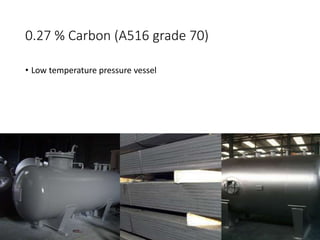
0.27 % Carbon (A516 grade 70)
• Low temperature pressure vessel
MEDIUM CARBON STEEL
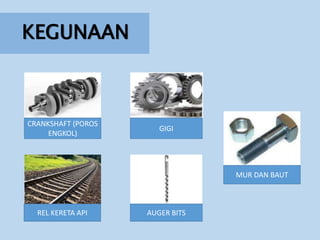
• Mempunyai kandungan Karbon (C) 0,25 % - 0,6 %.
• Lebih kuat daripada baja karbon rendah
• Banyak digunakan untuk membuat alat-alat yang
berhubungan dengan mesin serta untuk keperluan
kereta api.
• Sulit untuk dibengkokkan, dilas, dipotong.
KEGUNAAN
CRANKSHAFT (POROS
ENGKOL)
GIGI
REL KERETA API AUGER BITS
MUR DAN BAUT
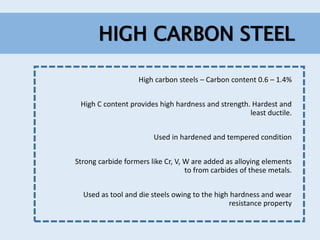
HIGH CARBON STEEL
High carbon steels – Carbon content 0.6 – 1.4%
High C content provides high hardness and strength. Hardest and
least ductile.
Used in hardened and tempered condition
Strong carbide formers like Cr, V, W are added as alloying elements
to from carbides of these metals.
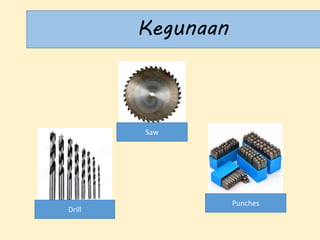
Used as tool and die steels owing to the high hardness and wear
resistance property
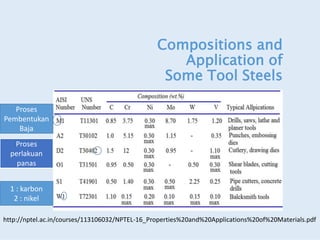
Compositions and
Application of
Some Tool Steels
http://nptel.ac.in/courses/113106032/NPTEL-16_Properties%20and%20Applications%20of%20Materials.pdf
Proses
Pembentukan
Baja
1 : karbon
2 : nikel
Proses
perlakuan
panas
Kegunaan
Saw
Drill
Punches
KELEMAHAN CARBON STEEL
1. Carbon steel tidak bisa menahan kekuatan tekanan sebesar
100.000 psia atau lebih.
2. Sebagian besar tidak bisa dibuat dengan struktur martensite oleh
karena itu carbon steel tidak terlalu keras.
3. Harus dilakukan pendinginan seketika untuk pengerasan media
karbon yang digunakan untuk membentuk carbon steel.
4. Carbon steel memiliki ketahanan yang buruk terhadap suhu rendah
5. Carbon steel memiliki ketahanan korosi yang buruk
6. Carbon steel mudah terbakar pada suhu tinggi
Code Standards for Carbon Steel
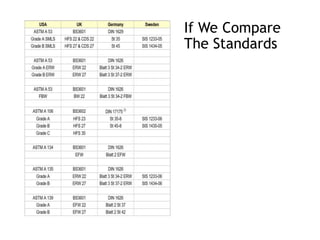
If We Compare
The Standards
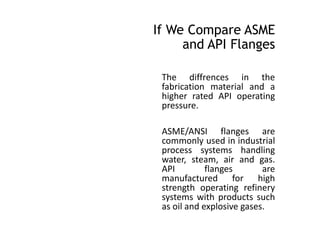
If We Compare ASME
and API Flanges
The diffrences in the
fabrication material and a
higher rated API operating
pressure.
ASME/ANSI flanges are
commonly used in industrial
process systems handling
water, steam, air and gas.
API flanges are
manufactured for high
strength operating refinery
systems with products such
as oil and explosive gases.
American Petroleum Institute ( API )
The standards referred by piping engingeers
• API 602 = compact design carbon steel gate valve
• API 605 = large diameter carbon steel flanges
American Society for Testing and Materials (
MATERIAL STANDARD)
• ASTM
• A106 - Seamless carbon steel pipe for HIGH TEMPERATURE SERVICE
• A181 - for FORGINGS, carbon steel for general prupose PIPING
• A194 - for BOLTS for HIGH PRESSURE and HIGH TEMPERATURE service
• A234 - for PIPING FITTINGS for MODERATE and ELEVATED TEMPERATURE
• A350 - for FORGINGS, (carbon and low alloy steel requirig notch toughness
testing) or piping components
• A420 - for PIPING FITTINGS for LOW TEMPERATURE SERVICE
• A694 - for FORGINGS, for PIPE FLANGERS, FITTINGs, VALVE, PART for HIGH
PRESSURE TRANSMISON SERVICE
• A707 - FLANGEs, FORGED carbon and alloy steel for LOW TEMPERATURE
SERVICE
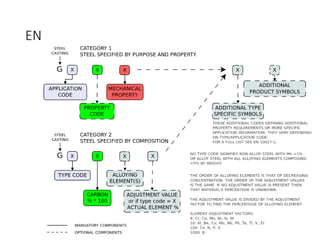
EN
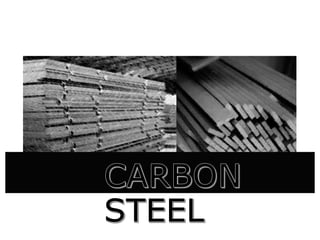
Carbon Steel Fundamental, Application, Code and Standart

Carbon Steel Fundamental, Application, Code and Standart

  • 2.
    Definition of carbonsteel Effectof alloying element on steel Low Carbon Steel Medium Carbon Steel High Carbon Steel The advantage and disadvantage OUTLINE
  • 3.
    Istilah steel/baja biasanyadiartikan sebagai paduan yang mengandung karbon dalam jumlah sekitar kurang dari 2%. Carbon steel dapat didefinisikan sebagai baja yang tersusun atas sedikit unsur selain karbon, seperti sulfur dan mangan. Unsur paduan utama bahan-bahan ironbased adalah karbon. Karena karbon adalah suatu unsur paduan yang kuat. Terdapat perbedaan yang signifikan dalam kekuatan, kekerasan, dan daktilitas yang dicapai dengan adanya variasi yang di tingkat komposisi karbon dalam baja. Electric power research institute EPRI Project Manager D. Gandy
  • 4.
    Carbon Steel Making Electricpower research institute EPRI Project Manager D. Gandy In the steel making process, compounds such as silicon, nitrogen, sulfur, phosphorus and excess crude carbon is taken away from the iron so that the iron bacomes purer and the bond between atoms in the iron will increased. Blended elements such as nickel, chromium, manganese and vanadium are added to the iron producing different grades of steel.
  • 5.
    Residual Elements AffectThe Carbon Steel
  • 6.
    Residual Elements Phosphorus (P) Silicon (Si) Sulphur(S) Oxygen (O) Hydrogen (H) Tin (Sn) Arsenic (As) Antimony (Sb) Nitrogen (N)
  • 7.
    Residual Element Effects Phosphorus• Affect the ductility and hardness. • Has a tendency to react with the iron to form a compound known as iron phosphide (Fe3P). • Increases brittleness. Silicon • Impairing hot and cold workability and machinability. • Affects the surface quality of the low carbon steel. Oxygen • Reduces the impact strength of steel. • Increases brittleness and causes red shortness. Hydrogen • Causes embrittlement by decreasing of elongation and reduction of area. • Causes the formation of ghost lines. • Atomic hydrogen can form blowholes. • Acts as a decarburising agent when it is in moisture form (at high temperatures). Sulphur • Has a great tendency to segregate. • Reacts with iron to form iron sulphide and cause red shortness. • Affecting weldability, toughness, and ductility of the steel Arsenic & Antimony • Impairs weldability. • Affecting the toughness of the steel.
  • 8.
    SAE steel numbersare indicated below. The Society of Automotive Engineers (SAE) designates SAE steel grade Example SAE No. 1020 •the first digit indicates that this is plain carbon steel. •the second digit indicates there are no alloying elements •the last two digits indicates that the steel contains approximately 0.20 percent carbon Example SAE No. 4340 •the first two digits indicates a Nickel- Chromium-Molybdenum alloy steel •the last two digits indicates carbon content roughly 0.4 percent http://www.engineeringtoolbox.com/ aisi-sae-steel-numbering-system-d_1449.html
  • 9.
  • 10.
    Philip A. Schweitzer,P.E.,2003, Metallic Materials
  • 11.
    LOW CARBON STEEL Bajakarbon rendah (low carbon steel)mengandung karbon antara 0,025% – 0,25% C. Baja karbon rendah paling banyak diproduksi dan paling murah harganya. Mudah dipotong (machinability) dan disambung (weldability)
  • 13.
    0.080-0.13 % Carbon(1010) • Automobile panel • Wire
  • 14.
    0.17 - 0.230% Carbon (1020) • Pipe • Carbon steel sheet
  • 15.
    0.25 - 0.290% Carbon (a36) • Structural material for building and bridge
  • 16.
    0.27 % Carbon(A516 grade 70) • Low temperature pressure vessel
  • 17.
    MEDIUM CARBON STEEL •Mempunyai kandungan Karbon (C) 0,25 % - 0,6 %. • Lebih kuat daripada baja karbon rendah • Banyak digunakan untuk membuat alat-alat yang berhubungan dengan mesin serta untuk keperluan kereta api. • Sulit untuk dibengkokkan, dilas, dipotong.
  • 18.
  • 19.
    HIGH CARBON STEEL Highcarbon steels – Carbon content 0.6 – 1.4% High C content provides high hardness and strength. Hardest and least ductile. Used in hardened and tempered condition Strong carbide formers like Cr, V, W are added as alloying elements to from carbides of these metals. Used as tool and die steels owing to the high hardness and wear resistance property
  • 20.
    Compositions and Application of SomeTool Steels http://nptel.ac.in/courses/113106032/NPTEL-16_Properties%20and%20Applications%20of%20Materials.pdf Proses Pembentukan Baja 1 : karbon 2 : nikel Proses perlakuan panas
  • 21.
  • 22.
    KELEMAHAN CARBON STEEL 1.Carbon steel tidak bisa menahan kekuatan tekanan sebesar 100.000 psia atau lebih. 2. Sebagian besar tidak bisa dibuat dengan struktur martensite oleh karena itu carbon steel tidak terlalu keras. 3. Harus dilakukan pendinginan seketika untuk pengerasan media karbon yang digunakan untuk membentuk carbon steel. 4. Carbon steel memiliki ketahanan yang buruk terhadap suhu rendah 5. Carbon steel memiliki ketahanan korosi yang buruk 6. Carbon steel mudah terbakar pada suhu tinggi
  • 23.
    Code Standards forCarbon Steel
  • 24.
  • 25.
    If We CompareASME and API Flanges The diffrences in the fabrication material and a higher rated API operating pressure. ASME/ANSI flanges are commonly used in industrial process systems handling water, steam, air and gas. API flanges are manufactured for high strength operating refinery systems with products such as oil and explosive gases.
  • 26.
    American Petroleum Institute( API ) The standards referred by piping engingeers • API 602 = compact design carbon steel gate valve • API 605 = large diameter carbon steel flanges
  • 27.
    American Society forTesting and Materials ( MATERIAL STANDARD) • ASTM • A106 - Seamless carbon steel pipe for HIGH TEMPERATURE SERVICE • A181 - for FORGINGS, carbon steel for general prupose PIPING • A194 - for BOLTS for HIGH PRESSURE and HIGH TEMPERATURE service • A234 - for PIPING FITTINGS for MODERATE and ELEVATED TEMPERATURE • A350 - for FORGINGS, (carbon and low alloy steel requirig notch toughness testing) or piping components • A420 - for PIPING FITTINGS for LOW TEMPERATURE SERVICE • A694 - for FORGINGS, for PIPE FLANGERS, FITTINGs, VALVE, PART for HIGH PRESSURE TRANSMISON SERVICE • A707 - FLANGEs, FORGED carbon and alloy steel for LOW TEMPERATURE SERVICE
  • 28.