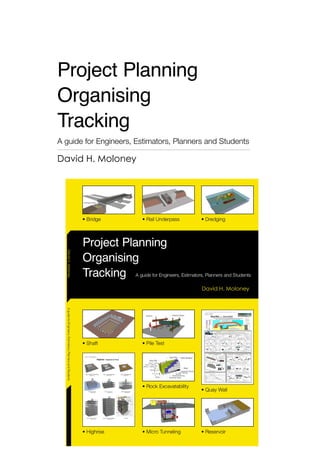
Project Planning
Organising
Tracking
A guide for Engineers, Estimators, Planners and Students
David H. Moloney
Foreword
The aim of this book is to show construction information relevant to planning, organising and
tracking progress, graphically, focusing on the essential facts that can be easily discussed,
communicated and implemented.
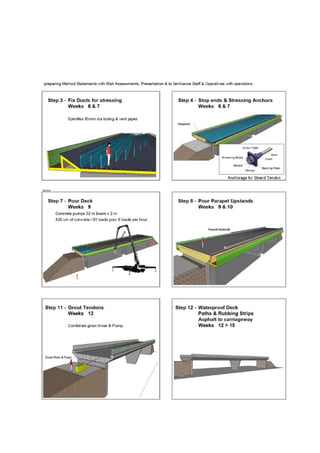
Regarding the illustrations showing construction sequences (storyboards), the approach is to
find the easiest, quickest and safest way to execute a project with maximum utilisation of the
employed resources also ensuring that executed work is right first time.
Gantt type chart programmes show the sequence and durations. Storyboards can show the
sequence, durations along with how to build an operation graphically in a way that all team
members along with operatives on site can understand leading to a collaborative effort.
This book deals mainly with heavy Civils and structures, the details and outputs are for
guidance, each case should be evaluated separately allowing for particular site conditions.
Programming & Designer’s inputs
The following are the designers contributions to ensure fast-track construction.
Front Engineering Period- At time of contract award, the design to be such, that it can be
used for procurement and to produce temporary works designs, method statements, safety
statements and a construction programme.
  Procurement time periods vary and could take up to eight weeks from issue of construction
information, depending on the material, hire plant item or sub-contract. Plus delivery and
mobilising periods.
Approval Periods- A maximum of four working days should be set for approval of technical
submissions and to answer queries.
I would welcome any comments as to corrections or improvements
Contents
Introduction to Storyboards				
Excavation, Haul & Place Fill			 	
Rock Excavatability, Rock Breakers & Soil classification	
Rock: Drill, Blast & Crush		
Pipelaying					
Ground Improvement by Vibro Compaction	
Basement: Dewatering & Construction	
Piles: Bored		
Piles: Testing		
Piles: Breakout & Waterproofing			
Highrise: Construction Sequence			
Highrise: Plant Selection				
Highrise: Planning					
Reservoir 					
Rail Underpass				
Bridge					
Bridge Deck Insitu
Metro Viaduct
Quay Wall	
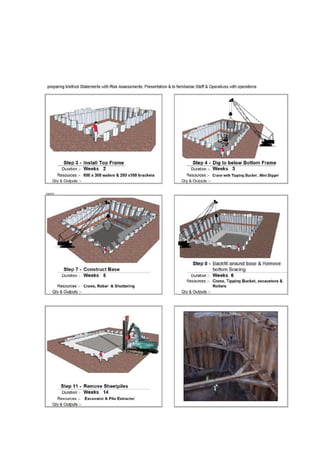
Temporary Sheetpile Shaft
Micro Tunnelling	
Marine Plant & Dredging		
Organogram 					
Programme & Cashflow				
Tacking: Progress			
Filing System				
Procurement: Quotation Enquiry			
Procurement: Directory of Suppliers etc		
Procurement: Comparison Sheets			
Tracking: Payments Sheet				
Tracking: Monthly Certificates v’s Costs			
Daily Allocations					
Dayworks Sheet					
Costing: Pipelaying					
Outputs: Programming & Estimating			
Plant: Fuel consumption 				
Compaction Table for Rollers			
Recording: Concrete orders				
Programme: Weekly Look-ahead & Review 		
Clip Arts of Plant & Site Team				
1
2
3
4
5
6
7
8
9
10
11
12
13
14
15
16
17
18
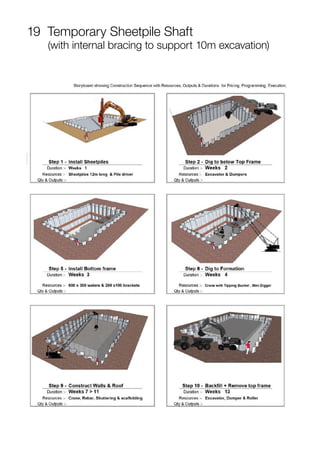
19
20
21
22
23
24
25
26
27
28
29
30
31
32
33
34
35
36
37
38
39
Acknowledgements
Published by David H. Moloney
Carron,
Tipperary Town,
Ireland
© 2009 David H. Moloney
All rights reserved
Printed and bound in Ireland
10 9 8 7 6 5 4 3 2 1
First Edition
No part of this book may be used or reproduced in any
manner without written permission from the author,
except in the context of reviews.
This book has been typeset in Helvetica Neue
ISBN xxxxxxxxxxxxxxxxxxxxxx
davmol.moloney@gmail
☎ 00353 87 317 6815
The author wish to acknowledge the help,
advise given and contributions made by
the companies listed below.
Company’s Name			
				
Dutco Balfour Beatty	 Civil
Herrenknecht		
PERI GmbH 	
ArcelorMittal 	
Caterpillar Inc
Freyssinet	
Putzmeister	
Product / Service
Engineering Contractor
Tunnelling Systems
Formwork & Scaffolding 	
Sheetpiles
Plant					
	
Stressing Systems 	 		
Concrete Pumps			
	
Website Address
www.dutcobalfourbeatty.com
www.herrenknecht.com
www.peri.de
www.arcelormittal.com
www.cat.com
www.freyssinet.com
www.putzmeister.com
Graphic Design and typesetting: Sarah Moloney
		 www.sarahmoloney.com
Introduction to Storyboards
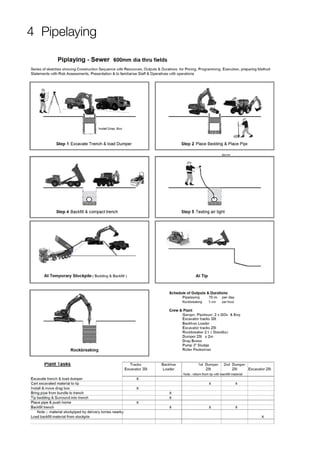
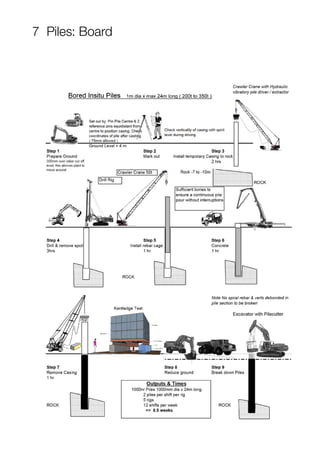
These Storyboards are a series of sketches showing construction sequences which include
Clip Art’s of plant and equipment, photos and SketchUp 3D drawings with quantities,
outputs, resources and durations to help to pre-visualize the construction and to find
potential problems before they occur.
There is truth in the old saying that a picture is worth a thousand words.
Benefits of using storyboards:
• Storyboards allows staff to experiment with changes in the planning and evoke stronger
interest and participation.
• The process of visual thinking and planning allows staff to brainstorm together. This
fosters more ideas and generates consensus.
• Unlike programmes storyboards are intuitive and easier to understand and because they
are visual it is easier to remember and discuss construction methods.
• Helps finding the easiest, quickest and safest way to do a job correctly, with the best
resources.
• Unlike Method Statements which tend to be general and are tiresome to read, storyboards
are particular and to the point.
• To justify Delay + Disruption Claims and establish entitlement for extra payment, easier to
show cause and effect leading to loss of productivity. Storyboards focus on the facts and
keep the analyses and the presentation of delays and disruption as simple as possible.
	
Storyboards can be used for the following:
• Presentations to Clients and third parties to explain proposed construction methods,
durations and sequences.
• To familiarize junior staff and workers with proposed work as required by health and safety
regulations.
• For foremen to see what plant and equipment is required and what is expected production
wise.
• To monitor progress.
• For Pricing, Costings, Programming, Execution, preparing Method Statements with Risk
Assessments.
• Improve efficiency by getting a better understanding of the process involved in
transforming resources into work, improvements can be made.
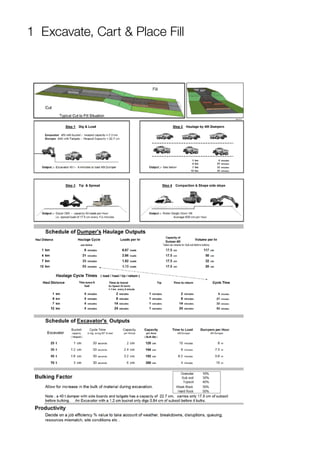
1 Excavate, Cart & Place Fill
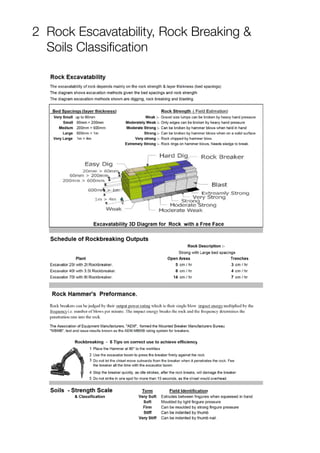
2 Rock Escavatability, Rock Breaking &
Soils Classification
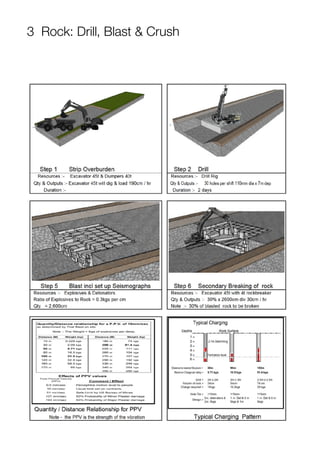
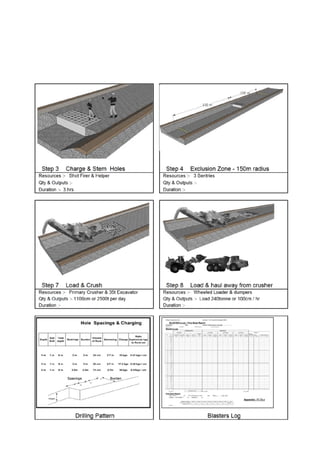
3 Rock: Drill, Blast & Crush
4 Pipelaying
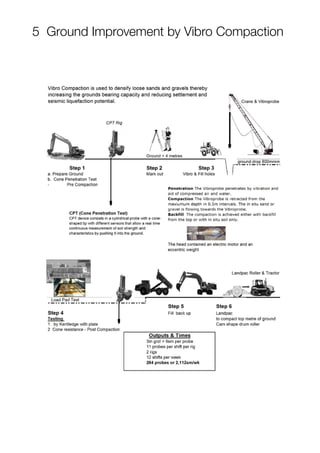
5 Ground Improvement by Vibro Compaction
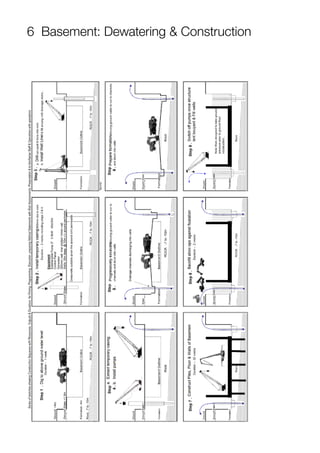
6 Basement: Dewatering & Construction
7 Piles: Board
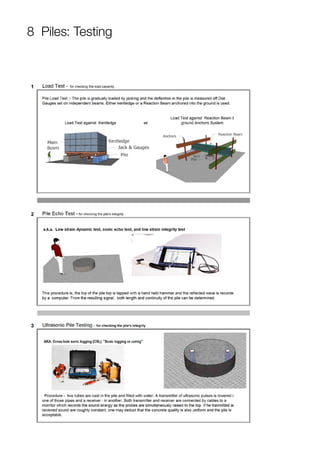
8 Piles: Testing
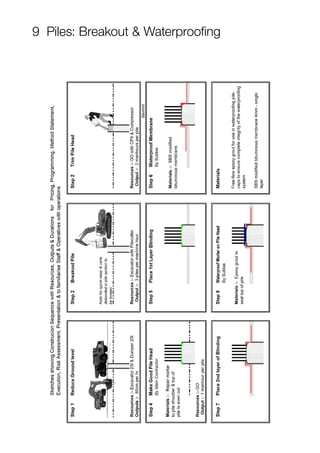
9 Piles: Breakout & Waterproofing
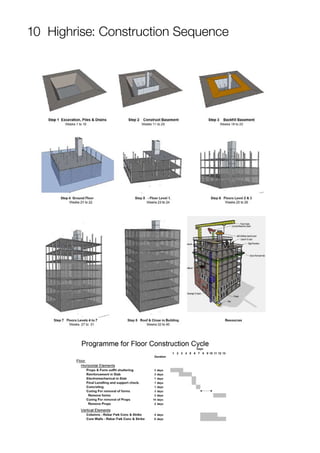
10 Highrise: Construction Sequence
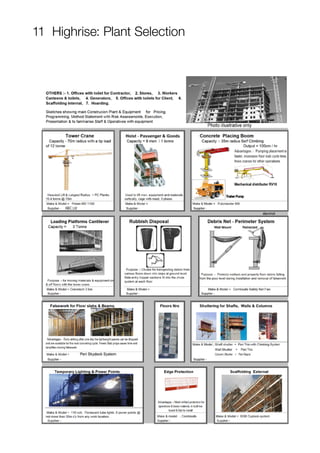
11 Highrise: Plant Selection
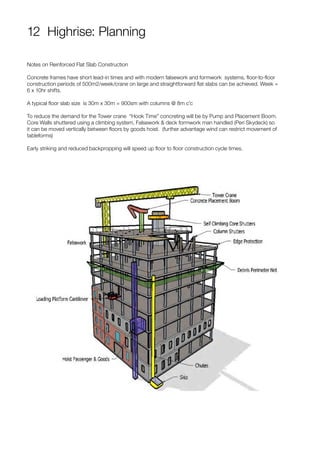
12 Highrise: Planning
Notes on Reinforced Flat Slab Construction
Concrete frames have short lead-in times and with modern falsework and formwork systems, floor-to-floor
construction periods of 500m2/week/crane on large and straightforward flat slabs can be achieved. Week =
6 x 10hr shifts.
A typical floor slab size is 30m x 30m = 900sm with columns @ 8m c’c
To reduce the demand for the Tower crane “Hook Time” concreting will be by Pump and Placement Boom.
Core Walls shuttered using a climbing system, Falsework & deck formwork man handled (Peri Skydeck) so
it can be moved vertically between floors by goods hoist. (further advantage wind can restrict movement of
tableforms)
Early striking and reduced backpropping will speed up floor to floor construction cycle times.
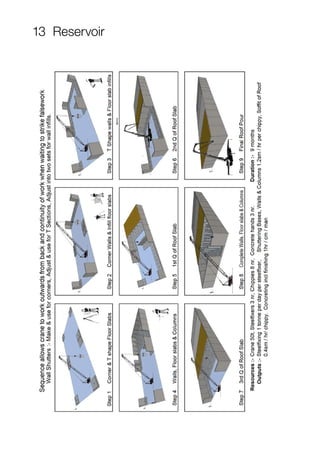
13 Reservoir
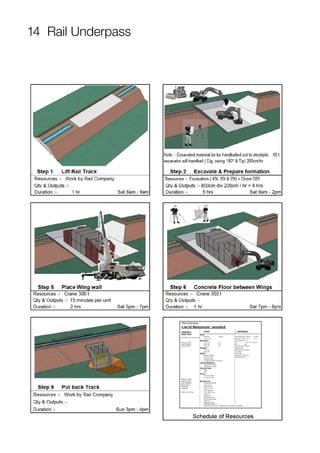
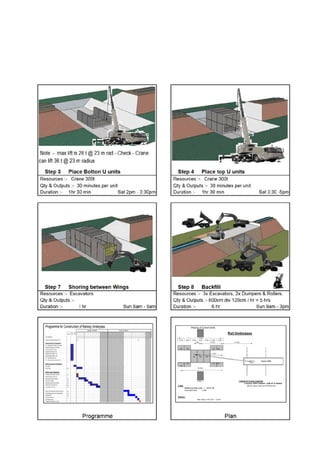
14 Rail Underpass
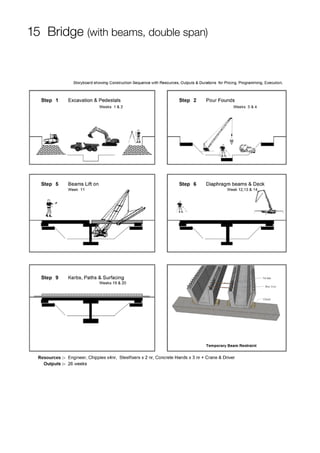
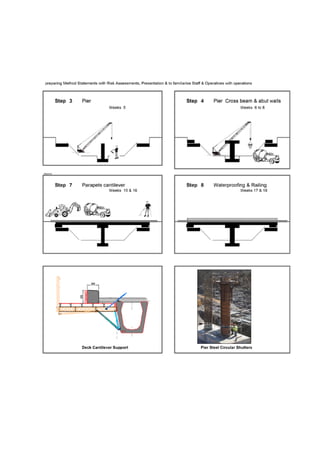
15 Bridge (with beams, double span)
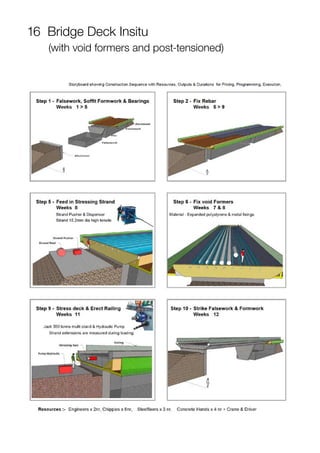
16 Bridge Deck Insitu
(with void formers and post-tensioned)
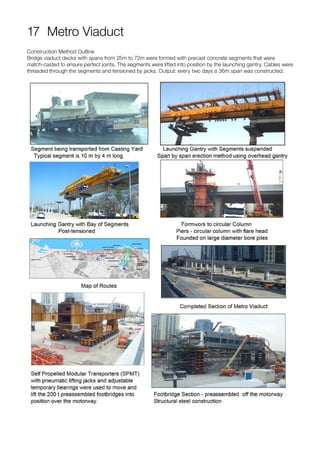
17 Metro Viaduct
Construction Method Outline
Bridge viaduct decks with spans from 25m to 72m were formed with precast concrete segments that were
match-casted to ensure perfect joints. The segments were lifted into position by the launching gantry. Cables were
threaded through the segments and tensioned by jacks. Output: every two days a 36m span was constructed.
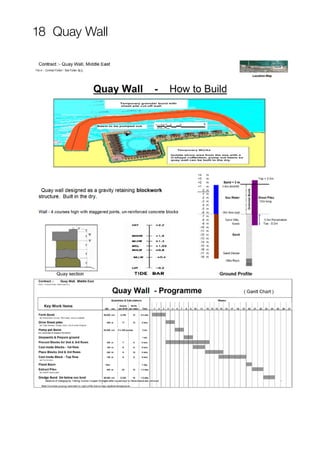
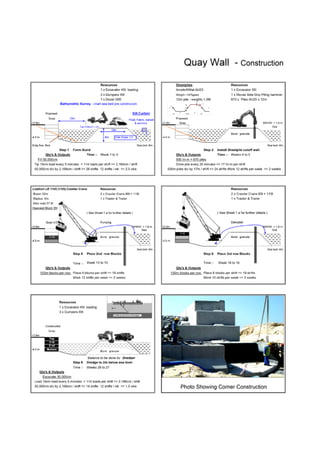
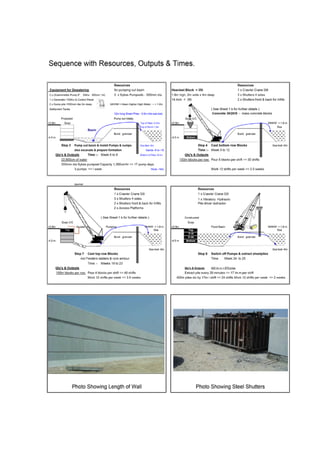
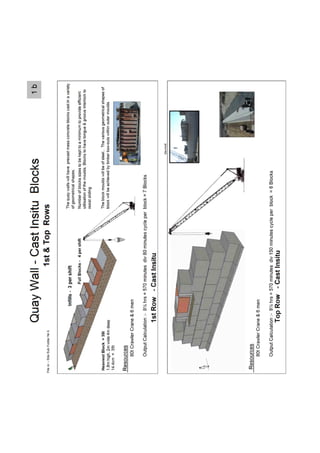
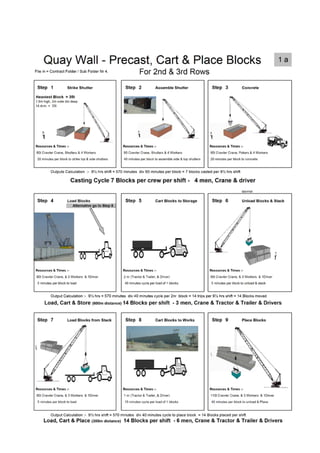
18 Quay Wall
19 Temporary Sheetpile Shaft
(with internal bracing to support 10m excavation)
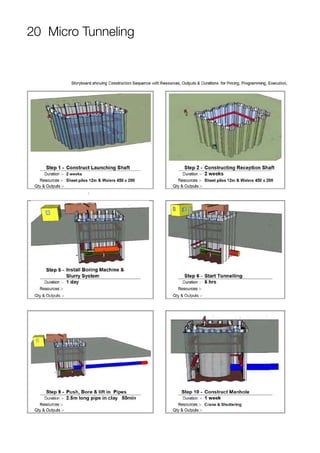
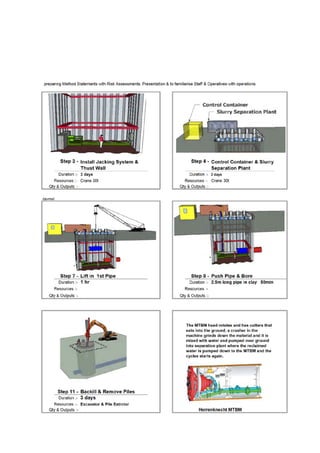
20 Micro Tunneling
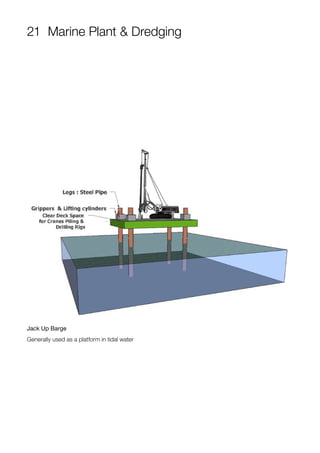
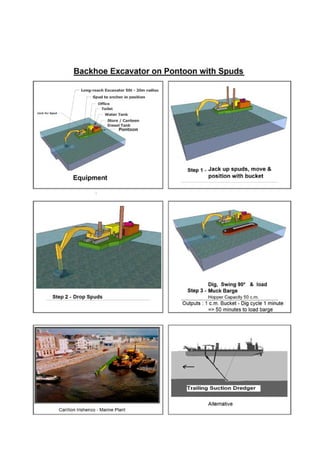
21 Marine Plant & Dredging
Jack Up Barge
Generally used as a platform in tidal water
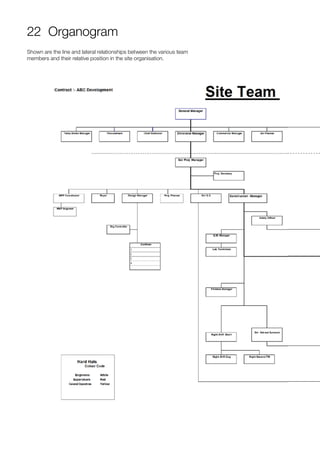
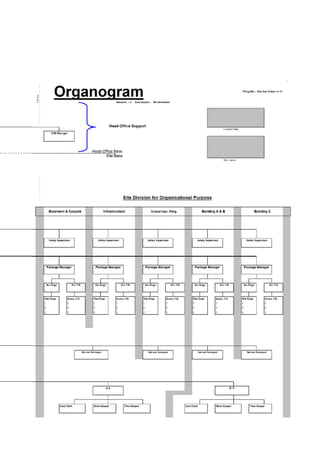
22 Organogram
Shown are the line and lateral relationships between the various team
members and their relative position in the site organisation.
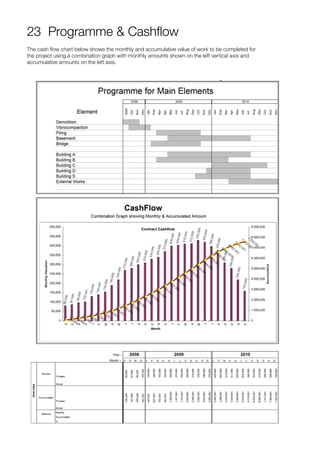
23 Programme & Cashflow
The cash flow chart below shows the monthly and accumulative value of work to be completed for
the project using a combination graph with monthly amounts shown on the left vertical axis and
accumulative amounts on the left axis.
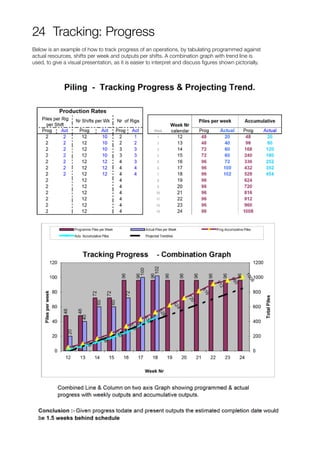
24 Tracking: Progress
Below is an example of how to track progress of an operations, by tabulating programmed against
actual resources, shifts per week and outputs per shifts. A combination graph with trend line is
used, to give a visual presentation, as it is easier to interpret and discuss figures shown pictorially.
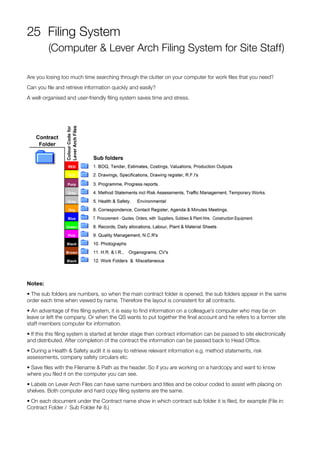
25 Filing System
(Computer & Lever Arch Filing System for Site Staff)
Are you losing too much time searching through the clutter on your computer for work files that you need?
Can you file and retrieve information quickly and easily?
A well-organised and user-friendly filing system saves time and stress.
Notes:
• The sub folders are numbers, so when the main contract folder is opened, the sub folders appear in the same
order each time when viewed by name. Therefore the layout is consistent for all contracts.
• An advantage of this filing system, it is easy to find information on a colleague’s computer who may be on
leave or left the company. Or when the QS wants to put together the final account and he refers to a former site
staff members computer for information.
• If this this filing system is started at tender stage then contract information can be passed to site electronically
and distributed. After completion of the contract the information can be passed back to Head Office.
• During a Health & Safety audit it is easy to retrieve relevant information e.g. method statements, risk
assessments, company safety circulars etc.
• Save files with the Filename & Path as the header. So if you are working on a hardcopy and want to know
where you filed it on the computer you can see.
• Labels on Lever Arch Files can have same numbers and titles and be colour coded to assist with placing on
shelves. Both computer and hard copy filing systems are the same.
• On each document under the Contract name show in which contract sub folder it is filed, for example (File in:
Contract Folder / Sub Folder Nr 8.)
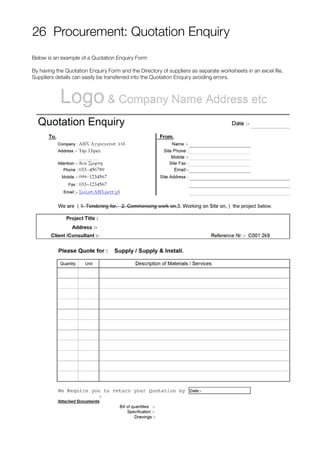
26 Procurement: Quotation Enquiry
Below is an example of a Quotation Enquiry Form
By having the Quotation Enquiry Form and the Directory of suppliers as separate worksheets in an excel file,
Suppliers details can easily be transferred into the Quotation Enquiry avoiding errors.
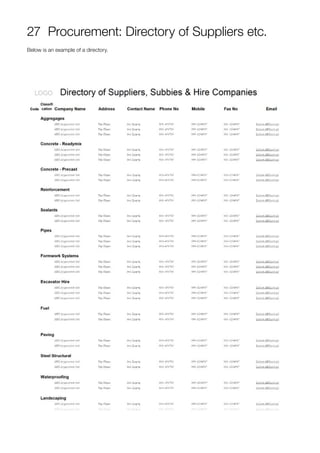
27 Procurement: Directory of Suppliers etc.
Below is an example of a directory.
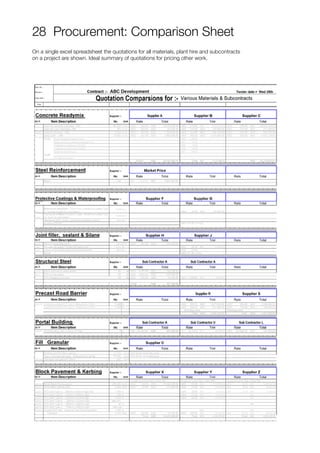
28 Procurement: Comparison Sheet
On a single excel spreadsheet the quotations for all materials, plant hire and subcontracts
on a project are shown. Ideal summary of quotations for pricing other work.
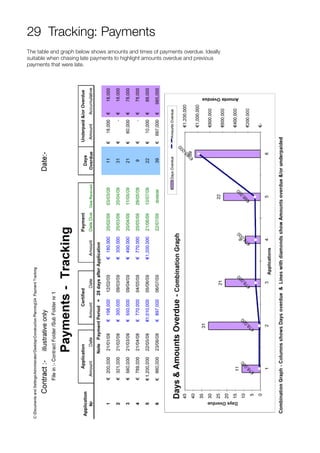
29 Tracking: Payments
The table and graph below shows amounts and times of payments overdue. Ideally
suitable when chasing late payments to highlight amounts overdue and previous
payments that were late.
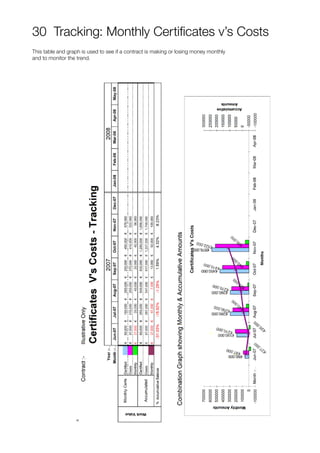
30 Tracking: Monthly Certificates v’s Costs
This table and graph is used to see if a contract is making or losing money monthly
and to monitor the trend.
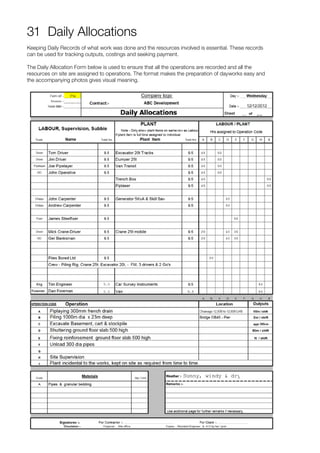
31 Daily Allocations
Keeping Daily Records of what work was done and the resources involved is essential. These records
can be used for tracking outputs, costings and seeking payment.
The Daily Allocation Form below is used to ensure that all the operations are recorded and all the
resources on site are assigned to operations. The format makes the preparation of dayworks easy and
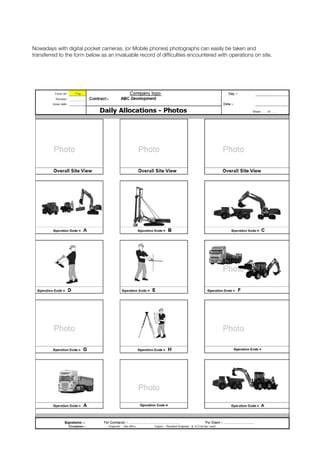
the accompanying photos gives visual meaning.
Nowadays with digital pocket cameras, (or Mobile phones) photographs can easily be taken and
transferred to the form below as an invaluable record of difficulties encountered with operations on site.
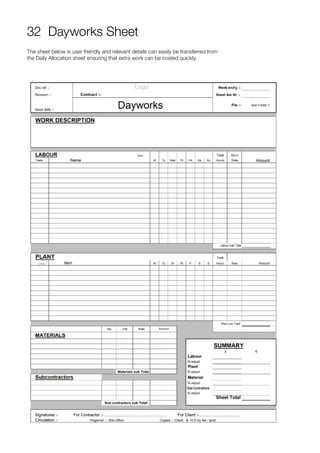
32 Dayworks Sheet
The sheet below is user friendly and relevant details can easily be transferred from
the Daily Allocation sheet ensuring that extra work can be costed quickly.
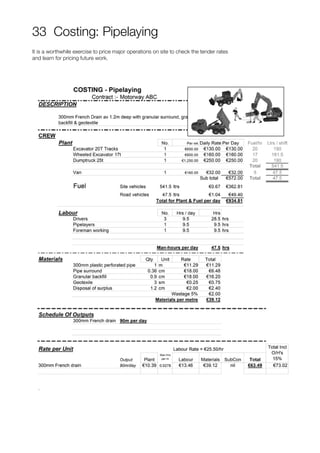
33 Costing: Pipelaying
It is a worthwhile exercise to price major operations on site to check the tender rates
and learn for pricing future work.
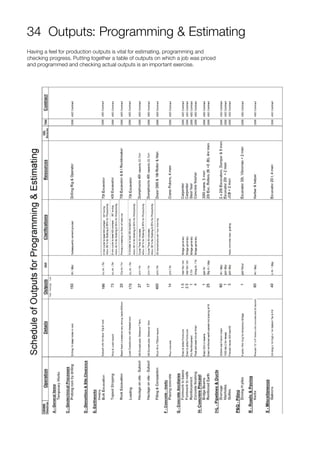
34 Outputs: Programming & Estimating
Having a feel for production outputs is vital for estimating, programming and
checking progress. Putting together a table of outputs on which a job was priced
and programmed and checking actual outputs is an important exercise.
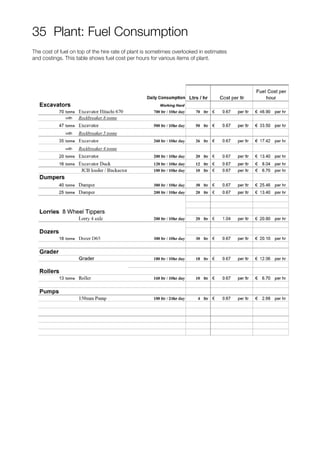
35 Plant: Fuel Consumption
The cost of fuel on top of the hire rate of plant is sometimes overlooked in estimates
and costings. This table shows fuel cost per hours for various items of plant.
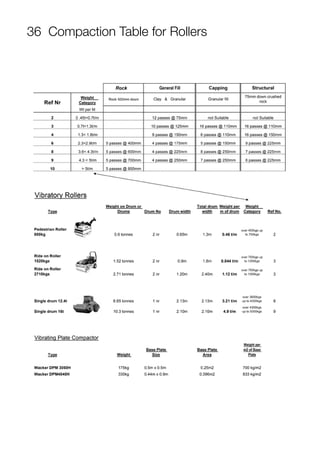
36 Compaction Table for Rollers
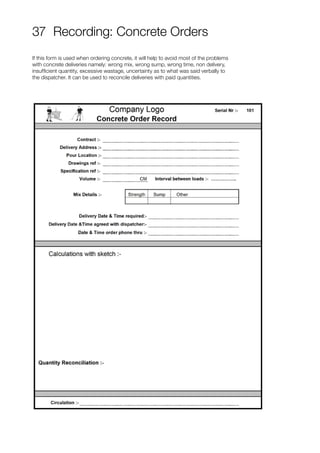
37 Recording: Concrete Orders
If this form is used when ordering concrete, it will help to avoid most of the problems
with concrete deliveries namely: wrong mix, wrong sump, wrong time, non delivery,
insufficient quantity, excessive wastage, uncertainty as to what was said verbally to
the dispatcher. It can be used to reconcile deliveries with paid quantities.
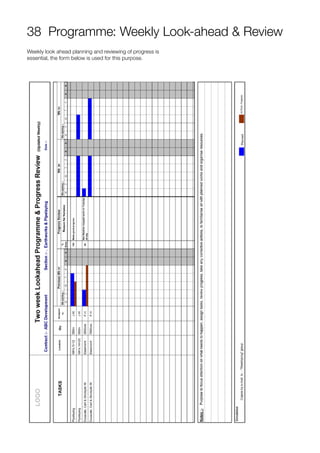
38 Programme: Weekly Look-ahead & Review
Weekly look ahead planning and reviewing of progress is
essential, the form below is used for this purpose.
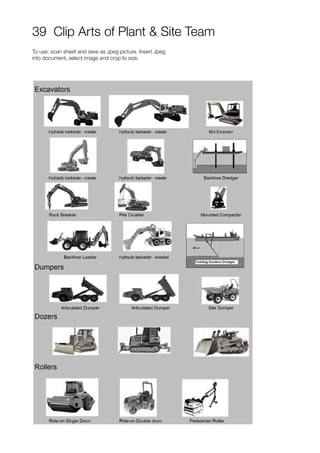
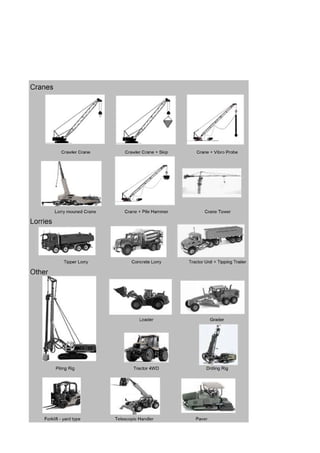
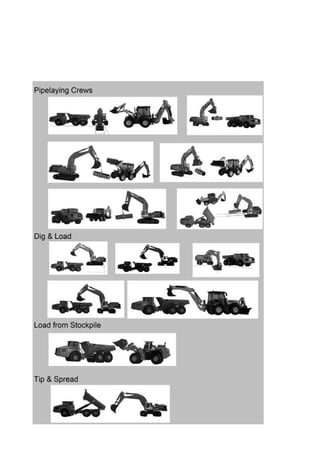
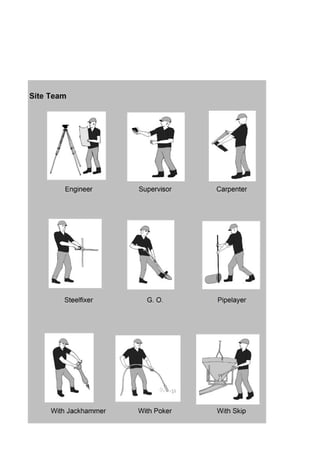
39 Clip Arts of Plant & Site Team
To use, scan sheet and save as Jpeg picture. Insert Jpeg
into document, select image and crop to size.
Project Planning Organising Tracking  Construction

Project Planning Organising Tracking Construction

  • 1.
    Project Planning Organising Tracking A guidefor Engineers, Estimators, Planners and Students David H. Moloney
  • 2.
    Foreword The aim ofthis book is to show construction information relevant to planning, organising and tracking progress, graphically, focusing on the essential facts that can be easily discussed, communicated and implemented. Regarding the illustrations showing construction sequences (storyboards), the approach is to find the easiest, quickest and safest way to execute a project with maximum utilisation of the employed resources also ensuring that executed work is right first time. Gantt type chart programmes show the sequence and durations. Storyboards can show the sequence, durations along with how to build an operation graphically in a way that all team members along with operatives on site can understand leading to a collaborative effort. This book deals mainly with heavy Civils and structures, the details and outputs are for guidance, each case should be evaluated separately allowing for particular site conditions. Programming & Designer’s inputs The following are the designers contributions to ensure fast-track construction. Front Engineering Period- At time of contract award, the design to be such, that it can be used for procurement and to produce temporary works designs, method statements, safety statements and a construction programme.   Procurement time periods vary and could take up to eight weeks from issue of construction information, depending on the material, hire plant item or sub-contract. Plus delivery and mobilising periods. Approval Periods- A maximum of four working days should be set for approval of technical submissions and to answer queries. I would welcome any comments as to corrections or improvements
  • 3.
    Contents Introduction to Storyboards Excavation,Haul & Place Fill Rock Excavatability, Rock Breakers & Soil classification Rock: Drill, Blast & Crush Pipelaying Ground Improvement by Vibro Compaction Basement: Dewatering & Construction Piles: Bored Piles: Testing Piles: Breakout & Waterproofing Highrise: Construction Sequence Highrise: Plant Selection Highrise: Planning Reservoir Rail Underpass Bridge Bridge Deck Insitu Metro Viaduct Quay Wall Temporary Sheetpile Shaft Micro Tunnelling Marine Plant & Dredging Organogram Programme & Cashflow Tacking: Progress Filing System Procurement: Quotation Enquiry Procurement: Directory of Suppliers etc Procurement: Comparison Sheets Tracking: Payments Sheet Tracking: Monthly Certificates v’s Costs Daily Allocations Dayworks Sheet Costing: Pipelaying Outputs: Programming & Estimating Plant: Fuel consumption Compaction Table for Rollers Recording: Concrete orders Programme: Weekly Look-ahead & Review Clip Arts of Plant & Site Team 1 2 3 4 5 6 7 8 9 10 11 12 13 14 15 16 17 18 19 20 21 22 23 24 25 26 27 28 29 30 31 32 33 34 35 36 37 38 39
  • 4.
    Acknowledgements Published by DavidH. Moloney Carron, Tipperary Town, Ireland © 2009 David H. Moloney All rights reserved Printed and bound in Ireland 10 9 8 7 6 5 4 3 2 1 First Edition No part of this book may be used or reproduced in any manner without written permission from the author, except in the context of reviews. This book has been typeset in Helvetica Neue ISBN xxxxxxxxxxxxxxxxxxxxxx davmol.moloney@gmail ☎ 00353 87 317 6815 The author wish to acknowledge the help, advise given and contributions made by the companies listed below. Company’s Name Dutco Balfour Beatty Civil Herrenknecht PERI GmbH ArcelorMittal Caterpillar Inc Freyssinet Putzmeister Product / Service Engineering Contractor Tunnelling Systems Formwork & Scaffolding Sheetpiles Plant Stressing Systems Concrete Pumps Website Address www.dutcobalfourbeatty.com www.herrenknecht.com www.peri.de www.arcelormittal.com www.cat.com www.freyssinet.com www.putzmeister.com Graphic Design and typesetting: Sarah Moloney www.sarahmoloney.com
  • 5.
    Introduction to Storyboards TheseStoryboards are a series of sketches showing construction sequences which include Clip Art’s of plant and equipment, photos and SketchUp 3D drawings with quantities, outputs, resources and durations to help to pre-visualize the construction and to find potential problems before they occur. There is truth in the old saying that a picture is worth a thousand words. Benefits of using storyboards: • Storyboards allows staff to experiment with changes in the planning and evoke stronger interest and participation. • The process of visual thinking and planning allows staff to brainstorm together. This fosters more ideas and generates consensus. • Unlike programmes storyboards are intuitive and easier to understand and because they are visual it is easier to remember and discuss construction methods. • Helps finding the easiest, quickest and safest way to do a job correctly, with the best resources. • Unlike Method Statements which tend to be general and are tiresome to read, storyboards are particular and to the point. • To justify Delay + Disruption Claims and establish entitlement for extra payment, easier to show cause and effect leading to loss of productivity. Storyboards focus on the facts and keep the analyses and the presentation of delays and disruption as simple as possible. Storyboards can be used for the following: • Presentations to Clients and third parties to explain proposed construction methods, durations and sequences. • To familiarize junior staff and workers with proposed work as required by health and safety regulations. • For foremen to see what plant and equipment is required and what is expected production wise. • To monitor progress. • For Pricing, Costings, Programming, Execution, preparing Method Statements with Risk Assessments. • Improve efficiency by getting a better understanding of the process involved in transforming resources into work, improvements can be made.
  • 6.
    1 Excavate, Cart& Place Fill
  • 7.
    2 Rock Escavatability,Rock Breaking & Soils Classification
  • 8.
    3 Rock: Drill,Blast & Crush
  • 10.
  • 11.
    5 Ground Improvementby Vibro Compaction
  • 12.
    6 Basement: Dewatering& Construction
  • 13.
  • 14.
  • 15.
    9 Piles: Breakout& Waterproofing
  • 16.
  • 17.
  • 18.
    12 Highrise: Planning Noteson Reinforced Flat Slab Construction Concrete frames have short lead-in times and with modern falsework and formwork systems, floor-to-floor construction periods of 500m2/week/crane on large and straightforward flat slabs can be achieved. Week = 6 x 10hr shifts. A typical floor slab size is 30m x 30m = 900sm with columns @ 8m c’c To reduce the demand for the Tower crane “Hook Time” concreting will be by Pump and Placement Boom. Core Walls shuttered using a climbing system, Falsework & deck formwork man handled (Peri Skydeck) so it can be moved vertically between floors by goods hoist. (further advantage wind can restrict movement of tableforms) Early striking and reduced backpropping will speed up floor to floor construction cycle times.
  • 19.
  • 20.
  • 22.
    15 Bridge (withbeams, double span)
  • 24.
    16 Bridge DeckInsitu (with void formers and post-tensioned)
  • 26.
    17 Metro Viaduct ConstructionMethod Outline Bridge viaduct decks with spans from 25m to 72m were formed with precast concrete segments that were match-casted to ensure perfect joints. The segments were lifted into position by the launching gantry. Cables were threaded through the segments and tensioned by jacks. Output: every two days a 36m span was constructed.
  • 27.
  • 32.
    19 Temporary SheetpileShaft (with internal bracing to support 10m excavation)
  • 34.
  • 36.
    21 Marine Plant& Dredging Jack Up Barge Generally used as a platform in tidal water
  • 38.
    22 Organogram Shown arethe line and lateral relationships between the various team members and their relative position in the site organisation.
  • 40.
    23 Programme &Cashflow The cash flow chart below shows the monthly and accumulative value of work to be completed for the project using a combination graph with monthly amounts shown on the left vertical axis and accumulative amounts on the left axis.
  • 41.
    24 Tracking: Progress Belowis an example of how to track progress of an operations, by tabulating programmed against actual resources, shifts per week and outputs per shifts. A combination graph with trend line is used, to give a visual presentation, as it is easier to interpret and discuss figures shown pictorially.
  • 42.
    25 Filing System (Computer& Lever Arch Filing System for Site Staff) Are you losing too much time searching through the clutter on your computer for work files that you need? Can you file and retrieve information quickly and easily? A well-organised and user-friendly filing system saves time and stress. Notes: • The sub folders are numbers, so when the main contract folder is opened, the sub folders appear in the same order each time when viewed by name. Therefore the layout is consistent for all contracts. • An advantage of this filing system, it is easy to find information on a colleague’s computer who may be on leave or left the company. Or when the QS wants to put together the final account and he refers to a former site staff members computer for information. • If this this filing system is started at tender stage then contract information can be passed to site electronically and distributed. After completion of the contract the information can be passed back to Head Office. • During a Health & Safety audit it is easy to retrieve relevant information e.g. method statements, risk assessments, company safety circulars etc. • Save files with the Filename & Path as the header. So if you are working on a hardcopy and want to know where you filed it on the computer you can see. • Labels on Lever Arch Files can have same numbers and titles and be colour coded to assist with placing on shelves. Both computer and hard copy filing systems are the same. • On each document under the Contract name show in which contract sub folder it is filed, for example (File in: Contract Folder / Sub Folder Nr 8.)
  • 43.
    26 Procurement: QuotationEnquiry Below is an example of a Quotation Enquiry Form By having the Quotation Enquiry Form and the Directory of suppliers as separate worksheets in an excel file, Suppliers details can easily be transferred into the Quotation Enquiry avoiding errors.
  • 44.
    27 Procurement: Directoryof Suppliers etc. Below is an example of a directory.
  • 45.
    28 Procurement: ComparisonSheet On a single excel spreadsheet the quotations for all materials, plant hire and subcontracts on a project are shown. Ideal summary of quotations for pricing other work.
  • 46.
    29 Tracking: Payments Thetable and graph below shows amounts and times of payments overdue. Ideally suitable when chasing late payments to highlight amounts overdue and previous payments that were late.
  • 47.
    30 Tracking: MonthlyCertificates v’s Costs This table and graph is used to see if a contract is making or losing money monthly and to monitor the trend.
  • 48.
    31 Daily Allocations KeepingDaily Records of what work was done and the resources involved is essential. These records can be used for tracking outputs, costings and seeking payment. The Daily Allocation Form below is used to ensure that all the operations are recorded and all the resources on site are assigned to operations. The format makes the preparation of dayworks easy and the accompanying photos gives visual meaning.
  • 49.
    Nowadays with digitalpocket cameras, (or Mobile phones) photographs can easily be taken and transferred to the form below as an invaluable record of difficulties encountered with operations on site.
  • 50.
    32 Dayworks Sheet Thesheet below is user friendly and relevant details can easily be transferred from the Daily Allocation sheet ensuring that extra work can be costed quickly.
  • 51.
    33 Costing: Pipelaying Itis a worthwhile exercise to price major operations on site to check the tender rates and learn for pricing future work.
  • 52.
    34 Outputs: Programming& Estimating Having a feel for production outputs is vital for estimating, programming and checking progress. Putting together a table of outputs on which a job was priced and programmed and checking actual outputs is an important exercise.
  • 53.
    35 Plant: FuelConsumption The cost of fuel on top of the hire rate of plant is sometimes overlooked in estimates and costings. This table shows fuel cost per hours for various items of plant.
  • 54.
  • 55.
    37 Recording: ConcreteOrders If this form is used when ordering concrete, it will help to avoid most of the problems with concrete deliveries namely: wrong mix, wrong sump, wrong time, non delivery, insufficient quantity, excessive wastage, uncertainty as to what was said verbally to the dispatcher. It can be used to reconcile deliveries with paid quantities.
  • 56.
    38 Programme: WeeklyLook-ahead & Review Weekly look ahead planning and reviewing of progress is essential, the form below is used for this purpose.
  • 57.
    39 Clip Artsof Plant & Site Team To use, scan sheet and save as Jpeg picture. Insert Jpeg into document, select image and crop to size.