Bahir Dar University
Bahir Dar Institute of Technology
Faculty of Civil and Water Resources Engineering
Program: MSc Construction Technology and Management
Course Title: Organization and Labor Management .
Title :construction Site Planning
By: 1st
Year Group 3
1.Introduction
The site-based management can make significant improvements in the cost and
time savings during the construction process without involving amass of
additional work. The important tasks of construction site layout planning
management is the number of manpower , subcontractors, and equipment
involved effective and systematic approach to site planning. (Elbeltagi, 2020)
A detailed planning of the site layout and location of temporary facilities can
enable the management to make considerable improvement by minimizing travel
time, waiting time, and increasing worker morale by showing better and safer
work environment.
1.1.Site plan
A site plan identifies buildings and other features in relation to property
boundaries.
Shows dwellings, garages, sheds, a north arrow ,All property lines, and
all easements (utilities, access, etc.).
The locations and dimensions of all existing and proposed buildings,
Locations of storm water drainage, sewer, septic tanks, water, electricity
and gas lines.
1.2.Site layout plan
Prepared by contractors as part of their mobilization activities before work
on site commence.
can help ensure that the works are undertaken efficiently and safely.
Careful sizing and positioning of temporary facilities can help reduce Travel
times ,Waiting times and increase productivity.
Help to make the site a more effective and attractive workplace.
1.2. Site layout plan
The Site layout planning involves four basic processes:(Elbeltagi, 2020)
1. Identifying the site facilities that will be required.
2. Determining the sizes, and other constraints of those facilities.
3. Establishing the inter-relationships between the facilities.
4. Optimizing the layout of the facilities on the site.
1.3. Site layout plans might include locations and sizes of:
Site offices.
Welfare facilities and Off-loading
temporary storage and storage areas.
Sub-contractor facilities.
Car parking
Emergency routes and muster points,
Access, entrances, security and access controls.
temporary roads and separate pedestrian routes.
Vehicle wheel washing facilities
1.3. Site layout plans might include locations and sizes of:
Waste management and recycling areas.
Protection for trees.
existing buildings and neighboring buildings.
Temporary services (including electrical power, lighting, water
distribution, drainage, information and communications technology, and site
security systems.
Areas for the construction testing and Fabrication facilities.

1.4. The problem and current practice
1. Material stocks wrongly located: They may stocked over a drainage line or near
the edge of excavation; They are too far from the work area.
2. Plant and equipment wrongly located: not enough room for the storage of
aggregates, cranes are unable to reach all parts of the works. The mixer is
inaccessible for the delivery of materials.
3. Inadequate space allowed: Materials may be stacked to high on roadways causing
hazards, Working areas may become too additional areas may have to be allocated
with the consequent waste of time caused by having to travel between them.
1.4.The problem and current practice(Emad,
2019)
4 .Site office wrongly located: Site office located too near noisy activities such
as mixer, or located too near to site roads in dusty conditions .
Therefore, before moving on to a site, it is necessary to prepare a detailed site
layout plan, showing the positions to be taken by every item of equipment,
accommodation and materials storage areas.
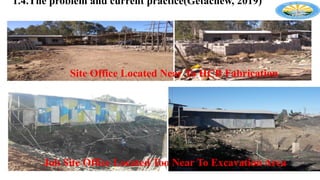
1.4.The problem and current practice(Getachew, 2019)
Site Office Located Near To HCB Fabrication
Job Site Office Located Too Near To Excavation Area
The problem and current practice
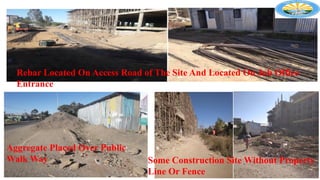
Some Construction Site Without Property
Line Or Fence
Aggregate Placed Over Public
Walk Way
Rebar Located On Access Road of The Site And Located On Job Office
Entrance
1.5.Site Types
• Illingworth (2000) indicates three basic site types which have an influence on the
construction planning.
1. Open field or extensive sites: (housing and industrial developments and many
civil engineering projects).
2. Linear sites :(highways, railways and pipelines).
3. Singular or restricted sites: (building rehabilitations or industrial
improvements).
1.5.Site Types
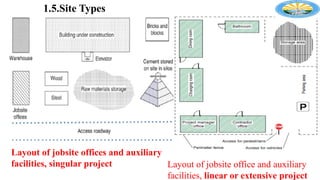
Layout of jobsite office and auxiliary
facilities, linear or extensive project
Layout of jobsite offices and auxiliary
facilities, singular project
1.6.Material Storage and Handling
• The efficient handling of materials at the construction site is very important to
optimize the productivity of tasks and project profitability.
• Deficiencies in the supply and flow of construction material will result in causing;
Serious degradations of performance and labor productivity as well as financial
losses.
• Trailers can be used to store tools, equipment, materials, or even spare parts for
generators, tractors, and power tools.
• In addition to trailers, the superintendent may designate a specific area on-site
where materials can be stored.
1.7.Job Site Security
• The construction site must be secured for persons, facilities and equipment.
• The contractor is responsible for preventing access by the general public, because there
are always dangers, such as heavy machinery, excavations, structures, hidden obstacles
and so on.
• Temporary fire protection, Side walk bridge or perimeter fencing for site, Warning signs and
lights, Safety and health and environmental protection, Private security patrols, Electronic
alarm systems, Night watchmen, Guard dogs.
• An open excavation is clearly hazardous to the safety of workers on the job; it should be fenced
off and marked with warning devices such as security tape, and traffic cones to alert workers.
1.8.Organizing Jobsite Offices
• The contractor installs jobsite offices before the start of the construction project.
The common types of jobsite offices may include existing buildings, modular
office units, trailers or site-built jobsite offices.
• Factors to select the best jobsite office is Cost, Space at the jobsite and
availability. The offices should not be located too close to the site in order to
avoid the problems related to noise and circulation of machinery.
• They should also avoid excessive or unnecessary travelling of the personnel.
1.8.Organizing Jobsite Offices
• The contractor can also rent a building near the construction site, such as
warehouses, office space for rent or even private homes.
• Another option would be the use of modular prefabricated offices or even
trailers, which enable a high flexibility in their assembly and disassembly, as
well as the possibility of using them later in other locations.
• When the construction project is going to be developed for a long period of time,
buildings are built as offices, which later can be used for other purposes or even
dismantled.
1.9.Site Layout Planning Elements
1. Safety:
• Fire prevention: Fire is a major cause of damage on construction sites. So that, fire
extinguishers are basic requirements on a construction project.
• Medical services: On construction project a first aid kit is a must. In remote projects a
well-equipped medical room with a doctor and nurse is important.
• Construction safety clothing: Basic safety supplies like safety shoes, hard hats, gloves,
and goggles must be used by workers.
2. Site Accessibility:
Easy accessibility will keep the morale of the equipment and vehicle drivers high,
minimize the chance of accidents, and save time.
1.9.Site Layout Planning Elements
3. Information Signs
• Site map: It should locate details of the project, and displayed in the office of the site superintendent
or project manager and posted at the entrance gate.
• Traffic regulatory signs: For large projects, traffic regulatory signs help in guiding the traffic on the
site and avoid accidents to a considerable extent.
• Display of labor relations’ policy and safety rules: This will help in eliminating disputes between
labor and management.
• Emergency routes and underground services: It is important to display the emergency escape
routes on every floor as the building progresses. Locations of underground services should be marked
to prevent its damage.
1.9.Site Layout Planning Elements
4. Security:
• Entrance: It is necessary to have a proper guard entrance to the site provided.
• Lighting: It is necessary to have a stand by generator to maintain site lighting.
• Fencing: The boundary should be fenced off from a security point of view.
5. Accommodation :
On large construction projects, it is necessary to provide camp accommodation for all type
of staff involved in the project.
6. Water Supply and Sanitation :
It is necessary to have water and toilet facilities in convenient locations to accommodate the
work force.
Site Layout Planning Elements
7. Offices:
• The offices should be close together, close to the site, and in a safe area. Also, provide the
offices with proper office equipment. The offices at the site may include job office, general
contractor office, and sub-contractors and consultants Offices.
8. Material Handling:
The use of proper equipment for material handling and advance planning for minimizing
multiple handling will result in direct cost and time savings
9. Craft Change-Houses:
Craft change-houses provide sheltered space for craft personnel to change and store clothes,
wash, and rest during waiting periods.
1.9.Site Layout Planning Elements
10. Storage and site cleaning:
• It is necessary to plan and reserve storage areas for materials so that multiple movement of material is
avoided.
• Laydown areas: Areas reserved for storage of large materials and equipment and it can be short-term or
long-term.
• Warehouses: They are sheltered storage facilities where materials are stored until they have disbursed to
the job.
• Material staging areas: They used when materials are stored near the work on a short-term basis. They
are generally as close to work as possible.
• Site cleaning: It is necessary at a work place and especially where the extent of debris produced is high.
Regular disposal of debris is necessary.
1.9.Site Layout Planning Elements
11. Batch plant and Fabrication Shops
• Batch plants are provided on projects where it is more economical to produce
concrete on site than to buy a ready mix. Aggregate storage piles, cement silos
and admixture tanks will a company an on-site batch plant.
• Shops are used where materials and equipment are fabricated on site. This
includes electrical, mechanical, carpentry, and paint shops. Also, testing
shops used to house the necessary testing equipment and personnel for the
project.
1.10.Temporary Facilities Characteristics
• Six generic temporary facility characteristics
1.Satisfying environmental and safety regulations.
2.Availability of diverse solutions for the same problem.
3.Relatively short life span of a specific location.
4.Reutilization with a minimum loss for the same or modified function at another
location.
5.Easy of assembly, dismantling, and exploitation
6. Standardization of design.
1.11.Temporary Facilities Selection
1. Construction type: The construction of an industrial plant, such as power
plant, requires more storage and fabrication area for process mechanical and
electrical work than other projects such as a highway project.
2. Type of contract: For turn-key contract, the contractor can consolidate the
administrative and construction operations, means that fewer but larger and
more efficient temporary facilities can be selected.
3. Project size: A relatively small project can be managed from a trailer or
portable structure. While a five to ten year project may need temporary
facilities of a more permanent nature
4. Project location: Projects located in places where skilled labor is scarce
require additional facilities for eating and living.
1.11.Temporary Facilities Selection
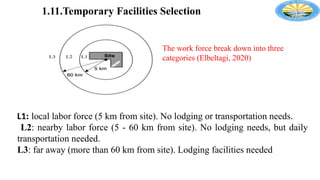
The work force break down into three
categories (Elbeltagi, 2020)
L1: local labor force (5 km from site). No lodging or transportation needs.
L2: nearby labor force (5 - 60 km from site). No lodging needs, but daily
transportation needed.
L3: far away (more than 60 km from site). Lodging facilities needed
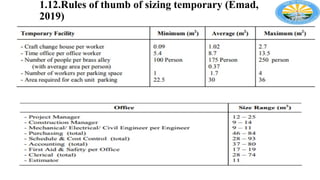
1.12.Rules of thumb of sizing temporary (Emad,
2019)
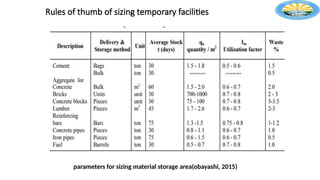
Rules of thumb of sizing temporary facilities
parameters for sizing material storage area(obayashi, 2015)
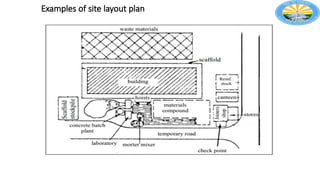
Examples of site layout plan
THANK YOU

Construction site planning group six ass

  • 1.
    Bahir Dar University BahirDar Institute of Technology Faculty of Civil and Water Resources Engineering Program: MSc Construction Technology and Management Course Title: Organization and Labor Management . Title :construction Site Planning By: 1st Year Group 3
  • 2.
    1.Introduction The site-based managementcan make significant improvements in the cost and time savings during the construction process without involving amass of additional work. The important tasks of construction site layout planning management is the number of manpower , subcontractors, and equipment involved effective and systematic approach to site planning. (Elbeltagi, 2020) A detailed planning of the site layout and location of temporary facilities can enable the management to make considerable improvement by minimizing travel time, waiting time, and increasing worker morale by showing better and safer work environment.
  • 3.
    1.1.Site plan A siteplan identifies buildings and other features in relation to property boundaries. Shows dwellings, garages, sheds, a north arrow ,All property lines, and all easements (utilities, access, etc.). The locations and dimensions of all existing and proposed buildings, Locations of storm water drainage, sewer, septic tanks, water, electricity and gas lines.
  • 4.
    1.2.Site layout plan Preparedby contractors as part of their mobilization activities before work on site commence. can help ensure that the works are undertaken efficiently and safely. Careful sizing and positioning of temporary facilities can help reduce Travel times ,Waiting times and increase productivity. Help to make the site a more effective and attractive workplace.
  • 5.
    1.2. Site layoutplan The Site layout planning involves four basic processes:(Elbeltagi, 2020) 1. Identifying the site facilities that will be required. 2. Determining the sizes, and other constraints of those facilities. 3. Establishing the inter-relationships between the facilities. 4. Optimizing the layout of the facilities on the site.
  • 6.
    1.3. Site layoutplans might include locations and sizes of: Site offices. Welfare facilities and Off-loading temporary storage and storage areas. Sub-contractor facilities. Car parking Emergency routes and muster points, Access, entrances, security and access controls. temporary roads and separate pedestrian routes. Vehicle wheel washing facilities
  • 7.
    1.3. Site layoutplans might include locations and sizes of: Waste management and recycling areas. Protection for trees. existing buildings and neighboring buildings. Temporary services (including electrical power, lighting, water distribution, drainage, information and communications technology, and site security systems. Areas for the construction testing and Fabrication facilities.
  • 8.
    1.4. The problemand current practice 1. Material stocks wrongly located: They may stocked over a drainage line or near the edge of excavation; They are too far from the work area. 2. Plant and equipment wrongly located: not enough room for the storage of aggregates, cranes are unable to reach all parts of the works. The mixer is inaccessible for the delivery of materials. 3. Inadequate space allowed: Materials may be stacked to high on roadways causing hazards, Working areas may become too additional areas may have to be allocated with the consequent waste of time caused by having to travel between them.
  • 9.
    1.4.The problem andcurrent practice(Emad, 2019) 4 .Site office wrongly located: Site office located too near noisy activities such as mixer, or located too near to site roads in dusty conditions . Therefore, before moving on to a site, it is necessary to prepare a detailed site layout plan, showing the positions to be taken by every item of equipment, accommodation and materials storage areas.
  • 10.
    1.4.The problem andcurrent practice(Getachew, 2019) Site Office Located Near To HCB Fabrication Job Site Office Located Too Near To Excavation Area
  • 11.
    The problem andcurrent practice Some Construction Site Without Property Line Or Fence Aggregate Placed Over Public Walk Way Rebar Located On Access Road of The Site And Located On Job Office Entrance
  • 12.
    1.5.Site Types • Illingworth(2000) indicates three basic site types which have an influence on the construction planning. 1. Open field or extensive sites: (housing and industrial developments and many civil engineering projects). 2. Linear sites :(highways, railways and pipelines). 3. Singular or restricted sites: (building rehabilitations or industrial improvements).
  • 13.
    1.5.Site Types Layout ofjobsite office and auxiliary facilities, linear or extensive project Layout of jobsite offices and auxiliary facilities, singular project
  • 14.
    1.6.Material Storage andHandling • The efficient handling of materials at the construction site is very important to optimize the productivity of tasks and project profitability. • Deficiencies in the supply and flow of construction material will result in causing; Serious degradations of performance and labor productivity as well as financial losses. • Trailers can be used to store tools, equipment, materials, or even spare parts for generators, tractors, and power tools. • In addition to trailers, the superintendent may designate a specific area on-site where materials can be stored.
  • 15.
    1.7.Job Site Security •The construction site must be secured for persons, facilities and equipment. • The contractor is responsible for preventing access by the general public, because there are always dangers, such as heavy machinery, excavations, structures, hidden obstacles and so on. • Temporary fire protection, Side walk bridge or perimeter fencing for site, Warning signs and lights, Safety and health and environmental protection, Private security patrols, Electronic alarm systems, Night watchmen, Guard dogs. • An open excavation is clearly hazardous to the safety of workers on the job; it should be fenced off and marked with warning devices such as security tape, and traffic cones to alert workers.
  • 16.
    1.8.Organizing Jobsite Offices •The contractor installs jobsite offices before the start of the construction project. The common types of jobsite offices may include existing buildings, modular office units, trailers or site-built jobsite offices. • Factors to select the best jobsite office is Cost, Space at the jobsite and availability. The offices should not be located too close to the site in order to avoid the problems related to noise and circulation of machinery. • They should also avoid excessive or unnecessary travelling of the personnel.
  • 17.
    1.8.Organizing Jobsite Offices •The contractor can also rent a building near the construction site, such as warehouses, office space for rent or even private homes. • Another option would be the use of modular prefabricated offices or even trailers, which enable a high flexibility in their assembly and disassembly, as well as the possibility of using them later in other locations. • When the construction project is going to be developed for a long period of time, buildings are built as offices, which later can be used for other purposes or even dismantled.
  • 18.
    1.9.Site Layout PlanningElements 1. Safety: • Fire prevention: Fire is a major cause of damage on construction sites. So that, fire extinguishers are basic requirements on a construction project. • Medical services: On construction project a first aid kit is a must. In remote projects a well-equipped medical room with a doctor and nurse is important. • Construction safety clothing: Basic safety supplies like safety shoes, hard hats, gloves, and goggles must be used by workers. 2. Site Accessibility: Easy accessibility will keep the morale of the equipment and vehicle drivers high, minimize the chance of accidents, and save time.
  • 19.
    1.9.Site Layout PlanningElements 3. Information Signs • Site map: It should locate details of the project, and displayed in the office of the site superintendent or project manager and posted at the entrance gate. • Traffic regulatory signs: For large projects, traffic regulatory signs help in guiding the traffic on the site and avoid accidents to a considerable extent. • Display of labor relations’ policy and safety rules: This will help in eliminating disputes between labor and management. • Emergency routes and underground services: It is important to display the emergency escape routes on every floor as the building progresses. Locations of underground services should be marked to prevent its damage.
  • 20.
    1.9.Site Layout PlanningElements 4. Security: • Entrance: It is necessary to have a proper guard entrance to the site provided. • Lighting: It is necessary to have a stand by generator to maintain site lighting. • Fencing: The boundary should be fenced off from a security point of view. 5. Accommodation : On large construction projects, it is necessary to provide camp accommodation for all type of staff involved in the project. 6. Water Supply and Sanitation : It is necessary to have water and toilet facilities in convenient locations to accommodate the work force.
  • 21.
    Site Layout PlanningElements 7. Offices: • The offices should be close together, close to the site, and in a safe area. Also, provide the offices with proper office equipment. The offices at the site may include job office, general contractor office, and sub-contractors and consultants Offices. 8. Material Handling: The use of proper equipment for material handling and advance planning for minimizing multiple handling will result in direct cost and time savings 9. Craft Change-Houses: Craft change-houses provide sheltered space for craft personnel to change and store clothes, wash, and rest during waiting periods.
  • 22.
    1.9.Site Layout PlanningElements 10. Storage and site cleaning: • It is necessary to plan and reserve storage areas for materials so that multiple movement of material is avoided. • Laydown areas: Areas reserved for storage of large materials and equipment and it can be short-term or long-term. • Warehouses: They are sheltered storage facilities where materials are stored until they have disbursed to the job. • Material staging areas: They used when materials are stored near the work on a short-term basis. They are generally as close to work as possible. • Site cleaning: It is necessary at a work place and especially where the extent of debris produced is high. Regular disposal of debris is necessary.
  • 23.
    1.9.Site Layout PlanningElements 11. Batch plant and Fabrication Shops • Batch plants are provided on projects where it is more economical to produce concrete on site than to buy a ready mix. Aggregate storage piles, cement silos and admixture tanks will a company an on-site batch plant. • Shops are used where materials and equipment are fabricated on site. This includes electrical, mechanical, carpentry, and paint shops. Also, testing shops used to house the necessary testing equipment and personnel for the project.
  • 24.
    1.10.Temporary Facilities Characteristics •Six generic temporary facility characteristics 1.Satisfying environmental and safety regulations. 2.Availability of diverse solutions for the same problem. 3.Relatively short life span of a specific location. 4.Reutilization with a minimum loss for the same or modified function at another location. 5.Easy of assembly, dismantling, and exploitation 6. Standardization of design.
  • 25.
    1.11.Temporary Facilities Selection 1.Construction type: The construction of an industrial plant, such as power plant, requires more storage and fabrication area for process mechanical and electrical work than other projects such as a highway project. 2. Type of contract: For turn-key contract, the contractor can consolidate the administrative and construction operations, means that fewer but larger and more efficient temporary facilities can be selected. 3. Project size: A relatively small project can be managed from a trailer or portable structure. While a five to ten year project may need temporary facilities of a more permanent nature 4. Project location: Projects located in places where skilled labor is scarce require additional facilities for eating and living.
  • 26.
    1.11.Temporary Facilities Selection Thework force break down into three categories (Elbeltagi, 2020) L1: local labor force (5 km from site). No lodging or transportation needs. L2: nearby labor force (5 - 60 km from site). No lodging needs, but daily transportation needed. L3: far away (more than 60 km from site). Lodging facilities needed
  • 27.
    1.12.Rules of thumbof sizing temporary (Emad, 2019)
  • 28.
    Rules of thumbof sizing temporary facilities parameters for sizing material storage area(obayashi, 2015)
  • 29.
    Examples of sitelayout plan
  • 30.
    Examples of sitelayout plan
  • 31.