
Created by- Hemant Kumar
1- INTRODUCTION
2- PROJECT MANAGEMENT LIFE CYCLE
3- PROJECT INTEGRATION MANAGEMENT
4- PROJECT SCOPE MANAGEMENT
5- PROJECT TIME MANAGEMENT
6- PROJECT COST MANAGEMENT
7- PROJECT QUALITY MANAGEMENT
8- PROJECT HUMAN RESOURCE MANAGEMENT
9- PROJECT COMMUNICATION MANAGEMENT
10- PROJECT PROCUREMENT MANAGEMENT
11- PROJECT RISK MANAGEMENT
Contents
1- Introduction
Project is a temporary endeavour undertaken to create a unique product service, or result.
 Has a beginning and an end.
 Creates a unique product, service or result.
 Always have a start and finish time
Examples of Project:
1- Building construction
2- Road construction
3- Shutdown maintenance
4- Wedding ceremony
5- Moving office to a new location
6- Election
1- Introduction
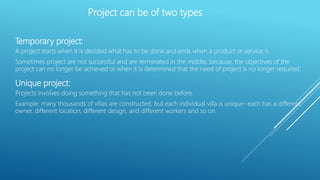
Temporary project:
A project starts when it is decided what has to be done and ends when a product or service is
Sometimes project are not successful and are terminated in the middle, because, the objectives of the
project can no longer be achieved or when it is determined that the need of project is no longer required.
Unique project:
Projects involves doing something that has not been done before.
Example: many thousands of villas are constructed, but each individual villa is unique- each has a different
owner, different location, different design, and different workers and so on.
Project can be of two types
2- Project Management
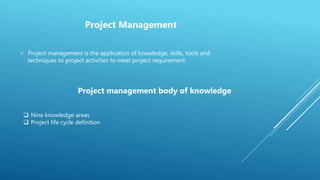
 Project management is the application of knowledge, skills, tools and
techniques to project activities to meet project requirement.
Project Management
Project management body of knowledge
 Nine knowledge areas
 Project life cycle definition
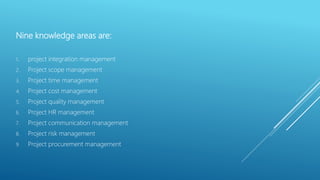
Nine knowledge areas are:
1. project integration management
2. Project scope management
3. Project time management
4. Project cost management
5. Project quality management
6. Project HR management
7. Project communication management
8. Project risk management
9. Project procurement management
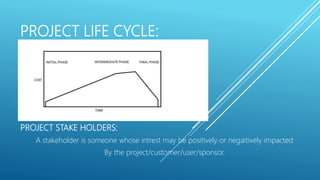
PROJECT LIFE CYCLE:
PROJECT STAKE HOLDERS:
A stakeholder is someone whose intrest may be positively or negaitively impacted
By the project/customer/user/sponsor.
3- Project Integration
Management
Integration management:
Integration management is a collection of processes required to ensure that the various elements of
the projects are properly coordinated. It involves making trade-offs among competing objectives and
alternatives to meet or exceed stakeholders needs and expectation.
4-PROJECT SCOPE
MANAGEMENT
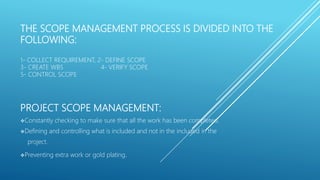
THE SCOPE MANAGEMENT PROCESS IS DIVIDED INTO THE
FOLLOWING:
1- COLLECT REQUIREMENT, 2- DEFINE SCOPE
3- CREATE WBS 4- VERIFY SCOPE
5- CONTROL SCOPE
PROJECT SCOPE MANAGEMENT:
Constantly checking to make sure that all the work has been completed.
Defining and controlling what is included and not in the included in the
project.
Preventing extra work or gold plating.
5- Project Time
Management
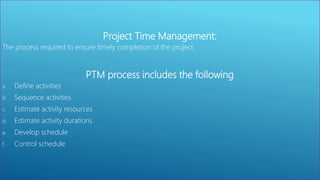
Project Time Management:
The process required to ensure timely completion of the project.
PTM process includes the following
a. Define activities
b. Sequence activities
c. Estimate activity resources
d. Estimate activity durations
e. Develop schedule
f. Control schedule
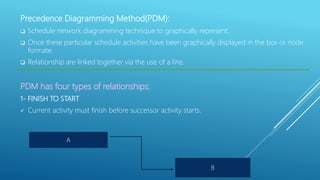
Precedence Diagramming Method(PDM):
 Schedule network diagramming technique to graphically represent..
 Once these particular schedule activities have been graphically displayed in the box or node
formate.
 Relationship are linked together via the use of a line.
PDM has four types of relationships:
1- FINISH TO START
 Current activity must finish before successor activity starts.
A
B
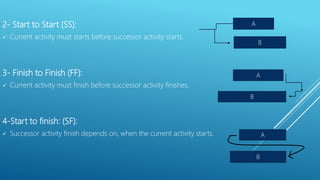
2- Start to Start (SS):
 Current activity must starts before successor activity starts.
3- Finish to Finish (FF):
 Current activity must finish before successor activity finishes.
4-Start to finish: (SF):
 Successor activity finish depends on, when the current activity starts.
A
B
A
B
A
B
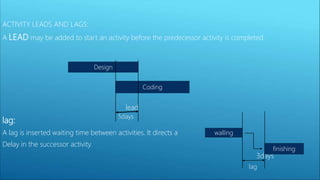
ACTIVITY LEADS AND LAGS:
A LEAD may be added to start an activity before the predecessor activity is completed.
lead
lag:
A lag is inserted waiting time between activities. It directs a
Delay in the successor activity.
3days
Design
Coding
walling
finishing
lag
5days
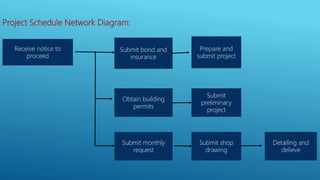
Project Schedule Network Diagram:
Receive notice to
proceed
Submit bond and
insurance
Prepare and
submit project
Obtain building
permits
Submit monthly
request
Submit
preliminary
project
Submit shop
drawing
Detailing and
delieve
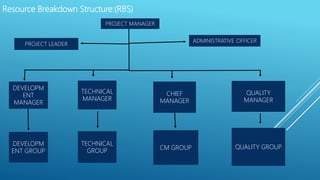
Resource Breakdown Structure:(RBS)
PROJECT MANAGER
ADMINISTRATIVE OFFICER
PROJECT LEADER
DEVELOPM
ENT
MANAGER
TECHNICAL
MANAGER
CHIEF
MANAGER
QUALITY
MANAGER
DEVELOPM
ENT GROUP
TECHNICAL
GROUP
CM GROUP QUALITY GROUP
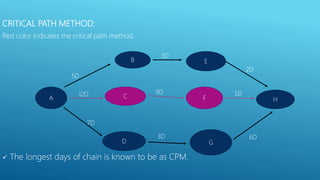
CRITICAL PATH METHOD:
Red color indicates the critical path method.
 The longest days of chain is known to be as CPM.
B
A
E
H
C F
D G
5D
3D
2D
12D 9D 5D
7D
3D 6D
6- PROJECT COST
MANAGEMENT:
Project Cost Management:
Project cost management is the process required to complete within the approved budget. It keeps your
projects within the defined budget.
Control cost:
Control cost can make or break a project’s budget. Control cost can be best be achieved by setting up a
budget which is consistent with plans for actual spending.
Earned value management (EVM):
EVM has been called “management with the lights on” because it can help clearly and objectively
illuminate where a project is and where it is going, as compared to where it was supposed to be and
where it was supposed to be going.
Note:- If there is a maintenance cost after the end of the project then it should be included in the project
cost management strategy.
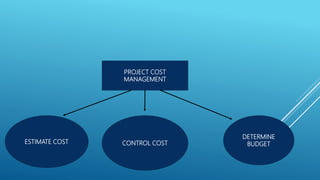
PROJECT COST
MANAGEMENT
DETERMINE
BUDGETCONTROL COSTESTIMATE COST
7- Project Quality
Management
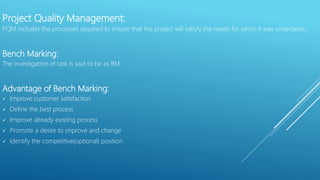
Project Quality Management:
PQM includes the processes required to ensure that the project will satisfy the needs for which it was undertaken.
Bench Marking:
The investigation of task is said to be as BM.
Advantage of Bench Marking:
 Improve customer satisfaction
 Define the best process
 Improve already existing process
 Promote a desire to improve and change
 Identify the competitive(optional) position
8-Project Human Resource
Management
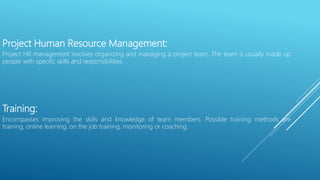
Project Human Resource Management:
Project HR management involves organizing and managing a project team. The team is usually made up
people with specific skills and responsibilities.
Training:
Encompasses improving the skills and knowledge of team members. Possible training methods are
training, online learning, on the job training, monitoring or coaching.
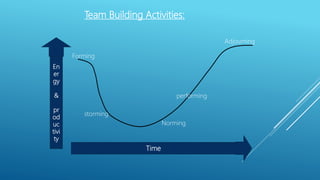
Team Building Activities:
En
er
gy
&
pr
od
uc
tivi
ty
Time
Forming
storming
Norming
performing
Adjourning
9-Project Communication
Management
Project Communications Management:
It is related to general communication skills but they encompass much more than an exchange of information.
Typical literary definitions of effective communications include:
 Exchange of information
 Act or instance of transmitting information
 Verbal or written message
 Technique for expressing ideas effectively
 Process by which meanings are exchanged between individuals through a common system of symbols
Understand key stakeholders:
 What financial or emotional interest do they have in the outcome of the work? What is the best way of
communicating the message to them
 What motivates them most of all
 How do they like to receive information from us? What is the best way of communicating the message to
 Who influence their opinions generally, and who influence their opinion about us?
 If they are not likely to be positive, what will win them around to support our projects?
 If we can’t win them around, how to manage their opposition?
Communication methods:
 Individual or group meetings
 Video or audio conference
 Computer/Mobile chats
 Other remote communication methods are used to distribute information
Information Distribution Tools:
o Hard copy document distribution
o Electronic communication and conferencing tools
o Web interface and project management software
10-Project Procurement
Management
Project Procurement Management:
It includes the processes involved in purchasing goods or services from vendors, contractors and suppliers
Project Manager’s role in procurement:
 Know the procurement process
 Understand contract terms and conditions
 Make sure the contract contains all project requirements such as attendance on meeting, report, actions
communications
Risk register:
Risk register includes the identified risk, risk owner responses in the procurement process
11- Project Risk
Management
Project Risk Management:
Project risk management is a continuous process engaged throughout the life cycle of the identifying the
cycle of the project. It’s a process of identifying and mitigating the risk.
Plan Risk Management:
The process of analysis and decision making with regards to be the best address, plan and implement the
management activities of a project. Appropriate stakeholder will be involved in planning.
Thank You

Project mangment

  • 1.
  • 2.
    1- INTRODUCTION 2- PROJECTMANAGEMENT LIFE CYCLE 3- PROJECT INTEGRATION MANAGEMENT 4- PROJECT SCOPE MANAGEMENT 5- PROJECT TIME MANAGEMENT 6- PROJECT COST MANAGEMENT 7- PROJECT QUALITY MANAGEMENT 8- PROJECT HUMAN RESOURCE MANAGEMENT 9- PROJECT COMMUNICATION MANAGEMENT 10- PROJECT PROCUREMENT MANAGEMENT 11- PROJECT RISK MANAGEMENT Contents
  • 3.
  • 4.
    Project is atemporary endeavour undertaken to create a unique product service, or result.  Has a beginning and an end.  Creates a unique product, service or result.  Always have a start and finish time Examples of Project: 1- Building construction 2- Road construction 3- Shutdown maintenance 4- Wedding ceremony 5- Moving office to a new location 6- Election 1- Introduction
  • 5.
    Temporary project: A projectstarts when it is decided what has to be done and ends when a product or service is Sometimes project are not successful and are terminated in the middle, because, the objectives of the project can no longer be achieved or when it is determined that the need of project is no longer required. Unique project: Projects involves doing something that has not been done before. Example: many thousands of villas are constructed, but each individual villa is unique- each has a different owner, different location, different design, and different workers and so on. Project can be of two types
  • 6.
  • 7.
     Project managementis the application of knowledge, skills, tools and techniques to project activities to meet project requirement. Project Management Project management body of knowledge  Nine knowledge areas  Project life cycle definition
  • 8.
    Nine knowledge areasare: 1. project integration management 2. Project scope management 3. Project time management 4. Project cost management 5. Project quality management 6. Project HR management 7. Project communication management 8. Project risk management 9. Project procurement management
  • 9.
    PROJECT LIFE CYCLE: PROJECTSTAKE HOLDERS: A stakeholder is someone whose intrest may be positively or negaitively impacted By the project/customer/user/sponsor.
  • 10.
  • 11.
    Integration management: Integration managementis a collection of processes required to ensure that the various elements of the projects are properly coordinated. It involves making trade-offs among competing objectives and alternatives to meet or exceed stakeholders needs and expectation.
  • 12.
  • 13.
    THE SCOPE MANAGEMENTPROCESS IS DIVIDED INTO THE FOLLOWING: 1- COLLECT REQUIREMENT, 2- DEFINE SCOPE 3- CREATE WBS 4- VERIFY SCOPE 5- CONTROL SCOPE PROJECT SCOPE MANAGEMENT: Constantly checking to make sure that all the work has been completed. Defining and controlling what is included and not in the included in the project. Preventing extra work or gold plating.
  • 14.
  • 15.
    Project Time Management: Theprocess required to ensure timely completion of the project. PTM process includes the following a. Define activities b. Sequence activities c. Estimate activity resources d. Estimate activity durations e. Develop schedule f. Control schedule
  • 16.
    Precedence Diagramming Method(PDM): Schedule network diagramming technique to graphically represent..  Once these particular schedule activities have been graphically displayed in the box or node formate.  Relationship are linked together via the use of a line. PDM has four types of relationships: 1- FINISH TO START  Current activity must finish before successor activity starts. A B
  • 17.
    2- Start toStart (SS):  Current activity must starts before successor activity starts. 3- Finish to Finish (FF):  Current activity must finish before successor activity finishes. 4-Start to finish: (SF):  Successor activity finish depends on, when the current activity starts. A B A B A B
  • 18.
    ACTIVITY LEADS ANDLAGS: A LEAD may be added to start an activity before the predecessor activity is completed. lead lag: A lag is inserted waiting time between activities. It directs a Delay in the successor activity. 3days Design Coding walling finishing lag 5days
  • 19.
    Project Schedule NetworkDiagram: Receive notice to proceed Submit bond and insurance Prepare and submit project Obtain building permits Submit monthly request Submit preliminary project Submit shop drawing Detailing and delieve
  • 20.
    Resource Breakdown Structure:(RBS) PROJECTMANAGER ADMINISTRATIVE OFFICER PROJECT LEADER DEVELOPM ENT MANAGER TECHNICAL MANAGER CHIEF MANAGER QUALITY MANAGER DEVELOPM ENT GROUP TECHNICAL GROUP CM GROUP QUALITY GROUP
  • 21.
    CRITICAL PATH METHOD: Redcolor indicates the critical path method.  The longest days of chain is known to be as CPM. B A E H C F D G 5D 3D 2D 12D 9D 5D 7D 3D 6D
  • 22.
  • 23.
    Project Cost Management: Projectcost management is the process required to complete within the approved budget. It keeps your projects within the defined budget. Control cost: Control cost can make or break a project’s budget. Control cost can be best be achieved by setting up a budget which is consistent with plans for actual spending. Earned value management (EVM): EVM has been called “management with the lights on” because it can help clearly and objectively illuminate where a project is and where it is going, as compared to where it was supposed to be and where it was supposed to be going. Note:- If there is a maintenance cost after the end of the project then it should be included in the project cost management strategy.
  • 24.
  • 25.
  • 26.
    Project Quality Management: PQMincludes the processes required to ensure that the project will satisfy the needs for which it was undertaken. Bench Marking: The investigation of task is said to be as BM. Advantage of Bench Marking:  Improve customer satisfaction  Define the best process  Improve already existing process  Promote a desire to improve and change  Identify the competitive(optional) position
  • 27.
  • 28.
    Project Human ResourceManagement: Project HR management involves organizing and managing a project team. The team is usually made up people with specific skills and responsibilities. Training: Encompasses improving the skills and knowledge of team members. Possible training methods are training, online learning, on the job training, monitoring or coaching.
  • 29.
  • 30.
  • 31.
    Project Communications Management: Itis related to general communication skills but they encompass much more than an exchange of information. Typical literary definitions of effective communications include:  Exchange of information  Act or instance of transmitting information  Verbal or written message  Technique for expressing ideas effectively  Process by which meanings are exchanged between individuals through a common system of symbols
  • 32.
    Understand key stakeholders: What financial or emotional interest do they have in the outcome of the work? What is the best way of communicating the message to them  What motivates them most of all  How do they like to receive information from us? What is the best way of communicating the message to  Who influence their opinions generally, and who influence their opinion about us?  If they are not likely to be positive, what will win them around to support our projects?  If we can’t win them around, how to manage their opposition?
  • 33.
    Communication methods:  Individualor group meetings  Video or audio conference  Computer/Mobile chats  Other remote communication methods are used to distribute information Information Distribution Tools: o Hard copy document distribution o Electronic communication and conferencing tools o Web interface and project management software
  • 34.
  • 35.
    Project Procurement Management: Itincludes the processes involved in purchasing goods or services from vendors, contractors and suppliers Project Manager’s role in procurement:  Know the procurement process  Understand contract terms and conditions  Make sure the contract contains all project requirements such as attendance on meeting, report, actions communications Risk register: Risk register includes the identified risk, risk owner responses in the procurement process
  • 36.
  • 37.
    Project Risk Management: Projectrisk management is a continuous process engaged throughout the life cycle of the identifying the cycle of the project. It’s a process of identifying and mitigating the risk. Plan Risk Management: The process of analysis and decision making with regards to be the best address, plan and implement the management activities of a project. Appropriate stakeholder will be involved in planning.
  • 38.