




NAVIGATING COMPLEXITY FOR MANAGING PROJECTS, PROGRAMS,
AND PORTFOLIOS
PROJECT COMPLEXITY
AND WHY MY PROJECT IS HINDERED
By Islam Hedjazy With reference to Navigating complexity: A practice guide – PMI
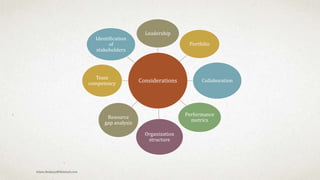
Considerations
Leadership
Portfolio
Collaboration
Performance
metrics
Organization
structure
Resource
gap analysis
Team
competency
Identification
of
stakeholders
Islam.Hedjazy@Hotmail.com
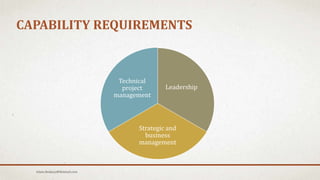
CAPABILITY REQUIREMENTS
Leadership
Strategic and
business
management
Technical
project
management
Islam.Hedjazy@Hotmail.com
COMPLEXITY
CATEGORIES
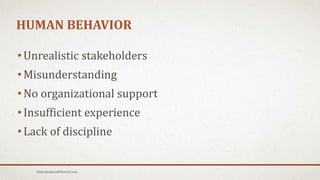
HUMAN BEHAVIOR
• Unrealistic stakeholders
• Misunderstanding
• No organizational support
• Insufficient experience
• Lack of discipline
Islam.Hedjazy@Hotmail.com
HUMAN BEHAVIOR
• Individual behavior
• Optimism bias and underestimation planning
• Anchoring
• Framing effect
• Loss aversion
• Resistance to change
• Misrepresentation
Islam.Hedjazy@Hotmail.com
HUMAN BEHAVIOR
• Group/Organizational/Political Behavior
• Tribal mindset
• Groupthink
• Group shift
• Self-organization
• Lack of stakeholder’s commitment
Islam.Hedjazy@Hotmail.com
HUMAN BEHAVIOR
• Communication and control
• Virtual teams
• Varying legal perspectives
• Culture diversity
Islam.Hedjazy@Hotmail.com
HUMAN BEHAVIOR
• Organizational Design and development
• Misalignment
• Opacity
Islam.Hedjazy@Hotmail.com
AMBIGUITY
• Emergence
• Uncertainty
Islam.Hedjazy@Hotmail.com
SYSTEM BEHAVIOR
• Connectedness
• Dependency
• System dynamics
Islam.Hedjazy@Hotmail.com
PMI
FOUNDATIONAL
STANDARDS
AND USEFUL PRACTICES
STAKEHOLDERS
• Diverse agendas
• Social & political interactions
Islam.Hedjazy@Hotmail.com
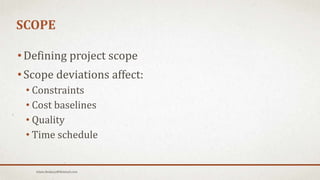
SCOPE
• Defining project scope
• Scope deviations affect:
• Constraints
• Cost baselines
• Quality
• Time schedule
Islam.Hedjazy@Hotmail.com
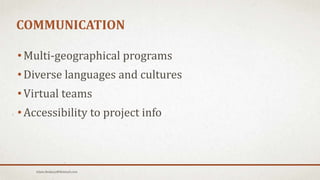
COMMUNICATION
• Multi-geographical programs
• Diverse languages and cultures
• Virtual teams
• Accessibility to project info
Islam.Hedjazy@Hotmail.com
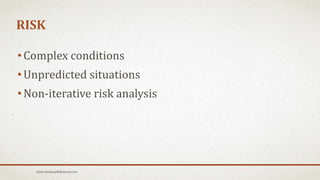
RISK
• Complex conditions
• Unpredicted situations
• Non-iterative risk analysis
Islam.Hedjazy@Hotmail.com
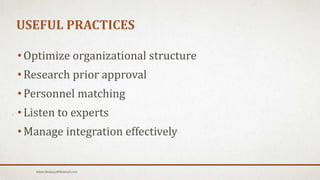
USEFUL PRACTICES
• Optimize organizational structure
• Research prior approval
• Personnel matching
• Listen to experts
• Manage integration effectively
Islam.Hedjazy@Hotmail.com
USEFUL PRACTICES
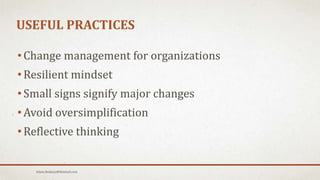
• Change management for organizations
• Resilient mindset
• Small signs signify major changes
• Avoid oversimplification
• Reflective thinking
Islam.Hedjazy@Hotmail.com
COMPLEXITY
ASSESSMENT
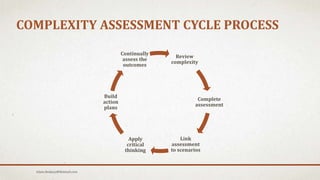
COMPLEXITY ASSESSMENT CYCLE PROCESS
Review
complexity
Complete
assessment
Link
assessment
to scenarios
Apply
critical
thinking
Build
action
plans
Continually
assess the
outcomes
Islam.Hedjazy@Hotmail.com
USING
COMPLEXITY
SCENARIOS
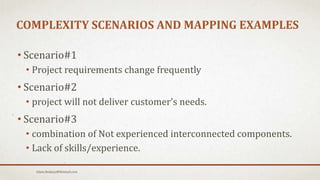
COMPLEXITY SCENARIOS AND MAPPING EXAMPLES
• Scenario#1
• Project requirements change frequently
• Scenario#2
• project will not deliver customer’s needs.
• Scenario#3
• combination of Not experienced interconnected components.
• Lack of skills/experience.
Islam.Hedjazy@Hotmail.com
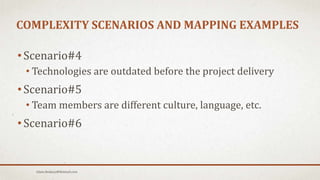
COMPLEXITY SCENARIOS AND MAPPING EXAMPLES
• Scenario#4
• Technologies are outdated before the project delivery
• Scenario#5
• Team members are different culture, language, etc.
• Scenario#6
Islam.Hedjazy@Hotmail.com
COMPLEXITY SCENARIOS AND MAPPING EXAMPLES
• Scenario#7
• Scenario#8
• Scenario#9
• Scenario#10
• Scenario#11
• Scenario#12
Islam.Hedjazy@Hotmail.com
ACTION
PLANNING
REFERENCES
• PMBOK – 4th Edition.
• PMBOK – 5th Edition
• Navigating complexity: A practice guide - PMI
• Critical thinking Articles
• Project closure documentations
Islam.Hedjazy@Hotmail.com
ABOUT THE
AUTHOR
• SAIB – IT project manager
• Freelance – Trainer
• Islam.Hedjazy@hotmail.com
Brief introduction
Islam.Hedjazy@Hotmail.com

Project complexity