1
A n i m a l A g r i c u l t u r e & C l i m a t e C h a n g e
Developing National Extension Capacity to Address Issues Related to Animal Agriculture and Climate Change
Livestock And Poultry
Environmental Learning CenterThis project was supported by Agricultural and Food Research Initiative Competitive Grant
No. 2011-67003-30206 from the USDA National Institute of Food and Agriculture.
Building Extension Capacity on
Animal Agriculture & Climate Change
Animal Agriculture and Climate Change Team
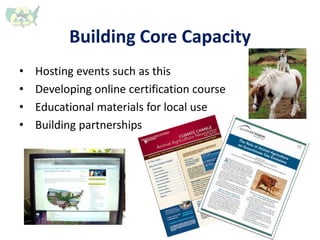
Building Core Capacity
• Hosting events such as this
• Developing online certification course
• Educational materials for local use
• Building partnerships
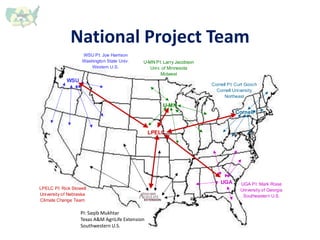
National Project Team
WSU PI: Joe Harrison
Washington State Univ.
Western U.S.
WSU
TAMU PI: Saqib Mukhtar
Texas A&M University
Southwestern U.S.
TAMU
U-MN PI: Larry Jacobson
Univ. of Minnesota
Midwest
U-MN
UGA UGA PI: Mark Risse
University of Georgia
Southeastern U.S.
Cornell
Cornell PI: Curt Gooch
Cornell University
Northeast
LPELC
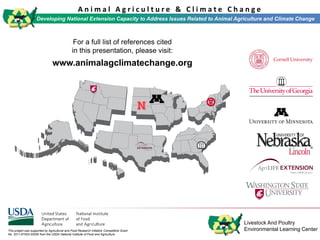
LPELC PI: Rick Stowell
University of Nebraska
Climate Change Team
WSU PI: Joe Harrison
Washington State Univ.
Western U.S.
WSU
TAMU PI: Saqib Mukhtar
Texas A&M University
Southwestern U.S.
TAMU
U-MN PI: Larry Jacobson
Univ. of Minnesota
Midwest
U-MN
UGA UGA PI: Mark Risse
University of Georgia
Southeastern U.S.
Cornell
Cornell PI: Curt Gooch
Cornell University
Northeast
LPELC
LPELC PI: Rick Stowell
University of Nebraska
Climate Change Team
PI: Saqib Mukhtar
Texas A&M AgriLife Extension
Southwestern U.S.
Online Course Overview
Symposium Recap
Major Project Focus
Currently in Pilot Phase
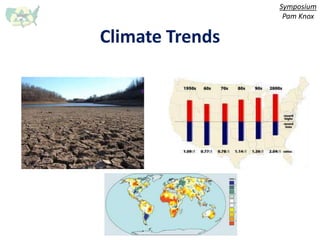
Climate Trends
Symposium
Pam Knox
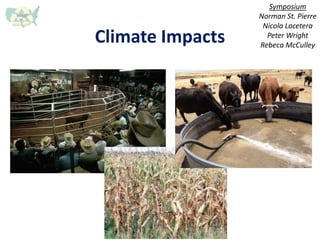
Climate Impacts
Symposium
Norman St. Pierre
Nicola Lacetera
Peter Wright
Rebeca McCulley
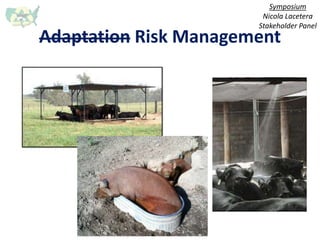
Adaptation Risk Management
Symposium
Nicola Lacetera
Stakeholder Panel
Climate Science
Symposium
Pam Knox
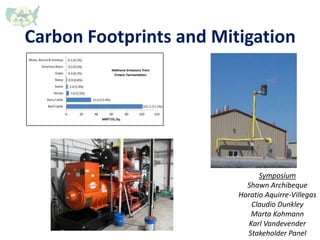
Carbon Footprints and Mitigation
Symposium
Shawn Archibeque
Horatio Aquirre-Villegas
Claudio Dunkley
Marta Kohmann
Karl Vandevender
Stakeholder Panel
Regulations
What are they going to do to me?
How can I make some money here?
Symposium
Jim Jensen
Stakeholder Panel
Communicating Controversial Issues
Symposium
Erik Nesbitt
Rebecca Mcculley
Damian Adams
Stakeholder Panel
So … why are you here?
• We need your help . . .
• You can help shape the future of our project . . .
both content and delivery
• You can help us spread the word about our
project through your connections (partnerships)
Livestock And Poultry
Environmental Learning Center
For a full list of references cited
in this presentation, please visit:
www.animalagclimatechange.org
This project was supported by Agricultural and Food Research Initiative Competitive Grant
No. 2011-67003-30206 from the USDA National Institute of Food and Agriculture.
Developing National Extension Capacity to Address Issues Related to Animal Agriculture and Climate Change
A n i m a l A g r i c u l t u r e & C l i m a t e C h a n g e
Developing National Extension Capacity to Address Issues Related to Animal Agriculture and Climate Change

Project and course overview for denver thursday 2

  • 1.
    1 A n im a l A g r i c u l t u r e & C l i m a t e C h a n g e Developing National Extension Capacity to Address Issues Related to Animal Agriculture and Climate Change Livestock And Poultry Environmental Learning CenterThis project was supported by Agricultural and Food Research Initiative Competitive Grant No. 2011-67003-30206 from the USDA National Institute of Food and Agriculture. Building Extension Capacity on Animal Agriculture & Climate Change Animal Agriculture and Climate Change Team
  • 2.
    Building Core Capacity •Hosting events such as this • Developing online certification course • Educational materials for local use • Building partnerships
  • 3.
    National Project Team WSUPI: Joe Harrison Washington State Univ. Western U.S. WSU TAMU PI: Saqib Mukhtar Texas A&M University Southwestern U.S. TAMU U-MN PI: Larry Jacobson Univ. of Minnesota Midwest U-MN UGA UGA PI: Mark Risse University of Georgia Southeastern U.S. Cornell Cornell PI: Curt Gooch Cornell University Northeast LPELC LPELC PI: Rick Stowell University of Nebraska Climate Change Team WSU PI: Joe Harrison Washington State Univ. Western U.S. WSU TAMU PI: Saqib Mukhtar Texas A&M University Southwestern U.S. TAMU U-MN PI: Larry Jacobson Univ. of Minnesota Midwest U-MN UGA UGA PI: Mark Risse University of Georgia Southeastern U.S. Cornell Cornell PI: Curt Gooch Cornell University Northeast LPELC LPELC PI: Rick Stowell University of Nebraska Climate Change Team PI: Saqib Mukhtar Texas A&M AgriLife Extension Southwestern U.S.
  • 4.
    Online Course Overview SymposiumRecap Major Project Focus Currently in Pilot Phase
  • 5.
  • 6.
    Climate Impacts Symposium Norman St.Pierre Nicola Lacetera Peter Wright Rebeca McCulley
  • 7.
  • 8.
  • 9.
    Carbon Footprints andMitigation Symposium Shawn Archibeque Horatio Aquirre-Villegas Claudio Dunkley Marta Kohmann Karl Vandevender Stakeholder Panel
  • 10.
    Regulations What are theygoing to do to me? How can I make some money here? Symposium Jim Jensen Stakeholder Panel
  • 11.
    Communicating Controversial Issues Symposium ErikNesbitt Rebecca Mcculley Damian Adams Stakeholder Panel
  • 12.
    So … whyare you here? • We need your help . . . • You can help shape the future of our project . . . both content and delivery • You can help us spread the word about our project through your connections (partnerships)
  • 13.
    Livestock And Poultry EnvironmentalLearning Center For a full list of references cited in this presentation, please visit: www.animalagclimatechange.org This project was supported by Agricultural and Food Research Initiative Competitive Grant No. 2011-67003-30206 from the USDA National Institute of Food and Agriculture. Developing National Extension Capacity to Address Issues Related to Animal Agriculture and Climate Change A n i m a l A g r i c u l t u r e & C l i m a t e C h a n g e Developing National Extension Capacity to Address Issues Related to Animal Agriculture and Climate Change

Editor's Notes

  • #2Ā Welcome, introductions
  • #3Ā The basic goal of the project is to BUILD EXTENSION CAPACITY in the area of animal agriculture and climate change and there are several methods to achieve this goal. The biggest effort is in the development and delivery of an online certification course. Why online – Dog and pony shows are expensive – both presenters and attendees, any time anywhere delivery, access to experts for course content, easy to update. Why Certification: Easy to browse the topics on the web but to insure a consistent message and consistent education, we need to guarantee that folks have adequate education on a variety of very complex topics. We easily can do this through assessment methods online for each of the topics that we deem critical. Our certification improves our program credibility – when we say 71 people have been certified you can be sure that those 71 took the course. Where as – counting web hits does not guarantee anything. IN ADDITION to the certification course we will be creating materials that educators can use in their local and regional meetings. These will be a combination of factsheets, power point templates or videos. We will also have website that can be accessed by anyone that will have all of the course content.
  • #4Ā This is a national 4 million dollar 5 year project funded by the USDA. Explain the partnership with LPELC. To organize the project we are split in 5 regions. This regional approach provides a framework for identifying and addressing regional issues. Recognize team members in attendance.
  • #6Ā Educational material produced for this project will focus on 6 primary issues or topics. The first topic provides the climate and weather trends data for different regions. We will look at past climate trends at the global, national and regional level. This a presentation of historic data on heat, precipitation and extreme weather. How has the climate been changing?
  • #7Ā We also look at IMPACTS of these weather and climate trends on animal agriculture. How does drought, heat and flooding impact livestock production – management and economics. Nothing new here just a quantification and summary of existing data.
  • #8Ā Probably the most important topic is ADAPTATION … how to minimize the risk of climate and weather changes. What management and technology is available to reduce the risk or minimize the impact. We currently deal with all of these weather events but if these extreme events occur more frequently, how should we change our plans – what options are available. As much as possible we will be looking at economics of these technologies and management practices.
  • #9Ā This topic of climate science is complex. In this project, we want to provide a basic understanding of climate process and the factors (both natural and human-caused) that result in regional and global climate change. For example, how do sun cycles and volcanoes impact our climate. What role does our atmosphere play in our climate? What issues are being debated in the discussion of climate change and global warming? What role does carbon dioxide or greenhouse gasses play? This is one of the most important topics because it provides the basis for understanding how human activity (such as animal agriculture production) influences climate.
  • #10Ā Another important topic is understanding the how and where animal agriculture production contributes to greenhouse gas emissions. We look at different species, management practices and waste management practices. More importantly, we want to know how to mitigate (or reduce) the emission of greenhouse gases … such as becoming more energy efficient, improving productivity, capturing and utilizing gases such as methane.
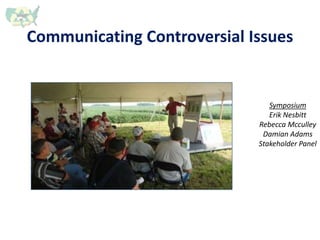
  • #12Ā Finally, its well known that the issue of ā€œclimate changeā€ at times gets contentious. Too often this is because of the way its introduced … as though there are only two sides of the issue with little room for agreement. Like many things, the truth often lies somewhere in the middle. Extension agents often present controversial topics but maybe there are some methods to best present this topic. How do we present climate change when 30% of our audience says the climate is not changing (and never has)?I think its important to realize that when addressing controversial issues, it becomes less about what we say and more about what they hear … so its important to understand the perspective and issues faced by those you wish to reach. That’s where you come in.
  • #13Ā Up to this point in the project, we’re gathered a lot of information regarding climate change and its relationship to agriculture. Now its time for Extension. Today we want to frame (through our invited speakers) the issue of climate change and then get your feedback on how to move forward in a productive manner. You know … (bullets)