Programming 101 for Group Training
Riley Rogers
Who am I?
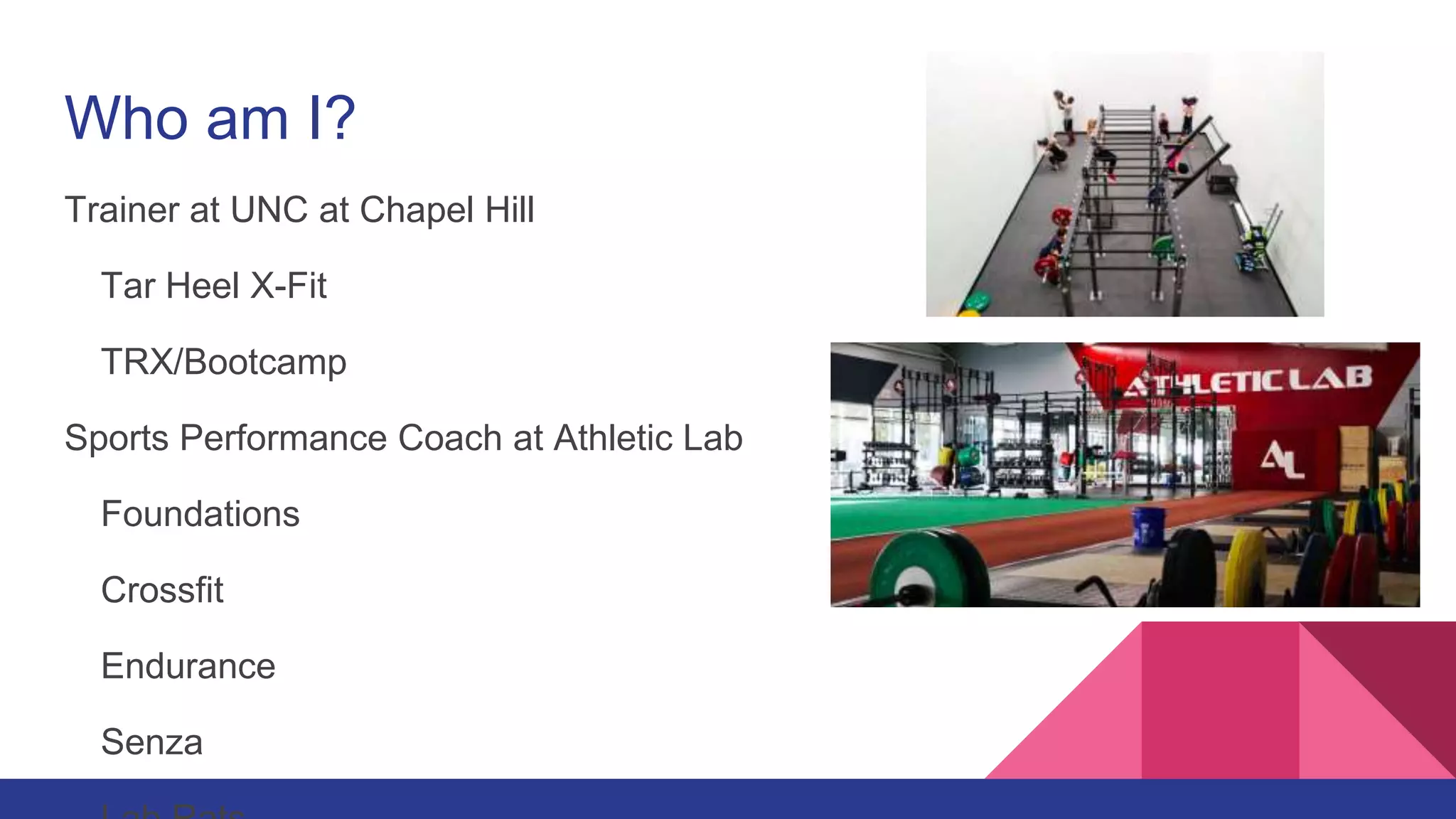
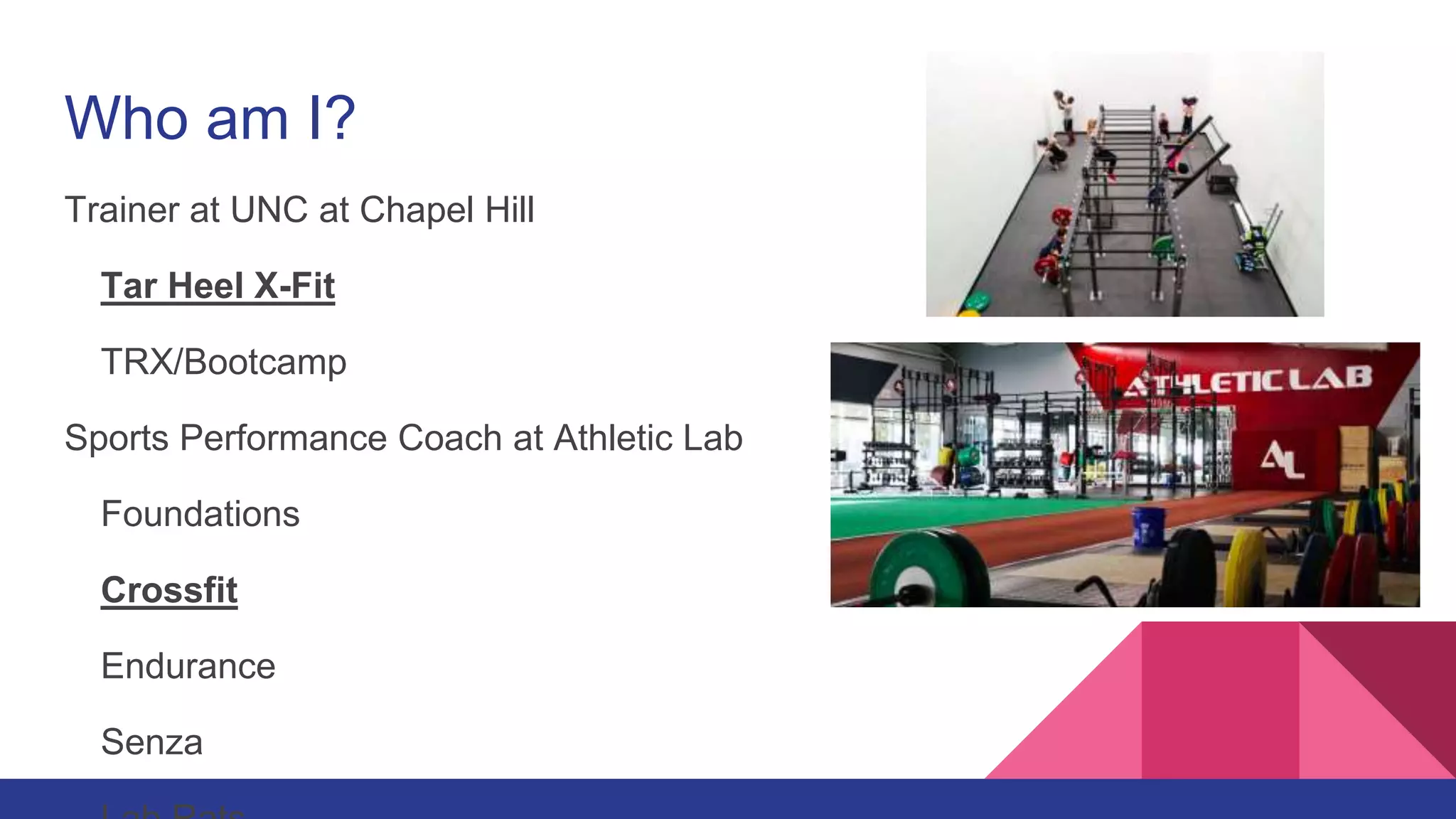
Trainer at UNC at Chapel Hill
Tar Heel X-Fit
TRX/Bootcamp
Sports Performance Coach at Athletic Lab
Foundations
Crossfit
Endurance
Senza
Who am I?
Trainer at UNC at Chapel Hill
Tar Heel X-Fit
TRX/Bootcamp
Sports Performance Coach at Athletic Lab
Foundations
Crossfit
Endurance
Senza
What is Small Group Training?
A systematic, periodized program designed for 2-10 people covering all aspects of
exercise designed to get results with the majority of clients the majority of the time,
in spite of the presence of multiple skill sets and goals.
What is Small Group Training?
A systematic, periodized program designed for 2-10 people covering all aspects of
exercise designed to get results with the majority of clients the majority of the time,
in spite of the presence of multiple skill sets and goals.
An experience!
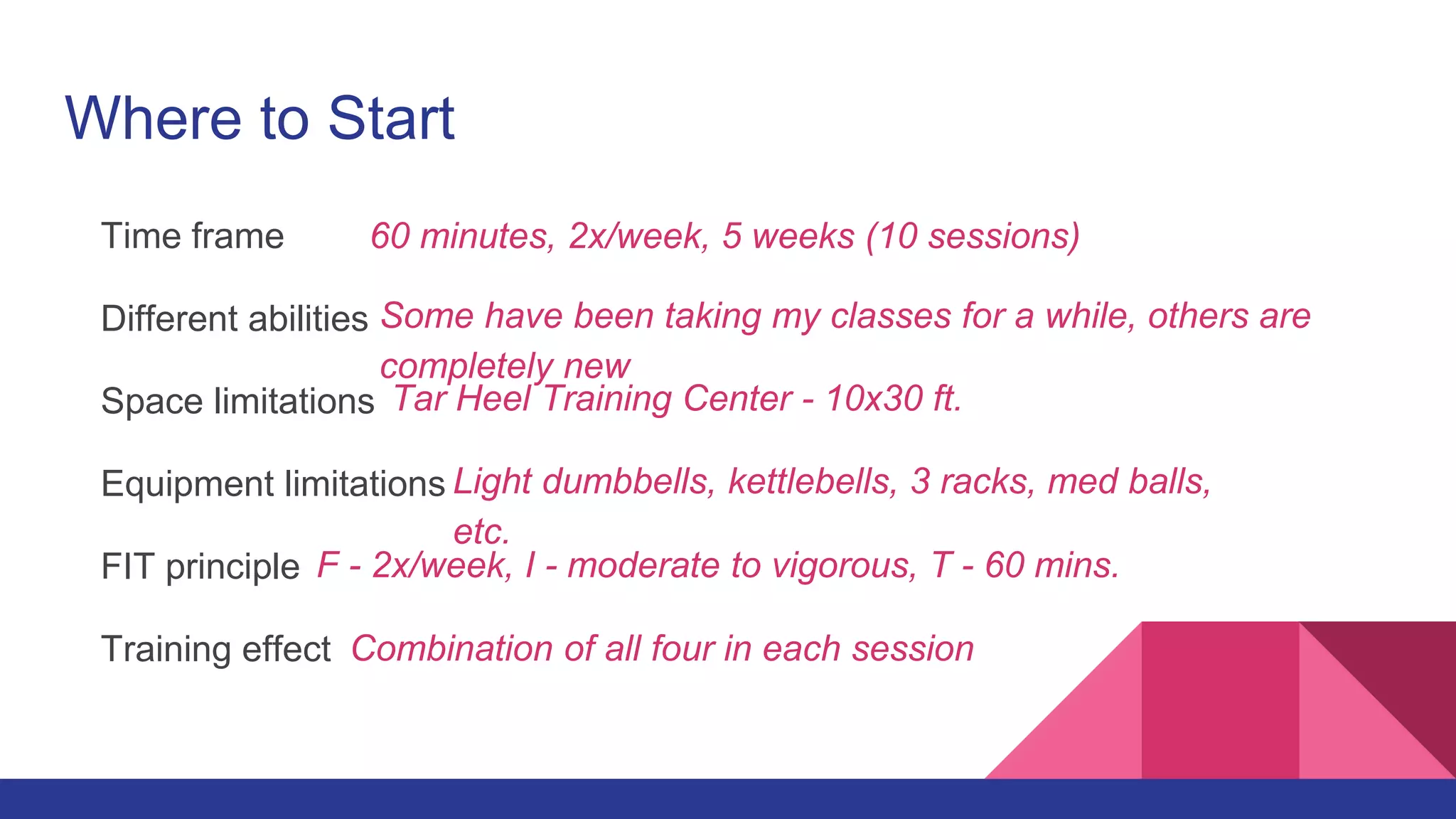
Group Exercise Group Trainingvs.
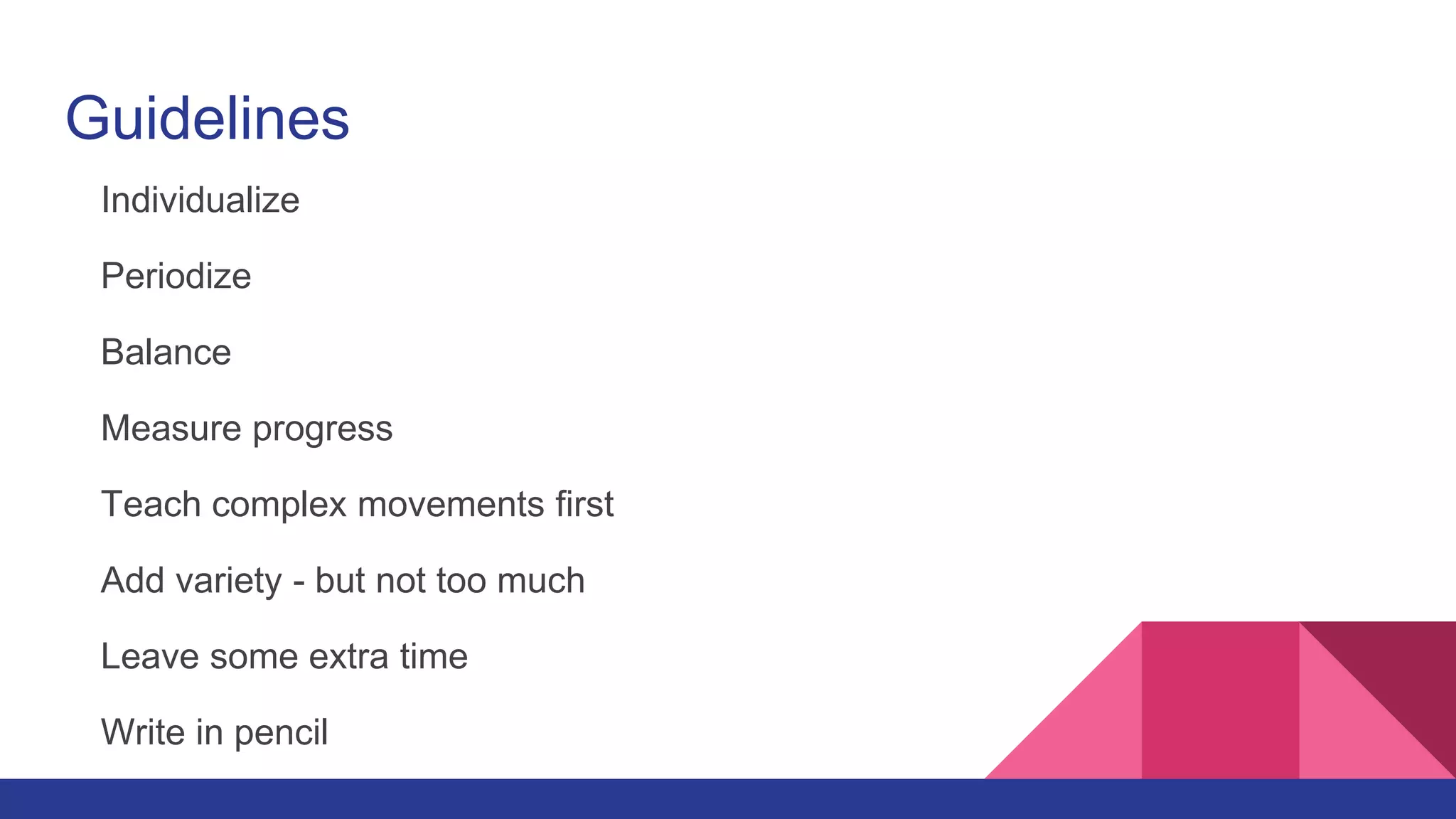
Where to Start
Time frame
Different abilities
Space limitations
Equipment limitations
FIT principle
Training effect
60 minutes, 2x/week, 5 weeks (10 sessions)
Some have been taking my classes for a while, others are
completely new
Tar Heel Training Center - 10x30 ft.
Light dumbbells, kettlebells, 3 racks, med balls,
etc.
F - 2x/week, I - moderate to vigorous, T - 60 mins.
Combination of all four in each session
Guidelines
Individualize
Periodize
Balance
Measure progress
Teach complex movements first
Add variety - but not too much
Leave some extra time
Write in pencil
There is no recipe.
Learn to cook.
Types of Programs
Equipment-based
Technique- or skill-based
Outcome-based
Session Guidelines
1. Warm-up
2. Complex Movements
3. General Strength
4. Metabolic Conditioning
5. Cool-Down
Breakdown
1. Warm-Up
- 8-10 minutes
- Dynamic
- Objective #1: Focus on correcting any movement issues
- Objective #2: Prepare participants for the workout they will be doing
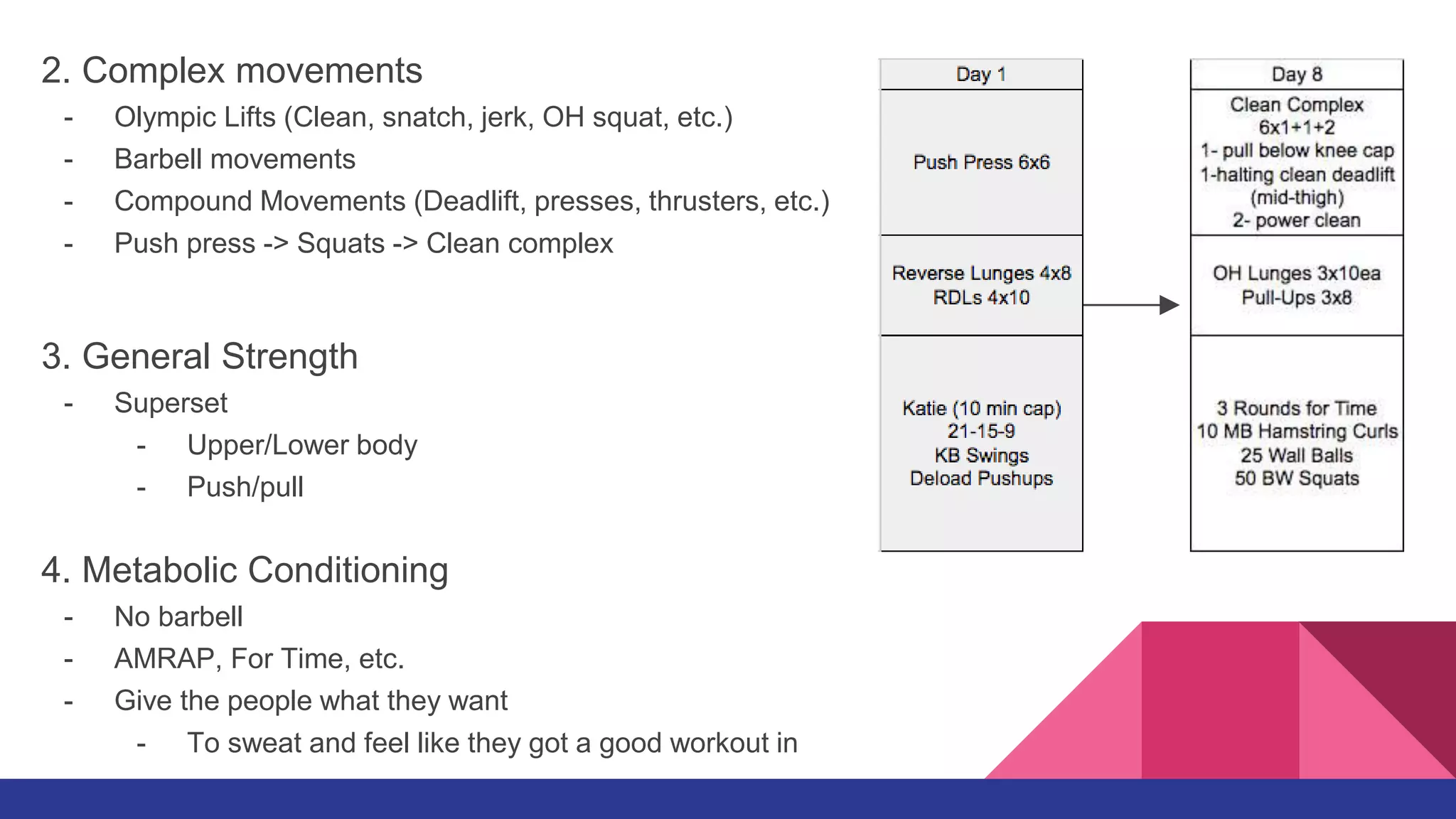
2. Complex movements
- Olympic Lifts (Clean, snatch, jerk, OH squat, etc.)
- Barbell movements
- Compound Movements (Deadlift, presses, thrusters, etc.)
- Push press -> Squats -> Clean complex
3. General Strength
- Superset
- Upper/Lower body
- Push/pull
4. Metabolic Conditioning
- No barbell
- AMRAP, For Time, etc.
- Give the people what they want
- To sweat and feel like they got a good workout in
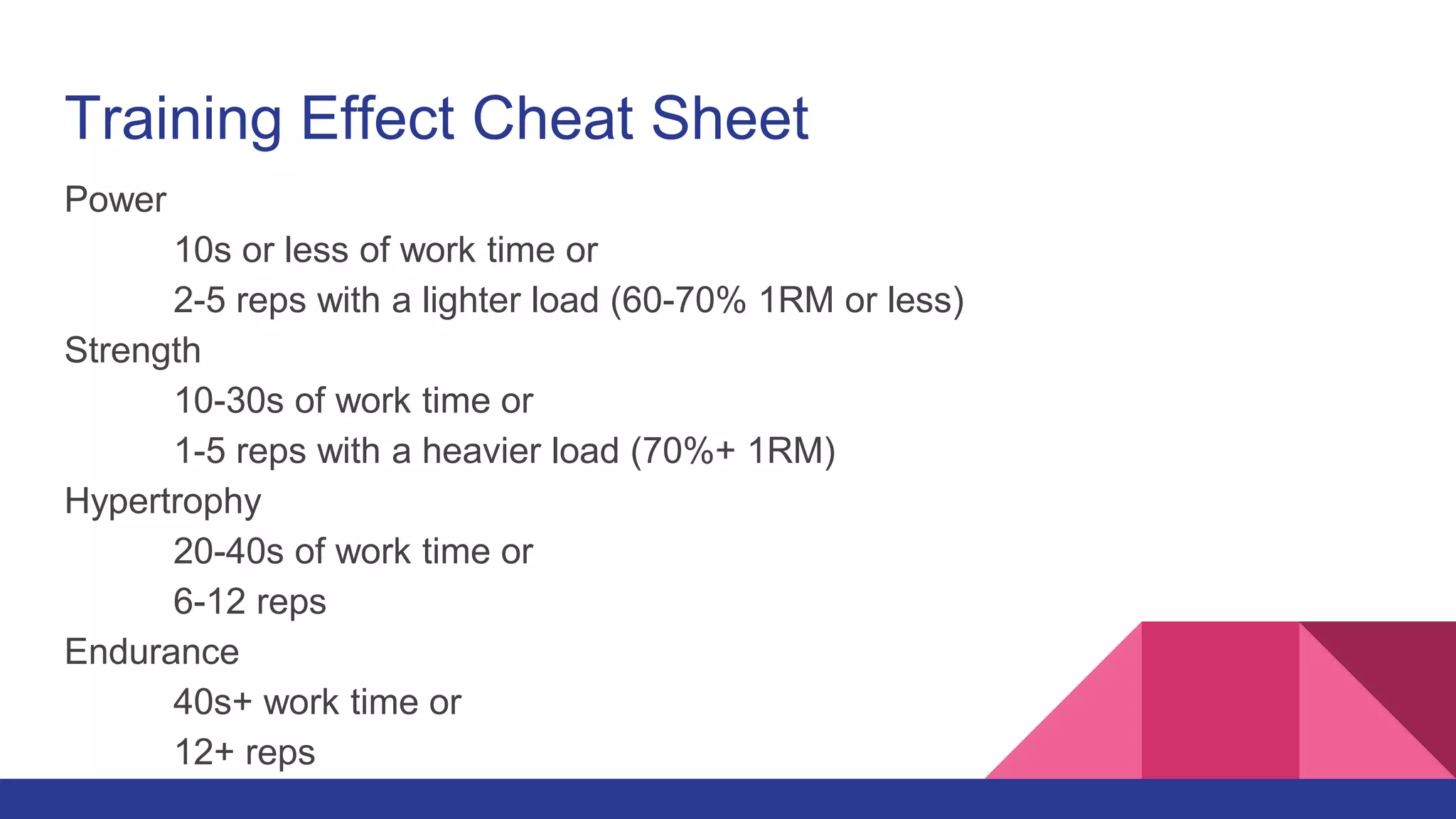
Training Effect Cheat Sheet
Power
10s or less of work time or
2-5 reps with a lighter load (60-70% 1RM or less)
Strength
10-30s of work time or
1-5 reps with a heavier load (70%+ 1RM)
Hypertrophy
20-40s of work time or
6-12 reps
Endurance
40s+ work time or
12+ reps
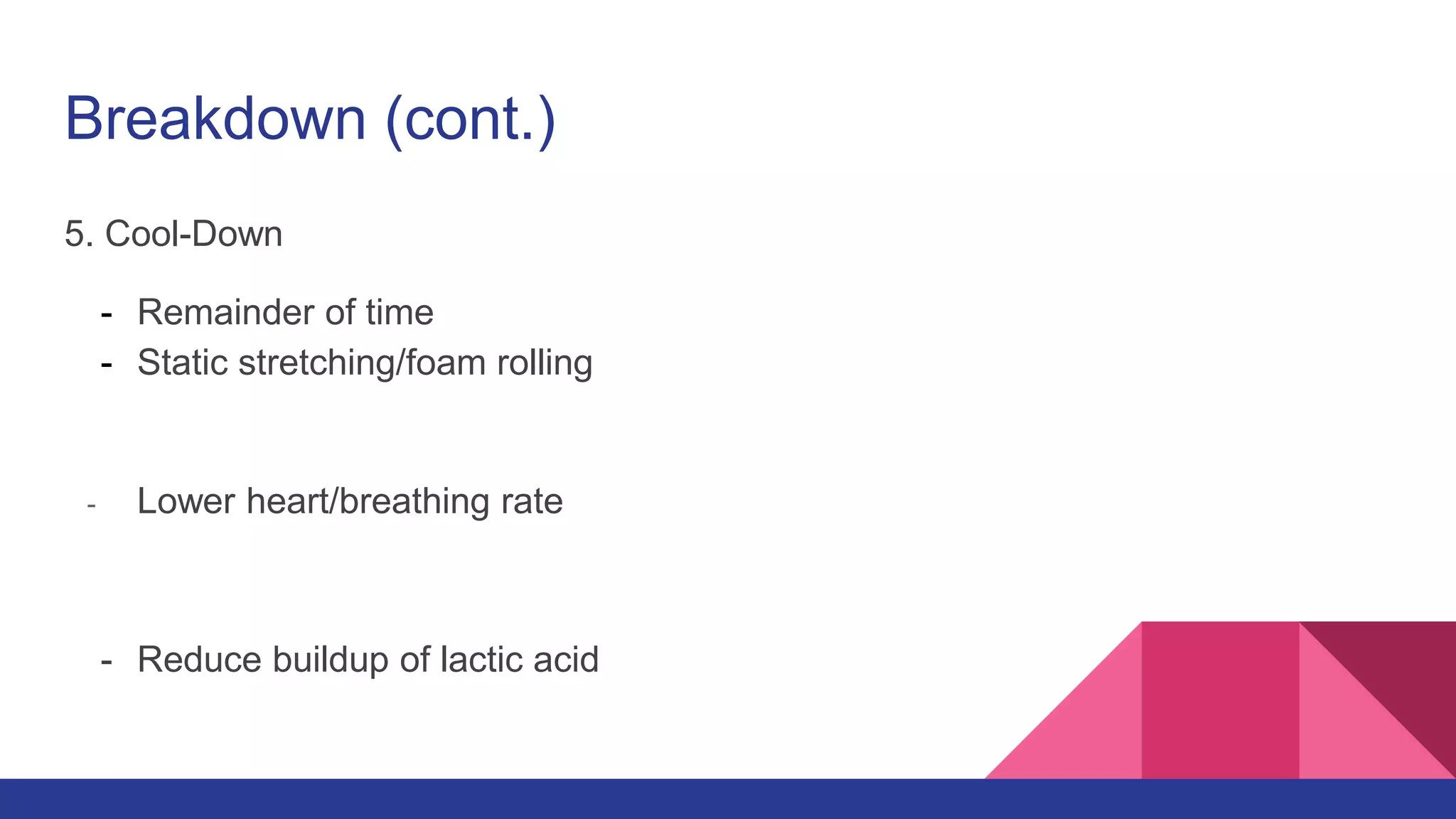
Breakdown (cont.)
5. Cool-Down
- Remainder of time
- Static stretching/foam rolling
- Lower heart/breathing rate
- Reduce buildup of lactic acid
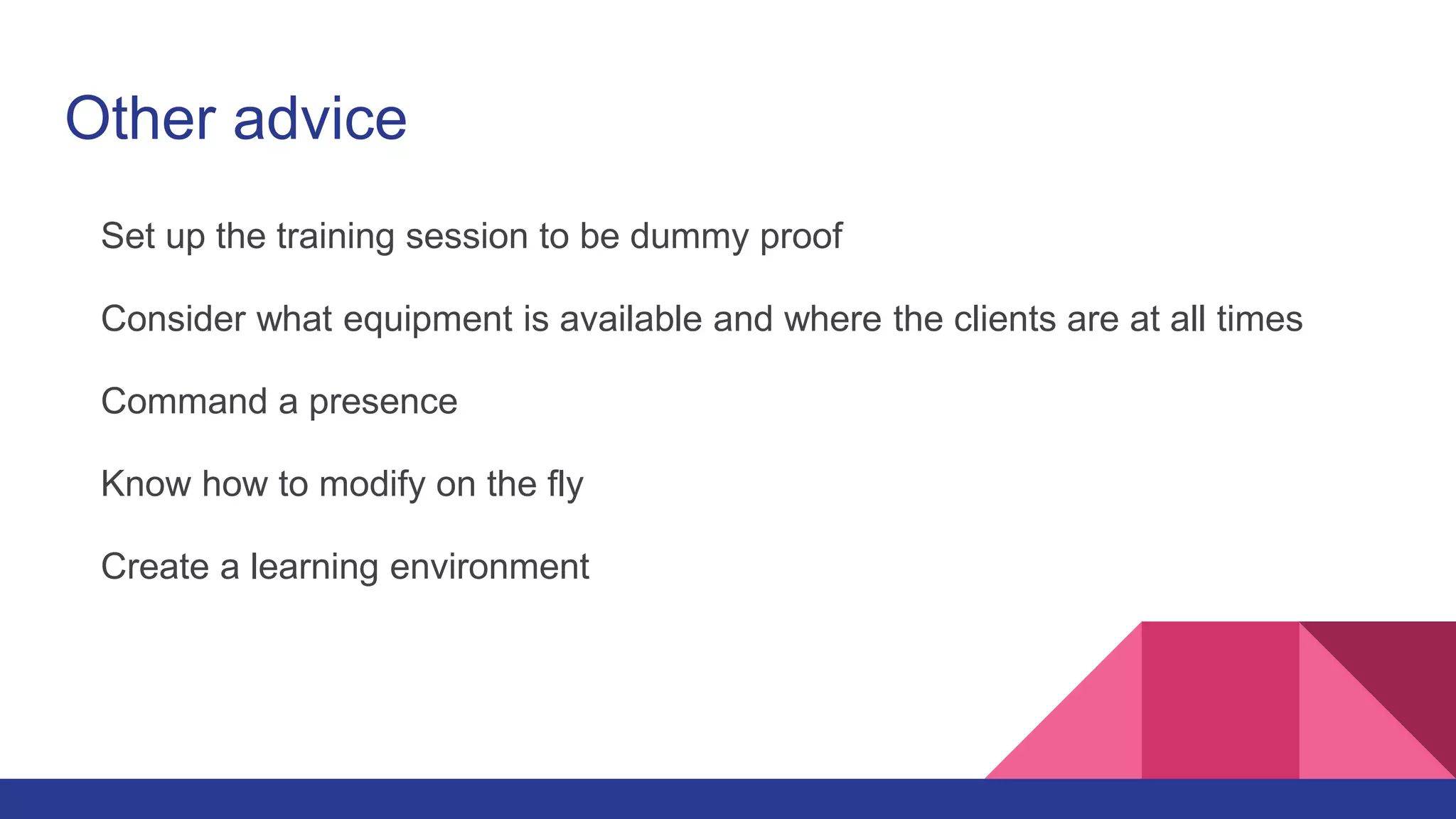
Other advice
Set up the training session to be dummy proof
Consider what equipment is available and where the clients are at all times
Command a presence
Know how to modify on the fly
Create a learning environment
Common Mistakes
Using a negative work to rest ratio with no reasoning and using it too often
Going 110% all the time
Not listening to your participants
Assuming participants have a base knowledge
Not continuing to learn
Resources
http://www.ptonthenet.com/articles/how-to-design-small-group-training-programs-3408
https://www.theptdc.com/2015/07/guide-to-programming-group-fitness-workouts/
https://www.acefitness.org/blog/2395/small-group-training-the-future-of-the-workout
http://frnation.com/the-foundation-of-group-training/
http://www.masslive.com/living/index.ssf/2010/09/whats_in_a_name_group_exercise_versus_group_personal_training.html
Thank you!
Riley Rogers
UNC at Chapel Hill
rogersre@live.unc.edu

Programming 101 for Group Training

Editor's Notes

  • #7 group exercise: looks much like a choreographed dance More aerobic-based typically larger and limited only by space available everyone, regardless of age/skill, performs the same exercise Group personal training: looks like a group of people doing different exercises together at their own rate of speed, intensity, and ability tend to be smaller in scale (6-10) Movements are much more variable More individualized coaching Progressive (each week you are learning new skills or the level of difficulty is ramping up)
  • #8 The hardest part about programming is knowing where to start. Jot down some ideas THEN organize them. Time frame 30 minutes, 60 minutes, 90 minutes? Take 10 minutes out for warm-up + cool-down Different abilities New to exercise Different specialties - crossfit athlete/runner/yogi Seasoned veteran Space limitations Tar heel training center v. studio Other classes? coordinate? Equipment limitations Barbells, dumbbells, KBs? Number of each = groups? FIT principle Frequency - how many days a week? Intensity - how hard? Time (duration) - how long? Training effect Power Strength Endurance Hypertrophy
  • #9 Individualize Include progressions/regressions Have to accommodate injuries/abilities Periodize build a base of knowledge Ie. push press -> front squat -> thruster Ie. clean pull -> power clean Balance Instead of trying to look at just one workout when programming look at your entire month or programming to make sure you have balance in the layout globally and understand that if you choose to not have balance (place two lower body movements back to back for example) how that impacts the workout. Measure progress First and last sessions are the same Measure by time, reps, body awareness Teach complex movements first Allow sufficient time for learning/mastering THEN incorporate later into workouts Even though YOU know how to do it, that doesn’t mean your clients do Add variety, but not too much don't want to confuse participants but also don't want to bore them can just mean varying a simple exercise in different ways (push up -> hindu push up -> deload push up) Leave some extra time For a 60-minute session, only plan for about 40 minutes Extra time goes to transitions, rest, warm-up/cool down, conversation NO NEED TO RUSH Write in pencil You should always be making changes/adapting the program Based on how your participants react, how fast they learn
  • #10 Even though I can give you guidelines that I use, you must make it your own.
  • #11 equipment - appeals to people who prefer a certain style of training or equipment type (kettlebells, TRX) technique/skill - allows for a targeted approach to individuals preparing for an activity or sport (kickboxing, marathon training) outcome - targets people who are looking for a specific physical result or change from the program (weight-loss, wedding preparation)
  • #12 Warm-Up 8-10 minutes Used as a feel for what may come out on the floor By incorporating new movements during the warm-up and seeing how people may respond to cues, you’ll gain a better understanding of how to coach someone out on the floor Dynamic Complex Movements Olympic Lifts (Clean, snatch, jerk, OH squat, etc.) Barbell movements Compound Movements (Deadlift, presses, thrusters, etc.) General Strength push/pull supersets Metabolic Conditioning Give the people what they want People want to sweat and feel like they got a good workout in Cool-Down Foam-roll Static stretching
  • #13 Objective #1 By incorporating new movements during the warm-up and seeing how people may respond to cues, you’ll gain a better understanding of how to coach someone out on the floor
  • #14 All come together to create the desired training effect....
  • #17 Set up the training session to be dummy proof Don’t want to confuse participants A great coach must be able to consider what equipment is available and where the clients are at all times Pay attention - programming is just the start Communicate - ask how they are feeling, notice signs of dehydration/fatigue Command a presence… be prepared for your classes communicate clearly coach your clients effectively don’t just be a cheerleader, provide useful criticism should be identifiable when someone walks in the room Know how to modify on the fly Meaning make it easier OR harder May have new injuries, soreness Create a learning environment
  • #18 Incorporate appropriate rest 1-2 minutes between sets for lifts At least 2-3 minutes for transitions/water breaks