HOMER’S
HOMER
•the greatest of ancient Greek epic
poets
•Lived in 850 BC, 12th century BC, or
7th century BC
•Teacher of Greece
•"the date of Homer" refers not to an
individual, but to the period when the
epics were created
•Melesigenes
•The poet's name is homophonous
with ὅμηρος (hómēros), "hostage" (or
"surety")
•Iliad was composed by "Homer" in
his maturity, while the Odyssey was a
work of his old age
•Homeric poems are dependent on
an oral tradition
The Iliad
“The Song of Ilion” or “The Song of
Ilium”
 Ancient Greek epic poem written in dactylic
hexameters
 tells of the battles and events during the weeks of a
quarrel between King Agamemmnon and the
warrior Achilles
 the story covers only a few weeks in the final year of
the war (Medias Res)
 the epic narrative takes up events prophesied for the
future, such as Achilles' looming death
 usually dated to around the eighth century BC
 contains 15,693 lines written in Homeric Greek
Characters: The Greeks
 Agamemmnon — King of Mycenae, leader of the
Greeks.
 Achilles — Leader of the Myrmidons, half-divine hero.
 Odysseus — King of Ithaca, the wiliest Greek
commander and hero of the Odyssey.
 Ajax the Greater — son of Telamon, with Diomedes, he
is second to Achilles in martial prowess.
 Menelaus — King of Sparta, husband of Helen and
brother of Agamemnon.
 Diomedes — son of Tydeus, King of Argos
 Ajax the Lesser — son of Oileus, often partner of Ajax
the Greater.
 Patroclus — Achilles’ closest companion.
 Nestor — King of Pylos, and trusted advisor to
Agamemnon.
Characters: The Trojan Men
 Hector — son of King Priam and the foremost Trojan warrior.
 Aeneas — son of Anchises and Aphrodite.
 Paris — Helen’s lover-abductor
 Deiphobus — brother of Hector and Paris.
 Priam — the aged King of Troy.
 Polydamas — a prudent commander whose advice is ignored; he is Hector’s
foil.
 Agenor — a Trojan warrior, son of Antenor, who attempts to fight Achilles
(Book XXI).
 Sarpedon, son of Zeus — killed by Patroclus. Was friend of Glaucus and co-
leader of the Lycians (fought for the Trojans).
 Glaucus, son of Hippolochus— friend of Sarpedon and co-leader of the
Lycians (fought for the Trojans).
 Euphorbus — first Trojan warrior to wound Patroclus.
 Dolon — a spy upon the Greek camp (Book X).
 Antenor — King Priam’s advisor, who argues for returning Helen to end the
war.
 Polydorus — son of Priam and Laothoe
 Pandarus — famous archer and son of Lycaon.
Characters: The Trojan Women
 Hecuba— Priam’s wife, mother of Hector,
Cassandra, Paris, and others.
 Helen— abducted by Paris
 Andromache — Hector’s wife, mother
of Astyanax
 Cassandra — Priam’s daughter; courted by
Apollo, who bestows the gift of prophecy to
her
 Briseis— a Trojan woman captured by the
Greeks; she was Achilles' prize of the Trojan
war.
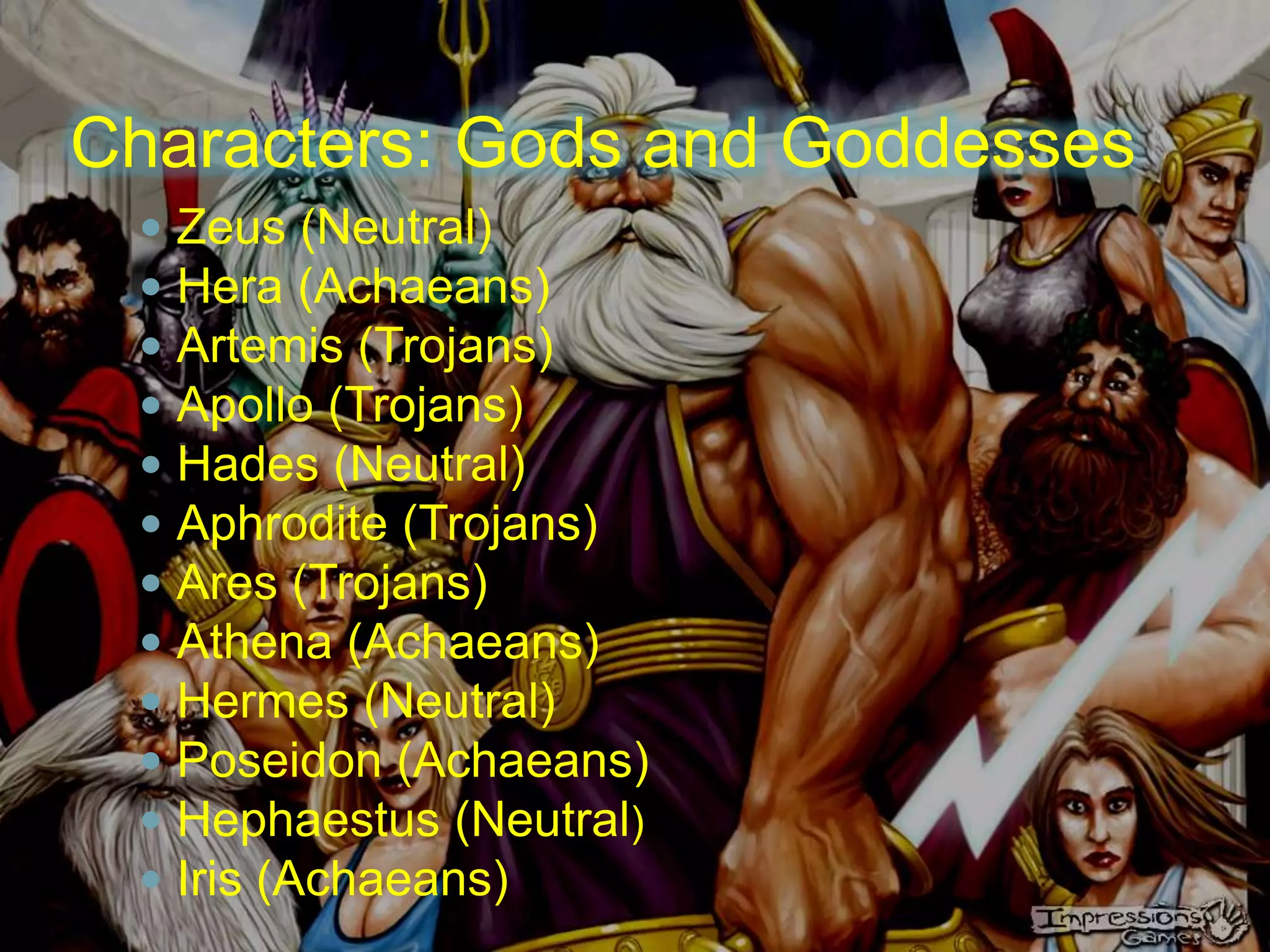
Characters: Gods and Goddesses
 Zeus (Neutral)
 Hera (Achaeans)
 Artemis (Trojans)
 Apollo (Trojans)
 Hades (Neutral)
 Aphrodite (Trojans)
 Ares (Trojans)
 Athena (Achaeans)
 Hermes (Neutral)
 Poseidon (Achaeans)
 Hephaestus (Neutral)
 Iris (Achaeans)
takes place in the tenth year
of the Trojan War
Greece and Troy
Prologue:
The Judgment of Paris
Paris was called to judge to whom the
golden apple would be given among
Pallas Athena, Aphrodite, and Hera
“For the Fairest”
 Hera: I promise to make you the Lord of
Europe and Asia!
 Athena: You will lead the Trojans to victory
against the Greeks and lay Greece in ruins!
 Aphrodite: The fairest woman in the world
should be yours!
Paris chose Aphrodite. This was how the
Trojan War began.
Trojan War
 Aphrodite led Paris to Sparta and he left
Oenone for Helen.
 Menelaus and Helen welcomed him as
their guest. Paris broke his trust and
completely left to Paris his home and
went off to Crete.
BUT…
“Paris who coming
Entered a friend’s kind
dwelling,
Shamed the hand there
that gave him food,
Stealing away a woman.”
Menelaus got back to find
Helen gone, and he called
upon all Greece to help him.
Wanted: Odysseus and
Achilles (later go to the Greek
camp)
Aulis- a place of dangerous
winds and strong tides
Calchas declared that the
Gods had spoken to him:
Artemis was angry.
Iphigenia must be sacrificed
for them to have a safe
voyage to Troy.
Agamemmnon wrote to his wife that he had
arranged marriage to Iphigenia and
Achilles. When she came to her wedding,
she was carried to the altar to be killed.
“And all her prayers---cries of
Father, Father,
Her maiden life,
These they held as nothing,
The savage warriors, battle-mad.”
 Protesilaus died upon leaping
ashore to the mouth of Simois
and Hermes brought him up from
the dead to see once again his
deeply, mourning wife, Laodamia.
 Laodamia killed herself and went
to the underworld with
Protesilaus.
“Very brief is your lot.
Would that you could be
free now from tears and
troubles, for you shall not
long endure, my child,
short-lived beyond all
men and to be pitied.”
~Thetis to Achilles
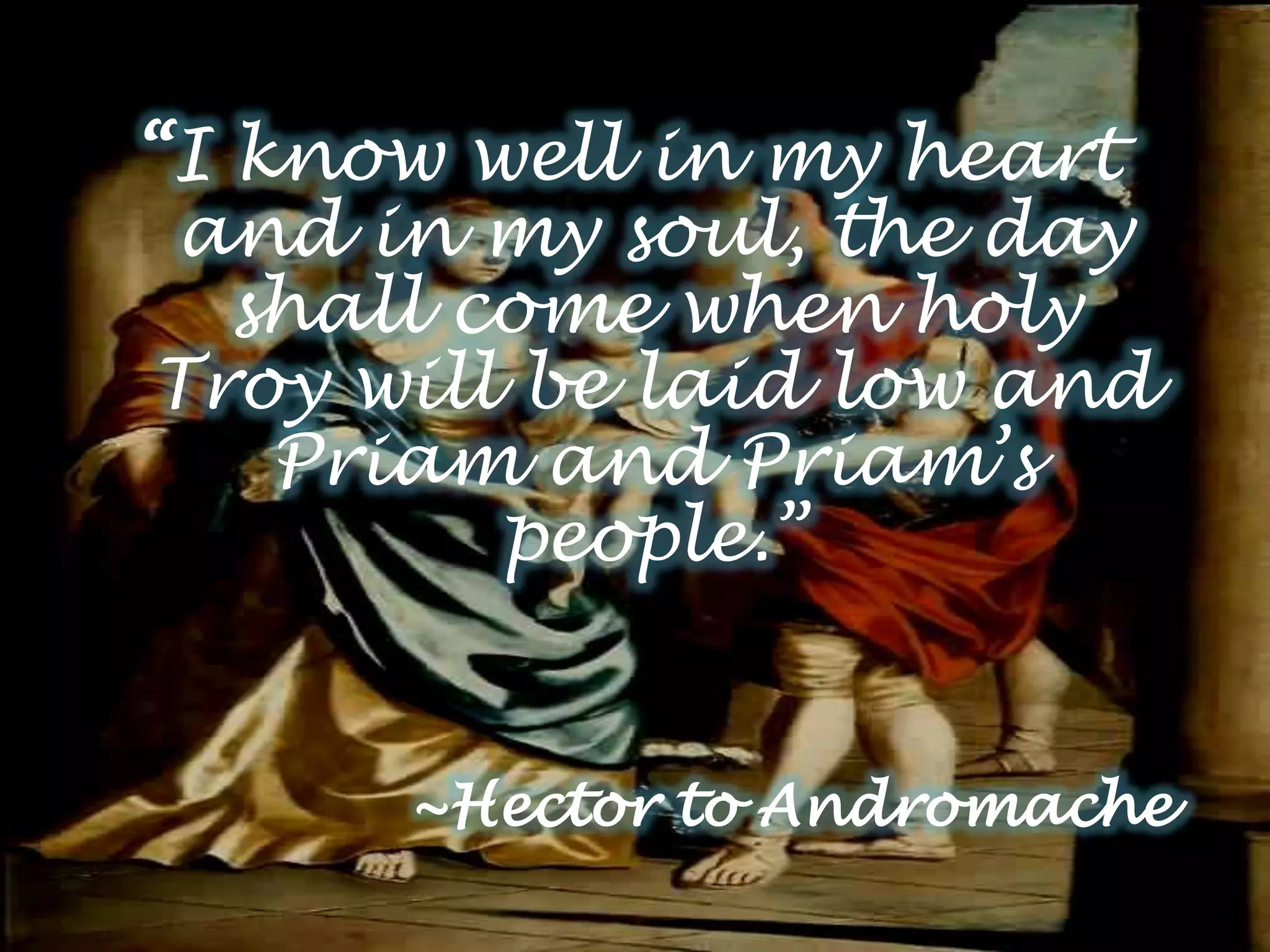
“I know well in my heart
and in my soul, the day
shall come when holy
Troy will be laid low and
Priam and Priam’s
people.”
~Hector to Andromache
Achilles vs.
Agamemmnon
 Chryses, a Trojan priest of Apollo,
offers the Greeks wealth for the return
of his daughter Chryseis.
 He prayed to Apollo and he set up a
plague against the Greek Army.
 Agamemnon agrees to
return Chryseis to her father, but also
decides to take Achilles's
captive, Briseis, as compensation.
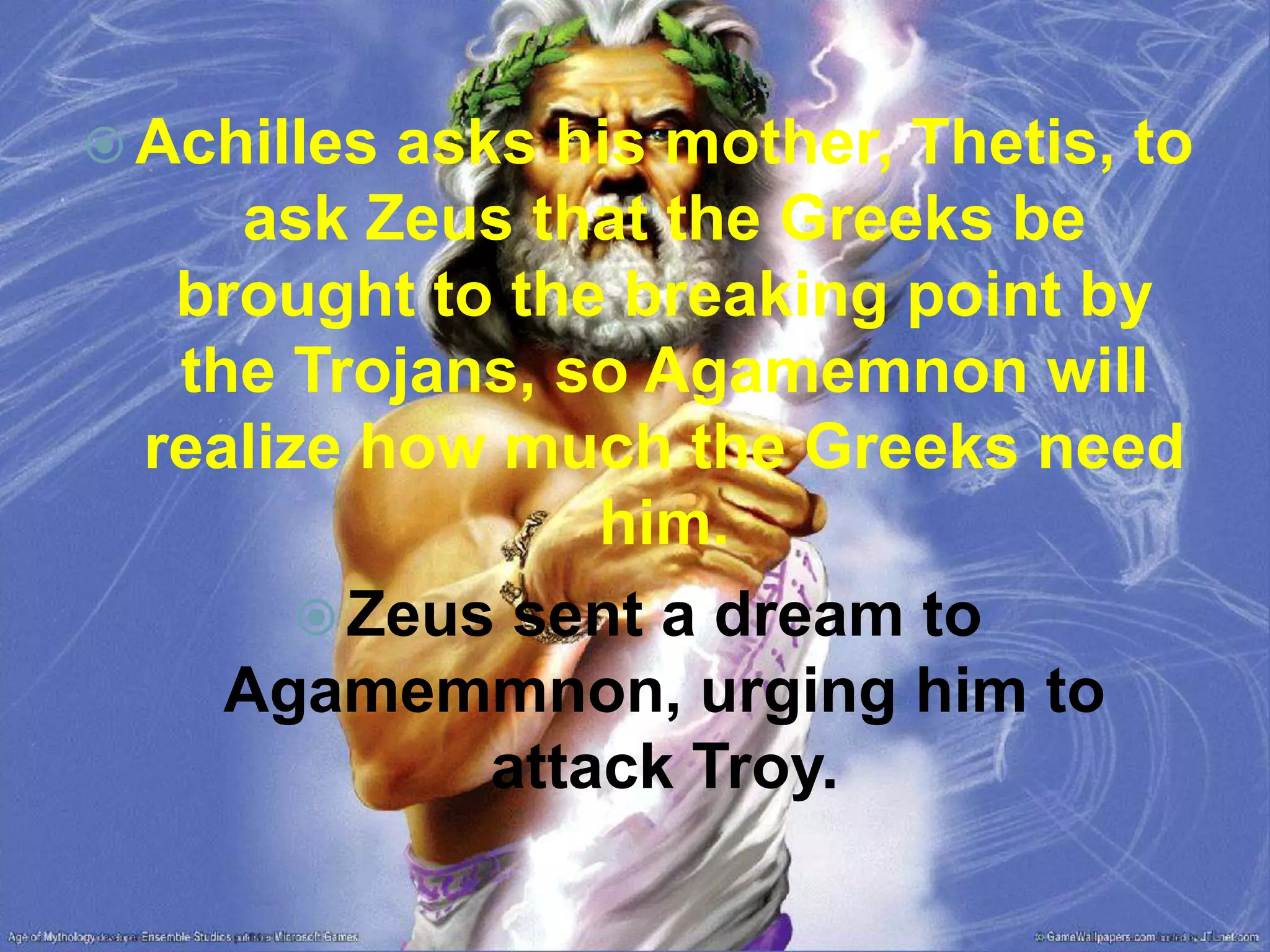
 Achilles asks his mother, Thetis, to
ask Zeus that the Greeks be
brought to the breaking point by
the Trojans, so Agamemnon will
realize how much the Greeks need
him.
 Zeus sent a dream to
Agamemmnon, urging him to
attack Troy.
Paris vs. Menelaus
 Paris offers to end the war by
fighting a duel with Menelaus
 Helen promised Priam to abide by
the outcome of the duel.
 Aphrodite rescues him and leads him
to bed with Helen before Menelaus
could kill him.
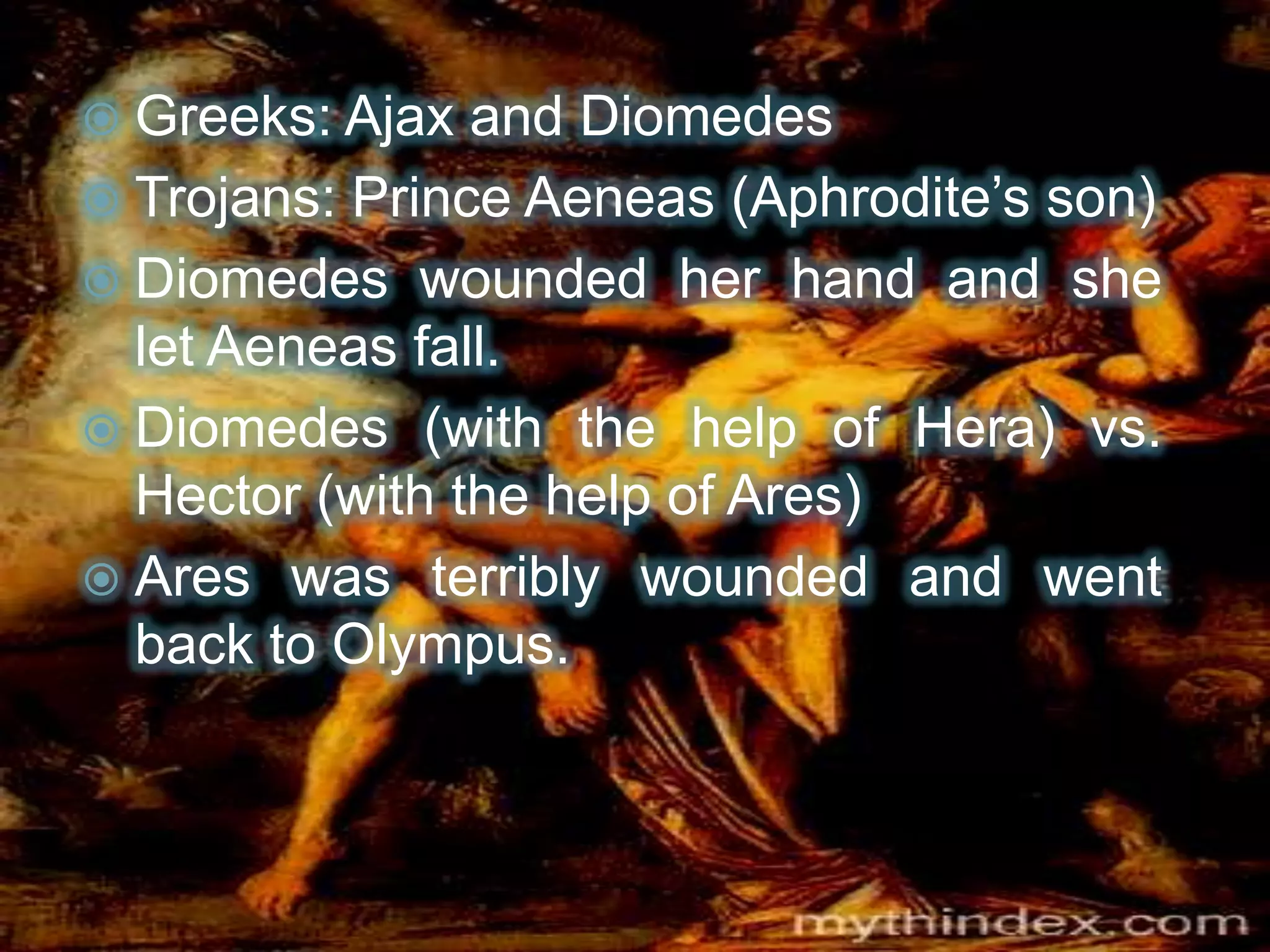
 Greeks: Ajax and Diomedes
 Trojans: Prince Aeneas (Aphrodite’s son)
 Diomedes wounded her hand and she
let Aeneas fall.
 Diomedes (with the help of Hera) vs.
Hector (with the help of Ares)
 Ares was terribly wounded and went
back to Olympus.
“Lady Athena, spare the
city and the wives of
the Trojans and the
little children.”
~Hector
Andromache: My dear lord, you are the
father and mother and brother unto me as
well as husband, stay here with us. Do not
make me a widow and your child an
orphan.”
Hector: I could not be a coward. It was for
me to fight always in the forefront of the
battle.
Hector to Astyanax: Far greater is he than
his father was.
 Zeus helped the Trojans as a promise to
Thetis.
 Nestor told Agamemmnon that if he had not
angered Achilles, they would not have been
defeated.
 Agamemmnon brought Briseis back to
Achilles and give them all the riches.
 Achilles angrily refuses Agamemnon's offer,
and declares that he would only return to
battle if the Trojans reach his ships and
threaten them with fire.
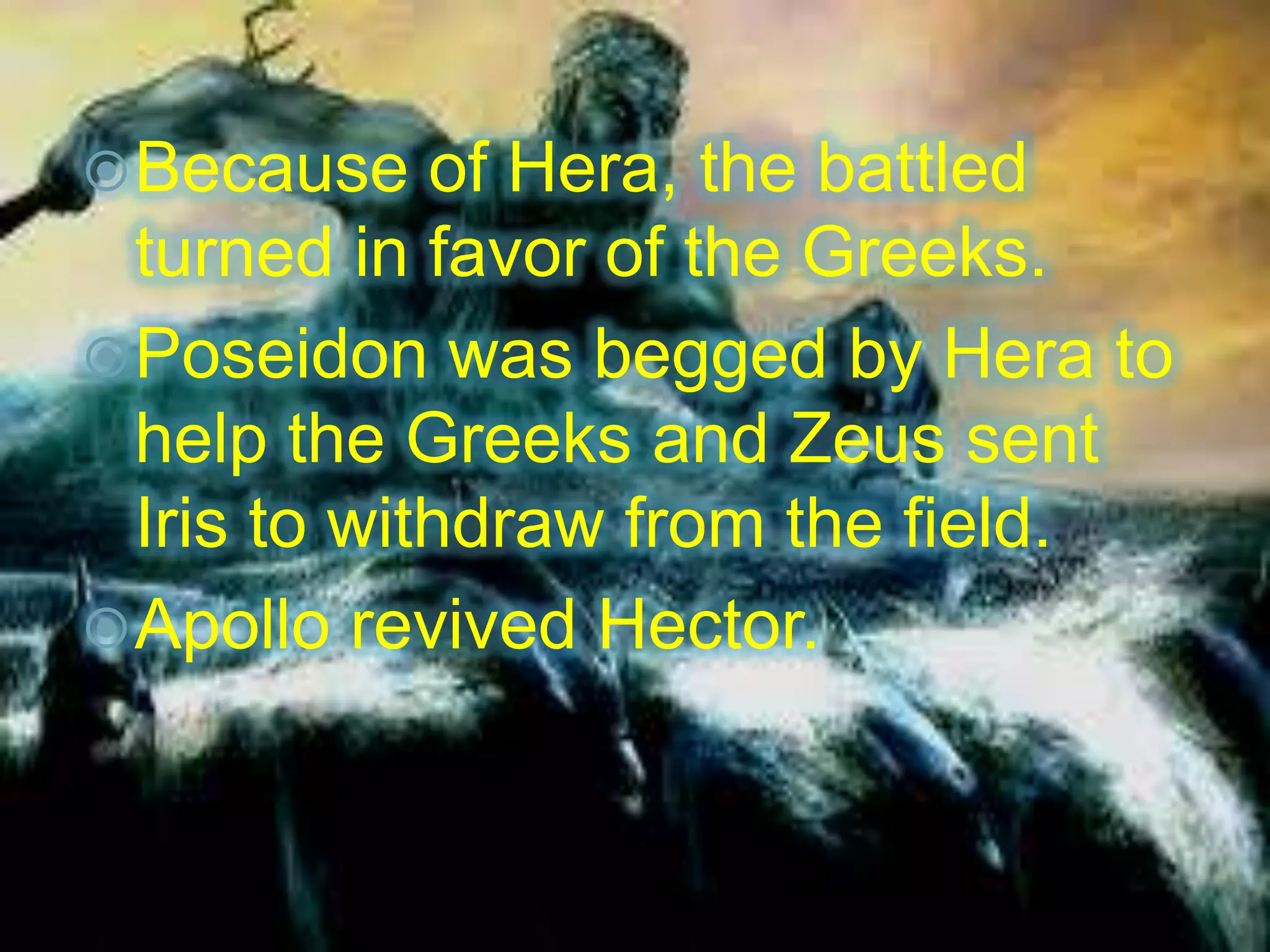
Because of Hera, the battled
turned in favor of the Greeks.
Poseidon was begged by Hera to
help the Greeks and Zeus sent
Iris to withdraw from the field.
Apollo revived Hector.
“You can keep your wrath while your
countrymen go down in ruin. I cannot.
Give me your armor. If they think I am
you, the Trojans may pause and the worn-
out Greeks have a breathing space. You
and I are fresh. We might yet drive back
the enemy. But if you will sit nursing
your anger, at least let me have the
armor.”
~Patroclus
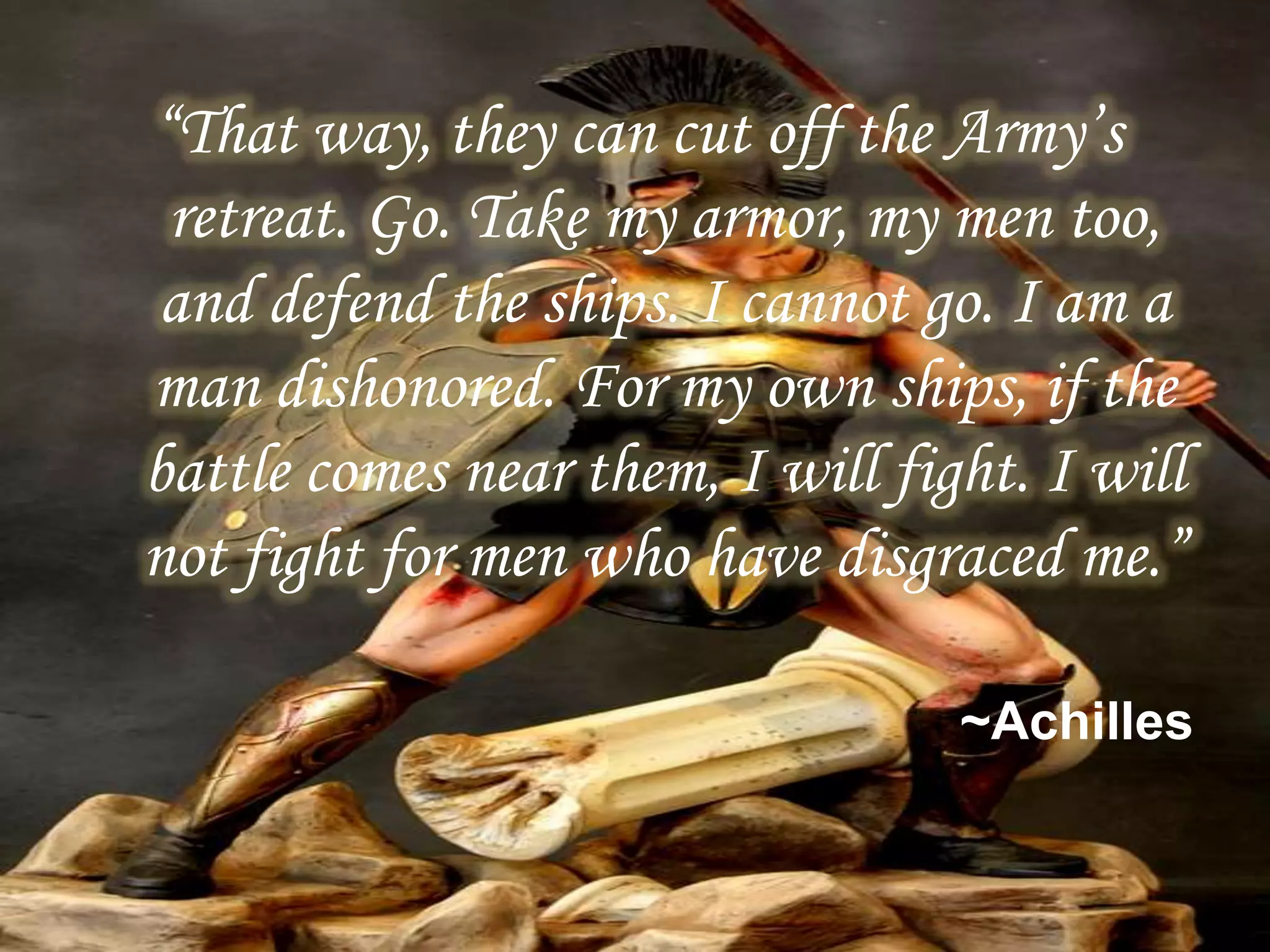
“That way, they can cut off the Army’s
retreat. Go. Take my armor, my men too,
and defend the ships. I cannot go. I am a
man dishonored. For my own ships, if the
battle comes near them, I will fight. I will
not fight for men who have disgraced me.”
~Achilles
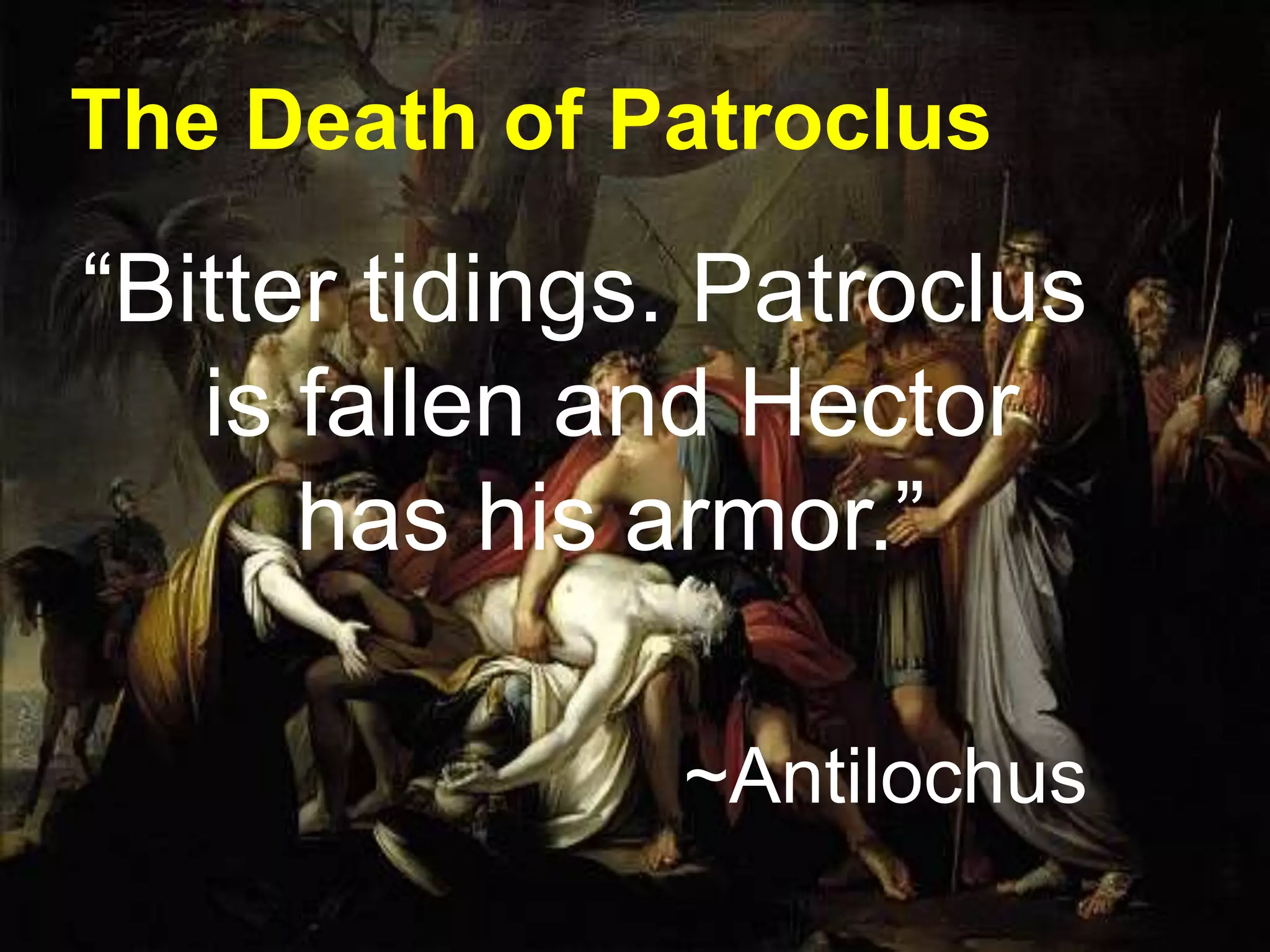
The Death of Patroclus
“Bitter tidings. Patroclus
is fallen and Hector
has his armor.”
~Antilochus
Achilles: I will no longer live among men,
if I do not make Hector pay his death
for he himself for Patroclus dead.
Thetis: You yourself is fated to die
straightway after Hector.
Achilles: So may I do. I who did not help
my comrade in his sore need. I will kill
the destroyer of him I loved; then I will
accept death when it comes.
Achilles vs. Hector
Hector: If I kill you, I will give back your
body to your friends and do you do
the same to me.
Achilles: Madman. There are no
covenants between sheep and
wolves, nor between you and me.
(hurling his spear)
The Death of Hector
Before Hector could approach, he who
knew well that armor taken by Hector
from the dead Patroclus aimed at an
opening in it near the throat, and
drove the spearpoint in.
HECTOR FELL, DYING AT LAST!
The Death of Hector
Hector (dying): Give back my body to
my father and my mother.
Achilles: No prayers from you to me,
you dog. I would that I could make
myself devour raw your flesh for the
evil you have brought upon me.
Achilles pierced the feet of Hector
and fastened them with thongs
to the back of his chariot, letting
the head trail. He lashed his
horses and round and round the
walls of Troy he dragged all that
was left for Hector.
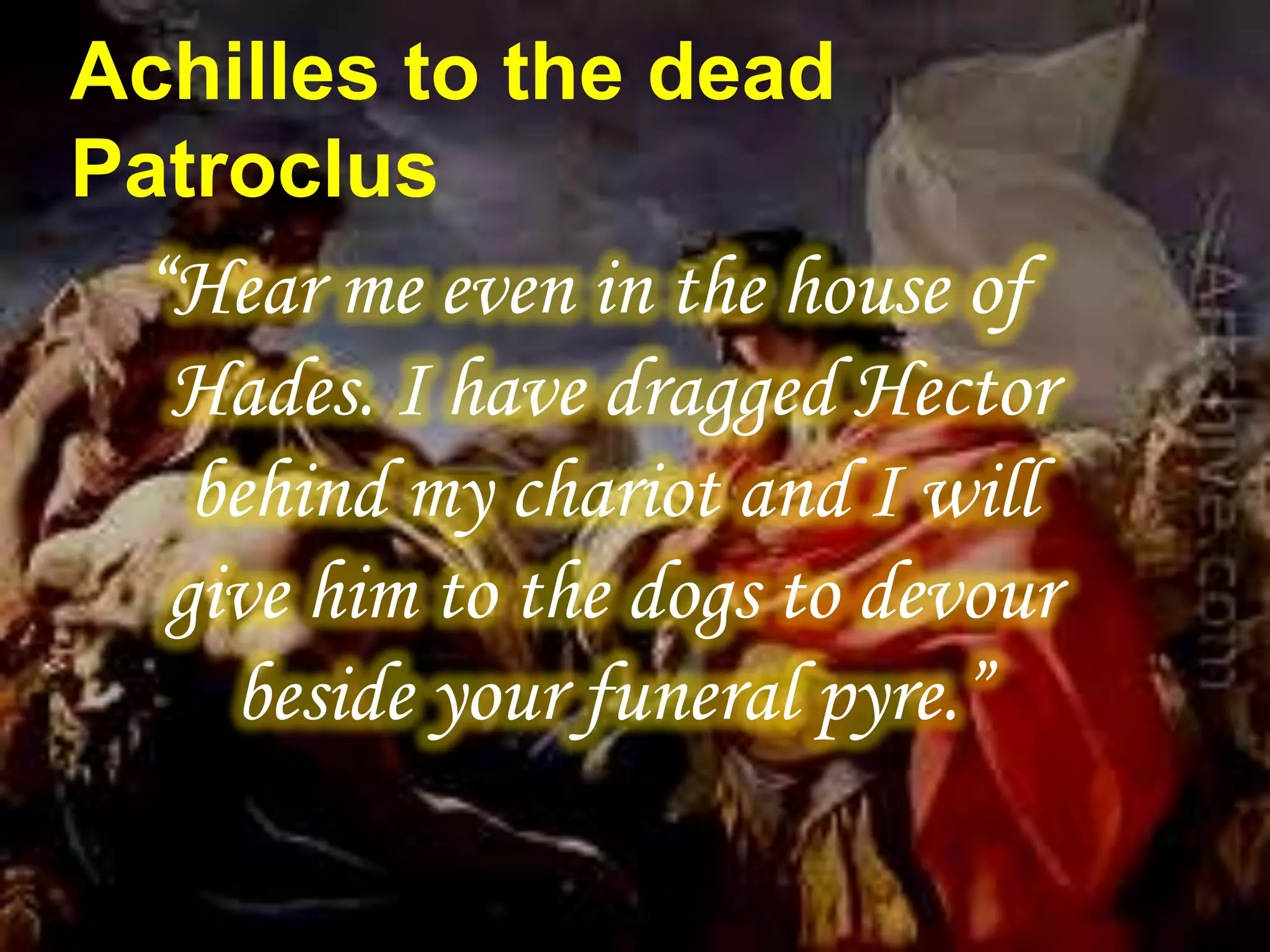
Achilles to the dead
Patroclus
“Hear me even in the house of
Hades. I have dragged Hector
behind my chariot and I will
give him to the dogs to devour
beside your funeral pyre.”
King Priam: Remember, Achilles, your
own father, of like years with me and
like me wretched for want of a son.
Yet, I am by far more to be pitied who
have braved what no man on earth
ever did before, to stretch out my
hand, to the slayer of my son.
Achilles: Sit me by here, and let our
sorrow lie quiet in our hearts. Evil is
all men’s lot, but yet, we must keep
courage.
“The other Trojans upbraid me.
But always I had comfort from
you through the gentleness of
your spirit and your gentle
words. You only were my
friend.”
~Helen of Troy to King Priam
 The Trojans lamented Hector for 9 days.
 When all was burned, they quenched
the flame with wine and gathered the
bones into a golden urn, shrouding them
in soft purple.
And with it, the Iliad ends.
The Fall of Troy
Achilles killed Prince Memnon of
Ethiopia
Paris shot an arrow at Achilles
and Apollo struck his foot in the
one spot where he could be
wounded…
HIS HEEL.
 Marvelous arms Thetis had brought
Achilles caused the death of Ajax.
 Odysseus got the arms and Ajax who
was defeated was held to be
dishonored.
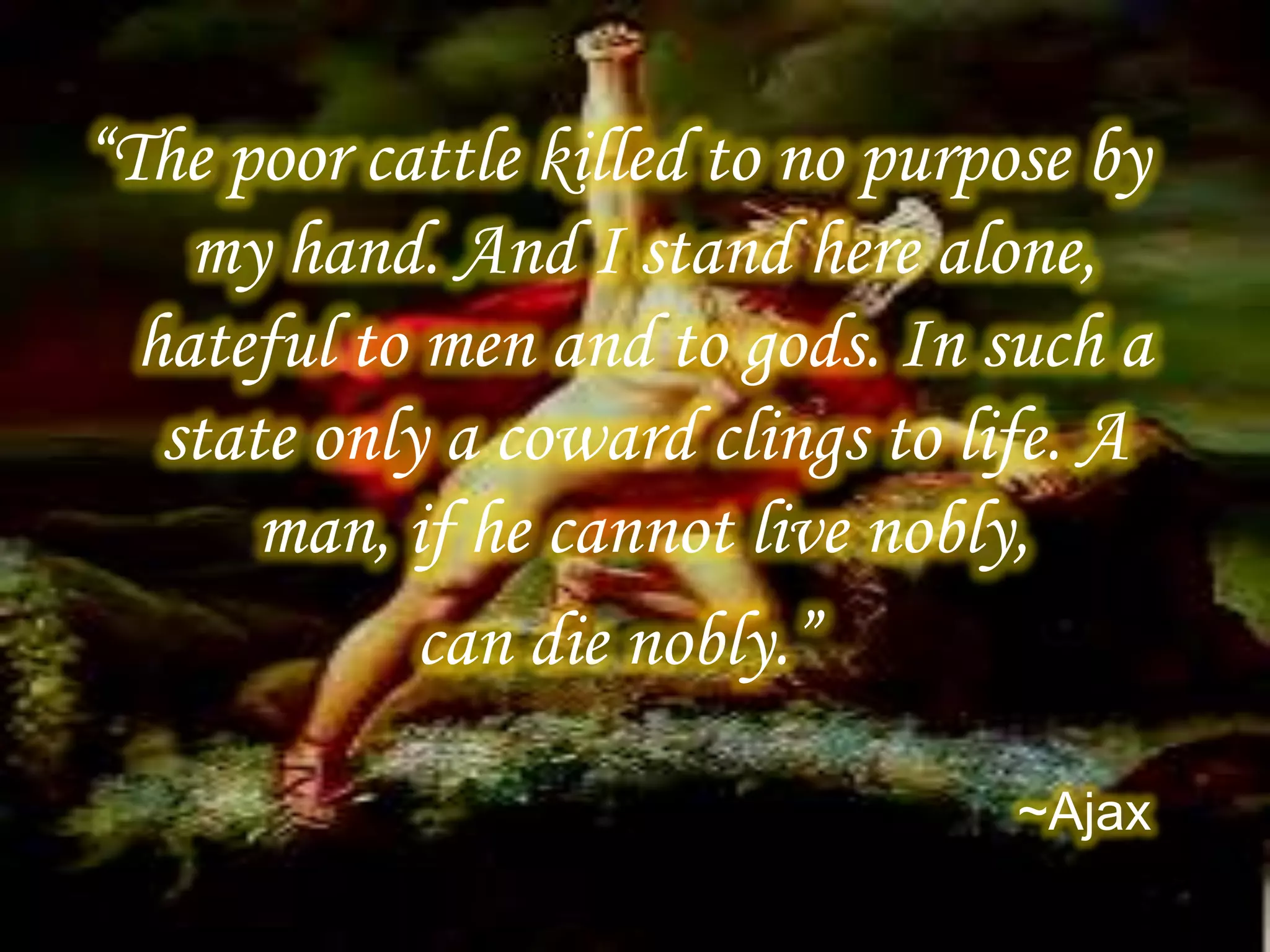
 Ajax was determined to kill
Agamemmnon and Menelaus.
 Because of his anger, he killed the
flocks and herds of the Greeks.
“The poor cattle killed to no purpose by
my hand. And I stand here alone,
hateful to men and to gods. In such a
state only a coward clings to life. A
man, if he cannot live nobly,
can die nobly.”
~Ajax
 There was a man from the Trojans who
knew the future, the prophet Helenus.
 Troy would not fall until some one
fought against the Trojans with the bow
and arrows of Hercules.
 Greeks stopped at an island to offer a
sacrifice, and Philocletes was bitten by
a serpent, and left him at Lemnos.
Philoctetes wounded Paris with
his arrows.
Paris begged to carry him to
Mount Ida where Oenone and he
once lived to be healed. But
Oenone only watched him died.
 As long as the Trojans had the
Palladium, the Greeks could not
defeat them.
 Diomedes stole the Palladium with
the help of Odysseus.
 The Greeks thought of a way to
defeat the Trojans.
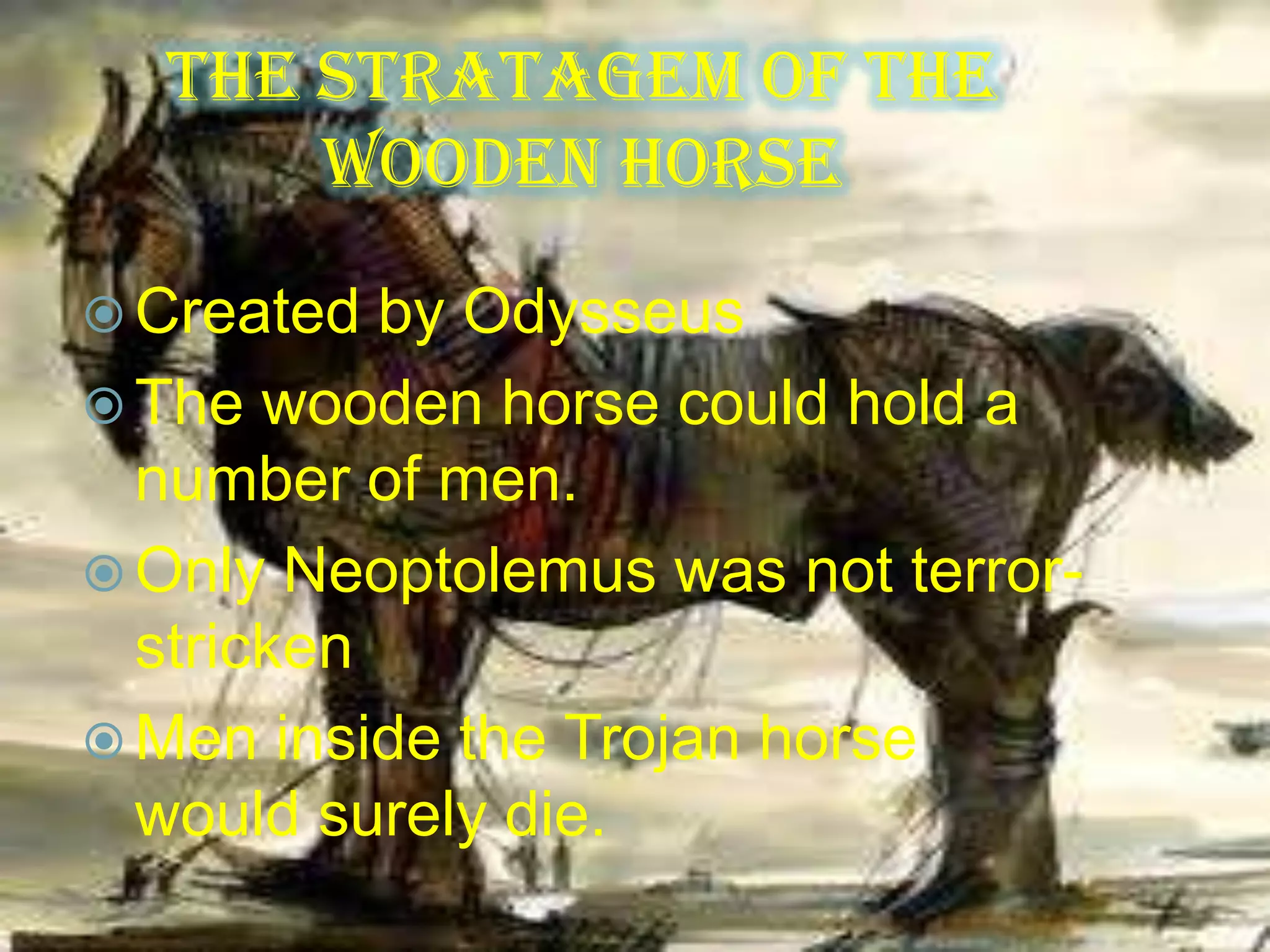
The Stratagem of the
Wooden Horse
 Created by Odysseus
 The wooden horse could hold a
number of men.
 Only Neoptolemus was not terror-
stricken
 Men inside the Trojan horse
would surely die.
The Plan
 To leave a single Greek behind in the
deserted camp for the Trojans to bring
the horse in their city
 At night, the Greeks would come out of
the horse and open the city gates to the
Army
In front of the Scaean gates
stood an enormous figure of a
horse
Sinon told Priam that the horse
was a votive offering to Pallas
Athena.
 Priest Laocoon warned the Trojans
to destroy the wooden horse
immediately.
 Cassandra had echoed his warning,
but no one believed her.
 Two serpents crushed the life out of
Laocoon and his two sons.
 Trojans dragged the horse through
the gate and up to the temple of
Athena.
 In the middle of the night, the door in
the horse opened.
 Troy was burning.
 Achilles’ son struck Priam down
before the eyes of Hecuba and their
daughters.
 Aeneas fought the Greeks alone.
 Even with Aphrodite’s wife, he
couldn’t really save his wife and
children.
 Aphrodite helped Helen got out of
the city and took her to Menelaus.
 Only Hecuba, Andromache, and
other Trojan women survived.
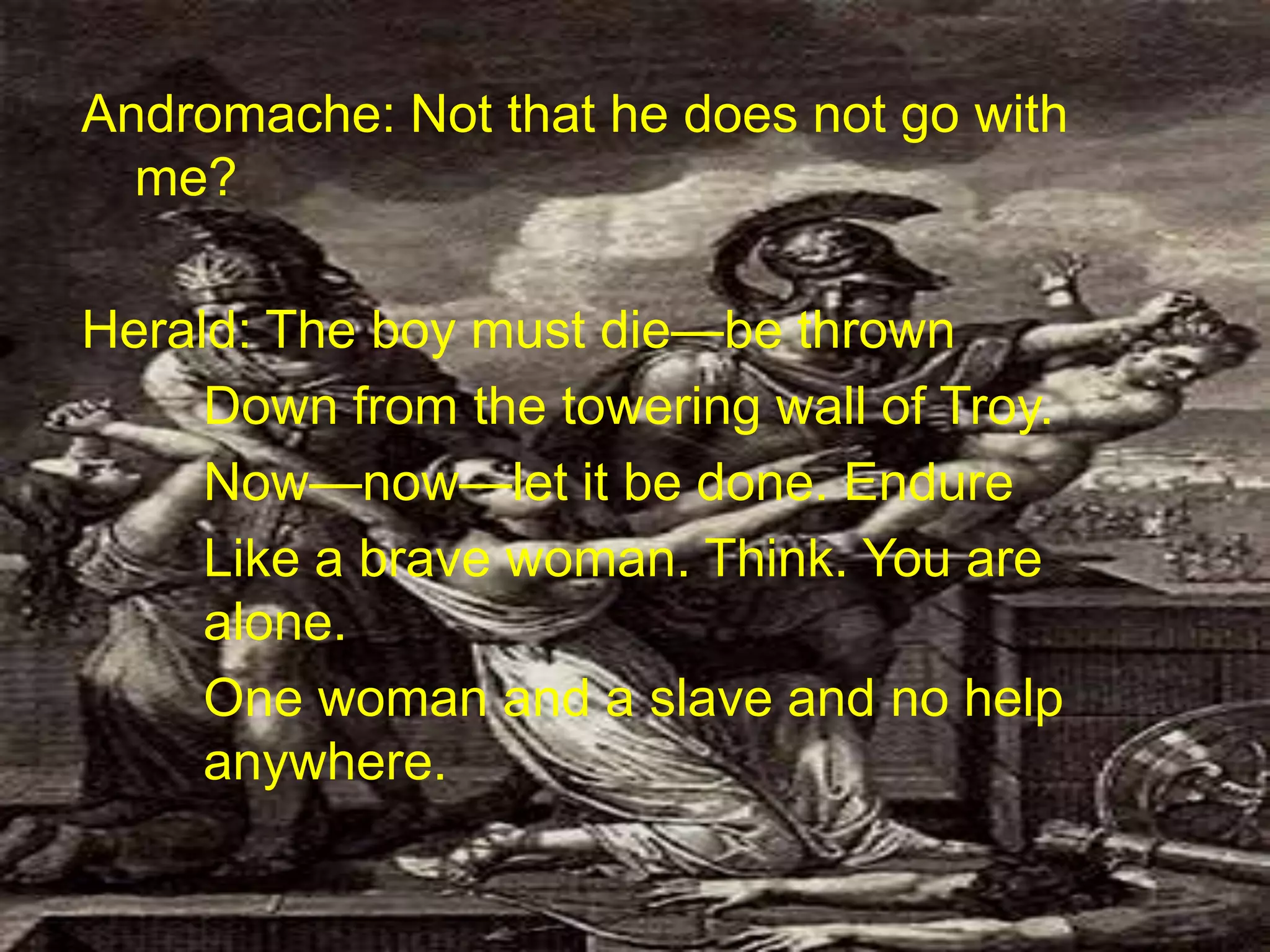
 Death of Astyanax
Andromache: Not that he does not go with
me?
Herald: The boy must die—be thrown
Down from the towering wall of Troy.
Now—now—let it be done. Endure
Like a brave woman. Think. You are
alone.
One woman and a slave and no help
anywhere.
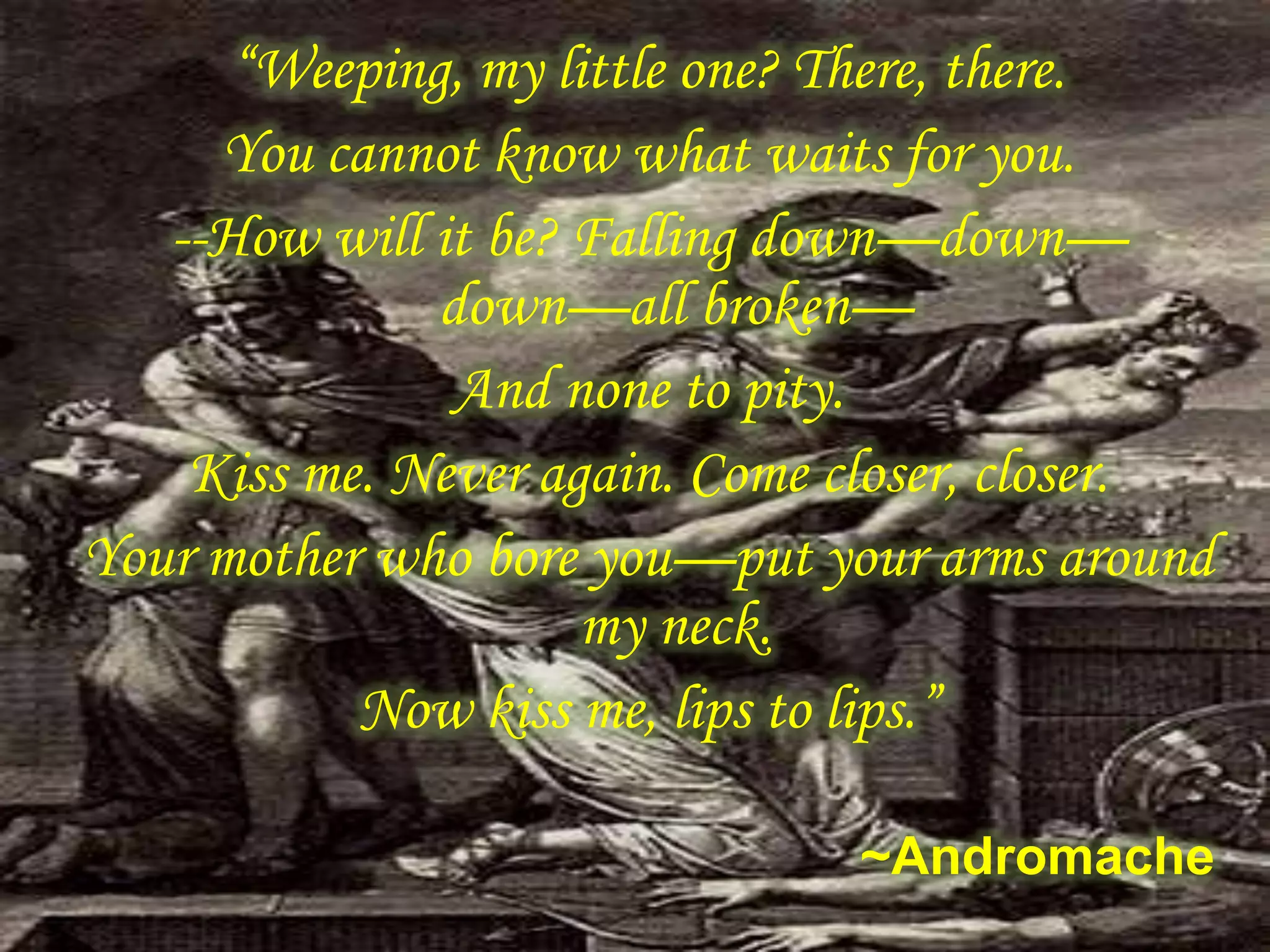
“Weeping, my little one? There, there.
You cannot know what waits for you.
--How will it be? Falling down—down—
down—all broken—
And none to pity.
Kiss me. Never again. Come closer, closer.
Your mother who bore you—put your arms around
my neck.
Now kiss me, lips to lips.”
~Andromache
polyxena’s Death
“Troy has perished, the great city.
Only the red flame now lives there.
The dust is rising, spreading out
like a great wing of smoke,
And all his hidden.
We are gone, one here, one there.
And Troy is gone forever.”
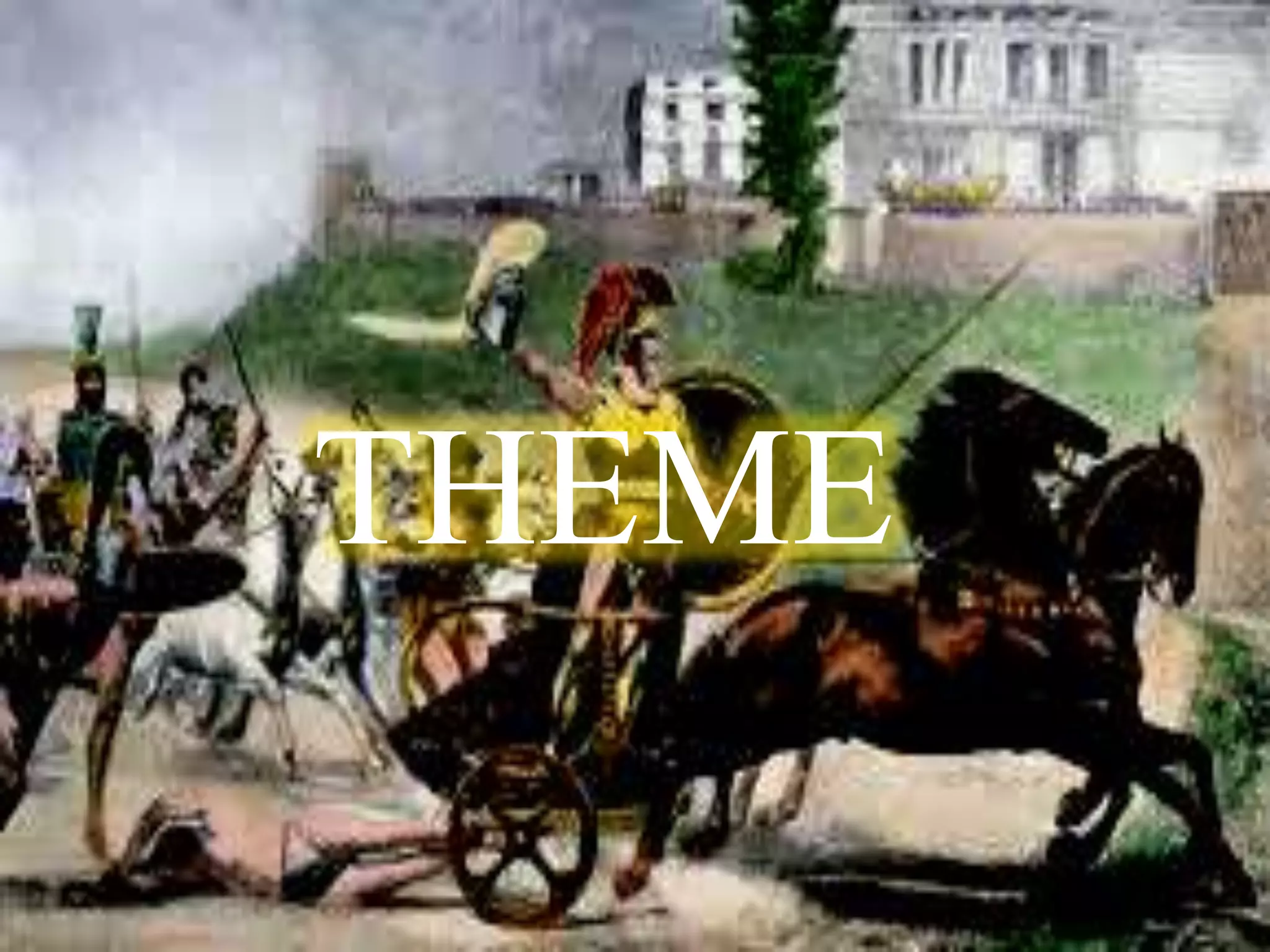
THEME
Fate and Freewill
because everything is fated
doesn't mean there isn't any
freedom
the gods don't control fate
 The Iliad’s male characters are
motivated in some way by
considerations of their social standing
 Priam and Patroclus
 depicted as a destructive force
 shown as having some benefits
Competition
 The way to get reputation and pride
 Hector prays that his son will grow up
to be a better warrior than him
 He wants to be able to boast about
having a better son than anyone else.
Compassion and Forgiveness
 Achilles refuses the offerings of
King Agamemmnon and did not
show compassion to the Greeks
 He refuses to make any deal with
Hector
Friendship
Achilles strong comradeship
with Patroclus
Helen and Hector
Love
 Hector and Andromache
 Not only love as a spouse, but a parental
love to Astyanax
 Priam’s love for Hector
 Hera’s seduction of Zeus
 Forbidden love of Paris and Helen
Hate
Achilles’ anger to
Agememmnon and
Hector
Warfare
Battle scenes are petrifying
and brutal
War is an almost inevitable
part of human life
Religion
 Gods and Goddesses are a daily
presence in people's lives
 the mortals honor the gods with
sacrifices, but they expect favors
in return
Glory of War
 Paris
 Achilles
 To fight is to prove one’s honor and integrity,
while to avoid warfare is to demonstrate
laziness, ignoble fear, or misaligned
priorities
 Homer portrays each side as having a
justifiable reason to fight and depicts warfare
as a respectable and even glorious manner
of settling the dispute
Military Glory over Family Life
 One wins in the eyes of others by
performing great deeds
 Hector knows that fighting among the front
ranks represents the only means of
“winning my father great glory.”
 Achilles chose to avenge Patroclus and kill
Hector rather than to stay with his aged
father.
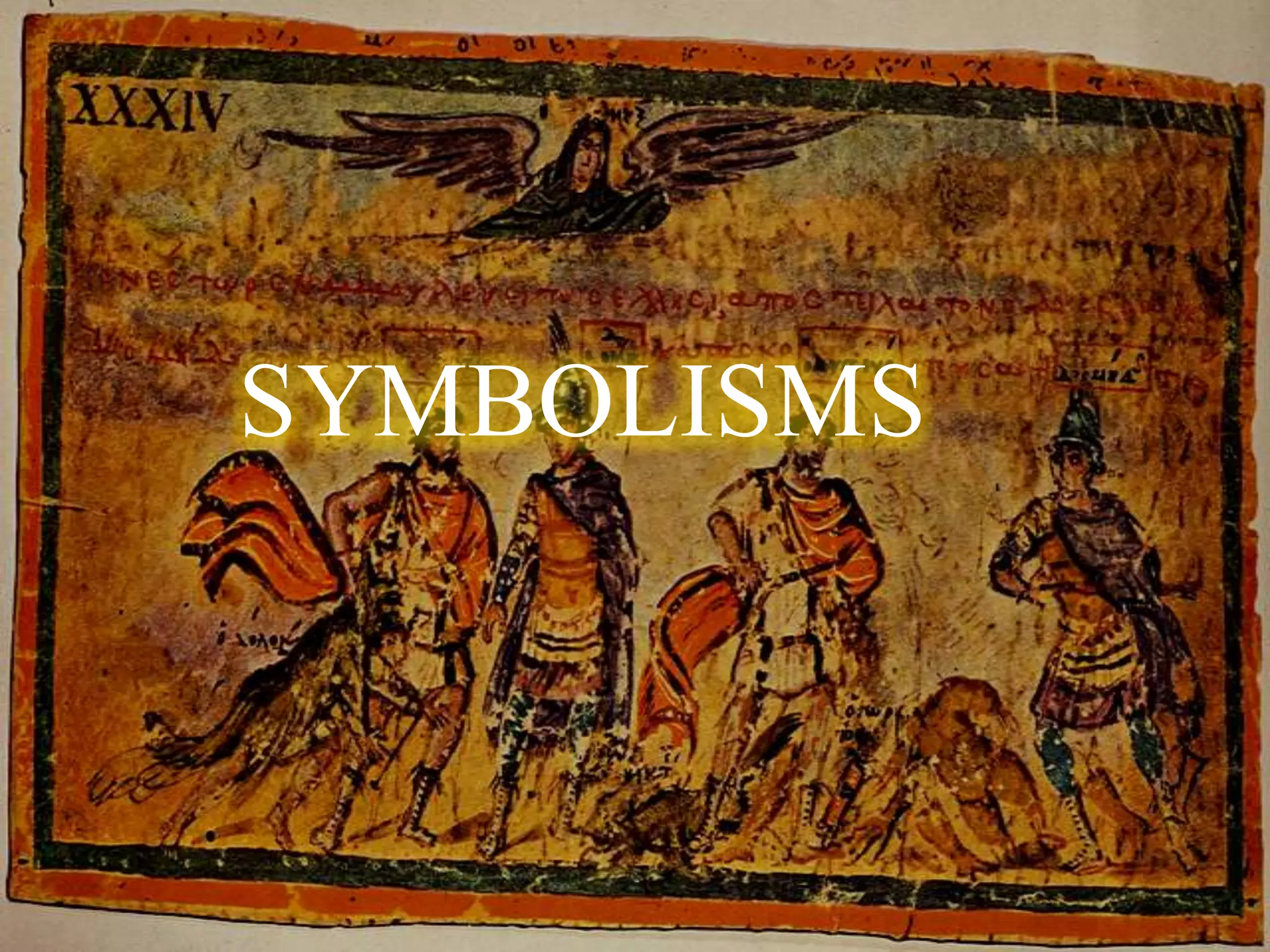
SYMBOLISMS
Achaean Ships
 future of the Greek race
 the heroes represented here actually
lived historically, as real kings who
ruled the various city-states of Greece
in their earliest years
 The mass death of these leaders and
role models would have meant the
decimation of a civilization.
Shield of Achilles
 The world beyond the battlefield
 Life as a whole
 Human beings may serve not
only as warriors but also as
artisans and laborers in the fields
Historical Approach
 reflected in the Homeric poems derives
from a tradition of epic poetry founded
on a war which actually took place
 Others accept that there may be a
foundation of historical events in the
Homeric narrative, but say that in the
absence of independent evidence it is
not possible to separate fact from myth
 Represent an historical campaign that took
place at the eve of the decline of the
Mycenaean civilization
 The Achilles of the Linear B tablet is a
shepherd, not a king or warrior
 Some story elements from the tablets
appear in the Iliad
 Troy VIh and Troy VIIa, both appear to have
been destroyed by fires
 The helmets covered with wild boar teeth
described in the Iliad can be found on
Bronze Age archeological contexts
 Their conclusion was that there is regularly
a consistency between the location of Troy
as Hisarlik (and other locations such as
the Greek camp)
 One may see Homer or his informants as
eyewitnesses to Troy and the landscape of
Troy at the close of the eighth century
B.C., the period when scholars generally
agree Homer composed his epic
 there were several armed conflicts in and
around Troy at the end of the Late Bronze
Age
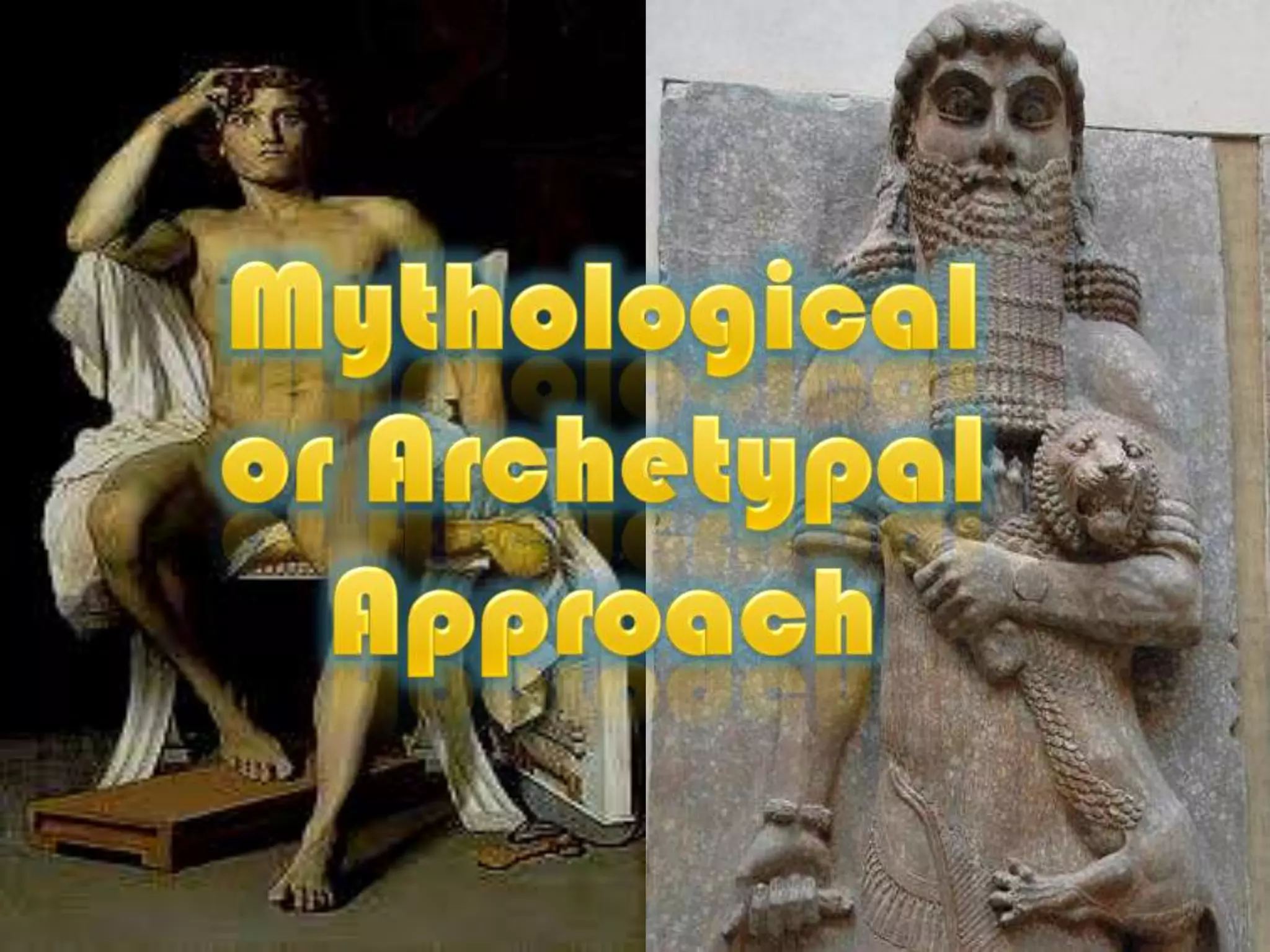
Gilgamesh The Iliad
(Achilles)
A warrior king
Expressed the
achievements of great
warriors
Partly divine, partly mortal Mixed divine and human
heritage
Expressed severe
loneliness in Enkidu’s
death
Expressed severe
loneliness in Patorclus’
death
Strives to achieve
immortality for Enkidu
Could not surpass
death
A bull was sent for him to
battle
Apollo set a plague that
wipes out a large number
of soldiers in the
Greek camp.
Searching for immortality Searching for honor
Attempted to ressurect
Enkidu’s body
Accepted Patroclus’ death
and avenged him
Raped the daughters in
each family
Women enjoyed Achilles’
“company”
Death was his destiny Death was his destiny
The Iliad by Homer (Yeng Bunsoy)

The Iliad by Homer (Yeng Bunsoy)

  • 1.
  • 2.
    HOMER •the greatest ofancient Greek epic poets •Lived in 850 BC, 12th century BC, or 7th century BC •Teacher of Greece •"the date of Homer" refers not to an individual, but to the period when the epics were created •Melesigenes •The poet's name is homophonous with ὅμηρος (hómēros), "hostage" (or "surety") •Iliad was composed by "Homer" in his maturity, while the Odyssey was a work of his old age •Homeric poems are dependent on an oral tradition
  • 3.
    The Iliad “The Songof Ilion” or “The Song of Ilium”  Ancient Greek epic poem written in dactylic hexameters  tells of the battles and events during the weeks of a quarrel between King Agamemmnon and the warrior Achilles  the story covers only a few weeks in the final year of the war (Medias Res)  the epic narrative takes up events prophesied for the future, such as Achilles' looming death  usually dated to around the eighth century BC  contains 15,693 lines written in Homeric Greek
  • 4.
    Characters: The Greeks Agamemmnon — King of Mycenae, leader of the Greeks.  Achilles — Leader of the Myrmidons, half-divine hero.  Odysseus — King of Ithaca, the wiliest Greek commander and hero of the Odyssey.  Ajax the Greater — son of Telamon, with Diomedes, he is second to Achilles in martial prowess.  Menelaus — King of Sparta, husband of Helen and brother of Agamemnon.  Diomedes — son of Tydeus, King of Argos  Ajax the Lesser — son of Oileus, often partner of Ajax the Greater.  Patroclus — Achilles’ closest companion.  Nestor — King of Pylos, and trusted advisor to Agamemnon.
  • 5.
    Characters: The TrojanMen  Hector — son of King Priam and the foremost Trojan warrior.  Aeneas — son of Anchises and Aphrodite.  Paris — Helen’s lover-abductor  Deiphobus — brother of Hector and Paris.  Priam — the aged King of Troy.  Polydamas — a prudent commander whose advice is ignored; he is Hector’s foil.  Agenor — a Trojan warrior, son of Antenor, who attempts to fight Achilles (Book XXI).  Sarpedon, son of Zeus — killed by Patroclus. Was friend of Glaucus and co- leader of the Lycians (fought for the Trojans).  Glaucus, son of Hippolochus— friend of Sarpedon and co-leader of the Lycians (fought for the Trojans).  Euphorbus — first Trojan warrior to wound Patroclus.  Dolon — a spy upon the Greek camp (Book X).  Antenor — King Priam’s advisor, who argues for returning Helen to end the war.  Polydorus — son of Priam and Laothoe  Pandarus — famous archer and son of Lycaon.
  • 6.
    Characters: The TrojanWomen  Hecuba— Priam’s wife, mother of Hector, Cassandra, Paris, and others.  Helen— abducted by Paris  Andromache — Hector’s wife, mother of Astyanax  Cassandra — Priam’s daughter; courted by Apollo, who bestows the gift of prophecy to her  Briseis— a Trojan woman captured by the Greeks; she was Achilles' prize of the Trojan war.
  • 7.
    Characters: Gods andGoddesses  Zeus (Neutral)  Hera (Achaeans)  Artemis (Trojans)  Apollo (Trojans)  Hades (Neutral)  Aphrodite (Trojans)  Ares (Trojans)  Athena (Achaeans)  Hermes (Neutral)  Poseidon (Achaeans)  Hephaestus (Neutral)  Iris (Achaeans)
  • 8.
    takes place inthe tenth year of the Trojan War Greece and Troy
  • 9.
    Prologue: The Judgment ofParis Paris was called to judge to whom the golden apple would be given among Pallas Athena, Aphrodite, and Hera “For the Fairest”
  • 10.
     Hera: Ipromise to make you the Lord of Europe and Asia!  Athena: You will lead the Trojans to victory against the Greeks and lay Greece in ruins!  Aphrodite: The fairest woman in the world should be yours! Paris chose Aphrodite. This was how the Trojan War began.
  • 11.
    Trojan War  Aphroditeled Paris to Sparta and he left Oenone for Helen.  Menelaus and Helen welcomed him as their guest. Paris broke his trust and completely left to Paris his home and went off to Crete. BUT…
  • 12.
    “Paris who coming Entereda friend’s kind dwelling, Shamed the hand there that gave him food, Stealing away a woman.”
  • 13.
    Menelaus got backto find Helen gone, and he called upon all Greece to help him. Wanted: Odysseus and Achilles (later go to the Greek camp) Aulis- a place of dangerous winds and strong tides
  • 14.
    Calchas declared thatthe Gods had spoken to him: Artemis was angry. Iphigenia must be sacrificed for them to have a safe voyage to Troy.
  • 15.
    Agamemmnon wrote tohis wife that he had arranged marriage to Iphigenia and Achilles. When she came to her wedding, she was carried to the altar to be killed. “And all her prayers---cries of Father, Father, Her maiden life, These they held as nothing, The savage warriors, battle-mad.”
  • 16.
     Protesilaus diedupon leaping ashore to the mouth of Simois and Hermes brought him up from the dead to see once again his deeply, mourning wife, Laodamia.  Laodamia killed herself and went to the underworld with Protesilaus.
  • 17.
    “Very brief isyour lot. Would that you could be free now from tears and troubles, for you shall not long endure, my child, short-lived beyond all men and to be pitied.” ~Thetis to Achilles
  • 18.
    “I know wellin my heart and in my soul, the day shall come when holy Troy will be laid low and Priam and Priam’s people.” ~Hector to Andromache
  • 19.
    Achilles vs. Agamemmnon  Chryses,a Trojan priest of Apollo, offers the Greeks wealth for the return of his daughter Chryseis.  He prayed to Apollo and he set up a plague against the Greek Army.  Agamemnon agrees to return Chryseis to her father, but also decides to take Achilles's captive, Briseis, as compensation.
  • 20.
     Achilles askshis mother, Thetis, to ask Zeus that the Greeks be brought to the breaking point by the Trojans, so Agamemnon will realize how much the Greeks need him.  Zeus sent a dream to Agamemmnon, urging him to attack Troy.
  • 21.
    Paris vs. Menelaus Paris offers to end the war by fighting a duel with Menelaus  Helen promised Priam to abide by the outcome of the duel.  Aphrodite rescues him and leads him to bed with Helen before Menelaus could kill him.
  • 23.
     Greeks: Ajaxand Diomedes  Trojans: Prince Aeneas (Aphrodite’s son)  Diomedes wounded her hand and she let Aeneas fall.  Diomedes (with the help of Hera) vs. Hector (with the help of Ares)  Ares was terribly wounded and went back to Olympus.
  • 24.
    “Lady Athena, sparethe city and the wives of the Trojans and the little children.” ~Hector
  • 25.
    Andromache: My dearlord, you are the father and mother and brother unto me as well as husband, stay here with us. Do not make me a widow and your child an orphan.” Hector: I could not be a coward. It was for me to fight always in the forefront of the battle. Hector to Astyanax: Far greater is he than his father was.
  • 26.
     Zeus helpedthe Trojans as a promise to Thetis.  Nestor told Agamemmnon that if he had not angered Achilles, they would not have been defeated.  Agamemmnon brought Briseis back to Achilles and give them all the riches.  Achilles angrily refuses Agamemnon's offer, and declares that he would only return to battle if the Trojans reach his ships and threaten them with fire.
  • 27.
    Because of Hera,the battled turned in favor of the Greeks. Poseidon was begged by Hera to help the Greeks and Zeus sent Iris to withdraw from the field. Apollo revived Hector.
  • 28.
    “You can keepyour wrath while your countrymen go down in ruin. I cannot. Give me your armor. If they think I am you, the Trojans may pause and the worn- out Greeks have a breathing space. You and I are fresh. We might yet drive back the enemy. But if you will sit nursing your anger, at least let me have the armor.” ~Patroclus
  • 29.
    “That way, theycan cut off the Army’s retreat. Go. Take my armor, my men too, and defend the ships. I cannot go. I am a man dishonored. For my own ships, if the battle comes near them, I will fight. I will not fight for men who have disgraced me.” ~Achilles
  • 30.
    The Death ofPatroclus “Bitter tidings. Patroclus is fallen and Hector has his armor.” ~Antilochus
  • 31.
    Achilles: I willno longer live among men, if I do not make Hector pay his death for he himself for Patroclus dead. Thetis: You yourself is fated to die straightway after Hector. Achilles: So may I do. I who did not help my comrade in his sore need. I will kill the destroyer of him I loved; then I will accept death when it comes.
  • 32.
    Achilles vs. Hector Hector:If I kill you, I will give back your body to your friends and do you do the same to me. Achilles: Madman. There are no covenants between sheep and wolves, nor between you and me. (hurling his spear)
  • 33.
    The Death ofHector Before Hector could approach, he who knew well that armor taken by Hector from the dead Patroclus aimed at an opening in it near the throat, and drove the spearpoint in. HECTOR FELL, DYING AT LAST!
  • 34.
    The Death ofHector Hector (dying): Give back my body to my father and my mother. Achilles: No prayers from you to me, you dog. I would that I could make myself devour raw your flesh for the evil you have brought upon me.
  • 35.
    Achilles pierced thefeet of Hector and fastened them with thongs to the back of his chariot, letting the head trail. He lashed his horses and round and round the walls of Troy he dragged all that was left for Hector.
  • 36.
    Achilles to thedead Patroclus “Hear me even in the house of Hades. I have dragged Hector behind my chariot and I will give him to the dogs to devour beside your funeral pyre.”
  • 37.
    King Priam: Remember,Achilles, your own father, of like years with me and like me wretched for want of a son. Yet, I am by far more to be pitied who have braved what no man on earth ever did before, to stretch out my hand, to the slayer of my son. Achilles: Sit me by here, and let our sorrow lie quiet in our hearts. Evil is all men’s lot, but yet, we must keep courage.
  • 38.
    “The other Trojansupbraid me. But always I had comfort from you through the gentleness of your spirit and your gentle words. You only were my friend.” ~Helen of Troy to King Priam
  • 39.
     The Trojanslamented Hector for 9 days.  When all was burned, they quenched the flame with wine and gathered the bones into a golden urn, shrouding them in soft purple. And with it, the Iliad ends.
  • 40.
  • 41.
    Achilles killed PrinceMemnon of Ethiopia Paris shot an arrow at Achilles and Apollo struck his foot in the one spot where he could be wounded… HIS HEEL.
  • 42.
     Marvelous armsThetis had brought Achilles caused the death of Ajax.  Odysseus got the arms and Ajax who was defeated was held to be dishonored.  Ajax was determined to kill Agamemmnon and Menelaus.  Because of his anger, he killed the flocks and herds of the Greeks.
  • 43.
    “The poor cattlekilled to no purpose by my hand. And I stand here alone, hateful to men and to gods. In such a state only a coward clings to life. A man, if he cannot live nobly, can die nobly.” ~Ajax
  • 44.
     There wasa man from the Trojans who knew the future, the prophet Helenus.  Troy would not fall until some one fought against the Trojans with the bow and arrows of Hercules.  Greeks stopped at an island to offer a sacrifice, and Philocletes was bitten by a serpent, and left him at Lemnos.
  • 45.
    Philoctetes wounded Pariswith his arrows. Paris begged to carry him to Mount Ida where Oenone and he once lived to be healed. But Oenone only watched him died.
  • 46.
     As longas the Trojans had the Palladium, the Greeks could not defeat them.  Diomedes stole the Palladium with the help of Odysseus.  The Greeks thought of a way to defeat the Trojans.
  • 47.
    The Stratagem ofthe Wooden Horse  Created by Odysseus  The wooden horse could hold a number of men.  Only Neoptolemus was not terror- stricken  Men inside the Trojan horse would surely die.
  • 48.
    The Plan  Toleave a single Greek behind in the deserted camp for the Trojans to bring the horse in their city  At night, the Greeks would come out of the horse and open the city gates to the Army
  • 49.
    In front ofthe Scaean gates stood an enormous figure of a horse Sinon told Priam that the horse was a votive offering to Pallas Athena.
  • 50.
     Priest Laocoonwarned the Trojans to destroy the wooden horse immediately.  Cassandra had echoed his warning, but no one believed her.  Two serpents crushed the life out of Laocoon and his two sons.
  • 51.
     Trojans draggedthe horse through the gate and up to the temple of Athena.  In the middle of the night, the door in the horse opened.  Troy was burning.  Achilles’ son struck Priam down before the eyes of Hecuba and their daughters.
  • 52.
     Aeneas foughtthe Greeks alone.  Even with Aphrodite’s wife, he couldn’t really save his wife and children.  Aphrodite helped Helen got out of the city and took her to Menelaus.  Only Hecuba, Andromache, and other Trojan women survived.  Death of Astyanax
  • 53.
    Andromache: Not thathe does not go with me? Herald: The boy must die—be thrown Down from the towering wall of Troy. Now—now—let it be done. Endure Like a brave woman. Think. You are alone. One woman and a slave and no help anywhere.
  • 54.
    “Weeping, my littleone? There, there. You cannot know what waits for you. --How will it be? Falling down—down— down—all broken— And none to pity. Kiss me. Never again. Come closer, closer. Your mother who bore you—put your arms around my neck. Now kiss me, lips to lips.” ~Andromache
  • 55.
  • 56.
    “Troy has perished,the great city. Only the red flame now lives there. The dust is rising, spreading out like a great wing of smoke, And all his hidden. We are gone, one here, one there. And Troy is gone forever.”
  • 57.
  • 58.
    Fate and Freewill becauseeverything is fated doesn't mean there isn't any freedom the gods don't control fate
  • 59.
     The Iliad’smale characters are motivated in some way by considerations of their social standing  Priam and Patroclus  depicted as a destructive force  shown as having some benefits
  • 60.
    Competition  The wayto get reputation and pride  Hector prays that his son will grow up to be a better warrior than him  He wants to be able to boast about having a better son than anyone else.
  • 61.
    Compassion and Forgiveness Achilles refuses the offerings of King Agamemmnon and did not show compassion to the Greeks  He refuses to make any deal with Hector
  • 62.
  • 63.
    Love  Hector andAndromache  Not only love as a spouse, but a parental love to Astyanax  Priam’s love for Hector  Hera’s seduction of Zeus  Forbidden love of Paris and Helen
  • 64.
  • 65.
    Warfare Battle scenes arepetrifying and brutal War is an almost inevitable part of human life
  • 66.
    Religion  Gods andGoddesses are a daily presence in people's lives  the mortals honor the gods with sacrifices, but they expect favors in return
  • 67.
    Glory of War Paris  Achilles  To fight is to prove one’s honor and integrity, while to avoid warfare is to demonstrate laziness, ignoble fear, or misaligned priorities  Homer portrays each side as having a justifiable reason to fight and depicts warfare as a respectable and even glorious manner of settling the dispute
  • 68.
    Military Glory overFamily Life  One wins in the eyes of others by performing great deeds  Hector knows that fighting among the front ranks represents the only means of “winning my father great glory.”  Achilles chose to avenge Patroclus and kill Hector rather than to stay with his aged father.
  • 69.
  • 70.
    Achaean Ships  futureof the Greek race  the heroes represented here actually lived historically, as real kings who ruled the various city-states of Greece in their earliest years  The mass death of these leaders and role models would have meant the decimation of a civilization.
  • 71.
    Shield of Achilles The world beyond the battlefield  Life as a whole  Human beings may serve not only as warriors but also as artisans and laborers in the fields
  • 74.
    Historical Approach  reflectedin the Homeric poems derives from a tradition of epic poetry founded on a war which actually took place  Others accept that there may be a foundation of historical events in the Homeric narrative, but say that in the absence of independent evidence it is not possible to separate fact from myth
  • 75.
     Represent anhistorical campaign that took place at the eve of the decline of the Mycenaean civilization  The Achilles of the Linear B tablet is a shepherd, not a king or warrior  Some story elements from the tablets appear in the Iliad  Troy VIh and Troy VIIa, both appear to have been destroyed by fires  The helmets covered with wild boar teeth described in the Iliad can be found on Bronze Age archeological contexts
  • 76.
     Their conclusionwas that there is regularly a consistency between the location of Troy as Hisarlik (and other locations such as the Greek camp)  One may see Homer or his informants as eyewitnesses to Troy and the landscape of Troy at the close of the eighth century B.C., the period when scholars generally agree Homer composed his epic  there were several armed conflicts in and around Troy at the end of the Late Bronze Age
  • 78.
    Gilgamesh The Iliad (Achilles) Awarrior king Expressed the achievements of great warriors Partly divine, partly mortal Mixed divine and human heritage Expressed severe loneliness in Enkidu’s death Expressed severe loneliness in Patorclus’ death Strives to achieve immortality for Enkidu Could not surpass death
  • 79.
    A bull wassent for him to battle Apollo set a plague that wipes out a large number of soldiers in the Greek camp. Searching for immortality Searching for honor Attempted to ressurect Enkidu’s body Accepted Patroclus’ death and avenged him Raped the daughters in each family Women enjoyed Achilles’ “company” Death was his destiny Death was his destiny