Profiling Floats and Gliders/AUVs Powered by Ocean Temperature Differential
Tony Loc and Thomas Valdez
Jet Propulsion Laboratory, California Institute of
Technology, Pasadena, California, USA
Russ Davis
Scripps Institute of Oceanography, University of
California, San Diego, California, USA
GENERATOR
HIGH
PRESSURE
BLADDER
LOW
PRESSURE
BLADDER
OIL
PCM
HYD TURBINE
VALVE
X
CALTECH
PATENT
GRANTED
Warm
Surface
water
Cold
Deep
water
Challenges in Ocean Observing: Unmanned Undersea Vehicles
The fundamental observational problem in oceanography is that of sampling a global, turbulent
fluid with physical, biological, and chemical processes that are active over a wide range of
scales. During the last decade, oceanography has witnessed a revolution in observing
capabilities such as UUVs (e.g., floats, gliders, or AUVs).
Ocean Thermal Energy: Unlimited Energy Supply for UUVs
Long endurance, high speed, and high payload power all require increased energy capacity on
the UUV. Energy considerations ultimate will impact vehicle design, size, and type. Furthermore,
there are disadvantages to using the conventional battery technologies for UUVs. The primary
batteries have to be discarded after use, and the cost penalty for batteries can be high for large
UUVs. High energy density batteries (e.g., lithium batteries) introduce safety concerns.
Rechargeable batteries are less costly over time. However, replenishment or recharge of
batteries (especially at-sea) is a major issue for UUV operations that require rapid
reconfigurability and may not be practical in many applications.
Phase Change Material (PCM)
WarmCold
Thermal RECharging
(TREC) Battery
We have developed a
commercially available Phase
Change Material (PCM) wax
with a phase change
temperature of 10oC, which can
be melted at sea level, and
frozen at deeper ocean depths.
The primary novelties of our
approach are to use advanced
materials and heat transfer
designs to generate a high
pressure fluid that drives a
hydraulic motor/generator to
charge the batteries. This
power cycle requires only a
small temperature difference
above and below a given
material s phase change
temperature of about 10oC,
which can be adjusted with
different mix of PCMs.
TREC Powered SOLO Float
We have designed a modified SOLO float so that the recharging batteries, and thus the
buoyancy control and all electrical operations, are powered by drawing the thermal energy from
the temperature differences between the warm upper ocean and the colder depths. A SOLO-
TREC prototype was deployed on Nov. 30, 2009, about 161 kilometers (100 miles) southwest of
Honolulu. Since its deployment, SOLO-TREC has been making 3 dives per day between the
surface and 500 meters depth. PCMs on-board the SOLO-TREC expand about 13% when
heated above 10oC and then correspondingly contract when cooled below 10oC. This
expansion/contraction produces a high pressure oil that can be collected and periodically
released to drive a hydraulic motor for electricity generation and battery recharging of about 1.6
Watt-hours (or over 7000 Joules) each dive. By June 2011, SOLO-TREC has made more
than1000 dives between surface and 500 meters.
Yi Chao, Tom Curtin, Charles Fisher, Dave Fratantoni, Jack Jones, Scott Leland, Robin Willis
Seatrec, Inc., Monrovia, California, USA
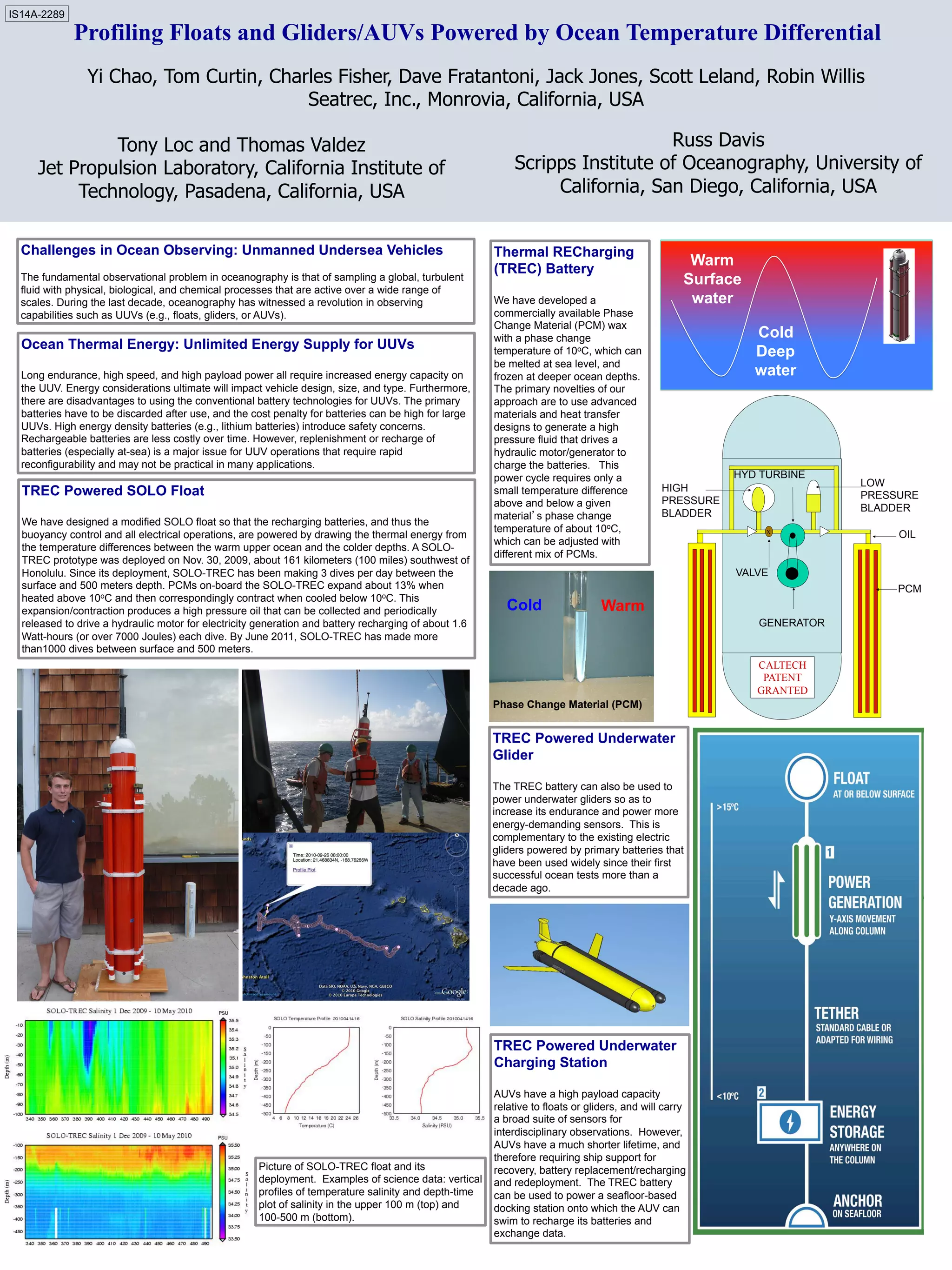
Picture of SOLO-TREC float and its
deployment. Examples of science data: vertical
profiles of temperature salinity and depth-time
plot of salinity in the upper 100 m (top) and
100-500 m (bottom).
TREC Powered Underwater
Glider
The TREC battery can also be used to
power underwater gliders so as to
increase its endurance and power more
energy-demanding sensors. This is
complementary to the existing electric
gliders powered by primary batteries that
have been used widely since their first
successful ocean tests more than a
decade ago.
TREC Powered Underwater
Charging Station
AUVs have a high payload capacity
relative to floats or gliders, and will carry
a broad suite of sensors for
interdisciplinary observations. However,
AUVs have a much shorter lifetime, and
therefore requiring ship support for
recovery, battery replacement/recharging
and redeployment. The TREC battery
can be used to power a seafloor-based
docking station onto which the AUV can
swim to recharge its batteries and
exchange data.
IS14A-2289

Profiling Floats and Gliders/AUVs Powered by Ocean Temperature Differential

  • 1.
    Profiling Floats andGliders/AUVs Powered by Ocean Temperature Differential Tony Loc and Thomas Valdez Jet Propulsion Laboratory, California Institute of Technology, Pasadena, California, USA Russ Davis Scripps Institute of Oceanography, University of California, San Diego, California, USA GENERATOR HIGH PRESSURE BLADDER LOW PRESSURE BLADDER OIL PCM HYD TURBINE VALVE X CALTECH PATENT GRANTED Warm Surface water Cold Deep water Challenges in Ocean Observing: Unmanned Undersea Vehicles The fundamental observational problem in oceanography is that of sampling a global, turbulent fluid with physical, biological, and chemical processes that are active over a wide range of scales. During the last decade, oceanography has witnessed a revolution in observing capabilities such as UUVs (e.g., floats, gliders, or AUVs). Ocean Thermal Energy: Unlimited Energy Supply for UUVs Long endurance, high speed, and high payload power all require increased energy capacity on the UUV. Energy considerations ultimate will impact vehicle design, size, and type. Furthermore, there are disadvantages to using the conventional battery technologies for UUVs. The primary batteries have to be discarded after use, and the cost penalty for batteries can be high for large UUVs. High energy density batteries (e.g., lithium batteries) introduce safety concerns. Rechargeable batteries are less costly over time. However, replenishment or recharge of batteries (especially at-sea) is a major issue for UUV operations that require rapid reconfigurability and may not be practical in many applications. Phase Change Material (PCM) WarmCold Thermal RECharging (TREC) Battery We have developed a commercially available Phase Change Material (PCM) wax with a phase change temperature of 10oC, which can be melted at sea level, and frozen at deeper ocean depths. The primary novelties of our approach are to use advanced materials and heat transfer designs to generate a high pressure fluid that drives a hydraulic motor/generator to charge the batteries. This power cycle requires only a small temperature difference above and below a given material s phase change temperature of about 10oC, which can be adjusted with different mix of PCMs. TREC Powered SOLO Float We have designed a modified SOLO float so that the recharging batteries, and thus the buoyancy control and all electrical operations, are powered by drawing the thermal energy from the temperature differences between the warm upper ocean and the colder depths. A SOLO- TREC prototype was deployed on Nov. 30, 2009, about 161 kilometers (100 miles) southwest of Honolulu. Since its deployment, SOLO-TREC has been making 3 dives per day between the surface and 500 meters depth. PCMs on-board the SOLO-TREC expand about 13% when heated above 10oC and then correspondingly contract when cooled below 10oC. This expansion/contraction produces a high pressure oil that can be collected and periodically released to drive a hydraulic motor for electricity generation and battery recharging of about 1.6 Watt-hours (or over 7000 Joules) each dive. By June 2011, SOLO-TREC has made more than1000 dives between surface and 500 meters. Yi Chao, Tom Curtin, Charles Fisher, Dave Fratantoni, Jack Jones, Scott Leland, Robin Willis Seatrec, Inc., Monrovia, California, USA Picture of SOLO-TREC float and its deployment. Examples of science data: vertical profiles of temperature salinity and depth-time plot of salinity in the upper 100 m (top) and 100-500 m (bottom). TREC Powered Underwater Glider The TREC battery can also be used to power underwater gliders so as to increase its endurance and power more energy-demanding sensors. This is complementary to the existing electric gliders powered by primary batteries that have been used widely since their first successful ocean tests more than a decade ago. TREC Powered Underwater Charging Station AUVs have a high payload capacity relative to floats or gliders, and will carry a broad suite of sensors for interdisciplinary observations. However, AUVs have a much shorter lifetime, and therefore requiring ship support for recovery, battery replacement/recharging and redeployment. The TREC battery can be used to power a seafloor-based docking station onto which the AUV can swim to recharge its batteries and exchange data. IS14A-2289