Ambareesh Kulkarni
Customer Engagement Life Cycle 
1.0 
Identify 
2.0 
Qualify 
3.0 
Propose 
4.0 
Negotiate 
5.0 
Deliver 
6.0 
Support
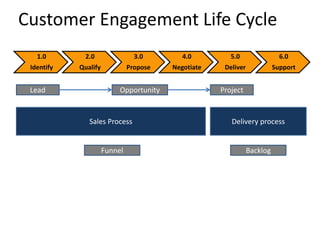
Customer Engagement Life Cycle 
1.0 
Identify 
2.0 
Qualify 
3.0 
Propose 
4.0 
Negotiate 
5.0 
Deliver 
6.0 
Support 
Lead Opportunity Project 
Sales Process Delivery process 
Funnel Backlog
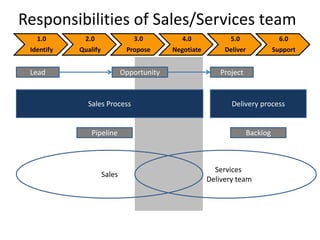
Responsibilities of Sales/Services team 
1.0 
Identify 
2.0 
Qualify 
3.0 
Propose 
4.0 
Negotiate 
5.0 
Deliver 
6.0 
Support 
Lead Opportunity Project 
Sales Process Delivery process 
Pipeline Backlog 
Sales 
Services 
Delivery team
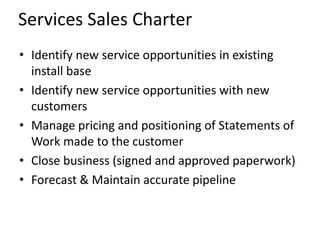
Services Sales Charter 
• Identify new service opportunities in existing 
install base 
• Identify new service opportunities with new 
customers 
• Manage pricing and positioning of Statements of 
Work made to the customer 
• Close business (signed and approved paperwork) 
• Forecast & Maintain accurate pipeline
Identify Service Opportunities 
1.0 
Identify 
2.0 
Qualify 
3.0 
Propose 
4.0 
Negotiate 
5.0 
Deliver 
6.0 
Support 
• Identify new service opportunities 
• Greatest revenue will come from existing install 
base 
• 80% of revenue will come form 20% of current 
customer accounts 
• Leads come from: Marketing activities, Strategic 
account managers, Personal contacts & 
Consultants
Qualify Service Opportunities 
1.0 
Identify 
2.0 
Qualify 
3.0 
Propose 
4.0 
Negotiate 
5.0 
Deliver 
6.0 
Support 
• Funding: Does the customer have the budget 
available for the proposed project? 
• Timing: When does the customer need to start? 
• Competition: How are we well positioned? How 
many competitors are we bidding against? 
• Services Expertise: Have we delivered this type of 
project before? Does the services group have the 
required resources to deliver the project?
Qualify Service Opportunities 
1.0 
Identify 
2.0 
Qualify 
3.0 
Propose 
4.0 
Negotiate 
5.0 
Deliver 
6.0 
Support 
Sirens’ Song: The more bids that we submit, the 
more business will be won and the more profit 
there will be 
Boulder ahead: Bidding on services 
opportunities that have a low probability of 
being won can be the most expensive mistake 
we can make
Qualify Service Opportunities 
1.0 
Identify 
2.0 
Qualify 
3.0 
Propose 
4.0 
Negotiate 
5.0 
Deliver 
6.0 
Support 
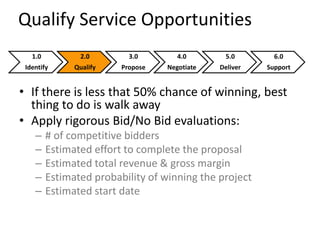
• If there is less that 50% chance of winning, best 
thing to do is walk away 
• Apply rigorous Bid/No Bid evaluations: 
– # of competitive bidders 
– Estimated effort to complete the proposal 
– Estimated total revenue & gross margin 
– Estimated probability of winning the project 
– Estimated start date
Propose Service Solution 
1.0 
Identify 
2.0 
Qualify 
3.0 
Propose 
4.0 
Negotiate 
5.0 
Deliver 
6.0 
Support 
• This is the step where a Statement of Work is 
created 
• Know the different types of services offerings that 
are available (see next slide) 
• Ensure that the opportunity is qualified and the 
customer is familiar with the products being 
proposed
Propose Service Solution 
1.0 
Identify 
2.0 
Qualify 
3.0 
Propose 
4.0 
Negotiate 
5.0 
Deliver 
6.0 
Support 
Offering Description 
Time & Materials Pay by the drink. High Value and aligns priorities. 
Fixed Price Highest risk. Customer’s perceived value is high. Shows 
confidence on our part. 
Packaged offering Easy to sell, High value and creates potential upsell 
opportunities. 
Bundled with 
software 
Easy to sell & easy to buy. Gets our foot in through the door. 
High risk of expectation mismatch.
Negotiate 
1.0 
Identify 
2.0 
Qualify 
3.0 
Propose 
4.0 
Negotiate 
5.0 
Deliver 
6.0 
Support 
• This is the step where the customer is seeking 
clarifications on the SOW 
• The customer may also want to negotiate on 
price, timelines etc. 
– Typical tactic: Request a T&M proposal and then ask 
that we fix price it! Can be done, with appropriate 
markups (about 20-20%). 
– Get agreement on ‘walk away’ price.
Negotiate – New Rate Card 
1.0 
Identify 
2.0 
Qualify 
3.0 
Propose 
4.0 
Negotiate 
5.0 
Deliver 
6.0 
Support
Delivery - Preparation 
1.0 
Identify 
2.0 
Qualify 
3.0 
Propose 
4.0 
Negotiate 
5.0 
Deliver 
6.0 
Support 
• Once signed SOW and PO is received, 
resourcing process begins 
• Typical lead time 4-6 weeks 
• Consultants are assigned based on skills set 
and availability 
• Consultants can be sourced Globally
Delivery – Project Start 
1.0 
Identify 
2.0 
Qualify 
3.0 
Propose 
4.0 
Negotiate 
5.0 
Deliver 
6.0 
Support 
• Consultants follow delivery methodology outlined in 
the SOW 
• Kick off call to be scheduled with customer 
– AD or SE to help schedule 
– Consultant will query customer on readiness (pre-reqs.) 
– Start-date and time to be agreed upon 
• Project admin. makes travel arrangements 
• Implementation begins
Opportunity forecasting 
• Critical for us to manage treacherous supply-demand 
curves 
• Inaccurate forecasting can lead to a deep and 
expensive hole or, at the minimum, a lost 
revenue opportunity
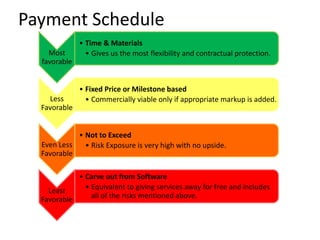
Payment Schedule 
Most 
favorable 
• Time & Materials 
• Gives us the most flexibility and contractual protection. 
Less 
Favorable 
• Fixed Price or Milestone based 
• Commercially viable only if appropriate markup is added. 
Even Less 
Favorable 
• Not to Exceed 
• Risk Exposure is very high with no upside. 
Least 
Favorable 
• Carve out from Software 
• Equivalent to giving services away for free and includes 
all of the risks mentioned above.

Professional Services Sales Techniques & Methodology

  • 1.
  • 2.
    Customer Engagement LifeCycle 1.0 Identify 2.0 Qualify 3.0 Propose 4.0 Negotiate 5.0 Deliver 6.0 Support
  • 3.
    Customer Engagement LifeCycle 1.0 Identify 2.0 Qualify 3.0 Propose 4.0 Negotiate 5.0 Deliver 6.0 Support Lead Opportunity Project Sales Process Delivery process Funnel Backlog
  • 4.
    Responsibilities of Sales/Servicesteam 1.0 Identify 2.0 Qualify 3.0 Propose 4.0 Negotiate 5.0 Deliver 6.0 Support Lead Opportunity Project Sales Process Delivery process Pipeline Backlog Sales Services Delivery team
  • 5.
    Services Sales Charter • Identify new service opportunities in existing install base • Identify new service opportunities with new customers • Manage pricing and positioning of Statements of Work made to the customer • Close business (signed and approved paperwork) • Forecast & Maintain accurate pipeline
  • 6.
    Identify Service Opportunities 1.0 Identify 2.0 Qualify 3.0 Propose 4.0 Negotiate 5.0 Deliver 6.0 Support • Identify new service opportunities • Greatest revenue will come from existing install base • 80% of revenue will come form 20% of current customer accounts • Leads come from: Marketing activities, Strategic account managers, Personal contacts & Consultants
  • 7.
    Qualify Service Opportunities 1.0 Identify 2.0 Qualify 3.0 Propose 4.0 Negotiate 5.0 Deliver 6.0 Support • Funding: Does the customer have the budget available for the proposed project? • Timing: When does the customer need to start? • Competition: How are we well positioned? How many competitors are we bidding against? • Services Expertise: Have we delivered this type of project before? Does the services group have the required resources to deliver the project?
  • 8.
    Qualify Service Opportunities 1.0 Identify 2.0 Qualify 3.0 Propose 4.0 Negotiate 5.0 Deliver 6.0 Support Sirens’ Song: The more bids that we submit, the more business will be won and the more profit there will be Boulder ahead: Bidding on services opportunities that have a low probability of being won can be the most expensive mistake we can make
  • 9.
    Qualify Service Opportunities 1.0 Identify 2.0 Qualify 3.0 Propose 4.0 Negotiate 5.0 Deliver 6.0 Support • If there is less that 50% chance of winning, best thing to do is walk away • Apply rigorous Bid/No Bid evaluations: – # of competitive bidders – Estimated effort to complete the proposal – Estimated total revenue & gross margin – Estimated probability of winning the project – Estimated start date
  • 10.
    Propose Service Solution 1.0 Identify 2.0 Qualify 3.0 Propose 4.0 Negotiate 5.0 Deliver 6.0 Support • This is the step where a Statement of Work is created • Know the different types of services offerings that are available (see next slide) • Ensure that the opportunity is qualified and the customer is familiar with the products being proposed
  • 11.
    Propose Service Solution 1.0 Identify 2.0 Qualify 3.0 Propose 4.0 Negotiate 5.0 Deliver 6.0 Support Offering Description Time & Materials Pay by the drink. High Value and aligns priorities. Fixed Price Highest risk. Customer’s perceived value is high. Shows confidence on our part. Packaged offering Easy to sell, High value and creates potential upsell opportunities. Bundled with software Easy to sell & easy to buy. Gets our foot in through the door. High risk of expectation mismatch.
  • 12.
    Negotiate 1.0 Identify 2.0 Qualify 3.0 Propose 4.0 Negotiate 5.0 Deliver 6.0 Support • This is the step where the customer is seeking clarifications on the SOW • The customer may also want to negotiate on price, timelines etc. – Typical tactic: Request a T&M proposal and then ask that we fix price it! Can be done, with appropriate markups (about 20-20%). – Get agreement on ‘walk away’ price.
  • 13.
    Negotiate – NewRate Card 1.0 Identify 2.0 Qualify 3.0 Propose 4.0 Negotiate 5.0 Deliver 6.0 Support
  • 14.
    Delivery - Preparation 1.0 Identify 2.0 Qualify 3.0 Propose 4.0 Negotiate 5.0 Deliver 6.0 Support • Once signed SOW and PO is received, resourcing process begins • Typical lead time 4-6 weeks • Consultants are assigned based on skills set and availability • Consultants can be sourced Globally
  • 15.
    Delivery – ProjectStart 1.0 Identify 2.0 Qualify 3.0 Propose 4.0 Negotiate 5.0 Deliver 6.0 Support • Consultants follow delivery methodology outlined in the SOW • Kick off call to be scheduled with customer – AD or SE to help schedule – Consultant will query customer on readiness (pre-reqs.) – Start-date and time to be agreed upon • Project admin. makes travel arrangements • Implementation begins
  • 16.
    Opportunity forecasting •Critical for us to manage treacherous supply-demand curves • Inaccurate forecasting can lead to a deep and expensive hole or, at the minimum, a lost revenue opportunity
  • 17.
    Payment Schedule Most favorable • Time & Materials • Gives us the most flexibility and contractual protection. Less Favorable • Fixed Price or Milestone based • Commercially viable only if appropriate markup is added. Even Less Favorable • Not to Exceed • Risk Exposure is very high with no upside. Least Favorable • Carve out from Software • Equivalent to giving services away for free and includes all of the risks mentioned above.