Professional CV Ian R McAllister M.Eng MBA UK Professional Recruiter Principle, CV4.biz http://cv4.biz [email_address] 0844 884 2825
This presentational video will show you: The requirements of the modern job market Creating your Professional CV How recruiters and employers reject job applicants Constructing your Professional CV  Job Application If you have any questions: http://cv4.biz 0844 884 2825
The modern job market is tough, and changed In the old days.... Executive and White collar jobs: found through broadsheet newspapers/networking Blue collar jobs: found through local newspapers/word of mouth Today..... One third of jobs are fulfilled internally - promotion One third by known job applicants – suppliers, customers, recommendation, networking One third by external hiring – Job Adverts BUT -  these are pretty much the same statistics as 30years ago, so why is the modern job market so tough?
Modern job market differences The visibility of a job advert was previously defined by the distribution of the newspaper. Now anyone in the world can register alerts with any jobs board. The result is around 1/3rd more job applicant competition per job, increased further through the effects of the global credit crunch/recession HR teams are more aware of the science of selecting the best candidates, particularly corporates who define 50% of UK commercial employment market The growth in SME enterprises means that although skills and qualifications still count, the boss and hiring manger are more often one person. Getting on with people counts as much/more than skills But the truth is that the basics of recruitment and employment remain the same: People hire people!
Job Applicants get confused by Jobs Boards Approximately 50,000 job boards in North America alone, and 50,000 in the rest of the world The cost of setting up a job board is less than $2500 = cheap! They seem to offer lots of jobs, but.... They attract paying customers (employers/recruiters) through the scale of their candidate database. Job Seekers are just commercial fodder for creating their business NOTE:  the average job seeker spends 40% of their time on job boards, but only 12% of jobs are filled from job board adverts The best jobs boards are often those run by your professional society: real members, real jobs, no duplicate postings, well vetted job adverts
Conclusions… Recruitment has not changed, but competition has increased due to better advertising  You need more than one method  to  find/apply for jobs  Use your time wisely and measure what counts  People STILL employ people!
Creating a Professional CV Don't start with.....  Something old - it will need revising  A template /something a mate gave you  - it will look like everyone else's The thought that you have to lie to get a job – you could get sacked/sent to jail That you have to include EVRYTHING – no, just the relevant stuff for that job
Creating a Professional CV Do start with... A good list of your career experiences - who would validate this/ provide  a reference?  A clear idea of what you want to do next - sector/position Know what you need to get paid to cover your bills  The geography in which you  could  work/move  to A market test of whether your ideal job exists … C heck the job boards! Find at least 20+ suitable positions Can’t find 20+ jobs? You might spend a long time job searching
How employers/recruiters reject job applicants E mployment starts with a business need = agreed business case  The need for an employee will be defined by a  combination of:  skills, qualifications, experiences  How that  SQE  is used  will be defined within a Job Description  HR team will  a dvise that :  such an SQE set exists ;  the pay level  A  Job Advert  is the core  5/8  SQE  requirements from the  J ob  D escription Whether they hire internally or externally, inclusion/rejection of all job applicants is defined by the test of whether or not they have those 5/8 skills If you d on't have th at SQE  OR don't communicate you have th at SQE = REJECTION!
Construction of your Professional CV All modern CV's are nominally a hybrid format:  Reverse chronological:  nice history, might not highlight  SQE   S k ills based:  nice  SQE , but difficult to confirm your work history  Hybrid:  best of both, including  SQE  and work history  Never use a Skills based CV  UNLESS  you are changing   career s, ie:  sales person to teacher designer to chemist
Construction of your Professional CV   Things you will need: Name : keep it the same everywhere! Contact details: address, eMail, telephone D on't use existing employer details! If security is a concern,  get a  P ost Office  Box and PAYG cellphone  Personal  S tatement:  “ I am, I do/deliver, I seek ” Chronological list of positions/SQE going back 5years  List of education, training and qualifications with dates ONLY add hobbies/interests IF they add value eg: no managerial experience, but you captain a football team
Personal Statement   Old style = focused on YOU and your ambitions New Style = focuses your skills on that JOB How do you construct one?   I am:   I am a Professional CV Writer I do/deliver:   who creates interview winning Professional CV’s, that get motivated job seekers employed within half the time of the average job seeker I seek:   (That job!) The great Power Words debate… Theory: Power Words create emphasis and action Reality: once you have seen three PW packed CV’s in a day, they lose their originality Conclusion:  like  BOLD  and bullets, use Power Words sparingly to emphasise your value to that employer
Positional Write Ups   Write-up each position, communicating what you did and achieved Break big jobs down: ie one 5year job could be two shorter jobs Amalgamate short positions: 3years of 3month contracts could be one job  Best write-up form is STAR: Situation: who, when, what, where, why? Task: what was the required achievement? Action: what action did you take, how did you deploy resources? Result: did you (over) achieve? Don’t focus all on the jobs duties, write up what you achieved: Not too much:  I was responsible for a checkout, where I… More of:  I won employee of the month twice because of customer written compliments Don’t over bullet or over bold Two/three lines of text, plus… 5 bullets maximum to highlight achievements/key SQE
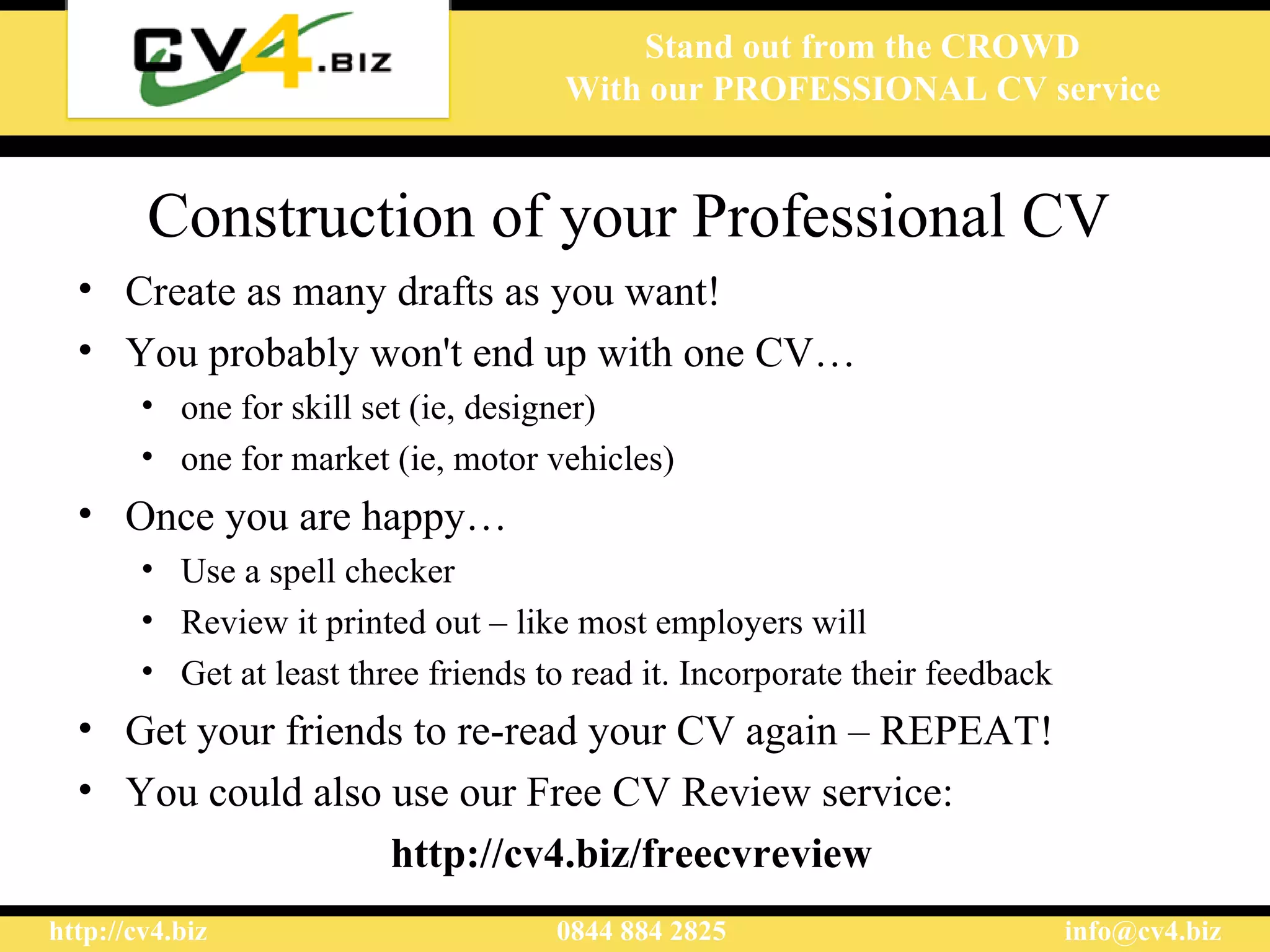
Construction of  your  Professional CV  Create as many drafts as you want!  You probably won't end up with one CV … one for skill  set  (ie, designer) one for market (ie, motor vehicles)  Once you are happy … Use a spell checker Review it printed out – like most employers will G et at least three friends to read it. Incorporate their feedback  Get your friends to re-read your CV again  – REPEAT! You could also use  our  Free CV Review service: http://cv4.biz/freecvreview
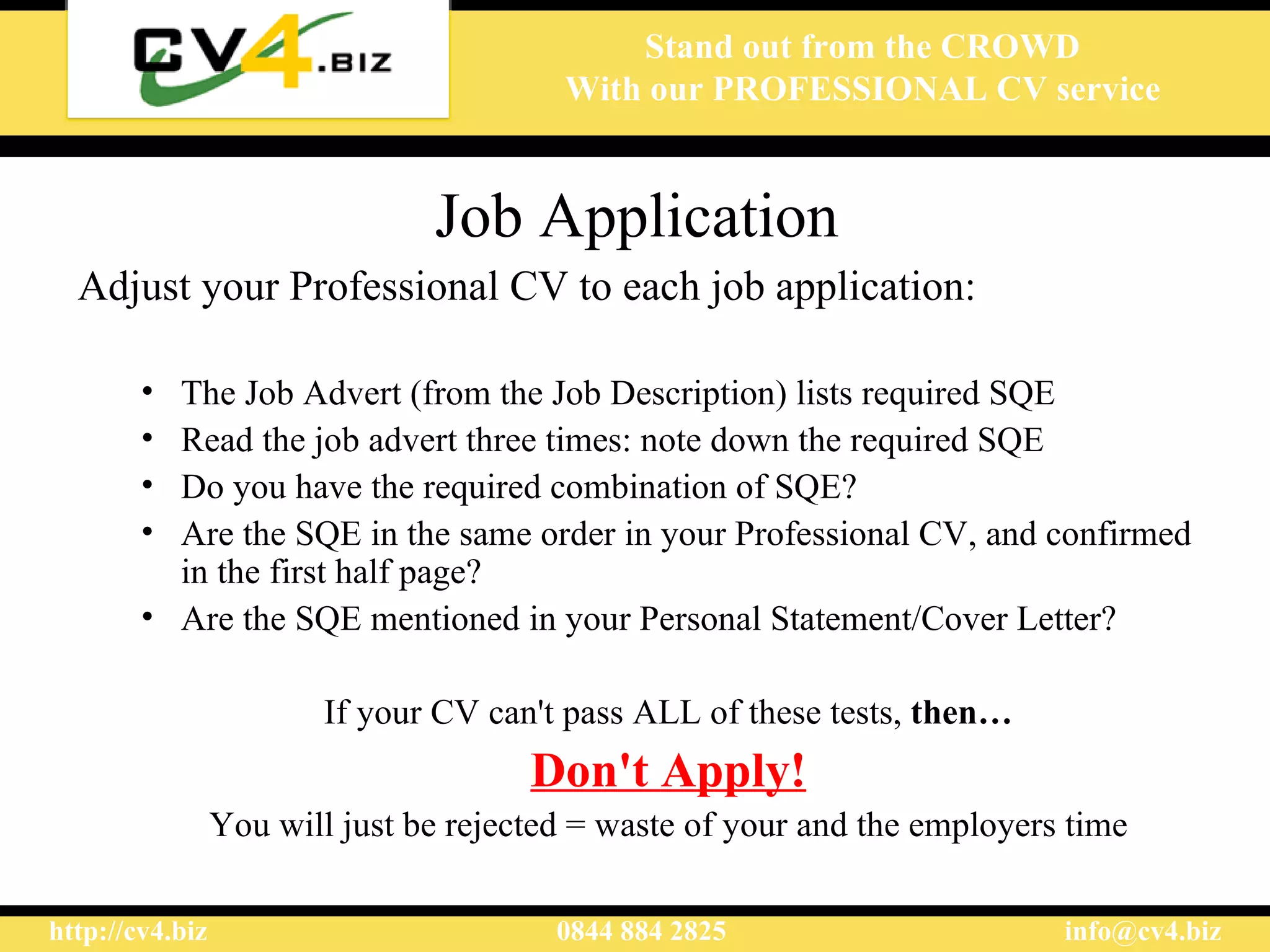
Job Application Adjust your Professional  CV to each job application : The  J ob  A dvert  (from the Job Description)  lists  required SQ E Read the job advert three times:  note down the required SQE D o you have th e required combination of SQE ? Are the SQE in the same order in your  Professional  CV , and confirmed in the first half page? Are the SQE mentioned in your Personal Statement/Cover Letter? If your CV can't pass ALL of these tests,  then … D on't  A pply ! Y ou will just be rejected  = waste of your and the employers time
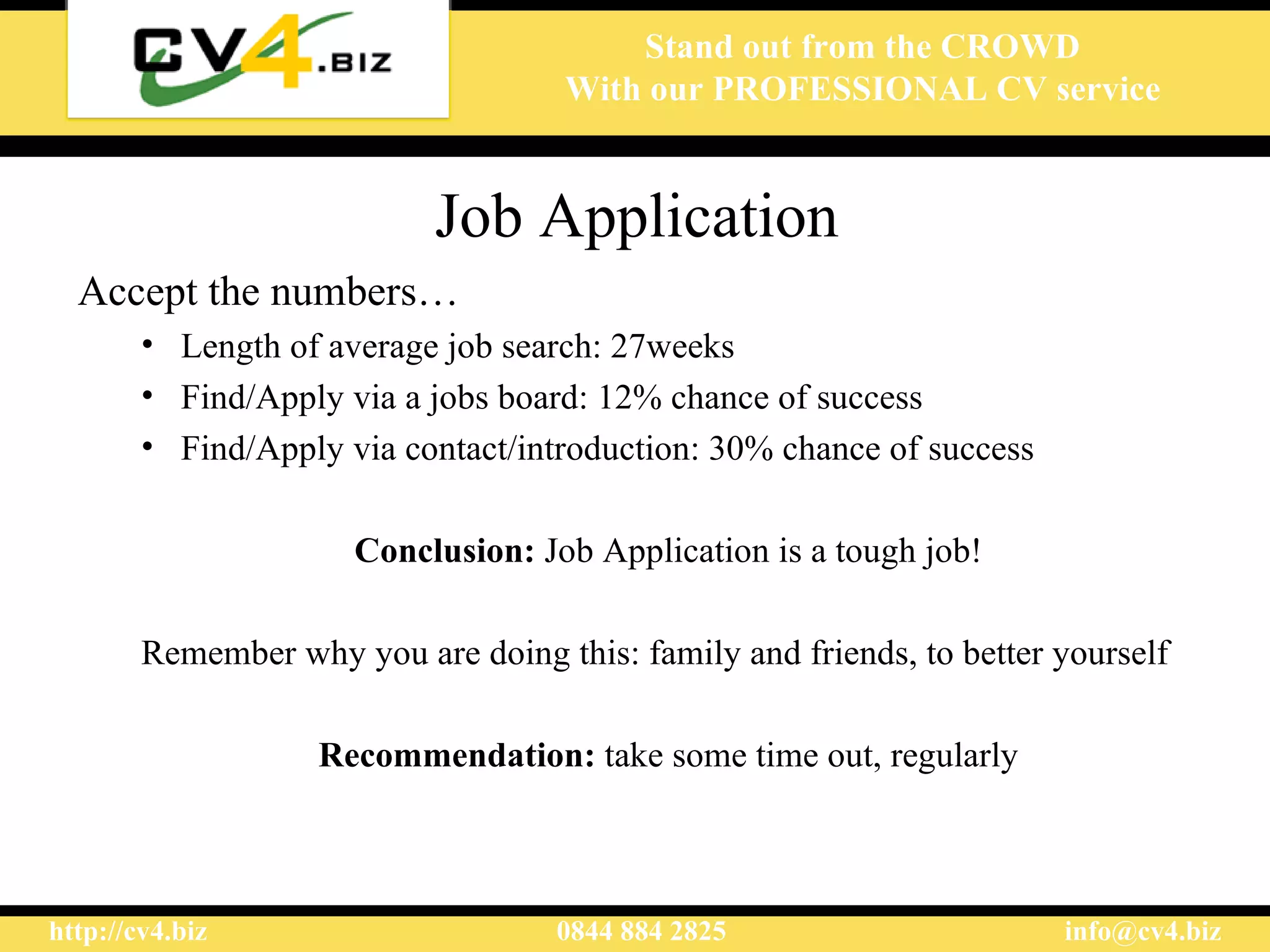
Job Application Accept the numbers… Length of average job search: 27weeks  Find/ Apply via a jobs board: 12% chance of success Find/ Apply via contact/introduction: 30% chance of success Conclusion:  Job Application is a tough job! Remember why you are doing this: family and friends, to better yourself Recommendation:  take some time out, regularly
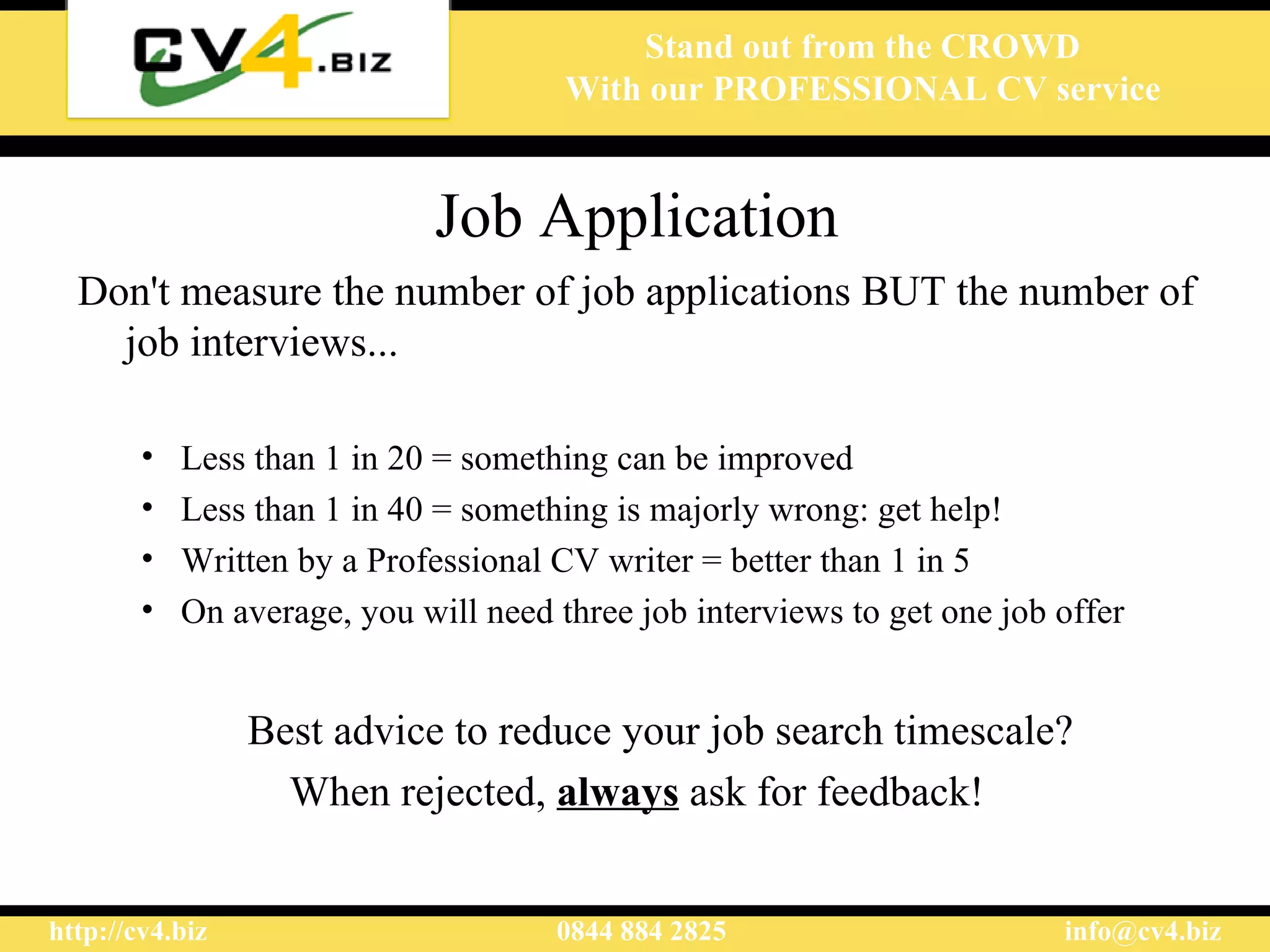
Job Application Don't measure the number of job applications BUT the number of  job  interviews...  Less than 1 in 20 = something can be improved Less than 1 in 40 = something is majorly wrong: get help! Written by a Professional CV writer = better than 1 in 5  On average, you will need three job interviews to get one job offer Best advice to reduce your job search  timescale ? When rejected,  always  ask for feedback !
Next Steps Job Application only finishes when you have a job offer Telephone Interviews are as key as Job Interviews Job Interviews are easy if… You have told the truth throughout your job application You are in a job interview with an employer you want to work for After that its about controlling your nerves and communication Don’t worry if you get rejected… Final choice will, like dating, come down to chemistry between you and the Hiring Manager – every recruiter knows this Keep measuring the job application to job interview ratio
One last thought… If you need some help… Submit your Professional CV for a free review at: http://cv4.biz/freecvreview Call us on: 0844 884 2825 Thank You, and Good Luck! Music:  “Finding the Balance”  Kevin MacLeod (incompetech.com) Licensed under Creative Commons "Attribution 3.0" http://creativecommons.org/licenses/by/3.0/

Professional CV

  • 1.
    Professional CV IanR McAllister M.Eng MBA UK Professional Recruiter Principle, CV4.biz http://cv4.biz [email_address] 0844 884 2825
  • 2.
    This presentational videowill show you: The requirements of the modern job market Creating your Professional CV How recruiters and employers reject job applicants Constructing your Professional CV Job Application If you have any questions: http://cv4.biz 0844 884 2825
  • 3.
    The modern jobmarket is tough, and changed In the old days.... Executive and White collar jobs: found through broadsheet newspapers/networking Blue collar jobs: found through local newspapers/word of mouth Today..... One third of jobs are fulfilled internally - promotion One third by known job applicants – suppliers, customers, recommendation, networking One third by external hiring – Job Adverts BUT - these are pretty much the same statistics as 30years ago, so why is the modern job market so tough?
  • 4.
    Modern job marketdifferences The visibility of a job advert was previously defined by the distribution of the newspaper. Now anyone in the world can register alerts with any jobs board. The result is around 1/3rd more job applicant competition per job, increased further through the effects of the global credit crunch/recession HR teams are more aware of the science of selecting the best candidates, particularly corporates who define 50% of UK commercial employment market The growth in SME enterprises means that although skills and qualifications still count, the boss and hiring manger are more often one person. Getting on with people counts as much/more than skills But the truth is that the basics of recruitment and employment remain the same: People hire people!
  • 5.
    Job Applicants getconfused by Jobs Boards Approximately 50,000 job boards in North America alone, and 50,000 in the rest of the world The cost of setting up a job board is less than $2500 = cheap! They seem to offer lots of jobs, but.... They attract paying customers (employers/recruiters) through the scale of their candidate database. Job Seekers are just commercial fodder for creating their business NOTE: the average job seeker spends 40% of their time on job boards, but only 12% of jobs are filled from job board adverts The best jobs boards are often those run by your professional society: real members, real jobs, no duplicate postings, well vetted job adverts
  • 6.
    Conclusions… Recruitment hasnot changed, but competition has increased due to better advertising You need more than one method to find/apply for jobs Use your time wisely and measure what counts People STILL employ people!
  • 7.
    Creating a ProfessionalCV Don't start with..... Something old - it will need revising A template /something a mate gave you - it will look like everyone else's The thought that you have to lie to get a job – you could get sacked/sent to jail That you have to include EVRYTHING – no, just the relevant stuff for that job
  • 8.
    Creating a ProfessionalCV Do start with... A good list of your career experiences - who would validate this/ provide a reference? A clear idea of what you want to do next - sector/position Know what you need to get paid to cover your bills The geography in which you could work/move to A market test of whether your ideal job exists … C heck the job boards! Find at least 20+ suitable positions Can’t find 20+ jobs? You might spend a long time job searching
  • 9.
    How employers/recruiters rejectjob applicants E mployment starts with a business need = agreed business case The need for an employee will be defined by a combination of: skills, qualifications, experiences How that SQE is used will be defined within a Job Description HR team will a dvise that : such an SQE set exists ; the pay level A Job Advert is the core 5/8 SQE requirements from the J ob D escription Whether they hire internally or externally, inclusion/rejection of all job applicants is defined by the test of whether or not they have those 5/8 skills If you d on't have th at SQE OR don't communicate you have th at SQE = REJECTION!
  • 10.
    Construction of yourProfessional CV All modern CV's are nominally a hybrid format: Reverse chronological: nice history, might not highlight SQE S k ills based: nice SQE , but difficult to confirm your work history Hybrid: best of both, including SQE and work history Never use a Skills based CV UNLESS you are changing career s, ie: sales person to teacher designer to chemist
  • 11.
    Construction of yourProfessional CV Things you will need: Name : keep it the same everywhere! Contact details: address, eMail, telephone D on't use existing employer details! If security is a concern, get a P ost Office Box and PAYG cellphone Personal S tatement: “ I am, I do/deliver, I seek ” Chronological list of positions/SQE going back 5years List of education, training and qualifications with dates ONLY add hobbies/interests IF they add value eg: no managerial experience, but you captain a football team
  • 12.
    Personal Statement Old style = focused on YOU and your ambitions New Style = focuses your skills on that JOB How do you construct one? I am: I am a Professional CV Writer I do/deliver: who creates interview winning Professional CV’s, that get motivated job seekers employed within half the time of the average job seeker I seek: (That job!) The great Power Words debate… Theory: Power Words create emphasis and action Reality: once you have seen three PW packed CV’s in a day, they lose their originality Conclusion: like BOLD and bullets, use Power Words sparingly to emphasise your value to that employer
  • 13.
    Positional Write Ups Write-up each position, communicating what you did and achieved Break big jobs down: ie one 5year job could be two shorter jobs Amalgamate short positions: 3years of 3month contracts could be one job Best write-up form is STAR: Situation: who, when, what, where, why? Task: what was the required achievement? Action: what action did you take, how did you deploy resources? Result: did you (over) achieve? Don’t focus all on the jobs duties, write up what you achieved: Not too much: I was responsible for a checkout, where I… More of: I won employee of the month twice because of customer written compliments Don’t over bullet or over bold Two/three lines of text, plus… 5 bullets maximum to highlight achievements/key SQE
  • 14.
    Construction of your Professional CV Create as many drafts as you want! You probably won't end up with one CV … one for skill set (ie, designer) one for market (ie, motor vehicles) Once you are happy … Use a spell checker Review it printed out – like most employers will G et at least three friends to read it. Incorporate their feedback Get your friends to re-read your CV again – REPEAT! You could also use our Free CV Review service: http://cv4.biz/freecvreview
  • 15.
    Job Application Adjustyour Professional CV to each job application : The J ob A dvert (from the Job Description) lists required SQ E Read the job advert three times: note down the required SQE D o you have th e required combination of SQE ? Are the SQE in the same order in your Professional CV , and confirmed in the first half page? Are the SQE mentioned in your Personal Statement/Cover Letter? If your CV can't pass ALL of these tests, then … D on't A pply ! Y ou will just be rejected = waste of your and the employers time
  • 16.
    Job Application Acceptthe numbers… Length of average job search: 27weeks Find/ Apply via a jobs board: 12% chance of success Find/ Apply via contact/introduction: 30% chance of success Conclusion: Job Application is a tough job! Remember why you are doing this: family and friends, to better yourself Recommendation: take some time out, regularly
  • 17.
    Job Application Don'tmeasure the number of job applications BUT the number of job interviews... Less than 1 in 20 = something can be improved Less than 1 in 40 = something is majorly wrong: get help! Written by a Professional CV writer = better than 1 in 5 On average, you will need three job interviews to get one job offer Best advice to reduce your job search timescale ? When rejected, always ask for feedback !
  • 18.
    Next Steps JobApplication only finishes when you have a job offer Telephone Interviews are as key as Job Interviews Job Interviews are easy if… You have told the truth throughout your job application You are in a job interview with an employer you want to work for After that its about controlling your nerves and communication Don’t worry if you get rejected… Final choice will, like dating, come down to chemistry between you and the Hiring Manager – every recruiter knows this Keep measuring the job application to job interview ratio
  • 19.
    One last thought…If you need some help… Submit your Professional CV for a free review at: http://cv4.biz/freecvreview Call us on: 0844 884 2825 Thank You, and Good Luck! Music: “Finding the Balance” Kevin MacLeod (incompetech.com) Licensed under Creative Commons "Attribution 3.0" http://creativecommons.org/licenses/by/3.0/