How to write a CV: Basic
principles
Graeme Jordan
CV writer and career Coach
www.GraemeJordan.co.uk
First …
What is a CV?
www.GraemeJordan.co.uk
A CV or Curriculum Vitae, is the
comprehensive presentation of your
education, experience and work skills as a
prospective employee.
www.GraemeJordan.co.uk
In many professions, you are always going to be
competing with people who have similar
qualifications and a similar number of years
experience.
So, what else you got?
www.GraemeJordan.co.uk
The ‘what else’ is the difference between being
good at your job and being excellent.
Don’t be discouraged if you struggle to identify
your unique skills. Try making a list of your
achievements from previous jobs and use that as
a basis to establish what sets you apart.
www.GraemeJordan.co.uk
The ought to be’s
www.GraemeJordan.co.uk
It’s really important not to put things on
your CV because you feel they ‘ought to
be’ there.
Put things on your CV that will get you
selected.
www.GraemeJordan.co.uk
Eliminate ought to be’s by researching
the industry, company and job that
you’re applying to.
Find out what their values are, the kinds
of people they employ, then present
yourself as somebody they want.
www.GraemeJordan.co.uk
Find a CV style that works
for you and with your
abilities!
www.GraemeJordan.co.uk
Getting back to
basics!
www.GraemeJordan.co.uk
 Select appropriate content
 Present it well
 Get feedback wherever possible (and act on
it)
 Avoid gimmicks
 Ignore the inevitable well-intended advice
you get from all over the place that just isn’t
right for you.
www.GraemeJordan.co.uk
What to include
on a CV
www.GraemeJordan.co.uk
Don’t believe any advice that says this
or that should or shouldn’t be included.
The test is very simple: If it says
something positive about you that is
relevant to the job; it should be in.
www.GraemeJordan.co.uk
A profile section at the start, which is
an introduction to you and your
background, can be very useful. But
keep it short!
www.GraemeJordan.co.uk
Okay, I know I just said don’t believe
advice on what not to include on your
CV, but there are a few things that
should be common sense…
www.GraemeJordan.co.uk
Don’t tell a story; you’re not writing prose - -
you’re writing a CV demonstrating your skills
and expertise.
An interview gives you the opportunity to
exercise your story telling skills!
www.GraemeJordan.co.uk
‘Socialising with friends’ is definitely not a hobby
that is going to impress employers
You should not state your ‘Career Objective’; you
should focus on what you can do for an
employer
You should not explain why you left any job,
write anything negative about yourself, or
criticise your previous employers (even if they
were unimaginable cretins).
www.GraemeJordan.co.uk
It’s all about appropriate presentation:
Why should an employer choose you?
www.GraemeJordan.co.uk
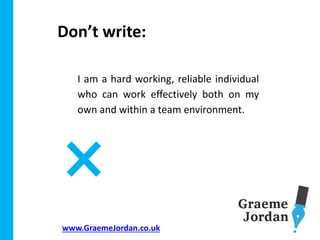
I am a hard working, reliable individual
who can work effectively both on my
own and within a team environment.
Don’t write:
www.GraemeJordan.co.uk
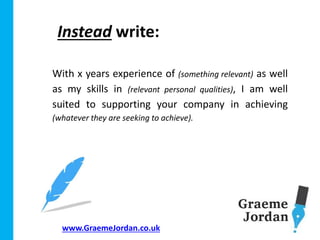
With x years experience of (something relevant) as well
as my skills in (relevant personal qualities), I am well
suited to supporting your company in achieving
(whatever they are seeking to achieve).
Instead write:
www.GraemeJordan.co.uk
Upgrade the language
you use.
www.GraemeJordan.co.uk
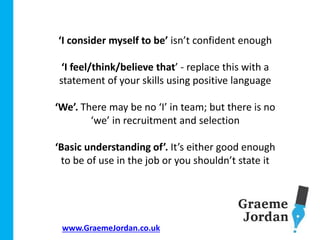
‘I consider myself to be’ isn’t confident enough
‘I feel/think/believe that’ - replace this with a
statement of your skills using positive language
‘We’. There may be no ‘I’ in team; but there is no
‘we’ in recruitment and selection
‘Basic understanding of’. It’s either good enough
to be of use in the job or you shouldn’t state it
www.GraemeJordan.co.uk
Remember: If it says something
positive about you that is relevant
to the job, it should be in.
If not? It shouldn’t.
Questions?
Visit www.GraemeJordan.co.uk
or email:
Graeme@graemejordan.co.uk

How to write a CV: Basic principles