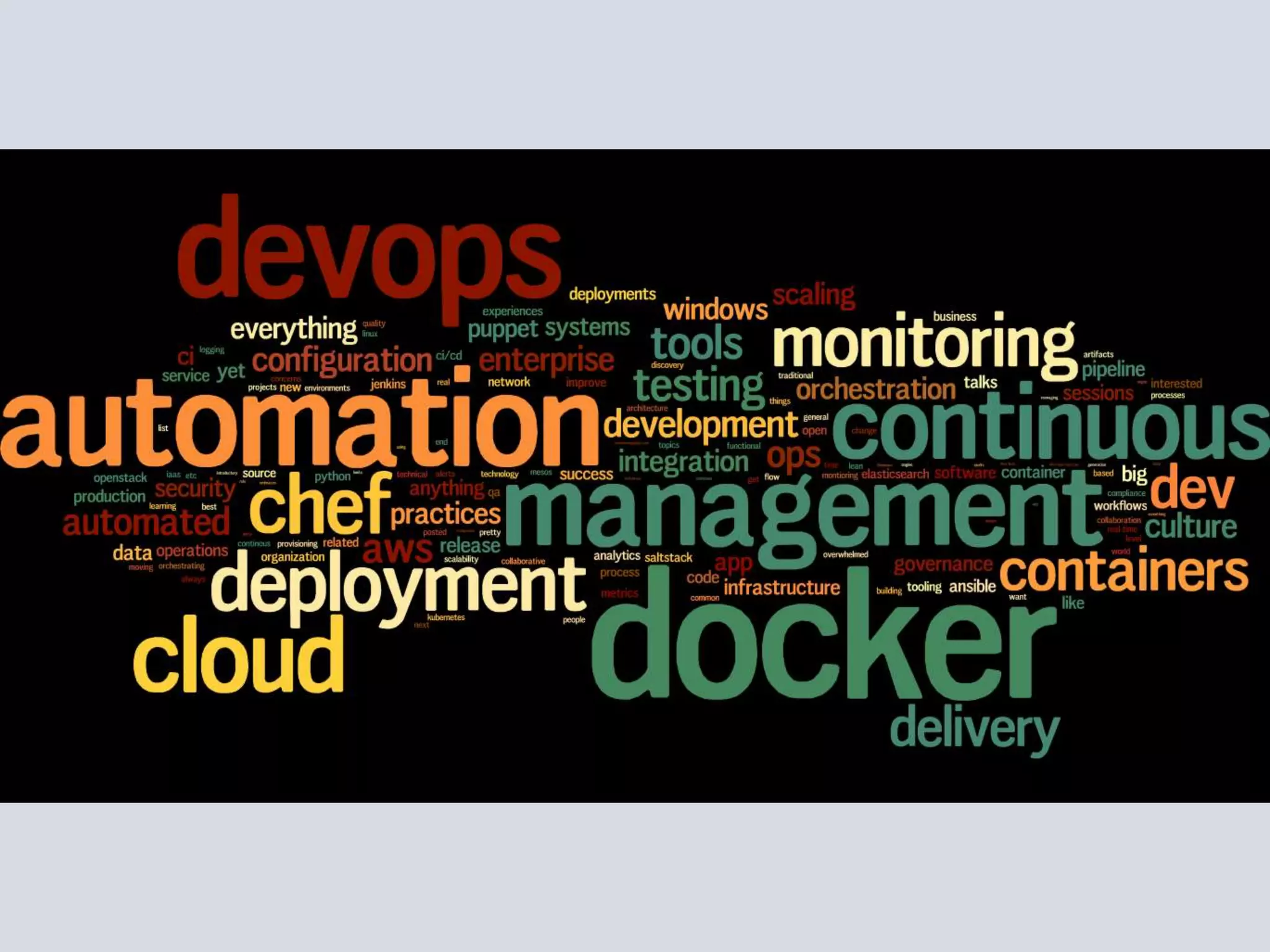
DEVOPS
By Professional guru
Questions I Will Answer Today
 What Is DevOps?
 What Problems Will DevOps
Help Me Solve?
 How Do I Get Started?
 What Mistakes Can I Avoid?
http://professional-guru.com
Who Am I?
http://professional-guru.com
The Problem In A Nutshell
 Everything needs software.
 Software runs on a server to become a
service.
 Delivering a service from inception to its
users is too slow and error-prone.
 There are internal friction points that
make this the case.
 This loses you money. (Delay = loss)
 Therefore IT is frequently the bottleneck
in the transition of “concept to cash.”
http://professional-guru.com
Symptoms
• Defects released into production, causing outage
• Inability to diagnose production issues quickly
• Problems appear in some environments only
• Blame shifting/finger pointing
• Long delays while dev, QA, or another team waits
on resource or response from other teams
• “Manual error” is a commonly cited root cause
• Releases slip/fail
• Quality of life issues in IT
http://professional-guru.com
Why Does This Problem Exist?
“Business-IT Alignment?”
The business has demanded the
wrong things out of IT
Cost sensitive
Risk averse
IT has metastasized over time into a
form to give the business what it’s
said it wants
Centralized and monolithic
Slow and penny wise, pound foolish
http://professional-guru.com
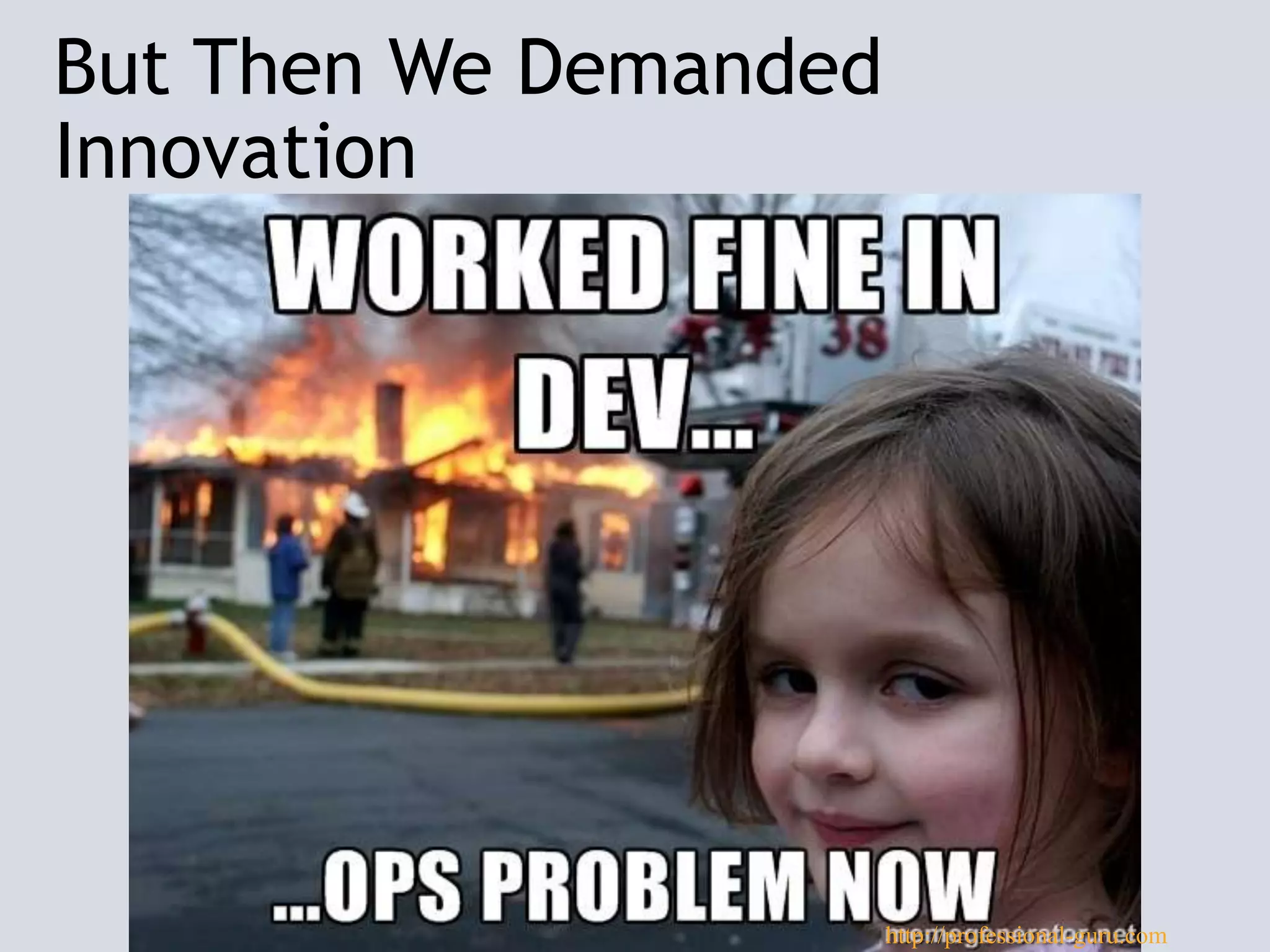
But Then We Demanded
Innovation
http://professional-guru.com
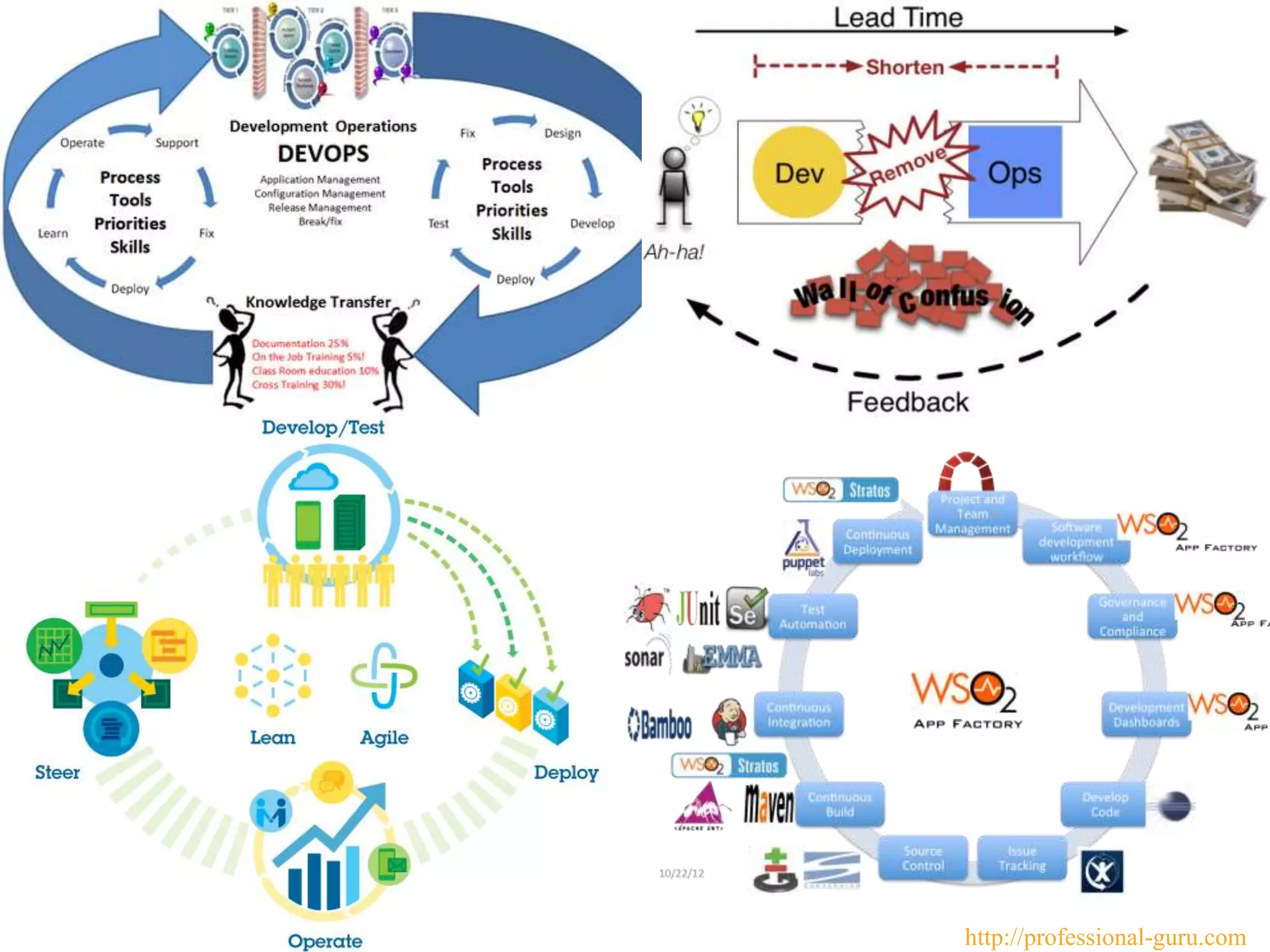
DevOps Defined
 DevOps is the practice of operations
and development engineers
participating together in the entire
service lifecycle, from design
through the development
process to production support.
 DevOps is also characterized by
operations staff making use many of
the same techniques as developers
for their systems work. http://professional-guru.com
DevOps Defined
 DevOps is the practice of operations
and development engineers
participating together in the entire
service lifecycle, from design
through the development
process to production support.
 DevOps is also characterized by
operations staff making use many of
the same techniques as developers
for their systems work. http://professional-guru.com
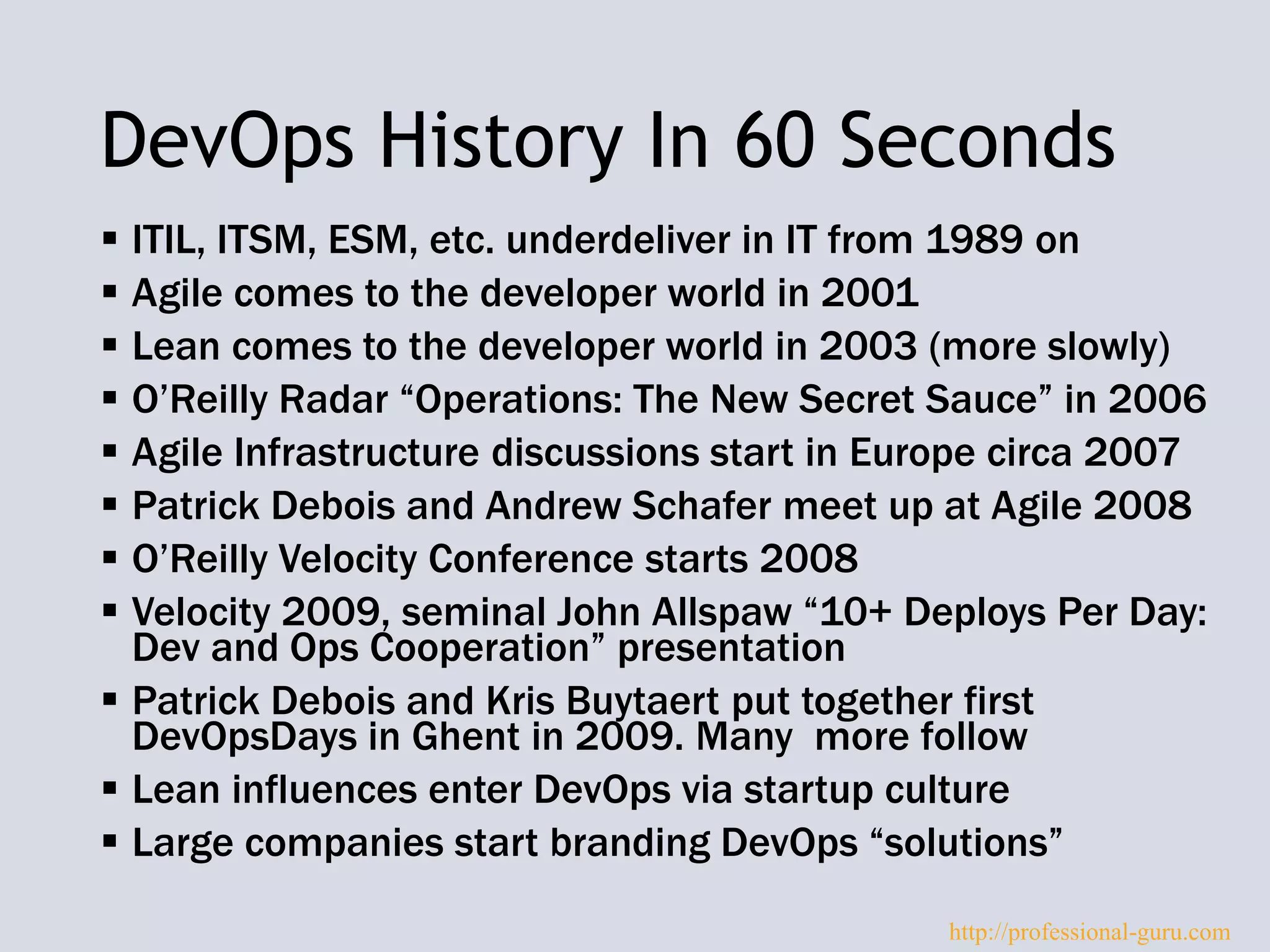
DevOps History In 60 Seconds
 ITIL, ITSM, ESM, etc. underdeliver in IT from 1989 on
 Agile comes to the developer world in 2001
 Lean comes to the developer world in 2003 (more slowly)
 O’Reilly Radar “Operations: The New Secret Sauce” in 2006
 Agile Infrastructure discussions start in Europe circa 2007
 Patrick Debois and Andrew Schafer meet up at Agile 2008
 O’Reilly Velocity Conference starts 2008
 Velocity 2009, seminal John Allspaw “10+ Deploys Per Day:
Dev and Ops Cooperation” presentation
 Patrick Debois and Kris Buytaert put together first
DevOpsDays in Ghent in 2009. Many more follow
 Lean influences enter DevOps via startup culture
 Large companies start branding DevOps “solutions”
http://professional-guru.com
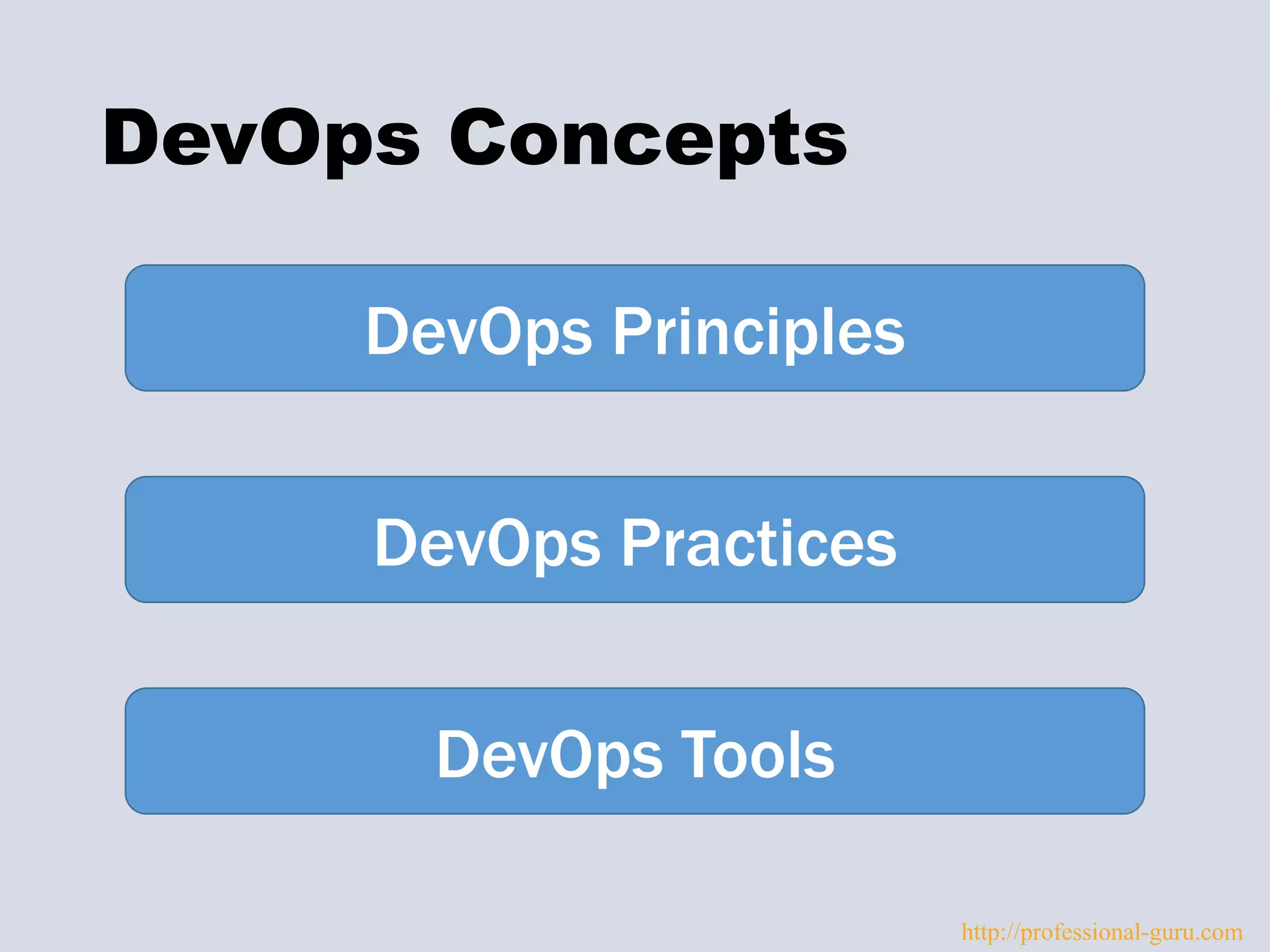
DevOps Concepts
DevOps Principles
DevOps Practices
DevOps Tools
http://professional-guru.com
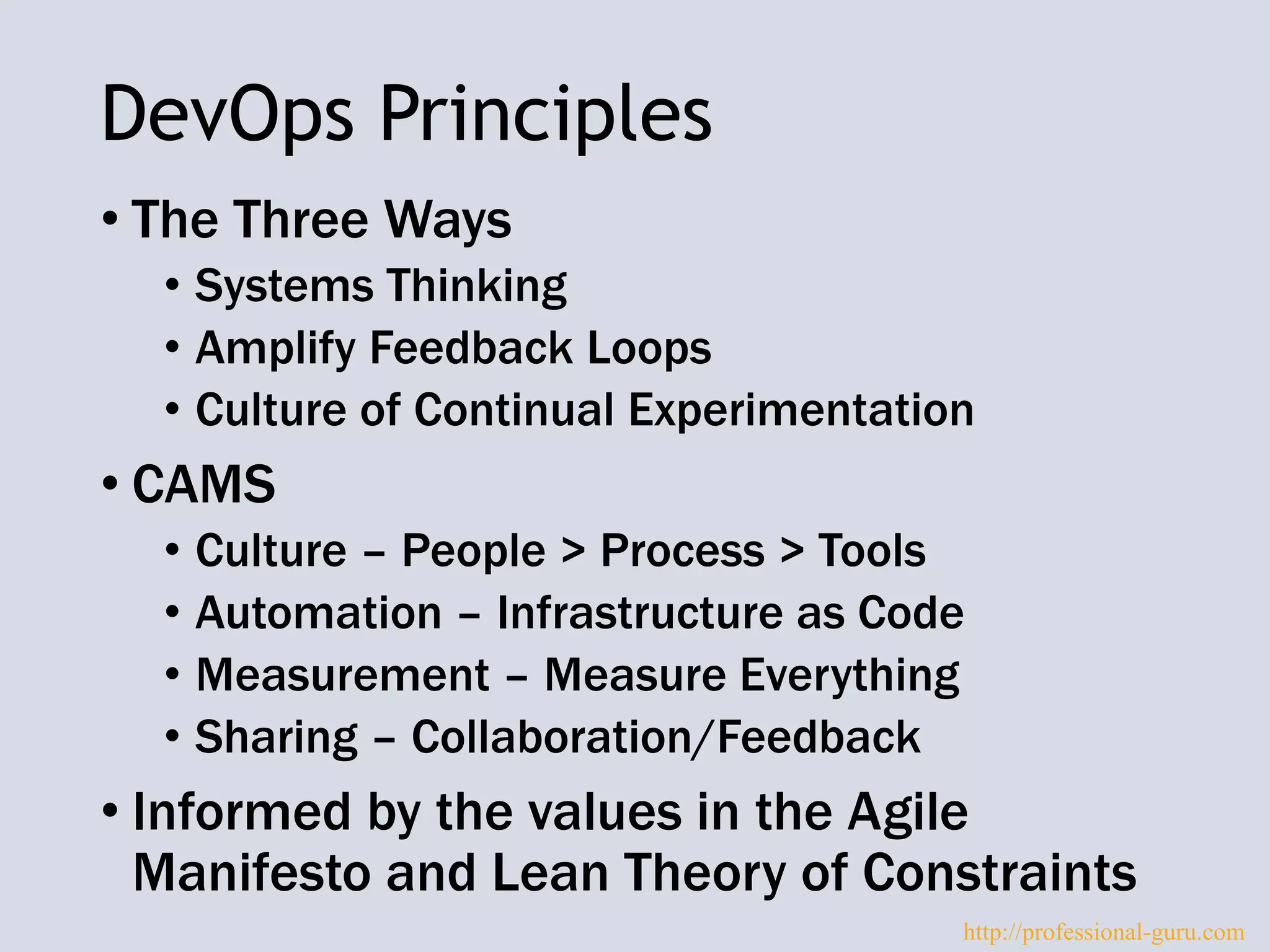
DevOps Principles
• The Three Ways
• Systems Thinking
• Amplify Feedback Loops
• Culture of Continual Experimentation
• CAMS
• Culture – People > Process > Tools
• Automation – Infrastructure as Code
• Measurement – Measure Everything
• Sharing – Collaboration/Feedback
• Informed by the values in the Agile
Manifesto and Lean Theory of Constraints
http://professional-guru.com
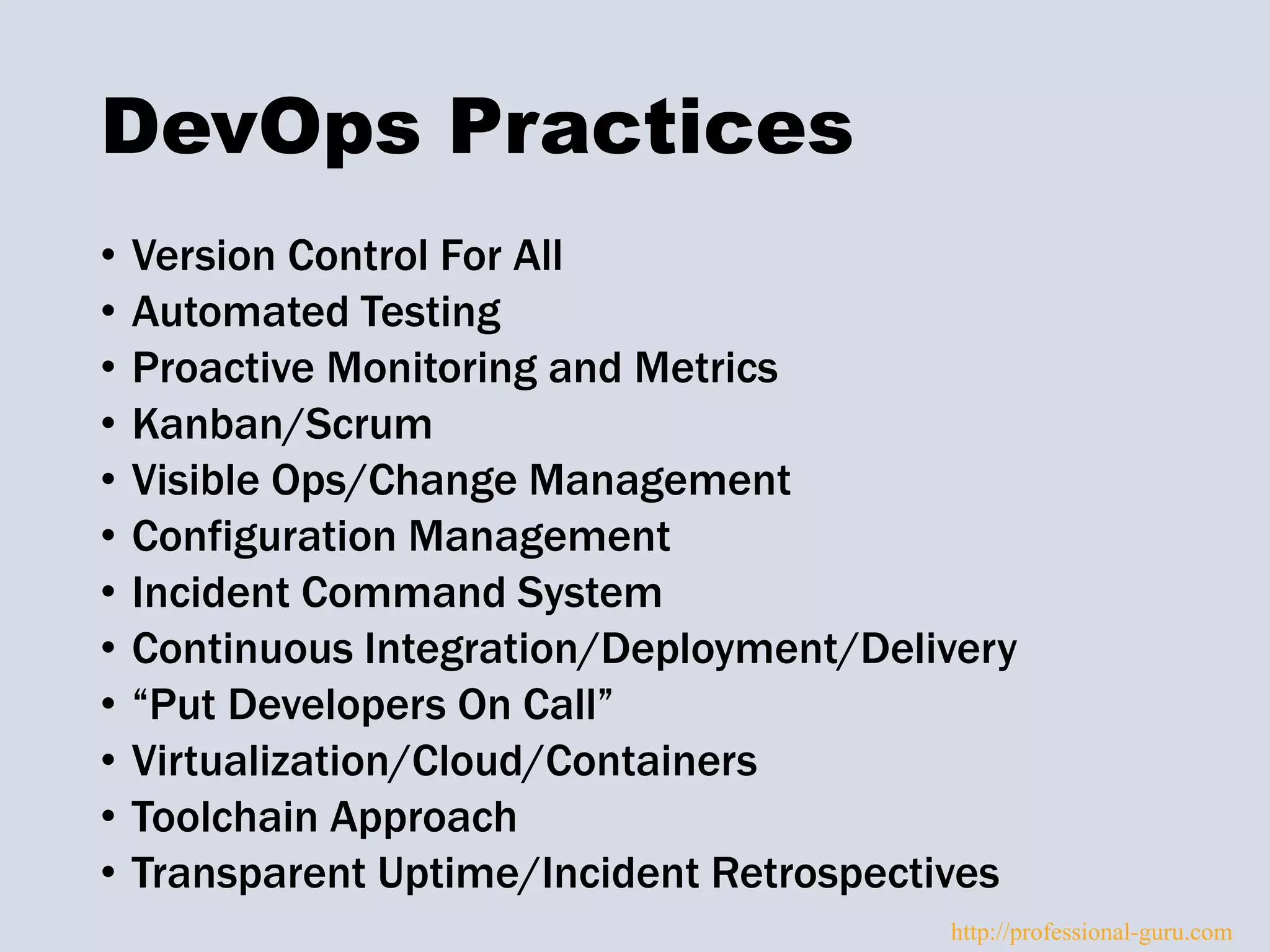
DevOps Practices
• Version Control For All
• Automated Testing
• Proactive Monitoring and Metrics
• Kanban/Scrum
• Visible Ops/Change Management
• Configuration Management
• Incident Command System
• Continuous Integration/Deployment/Delivery
• “Put Developers On Call”
• Virtualization/Cloud/Containers
• Toolchain Approach
• Transparent Uptime/Incident Retrospectives
http://professional-guru.com
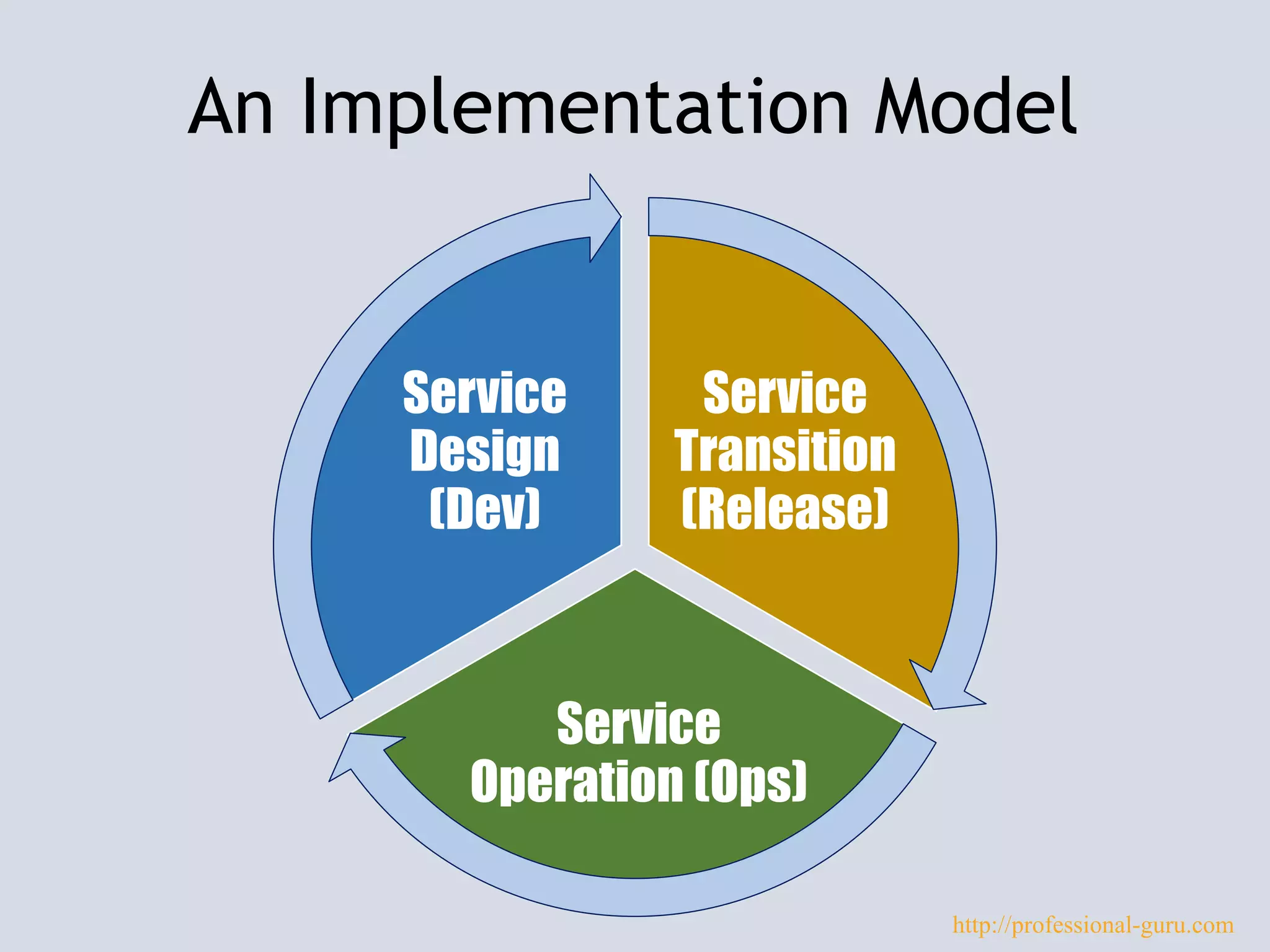
An Implementation Model
Service
Transition
(Release)
Service
Operation (Ops)
Service
Design
(Dev)
http://professional-guru.com
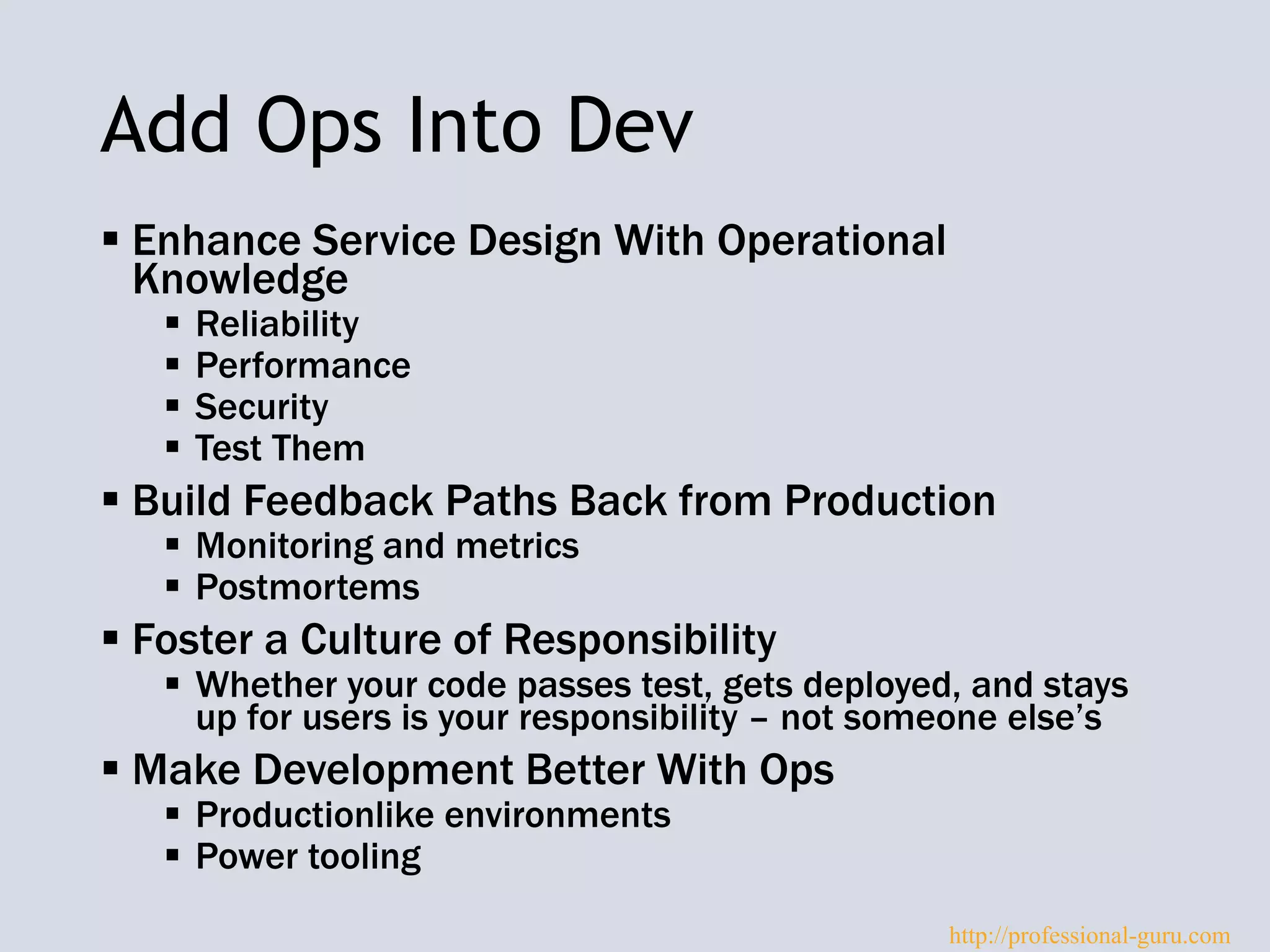
Add Ops Into Dev
 Enhance Service Design With Operational
Knowledge
 Reliability
 Performance
 Security
 Test Them
 Build Feedback Paths Back from Production
 Monitoring and metrics
 Postmortems
 Foster a Culture of Responsibility
 Whether your code passes test, gets deployed, and stays
up for users is your responsibility – not someone else’s
 Make Development Better With Ops
 Productionlike environments
 Power tooling
http://professional-guru.com
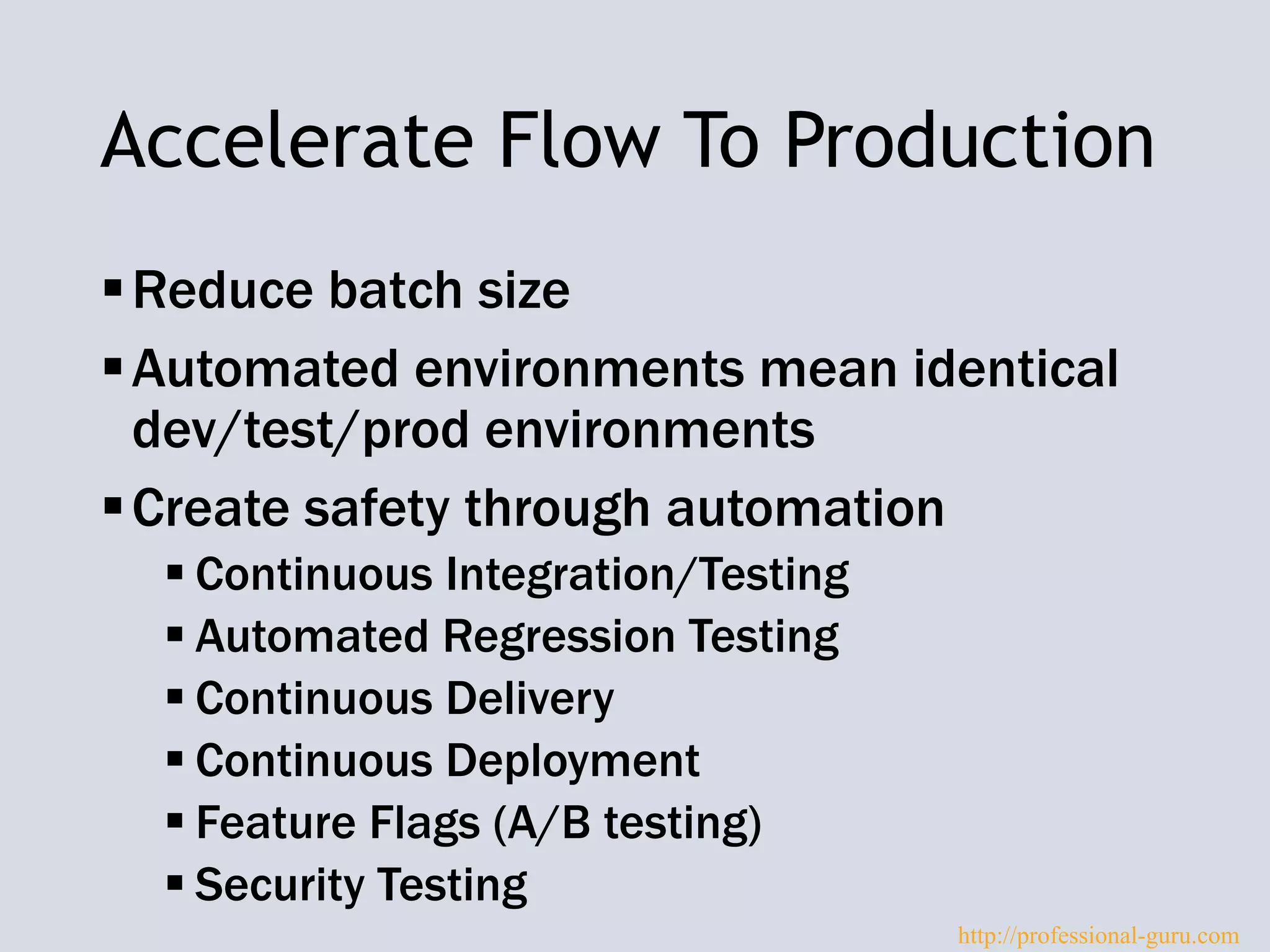
Accelerate Flow To Production
Reduce batch size
Automated environments mean identical
dev/test/prod environments
Create safety through automation
 Continuous Integration/Testing
 Automated Regression Testing
 Continuous Delivery
 Continuous Deployment
 Feature Flags (A/B testing)
 Security Testing
http://professional-guru.com
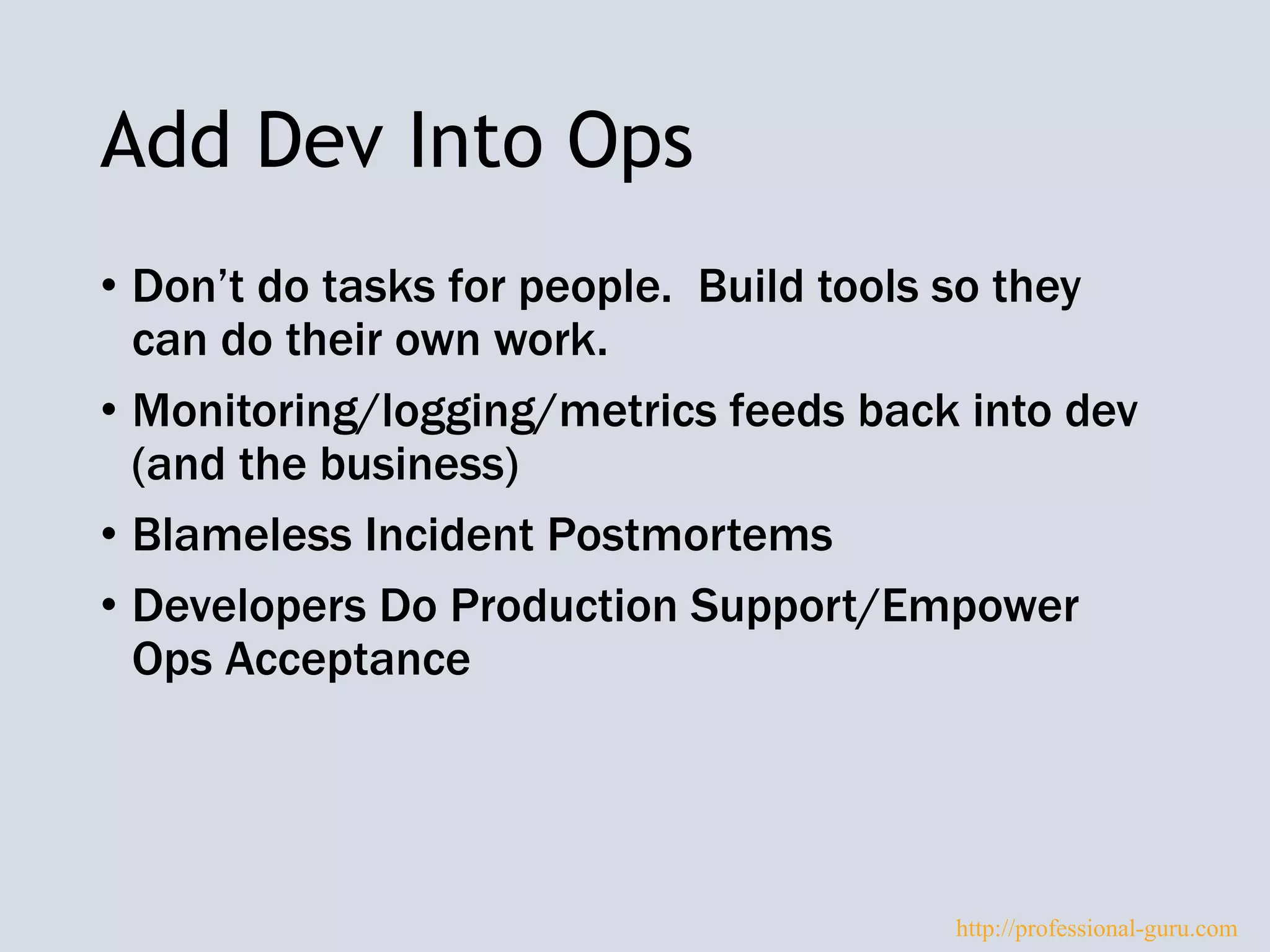
Add Dev Into Ops
• Don’t do tasks for people. Build tools so they
can do their own work.
• Monitoring/logging/metrics feeds back into dev
(and the business)
• Blameless Incident Postmortems
• Developers Do Production Support/Empower
Ops Acceptance
http://professional-guru.com
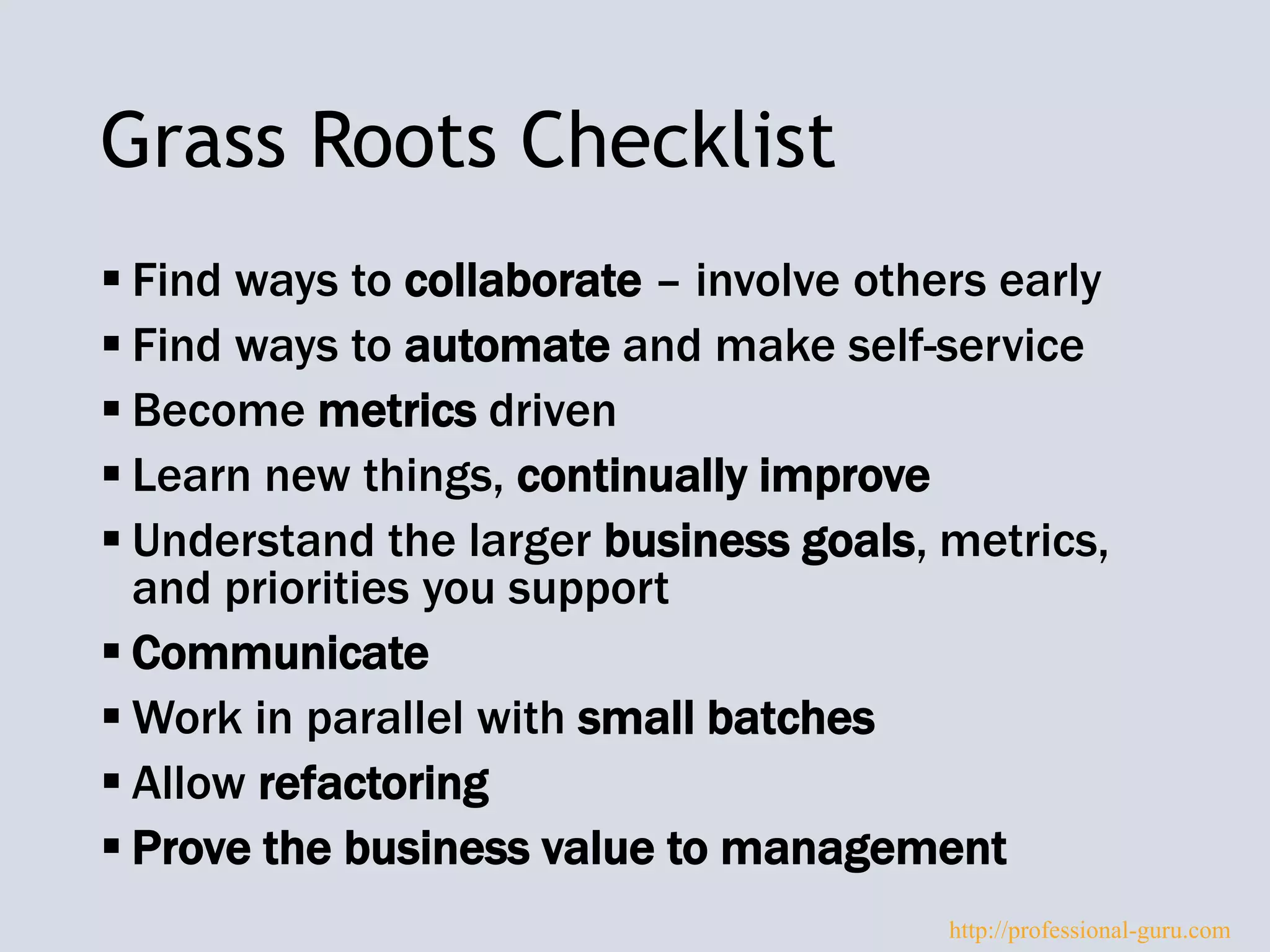
Grass Roots Checklist
 Find ways to collaborate – involve others early
 Find ways to automate and make self-service
 Become metrics driven
 Learn new things, continually improve
 Understand the larger business goals, metrics,
and priorities you support
 Communicate
 Work in parallel with small batches
 Allow refactoring
 Prove the business value to management
http://professional-guru.com
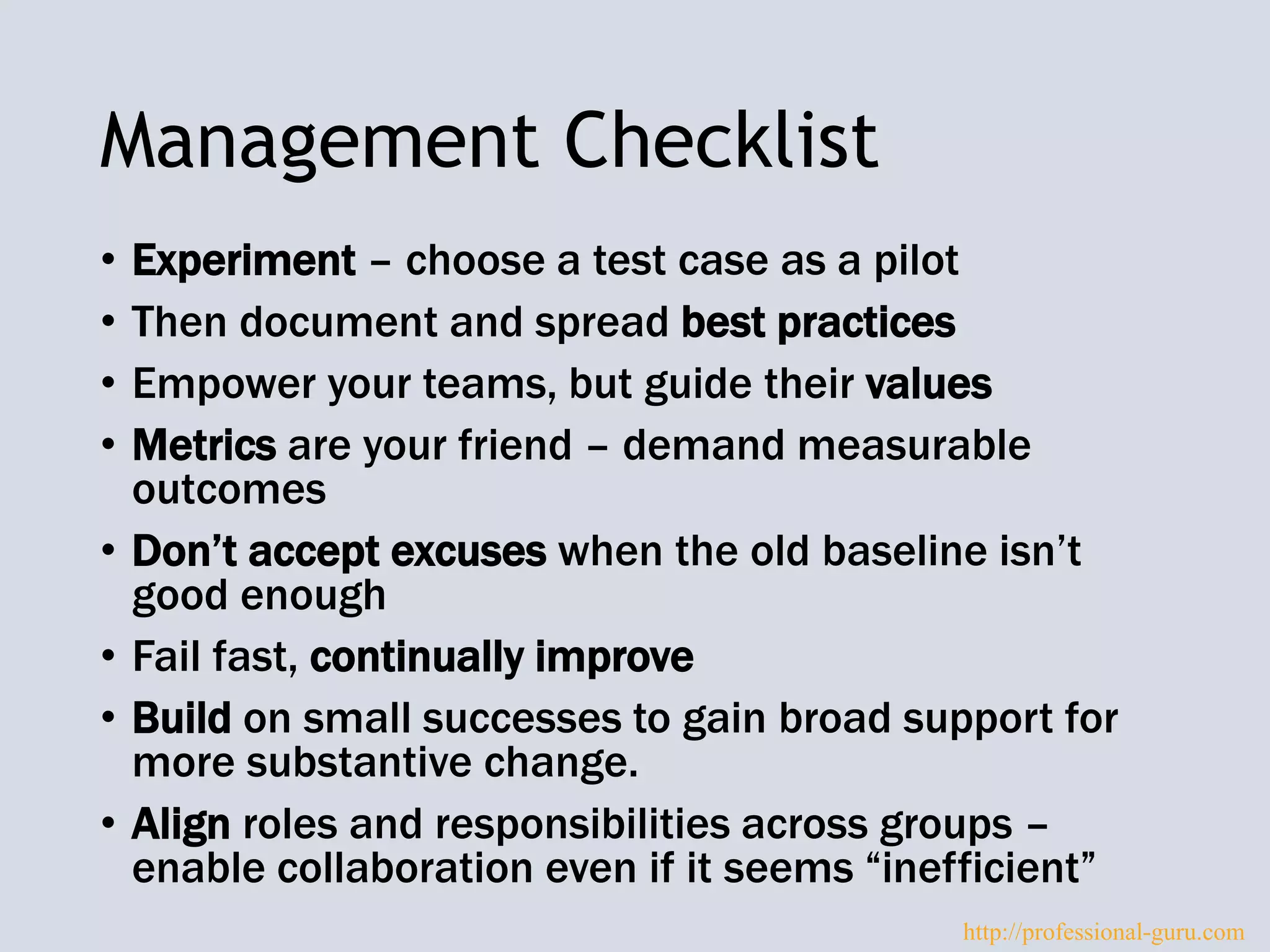
Management Checklist
• Experiment – choose a test case as a pilot
• Then document and spread best practices
• Empower your teams, but guide their values
• Metrics are your friend – demand measurable
outcomes
• Don’t accept excuses when the old baseline isn’t
good enough
• Fail fast, continually improve
• Build on small successes to gain broad support for
more substantive change.
• Align roles and responsibilities across groups –
enable collaboration even if it seems “inefficient”
http://professional-guru.com
Things Not To Do
 Only Token Gestures
 “Ops team, change your name to DevOps team!”
 “Put DevOps in those job titles!”
 Only Implement Tools
 Changing tools without changing tactics leaves the
battlefield strewn with bodies
 Create More Silos
 Devalue Operations Or Development Knowledge
 Anything You’re Not Measuring The Impact Of
http://professional-guru.com
Does It Really Help?
•2014 State of DevOps Report (9200
surveyed) measured correlation
between high performing
organizations and DevOps practice
adoption
• Lead time to changes down
• MTTR up
• No alteration in change fail rate
http://professional-guru.com
Core DevOps Research List
• Gene Kim’s Visible Ops
• Tom Limoncelli’s The Practice Of Cloud System Administration
• Gene Kim’s The Phoenix Project (modeled on Goldratt’s The Goal)
• Jez Humble’s Continuous Delivery
• Michael Nygard’s Release It!
• Gene Kim’s The DevOps Cookbook (coming soon-ish)
• Various Mary and Tom Poppendieck Lean Software Development
Books
• Velocity Conference (velocityconf.com)
• DevOpsDays Unconferences – There’s one near you!
(devopsdays.org)
• DevOps Weekly newsletter (devopsweekly.com)
• DevOps Café Podcast (devopscafe.com)
• The Twelve Factor App (12factor.net)
• The Agile Admin (theagileadmin.com)
http://professional-guru.com
Dev ops concept
Dev ops concept

Dev ops concept

  • 1.
  • 2.
    Questions I WillAnswer Today  What Is DevOps?  What Problems Will DevOps Help Me Solve?  How Do I Get Started?  What Mistakes Can I Avoid? http://professional-guru.com
  • 3.
  • 4.
  • 5.
    The Problem InA Nutshell  Everything needs software.  Software runs on a server to become a service.  Delivering a service from inception to its users is too slow and error-prone.  There are internal friction points that make this the case.  This loses you money. (Delay = loss)  Therefore IT is frequently the bottleneck in the transition of “concept to cash.” http://professional-guru.com
  • 6.
    Symptoms • Defects releasedinto production, causing outage • Inability to diagnose production issues quickly • Problems appear in some environments only • Blame shifting/finger pointing • Long delays while dev, QA, or another team waits on resource or response from other teams • “Manual error” is a commonly cited root cause • Releases slip/fail • Quality of life issues in IT http://professional-guru.com
  • 7.
    Why Does ThisProblem Exist? “Business-IT Alignment?” The business has demanded the wrong things out of IT Cost sensitive Risk averse IT has metastasized over time into a form to give the business what it’s said it wants Centralized and monolithic Slow and penny wise, pound foolish http://professional-guru.com
  • 8.
    But Then WeDemanded Innovation http://professional-guru.com
  • 9.
    DevOps Defined  DevOpsis the practice of operations and development engineers participating together in the entire service lifecycle, from design through the development process to production support.  DevOps is also characterized by operations staff making use many of the same techniques as developers for their systems work. http://professional-guru.com
  • 10.
    DevOps Defined  DevOpsis the practice of operations and development engineers participating together in the entire service lifecycle, from design through the development process to production support.  DevOps is also characterized by operations staff making use many of the same techniques as developers for their systems work. http://professional-guru.com
  • 11.
    DevOps History In60 Seconds  ITIL, ITSM, ESM, etc. underdeliver in IT from 1989 on  Agile comes to the developer world in 2001  Lean comes to the developer world in 2003 (more slowly)  O’Reilly Radar “Operations: The New Secret Sauce” in 2006  Agile Infrastructure discussions start in Europe circa 2007  Patrick Debois and Andrew Schafer meet up at Agile 2008  O’Reilly Velocity Conference starts 2008  Velocity 2009, seminal John Allspaw “10+ Deploys Per Day: Dev and Ops Cooperation” presentation  Patrick Debois and Kris Buytaert put together first DevOpsDays in Ghent in 2009. Many more follow  Lean influences enter DevOps via startup culture  Large companies start branding DevOps “solutions” http://professional-guru.com
  • 12.
    DevOps Concepts DevOps Principles DevOpsPractices DevOps Tools http://professional-guru.com
  • 13.
    DevOps Principles • TheThree Ways • Systems Thinking • Amplify Feedback Loops • Culture of Continual Experimentation • CAMS • Culture – People > Process > Tools • Automation – Infrastructure as Code • Measurement – Measure Everything • Sharing – Collaboration/Feedback • Informed by the values in the Agile Manifesto and Lean Theory of Constraints http://professional-guru.com
  • 14.
    DevOps Practices • VersionControl For All • Automated Testing • Proactive Monitoring and Metrics • Kanban/Scrum • Visible Ops/Change Management • Configuration Management • Incident Command System • Continuous Integration/Deployment/Delivery • “Put Developers On Call” • Virtualization/Cloud/Containers • Toolchain Approach • Transparent Uptime/Incident Retrospectives http://professional-guru.com
  • 15.
    An Implementation Model Service Transition (Release) Service Operation(Ops) Service Design (Dev) http://professional-guru.com
  • 16.
    Add Ops IntoDev  Enhance Service Design With Operational Knowledge  Reliability  Performance  Security  Test Them  Build Feedback Paths Back from Production  Monitoring and metrics  Postmortems  Foster a Culture of Responsibility  Whether your code passes test, gets deployed, and stays up for users is your responsibility – not someone else’s  Make Development Better With Ops  Productionlike environments  Power tooling http://professional-guru.com
  • 17.
    Accelerate Flow ToProduction Reduce batch size Automated environments mean identical dev/test/prod environments Create safety through automation  Continuous Integration/Testing  Automated Regression Testing  Continuous Delivery  Continuous Deployment  Feature Flags (A/B testing)  Security Testing http://professional-guru.com
  • 18.
    Add Dev IntoOps • Don’t do tasks for people. Build tools so they can do their own work. • Monitoring/logging/metrics feeds back into dev (and the business) • Blameless Incident Postmortems • Developers Do Production Support/Empower Ops Acceptance http://professional-guru.com
  • 19.
    Grass Roots Checklist Find ways to collaborate – involve others early  Find ways to automate and make self-service  Become metrics driven  Learn new things, continually improve  Understand the larger business goals, metrics, and priorities you support  Communicate  Work in parallel with small batches  Allow refactoring  Prove the business value to management http://professional-guru.com
  • 20.
    Management Checklist • Experiment– choose a test case as a pilot • Then document and spread best practices • Empower your teams, but guide their values • Metrics are your friend – demand measurable outcomes • Don’t accept excuses when the old baseline isn’t good enough • Fail fast, continually improve • Build on small successes to gain broad support for more substantive change. • Align roles and responsibilities across groups – enable collaboration even if it seems “inefficient” http://professional-guru.com
  • 21.
    Things Not ToDo  Only Token Gestures  “Ops team, change your name to DevOps team!”  “Put DevOps in those job titles!”  Only Implement Tools  Changing tools without changing tactics leaves the battlefield strewn with bodies  Create More Silos  Devalue Operations Or Development Knowledge  Anything You’re Not Measuring The Impact Of http://professional-guru.com
  • 22.
    Does It ReallyHelp? •2014 State of DevOps Report (9200 surveyed) measured correlation between high performing organizations and DevOps practice adoption • Lead time to changes down • MTTR up • No alteration in change fail rate http://professional-guru.com
  • 23.
    Core DevOps ResearchList • Gene Kim’s Visible Ops • Tom Limoncelli’s The Practice Of Cloud System Administration • Gene Kim’s The Phoenix Project (modeled on Goldratt’s The Goal) • Jez Humble’s Continuous Delivery • Michael Nygard’s Release It! • Gene Kim’s The DevOps Cookbook (coming soon-ish) • Various Mary and Tom Poppendieck Lean Software Development Books • Velocity Conference (velocityconf.com) • DevOpsDays Unconferences – There’s one near you! (devopsdays.org) • DevOps Weekly newsletter (devopsweekly.com) • DevOps Café Podcast (devopscafe.com) • The Twelve Factor App (12factor.net) • The Agile Admin (theagileadmin.com) http://professional-guru.com