8-1
Part Three


Business Marketing
PART THREE

Business Marketing Programming
• Chapter 8 Developing and Managing Products

• Chapter 9 Business Marketing Channels

• Chapter 10 Managing Customer Relationships

• Chapter 11 Communicating with the Market

• Chapter 12 IMC

• Chapter 13 Sales and Sales Management

• Chapter 14 Pricing and Negotiating for Value
                                                 8-3
Chapter Eight
    Developing and Managing Products:
        What do Customers Want?


McGraw-Hill/Irwin         Copyright © 2006 The McGraw-Hill Companies, Inc. All rights reserved.
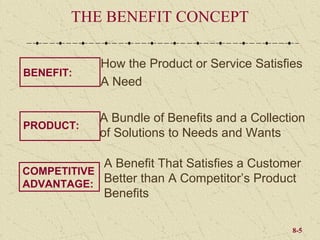
THE BENEFIT CONCEPT

             How the Product or Service Satisfies
BENEFIT:
             A Need

             A Bundle of Benefits and a Collection
PRODUCT:
             of Solutions to Needs and Wants

            A Benefit That Satisfies a Customer
COMPETITIVE
ADVANTAGE: Better than A Competitor’s Product
            Benefits

                                               8-5
AUGMENTING:
CREATING CUSTOMER SATISFACTION

• Objective is to customize a product for a
  customer to exceed their expectations


                                              8-6
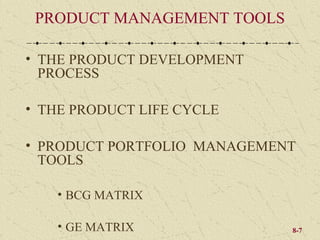
PRODUCT MANAGEMENT TOOLS

• THE PRODUCT DEVELOPMENT
  PROCESS

• THE PRODUCT LIFE CYCLE

• PRODUCT PORTFOLIO MANAGEMENT
  TOOLS

   • BCG MATRIX

   • GE MATRIX               8-7
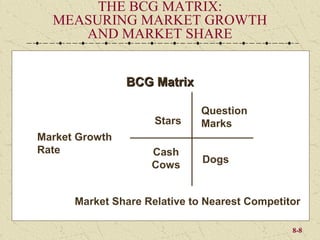
THE BCG MATRIX:
  MEASURING MARKET GROWTH
     AND MARKET SHARE


                BCG Matrix

                              Question
                     Stars    Marks
Market Growth
Rate                Cash
                              Dogs
                    Cows


      Market Share Relative to Nearest Competitor

                                               8-8
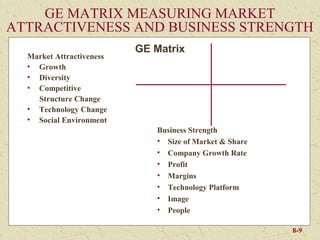
GE MATRIX MEASURING MARKET
ATTRACTIVENESS AND BUSINESS STRENGTH
                          GE Matrix
  Market Attractiveness
  • Growth
  • Diversity
  • Competitive
    Structure Change
  • Technology Change
  • Social Environment
                             Business Strength
                             • Size of Market & Share
                             • Company Growth Rate
                             • Profit
                             • Margins
                             • Technology Platform
                             • Image
                             • People

                                                        8-9
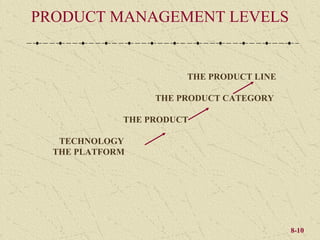
PRODUCT MANAGEMENT LEVELS


                       THE PRODUCT LINE

                  THE PRODUCT CATEGORY

             THE PRODUCT

   TECHNOLOGY
  THE PLATFORM


                                          8-10
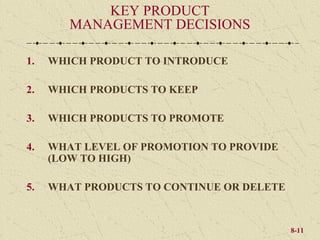
KEY PRODUCT
        MANAGEMENT DECISIONS

1.   WHICH PRODUCT TO INTRODUCE

2.   WHICH PRODUCTS TO KEEP

3.   WHICH PRODUCTS TO PROMOTE

4.   WHAT LEVEL OF PROMOTION TO PROVIDE
     (LOW TO HIGH)

5.   WHAT PRODUCTS TO CONTINUE OR DELETE


                                           8-11
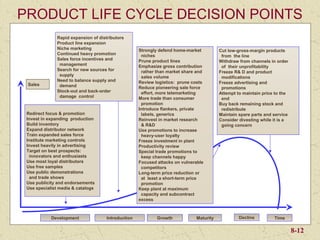
PRODUCT LIFE CYCLE DECISION POINTS
              Rapid expansion of distributors
              Product line expansion
              Niche marketing                       Strongly defend home-market         Cut low-gross-margin products
              Continued heavy promotion              niches                              from the line
              Sales force incentives and            Prune product lines                 Withdraw from channels in order
               management                           Emphasize gross contribution         of their unprofitability
              Search for new sources for             rather than market share and       Freeze R& D and product
               supply                                sales volume                        modifications
              Need to balance supply and            Review logistics: prune costs
 Sales                                                                                  Freeze advertising and
               demand                               Reduce pioneering sale force         promotions
              Stock-out and back-order               effort, more telemarketing         Attempt to maintain price to the
               damage control                       More trade than consumer             end
                                                     promotion                          Buy back remaining stock and
                                                    Introduce flankers, private          redistribute
 Redirect focus & promotion                          labels, generics                   Maintain spare parts and service
 Invest in expanding production                     Reinvest in market research         Consider divesting while it is a
 Build inventory                                     & R&D                               going concern
 Expand distributor network                         Use promotions to increase
 Train expanded sales force                          heavy-user loyalty
 Institute marketing controls                       Freeze investment in plant
 Invest heavily in advertising                      Productivity review
 Target on best prospects:                          Special trade promotions to
  innovators and enthusiasts                         keep channels happy
 Use most loyal distributors                        Focused attacks on vulnerable
 Use free samples                                    competitors
 Use public demonstrations                          Long-term price reduction or
  and trade shows                                    at least a short-term price
 Use publicity and endorsements                      promotion
 Use specialist media & catalogs                    Keep plant at maximum
                                                     capacity and subcontract
                                                    excess


            Development              Introduction           Growth           Maturity            Decline         Time

                                                                                                                           8-12
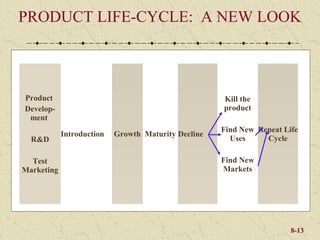
PRODUCT LIFE-CYCLE: A NEW LOOK


Product                                              Kill the
Develop-                                             product
 ment
                                                     Find New Repeat Life
            Introduction   Growth Maturity Decline
  R&D                                                  Uses     Cycle

  Test                                               Find New
Marketing                                            Markets


                                                                       8-13
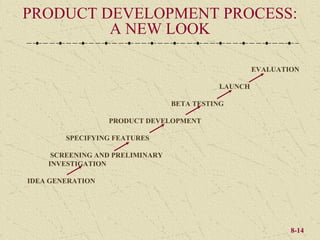
PRODUCT DEVELOPMENT PROCESS:
         A NEW LOOK

                                                    EVALUATION

                                           LAUNCH

                                 BETA TESTING

                  PRODUCT DEVELOPMENT

        SPECIFYING FEATURES

     SCREENING AND PRELIMINARY
    INVESTIGATION

IDEA GENERATION


                                                            8-14
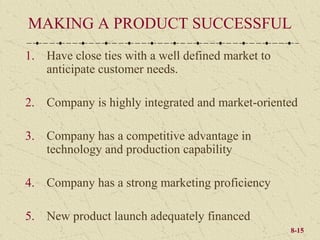
MAKING A PRODUCT SUCCESSFUL
1. Have close ties with a well defined market to
   anticipate customer needs.

2. Company is highly integrated and market-oriented

3. Company has a competitive advantage in
   technology and production capability

4. Company has a strong marketing proficiency

5. New product launch adequately financed
                                                   8-15
WINNING THE NEW PRODUCT CONTEST

 • FOCUS ON CORE COMPETENCY
   (WHAT YOU DO BEST FOR A COMPETITIVE ADVANTAGE)

                      PLUS

 • PROVIDE GREATEST VALUE TO CUSTOMER

                     EQUALS

 • SUCCESSFUL PRODUCT


                                                8-16

Pp chap008

  • 1.
  • 2.
  • 3.
    PART THREE Business MarketingProgramming • Chapter 8 Developing and Managing Products • Chapter 9 Business Marketing Channels • Chapter 10 Managing Customer Relationships • Chapter 11 Communicating with the Market • Chapter 12 IMC • Chapter 13 Sales and Sales Management • Chapter 14 Pricing and Negotiating for Value 8-3
  • 4.
    Chapter Eight Developing and Managing Products: What do Customers Want? McGraw-Hill/Irwin Copyright © 2006 The McGraw-Hill Companies, Inc. All rights reserved.
  • 5.
    THE BENEFIT CONCEPT How the Product or Service Satisfies BENEFIT: A Need A Bundle of Benefits and a Collection PRODUCT: of Solutions to Needs and Wants A Benefit That Satisfies a Customer COMPETITIVE ADVANTAGE: Better than A Competitor’s Product Benefits 8-5
  • 6.
    AUGMENTING: CREATING CUSTOMER SATISFACTION •Objective is to customize a product for a customer to exceed their expectations 8-6
  • 7.
    PRODUCT MANAGEMENT TOOLS •THE PRODUCT DEVELOPMENT PROCESS • THE PRODUCT LIFE CYCLE • PRODUCT PORTFOLIO MANAGEMENT TOOLS • BCG MATRIX • GE MATRIX 8-7
  • 8.
    THE BCG MATRIX: MEASURING MARKET GROWTH AND MARKET SHARE BCG Matrix Question Stars Marks Market Growth Rate Cash Dogs Cows Market Share Relative to Nearest Competitor 8-8
  • 9.
    GE MATRIX MEASURINGMARKET ATTRACTIVENESS AND BUSINESS STRENGTH GE Matrix Market Attractiveness • Growth • Diversity • Competitive Structure Change • Technology Change • Social Environment Business Strength • Size of Market & Share • Company Growth Rate • Profit • Margins • Technology Platform • Image • People 8-9
  • 10.
    PRODUCT MANAGEMENT LEVELS THE PRODUCT LINE THE PRODUCT CATEGORY THE PRODUCT TECHNOLOGY THE PLATFORM 8-10
  • 11.
    KEY PRODUCT MANAGEMENT DECISIONS 1. WHICH PRODUCT TO INTRODUCE 2. WHICH PRODUCTS TO KEEP 3. WHICH PRODUCTS TO PROMOTE 4. WHAT LEVEL OF PROMOTION TO PROVIDE (LOW TO HIGH) 5. WHAT PRODUCTS TO CONTINUE OR DELETE 8-11
  • 12.
    PRODUCT LIFE CYCLEDECISION POINTS Rapid expansion of distributors Product line expansion Niche marketing Strongly defend home-market Cut low-gross-margin products Continued heavy promotion niches from the line Sales force incentives and Prune product lines Withdraw from channels in order management Emphasize gross contribution of their unprofitability Search for new sources for rather than market share and Freeze R& D and product supply sales volume modifications Need to balance supply and Review logistics: prune costs Sales Freeze advertising and demand Reduce pioneering sale force promotions Stock-out and back-order effort, more telemarketing Attempt to maintain price to the damage control More trade than consumer end promotion Buy back remaining stock and Introduce flankers, private redistribute Redirect focus & promotion labels, generics Maintain spare parts and service Invest in expanding production Reinvest in market research Consider divesting while it is a Build inventory & R&D going concern Expand distributor network Use promotions to increase Train expanded sales force heavy-user loyalty Institute marketing controls Freeze investment in plant Invest heavily in advertising Productivity review Target on best prospects: Special trade promotions to innovators and enthusiasts keep channels happy Use most loyal distributors Focused attacks on vulnerable Use free samples competitors Use public demonstrations Long-term price reduction or and trade shows at least a short-term price Use publicity and endorsements promotion Use specialist media & catalogs Keep plant at maximum capacity and subcontract excess Development Introduction Growth Maturity Decline Time 8-12
  • 13.
    PRODUCT LIFE-CYCLE: ANEW LOOK Product Kill the Develop- product ment Find New Repeat Life Introduction Growth Maturity Decline R&D Uses Cycle Test Find New Marketing Markets 8-13
  • 14.
    PRODUCT DEVELOPMENT PROCESS: A NEW LOOK EVALUATION LAUNCH BETA TESTING PRODUCT DEVELOPMENT SPECIFYING FEATURES SCREENING AND PRELIMINARY INVESTIGATION IDEA GENERATION 8-14
  • 15.
    MAKING A PRODUCTSUCCESSFUL 1. Have close ties with a well defined market to anticipate customer needs. 2. Company is highly integrated and market-oriented 3. Company has a competitive advantage in technology and production capability 4. Company has a strong marketing proficiency 5. New product launch adequately financed 8-15
  • 16.
    WINNING THE NEWPRODUCT CONTEST • FOCUS ON CORE COMPETENCY (WHAT YOU DO BEST FOR A COMPETITIVE ADVANTAGE) PLUS • PROVIDE GREATEST VALUE TO CUSTOMER EQUALS • SUCCESSFUL PRODUCT 8-16