At the heart of a great
brand is a great
product. Product is a
key element in the
market offering. Market
leaders generally offer
products and services of
superior quality.
Kotler on MarketingKotler on Marketing
Managing Product Lines,
Brands, and Packaging
   Five levels of product
 
Core product : Use-benefit, problem-solving service.
 
Generic product : Basic version of the product.
 
Expected product  :  Set  of  attributes  and  conditions 
that buyers normally expect. 
Augmented product  :  Consists  of  additional 
services  and  benefits  that  distinguish  the   
company’s offer from that of the competition.
 
Potential product  :  Possible  augmentations  and 
transformations  that  this  product  might  ultimately 
undergo in future.
 ♦ Product classifications
 
1. Durability and Tangibility
Non-durable goods  –  Normally consumed  in  one 
or few uses.
Durable goods – Normally survives many uses.
 
Services  –  Intangible,  inseparable,  variable  and 
perishable products.
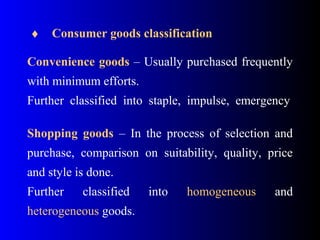
 ♦    Consumer goods classification
 
Convenience goods – Usually purchased frequently 
with minimum efforts.
Further  classified  into  staple,  impulse,  emergency
 
Shopping goods  –  In  the  process  of  selection  and 
purchase,  comparison  on  suitability,  quality,  price 
and style is done.
Further  classified  into  homogeneous  and 
heterogeneous goods.  
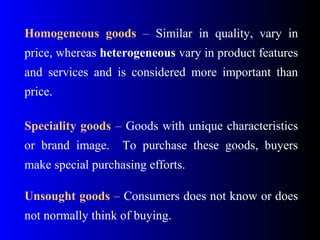
Homogeneous goods  –  Similar  in  quality,  vary  in 
price, whereas heterogeneous vary in product features 
and  services  and  is  considered  more  important  than 
price.
 
Speciality goods – Goods with unique characteristics 
or  brand  image.    To  purchase  these  goods,  buyers 
make special purchasing efforts.
 
Unsought goods – Consumers does not know or does 
not normally think of buying.
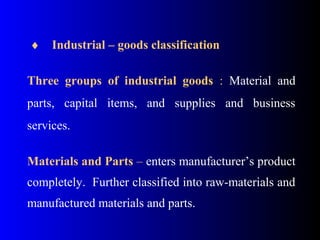
 ♦    Industrial – goods classification
 
Three groups of industrial goods  :  Material  and 
parts,  capital  items,  and  supplies  and  business 
services.
 
Materials and Parts – enters manufacturer’s product 
completely.  Further classified into raw-materials and 
manufactured materials and parts. 
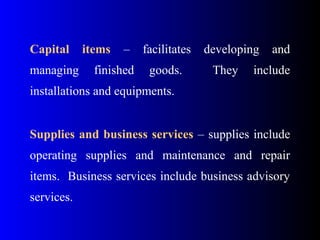
Capital items – facilitates developing and
managing finished goods. They include
installations and equipments.
Supplies and business services – supplies include
operating supplies and maintenance and repair
items. Business services include business advisory
services.
 Differentiation – Products can be differentiated
on the basis form, features, performance quality,
conformance quality, durability, reliability,
repairability, and style.
 Product Differentiation :
 Form – can be differentiated on the basis of
size, shape or physical structure of a product.
 Features – A company can identify and select
appropriate new features by surveying recent
buyers and then calculating customer value versus
company cost for each potential feature.
 Each company must also think in terms of feature
customization at a higher cost or a few standard
packages at lower cost.
 Performance quality – most products are
established at one of four performance levels;
low, average, high or superior.
 Performance quality is the level at which the
product’s primary characteristics operate.
 The manufacturer must design a performance
level appropriate to the target market and
competitor’s performance levels.
 Continuously improving the product can
produce the high returns and market share.
 Conformance Quality – Is the degree to which all
the produced units are identical and meet the
promised specification.
 Durability – In a measure of the product’s
expected operating life under natural or stressful
conditions.
 For such products consumers are willing to pay a
little extra, provided the product will not be
subject to rapid technological obsolescence.
 Reliability – Reliability is a measure of the
probability that a product will not malfunction or
fail within a specified time period.
 Repairability – Is a measure of the ease of fixing a
product when it malfunctions or fails.
 Ideal repairability would exist if users could fix
the product themselves with a little cost in money
or time.
 Style – It is the product’s look and feel to the
buyer.
 Buyers are willing to pay a premium because
of the extraordinary look.
 Style has the advantage of creating
distinctiveness that is difficult to copy.
 Design : The Integrative Force.
Design is the totality of features that affect how
a product looks and functions in terms of
customer requirements.
 As competition intensifies, design offers a
potent way to differentiate and position a
company’s product and services.
 To the company, a well – designed product is
one that is easy to manufacture and distribute.
 To the consumer, a well – designed product is
the one that is pleasant to look at and easy to
open, install, use, repair, and dispose of. The
designer has to take all these factors into
consideration.
 Services Differentiation – Where physical
product cannot be differentiated, the key to
competitive success may lie in adding valued
services and improving their quality.
 The main service differentiators are ordering
ease, delivery, installation, customer training,
customer consulting, and maintenance and
repair.
 Ordering Ease -
 Delivery – It includes speed, accuracy, and care
attending the delivery process.
 Installation – refers to the work done to make a
product operational in its planned location.
 Customer Training – Refers to training the
customer’s employees to use the vendor’s
equipment properly and efficiently.
 Customer consulting refers to data,
information systems and advice services that
the seller offers to the buyer.
 Maintenance and repair describes the service
programme for helping customers keep
purchased products in good working order.
Product Systems :
 A product system is a group of diverse but
related items that function in a compatible
manner.
Eg: Smart phone product lines come with detachable
products including headsets, cameras,
keyboards, presentation, projectors, e-books,
MP3 players and voice recorders.
 Product mix (Product Assortment) is a set of
all products and items a particular seller offers for
sale. A product mix consists of various product
lines.
Width – how many different product lines the
company carries. Eg HLL: detergents, toothpaste,
shampoos, bathing soaps, etc.
Length – refers to total number of items in the
mix. Eg: All items in each line gives the length. It
may be 20-30
Depth – refers to how many variants are offered in
each product line. Eg: detergents may have six to
eight. Suppose surf comes in three sizes in three
formulations, here surf has a depth of nine.
Consistency : refers to how closely related with
various product lines are in the end use, production
requirements, distribution channels etc.
♦ Product - line Analysis
Product – line sales and profits
Product – line market profile – positioning against
competitors.
♦ Product – line Length
 Line is too short if the managers can increase
profits by adding items.
 Line is too long if the manager can increase
profits by dropping items.
♦ Line – stretching decision
a) Downward stretch
b) Upward stretch
c) Two-way stretch
d) Line-filling
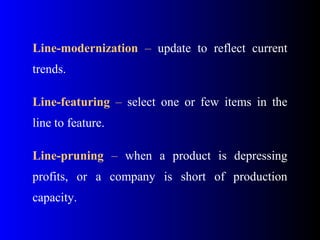
Line-modernization – update to reflect current
trends.
Line-featuring – select one or few items in the
line to feature.
Line-pruning – when a product is depressing
profits, or a company is short of production
capacity.
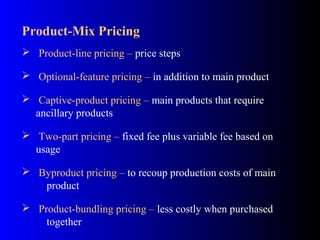
Product-Mix Pricing
 Product-line pricing – price steps
 Optional-feature pricing – in addition to main product
 Captive-product pricing – main products that require
ancillary products
 Two-part pricing – fixed fee plus variable fee based on
usage
 Byproduct pricing – to recoup production costs of main
product
 Product-bundling pricing – less costly when purchased
together

Product strategy

  • 1.
    At the heartof a great brand is a great product. Product is a key element in the market offering. Market leaders generally offer products and services of superior quality. Kotler on MarketingKotler on Marketing
  • 2.
    Managing Product Lines, Brands,and Packaging    Five levels of product   Core product : Use-benefit, problem-solving service.   Generic product : Basic version of the product.   Expected product  :  Set  of  attributes  and  conditions  that buyers normally expect. 
  • 3.
    Augmented product  : Consists  of  additional  services  and  benefits  that  distinguish  the    company’s offer from that of the competition.   Potential product  :  Possible  augmentations  and  transformations  that  this  product  might  ultimately  undergo in future.
  • 4.
     ♦ Product classifications   1.Durability and Tangibility Non-durable goods  –  Normally consumed  in  one  or few uses. Durable goods – Normally survives many uses.   Services  –  Intangible,  inseparable,  variable  and  perishable products.
  • 5.
     ♦    Consumer goods classification   Conveniencegoods – Usually purchased frequently  with minimum efforts. Further  classified  into  staple,  impulse,  emergency   Shopping goods  –  In  the  process  of  selection  and  purchase,  comparison  on  suitability,  quality,  price  and style is done. Further  classified  into  homogeneous  and  heterogeneous goods.  
  • 6.
    Homogeneous goods  – Similar  in  quality,  vary  in  price, whereas heterogeneous vary in product features  and  services  and  is  considered  more  important  than  price.   Speciality goods – Goods with unique characteristics  or  brand  image.    To  purchase  these  goods,  buyers  make special purchasing efforts.   Unsought goods – Consumers does not know or does  not normally think of buying.
  • 7.
     ♦    Industrial – goodsclassification   Three groups of industrial goods  :  Material  and  parts,  capital  items,  and  supplies  and  business  services.   Materials and Parts – enters manufacturer’s product  completely.  Further classified into raw-materials and  manufactured materials and parts. 
  • 8.
    Capital items –facilitates developing and managing finished goods. They include installations and equipments. Supplies and business services – supplies include operating supplies and maintenance and repair items. Business services include business advisory services.
  • 9.
     Differentiation –Products can be differentiated on the basis form, features, performance quality, conformance quality, durability, reliability, repairability, and style.  Product Differentiation :  Form – can be differentiated on the basis of size, shape or physical structure of a product.
  • 10.
     Features –A company can identify and select appropriate new features by surveying recent buyers and then calculating customer value versus company cost for each potential feature.  Each company must also think in terms of feature customization at a higher cost or a few standard packages at lower cost.
  • 11.
     Performance quality– most products are established at one of four performance levels; low, average, high or superior.  Performance quality is the level at which the product’s primary characteristics operate.  The manufacturer must design a performance level appropriate to the target market and competitor’s performance levels.  Continuously improving the product can produce the high returns and market share.
  • 12.
     Conformance Quality– Is the degree to which all the produced units are identical and meet the promised specification.  Durability – In a measure of the product’s expected operating life under natural or stressful conditions.  For such products consumers are willing to pay a little extra, provided the product will not be subject to rapid technological obsolescence.
  • 13.
     Reliability –Reliability is a measure of the probability that a product will not malfunction or fail within a specified time period.  Repairability – Is a measure of the ease of fixing a product when it malfunctions or fails.  Ideal repairability would exist if users could fix the product themselves with a little cost in money or time.
  • 14.
     Style –It is the product’s look and feel to the buyer.  Buyers are willing to pay a premium because of the extraordinary look.  Style has the advantage of creating distinctiveness that is difficult to copy.
  • 15.
     Design :The Integrative Force. Design is the totality of features that affect how a product looks and functions in terms of customer requirements.  As competition intensifies, design offers a potent way to differentiate and position a company’s product and services.  To the company, a well – designed product is one that is easy to manufacture and distribute.
  • 16.
     To theconsumer, a well – designed product is the one that is pleasant to look at and easy to open, install, use, repair, and dispose of. The designer has to take all these factors into consideration.
  • 17.
     Services Differentiation– Where physical product cannot be differentiated, the key to competitive success may lie in adding valued services and improving their quality.  The main service differentiators are ordering ease, delivery, installation, customer training, customer consulting, and maintenance and repair.
  • 18.
     Ordering Ease-  Delivery – It includes speed, accuracy, and care attending the delivery process.  Installation – refers to the work done to make a product operational in its planned location.  Customer Training – Refers to training the customer’s employees to use the vendor’s equipment properly and efficiently.
  • 19.
     Customer consultingrefers to data, information systems and advice services that the seller offers to the buyer.  Maintenance and repair describes the service programme for helping customers keep purchased products in good working order.
  • 20.
    Product Systems : A product system is a group of diverse but related items that function in a compatible manner. Eg: Smart phone product lines come with detachable products including headsets, cameras, keyboards, presentation, projectors, e-books, MP3 players and voice recorders.
  • 21.
     Product mix(Product Assortment) is a set of all products and items a particular seller offers for sale. A product mix consists of various product lines. Width – how many different product lines the company carries. Eg HLL: detergents, toothpaste, shampoos, bathing soaps, etc.
  • 22.
    Length – refersto total number of items in the mix. Eg: All items in each line gives the length. It may be 20-30 Depth – refers to how many variants are offered in each product line. Eg: detergents may have six to eight. Suppose surf comes in three sizes in three formulations, here surf has a depth of nine.
  • 23.
    Consistency : refersto how closely related with various product lines are in the end use, production requirements, distribution channels etc. ♦ Product - line Analysis Product – line sales and profits Product – line market profile – positioning against competitors.
  • 24.
    ♦ Product –line Length  Line is too short if the managers can increase profits by adding items.  Line is too long if the manager can increase profits by dropping items. ♦ Line – stretching decision a) Downward stretch b) Upward stretch c) Two-way stretch d) Line-filling
  • 25.
    Line-modernization – updateto reflect current trends. Line-featuring – select one or few items in the line to feature. Line-pruning – when a product is depressing profits, or a company is short of production capacity.
  • 26.
    Product-Mix Pricing  Product-linepricing – price steps  Optional-feature pricing – in addition to main product  Captive-product pricing – main products that require ancillary products  Two-part pricing – fixed fee plus variable fee based on usage  Byproduct pricing – to recoup production costs of main product  Product-bundling pricing – less costly when purchased together