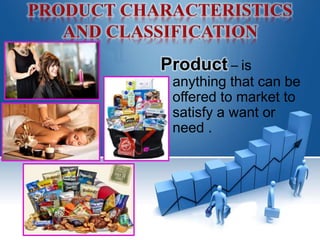
Product – is
anything that can be
offered to market to
satisfy a want or
need .
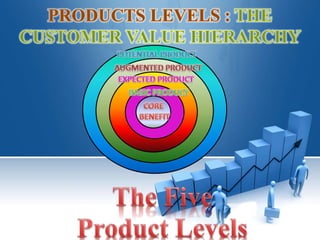
• Core benefit – it is the fundamental
level. This is the basic product and the
focus is on the purpose for which the
product is intended
• Basic product –This represents all the
qualities of the product.
• Expected product – a set of attributes
and conditions buyers normally expect
when they purchase the product.
• Augmented product - This
refers to all additional factors which
sets the product apart from that of the
competition.
• Potential product –
encompasses all the possible
augmentations and transformation
that the product may undergo in the
future.
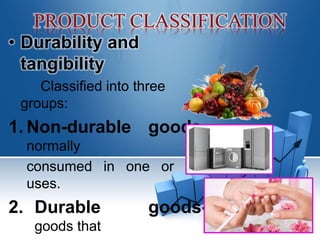
• Durability and
tangibility
Classified into three
groups:
1. Non-durable goods-
normally
consumed in one or few
uses.
2. Durable goods-
goods that
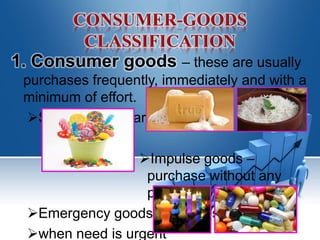
1. Consumer goods – these are usually
purchases frequently, immediately and with a
minimum of effort.
Staples – regular basis
Impulse goods –
purchase without any
planning or research
Emergency goods – purchase
when need is urgent
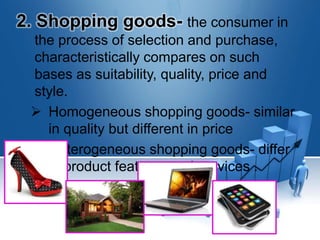
2. Shopping goods- the consumer in
the process of selection and purchase,
characteristically compares on such
bases as suitability, quality, price and
style.
 Homogeneous shopping goods- similar
in quality but different in price
 Heterogeneous shopping goods- differ
in product features and services .
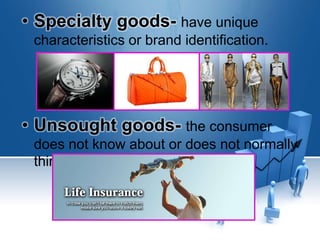
• Specialty goods- have unique
characteristics or brand identification.
• Unsought goods- the consumer
does not know about or does not normally
think buying.
Three groups of industrial goods:
1. Materials and parts – goods that enter
the manufacturer’s product completely.
Two classes:
-Raw materials - two major groups: farm
products and natural products
-Manufactured materials and parts -two
categories: COMPONENT MATERIALS –
usually fabricated
COMPONENT PARTS - enter the finished
product with no further change.
2. Capital items – long lasting goods
that facilitate developing or managing
the finished product.
Two groups:
Installations consists of
buildings and heavy equipments
Equipment comprises portable
factory equipment and tools and
office equipment.
3. Supplies and business
services – short-term goods and
services that facilitate developing or
managing the finished product.
Two kinds of supplies:
Maintenance and repair items (
paint, nails, brooms)
Operating supplies (lubricants,
coal, writing paper, pencils)
Business includes:
Maintenance and repair
services (window cleaning,
copier repair)
Business advisory services
(legal, management consulting,
advertising)
• PRODUCT DIFFERENTIATION
-Form – size, shape, or physical
structure of a product.
-Features - most products an be
offered with varying features that
supplement it basic function
-Customization – Mass
customization is the ability of a company
to meet each customer’s requirement.
Performance Quality – the level
at which the product’s primary
characteristics operate.
Conformance Quality – the
degree to which all the produced units
are identical and meet the promised
specifications.
Durability - measure of the
product’s expected operating life under
natural or stressful conditions, also
Reliability – measure of the
probability that a product will not
malfunction or fail within a specified time
period.
Repairability – measure of the ease
of fixing a product when it malfunctions
or fails.
Style – describes the product’s outlook
and feel to the buyer.
Design – the totality of features that
affects how a product looks and
functions .
Design – the totality of features that
affects how a product looks and functions
• It is the factor that will often give a company
its competitive edge .
• Important in making and marketing retail
services, apparel, packaged goods and
durable equipment.
• SERVICE
DIFFERENTIATION
-Ordering Ease – refers to how
easy it is for the customer to place
an order with the company.
-Delivery – refers to how well the
product or service is delivered to
the customer.
-Installation – refers to the work
done to make a product operational
Customer Training – refers to training
the customer’s employees to use the
vendor’s equipment properly and
efficiently.
Customer Consulting - refers to data,
information system, and advice services
that the seller offers to the buyers.
Maintenance and Repair - describes the
service program for helping customers
and keep purchased products in good
working order.
Returns – products returns are
undoubtedly a nuisance to customers,
manufacturers, retailers, and distributors
alike, they are also an unavoidable reality
of doing business
Two ways of product returns :
1. Controllable returns
2. Uncontrollable returns
The Product Hierarchy
1. Need family – the core need that
underlies the existence of a product
family.
2. Product family- all product classes that
can satisfy a core need with reasonable
effectiveness
3. Product class – a group of products
within product family recognized as
having a certain functional coherence.
4. Product line - a group of products within
a product class that are closely related.
5. Product type – a group of item within a
product line that share one several
possible forms of the product
6. Item ( also called stock keeping unit or
product variant ) - a distinct unit within a
brand or product line distinguished by
size, price appearance or some other
attribute.
• Product system – a group of diverse
but related items that function in a
compatible manner.
• Product mix ( product
assortment) – set of all products and
items a particular sellers offers for sale.
A company’s product mix has a certain
width, length, depth, and consistency.
Width – refers to how many different
product lines the company carries.
Length – refers to the total number of
items in the mix.
Depth – refers to how many variants are
offered of each product in the line.
Consistency- refers to how closely
related the various product lines are in end
use, production requirement, distribution
channels and some other way
- Companies normally develop a basic
platform and modules that can be added
to meet different customers requirements.
- Product line managers need to know the
sales and profits of each item to determine
which items to build , maintain, harvest
and divest.
Four types of products that yield different
gross margins depending on sale volume
and promotion
• Core product
• Staples
• Specialties
• Convenient items
Market profile
Product-line manager must review how
the line is positioned against competitor’s
lines.
Product line length
company’s lengthens its product line in
two ways :
Line Stretching occurs when a
company lengthens its product line beyond
its current range.
It can be done through down- market, up
market or both ways.
Down market stretch – company may
want to introduce a lower – Priced line for
any of the three reasons :
1. The company may notice strong growth
opportunities as mass retailers.
2. The company may wish to tie up lower-
end competitor who might otherwise try to
Up- market stretch – companies may wish
to enter the high end of the market for
more growth, higher margins or simply to
position themselves as full line
manufacturers.
Two way stretch
- companies serving the middle market
might decide to stretch their line in both
directions.
 Line Filling – adding more items
within the present range .
• Product lines need to be modernized.
• In rapidly changing product markets,
modernization is continuous.
• The product line manager typically selects
one or few items in line to feature.
• Product line managers must periodically
review the line for deadwood that is
depressing profits.
• Product mix pricing
-The firm searches for a set of prices
that maximize profits on the total mix.
1. Product Line Pricing
-Seller use a well-established price points
for the product in their line.
2. Optional- Feature Pricing
-companies must decide which item to
include in the standard price and which to
offer as an option.
3. Captive-product pricing
- Captive products are strategically used
to maximize revenue. Sellers generally
follow a product-mix pricing strategy .
4. Two-part pricing
-consisting of a fixed fee plus a variable
usage fee.
5. By product pricing
-products are price according to their
value.
6. Product-Bundling pricing
-Products are offered for sale in one
combined unit that is often marked at a
reduced price compared to the sum of
their separate purchase prices.
Pure-bundling occurs when the firm
only offers its product as a bundle.
Mixed-bundling sellers offers goods
both individually and in bundles.
CO-BRANDING AND
INGREDIENT BRANDING
Co-branding
-also called dual branding or brand
bundling, to or more well known existing
brands are combined into a joint product
and or marketed together in some
fashion.
• Same-company co-branding
• Joint venture co-branding
• Multiple-sponsor co-branding
Ingredient Branding
-special case of co-branding
-involves creating brand equity for
materials components or parts that are
necessarily contained within other
branded products.
“Selfbranding”
-companies advertise and even
trademark their own ingredients.
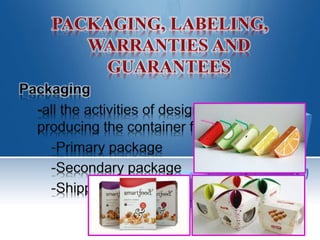
Factors that contributed to the
growing us of packaging as a
marketing tool:
• Self service
• Consumer Affluence
• Company and Brand Name Image
• Innovation Opportunity
• Protecting Intellectual Rights
Packaging objectives:
• Identify the brand
• Convey description and persuasive
information
• Facilitate product transportation and
protection
• Assist at home storage
• Aid product consumption
Labelling
• Simple tag attached to the product or an
elaborately designed graphic that is part
of the package.
• Carry only the brand name or a great deal
of information.
Functions of labels:
-Identify
-Grade
-Describe
Warranties and Guarantees
-Warrantees are formal statements of
expected product performance by the
manufacturer.
-Guarantees reduce buyers risk. They
suggest that the product is of high quality
and that the company and its service
performance are dependable.

Developing product strategy

  • 2.
    Product – is anythingthat can be offered to market to satisfy a want or need .
  • 4.
    • Core benefit– it is the fundamental level. This is the basic product and the focus is on the purpose for which the product is intended • Basic product –This represents all the qualities of the product. • Expected product – a set of attributes and conditions buyers normally expect when they purchase the product.
  • 5.
    • Augmented product- This refers to all additional factors which sets the product apart from that of the competition. • Potential product – encompasses all the possible augmentations and transformation that the product may undergo in the future.
  • 6.
    • Durability and tangibility Classifiedinto three groups: 1. Non-durable goods- normally consumed in one or few uses. 2. Durable goods- goods that
  • 7.
    1. Consumer goods– these are usually purchases frequently, immediately and with a minimum of effort. Staples – regular basis Impulse goods – purchase without any planning or research Emergency goods – purchase when need is urgent
  • 8.
    2. Shopping goods-the consumer in the process of selection and purchase, characteristically compares on such bases as suitability, quality, price and style.  Homogeneous shopping goods- similar in quality but different in price  Heterogeneous shopping goods- differ in product features and services .
  • 9.
    • Specialty goods-have unique characteristics or brand identification. • Unsought goods- the consumer does not know about or does not normally think buying.
  • 10.
    Three groups ofindustrial goods: 1. Materials and parts – goods that enter the manufacturer’s product completely. Two classes: -Raw materials - two major groups: farm products and natural products -Manufactured materials and parts -two categories: COMPONENT MATERIALS – usually fabricated COMPONENT PARTS - enter the finished product with no further change.
  • 11.
    2. Capital items– long lasting goods that facilitate developing or managing the finished product. Two groups: Installations consists of buildings and heavy equipments Equipment comprises portable factory equipment and tools and office equipment.
  • 12.
    3. Supplies andbusiness services – short-term goods and services that facilitate developing or managing the finished product. Two kinds of supplies: Maintenance and repair items ( paint, nails, brooms) Operating supplies (lubricants, coal, writing paper, pencils)
  • 13.
    Business includes: Maintenance andrepair services (window cleaning, copier repair) Business advisory services (legal, management consulting, advertising)
  • 14.
    • PRODUCT DIFFERENTIATION -Form– size, shape, or physical structure of a product. -Features - most products an be offered with varying features that supplement it basic function -Customization – Mass customization is the ability of a company to meet each customer’s requirement.
  • 15.
    Performance Quality –the level at which the product’s primary characteristics operate. Conformance Quality – the degree to which all the produced units are identical and meet the promised specifications. Durability - measure of the product’s expected operating life under natural or stressful conditions, also
  • 16.
    Reliability – measureof the probability that a product will not malfunction or fail within a specified time period. Repairability – measure of the ease of fixing a product when it malfunctions or fails. Style – describes the product’s outlook and feel to the buyer. Design – the totality of features that affects how a product looks and functions .
  • 17.
    Design – thetotality of features that affects how a product looks and functions • It is the factor that will often give a company its competitive edge . • Important in making and marketing retail services, apparel, packaged goods and durable equipment.
  • 18.
    • SERVICE DIFFERENTIATION -Ordering Ease– refers to how easy it is for the customer to place an order with the company. -Delivery – refers to how well the product or service is delivered to the customer. -Installation – refers to the work done to make a product operational
  • 19.
    Customer Training –refers to training the customer’s employees to use the vendor’s equipment properly and efficiently. Customer Consulting - refers to data, information system, and advice services that the seller offers to the buyers. Maintenance and Repair - describes the service program for helping customers and keep purchased products in good working order.
  • 20.
    Returns – productsreturns are undoubtedly a nuisance to customers, manufacturers, retailers, and distributors alike, they are also an unavoidable reality of doing business Two ways of product returns : 1. Controllable returns 2. Uncontrollable returns
  • 21.
    The Product Hierarchy 1.Need family – the core need that underlies the existence of a product family. 2. Product family- all product classes that can satisfy a core need with reasonable effectiveness 3. Product class – a group of products within product family recognized as having a certain functional coherence.
  • 22.
    4. Product line- a group of products within a product class that are closely related. 5. Product type – a group of item within a product line that share one several possible forms of the product 6. Item ( also called stock keeping unit or product variant ) - a distinct unit within a brand or product line distinguished by size, price appearance or some other attribute.
  • 23.
    • Product system– a group of diverse but related items that function in a compatible manner. • Product mix ( product assortment) – set of all products and items a particular sellers offers for sale. A company’s product mix has a certain width, length, depth, and consistency.
  • 24.
    Width – refersto how many different product lines the company carries. Length – refers to the total number of items in the mix. Depth – refers to how many variants are offered of each product in the line. Consistency- refers to how closely related the various product lines are in end use, production requirement, distribution channels and some other way
  • 25.
    - Companies normallydevelop a basic platform and modules that can be added to meet different customers requirements. - Product line managers need to know the sales and profits of each item to determine which items to build , maintain, harvest and divest.
  • 26.
    Four types ofproducts that yield different gross margins depending on sale volume and promotion • Core product • Staples • Specialties • Convenient items
  • 27.
    Market profile Product-line managermust review how the line is positioned against competitor’s lines. Product line length company’s lengthens its product line in two ways :
  • 28.
    Line Stretching occurswhen a company lengthens its product line beyond its current range. It can be done through down- market, up market or both ways. Down market stretch – company may want to introduce a lower – Priced line for any of the three reasons : 1. The company may notice strong growth opportunities as mass retailers. 2. The company may wish to tie up lower- end competitor who might otherwise try to
  • 29.
    Up- market stretch– companies may wish to enter the high end of the market for more growth, higher margins or simply to position themselves as full line manufacturers. Two way stretch - companies serving the middle market might decide to stretch their line in both directions.  Line Filling – adding more items within the present range .
  • 30.
    • Product linesneed to be modernized. • In rapidly changing product markets, modernization is continuous. • The product line manager typically selects one or few items in line to feature. • Product line managers must periodically review the line for deadwood that is depressing profits.
  • 31.
    • Product mixpricing -The firm searches for a set of prices that maximize profits on the total mix. 1. Product Line Pricing -Seller use a well-established price points for the product in their line. 2. Optional- Feature Pricing -companies must decide which item to include in the standard price and which to offer as an option.
  • 32.
    3. Captive-product pricing -Captive products are strategically used to maximize revenue. Sellers generally follow a product-mix pricing strategy . 4. Two-part pricing -consisting of a fixed fee plus a variable usage fee. 5. By product pricing -products are price according to their value.
  • 33.
    6. Product-Bundling pricing -Productsare offered for sale in one combined unit that is often marked at a reduced price compared to the sum of their separate purchase prices. Pure-bundling occurs when the firm only offers its product as a bundle. Mixed-bundling sellers offers goods both individually and in bundles.
  • 34.
    CO-BRANDING AND INGREDIENT BRANDING Co-branding -alsocalled dual branding or brand bundling, to or more well known existing brands are combined into a joint product and or marketed together in some fashion. • Same-company co-branding • Joint venture co-branding • Multiple-sponsor co-branding
  • 35.
    Ingredient Branding -special caseof co-branding -involves creating brand equity for materials components or parts that are necessarily contained within other branded products. “Selfbranding” -companies advertise and even trademark their own ingredients.
  • 37.
    Factors that contributedto the growing us of packaging as a marketing tool: • Self service • Consumer Affluence • Company and Brand Name Image • Innovation Opportunity • Protecting Intellectual Rights
  • 38.
    Packaging objectives: • Identifythe brand • Convey description and persuasive information • Facilitate product transportation and protection • Assist at home storage • Aid product consumption
  • 39.
    Labelling • Simple tagattached to the product or an elaborately designed graphic that is part of the package. • Carry only the brand name or a great deal of information. Functions of labels: -Identify -Grade -Describe
  • 40.
    Warranties and Guarantees -Warranteesare formal statements of expected product performance by the manufacturer. -Guarantees reduce buyers risk. They suggest that the product is of high quality and that the company and its service performance are dependable.