1©www.dhirenjani.com
Product Manager or Product Owner
Different Roles for Different Folks
August 2019
2©www.dhirenjani.com
Contents Part I – Role and Responsibilities
Part II – Activities and Stakeholders
Part III – Organization
3©www.dhirenjani.com
Part I – Roles and Responsibilities
4©www.dhirenjani.com
4
“The Product Manager is the CEO of the Product”
5©www.dhirenjani.com
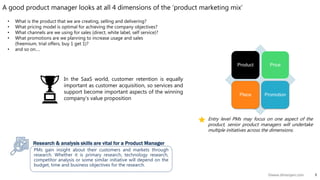
Product Price
Place Promotion
A good product manager looks at all 4 dimensions of the ‘product marketing mix’
Entry level PMs may focus on one aspect of the
product, senior product managers will undertake
multiple initiatives across the dimensions.
PMs gain insight about their customers and markets through
research. Whether it is primary research, technology research,
competitor analysis or some similar initiative will depend on the
budget, time and business objectives for the research.
Research & analysis skills are vital for a Product Manager
In the SaaS world, customer retention is equally
important as customer acquisition, so services and
support become important aspects of the winning
company’s value proposition
• What is the product that we are creating, selling and delivering?
• What pricing model is optimal for achieving the company objectives?
• What channels are we using for sales (direct, white label, self service)?
• What promotions are we planning to increase usage and sales
(freemium, trial offers, buy 1 get 1)?
• and so on….
6©www.dhirenjani.com
Seniority
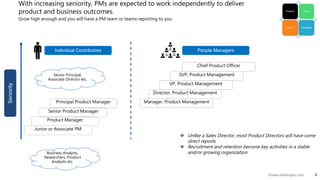
With increasing seniority, PMs are expected to work independently to deliver
product and business outcomes.
Grow high enough and you will have a PM team or teams reporting to you
Junior or Associate PM
Product Manager
Senior Product Manager
Principal Product Manager Manager, Product Management
Director, Product Management
VP, Product Management
SVP, Product Management
Chief Product Officer
Business Analysts,
Researchers, Product
Analysts etc.
Individual Contributors People Managers
 Unlike a Sales Director, most Product Directors will have some
direct reports
 Recruitment and retention become key activities in a stable
and/or growing organization
Senior Principal,
Associate Director etc.
7©www.dhirenjani.com
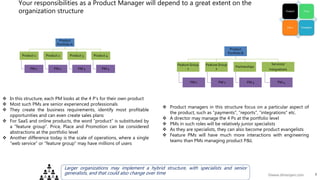
Your responsibilities as a Product Manager will depend to a great extent on the
organization structure
Product
Portfolio A
Product 1
PM 1
Product 2
PM 2
Product 3
PM 3
Product 4
PM 4
 In this structure, each PM looks at the 4 P’s for their own product
 Most such PMs are senior experienced professionals
 They create the business requirements, identify most profitable
opportunities and can even create sales plans
 For SaaS and online products, the word “product” is substituted by
a “feature group”. Price, Place and Promotion can be considered
abstractions at the portfolio level
 Another difference today is the scale of operations, where a single
“web service” or “feature group” may have millions of users
Product
Portfolio B
Feature Group
1
PM 1
Feature Group
2
PM 2
Partnerships
PM 3
Services/
Integrations
PM 4
 Product managers in this structure focus on a particular aspect of
the product, such as “payments”, “reports”, “integrations” etc.
 A director may manage the 4 Ps at the portfolio level
 PMs in such roles will be relatively junior specialists
 As they are specialists, they can also become product evangelists
 Feature PMs will have much more interactions with engineering
teams than PMs managing product P&L
Larger organizations may implement a hybrid structure, with specialists and senior
generalists, and that could also change over time
8©www.dhirenjani.com
8
“In Agile methodology, the Product Owner
represents the customer to the development
team”
9©www.dhirenjani.com
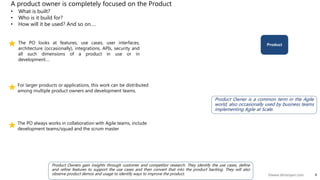
A product owner is completely focused on the Product
• What is built?
• Who is it build for?
• How will it be used? And so on….
ProductThe PO looks at features, use cases, user interfaces,
architecture (occasionally), integrations, APIs, security and
all such dimensions of a product in use or in
development….
For larger products or applications, this work can be distributed
among multiple product owners and development teams.
The PO always works in collaboration with Agile teams, include
development teams/squad and the scrum master
Product Owners gain insights through customer and competitor research. They identify the use cases, define
and refine features to support the use cases and then convert that into the product backlog. They will also
observe product demos and usage to identify ways to improve the product.
Product Owner is a common term in the Agile
world, also occasionally used by business teams
implementing Agile at Scale.
10©www.dhirenjani.com
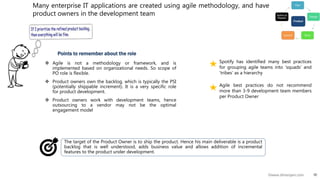
Many enterprise IT applications are created using agile methodology, and have
product owners in the development team
 Agile is not a methodology or framework, and is
implemented based on organizational needs. So scope of
PO role is flexible.
 Product owners own the backlog, which is typically the PSI
(potentially shippable increment). It is a very specific role
for product development.
 Product owners work with development teams, hence
outsourcing to a vendor may not be the optimal
engagement model
Points to remember about the role
Spotify has identified many best practices
for grouping agile teams into ‘squads’ and
‘tribes’ as a hierarchy
The target of the Product Owner is to ship the product. Hence his main deliverable is a product
backlog that is well understood, adds business value and allows addition of incremental
features to the product under development.
Agile best practices do not recommend
more than 3-9 development team members
per Product Owner
11©www.dhirenjani.com
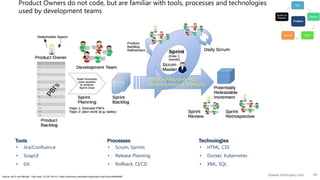
Product Owners do not code, but are familiar with tools, processes and technologies
used by development teams
Source: By Dr Ian Mitchell - Own work, CC BY-SA 4.0, https://commons.wikimedia.org/w/index.php?curid=44894952
• Jira/Confluence
• SoapUI
• Git
Tools
• Scrum, Sprints
• Release Planning
• Rollback, CI/CD
Processes
• HTML, CSS
• Docker, Kubernetes
• XML, SQL
Technologies
12©www.dhirenjani.com
Part II – Activities & Stakeholders
13©www.dhirenjani.com
13
“Launching a product is only the beginning of
the journey”
14©www.dhirenjani.com
Product
Manager
Services
Sales
Pre-sales
Architects
Engineerin
g
Cloud
Team
Education
& Training
Product
Marketing
Marketing
Support
Business
Developme
nt
Strategy
Finance
Human
Resources
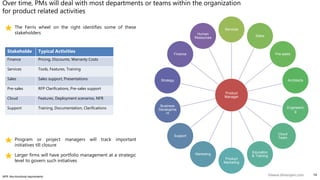
Over time, PMs will deal with most departments or teams within the organization
for product related activities
The Ferris wheel on the right identifies some of these
stakeholders
Stakeholde Typical Activities
Finance Pricing, Discounts, Warranty Costs
Services Tools, Features, Training
Sales Sales support, Presentations
Pre-sales RFP Clarifications, Pre-sales support
Cloud Features, Deployment scenarios, NFR
Support Training, Documentation, Clarifications
Program or project managers will track important
initiatives till closure
Larger firms will have portfolio management at a strategic
level to govern such initiatives
NFR: Non-functional requirements
15©www.dhirenjani.com
15
“For the Product Owner to succeed, the entire
organization must respect his or her decisions”
The Scrum Guide
16©www.dhirenjani.com
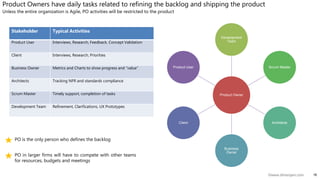
Product Owner
Development
Team
Scrum Master
Architects
Business
Owner
Client
Product User
Product Owners have daily tasks related to refining the backlog and shipping the product
Unless the entire organization is Agile, PO activities will be restricted to the product
Stakeholder Typical Activities
Product User Interviews, Research, Feedback, Concept Validation
Client Interviews, Research, Priorities
Business Owner Metrics and Charts to show progress and “value”
Architects Tracking NFR and standards compliance
Scrum Master Timely support, completion of tasks
Development Team Refinement, Clarifications, UX Prototypes
PO is the only person who defines the backlog
PO in larger firms will have to compete with other teams
for resources, budgets and meetings
17©www.dhirenjani.com
Part III – Organization Structure
18©www.dhirenjani.com
18
“Many organizations use Product Managers,
Business Analysts, Product Owners and
Program Managers interchangeably, without
success”
“Scrum recognizes no titles for
Development Team members”
19©www.dhirenjani.com
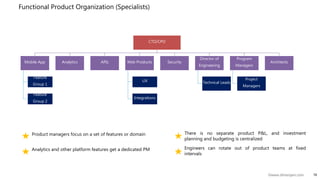
Functional Product Organization (Specialists)
CTO/CPO
Mobile App
Feature
Group 1
Feature
Group 2
Analytics APIs Web Products
UX
Integrations
Security
Director of
Engineering
Technical Leads
Program
Managers
Project
Managers
Architects
Product managers focus on a set of features or domain
Analytics and other platform features get a dedicated PM
There is no separate product P&L, and investment
planning and budgeting is centralized
Engineers can rotate out of product teams at fixed
intervals
20©www.dhirenjani.com
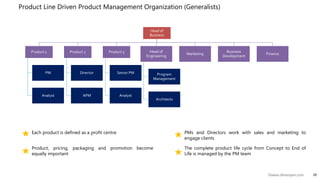
Product Line Driven Product Management Organization (Generalists)
Head of
Business
Product 1
PM
Analyst
Product 2
Director
APM
Product 3
Senior PM
Analyst
Head of
Engineering
Program
Management
Architects
Marketing
Business
Development
Finance
Each product is defined as a profit centre
Product, pricing, packaging and promotion become
equally important
PMs and Directors work with sales and marketing to
engage clients
The complete product life cycle from Concept to End of
Life is managed by the PM team
21©www.dhirenjani.com
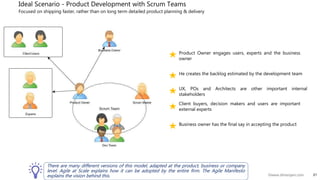
Ideal Scenario - Product Development with Scrum Teams
Focused on shipping faster, rather than on long term detailed product planning & delivery
Product Owner engages users, experts and the business
owner
He creates the backlog estimated by the development team
UX, POs and Architects are other important internal
stakeholders
Client buyers, decision makers and users are important
external experts
Business owner has the final say in accepting the product
There are many different versions of this model, adapted at the product, business or company
level. Agile at Scale explains how it can be adopted by the entire firm. The Agile Manifesto
explains the vision behind this.
22©www.dhirenjani.com
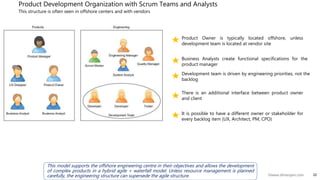
Product Development Organization with Scrum Teams and Analysts
This structure is often seen in offshore centers and with vendors
Product Owner is typically located offshore, unless
development team is located at vendor site
Business Analysts create functional specifications for the
product manager
Development team is driven by engineering priorities, not the
backlog
There is an additional interface between product owner
and client
It is possible to have a different owner or stakeholder for
every backlog item (UX, Architect, PM, CPO)
This model supports the offshore engineering centre in their objectives and allows the development
of complex products in a hybrid agile + waterfall model. Unless resource management is planned
carefully, the engineering structure can supersede the agile structure.
23©www.dhirenjani.com
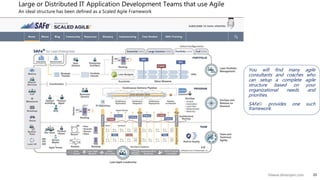
Large or Distributed IT Application Development Teams that use Agile
An ideal structure has been defined as a Scaled Agile Framework
You will find many agile
consultants and coaches who
can setup a complete agile
structure based on your
organizational needs and
priorities.
SAFe© provides one such
framework.
24©www.dhirenjani.com
Final Thoughts
Product Owners and Product Managers have different roles
Role and responsibilities depend on the organization structure
and stakeholders
There is no ideal organization or definition for these roles
25©www.dhirenjani.com
@dhirenjaniDhiren Jani
Questions or Comments?
dhirenjani
Next presentation will cover product activities per role, at
different stages of the product lifecycle

Product Manager or Product Owner

  • 1.
    1©www.dhirenjani.com Product Manager orProduct Owner Different Roles for Different Folks August 2019
  • 2.
    2©www.dhirenjani.com Contents Part I– Role and Responsibilities Part II – Activities and Stakeholders Part III – Organization
  • 3.
    3©www.dhirenjani.com Part I –Roles and Responsibilities
  • 4.
  • 5.
    5©www.dhirenjani.com Product Price Place Promotion Agood product manager looks at all 4 dimensions of the ‘product marketing mix’ Entry level PMs may focus on one aspect of the product, senior product managers will undertake multiple initiatives across the dimensions. PMs gain insight about their customers and markets through research. Whether it is primary research, technology research, competitor analysis or some similar initiative will depend on the budget, time and business objectives for the research. Research & analysis skills are vital for a Product Manager In the SaaS world, customer retention is equally important as customer acquisition, so services and support become important aspects of the winning company’s value proposition • What is the product that we are creating, selling and delivering? • What pricing model is optimal for achieving the company objectives? • What channels are we using for sales (direct, white label, self service)? • What promotions are we planning to increase usage and sales (freemium, trial offers, buy 1 get 1)? • and so on….
  • 6.
    6©www.dhirenjani.com Seniority With increasing seniority,PMs are expected to work independently to deliver product and business outcomes. Grow high enough and you will have a PM team or teams reporting to you Junior or Associate PM Product Manager Senior Product Manager Principal Product Manager Manager, Product Management Director, Product Management VP, Product Management SVP, Product Management Chief Product Officer Business Analysts, Researchers, Product Analysts etc. Individual Contributors People Managers  Unlike a Sales Director, most Product Directors will have some direct reports  Recruitment and retention become key activities in a stable and/or growing organization Senior Principal, Associate Director etc.
  • 7.
    7©www.dhirenjani.com Your responsibilities asa Product Manager will depend to a great extent on the organization structure Product Portfolio A Product 1 PM 1 Product 2 PM 2 Product 3 PM 3 Product 4 PM 4  In this structure, each PM looks at the 4 P’s for their own product  Most such PMs are senior experienced professionals  They create the business requirements, identify most profitable opportunities and can even create sales plans  For SaaS and online products, the word “product” is substituted by a “feature group”. Price, Place and Promotion can be considered abstractions at the portfolio level  Another difference today is the scale of operations, where a single “web service” or “feature group” may have millions of users Product Portfolio B Feature Group 1 PM 1 Feature Group 2 PM 2 Partnerships PM 3 Services/ Integrations PM 4  Product managers in this structure focus on a particular aspect of the product, such as “payments”, “reports”, “integrations” etc.  A director may manage the 4 Ps at the portfolio level  PMs in such roles will be relatively junior specialists  As they are specialists, they can also become product evangelists  Feature PMs will have much more interactions with engineering teams than PMs managing product P&L Larger organizations may implement a hybrid structure, with specialists and senior generalists, and that could also change over time
  • 8.
    8©www.dhirenjani.com 8 “In Agile methodology,the Product Owner represents the customer to the development team”
  • 9.
    9©www.dhirenjani.com A product owneris completely focused on the Product • What is built? • Who is it build for? • How will it be used? And so on…. ProductThe PO looks at features, use cases, user interfaces, architecture (occasionally), integrations, APIs, security and all such dimensions of a product in use or in development…. For larger products or applications, this work can be distributed among multiple product owners and development teams. The PO always works in collaboration with Agile teams, include development teams/squad and the scrum master Product Owners gain insights through customer and competitor research. They identify the use cases, define and refine features to support the use cases and then convert that into the product backlog. They will also observe product demos and usage to identify ways to improve the product. Product Owner is a common term in the Agile world, also occasionally used by business teams implementing Agile at Scale.
  • 10.
    10©www.dhirenjani.com Many enterprise ITapplications are created using agile methodology, and have product owners in the development team  Agile is not a methodology or framework, and is implemented based on organizational needs. So scope of PO role is flexible.  Product owners own the backlog, which is typically the PSI (potentially shippable increment). It is a very specific role for product development.  Product owners work with development teams, hence outsourcing to a vendor may not be the optimal engagement model Points to remember about the role Spotify has identified many best practices for grouping agile teams into ‘squads’ and ‘tribes’ as a hierarchy The target of the Product Owner is to ship the product. Hence his main deliverable is a product backlog that is well understood, adds business value and allows addition of incremental features to the product under development. Agile best practices do not recommend more than 3-9 development team members per Product Owner
  • 11.
    11©www.dhirenjani.com Product Owners donot code, but are familiar with tools, processes and technologies used by development teams Source: By Dr Ian Mitchell - Own work, CC BY-SA 4.0, https://commons.wikimedia.org/w/index.php?curid=44894952 • Jira/Confluence • SoapUI • Git Tools • Scrum, Sprints • Release Planning • Rollback, CI/CD Processes • HTML, CSS • Docker, Kubernetes • XML, SQL Technologies
  • 12.
    12©www.dhirenjani.com Part II –Activities & Stakeholders
  • 13.
    13©www.dhirenjani.com 13 “Launching a productis only the beginning of the journey”
  • 14.
    14©www.dhirenjani.com Product Manager Services Sales Pre-sales Architects Engineerin g Cloud Team Education & Training Product Marketing Marketing Support Business Developme nt Strategy Finance Human Resources Over time,PMs will deal with most departments or teams within the organization for product related activities The Ferris wheel on the right identifies some of these stakeholders Stakeholde Typical Activities Finance Pricing, Discounts, Warranty Costs Services Tools, Features, Training Sales Sales support, Presentations Pre-sales RFP Clarifications, Pre-sales support Cloud Features, Deployment scenarios, NFR Support Training, Documentation, Clarifications Program or project managers will track important initiatives till closure Larger firms will have portfolio management at a strategic level to govern such initiatives NFR: Non-functional requirements
  • 15.
    15©www.dhirenjani.com 15 “For the ProductOwner to succeed, the entire organization must respect his or her decisions” The Scrum Guide
  • 16.
    16©www.dhirenjani.com Product Owner Development Team Scrum Master Architects Business Owner Client ProductUser Product Owners have daily tasks related to refining the backlog and shipping the product Unless the entire organization is Agile, PO activities will be restricted to the product Stakeholder Typical Activities Product User Interviews, Research, Feedback, Concept Validation Client Interviews, Research, Priorities Business Owner Metrics and Charts to show progress and “value” Architects Tracking NFR and standards compliance Scrum Master Timely support, completion of tasks Development Team Refinement, Clarifications, UX Prototypes PO is the only person who defines the backlog PO in larger firms will have to compete with other teams for resources, budgets and meetings
  • 17.
  • 18.
    18©www.dhirenjani.com 18 “Many organizations useProduct Managers, Business Analysts, Product Owners and Program Managers interchangeably, without success” “Scrum recognizes no titles for Development Team members”
  • 19.
    19©www.dhirenjani.com Functional Product Organization(Specialists) CTO/CPO Mobile App Feature Group 1 Feature Group 2 Analytics APIs Web Products UX Integrations Security Director of Engineering Technical Leads Program Managers Project Managers Architects Product managers focus on a set of features or domain Analytics and other platform features get a dedicated PM There is no separate product P&L, and investment planning and budgeting is centralized Engineers can rotate out of product teams at fixed intervals
  • 20.
    20©www.dhirenjani.com Product Line DrivenProduct Management Organization (Generalists) Head of Business Product 1 PM Analyst Product 2 Director APM Product 3 Senior PM Analyst Head of Engineering Program Management Architects Marketing Business Development Finance Each product is defined as a profit centre Product, pricing, packaging and promotion become equally important PMs and Directors work with sales and marketing to engage clients The complete product life cycle from Concept to End of Life is managed by the PM team
  • 21.
    21©www.dhirenjani.com Ideal Scenario -Product Development with Scrum Teams Focused on shipping faster, rather than on long term detailed product planning & delivery Product Owner engages users, experts and the business owner He creates the backlog estimated by the development team UX, POs and Architects are other important internal stakeholders Client buyers, decision makers and users are important external experts Business owner has the final say in accepting the product There are many different versions of this model, adapted at the product, business or company level. Agile at Scale explains how it can be adopted by the entire firm. The Agile Manifesto explains the vision behind this.
  • 22.
    22©www.dhirenjani.com Product Development Organizationwith Scrum Teams and Analysts This structure is often seen in offshore centers and with vendors Product Owner is typically located offshore, unless development team is located at vendor site Business Analysts create functional specifications for the product manager Development team is driven by engineering priorities, not the backlog There is an additional interface between product owner and client It is possible to have a different owner or stakeholder for every backlog item (UX, Architect, PM, CPO) This model supports the offshore engineering centre in their objectives and allows the development of complex products in a hybrid agile + waterfall model. Unless resource management is planned carefully, the engineering structure can supersede the agile structure.
  • 23.
    23©www.dhirenjani.com Large or DistributedIT Application Development Teams that use Agile An ideal structure has been defined as a Scaled Agile Framework You will find many agile consultants and coaches who can setup a complete agile structure based on your organizational needs and priorities. SAFe© provides one such framework.
  • 24.
    24©www.dhirenjani.com Final Thoughts Product Ownersand Product Managers have different roles Role and responsibilities depend on the organization structure and stakeholders There is no ideal organization or definition for these roles
  • 25.
    25©www.dhirenjani.com @dhirenjaniDhiren Jani Questions orComments? dhirenjani Next presentation will cover product activities per role, at different stages of the product lifecycle