Business
Analysis Skills
An Authority vs In Authority - Better having a
sharp Business Analysis Skill than being in the
role of a Business Analyst
Rainer Wendt, CBAP, PMP, PMI-PBA, PMI-ACP
BBA 2019, October 11th 2019, Belgradewww.masventa.de
www.ba-day.com
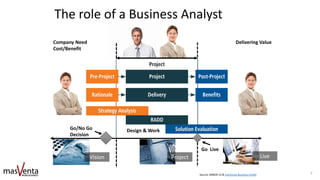
The role of a Business Analyst
Source: BABOK v3
Company Need
Cost/Benefit
Delivering Value
Design & WorkGo/No Go
Decision
Go Live
Vision Project Live
2Source: BABOK v3 & masVenta Business GmbH
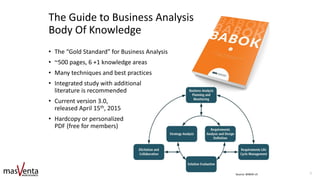
The Guide to Business Analysis
Body Of Knowledge
• The “Gold Standard” for Business Analysis
• ~500 pages, 6 +1 knowledge areas
• Many techniques and best practices
• Integrated study with additional
literature is recommended
• Current version 3.0,
released April 15th, 2015
• Hardcopy or personalized
PDF (free for members)
3Source: BABOK v3
Definition: Business Analysis is…
“…the practice of
enabling change in
an enterprise
[context] by defining
needs and
recommending
solutions that deliver
value to
stakeholders”
Source: BABOK v3
4
BABOK® v3 - Core Concept Model (BACCM TM).
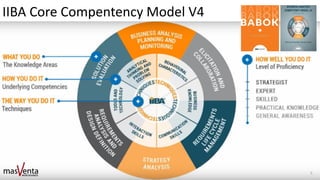
IIBA Core Compentency Model V4
5
The CBAP® Certificate
• Globally accepted certificate for professional Analysts, Architects
or Consultants, the “Gold Standard” for Business Analysis
• Certified CBAP® have at least 5 years experience in Business
Analysis, i.e., they are experienced senior professionals.
• Many CBAP® have a good knowledge in project management;
most of them have worked in “hybrid” mode as BA and PM.
• Business Analysis is most popular in branches like Banking,
Insurances and Telecommunications, other branches follow.
• BAs should have good Domain knowledge, but the certificate
is independent from branches, strongly IT focused.
• Nearly 10.000 CBAP® worldwide, growth rate > 15%
• Central Europe is significantly behind.
• CBAP® Exam: 3,5 h multiple choice with 120 questions,
provided by accredited examination centers only.
• Cost for application and exam is around Euro 500,-
7
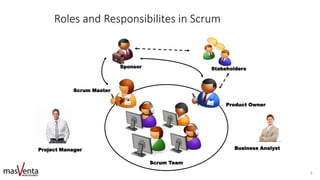
Roles and Responsibilites in Scrum
Scrum Master
Product Owner
Scrum Team
StakeholdersSponsor
Business AnalystProject Manager
8
A key role in Scrum:
The Product Owner
9
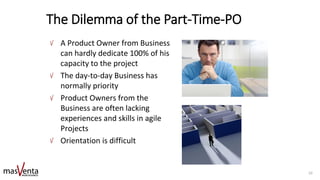
The Dilemma of the Part-Time-PO
A Product Owner from Business
can hardly dedicate 100% of his
capacity to the project
The day-to-day Business has
normally priority
Product Owners from the
Business are often lacking
experiences and skills in agile
Projects
Orientation is difficult
10
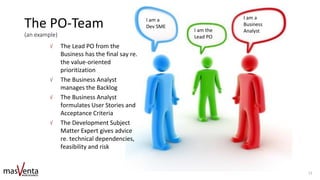
The PO-Team
(an example)
I am the
Lead PO
I am a
Business
Analyst
I am a
Dev SME
The Lead PO from the
Business has the final say re.
the value-oriented
prioritization
The Business Analyst
manages the Backlog
The Business Analyst
formulates User Stories and
Acceptance Criteria
The Development Subject
Matter Expert gives advice
re. technical dependencies,
feasibility and risk
11
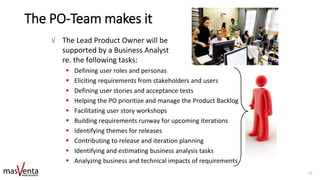
The PO-Team makes it
The Lead Product Owner will be
supported by a Business Analyst
re. the following tasks:
▪ Defining user roles and personas
▪ Eliciting requirements from stakeholders and users
▪ Defining user stories and acceptance tests
▪ Helping the PO prioritize and manage the Product Backlog
▪ Facilitating user story workshops
▪ Building requirements runway for upcoming iterations
▪ Identifying themes for releases
▪ Contributing to release and iteration planning
▪ Identifying and estimating business analysis tasks
▪ Analyzing business and technical impacts of requirements
12
13Quelle: BABOK v3
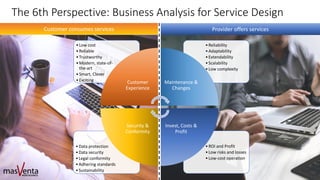
The 6th Perspective: Business Analysis for Service Design
•ROI and Profit
•Low risks and losses
•Low-cost operation
•Data protection
•Data security
•Legal conformity
•Adhering standards
•Sustainability
•Reliability
•Adaptability
•Extendability
•Scalability
•Low complexity
•Low cost
•Reliable
•Trustworthy
•Modern, state-of-
the-art
•Smart, Clever
•Exciting Customer
Experience
Maintenance &
Changes
Invest, Costs &
Profit
Security &
Conformity
Customer consumes services Provider offers services
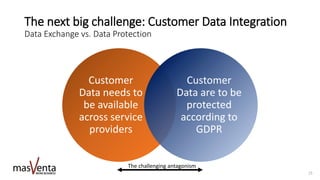
The next big challenge: Customer Data Integration
Data Exchange vs. Data Protection
Customer
Data needs to
be available
across service
providers
Customer
Data are to be
protected
according to
GDPR
The challenging antagonism
15
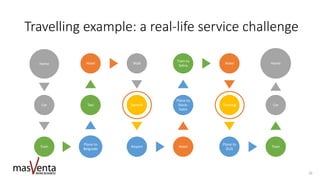
Travelling example: a real-life service challenge
Home
Car
Train
Plane to
Belgrade
Taxi
Hotel Walk
Speech
Airport Hotel
Plane to
Stock-
holm
Train to
Solna
Hotel
Training
Plane to
DUS
Train
Car
Home
16
17
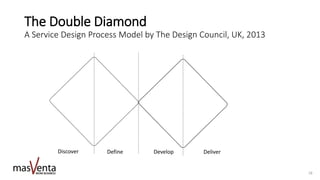
The Double Diamond
A Service Design Process Model by The Design Council, UK, 2013
Discover Define Develop Deliver
18
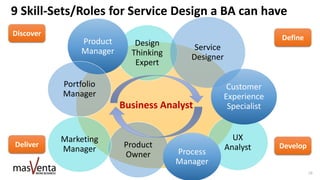
Business Analyst
Design
Thinking
Expert
UX
Analyst
Customer
Experience
Specialist
Service
Designer
Product
Manager
Product
Owner
Portfolio
Manager
9 Skill-Sets/Roles for Service Design a BA can have
Marketing
Manager Process
Manager
19
Discover
Define
Deliver Develop
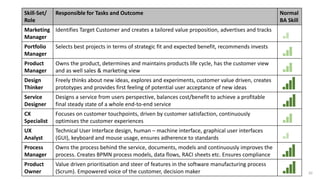
Skill-Set/
Role
Responsible for Tasks and Outcome Normal
BA Skill
Marketing
Manager
Identifies Target Customer and creates a tailored value proposition, advertises and tracks
Portfolio
Manager
Selects best projects in terms of strategic fit and expected benefit, recommends invests
Product
Manager
Owns the product, determines and maintains products life cycle, has the customer view
and as well sales & marketing view
Design
Thinker
Freely thinks about new ideas, explores and experiments, customer value driven, creates
prototypes and provides first feeling of potential user acceptance of new ideas
Service
Designer
Designs a service from users perspective, balances cost/benefit to achieve a profitable
final steady state of a whole end-to-end service
CX
Specialist
Focuses on customer touchpoints, driven by customer satisfaction, continuously
optimises the customer experiences
UX
Analyst
Technical User Interface design, human – machine interface, graphical user interfaces
(GUI), keyboard and mouse usage, ensures adherence to standards
Process
Manager
Owns the process behind the service, documents, models and continuously improves the
process. Creates BPMN process models, data flows, RACI sheets etc. Ensures compliance
Product
Owner
Value driven prioritisation and steer of features in the software manufacturing process
(Scrum). Empowered voice of the customer, decision maker 20
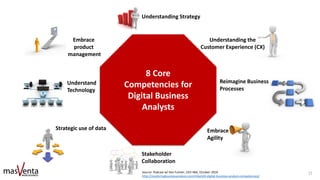
8 Core
Competencies for
Digital Business
Analysts
Understanding Strategy
Understanding the
Customer Experience (CX)
Reimagine Business
Processes
Embrace
Agility
Stakeholder
Collaboration
Strategic use of data
Understand
Technology
Embrace
product
management
Source: Podcast w/ Ken Fulmer, CEO IIBA, October 2018
http://masteringbusinessanalysis.com/mba169-digital-business-analyst-competencies/
21
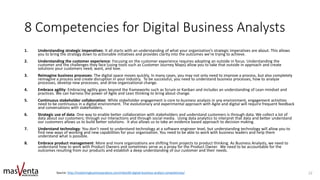
8 Competencies for Digital Business Analysts
1. Understanding strategic imperatives: It all starts with an understanding of what your organization’s strategic imperatives are about. This allows
you to bring the strategy down to actionable initiatives and provides clarity into the outcomes we’re trying to achieve.
2. Understanding the customer experience: Focusing on the customer experience requires adopting an outside in focus. Understanding the
customer and the challenges they face (using tools such as Customer Journey Maps) allow you to take that outside in approach and create
solutions your customers need, want, and love.
3. Reimagine business processes: The digital space moves quickly. In many cases, you may not only need to improve a process, but also completely
reimagine a process and create disruption in your industry. To be successful, you need to understand business processes, how to analyze
processes, develop new processes, and drive organizational change.
4. Embrace agility: Embracing agility goes beyond the frameworks such as Scrum or Kanban and includes an understanding of Lean mindset and
practices. We can harness the power of Agile and Lean thinking to bring about change.
5. Continuous stakeholder collaboration: While stakeholder engagement is core to business analysis in any environment, engagement activities
need to be continuous in a digital environment. The evolutionary and experimental approach with Agile and digital will require frequent feedback
and conversations with stakeholders.
6. Strategic use of data: One way to enable better collaboration with stakeholders and understand customers is through data. We collect a lot of
data about our customers; through our interactions and through social media. Using data analytics to interpret that data and better understand
our customers allows us to build better solutions. It also allows us to take an evidence based approach to decision making.
7. Understand technology: You don’t need to understand technology at a software engineer level, but understanding technology will allow you to
find new ways of working and new capabilities for your organization. You need to be able to work with business leaders and help them
understand what is possible.
8. Embrace product management: More and more organizations are shifting from projects to product thinking. As Business Analysts, we need to
understand how to work with Product Owners and sometimes serve as a proxy for the Product Owner. We need to be accountable for the
outcomes resulting from our products and establish a deep understanding of our customer and their needs.
Source: http://masteringbusinessanalysis.com/mba169-digital-business-analyst-competencies/ 22
Summary – Business Analysis Skills
Sharp Business Analysis skills are indispensable for various
roles in companies, as many employees do “Business
Analysis“ day by day, even if they do not name it Business
Analysis
Rather than trying to achieve to being in an official role of
a Business Analyst, professionals should better go for
broad and excellent Business Analysis skills to support
company strategy and development
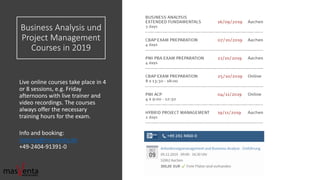
Business Analysis und
Project Management
Courses in 2019
Live online courses take place in 4
or 8 sessions, e.g. Friday
afternoons with live trainer and
video recordings. The courses
always offer the necessary
training hours for the exam.
Info and booking:
training@masventa.de
+49-2404-91391-0
www.ba-day.com
Early Bird Tickets available!
http://ba-day.com/index.php/tickets/
14. / 15. May 2020

masVenta Business Analysis Skills

  • 1.
    Business Analysis Skills An Authorityvs In Authority - Better having a sharp Business Analysis Skill than being in the role of a Business Analyst Rainer Wendt, CBAP, PMP, PMI-PBA, PMI-ACP BBA 2019, October 11th 2019, Belgradewww.masventa.de www.ba-day.com
  • 2.
    The role ofa Business Analyst Source: BABOK v3 Company Need Cost/Benefit Delivering Value Design & WorkGo/No Go Decision Go Live Vision Project Live 2Source: BABOK v3 & masVenta Business GmbH
  • 3.
    The Guide toBusiness Analysis Body Of Knowledge • The “Gold Standard” for Business Analysis • ~500 pages, 6 +1 knowledge areas • Many techniques and best practices • Integrated study with additional literature is recommended • Current version 3.0, released April 15th, 2015 • Hardcopy or personalized PDF (free for members) 3Source: BABOK v3
  • 4.
    Definition: Business Analysisis… “…the practice of enabling change in an enterprise [context] by defining needs and recommending solutions that deliver value to stakeholders” Source: BABOK v3 4 BABOK® v3 - Core Concept Model (BACCM TM).
  • 5.
  • 7.
    The CBAP® Certificate •Globally accepted certificate for professional Analysts, Architects or Consultants, the “Gold Standard” for Business Analysis • Certified CBAP® have at least 5 years experience in Business Analysis, i.e., they are experienced senior professionals. • Many CBAP® have a good knowledge in project management; most of them have worked in “hybrid” mode as BA and PM. • Business Analysis is most popular in branches like Banking, Insurances and Telecommunications, other branches follow. • BAs should have good Domain knowledge, but the certificate is independent from branches, strongly IT focused. • Nearly 10.000 CBAP® worldwide, growth rate > 15% • Central Europe is significantly behind. • CBAP® Exam: 3,5 h multiple choice with 120 questions, provided by accredited examination centers only. • Cost for application and exam is around Euro 500,- 7
  • 8.
    Roles and Responsibilitesin Scrum Scrum Master Product Owner Scrum Team StakeholdersSponsor Business AnalystProject Manager 8
  • 9.
    A key rolein Scrum: The Product Owner 9
  • 10.
    The Dilemma ofthe Part-Time-PO A Product Owner from Business can hardly dedicate 100% of his capacity to the project The day-to-day Business has normally priority Product Owners from the Business are often lacking experiences and skills in agile Projects Orientation is difficult 10
  • 11.
    The PO-Team (an example) Iam the Lead PO I am a Business Analyst I am a Dev SME The Lead PO from the Business has the final say re. the value-oriented prioritization The Business Analyst manages the Backlog The Business Analyst formulates User Stories and Acceptance Criteria The Development Subject Matter Expert gives advice re. technical dependencies, feasibility and risk 11
  • 12.
    The PO-Team makesit The Lead Product Owner will be supported by a Business Analyst re. the following tasks: ▪ Defining user roles and personas ▪ Eliciting requirements from stakeholders and users ▪ Defining user stories and acceptance tests ▪ Helping the PO prioritize and manage the Product Backlog ▪ Facilitating user story workshops ▪ Building requirements runway for upcoming iterations ▪ Identifying themes for releases ▪ Contributing to release and iteration planning ▪ Identifying and estimating business analysis tasks ▪ Analyzing business and technical impacts of requirements 12
  • 13.
  • 14.
    The 6th Perspective:Business Analysis for Service Design •ROI and Profit •Low risks and losses •Low-cost operation •Data protection •Data security •Legal conformity •Adhering standards •Sustainability •Reliability •Adaptability •Extendability •Scalability •Low complexity •Low cost •Reliable •Trustworthy •Modern, state-of- the-art •Smart, Clever •Exciting Customer Experience Maintenance & Changes Invest, Costs & Profit Security & Conformity Customer consumes services Provider offers services
  • 15.
    The next bigchallenge: Customer Data Integration Data Exchange vs. Data Protection Customer Data needs to be available across service providers Customer Data are to be protected according to GDPR The challenging antagonism 15
  • 16.
    Travelling example: areal-life service challenge Home Car Train Plane to Belgrade Taxi Hotel Walk Speech Airport Hotel Plane to Stock- holm Train to Solna Hotel Training Plane to DUS Train Car Home 16
  • 17.
  • 18.
    The Double Diamond AService Design Process Model by The Design Council, UK, 2013 Discover Define Develop Deliver 18
  • 19.
  • 20.
    Skill-Set/ Role Responsible for Tasksand Outcome Normal BA Skill Marketing Manager Identifies Target Customer and creates a tailored value proposition, advertises and tracks Portfolio Manager Selects best projects in terms of strategic fit and expected benefit, recommends invests Product Manager Owns the product, determines and maintains products life cycle, has the customer view and as well sales & marketing view Design Thinker Freely thinks about new ideas, explores and experiments, customer value driven, creates prototypes and provides first feeling of potential user acceptance of new ideas Service Designer Designs a service from users perspective, balances cost/benefit to achieve a profitable final steady state of a whole end-to-end service CX Specialist Focuses on customer touchpoints, driven by customer satisfaction, continuously optimises the customer experiences UX Analyst Technical User Interface design, human – machine interface, graphical user interfaces (GUI), keyboard and mouse usage, ensures adherence to standards Process Manager Owns the process behind the service, documents, models and continuously improves the process. Creates BPMN process models, data flows, RACI sheets etc. Ensures compliance Product Owner Value driven prioritisation and steer of features in the software manufacturing process (Scrum). Empowered voice of the customer, decision maker 20
  • 21.
    8 Core Competencies for DigitalBusiness Analysts Understanding Strategy Understanding the Customer Experience (CX) Reimagine Business Processes Embrace Agility Stakeholder Collaboration Strategic use of data Understand Technology Embrace product management Source: Podcast w/ Ken Fulmer, CEO IIBA, October 2018 http://masteringbusinessanalysis.com/mba169-digital-business-analyst-competencies/ 21
  • 22.
    8 Competencies forDigital Business Analysts 1. Understanding strategic imperatives: It all starts with an understanding of what your organization’s strategic imperatives are about. This allows you to bring the strategy down to actionable initiatives and provides clarity into the outcomes we’re trying to achieve. 2. Understanding the customer experience: Focusing on the customer experience requires adopting an outside in focus. Understanding the customer and the challenges they face (using tools such as Customer Journey Maps) allow you to take that outside in approach and create solutions your customers need, want, and love. 3. Reimagine business processes: The digital space moves quickly. In many cases, you may not only need to improve a process, but also completely reimagine a process and create disruption in your industry. To be successful, you need to understand business processes, how to analyze processes, develop new processes, and drive organizational change. 4. Embrace agility: Embracing agility goes beyond the frameworks such as Scrum or Kanban and includes an understanding of Lean mindset and practices. We can harness the power of Agile and Lean thinking to bring about change. 5. Continuous stakeholder collaboration: While stakeholder engagement is core to business analysis in any environment, engagement activities need to be continuous in a digital environment. The evolutionary and experimental approach with Agile and digital will require frequent feedback and conversations with stakeholders. 6. Strategic use of data: One way to enable better collaboration with stakeholders and understand customers is through data. We collect a lot of data about our customers; through our interactions and through social media. Using data analytics to interpret that data and better understand our customers allows us to build better solutions. It also allows us to take an evidence based approach to decision making. 7. Understand technology: You don’t need to understand technology at a software engineer level, but understanding technology will allow you to find new ways of working and new capabilities for your organization. You need to be able to work with business leaders and help them understand what is possible. 8. Embrace product management: More and more organizations are shifting from projects to product thinking. As Business Analysts, we need to understand how to work with Product Owners and sometimes serve as a proxy for the Product Owner. We need to be accountable for the outcomes resulting from our products and establish a deep understanding of our customer and their needs. Source: http://masteringbusinessanalysis.com/mba169-digital-business-analyst-competencies/ 22
  • 23.
    Summary – BusinessAnalysis Skills Sharp Business Analysis skills are indispensable for various roles in companies, as many employees do “Business Analysis“ day by day, even if they do not name it Business Analysis Rather than trying to achieve to being in an official role of a Business Analyst, professionals should better go for broad and excellent Business Analysis skills to support company strategy and development
  • 24.
    Business Analysis und ProjectManagement Courses in 2019 Live online courses take place in 4 or 8 sessions, e.g. Friday afternoons with live trainer and video recordings. The courses always offer the necessary training hours for the exam. Info and booking: training@masventa.de +49-2404-91391-0
  • 25.
    www.ba-day.com Early Bird Ticketsavailable! http://ba-day.com/index.php/tickets/ 14. / 15. May 2020