If you want to be a 
professional project manager 
you should be proficient in 
Agile! 
27.06.2014
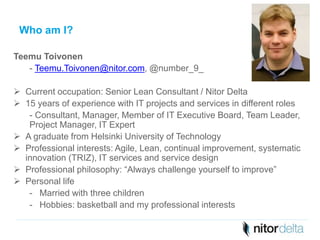
Who am I? 
Teemu Toivonen 
- Teemu.Toivonen@nitor.com, @number_9_ 
 Current occupation: Senior Lean Consultant / Nitor Delta 
 15 years of experience with IT projects and services in different roles 
- Consultant, Manager, Member of IT Executive Board, Team Leader, 
Project Manager, IT Expert 
 A graduate from Helsinki University of Technology 
 Professional interests: Agile, Lean, continual improvement, systematic 
innovation (TRIZ), IT services and service design 
 Professional philosophy: “Always challenge yourself to improve” 
 Personal life 
- Married with three children 
- Hobbies: basketball and my professional interests
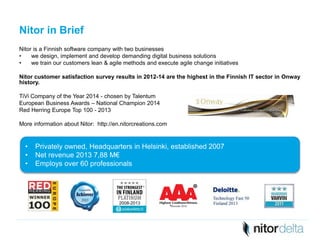
Nitor in Brief 
Nitor is a Finnish software company with two businesses 
• we design, implement and develop demanding digital business solutions 
• we train our customers lean & agile methods and execute agile change initiatives 
Nitor customer satisfaction survey results in 2012-14 are the highest in the Finnish IT sector in Onway 
history. 
TiVi Company of the Year 2014 - chosen by Talentum 
European Business Awards – National Champion 2014 
Red Herring Europe Top 100 - 2013 
More information about Nitor: http://en.nitorcreations.com 
• Privately owned, Headquarters in Helsinki, established 2007 
• Net revenue 2013 7,88 M€ 
• Employs over 60 professionals 
3 
2008-2013
A personal perspective on what it takes to be world class 
After this course you will have the 
knowledge to consult an average 
company about projects 
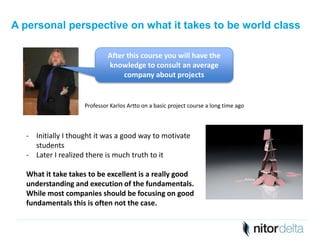
Professor Karlos Artto on a basic project course a long time ago 
- Initially I thought it was a good way to motivate 
students 
- Later I realized there is much truth to it 
What it take takes to be excellent is a really good 
understanding and execution of the fundamentals. 
While most companies should be focusing on good 
fundamentals this is often not the case.
Agenda 
• The Agile vs. Waterfall wars 
• Defining Waterfall and Agile 
• Scrum as an example of Agile 
• Consequences of global competition 
• Results with Agile 
• Theories, principles and related stories 
– Small batch sizes 
– Effective communication 
– Self organization - ”the secret sauce” 
– Empirical process control 
• Advanced topics in Agile 
• My one piece of wisdom regarding project management
How many of you… 
• Know what is waterfall development? 
• Know what is Agile development?
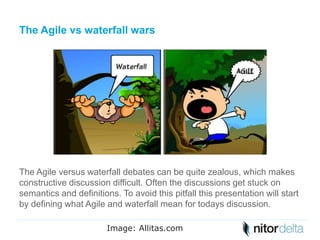
The Agile vs waterfall wars 
The Agile versus waterfall debates can be quite zealous, which makes 
constructive discussion difficult. Often the discussions get stuck on 
semantics and definitions. To avoid this pitfall this presentation will start 
by defining what Agile and waterfall mean for todays discussion. 
Image: Allitas.com
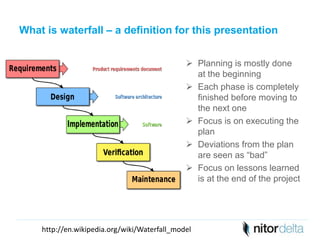
What is waterfall – a definition for this presentation 
 Planning is mostly done 
at the beginning 
 Each phase is completely 
finished before moving to 
the next one 
 Focus is on executing the 
plan 
 Deviations from the plan 
are seen as “bad” 
 Focus on lessons learned 
is at the end of the project 
http://en.wikipedia.org/wiki/Waterfall_model
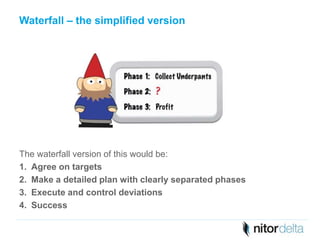
Waterfall – the simplified version 
The waterfall version of this would be: 
1. Agree on targets 
2. Make a detailed plan with clearly separated phases 
3. Execute and control deviations 
4. Success
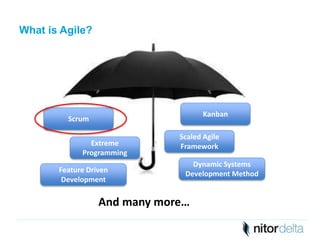
What is Agile? 
Scrum 
Extreme 
Programming 
Kanban 
Scaled Agile 
Framework 
Dynamic Systems 
Feature Driven DevelopmentMethod 
Development 
And many more…
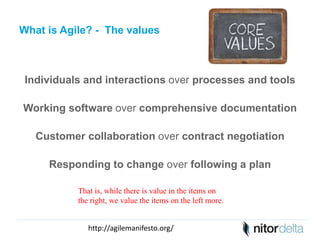
What is Agile? - The values 
Individuals and interactions over processes and tools 
Working software over comprehensive documentation 
Customer collaboration over contract negotiation 
Responding to change over following a plan 
That is, while there is value in the items on 
the right, we value the items on the left more. 
http://agilemanifesto.org/
What is Agile? - The 12 principles 
1. Our highest priority is to satisfy the customer through early and 
continuous delivery of valuable software. 
2. Welcome changing requirements, even late in development. Agile 
processes harness change for the customer's competitive advantage. 
3. Deliver working software frequently, from a couple of weeks to a couple 
of months, with a preference to the shorter timescale. 
4. Business people and developers must work together daily throughout the 
project. 
5. Build projects around motivated individuals. Give them the environment 
and support they need, and trust them to get the job done. 
6. The most efficient and effective method of conveying information to and 
within a development team is face-to-face conversation. 
7. Working software is the primary measure of progress. 
8. Agile processes promote sustainable development. The sponsors, developers, 
and users should be able to maintain a constant pace indefinitely. 
9. Continuous attention to technical excellence and good design enhances agility. 
10. Simplicity--the art of maximizing the amount of work not done--is essential. 
11. The best architectures, requirements, and designs emerge from self-organizing 
teams. 
12. At regular intervals, the team reflects on how to become more effective, 
then tunes and adjusts its behavior accordingly.
What is Agile? - Scrum as an example 1/3 
Explaining Scrum in a couple of minutes is a really challenging 
task. 
Luckily there is… 
https://www.youtube.com/watch?v=Qoa5CS9JJPQ
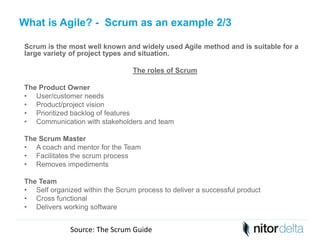
What is Agile? - Scrum as an example 2/3 
Scrum is the most well known and widely used Agile method and is suitable for a 
large variety of project types and situation. 
The roles of Scrum 
The Product Owner 
• User/customer needs 
• Product/project vision 
• Prioritized backlog of features 
• Communication with stakeholders and team 
The Scrum Master 
• A coach and mentor for the Team 
• Facilitates the scrum process 
• Removes impediments 
The Team 
• Self organized within the Scrum process to deliver a successful product 
• Cross functional 
• Delivers working software 
Source: The Scrum Guide
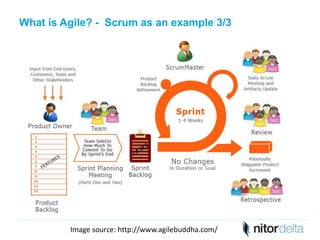
What is Agile? - Scrum as an example 3/3 
The roles of Scrum: 
The Scrum process: 
Image source: http://www.agilebuddha.com/
16 pages of pure wisdom 
https://www.scrum.org/Scrum-Guide
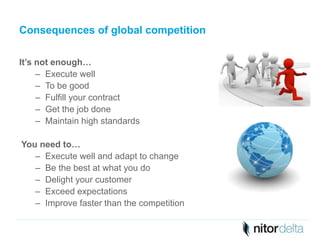
Consequences of global competition 
It’s not enough… 
– Execute well 
– To be good 
– Fulfill your contract 
– Get the job done 
– Maintain high standards 
You need to… 
– Execute well and adapt to change 
– Be the best at what you do 
– Delight your customer 
– Exceed expectations 
– Improve faster than the competition
Consequences of global competition 
It’s not enough… 
– Execute well 
– To be good 
– Fulfill your contract 
– Get the job done 
– Maintain high standards 
Doing a project is selling the next one, which is 
why you need to make an impression. 
You need to… 
– Execute well and adapt to change 
– Be the best at what you do 
– Delight your customer 
– Exceed expectations 
– Improve faster than the competition
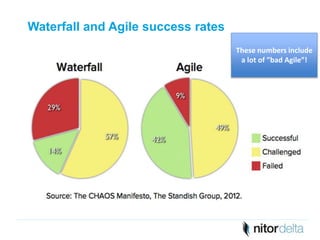
Waterfall and Agile success rates 
These numbers include 
a lot of ”bad Agile”!
Scaled Agile Framework – benefits for large software programs 
 Time to market 
- 30 – 50 % faster time to market 
 Quality 
- 50 % + defect reduction 
 Productivity 
- 20 – 50 increase in productivity 
 Employee engagement 
- Significant increase in employee engagement 
http://scaledagileframework.com/
Nitor – Agile 
• Nitor is very successful Finnish software company 
• Good results against global competition 
– Including offshoring 
• Agile working methods is one of the cornerstones of this success
Theories, principles and related stories 
Some of the most important aspects to understand for project 
performance: 
 Small batch sizes 
 Effective communication 
 Self organization - ”the secret sauce” 
 Adapting to change - empirical process control
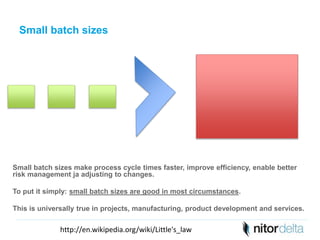
Small batch sizes 
Small batch sizes make process cycle times faster, improve efficiency, enable better 
risk management ja adjusting to changes. 
To put it simply: small batch sizes are good in most circumstances. 
This is universally true in projects, manufacturing, product development and services. 
http://en.wikipedia.org/wiki/Little's_law
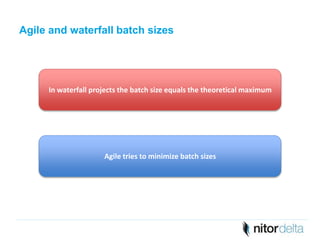
Agile and waterfall batch sizes 
In waterfall projects the batch size equals the theoretical maximum 
Agile tries to minimize batch sizes
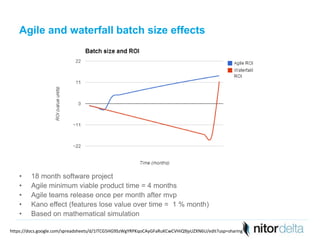
Agile and waterfall batch size effects 
• 18 month software project 
• Agile minimum viable product time = 4 months 
• Agile teams release once per month after mvp 
• Kano effect (features lose value over time = 1 % month) 
• Based on mathematical simulation 
https://docs.google.com/spreadsheets/d/1ITCG5HG9SzWgYRPKqoCAyGFaRuKCwCVHiQ9jyUZXN6U/edit?usp=sharing
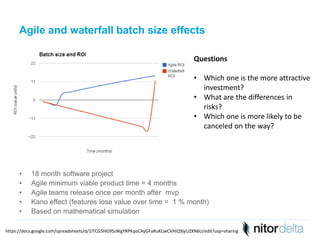
Agile and waterfall batch size effects 
Questions 
• Which one is the more attractive 
investment? 
• What are the differences in 
risks? 
• Which one is more likely to be 
canceled on the way? 
• 18 month software project 
• Agile minimum viable product time = 4 months 
• Agile teams release once per month after mvp 
• Kano effect (features lose value over time = 1 % month) 
• Based on mathematical simulation 
https://docs.google.com/spreadsheets/d/1ITCG5HG9SzWgYRPKqoCAyGFaRuKCwCVHiQ9jyUZXN6U/edit?usp=sharing
Creating small batch sizes 
In most circumstances it is possible to use small 
batch sizes, although it often seems difficult at firs. It 
will get easier with practice. The Lean startup 
movement has take this to the extreme and is worth 
studying. 
Examples from my experience: 
• Software development 
• IT infrastructure projects 
• “Off the shelf” IT projects 
• IT migration projects 
• Process development/design projects 
• Organizational change projects
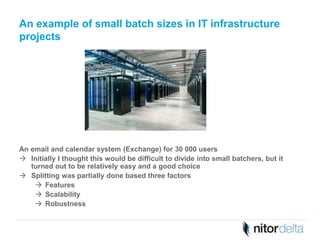
An example of small batch sizes in IT infrastructure 
projects 
An email and calendar system (Exchange) for 30 000 users 
 Initially I thought this would be difficult to divide into small batchers, but it 
turned out to be relatively easy and a good choice 
 Splitting was partially done based three factors 
 Features 
 Scalability 
 Robustness
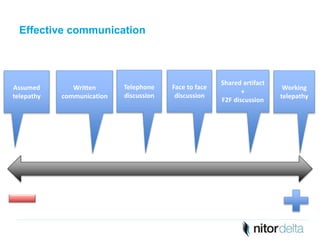
Effective communication 
Assumed 
telepathy 
Working 
telepathy 
Shared artifact 
+ 
F2F discussion 
Face to face 
discussion 
Written 
communication 
Telephone 
discussion
Effective communication 
Assumed 
telepathy 
Working 
telepathy 
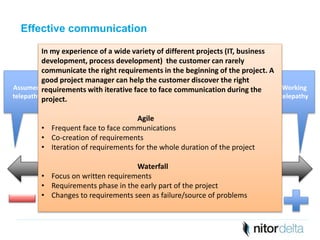
In my experience of a wide variety of different projects (IT, business 
development, process development) the customer can rarely 
communicate the right requirements in the beginning of the project. A 
good project manager can help the customer discover the Shared right 
artifact 
requirements with iterative face to face communication during + 
the 
project. 
F2F discussion 
Face to face 
discussion 
Written 
communication 
Telephone 
discussion 
Agile 
• Frequent face to face communications 
• Co-creation of requirements 
• Iteration of requirements for the whole duration of the project 
Waterfall 
• Focus on written requirements 
• Requirements phase in the early part of the project 
• Changes to requirements seen as failure/source of problems
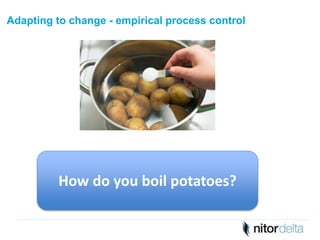
Adapting to change - empirical process control 
How do you boil potatoes?
Adapting to change - empirical process control 
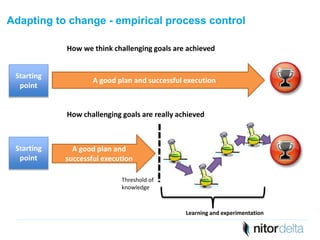
Starting 
point 
How we think challenging goals are achieved 
A good plan and successful execution 
How challenging goals are really achieved 
Starting 
point 
A good plan and 
successful execution 
Threshold of 
knowledge 
Learning and experimentation
Self organization - ”the secret sauce” 
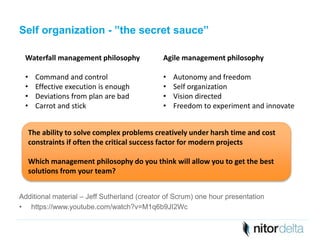
Waterfall management philosophy 
• Command and control 
• Effective execution is enough 
• Deviations from plan are bad 
• Carrot and stick 
Agile management philosophy 
• Autonomy and freedom 
• Self organization 
• Vision directed 
• Freedom to experiment and innovate 
The ability to solve complex problems creatively under harsh time and cost 
constraints if often the critical success factor for modern projects 
Which management philosophy do you think will allow you to get the best 
solutions from your team? 
Additional material – Jeff Sutherland (creator of Scrum) one hour presentation 
• https://www.youtube.com/watch?v=M1q6b9JI2Wc
Advanced topics in Agile 
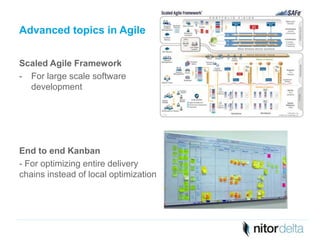
Scaled Agile Framework 
- For large scale software 
development 
End to end Kanban 
- For optimizing entire delivery 
chains instead of local optimization
My one piece of wisdom about complex projects 
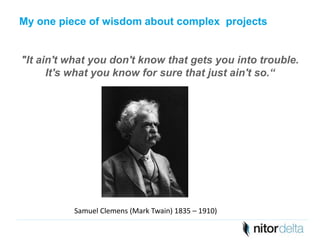
"It ain't what you don't know that gets you into trouble. 
It's what you know for sure that just ain't so.“ 
Samuel Clemens (Mark Twain) 1835 – 1910)

Professional Project Manager Should Be Proficient in Agile

  • 1.
    If you wantto be a professional project manager you should be proficient in Agile! 27.06.2014
  • 2.
    Who am I? Teemu Toivonen - Teemu.Toivonen@nitor.com, @number_9_  Current occupation: Senior Lean Consultant / Nitor Delta  15 years of experience with IT projects and services in different roles - Consultant, Manager, Member of IT Executive Board, Team Leader, Project Manager, IT Expert  A graduate from Helsinki University of Technology  Professional interests: Agile, Lean, continual improvement, systematic innovation (TRIZ), IT services and service design  Professional philosophy: “Always challenge yourself to improve”  Personal life - Married with three children - Hobbies: basketball and my professional interests
  • 3.
    Nitor in Brief Nitor is a Finnish software company with two businesses • we design, implement and develop demanding digital business solutions • we train our customers lean & agile methods and execute agile change initiatives Nitor customer satisfaction survey results in 2012-14 are the highest in the Finnish IT sector in Onway history. TiVi Company of the Year 2014 - chosen by Talentum European Business Awards – National Champion 2014 Red Herring Europe Top 100 - 2013 More information about Nitor: http://en.nitorcreations.com • Privately owned, Headquarters in Helsinki, established 2007 • Net revenue 2013 7,88 M€ • Employs over 60 professionals 3 2008-2013
  • 4.
    A personal perspectiveon what it takes to be world class After this course you will have the knowledge to consult an average company about projects Professor Karlos Artto on a basic project course a long time ago - Initially I thought it was a good way to motivate students - Later I realized there is much truth to it What it take takes to be excellent is a really good understanding and execution of the fundamentals. While most companies should be focusing on good fundamentals this is often not the case.
  • 5.
    Agenda • TheAgile vs. Waterfall wars • Defining Waterfall and Agile • Scrum as an example of Agile • Consequences of global competition • Results with Agile • Theories, principles and related stories – Small batch sizes – Effective communication – Self organization - ”the secret sauce” – Empirical process control • Advanced topics in Agile • My one piece of wisdom regarding project management
  • 6.
    How many ofyou… • Know what is waterfall development? • Know what is Agile development?
  • 7.
    The Agile vswaterfall wars The Agile versus waterfall debates can be quite zealous, which makes constructive discussion difficult. Often the discussions get stuck on semantics and definitions. To avoid this pitfall this presentation will start by defining what Agile and waterfall mean for todays discussion. Image: Allitas.com
  • 8.
    What is waterfall– a definition for this presentation  Planning is mostly done at the beginning  Each phase is completely finished before moving to the next one  Focus is on executing the plan  Deviations from the plan are seen as “bad”  Focus on lessons learned is at the end of the project http://en.wikipedia.org/wiki/Waterfall_model
  • 9.
    Waterfall – thesimplified version The waterfall version of this would be: 1. Agree on targets 2. Make a detailed plan with clearly separated phases 3. Execute and control deviations 4. Success
  • 10.
    What is Agile? Scrum Extreme Programming Kanban Scaled Agile Framework Dynamic Systems Feature Driven DevelopmentMethod Development And many more…
  • 11.
    What is Agile?- The values Individuals and interactions over processes and tools Working software over comprehensive documentation Customer collaboration over contract negotiation Responding to change over following a plan That is, while there is value in the items on the right, we value the items on the left more. http://agilemanifesto.org/
  • 12.
    What is Agile?- The 12 principles 1. Our highest priority is to satisfy the customer through early and continuous delivery of valuable software. 2. Welcome changing requirements, even late in development. Agile processes harness change for the customer's competitive advantage. 3. Deliver working software frequently, from a couple of weeks to a couple of months, with a preference to the shorter timescale. 4. Business people and developers must work together daily throughout the project. 5. Build projects around motivated individuals. Give them the environment and support they need, and trust them to get the job done. 6. The most efficient and effective method of conveying information to and within a development team is face-to-face conversation. 7. Working software is the primary measure of progress. 8. Agile processes promote sustainable development. The sponsors, developers, and users should be able to maintain a constant pace indefinitely. 9. Continuous attention to technical excellence and good design enhances agility. 10. Simplicity--the art of maximizing the amount of work not done--is essential. 11. The best architectures, requirements, and designs emerge from self-organizing teams. 12. At regular intervals, the team reflects on how to become more effective, then tunes and adjusts its behavior accordingly.
  • 13.
    What is Agile?- Scrum as an example 1/3 Explaining Scrum in a couple of minutes is a really challenging task. Luckily there is… https://www.youtube.com/watch?v=Qoa5CS9JJPQ
  • 14.
    What is Agile?- Scrum as an example 2/3 Scrum is the most well known and widely used Agile method and is suitable for a large variety of project types and situation. The roles of Scrum The Product Owner • User/customer needs • Product/project vision • Prioritized backlog of features • Communication with stakeholders and team The Scrum Master • A coach and mentor for the Team • Facilitates the scrum process • Removes impediments The Team • Self organized within the Scrum process to deliver a successful product • Cross functional • Delivers working software Source: The Scrum Guide
  • 15.
    What is Agile?- Scrum as an example 3/3 The roles of Scrum: The Scrum process: Image source: http://www.agilebuddha.com/
  • 16.
    16 pages ofpure wisdom https://www.scrum.org/Scrum-Guide
  • 17.
    Consequences of globalcompetition It’s not enough… – Execute well – To be good – Fulfill your contract – Get the job done – Maintain high standards You need to… – Execute well and adapt to change – Be the best at what you do – Delight your customer – Exceed expectations – Improve faster than the competition
  • 18.
    Consequences of globalcompetition It’s not enough… – Execute well – To be good – Fulfill your contract – Get the job done – Maintain high standards Doing a project is selling the next one, which is why you need to make an impression. You need to… – Execute well and adapt to change – Be the best at what you do – Delight your customer – Exceed expectations – Improve faster than the competition
  • 19.
    Waterfall and Agilesuccess rates These numbers include a lot of ”bad Agile”!
  • 20.
    Scaled Agile Framework– benefits for large software programs  Time to market - 30 – 50 % faster time to market  Quality - 50 % + defect reduction  Productivity - 20 – 50 increase in productivity  Employee engagement - Significant increase in employee engagement http://scaledagileframework.com/
  • 21.
    Nitor – Agile • Nitor is very successful Finnish software company • Good results against global competition – Including offshoring • Agile working methods is one of the cornerstones of this success
  • 22.
    Theories, principles andrelated stories Some of the most important aspects to understand for project performance:  Small batch sizes  Effective communication  Self organization - ”the secret sauce”  Adapting to change - empirical process control
  • 23.
    Small batch sizes Small batch sizes make process cycle times faster, improve efficiency, enable better risk management ja adjusting to changes. To put it simply: small batch sizes are good in most circumstances. This is universally true in projects, manufacturing, product development and services. http://en.wikipedia.org/wiki/Little's_law
  • 24.
    Agile and waterfallbatch sizes In waterfall projects the batch size equals the theoretical maximum Agile tries to minimize batch sizes
  • 25.
    Agile and waterfallbatch size effects • 18 month software project • Agile minimum viable product time = 4 months • Agile teams release once per month after mvp • Kano effect (features lose value over time = 1 % month) • Based on mathematical simulation https://docs.google.com/spreadsheets/d/1ITCG5HG9SzWgYRPKqoCAyGFaRuKCwCVHiQ9jyUZXN6U/edit?usp=sharing
  • 26.
    Agile and waterfallbatch size effects Questions • Which one is the more attractive investment? • What are the differences in risks? • Which one is more likely to be canceled on the way? • 18 month software project • Agile minimum viable product time = 4 months • Agile teams release once per month after mvp • Kano effect (features lose value over time = 1 % month) • Based on mathematical simulation https://docs.google.com/spreadsheets/d/1ITCG5HG9SzWgYRPKqoCAyGFaRuKCwCVHiQ9jyUZXN6U/edit?usp=sharing
  • 27.
    Creating small batchsizes In most circumstances it is possible to use small batch sizes, although it often seems difficult at firs. It will get easier with practice. The Lean startup movement has take this to the extreme and is worth studying. Examples from my experience: • Software development • IT infrastructure projects • “Off the shelf” IT projects • IT migration projects • Process development/design projects • Organizational change projects
  • 28.
    An example ofsmall batch sizes in IT infrastructure projects An email and calendar system (Exchange) for 30 000 users  Initially I thought this would be difficult to divide into small batchers, but it turned out to be relatively easy and a good choice  Splitting was partially done based three factors  Features  Scalability  Robustness
  • 29.
    Effective communication Assumed telepathy Working telepathy Shared artifact + F2F discussion Face to face discussion Written communication Telephone discussion
  • 30.
    Effective communication Assumed telepathy Working telepathy In my experience of a wide variety of different projects (IT, business development, process development) the customer can rarely communicate the right requirements in the beginning of the project. A good project manager can help the customer discover the Shared right artifact requirements with iterative face to face communication during + the project. F2F discussion Face to face discussion Written communication Telephone discussion Agile • Frequent face to face communications • Co-creation of requirements • Iteration of requirements for the whole duration of the project Waterfall • Focus on written requirements • Requirements phase in the early part of the project • Changes to requirements seen as failure/source of problems
  • 31.
    Adapting to change- empirical process control How do you boil potatoes?
  • 32.
    Adapting to change- empirical process control Starting point How we think challenging goals are achieved A good plan and successful execution How challenging goals are really achieved Starting point A good plan and successful execution Threshold of knowledge Learning and experimentation
  • 33.
    Self organization -”the secret sauce” Waterfall management philosophy • Command and control • Effective execution is enough • Deviations from plan are bad • Carrot and stick Agile management philosophy • Autonomy and freedom • Self organization • Vision directed • Freedom to experiment and innovate The ability to solve complex problems creatively under harsh time and cost constraints if often the critical success factor for modern projects Which management philosophy do you think will allow you to get the best solutions from your team? Additional material – Jeff Sutherland (creator of Scrum) one hour presentation • https://www.youtube.com/watch?v=M1q6b9JI2Wc
  • 34.
    Advanced topics inAgile Scaled Agile Framework - For large scale software development End to end Kanban - For optimizing entire delivery chains instead of local optimization
  • 35.
    My one pieceof wisdom about complex projects "It ain't what you don't know that gets you into trouble. It's what you know for sure that just ain't so.“ Samuel Clemens (Mark Twain) 1835 – 1910)

Editor's Notes

  • #3 Story about me as a student in Artos class and listening to old visiting lecturers from the industry Story about having colleques who challene you in a positive way – should be the number one thing you look for in a job
  • #5 This believe will shine thorugh my presentation! What made Michael Jordan so great? – It was not the tricks, it was the amazing fundementals that made the tricks possible!
  • #7 Ask to raise their hands
  • #9 Ask the audiene – what potential issues does this model have?
  • #10 Do southpark
  • #13 Chooes 2-4 to highlight
  • #14 Chooes 2-4 to highlight
  • #16 Chooes 2-4 to highlight
  • #17 Available in many languages, including finnish
  • #18 Although not everything is yet open to global competetion in projects you need to think like it is, because soon it will be Doing a procect is selling the next one – which is why you need to make in impression How long will companies that say ”but its in our contract” will be in business with unhappy customers?
  • #19 Although not everything is yet open to global competetion in projects you need to think like it is, because soon it will be Doing a procect is selling the next one – which is why you need to make in impression How long will companies that say ”but its in our contract” will be in business with unhappy customers?
  • #22 Productivity, understanding business goals, cocreation of VAU solutions
  • #24 History with car manufacturing
  • #25 Waterfall by defenition (finish doing 1 phase at the time ) Scrum batch size -> sprint length
  • #31 Tell story of 6 week consulting engagement, where we discovered on week 4 what the customer really wanted This is good and offers a posiibility to VAU the customer by adapting to change Other choice is to tell him this is not what we agreed to and demand we do what we initially agreed on or renegociate  Which will bring future business?
  • #32 Ask the audience? The answer is you put them in the catle and adjust the tempature based on how hard they are boiling? Do you make a detailed plan and execute it? No ofcourse not  this is called empirical process control
  • #33 Agile is especially good in the Learning and experimentation phase after we have crossed our threshold of knowledge
  • #36 This is something that in my experience Agile does very well compared to waterfall The world is not black and white – you should definately learn Agile, but there is alot you can learn from traditional methods as well, like stakeholder anlyses and some aspects of risk management for example