PRODUCT DEVELOPMENT
FOR STARTUPS

PRESENTED BY
What to build

2
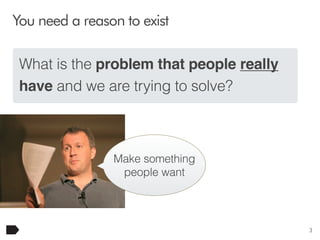
You need a reason to exist
What is the problem that people really
have and we are trying to solve?

Make something
people want

3
Thanks for viewing!
Nice find! You're well on your way to becoming a sales machine.
Now be a friend and share this resource with hundreds of your
closest Internet pals.
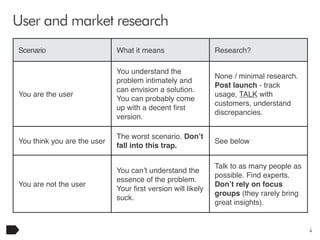
User and market research
Scenario

What it means

Research?

You are the user

You understand the
problem intimately and
can envision a solution.
You can probably come
up with a decent first
version.

None / minimal research.
Post launch - track
usage, TALK with
customers, understand
discrepancies.

You think you are the user

The worst scenario. Don’t
fall into this trap.

See below

You can’t understand the
essence of the problem.
Your first version will likely
suck.

Talk to as many people as
possible. Find experts.
Don’t rely on focus
groups (they rarely bring
great insights).

You are not the user

4
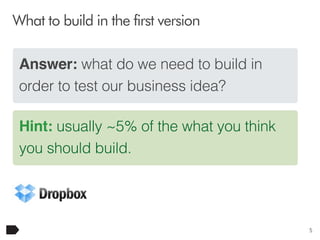
What to build in the first version
Answer: what do we need to build in
order to test our business idea?
Hint: usually ~5% of the what you think
you should build.

5
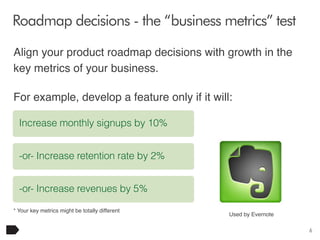
Roadmap decisions - the “business metrics” test
Align your product roadmap decisions with growth in the
key metrics of your business.
For example, develop a feature only if it will:
Increase monthly signups by 10%
-or- Increase retention rate by 2%
-or- Increase revenues by 5%
* Your key metrics might be totally different

Used by Evernote
6
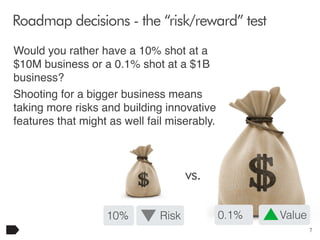
Roadmap decisions - the “risk/reward” test
Would you rather have a 10% shot at a
$10M business or a 0.1% shot at a $1B
business?
Shooting for a bigger business means
taking more risks and building innovative
features that might as well fail miserably.

vs.
10%

Risk

0.1%

Value
7
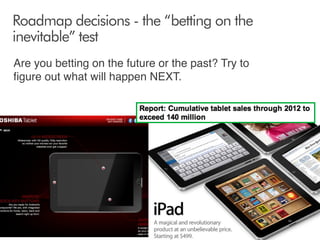
Roadmap decisions - the “betting on the
inevitable” test
Are you betting on the future or the past? Try to
figure out what will happen NEXT.

8
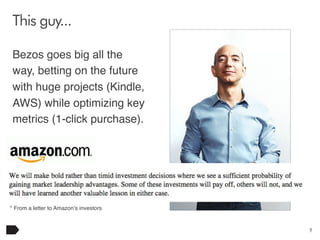
This guy...
Bezos goes big all the
way, betting on the future
with huge projects (Kindle,
AWS) while optimizing key
metrics (1-click purchase).

* From a letter to Amazon’s investors

9
How to build it

10
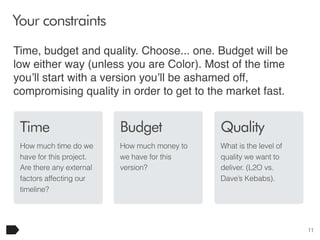
Your constraints
Time, budget and quality. Choose... one. Budget will be
low either way (unless you are Color). Most of the time
you’ll start with a version you’ll be ashamed off,
compromising quality in order to get to the market fast.

Time

Budget

Quality

How much time do we
have for this project.
Are there any external
factors affecting our
timeline?

How much money to
we have for this
version?

What is the level of
quality we want to
deliver. (L2O vs.
Dave’s Kebabs).

11
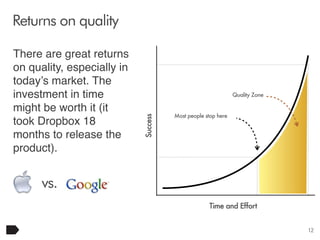
Returns on quality

Quality Zone

Success

There are great returns
on quality, especially in
today’s market. The
investment in time
might be worth it (it
took Dropbox 18
months to release the
product).

Most people stop here

vs.
Time and Effort
12
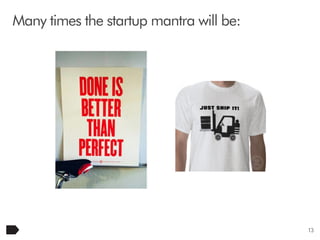
Many times the startup mantra will be:

13
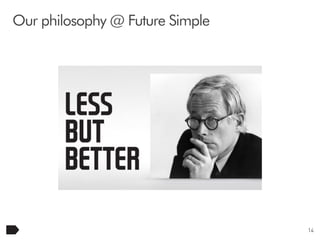
Our philosophy @ Future Simple

14
Who should build

15
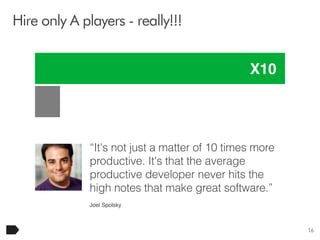
Hire only A players - really!!!
X10

“It's not just a matter of 10 times more
productive. It's that the average
productive developer never hits the
high notes that make great software.”
Joel Spolsky

16
A note on dogfooding

17
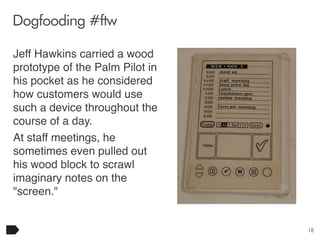
Dogfooding #ftw
Jeff Hawkins carried a wood
prototype of the Palm Pilot in
his pocket as he considered
how customers would use
such a device throughout the
course of a day.
At staff meetings, he
sometimes even pulled out
his wood block to scrawl
imaginary notes on the
"screen."

18
F-O-C-U-S

19
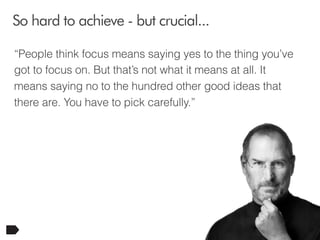
So hard to achieve - but crucial...
“People think focus means saying yes to the thing you’ve
got to focus on. But that’s not what it means at all. It
means saying no to the hundred other good ideas that
there are. You have to pick carefully.”

20
Product Development for Startups

Product Development for Startups

  • 1.
  • 2.
  • 3.
    You need areason to exist What is the problem that people really have and we are trying to solve? Make something people want 3
  • 4.
    Thanks for viewing! Nicefind! You're well on your way to becoming a sales machine. Now be a friend and share this resource with hundreds of your closest Internet pals.
  • 5.
    User and marketresearch Scenario What it means Research? You are the user You understand the problem intimately and can envision a solution. You can probably come up with a decent first version. None / minimal research. Post launch - track usage, TALK with customers, understand discrepancies. You think you are the user The worst scenario. Don’t fall into this trap. See below You can’t understand the essence of the problem. Your first version will likely suck. Talk to as many people as possible. Find experts. Don’t rely on focus groups (they rarely bring great insights). You are not the user 4
  • 6.
    What to buildin the first version Answer: what do we need to build in order to test our business idea? Hint: usually ~5% of the what you think you should build. 5
  • 7.
    Roadmap decisions -the “business metrics” test Align your product roadmap decisions with growth in the key metrics of your business. For example, develop a feature only if it will: Increase monthly signups by 10% -or- Increase retention rate by 2% -or- Increase revenues by 5% * Your key metrics might be totally different Used by Evernote 6
  • 8.
    Roadmap decisions -the “risk/reward” test Would you rather have a 10% shot at a $10M business or a 0.1% shot at a $1B business? Shooting for a bigger business means taking more risks and building innovative features that might as well fail miserably. vs. 10% Risk 0.1% Value 7
  • 9.
    Roadmap decisions -the “betting on the inevitable” test Are you betting on the future or the past? Try to figure out what will happen NEXT. 8
  • 10.
    This guy... Bezos goesbig all the way, betting on the future with huge projects (Kindle, AWS) while optimizing key metrics (1-click purchase). * From a letter to Amazon’s investors 9
  • 11.
  • 12.
    Your constraints Time, budgetand quality. Choose... one. Budget will be low either way (unless you are Color). Most of the time you’ll start with a version you’ll be ashamed off, compromising quality in order to get to the market fast. Time Budget Quality How much time do we have for this project. Are there any external factors affecting our timeline? How much money to we have for this version? What is the level of quality we want to deliver. (L2O vs. Dave’s Kebabs). 11
  • 13.
    Returns on quality QualityZone Success There are great returns on quality, especially in today’s market. The investment in time might be worth it (it took Dropbox 18 months to release the product). Most people stop here vs. Time and Effort 12
  • 14.
    Many times thestartup mantra will be: 13
  • 15.
    Our philosophy @Future Simple 14
  • 16.
  • 17.
    Hire only Aplayers - really!!! X10 “It's not just a matter of 10 times more productive. It's that the average productive developer never hits the high notes that make great software.” Joel Spolsky 16
  • 18.
    A note ondogfooding 17
  • 19.
    Dogfooding #ftw Jeff Hawkinscarried a wood prototype of the Palm Pilot in his pocket as he considered how customers would use such a device throughout the course of a day. At staff meetings, he sometimes even pulled out his wood block to scrawl imaginary notes on the "screen." 18
  • 20.
  • 21.
    So hard toachieve - but crucial... “People think focus means saying yes to the thing you’ve got to focus on. But that’s not what it means at all. It means saying no to the hundred other good ideas that there are. You have to pick carefully.” 20