Starting a business as engineers:
algorithms aren't everything
Lessons from building and failing tech startups
Alja Isaković
alja@artesia.si
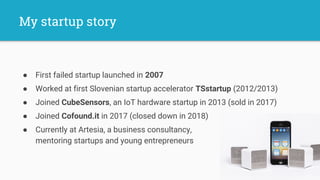
My startup story
● First failed startup launched in 2007
● Worked at first Slovenian startup accelerator TSstartup (2012/2013)
● Joined CubeSensors, an IoT hardware startup in 2013 (sold in 2017)
● Joined Cofound.it in 2017 (closed down in 2018)
● Currently at Artesia, a business consultancy,
mentoring startups and young entrepreneurs
Why am I here?
● To bust some startup myths.
● To share some of the lessons I learned the hard way in the past 10+ years.
● To give you some tips on where/how to start.
● Answer many questions :)
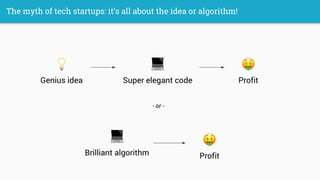
The myth of tech startups: it’s all about the idea or algorithm!
💡
Genius idea
💻
Super elegant code Profit
💻
Brilliant algorithm
- or -
Profit
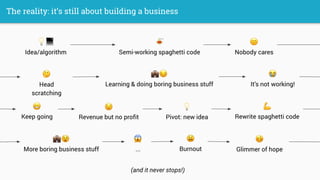
The reality: it’s still about building a business
💡💻
Idea/algorithm
🍝
Semi-working spaghetti code Nobody cares
Head scratching
💼😔
Learning & doing boring business stuff
😭
It’s not working!
Keep going Revenue but no profit
💡
Pivot: new idea
💪
Rewrite spaghetti code
💼😵
More boring business stuff
😱
...
😫
Burnout Glimmer of hope
(and it never stops!)
10 things I wish I knew before
starting my first startup
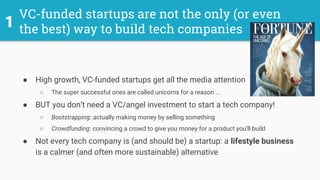
VC-funded startups are not the only (or even
the best) way to build tech companies
● High growth, VC-funded startups get all the media attention
○ The super successful ones are called unicorns for a reason ...
● BUT you don’t need a VC/angel investment to start a tech company!
○ Bootstrapping: actually making money by selling something
○ Crowdfunding: convincing a crowd to give you money for a product you’ll build
● Not every tech company is (and should be) a startup: a lifestyle business
is a calmer (and often more sustainable) alternative
1
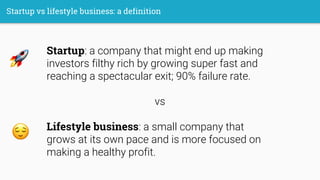
Startup vs lifestyle business: a definition
Startup: a company that might end up making
investors filthy rich by growing super fast and
reaching a spectacular exit; 90% failure rate.
vs
Lifestyle business: a small company that
grows at its own pace and is more focused on
making a healthy profit.
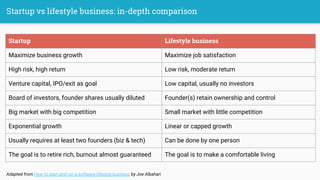
Startup vs lifestyle business: in-depth comparison
Adapted from How to start and run a software lifestyle business by Joe Albahari
Startup Lifestyle business
Maximize business growth Maximize job satisfaction
High risk, high return Low risk, moderate return
Venture capital, IPO/exit as goal Low capital, usually no investors
Board of investors, founder shares usually diluted Founder(s) retain ownership and control
Big market with big competition Small market with little competition
Exponential growth Linear or capped growth
Usually requires at least two founders (biz & tech) Can be done by one person
The goal is to retire rich, burnout almost guaranteed The goal is to make a comfortable living
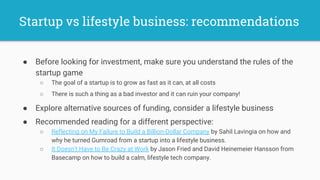
● Before looking for investment, make sure you understand the rules of the
startup game
○ The goal of a startup is to grow as fast as it can, at all costs
○ There is such a thing as a bad investor and it can ruin your company!
● Explore alternative sources of funding, consider a lifestyle business
● Recommended reading for a different perspective:
○ Reflecting on My Failure to Build a Billion-Dollar Company by Sahil Lavingia on how and
why he turned Gumroad from a startup into a lifestyle business.
○ It Doesn't Have to Be Crazy at Work by Jason Fried and David Heinemeier Hansson from
Basecamp on how to build a calm, lifestyle tech company.
Startup vs lifestyle business: recommendations
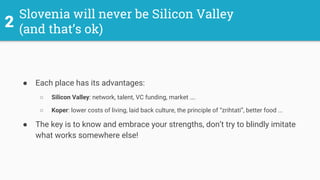
Slovenia will never be Silicon Valley
(and that’s ok)
● Each place has its advantages:
○ Silicon Valley: network, talent, VC funding, market ….
○ Koper: lower costs of living, laid back culture, the principle of “zrihtati”, better food ...
● The key is to know and embrace your strengths, don’t try to blindly imitate
what works somewhere else!
2
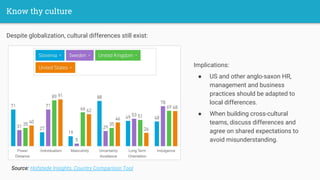
Know thy culture
Source: Hofstede Insights, Country Comparison Tool
Despite globalization, cultural differences still exist:
Implications:
● US and other anglo-saxon HR,
management and business
practices should be adapted to
local differences.
● When building cross-cultural
teams, discuss differences and
agree on shared expectations to
avoid misunderstanding.
Tech doeth not a company make: it’s all about
Product/Market fit
● The common approach (especially among engineers):
We have a technical solution
looking for a problem to solve.
3
Tech doeth not a company make: it’s all about
Product/Market fit
● It doesn’t matter if you have the best algorithm/code base/product if
people aren’t willing to pay for it
● The only thing that matters:
Are you solving a real problem in a way that
people are willing to pay for right now?
● It’s called Product/Market fit
3
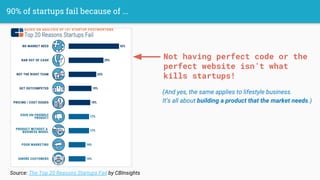
90% of startups fail because of ...
Source: The Top 20 Reasons Startups Fail by CBInsights
Not having perfect code or the
perfect website isn’t what
kills startups!
(And yes, the same applies to lifestyle business.
It’s all about building a product that the market needs.)
You didn’t make a sale until the money is
in your bank account
● Finding your market is about selling
● Saying “This is awesome!” != buying a product
○ This is especially important in B2B: customers are excited and make promises but until the
contract is signed and the money is in your account, you’re still negotiating
○ Don’t overestimate your Product/Market fit based on promises!
4
You’ll never be happy with the code you release
● … if you are happy, you probably released too late
● Other common traps:
○ Chasing the latest trendy framework
○ Over-engineering and over-optimising when just starting out: you’re not Google!
○ Waiting months or years to release v1 so it can be just perfect
● P.S.: But do take privacy and security seriously
5
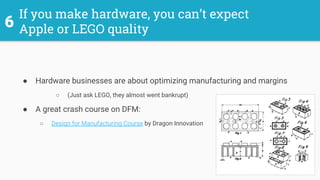
If you make hardware, you can’t expect
Apple or LEGO quality
● Hardware businesses are about optimizing manufacturing and margins
○ (Just ask LEGO, they almost went bankrupt)
● A great crash course on DFM:
○ Design for Manufacturing Course by Dragon Innovation
6
You don’t have to write a single line of code to
test your business idea
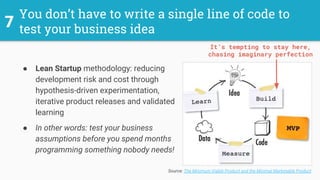
● Lean Startup methodology: reducing
development risk and cost through
hypothesis-driven experimentation,
iterative product releases and validated
learning
● In other words: test your business
assumptions before you spend months
programming something nobody needs!
7
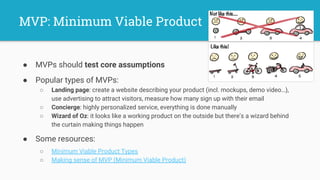
Source: The Minimum Viable Product and the Minimal Marketable Product
It’s tempting to stay here,
chasing imaginary perfection
MVP: Minimum Viable Product
● MVPs should test core assumptions
● Popular types of MVPs:
○ Landing page: create a website describing your product (incl. mockups, demo video…),
use advertising to attract visitors, measure how many sign up with their email
○ Concierge: highly personalized service, everything is done manually
○ Wizard of Oz: it looks like a working product on the outside but there’s a wizard behind
the curtain making things happen
● Some resources:
○ Minimum Viable Product Types
○ Making sense of MVP (Minimum Viable Product)
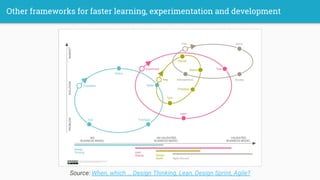
Other frameworks for faster learning, experimentation and development
Source: When, which … Design Thinking, Lean, Design Sprint, Agile?
Talk to customers, a lot. And listen!
● You can save a lot of time, money and effort by talking to customers as
early as possible
○ There’s no substitute for that. No advisor or mentor smart enough!
● Keep listening, your job isn’t done when v1 hits the market
● Note: In B2B, customers (people who pay) might not be your users, you need
to understand both
8
Common excuses for not talking to potential
customers (yes, I’ve used them all!)
1) Our product isn’t finished yet, we’ll wait for the first release.
2) We don’t know the right people.
3) Talking to people is hard.
4) People don’t really know what they want.
5) We are our own customers, we know our pains.
6) Our product is special, we can’t easily build a prototype.
7) We already have Google Analytics/Mixpanel/other analytics.
(Tips on how to get over them.)
If you want to focus on tech, you’ll need a
cofounder to take care of the rest
● Building a company is more than just building technology, somebody
needs to sell it!
● If you want to avoid business, you’ll need a good cofounder and learn to
appreciate what they do even though it might look like they’re just “wasting
time” making calls and answering emails
○ A business partnership is like a marriage, there will be ups and downs, so choose carefully!
9
… things somebody will need to do (there’s no department yet)
● Product design: wrapping the technology in something that’s actually
valuable to people and makes users happy
● Business stuff: setting strategy, pricing, keeping track of expenses and
income
● Sales and marketing: letting potential customers know about your product
and getting money for it
● Support: keeping customers happy, helping them buy your product
● HR and management: hiring (and firing) the right people at the right time,
making sure they do what they’re supposed to and get paid on time
● Other annoying little things: paying rent, AWS fees, dealing with accountants,
lawyers, suppliers, ...
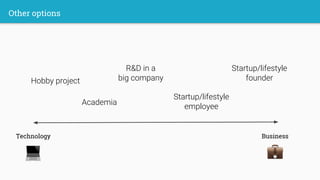
Other options
Technology Business
Startup/lifestyle
founder
Academia
R&D in a
big companyHobby project
Startup/lifestyle
employee
Don’t over-engineer your business too soon
● Act your size and don’t grow until you’re ready: building complex
processes, contracts etc. too soon can do more harm than good
● Don’t worry about patents until you’ve got money to cover litigation fees
● Focus on delivering value to customers first!
10
Still want to start a business? :)
Start small, start today
● Talk to customers: don’t hide your idea, talk to potential customers to
understand their problems and how your idea fits in.
● Decide what kind of business you want: lifestyle or startup? How big?
● Do your homework: analyze the competition, define your ideal customers.
● Smart as small as you can: choose cofounders and first employees
carefully, start experimenting asap (landing page, MVP, ...).
● Build your professional network: UIP Podjetna Primorska competition for
entrepreneurs who are just getting started is a good place to start locally.
Questions?
alja@artesia.si
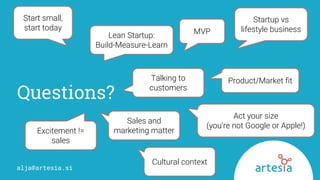
Start small,
start today
Startup vs
lifestyle business
Lean Startup:
Build-Measure-Learn
MVP
Sales and
marketing matter
Cultural context
Product/Market fit
Act your size
(you’re not Google or Apple!)
Talking to
customers
Excitement !=
sales

Starting a business as engineers: algorithms aren't everything

  • 1.
    Starting a businessas engineers: algorithms aren't everything Lessons from building and failing tech startups Alja Isaković alja@artesia.si
  • 2.
    My startup story ●First failed startup launched in 2007 ● Worked at first Slovenian startup accelerator TSstartup (2012/2013) ● Joined CubeSensors, an IoT hardware startup in 2013 (sold in 2017) ● Joined Cofound.it in 2017 (closed down in 2018) ● Currently at Artesia, a business consultancy, mentoring startups and young entrepreneurs
  • 3.
    Why am Ihere? ● To bust some startup myths. ● To share some of the lessons I learned the hard way in the past 10+ years. ● To give you some tips on where/how to start. ● Answer many questions :)
  • 4.
    The myth oftech startups: it’s all about the idea or algorithm! 💡 Genius idea 💻 Super elegant code Profit 💻 Brilliant algorithm - or - Profit
  • 5.
    The reality: it’sstill about building a business 💡💻 Idea/algorithm 🍝 Semi-working spaghetti code Nobody cares Head scratching 💼😔 Learning & doing boring business stuff 😭 It’s not working! Keep going Revenue but no profit 💡 Pivot: new idea 💪 Rewrite spaghetti code 💼😵 More boring business stuff 😱 ... 😫 Burnout Glimmer of hope (and it never stops!)
  • 6.
    10 things Iwish I knew before starting my first startup
  • 7.
    VC-funded startups arenot the only (or even the best) way to build tech companies ● High growth, VC-funded startups get all the media attention ○ The super successful ones are called unicorns for a reason ... ● BUT you don’t need a VC/angel investment to start a tech company! ○ Bootstrapping: actually making money by selling something ○ Crowdfunding: convincing a crowd to give you money for a product you’ll build ● Not every tech company is (and should be) a startup: a lifestyle business is a calmer (and often more sustainable) alternative 1
  • 8.
    Startup vs lifestylebusiness: a definition Startup: a company that might end up making investors filthy rich by growing super fast and reaching a spectacular exit; 90% failure rate. vs Lifestyle business: a small company that grows at its own pace and is more focused on making a healthy profit.
  • 9.
    Startup vs lifestylebusiness: in-depth comparison Adapted from How to start and run a software lifestyle business by Joe Albahari Startup Lifestyle business Maximize business growth Maximize job satisfaction High risk, high return Low risk, moderate return Venture capital, IPO/exit as goal Low capital, usually no investors Board of investors, founder shares usually diluted Founder(s) retain ownership and control Big market with big competition Small market with little competition Exponential growth Linear or capped growth Usually requires at least two founders (biz & tech) Can be done by one person The goal is to retire rich, burnout almost guaranteed The goal is to make a comfortable living
  • 10.
    ● Before lookingfor investment, make sure you understand the rules of the startup game ○ The goal of a startup is to grow as fast as it can, at all costs ○ There is such a thing as a bad investor and it can ruin your company! ● Explore alternative sources of funding, consider a lifestyle business ● Recommended reading for a different perspective: ○ Reflecting on My Failure to Build a Billion-Dollar Company by Sahil Lavingia on how and why he turned Gumroad from a startup into a lifestyle business. ○ It Doesn't Have to Be Crazy at Work by Jason Fried and David Heinemeier Hansson from Basecamp on how to build a calm, lifestyle tech company. Startup vs lifestyle business: recommendations
  • 11.
    Slovenia will neverbe Silicon Valley (and that’s ok) ● Each place has its advantages: ○ Silicon Valley: network, talent, VC funding, market …. ○ Koper: lower costs of living, laid back culture, the principle of “zrihtati”, better food ... ● The key is to know and embrace your strengths, don’t try to blindly imitate what works somewhere else! 2
  • 12.
    Know thy culture Source:Hofstede Insights, Country Comparison Tool Despite globalization, cultural differences still exist: Implications: ● US and other anglo-saxon HR, management and business practices should be adapted to local differences. ● When building cross-cultural teams, discuss differences and agree on shared expectations to avoid misunderstanding.
  • 13.
    Tech doeth nota company make: it’s all about Product/Market fit ● The common approach (especially among engineers): We have a technical solution looking for a problem to solve. 3
  • 14.
    Tech doeth nota company make: it’s all about Product/Market fit ● It doesn’t matter if you have the best algorithm/code base/product if people aren’t willing to pay for it ● The only thing that matters: Are you solving a real problem in a way that people are willing to pay for right now? ● It’s called Product/Market fit 3
  • 15.
    90% of startupsfail because of ... Source: The Top 20 Reasons Startups Fail by CBInsights Not having perfect code or the perfect website isn’t what kills startups! (And yes, the same applies to lifestyle business. It’s all about building a product that the market needs.)
  • 16.
    You didn’t makea sale until the money is in your bank account ● Finding your market is about selling ● Saying “This is awesome!” != buying a product ○ This is especially important in B2B: customers are excited and make promises but until the contract is signed and the money is in your account, you’re still negotiating ○ Don’t overestimate your Product/Market fit based on promises! 4
  • 17.
    You’ll never behappy with the code you release ● … if you are happy, you probably released too late ● Other common traps: ○ Chasing the latest trendy framework ○ Over-engineering and over-optimising when just starting out: you’re not Google! ○ Waiting months or years to release v1 so it can be just perfect ● P.S.: But do take privacy and security seriously 5
  • 18.
    If you makehardware, you can’t expect Apple or LEGO quality ● Hardware businesses are about optimizing manufacturing and margins ○ (Just ask LEGO, they almost went bankrupt) ● A great crash course on DFM: ○ Design for Manufacturing Course by Dragon Innovation 6
  • 19.
    You don’t haveto write a single line of code to test your business idea ● Lean Startup methodology: reducing development risk and cost through hypothesis-driven experimentation, iterative product releases and validated learning ● In other words: test your business assumptions before you spend months programming something nobody needs! 7 Source: The Minimum Viable Product and the Minimal Marketable Product It’s tempting to stay here, chasing imaginary perfection
  • 20.
    MVP: Minimum ViableProduct ● MVPs should test core assumptions ● Popular types of MVPs: ○ Landing page: create a website describing your product (incl. mockups, demo video…), use advertising to attract visitors, measure how many sign up with their email ○ Concierge: highly personalized service, everything is done manually ○ Wizard of Oz: it looks like a working product on the outside but there’s a wizard behind the curtain making things happen ● Some resources: ○ Minimum Viable Product Types ○ Making sense of MVP (Minimum Viable Product)
  • 21.
    Other frameworks forfaster learning, experimentation and development Source: When, which … Design Thinking, Lean, Design Sprint, Agile?
  • 22.
    Talk to customers,a lot. And listen! ● You can save a lot of time, money and effort by talking to customers as early as possible ○ There’s no substitute for that. No advisor or mentor smart enough! ● Keep listening, your job isn’t done when v1 hits the market ● Note: In B2B, customers (people who pay) might not be your users, you need to understand both 8
  • 23.
    Common excuses fornot talking to potential customers (yes, I’ve used them all!) 1) Our product isn’t finished yet, we’ll wait for the first release. 2) We don’t know the right people. 3) Talking to people is hard. 4) People don’t really know what they want. 5) We are our own customers, we know our pains. 6) Our product is special, we can’t easily build a prototype. 7) We already have Google Analytics/Mixpanel/other analytics. (Tips on how to get over them.)
  • 24.
    If you wantto focus on tech, you’ll need a cofounder to take care of the rest ● Building a company is more than just building technology, somebody needs to sell it! ● If you want to avoid business, you’ll need a good cofounder and learn to appreciate what they do even though it might look like they’re just “wasting time” making calls and answering emails ○ A business partnership is like a marriage, there will be ups and downs, so choose carefully! 9
  • 25.
    … things somebodywill need to do (there’s no department yet) ● Product design: wrapping the technology in something that’s actually valuable to people and makes users happy ● Business stuff: setting strategy, pricing, keeping track of expenses and income ● Sales and marketing: letting potential customers know about your product and getting money for it ● Support: keeping customers happy, helping them buy your product ● HR and management: hiring (and firing) the right people at the right time, making sure they do what they’re supposed to and get paid on time ● Other annoying little things: paying rent, AWS fees, dealing with accountants, lawyers, suppliers, ...
  • 26.
    Other options Technology Business Startup/lifestyle founder Academia R&Din a big companyHobby project Startup/lifestyle employee
  • 27.
    Don’t over-engineer yourbusiness too soon ● Act your size and don’t grow until you’re ready: building complex processes, contracts etc. too soon can do more harm than good ● Don’t worry about patents until you’ve got money to cover litigation fees ● Focus on delivering value to customers first! 10
  • 28.
    Still want tostart a business? :)
  • 29.
    Start small, starttoday ● Talk to customers: don’t hide your idea, talk to potential customers to understand their problems and how your idea fits in. ● Decide what kind of business you want: lifestyle or startup? How big? ● Do your homework: analyze the competition, define your ideal customers. ● Smart as small as you can: choose cofounders and first employees carefully, start experimenting asap (landing page, MVP, ...). ● Build your professional network: UIP Podjetna Primorska competition for entrepreneurs who are just getting started is a good place to start locally.
  • 30.
    Questions? alja@artesia.si Start small, start today Startupvs lifestyle business Lean Startup: Build-Measure-Learn MVP Sales and marketing matter Cultural context Product/Market fit Act your size (you’re not Google or Apple!) Talking to customers Excitement != sales