PROCUREMENT: EXPEDITING: GENERAL:
HOW TO?
MOHD ISHAR ISHAK
Kuala Lumpur, October 2014
EXPEDITING : GENERAL: HOW TO
2
CONTENT
EXPEDITING : GENERAL: HOW TO
3
Safety Moment
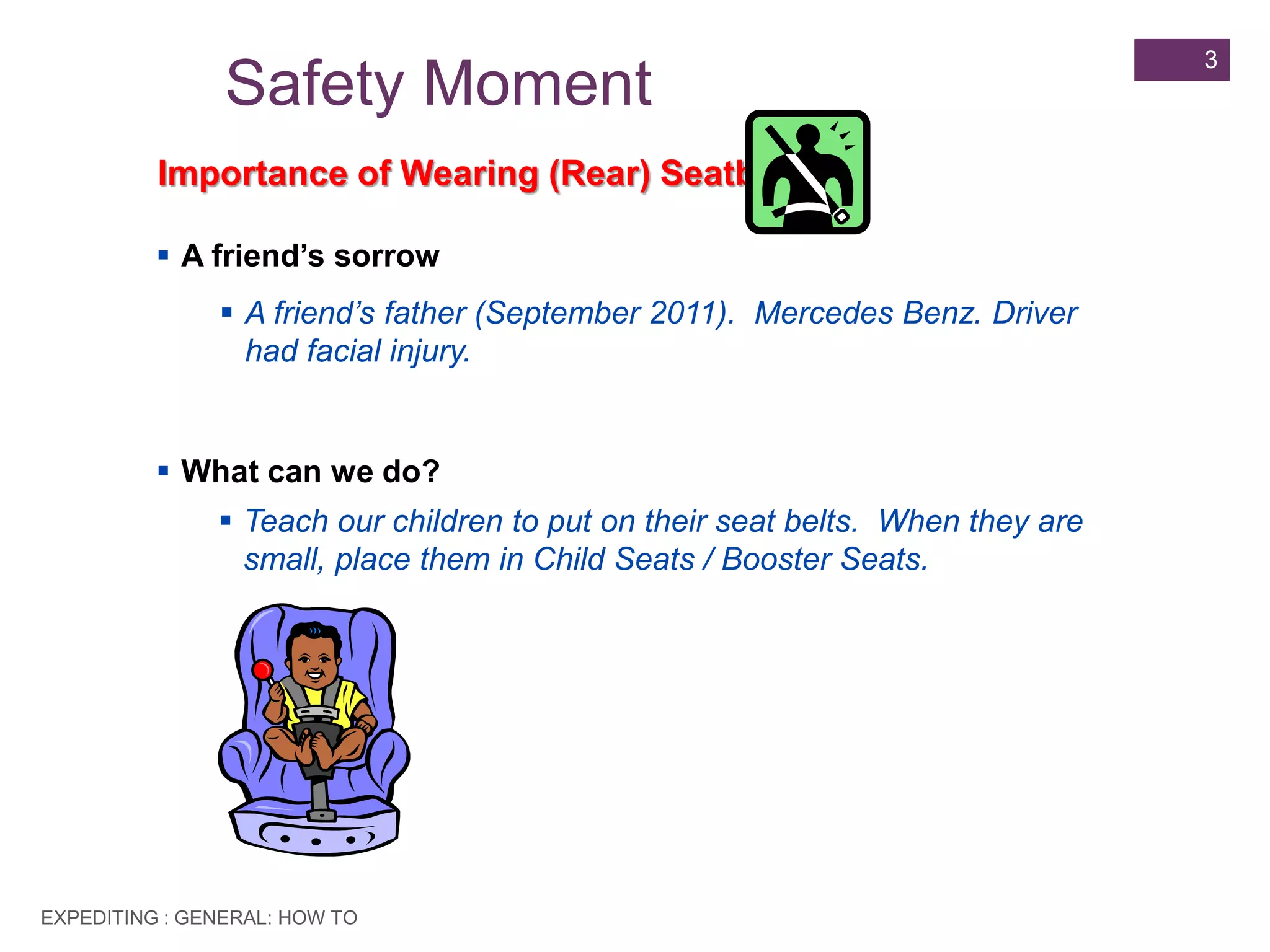
Importance of Wearing (Rear) Seatbelt
 A friend’s sorrow
 A friend’s father (September 2011). Mercedes Benz. Driver
had facial injury.
 What can we do?
 Teach our children to put on their seat belts. When they are
small, place them in Child Seats / Booster Seats.
EXPEDITING : GENERAL: HOW TO
4
 How To Know What Is Being Expedited? Where Can We Find The
Information?
• An Expeditor, by nature should be inquisitive, probing and relentless in information
gathering. Without sufficient information, the report produced would not have the
necessary or required back up to support what had been written.
• The necessary information could be found from, but not limited to the following sources:
i. SR Part 1 (Materials/Equipment Scope of Supply) and SR Part 2 (Document Scope of Supply)
ii. eg. Cost-It (Id Cards) provides good/sufficient description of all the Materials and Equipment that
we would normally purchase for each project.
iii. Ask the Expediting Coordinator or the Package Engineer.
iv. Internet.
 How Complicated Is The PO Being Expedited?
• I would consider most POs up to the maximum of 3 or 4 main components to be
straightforward.
• Package POs, DCS/PMCS/ICS and Telecommunication Package are those, I would rate
as complicated as they involves a lot of components, interfaces and systems, where
better technical understanding would be necessary, in order to successfully expedite
these POs.
What Are Being Expedited?
EXPEDITING : GENERAL: HOW TO
5
 To successfully expedite a PO, we need to have the guideline on how to
perform the function and most importantly, we need to know the current
phase of the POs and the related critical milestones during that phase.
 Project Expediting Procedure
• The above procedure provides the guideline to perform an expediting function for a
project. It is actually the minimum activities that are expected of an expeditor in order to
ensure that POs are properly monitored/expedited. In order to ensure on time delivery of
supply, extra effort and coordination might/would be needed, not only by the expeditor,
but also the other stake holders – engineering, project, inspection & logistics.
 What Are the Critical Milestones and Milestone Dates
• Critical Milestones are not only those indicated as Payment Milestones in Article 4 of the
PO, but also, the Critical Activities for each of a PO. Listed below are critical milestones
other than that normally indicated in a PO:
• Kick-Off Phase
i. Kick-Off Meeting attended by all interested and relevant parties.
How Do We Go About Expediting a PO?
EXPEDITING : GENERAL: HOW TO
6
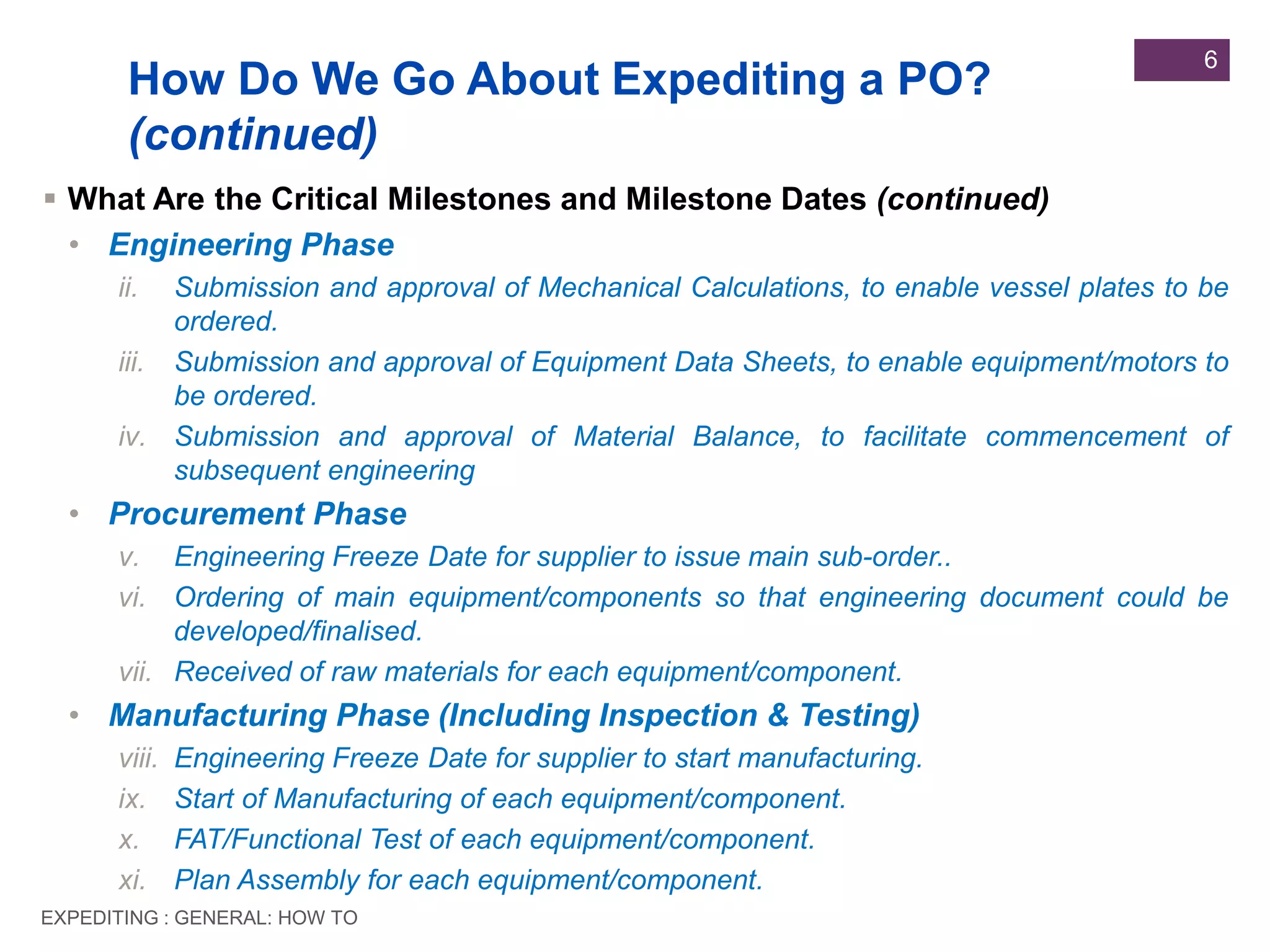
 What Are the Critical Milestones and Milestone Dates (continued)
• Engineering Phase
ii. Submission and approval of Mechanical Calculations, to enable vessel plates to be
ordered.
iii. Submission and approval of Equipment Data Sheets, to enable equipment/motors to
be ordered.
iv. Submission and approval of Material Balance, to facilitate commencement of
subsequent engineering
• Procurement Phase
v. Engineering Freeze Date for supplier to issue main sub-order..
vi. Ordering of main equipment/components so that engineering document could be
developed/finalised.
vii. Received of raw materials for each equipment/component.
• Manufacturing Phase (Including Inspection & Testing)
viii. Engineering Freeze Date for supplier to start manufacturing.
ix. Start of Manufacturing of each equipment/component.
x. FAT/Functional Test of each equipment/component.
xi. Plan Assembly for each equipment/component.
How Do We Go About Expediting a PO?
(continued)
EXPEDITING : GENERAL: HOW TO
7
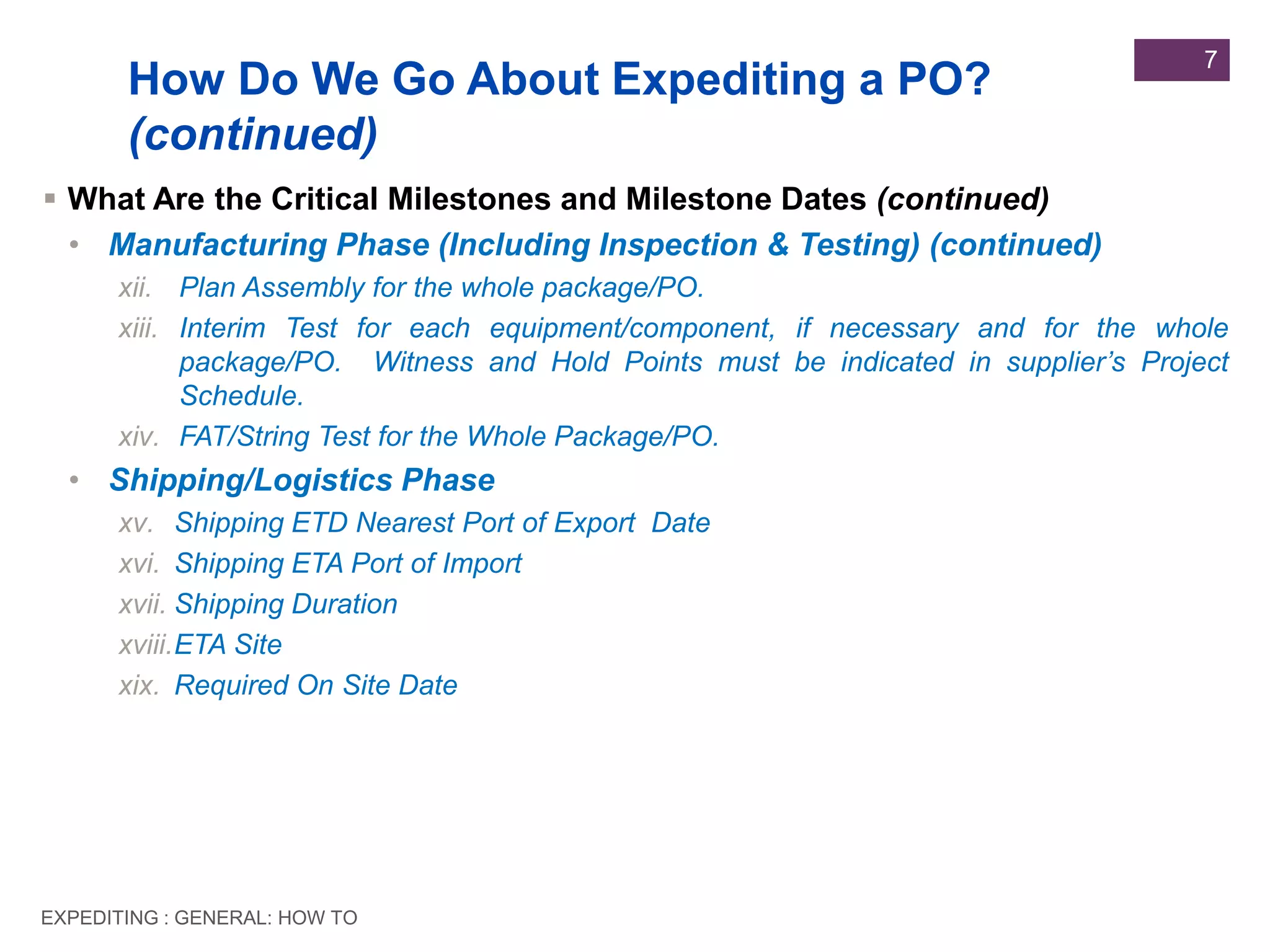
 What Are the Critical Milestones and Milestone Dates (continued)
• Manufacturing Phase (Including Inspection & Testing) (continued)
xii. Plan Assembly for the whole package/PO.
xiii. Interim Test for each equipment/component, if necessary and for the whole
package/PO. Witness and Hold Points must be indicated in supplier’s Project
Schedule.
xiv. FAT/String Test for the Whole Package/PO.
• Shipping/Logistics Phase
xv. Shipping ETD Nearest Port of Export Date
xvi. Shipping ETA Port of Import
xvii. Shipping Duration
xviii.ETA Site
xix. Required On Site Date
How Do We Go About Expediting a PO?
(continued)
EXPEDITING : GENERAL: HOW TO
8
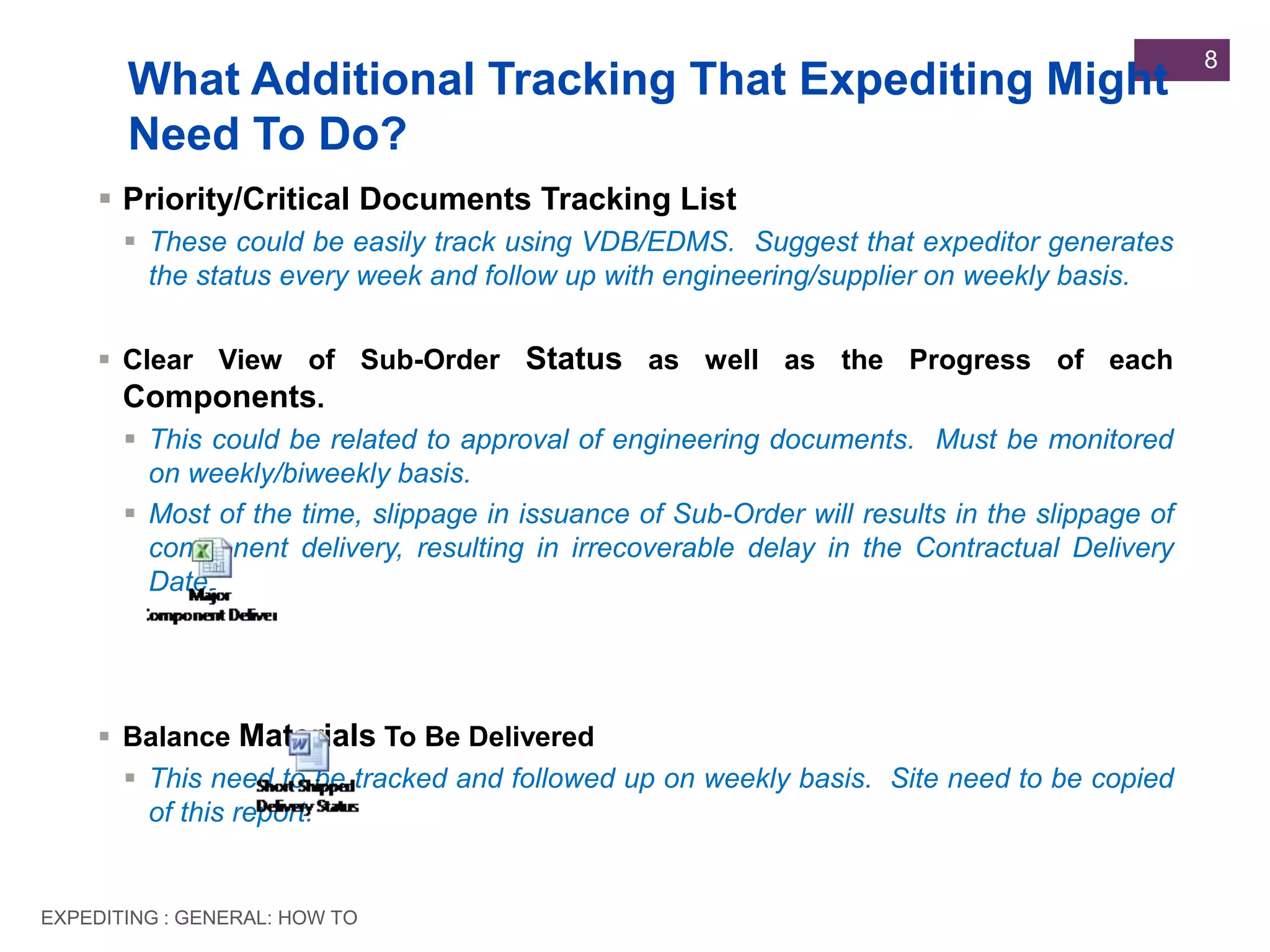
 Priority/Critical Documents Tracking List
 These could be easily track using VDB/EDMS. Suggest that expeditor generates
the status every week and follow up with engineering/supplier on weekly basis.
 Clear View of Sub-Order Status as well as the Progress of each
Components.
 This could be related to approval of engineering documents. Must be monitored
on weekly/biweekly basis.
 Most of the time, slippage in issuance of Sub-Order will results in the slippage of
component delivery, resulting in irrecoverable delay in the Contractual Delivery
Date.
 Balance Materials To Be Delivered
 This need to be tracked and followed up on weekly basis. Site need to be copied
of this report.
What Additional Tracking That Expediting Might
Need To Do?
EXPEDITING : GENERAL: HOW TO
9
 Challenges are part and parcel of work. Following a few of the
challenges that expediting normally experienced during project
execution.
 Workshop Capacity – need to be checked during bidding stage
 Manpower Shortage – to be confirmed during bidding stage
 Financial Problem – to be verified during bidding stage
 Multi-Tier Sub-Vendors - to be verified during bidding stage
 Location Time Zone – can be easily adapted. Also use 3rd Party Expeditor
 Engineering Team Experience or the Lack Of Experience – notify Engineering
Manager & Project Management of any engineering shortcomings
 Computerised Fluid Dynamic Analysis – Only Sulzer & Rhine Ruhr currently had
done CFD Analysis for XXXXXX Projects. Need to know if there is any
alternative.
 New Supplier – closer monitoring, ensure understanding of our PO Management
requirements during KOM.
 DCC / VDBx – no introduction of new system to a new project.
 End User Statement [USA/GmbH/France – Ti/Monel/Hasteloy Materiels] –
requiring a letter in Client’s Letter Head.
Challenges
Questions & Answers
10 EXPEDITING : GENERAL: HOW TO
Thank you

PROCUREMENT: Expediting How To - General

  • 1.
    PROCUREMENT: EXPEDITING: GENERAL: HOWTO? MOHD ISHAR ISHAK Kuala Lumpur, October 2014
  • 2.
    EXPEDITING : GENERAL:HOW TO 2 CONTENT
  • 3.
    EXPEDITING : GENERAL:HOW TO 3 Safety Moment Importance of Wearing (Rear) Seatbelt  A friend’s sorrow  A friend’s father (September 2011). Mercedes Benz. Driver had facial injury.  What can we do?  Teach our children to put on their seat belts. When they are small, place them in Child Seats / Booster Seats.
  • 4.
    EXPEDITING : GENERAL:HOW TO 4  How To Know What Is Being Expedited? Where Can We Find The Information? • An Expeditor, by nature should be inquisitive, probing and relentless in information gathering. Without sufficient information, the report produced would not have the necessary or required back up to support what had been written. • The necessary information could be found from, but not limited to the following sources: i. SR Part 1 (Materials/Equipment Scope of Supply) and SR Part 2 (Document Scope of Supply) ii. eg. Cost-It (Id Cards) provides good/sufficient description of all the Materials and Equipment that we would normally purchase for each project. iii. Ask the Expediting Coordinator or the Package Engineer. iv. Internet.  How Complicated Is The PO Being Expedited? • I would consider most POs up to the maximum of 3 or 4 main components to be straightforward. • Package POs, DCS/PMCS/ICS and Telecommunication Package are those, I would rate as complicated as they involves a lot of components, interfaces and systems, where better technical understanding would be necessary, in order to successfully expedite these POs. What Are Being Expedited?
  • 5.
    EXPEDITING : GENERAL:HOW TO 5  To successfully expedite a PO, we need to have the guideline on how to perform the function and most importantly, we need to know the current phase of the POs and the related critical milestones during that phase.  Project Expediting Procedure • The above procedure provides the guideline to perform an expediting function for a project. It is actually the minimum activities that are expected of an expeditor in order to ensure that POs are properly monitored/expedited. In order to ensure on time delivery of supply, extra effort and coordination might/would be needed, not only by the expeditor, but also the other stake holders – engineering, project, inspection & logistics.  What Are the Critical Milestones and Milestone Dates • Critical Milestones are not only those indicated as Payment Milestones in Article 4 of the PO, but also, the Critical Activities for each of a PO. Listed below are critical milestones other than that normally indicated in a PO: • Kick-Off Phase i. Kick-Off Meeting attended by all interested and relevant parties. How Do We Go About Expediting a PO?
  • 6.
    EXPEDITING : GENERAL:HOW TO 6  What Are the Critical Milestones and Milestone Dates (continued) • Engineering Phase ii. Submission and approval of Mechanical Calculations, to enable vessel plates to be ordered. iii. Submission and approval of Equipment Data Sheets, to enable equipment/motors to be ordered. iv. Submission and approval of Material Balance, to facilitate commencement of subsequent engineering • Procurement Phase v. Engineering Freeze Date for supplier to issue main sub-order.. vi. Ordering of main equipment/components so that engineering document could be developed/finalised. vii. Received of raw materials for each equipment/component. • Manufacturing Phase (Including Inspection & Testing) viii. Engineering Freeze Date for supplier to start manufacturing. ix. Start of Manufacturing of each equipment/component. x. FAT/Functional Test of each equipment/component. xi. Plan Assembly for each equipment/component. How Do We Go About Expediting a PO? (continued)
  • 7.
    EXPEDITING : GENERAL:HOW TO 7  What Are the Critical Milestones and Milestone Dates (continued) • Manufacturing Phase (Including Inspection & Testing) (continued) xii. Plan Assembly for the whole package/PO. xiii. Interim Test for each equipment/component, if necessary and for the whole package/PO. Witness and Hold Points must be indicated in supplier’s Project Schedule. xiv. FAT/String Test for the Whole Package/PO. • Shipping/Logistics Phase xv. Shipping ETD Nearest Port of Export Date xvi. Shipping ETA Port of Import xvii. Shipping Duration xviii.ETA Site xix. Required On Site Date How Do We Go About Expediting a PO? (continued)
  • 8.
    EXPEDITING : GENERAL:HOW TO 8  Priority/Critical Documents Tracking List  These could be easily track using VDB/EDMS. Suggest that expeditor generates the status every week and follow up with engineering/supplier on weekly basis.  Clear View of Sub-Order Status as well as the Progress of each Components.  This could be related to approval of engineering documents. Must be monitored on weekly/biweekly basis.  Most of the time, slippage in issuance of Sub-Order will results in the slippage of component delivery, resulting in irrecoverable delay in the Contractual Delivery Date.  Balance Materials To Be Delivered  This need to be tracked and followed up on weekly basis. Site need to be copied of this report. What Additional Tracking That Expediting Might Need To Do?
  • 9.
    EXPEDITING : GENERAL:HOW TO 9  Challenges are part and parcel of work. Following a few of the challenges that expediting normally experienced during project execution.  Workshop Capacity – need to be checked during bidding stage  Manpower Shortage – to be confirmed during bidding stage  Financial Problem – to be verified during bidding stage  Multi-Tier Sub-Vendors - to be verified during bidding stage  Location Time Zone – can be easily adapted. Also use 3rd Party Expeditor  Engineering Team Experience or the Lack Of Experience – notify Engineering Manager & Project Management of any engineering shortcomings  Computerised Fluid Dynamic Analysis – Only Sulzer & Rhine Ruhr currently had done CFD Analysis for XXXXXX Projects. Need to know if there is any alternative.  New Supplier – closer monitoring, ensure understanding of our PO Management requirements during KOM.  DCC / VDBx – no introduction of new system to a new project.  End User Statement [USA/GmbH/France – Ti/Monel/Hasteloy Materiels] – requiring a letter in Client’s Letter Head. Challenges
  • 10.
    Questions & Answers 10EXPEDITING : GENERAL: HOW TO
  • 11.