Earth & Life Science
Grade 11
2
1. Explain the process of evolution.
2. Identify some scientists who contributed to the historical
developments of evolutionary thoughts;
3. Explain how populations of organisms have changed and
continue to change over time showing patterns of descent with
modification from common ancestors to produce the organismal
diversity observed today; and
4. Compare Lamarckian and Darwinian Evolution.
Note: Populations are groups of
organisms of the same species living in
the same area at the same time.
3
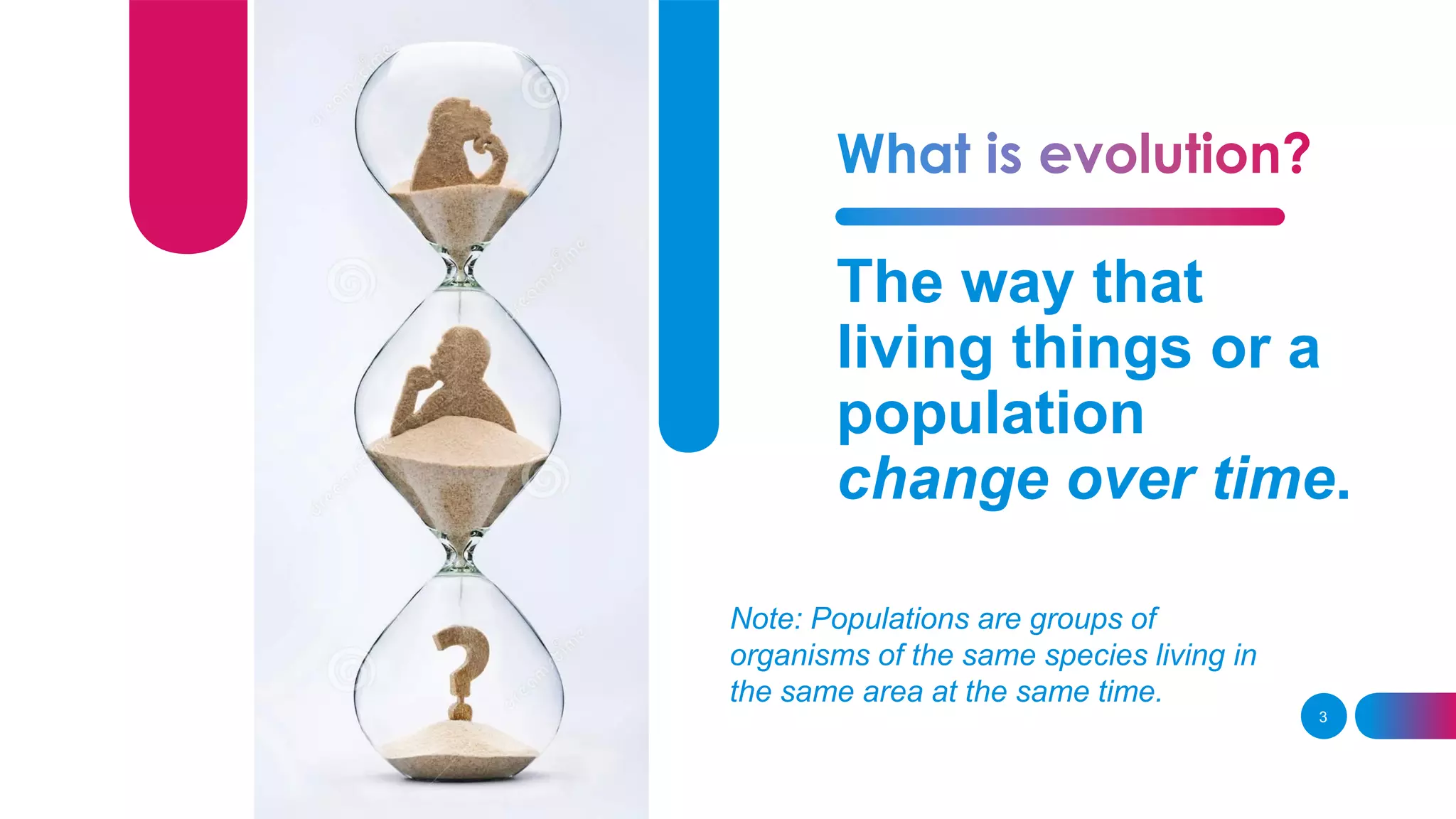
The way that
living things or a
population
change over time.
ADD A FOOTER 4
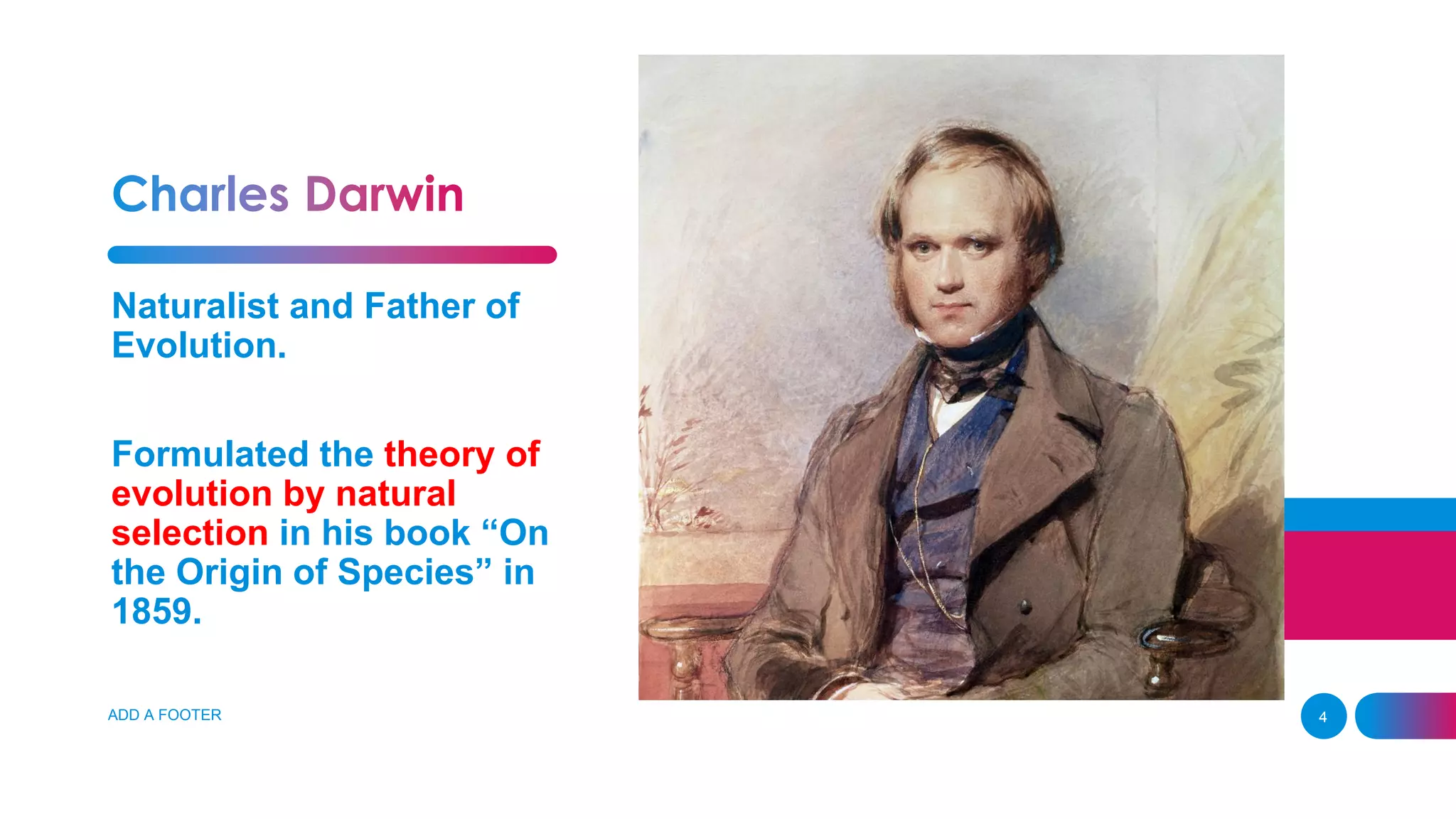
Naturalist and Father of
Evolution.
Formulated the theory of
evolution by natural
selection in his book “On
the Origin of Species” in
1859.
5
• Darwin’s theory actually contains two major ideas:
1.Evolution happens. Organisms change over time. Life on
Earth has changed as descendants (offspring) differed from
common ancestors in the past.
2.Natural selection drives evolution. Natural selection is the
process through which advantageous qualities in living
organisms create more offspring than others. This causes
changes in the characteristics of living things over time.
6
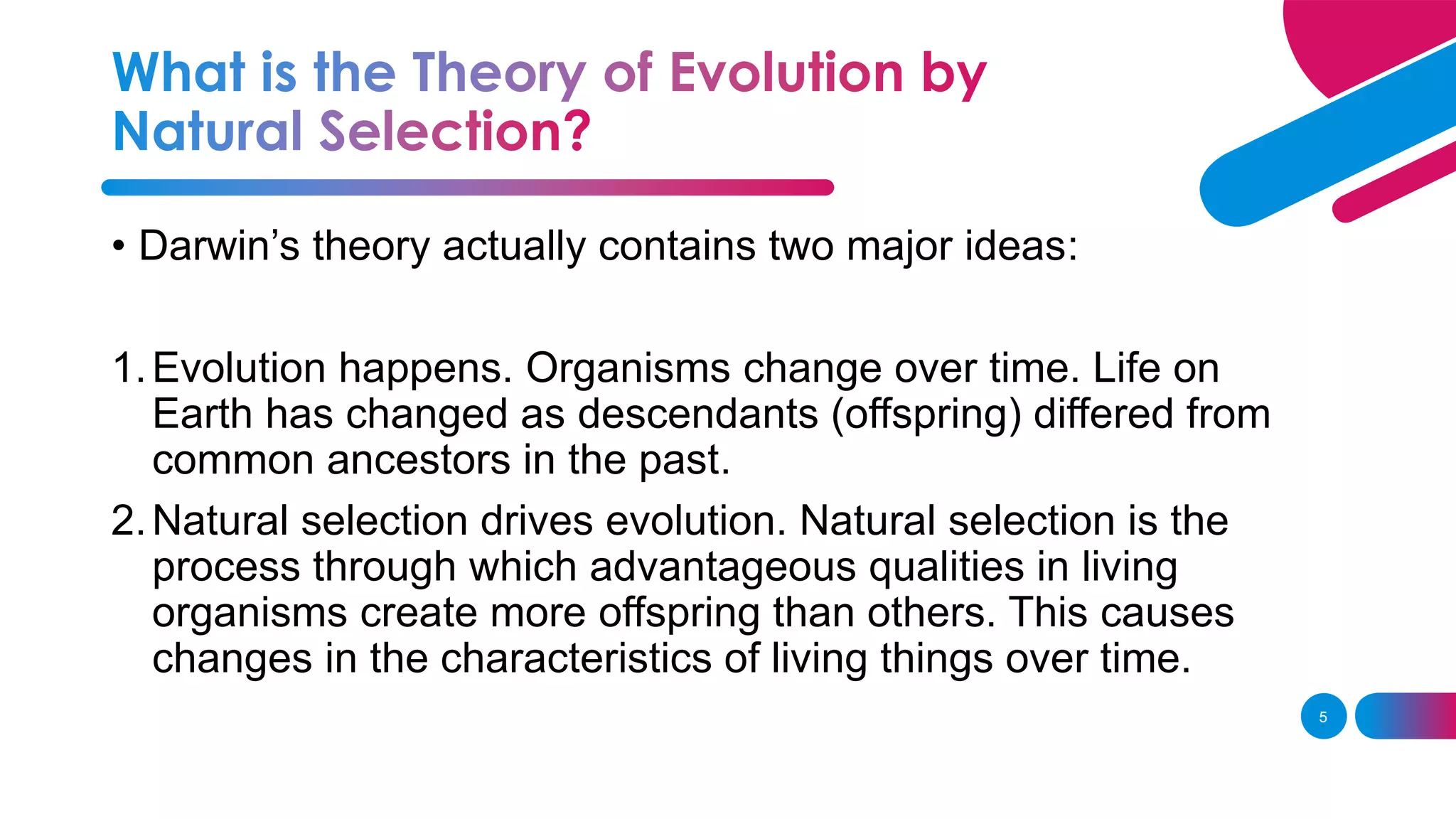
In Darwin’s era, most people
believed that all species
were created at the same
time and remained
unchanged thereafter. They
also believed that Earth was
only 6,000 years old.
7
ADD A FOOTER 8
The basis for the modern
theory of evolution was laid
during 1700s and 1800s.
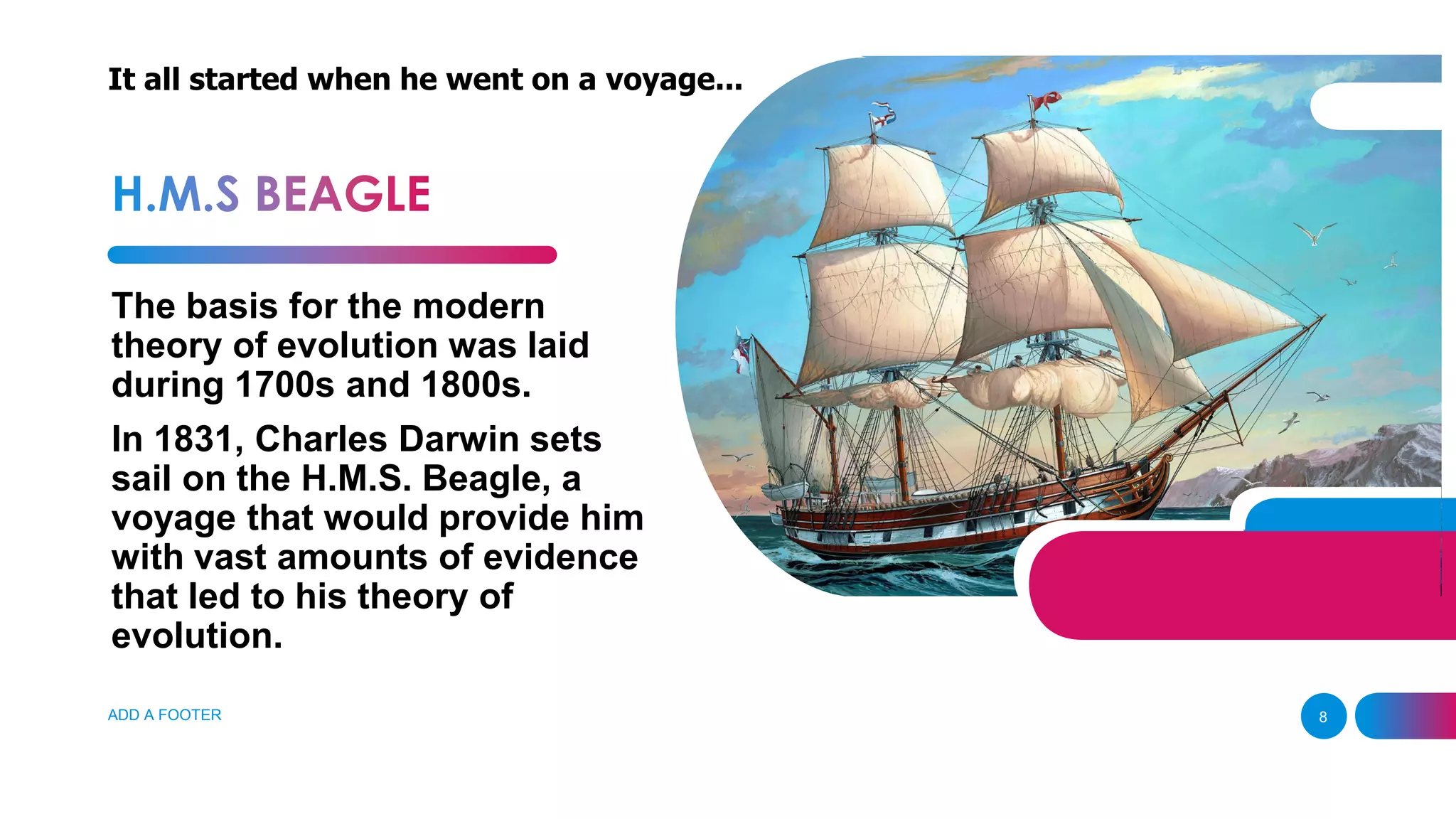
In 1831, Charles Darwin sets
sail on the H.M.S. Beagle, a
voyage that would provide him
with vast amounts of evidence
that led to his theory of
evolution.
It all started when he went on a voyage...
9
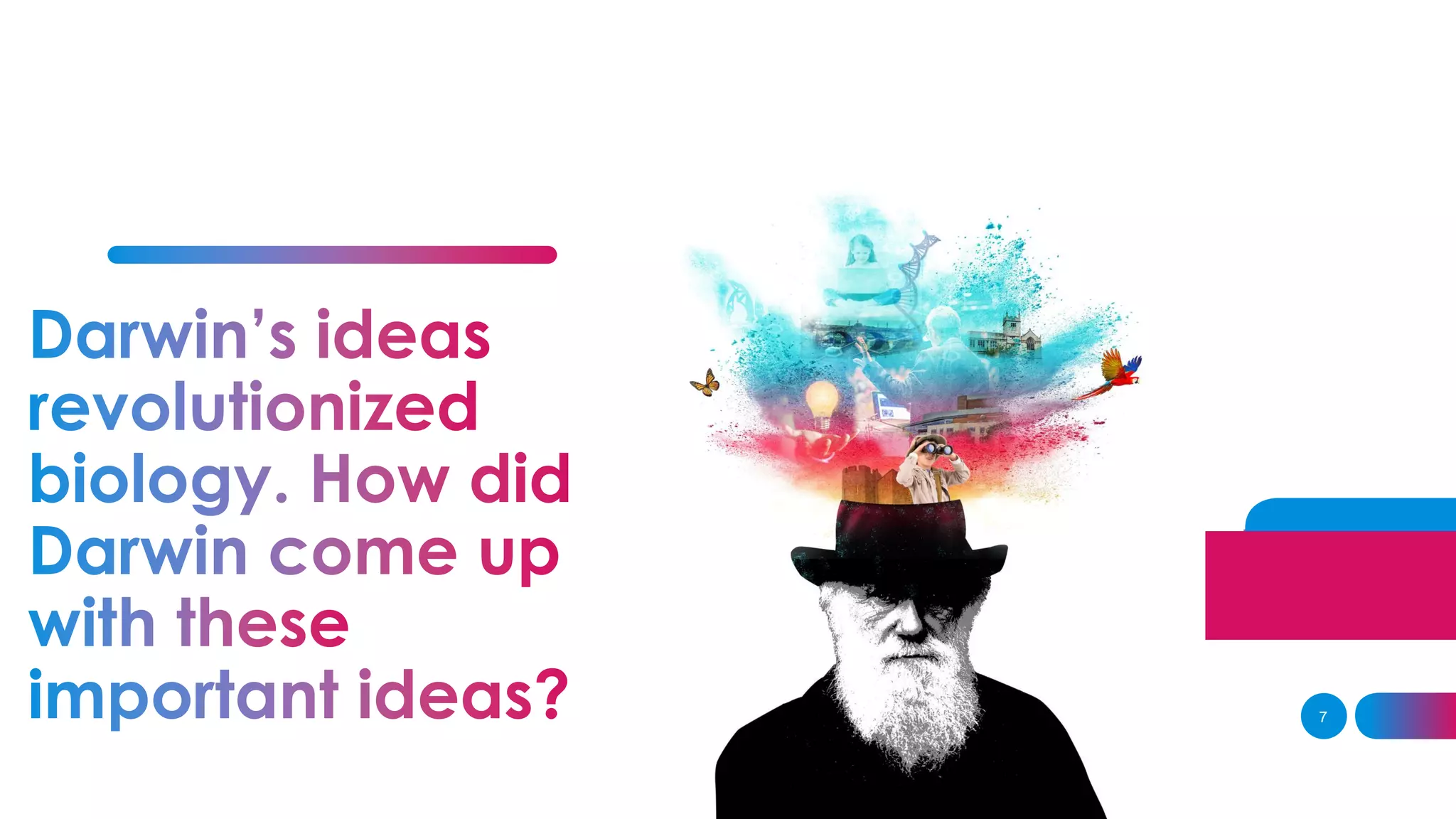
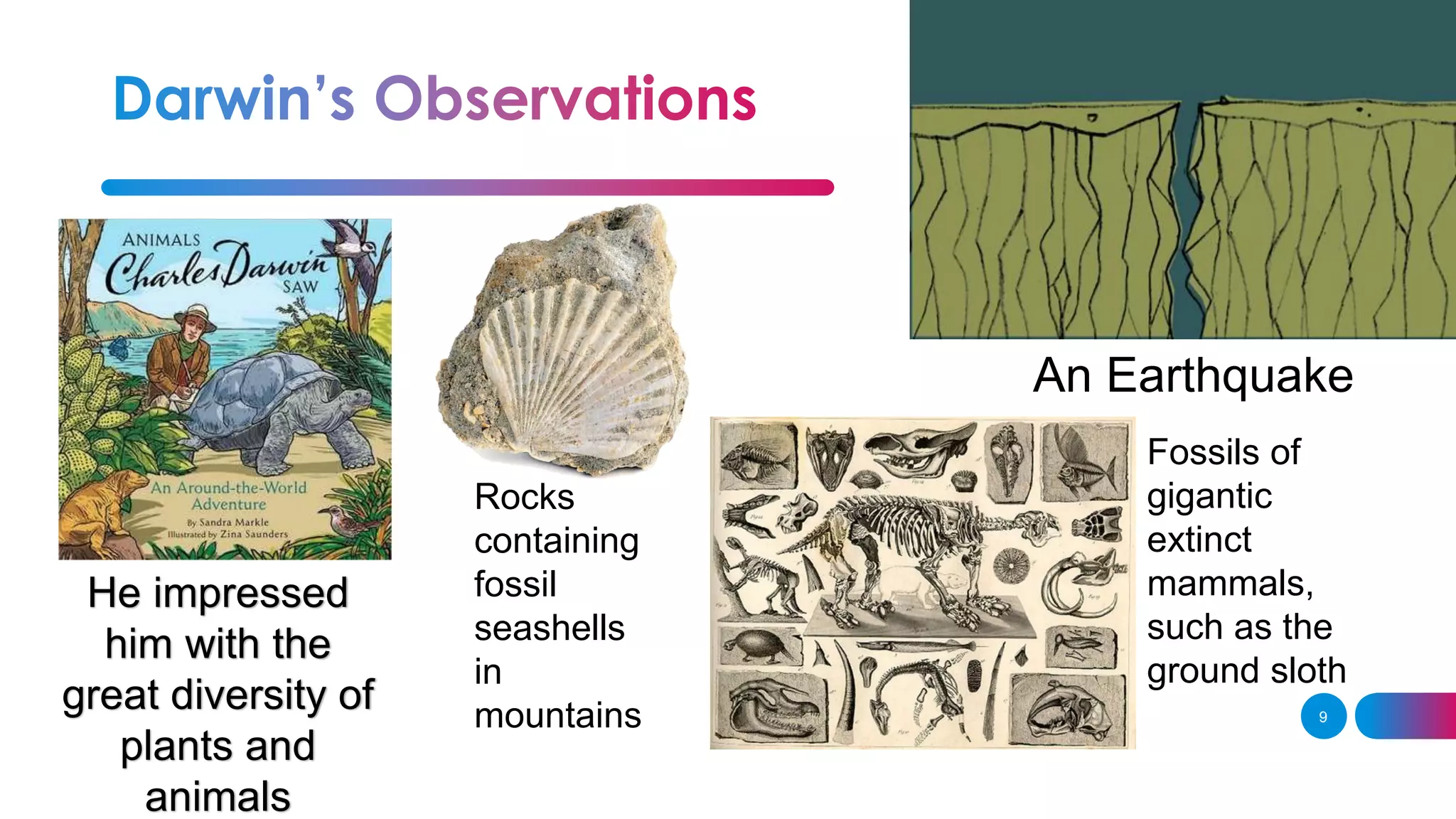
He impressed
him with the
great diversity of
plants and
animals
An Earthquake
Rocks
containing
fossil
seashells
in
mountains
Fossils of
gigantic
extinct
mammals,
such as the
ground sloth
ADD A FOOTER 10
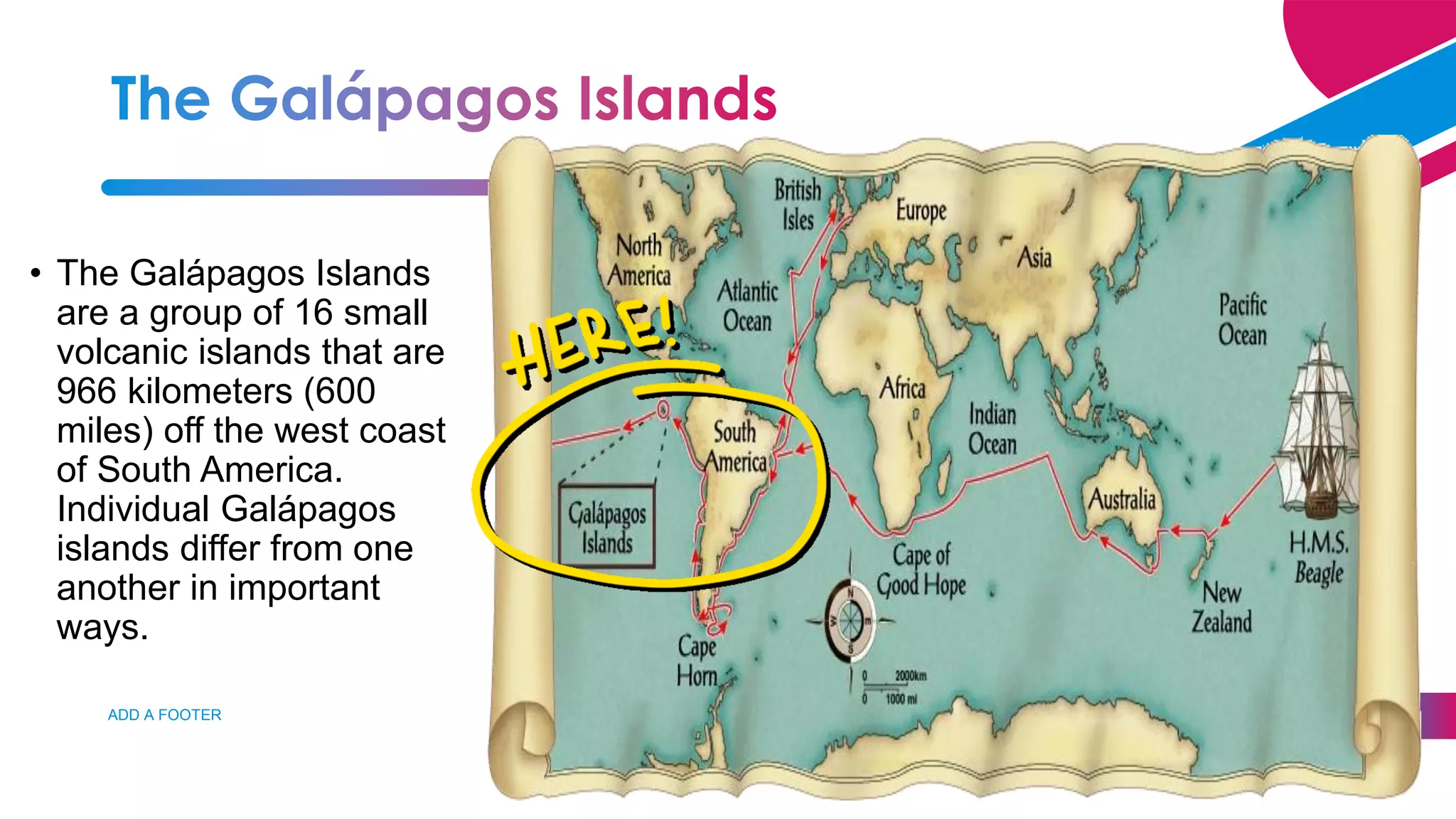
• The Galápagos Islands
are a group of 16 small
volcanic islands that are
966 kilometers (600
miles) off the west coast
of South America.
Individual Galápagos
islands differ from one
another in important
ways.
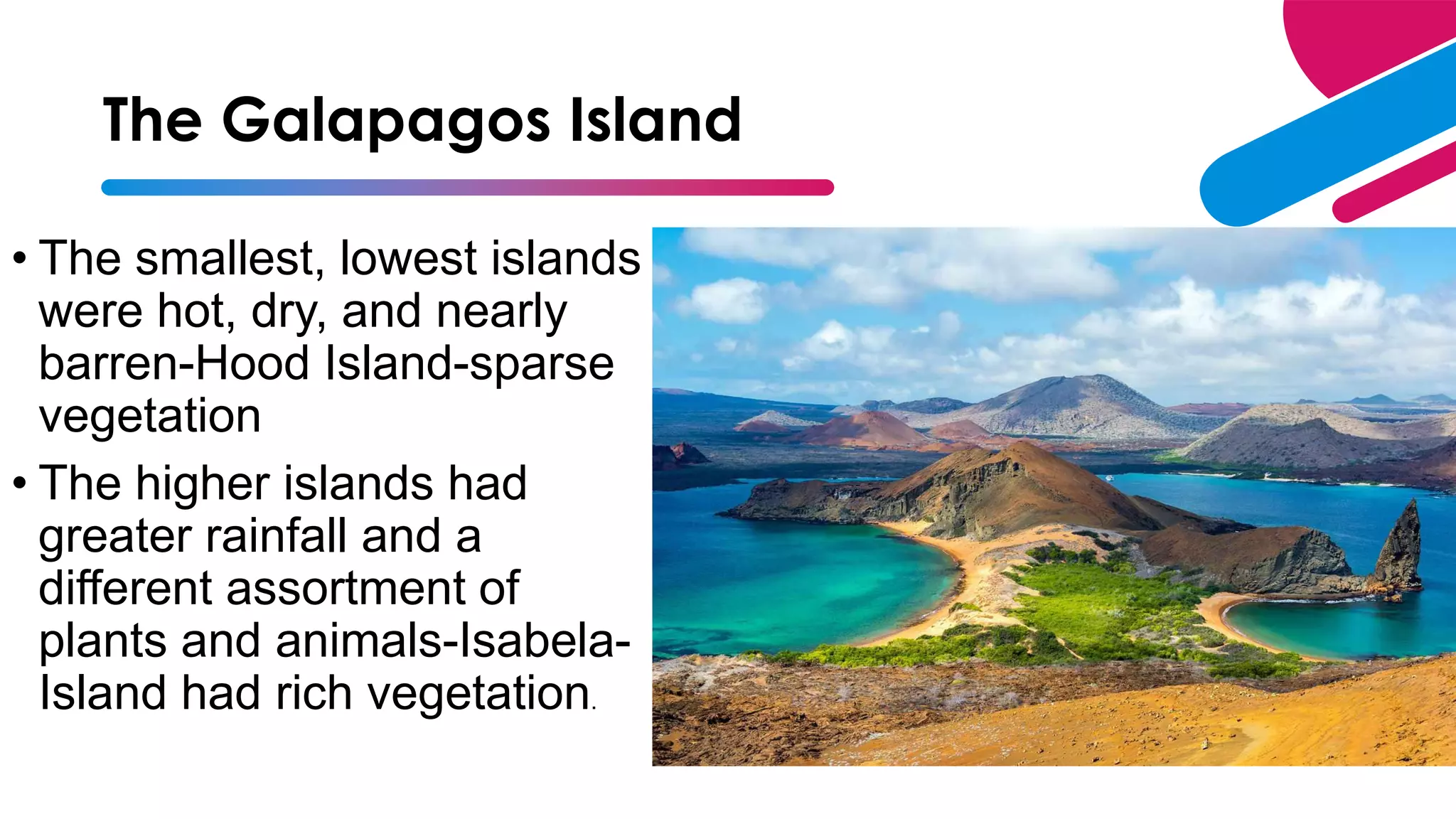
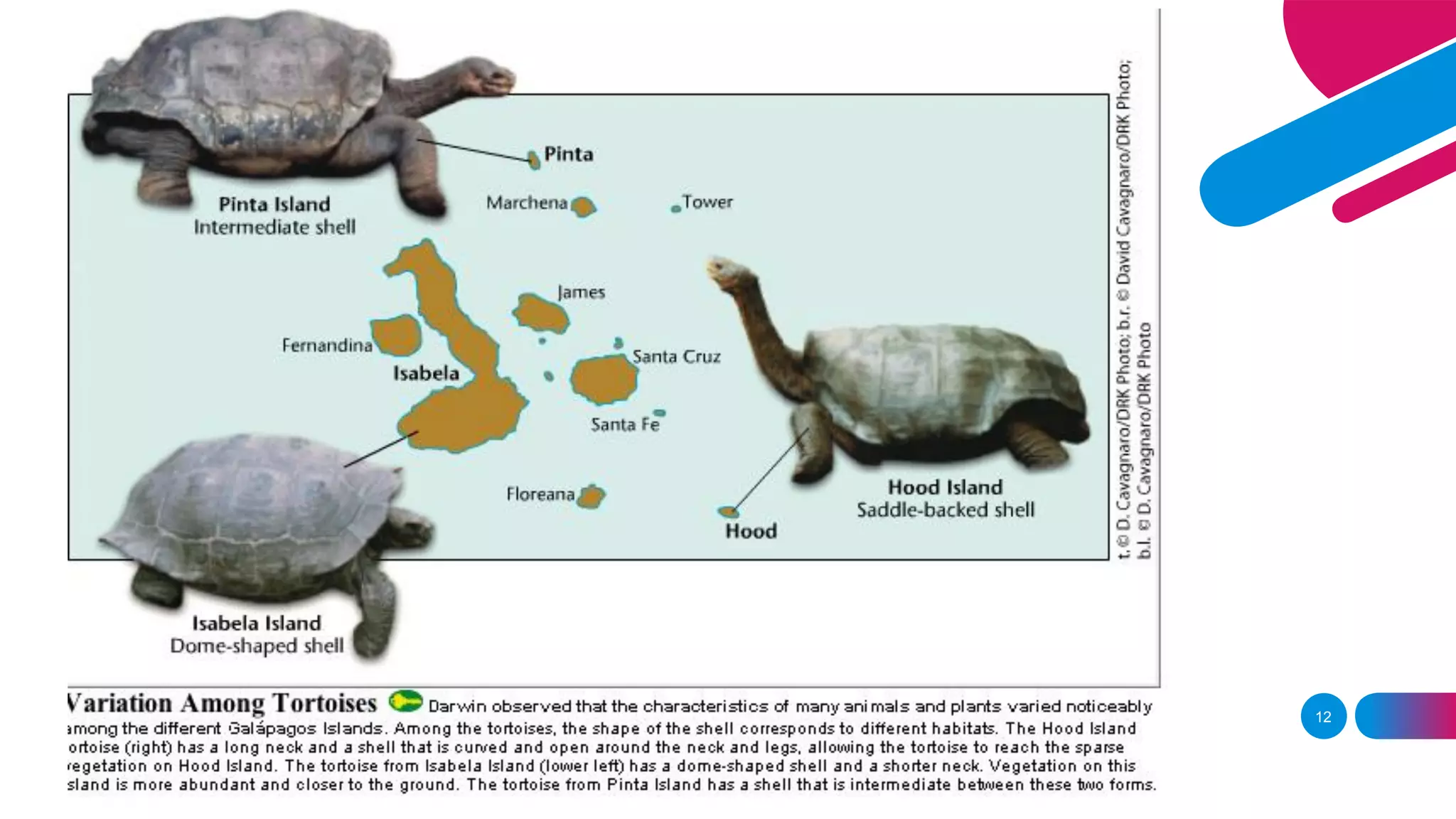
The Galapagos Island
• The smallest, lowest islands
were hot, dry, and nearly
barren-Hood Island-sparse
vegetation
• The higher islands had
greater rainfall and a
different assortment of
plants and animals-Isabela-
Island had rich vegetation.
ADD A FOOTER 12
13
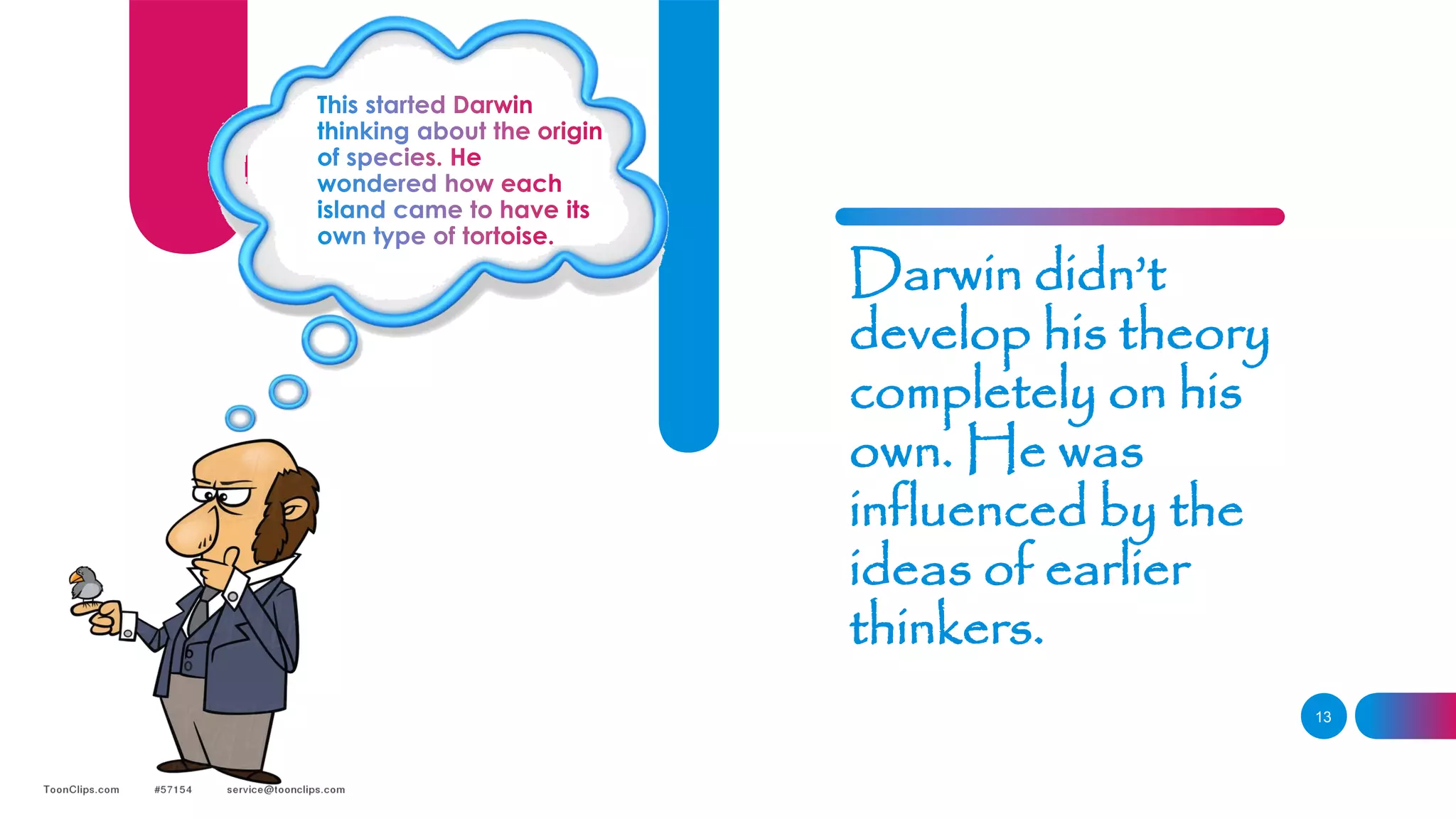
Darwin didn’t
develop his theory
completely on his
own. He was
influenced by the
ideas of earlier
thinkers.
14
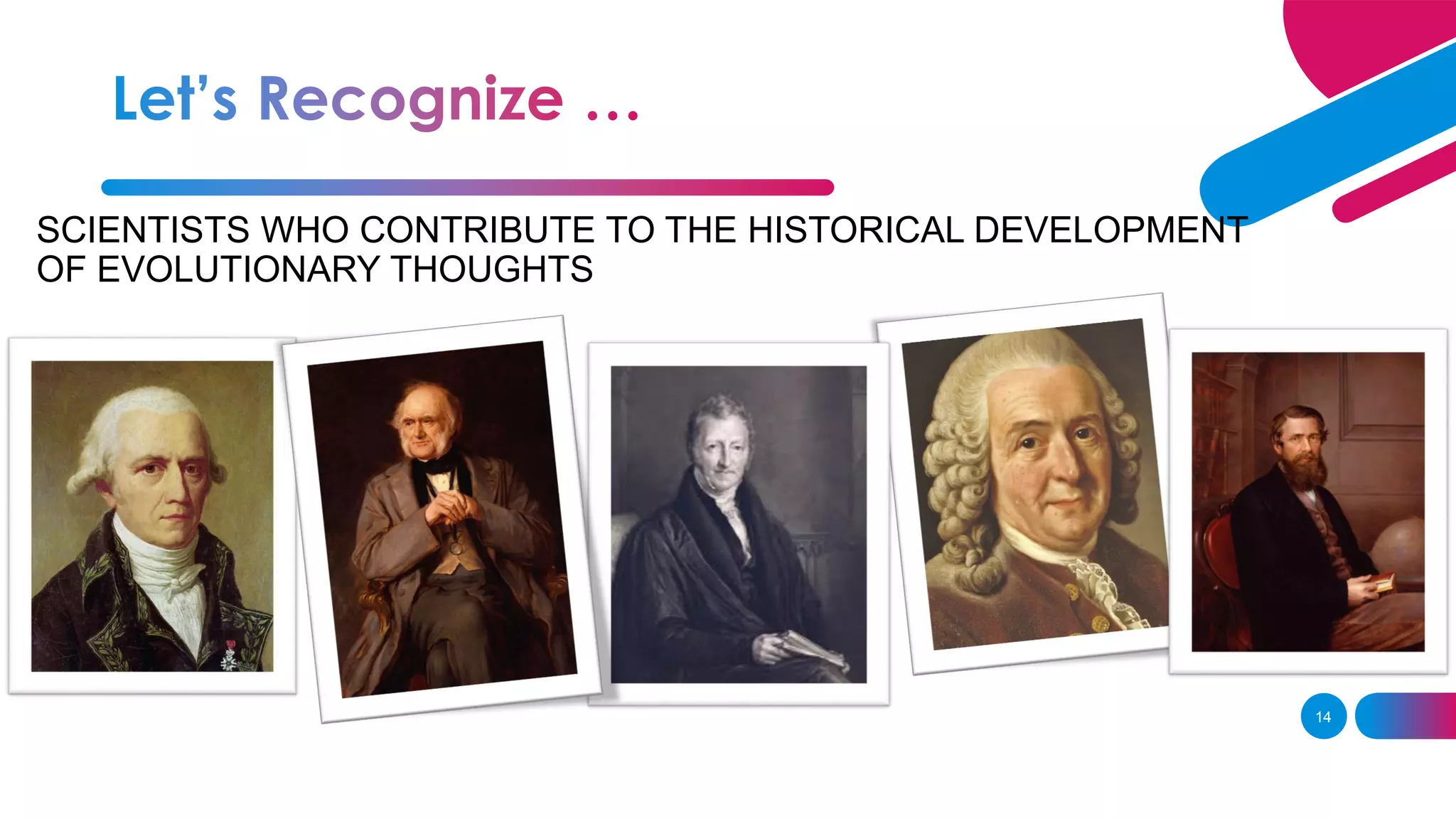
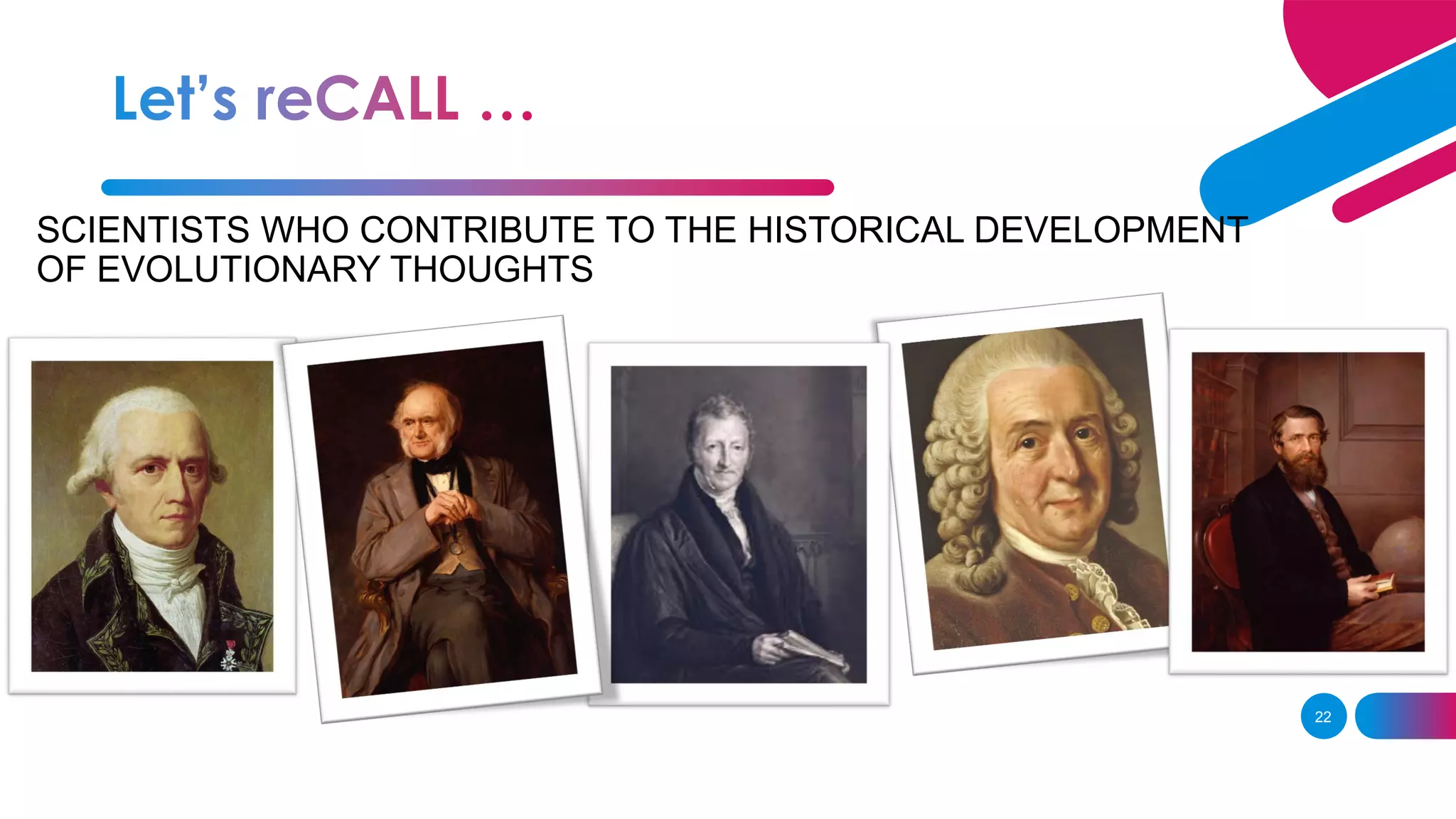
SCIENTISTS WHO CONTRIBUTE TO THE HISTORICAL DEVELOPMENT
OF EVOLUTIONARY THOUGHTS
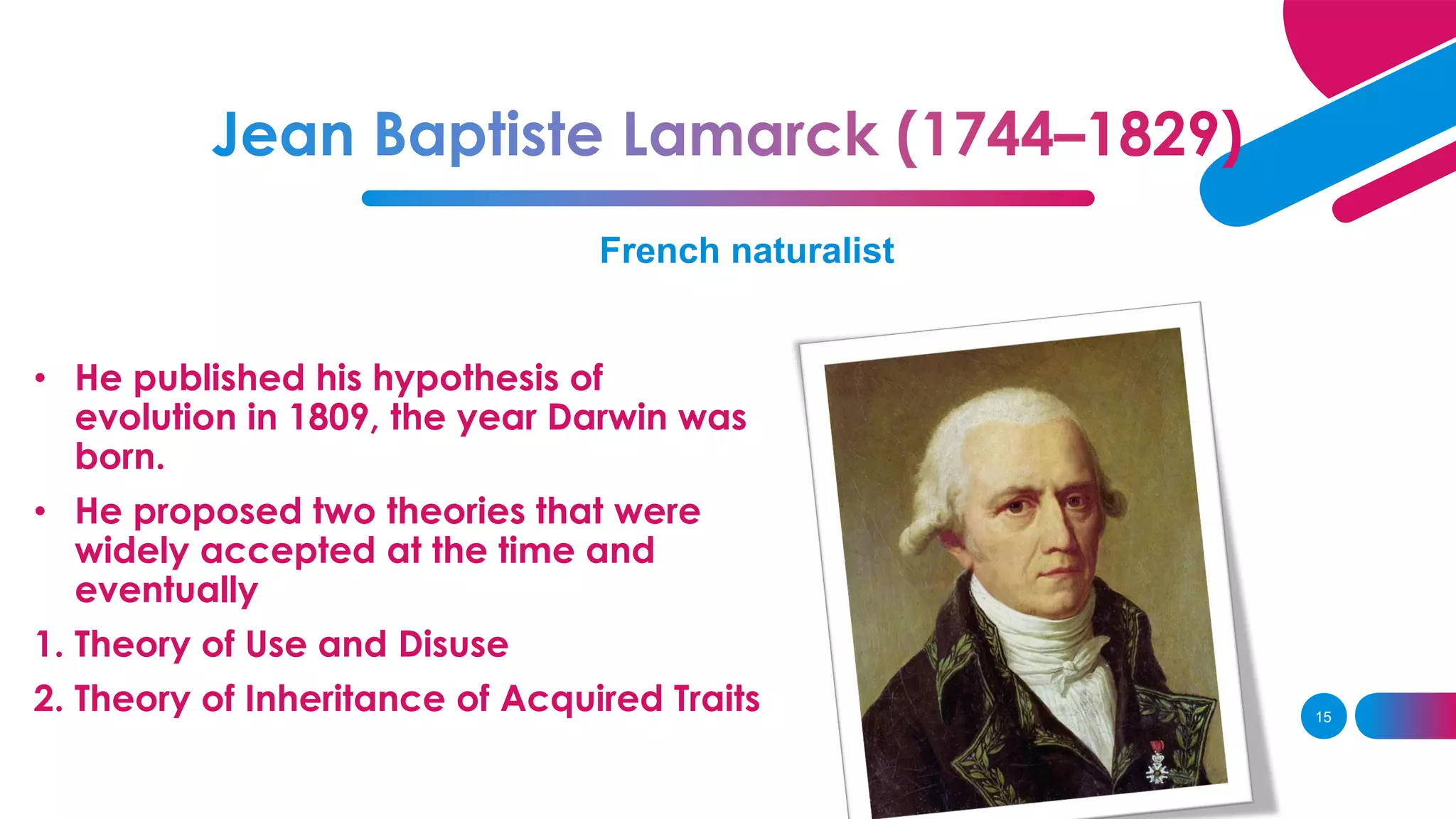
French naturalist
• He published his hypothesis of
evolution in 1809, the year Darwin was
born.
• He proposed two theories that were
widely accepted at the time and
eventually
1. Theory of Use and Disuse
2. Theory of Inheritance of Acquired Traits 15
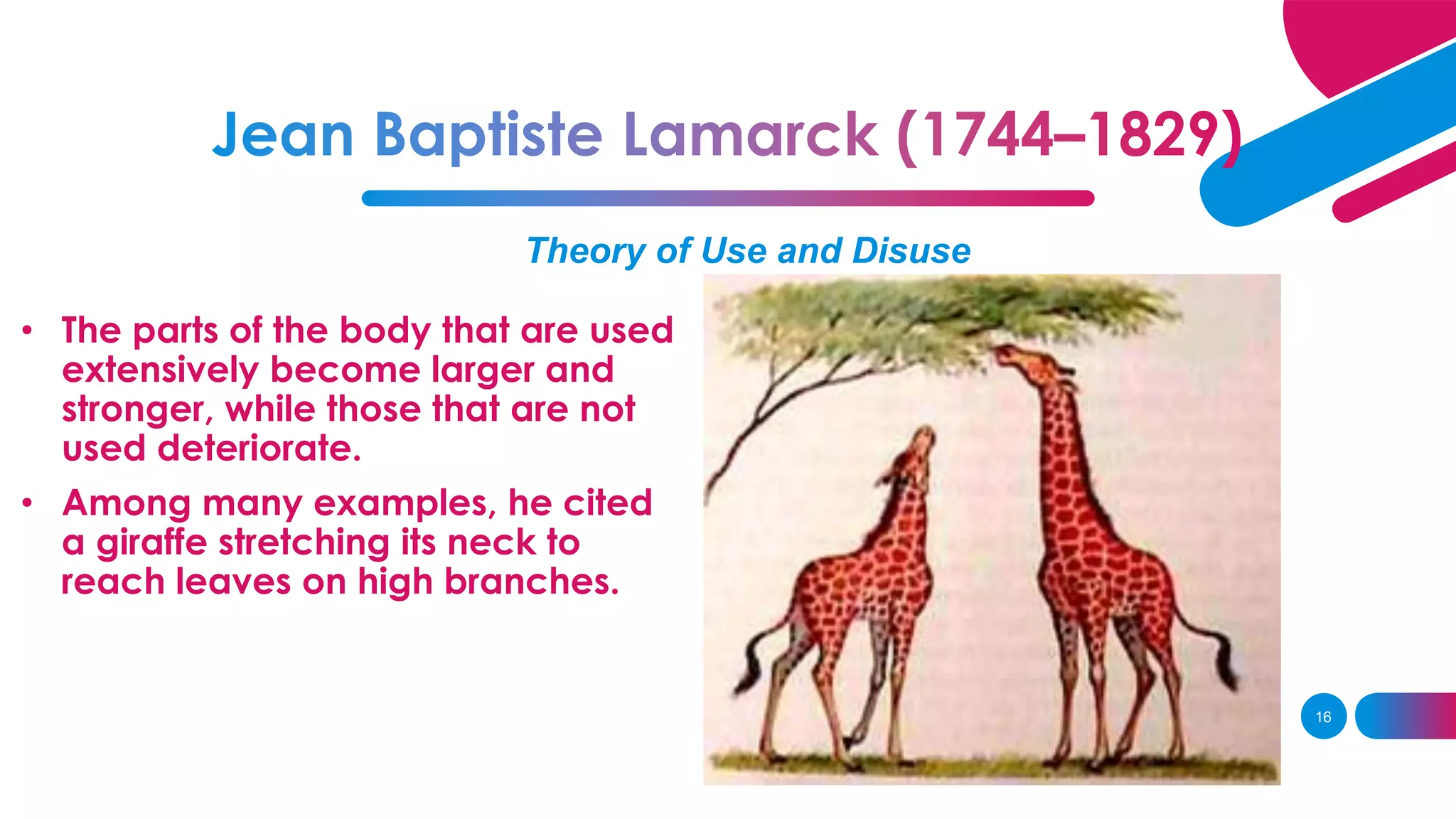
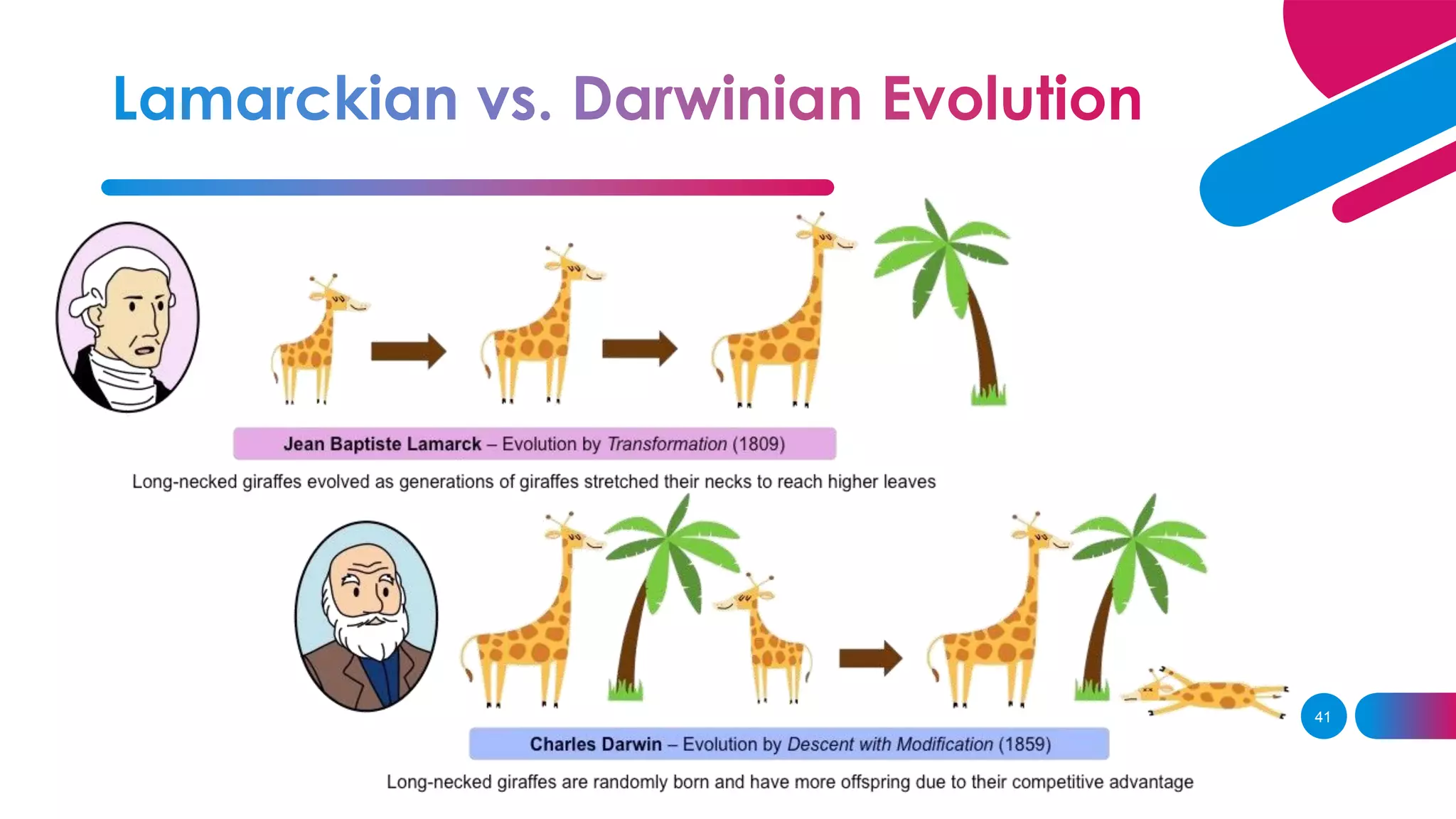
Theory of Use and Disuse
• The parts of the body that are used
extensively become larger and
stronger, while those that are not
used deteriorate.
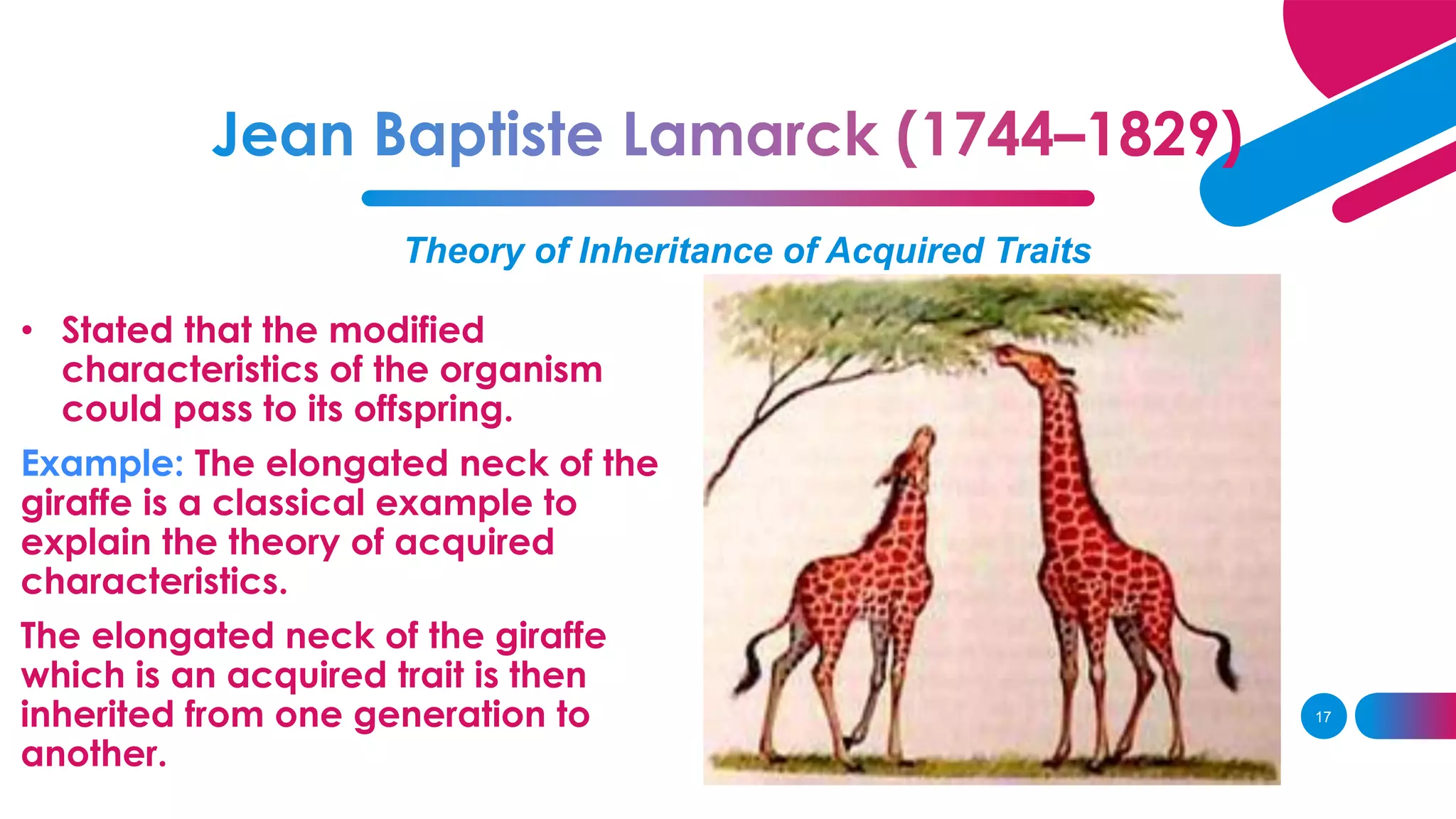
• Among many examples, he cited
a giraffe stretching its neck to
reach leaves on high branches.
16
Theory of Inheritance of Acquired Traits
• Stated that the modified
characteristics of the organism
could pass to its offspring.
Example: The elongated neck of the
giraffe is a classical example to
explain the theory of acquired
characteristics.
The elongated neck of the giraffe
which is an acquired trait is then
inherited from one generation to
another.
17
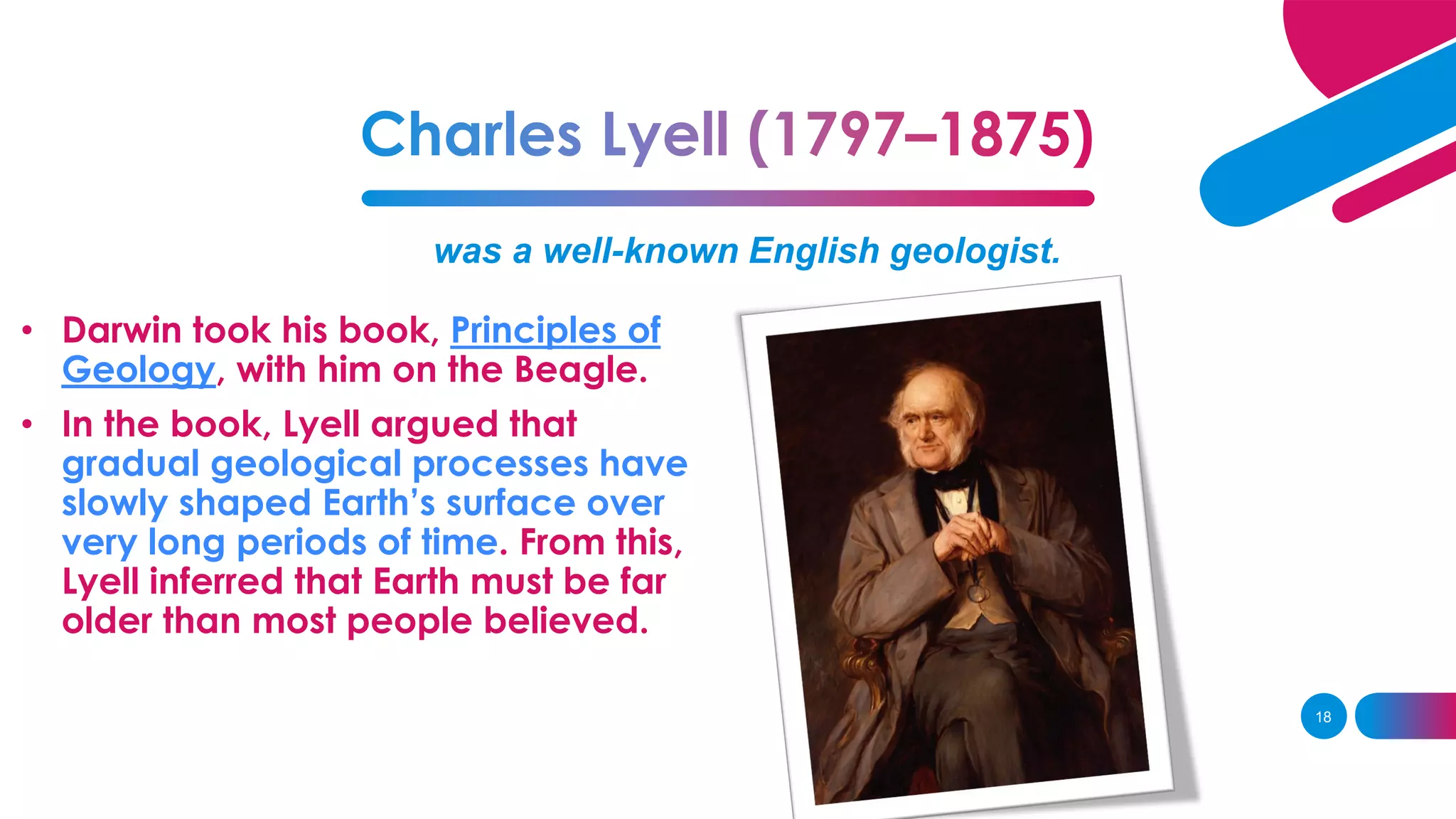
was a well-known English geologist.
• Darwin took his book, Principles of
Geology, with him on the Beagle.
• In the book, Lyell argued that
gradual geological processes have
slowly shaped Earth’s surface over
very long periods of time. From this,
Lyell inferred that Earth must be far
older than most people believed.
18
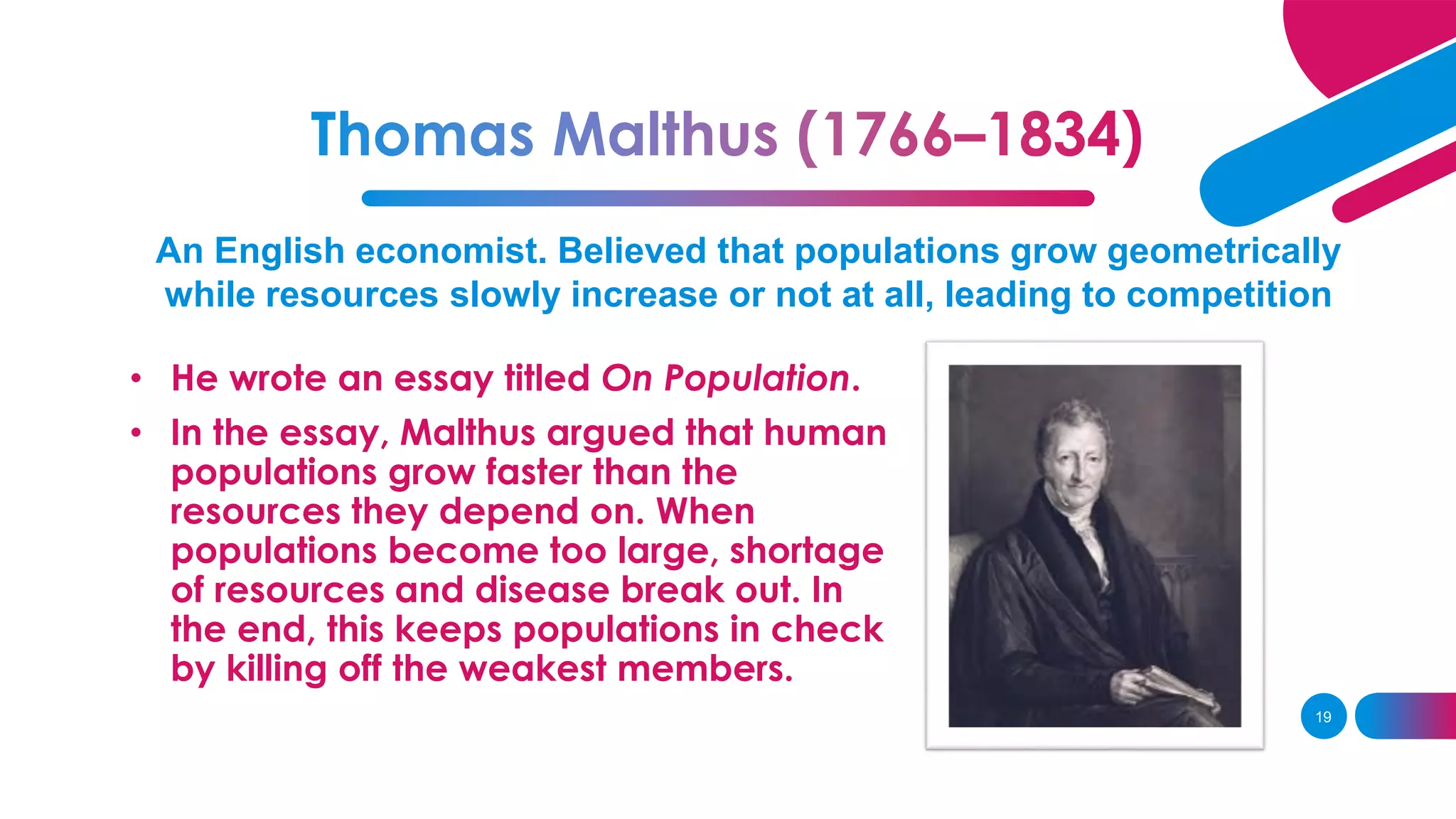
An English economist. Believed that populations grow geometrically
while resources slowly increase or not at all, leading to competition
• He wrote an essay titled On Population.
• In the essay, Malthus argued that human
populations grow faster than the
resources they depend on. When
populations become too large, shortage
of resources and disease break out. In
the end, this keeps populations in check
by killing off the weakest members.
19
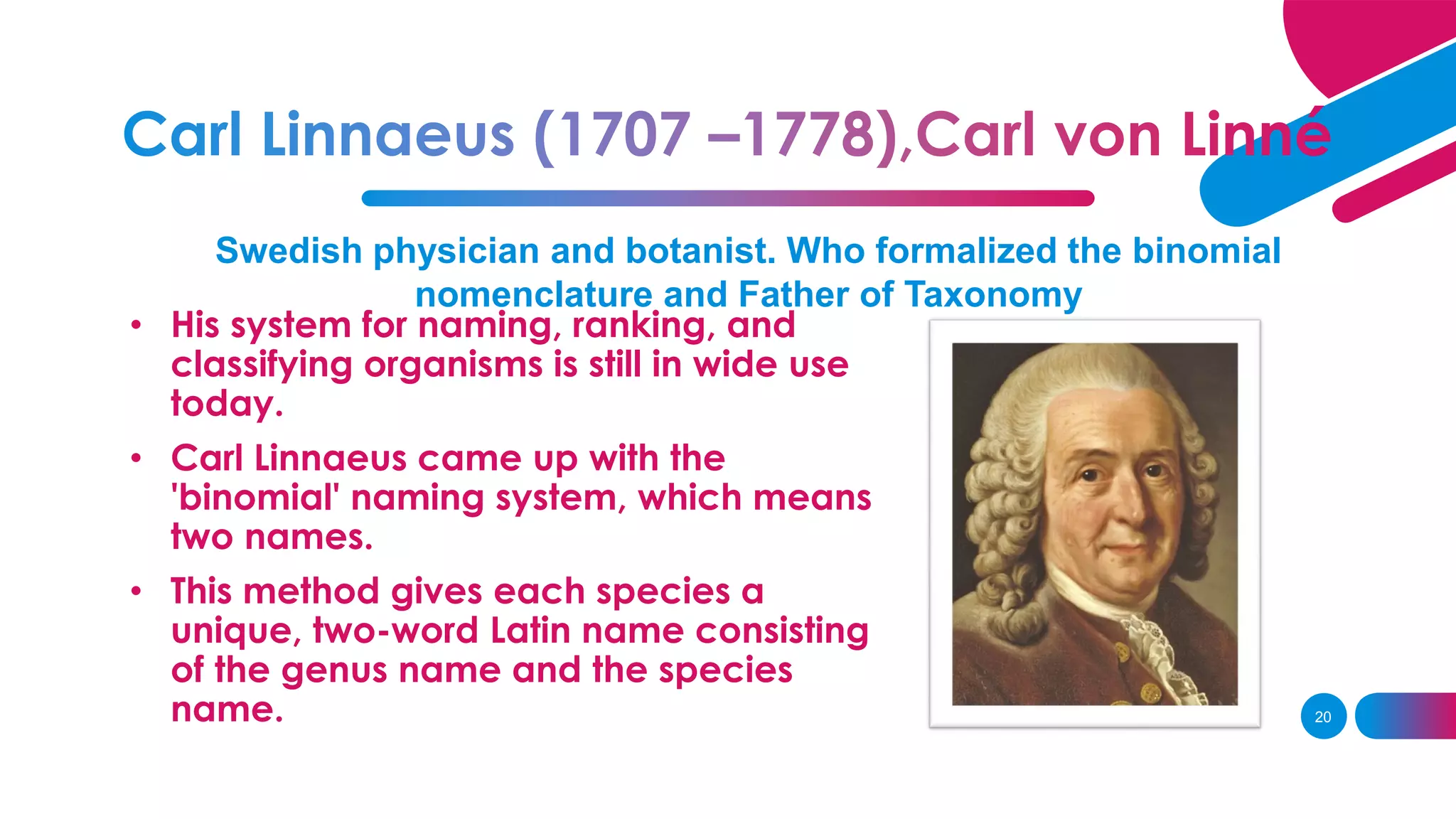
Swedish physician and botanist. Who formalized the binomial
nomenclature and Father of Taxonomy
• His system for naming, ranking, and
classifying organisms is still in wide use
today.
• Carl Linnaeus came up with the
'binomial' naming system, which means
two names.
• This method gives each species a
unique, two-word Latin name consisting
of the genus name and the species
name. 20
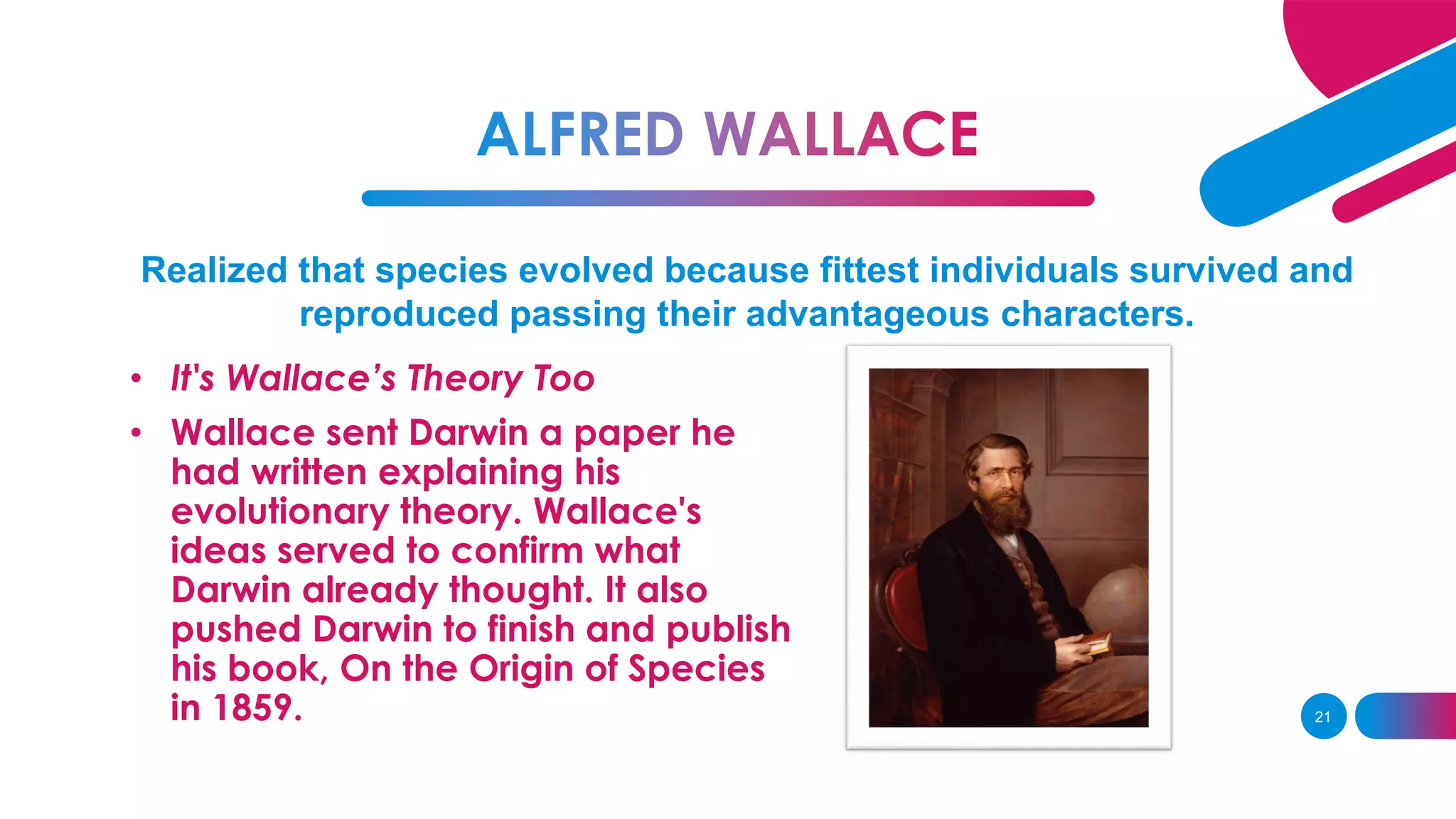
Realized that species evolved because fittest individuals survived and
reproduced passing their advantageous characters.
• It's Wallace’s Theory Too
• Wallace sent Darwin a paper he
had written explaining his
evolutionary theory. Wallace's
ideas served to confirm what
Darwin already thought. It also
pushed Darwin to finish and publish
his book, On the Origin of Species
in 1859. 21
22
SCIENTISTS WHO CONTRIBUTE TO THE HISTORICAL DEVELOPMENT
OF EVOLUTIONARY THOUGHTS
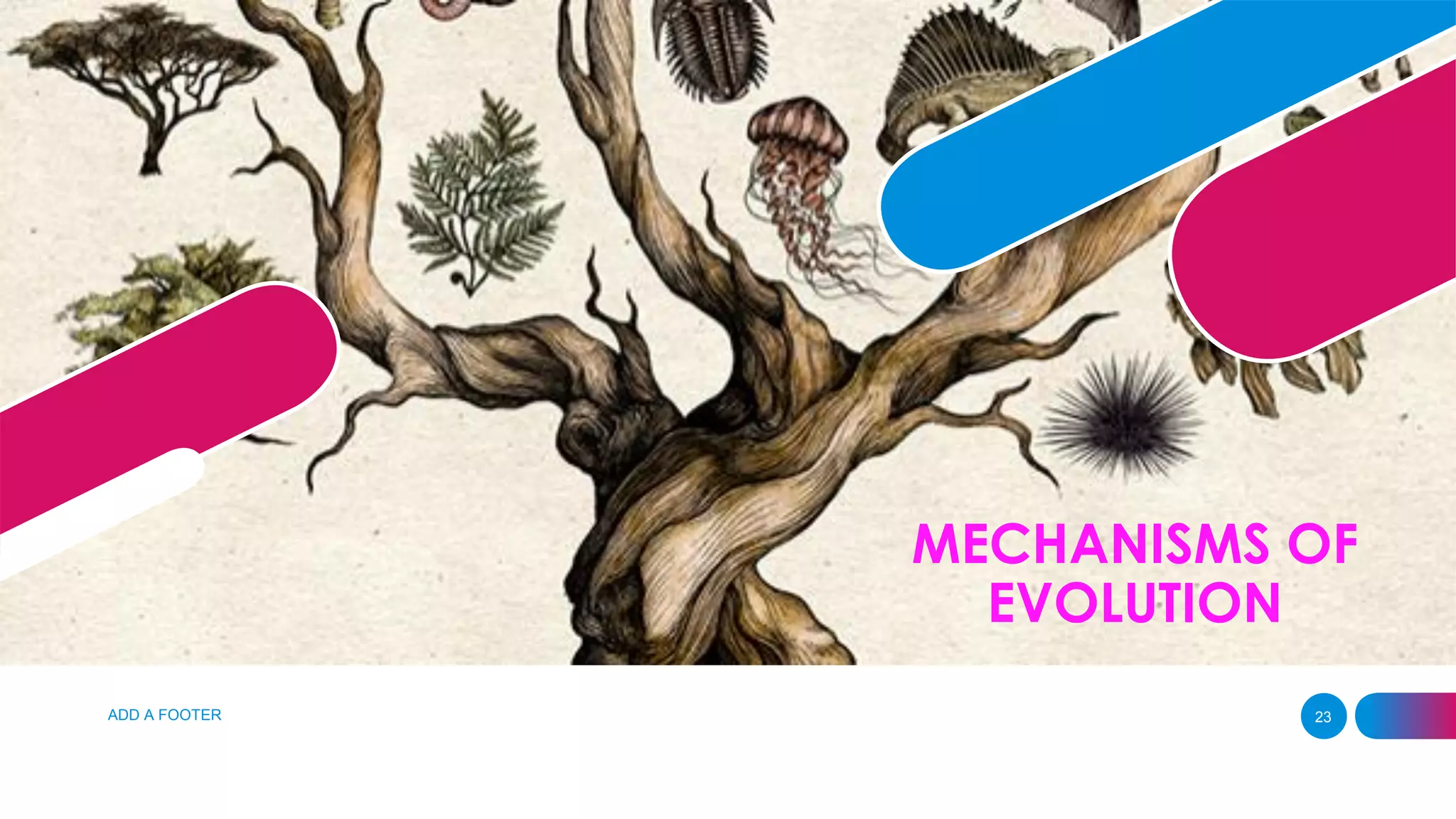
MECHANISMS OF
EVOLUTION
ADD A FOOTER 23
ADD A FOOTER 24
ADD A FOOTER 25
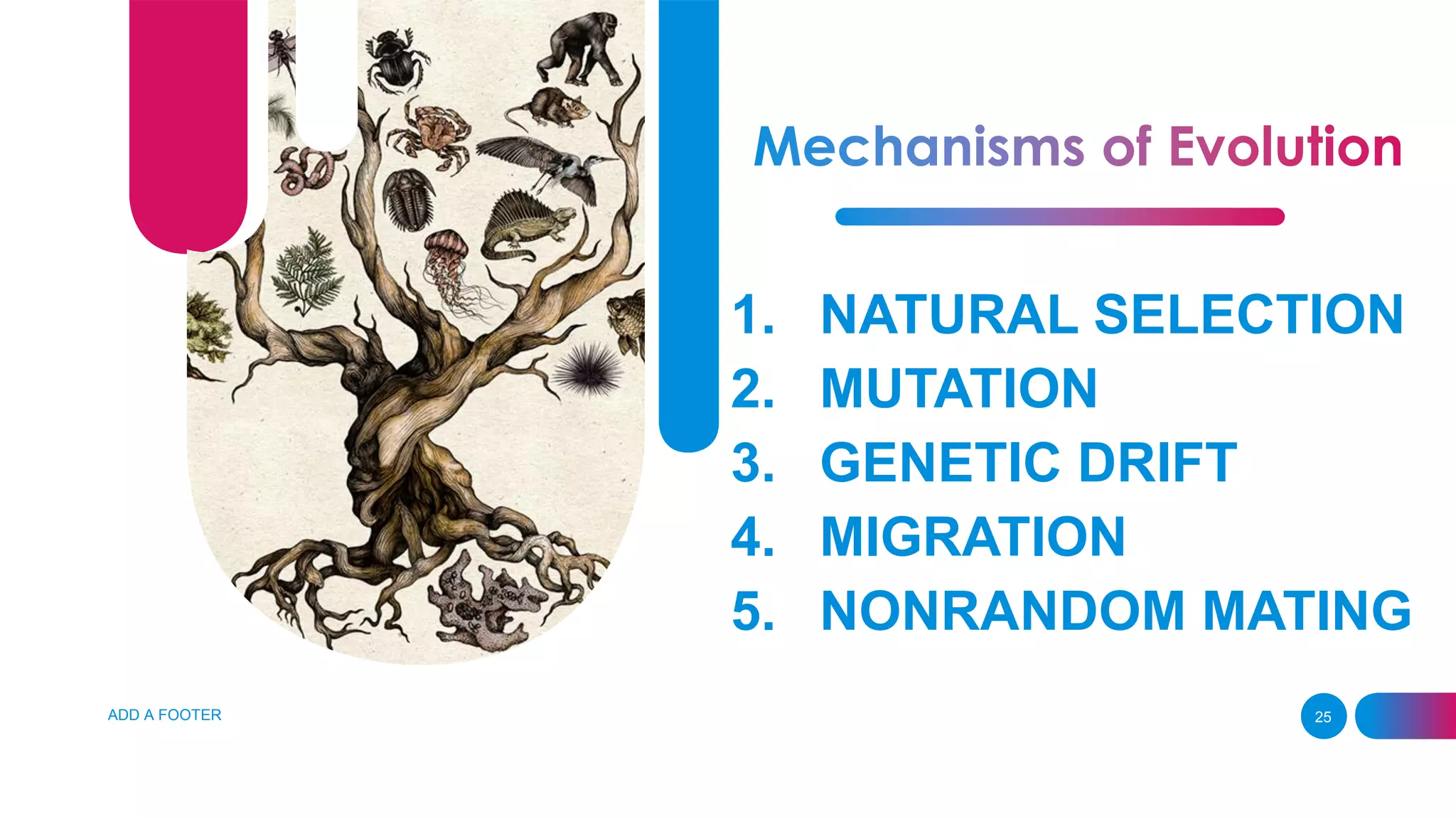
1. NATURAL SELECTION
2. MUTATION
3. GENETIC DRIFT
4. MIGRATION
5. NONRANDOM MATING
ADD A FOOTER 26
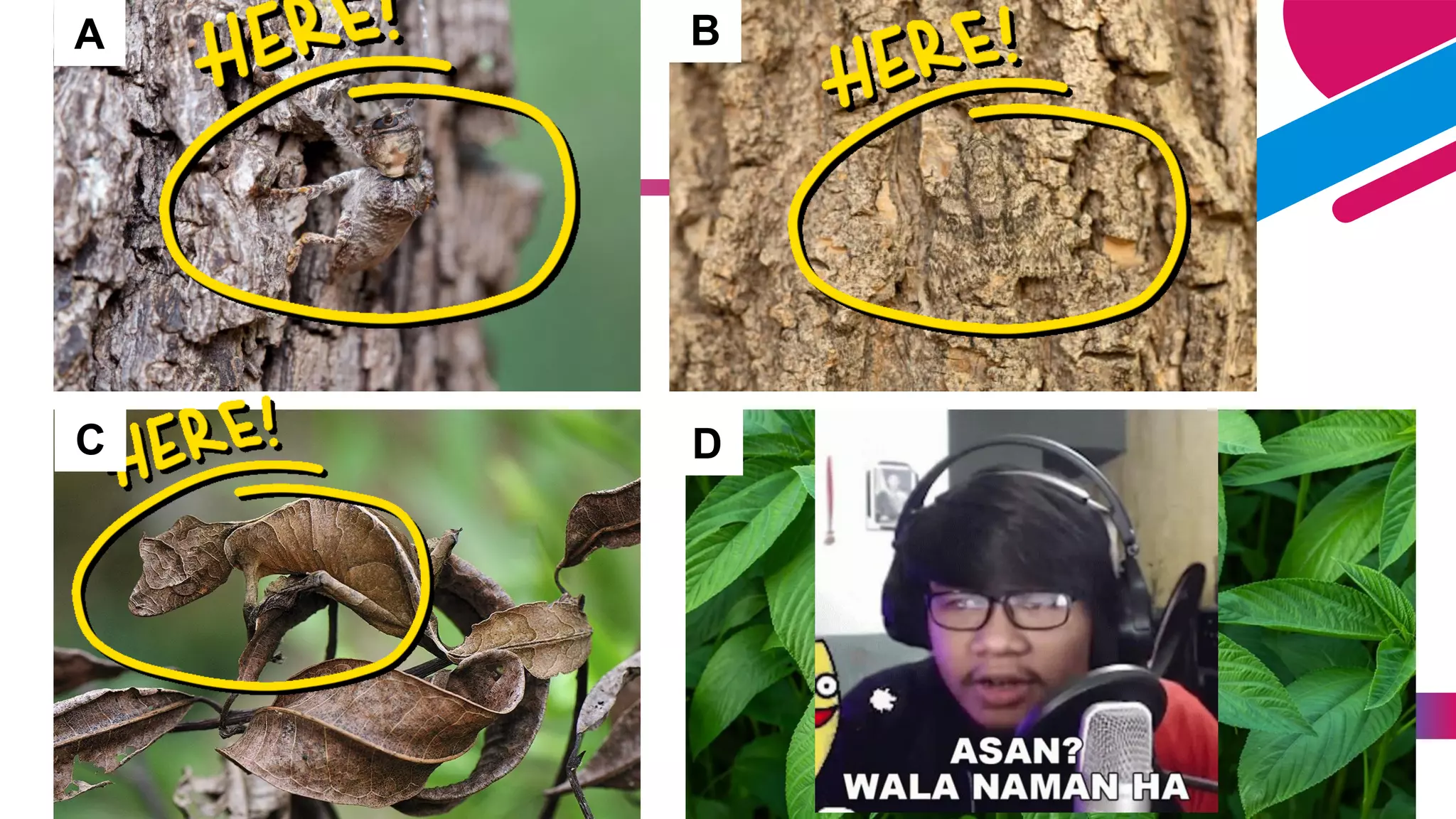
A B
C D
27
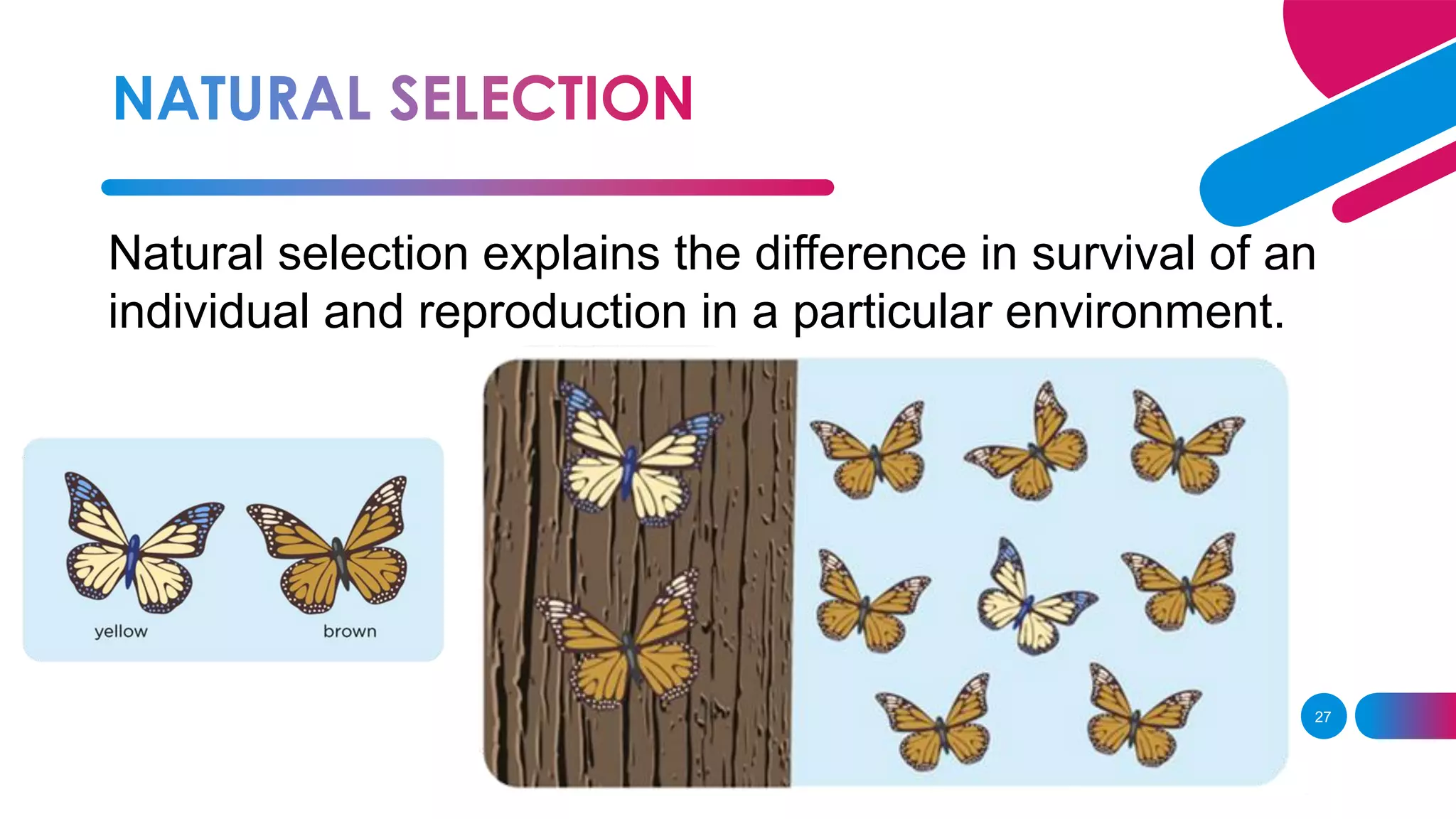
Natural selection explains the difference in survival of an
individual and reproduction in a particular environment.
28
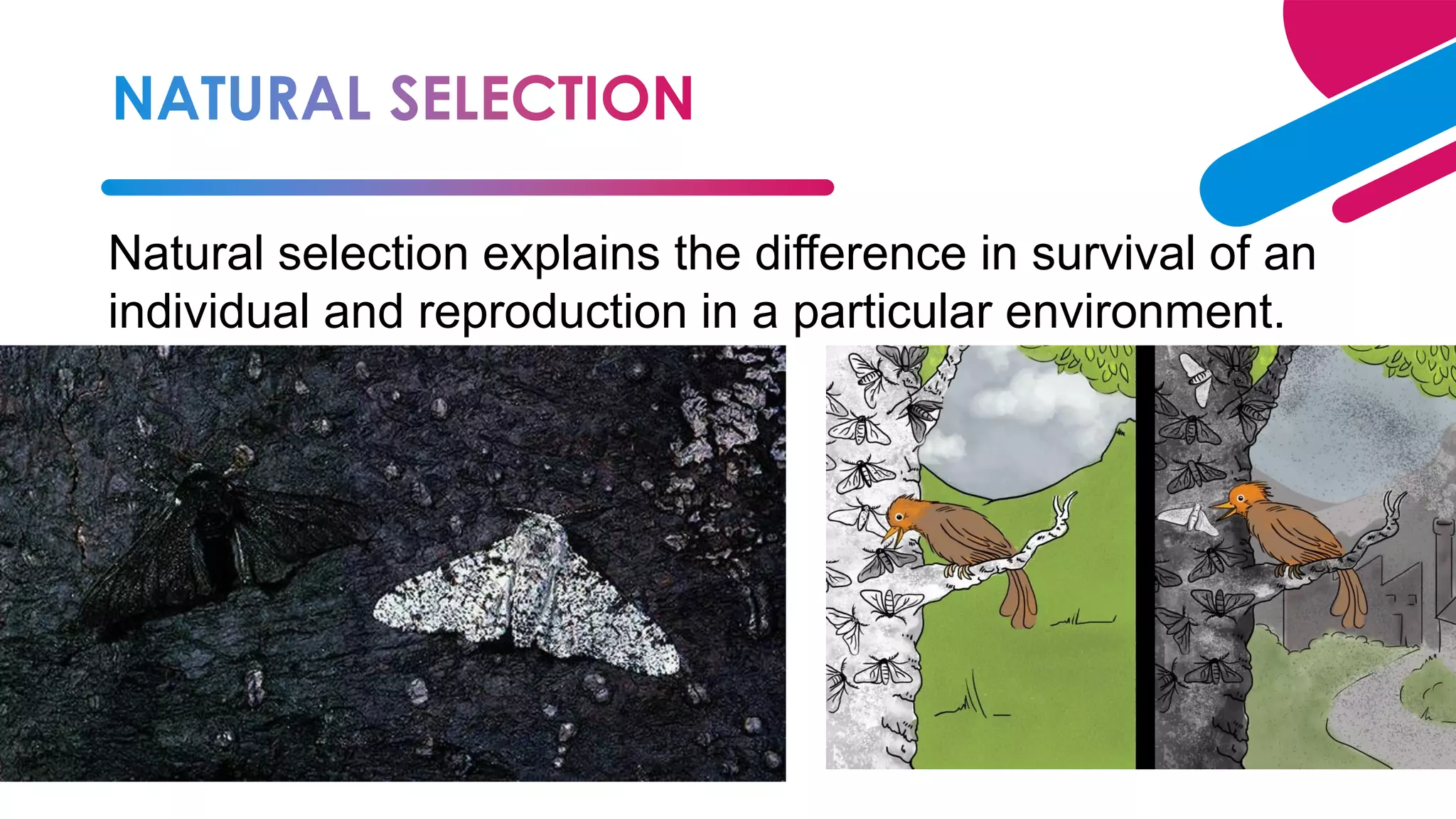
Natural selection explains the difference in survival of an
individual and reproduction in a particular environment.
29
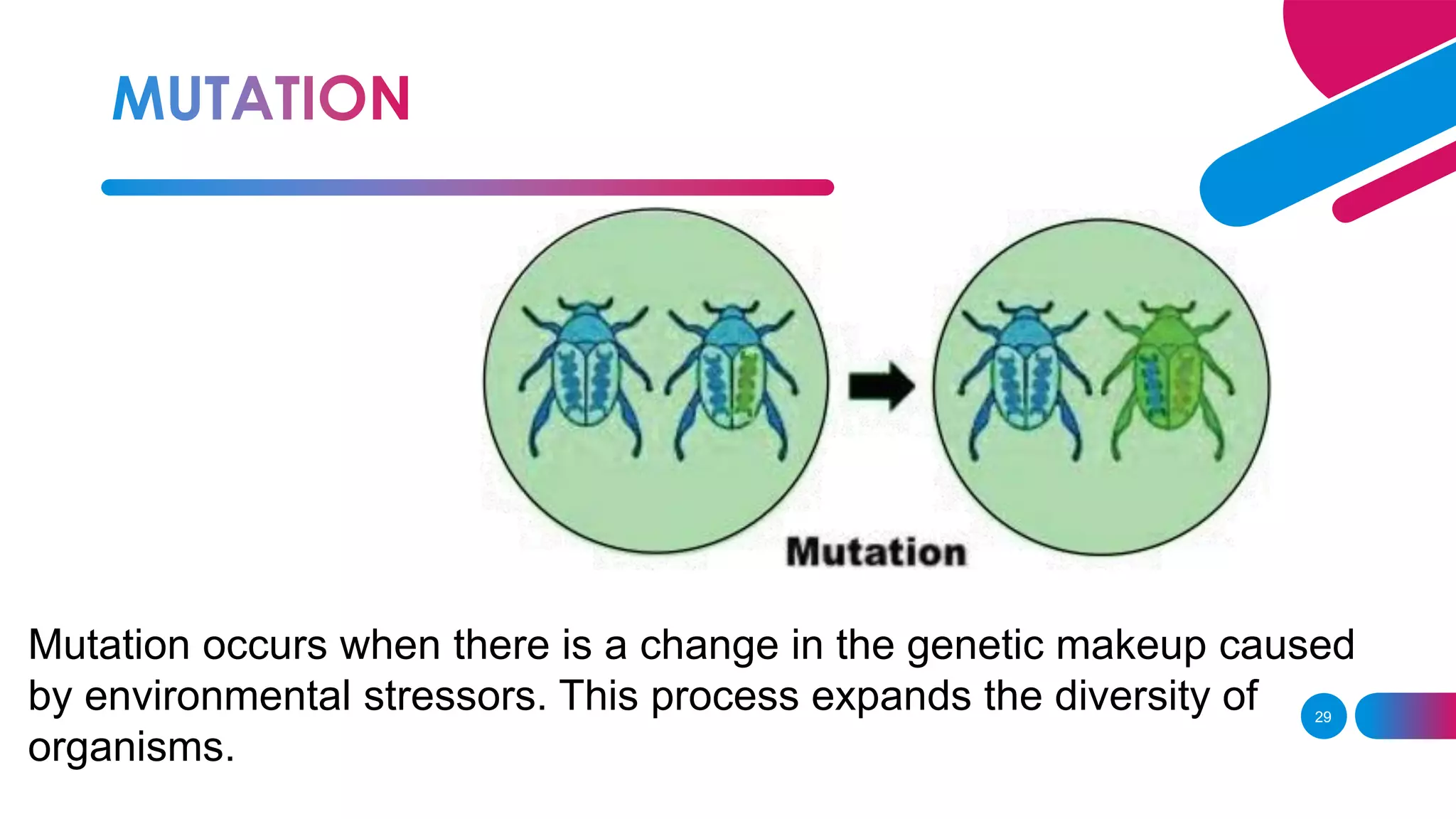
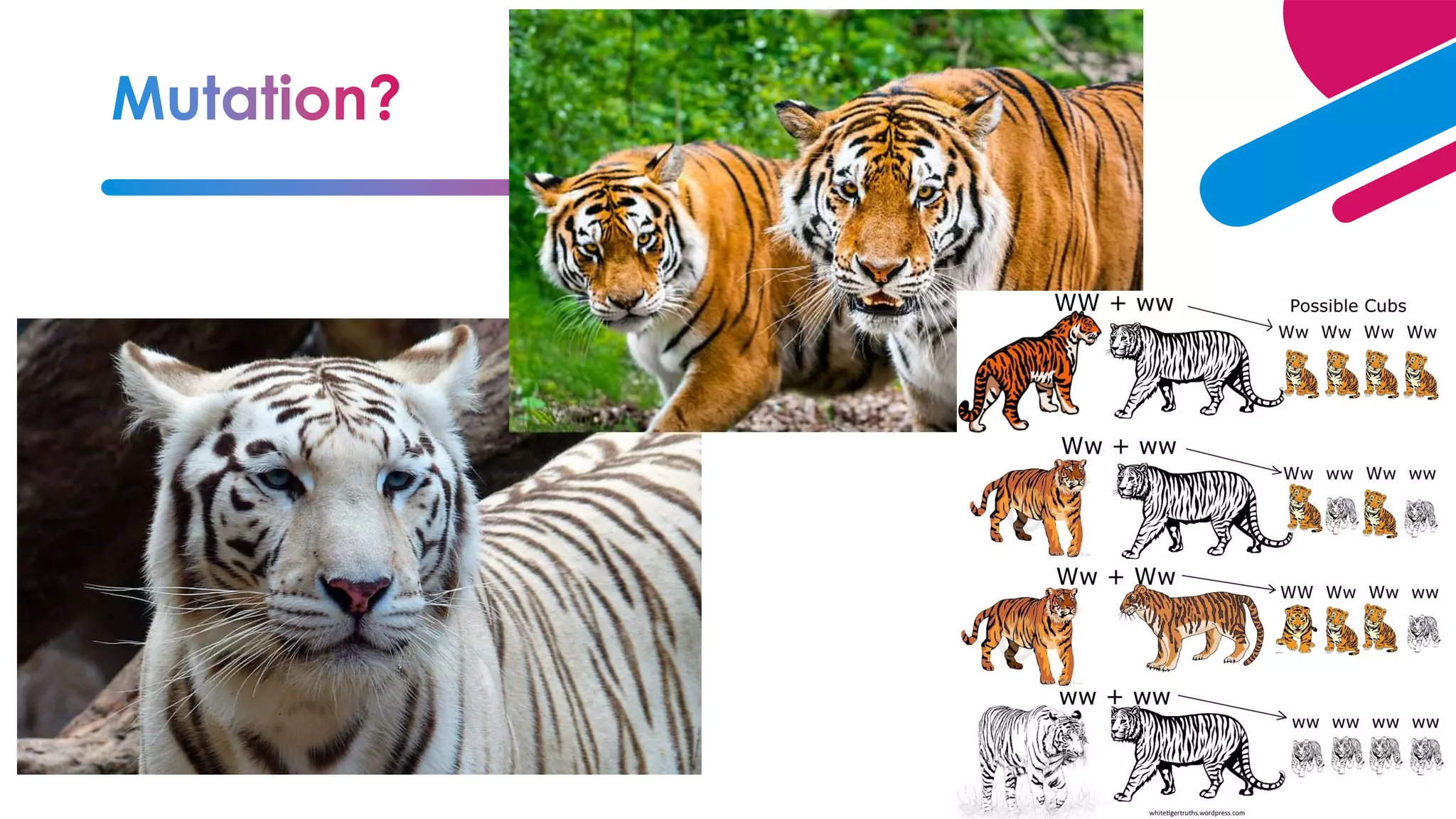
Mutation occurs when there is a change in the genetic makeup caused
by environmental stressors. This process expands the diversity of
organisms.
ADD A FOOTER 30
ADD A FOOTER 31
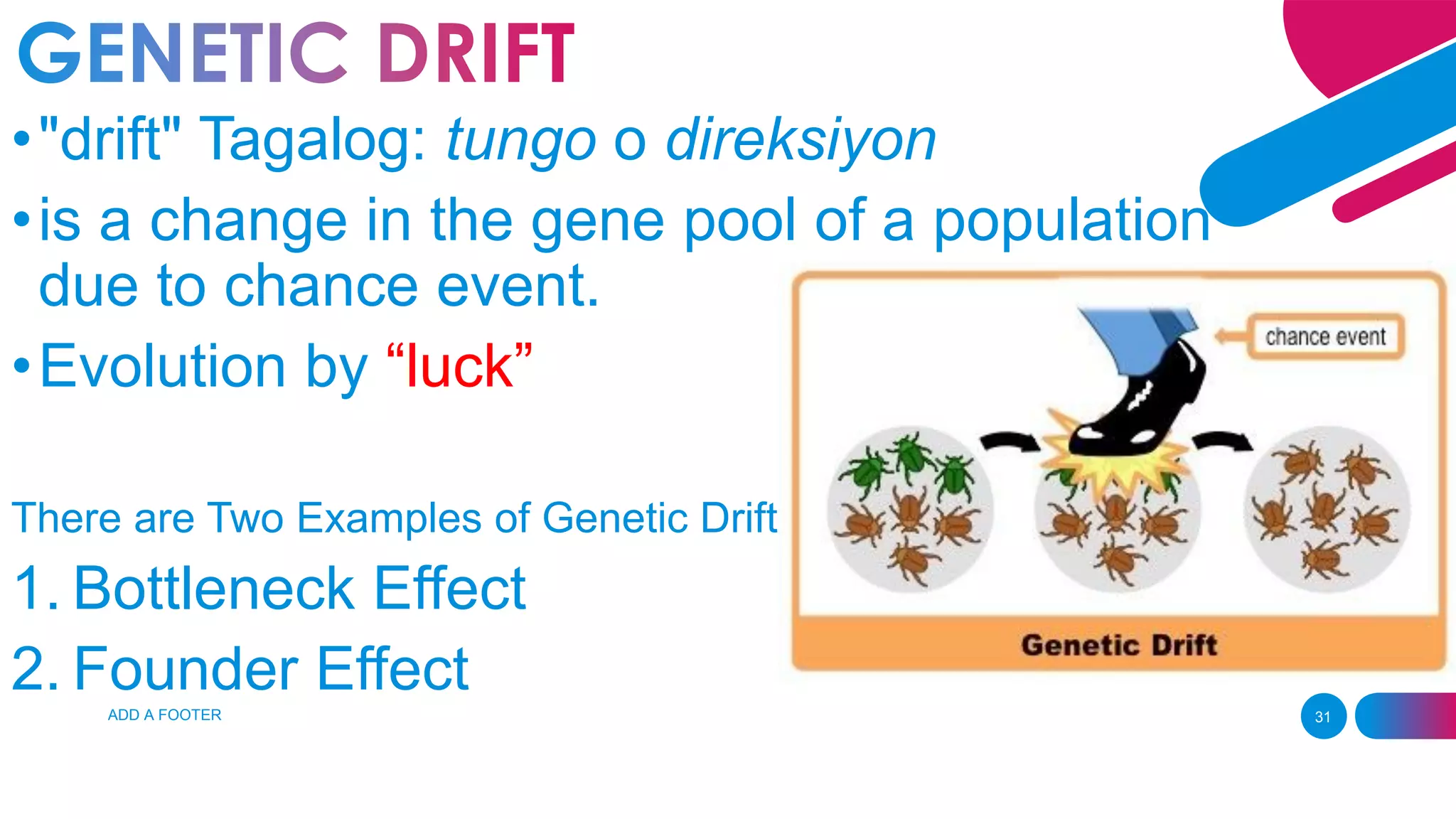
•"drift" Tagalog: tungo o direksiyon
•is a change in the gene pool of a population
due to chance event.
•Evolution by “luck”
There are Two Examples of Genetic Drift
1. Bottleneck Effect
2. Founder Effect
ADD A FOOTER 32
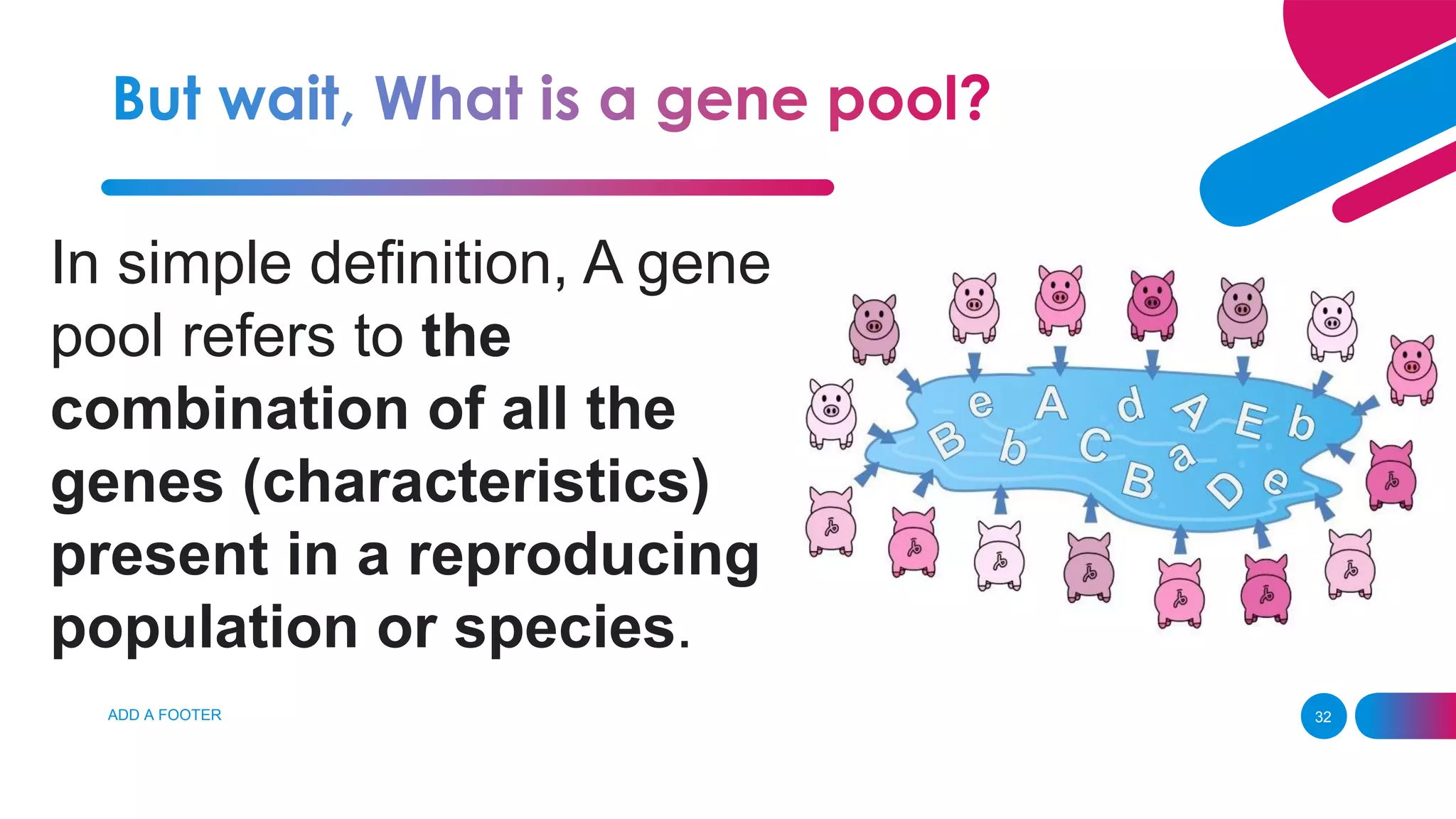
In simple definition, A gene
pool refers to the
combination of all the
genes (characteristics)
present in a reproducing
population or species.
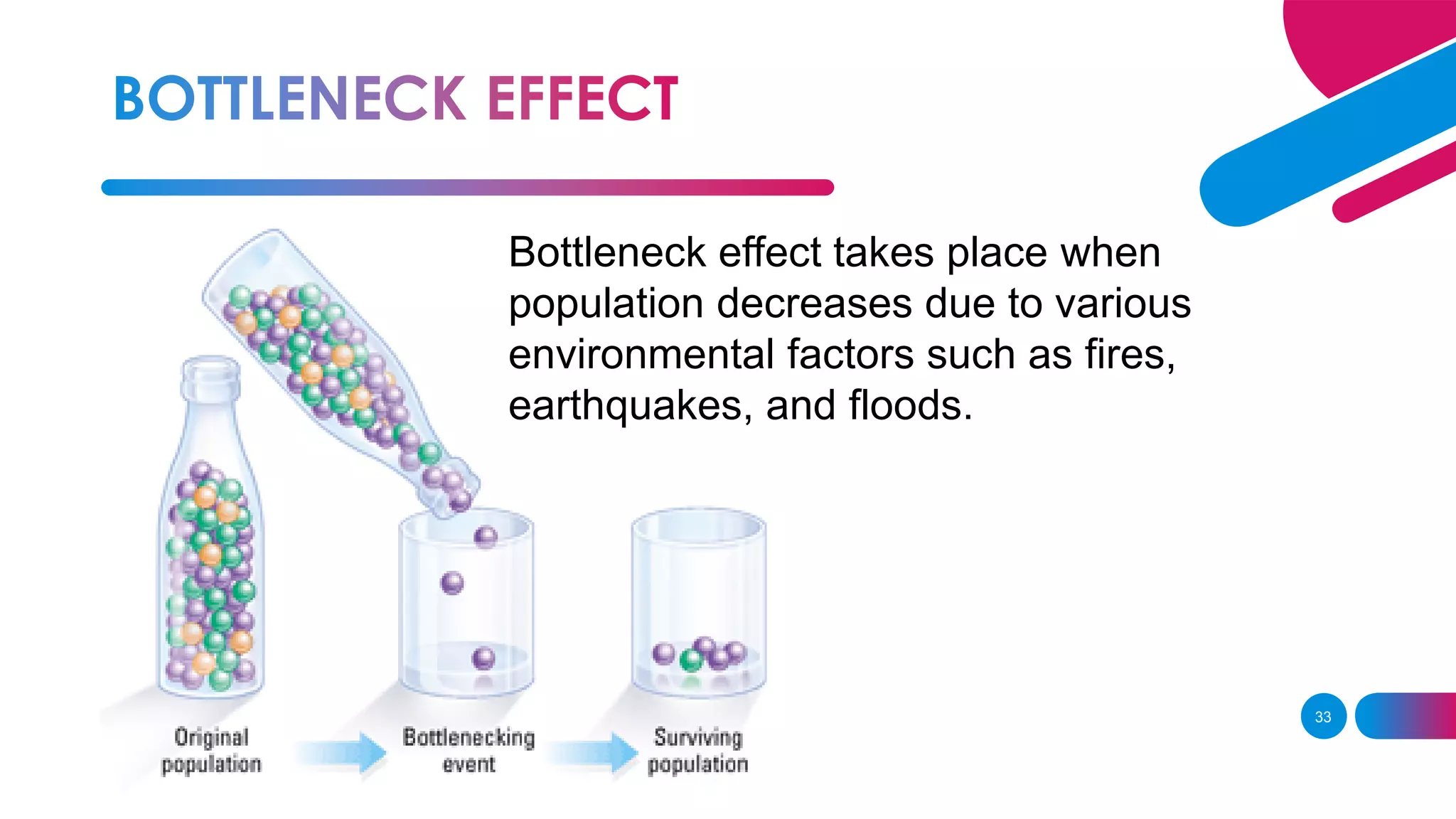
33
Bottleneck effect takes place when
population decreases due to various
environmental factors such as fires,
earthquakes, and floods.
34
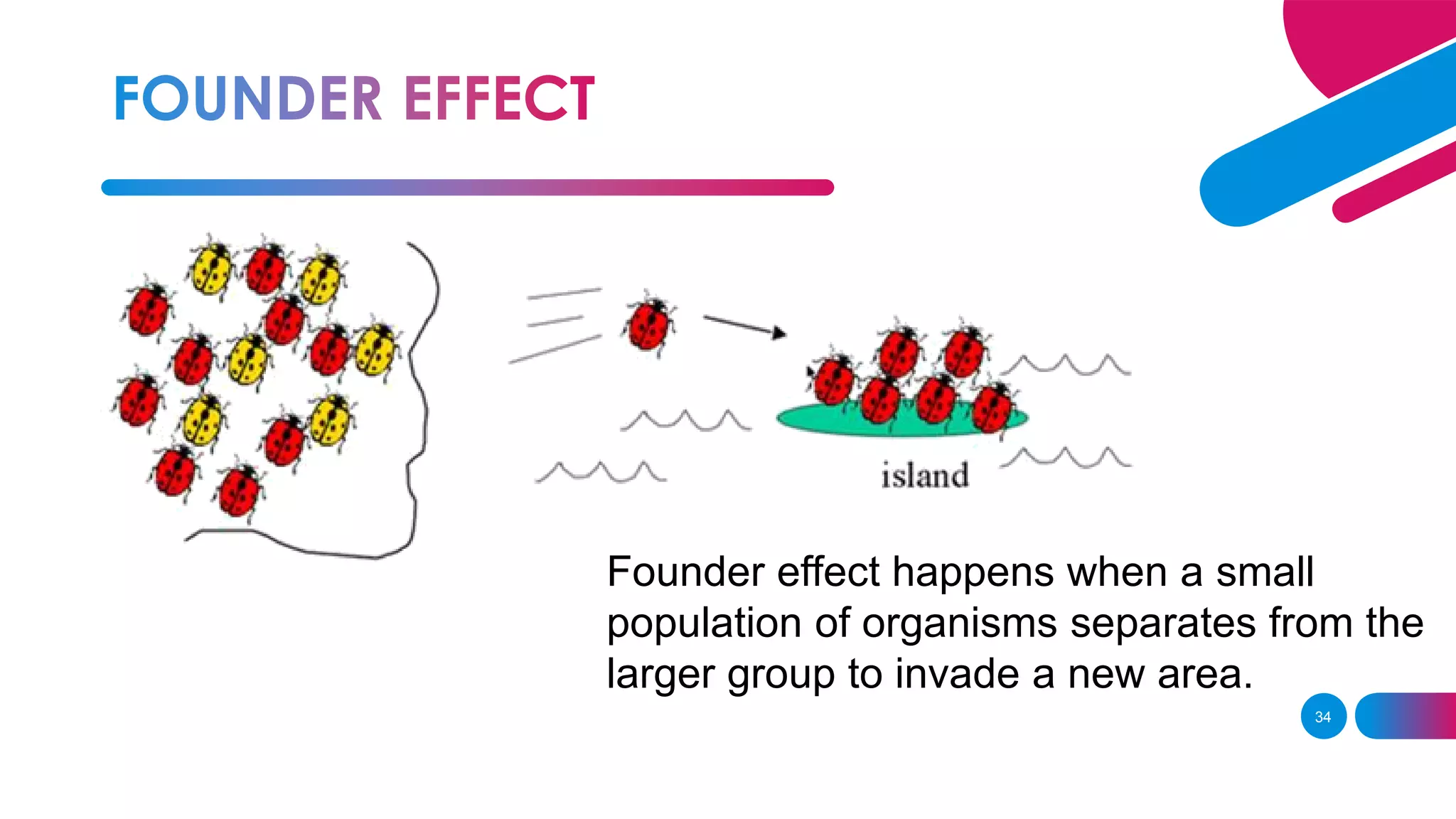
Founder effect happens when a small
population of organisms separates from the
larger group to invade a new area.
35
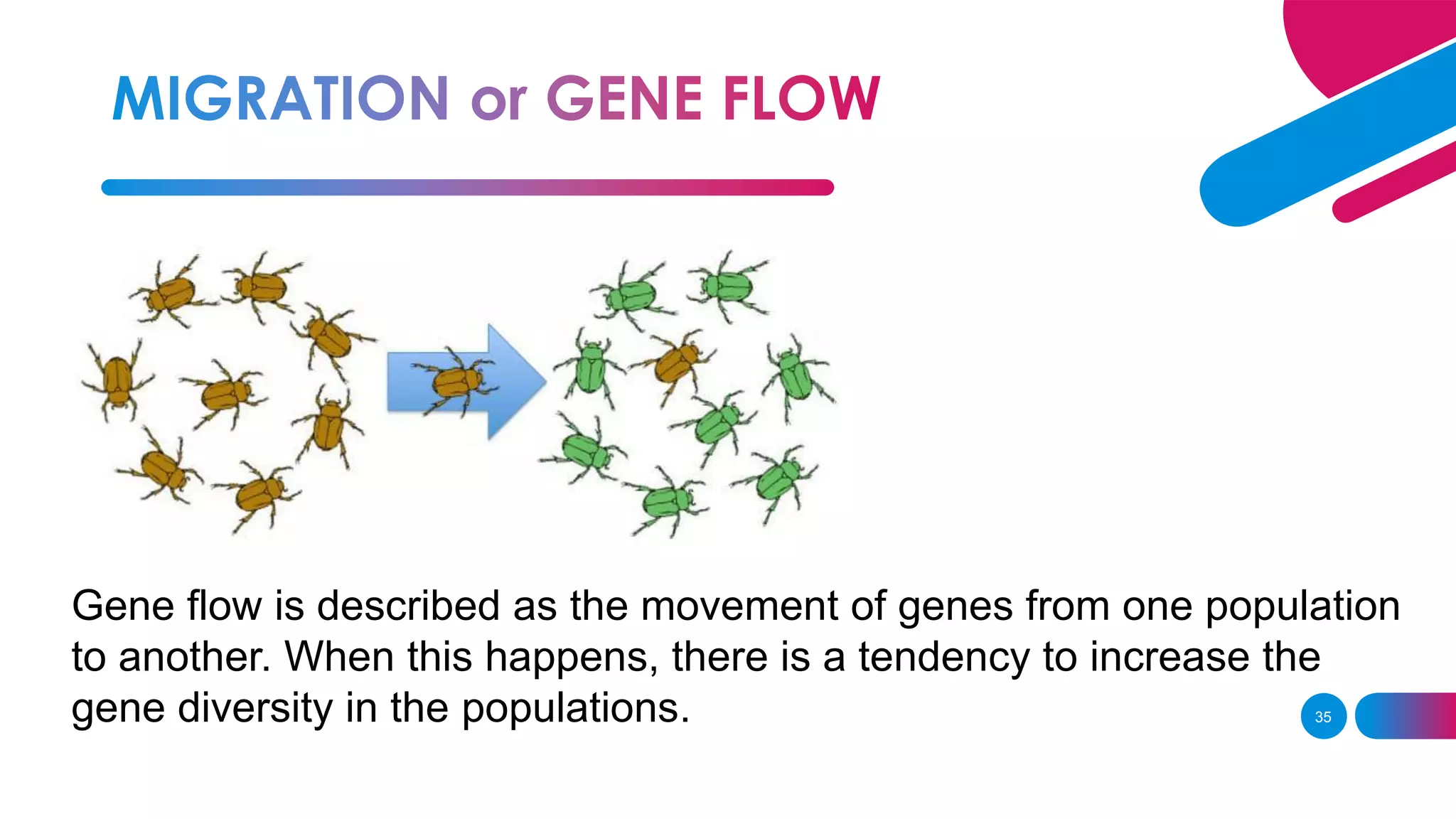
Gene flow is described as the movement of genes from one population
to another. When this happens, there is a tendency to increase the
gene diversity in the populations.
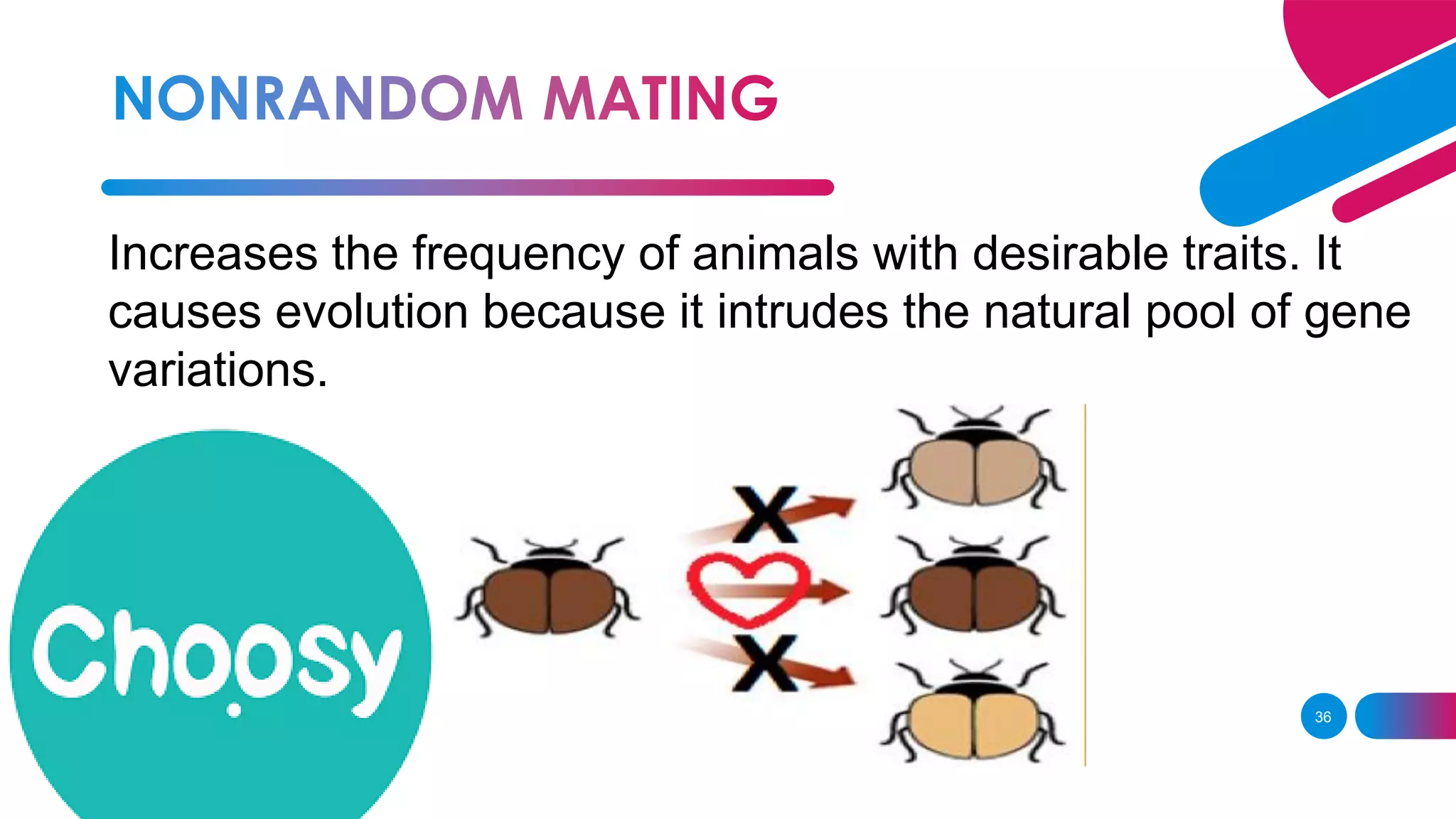
36
Increases the frequency of animals with desirable traits. It
causes evolution because it intrudes the natural pool of gene
variations.
37
38
39
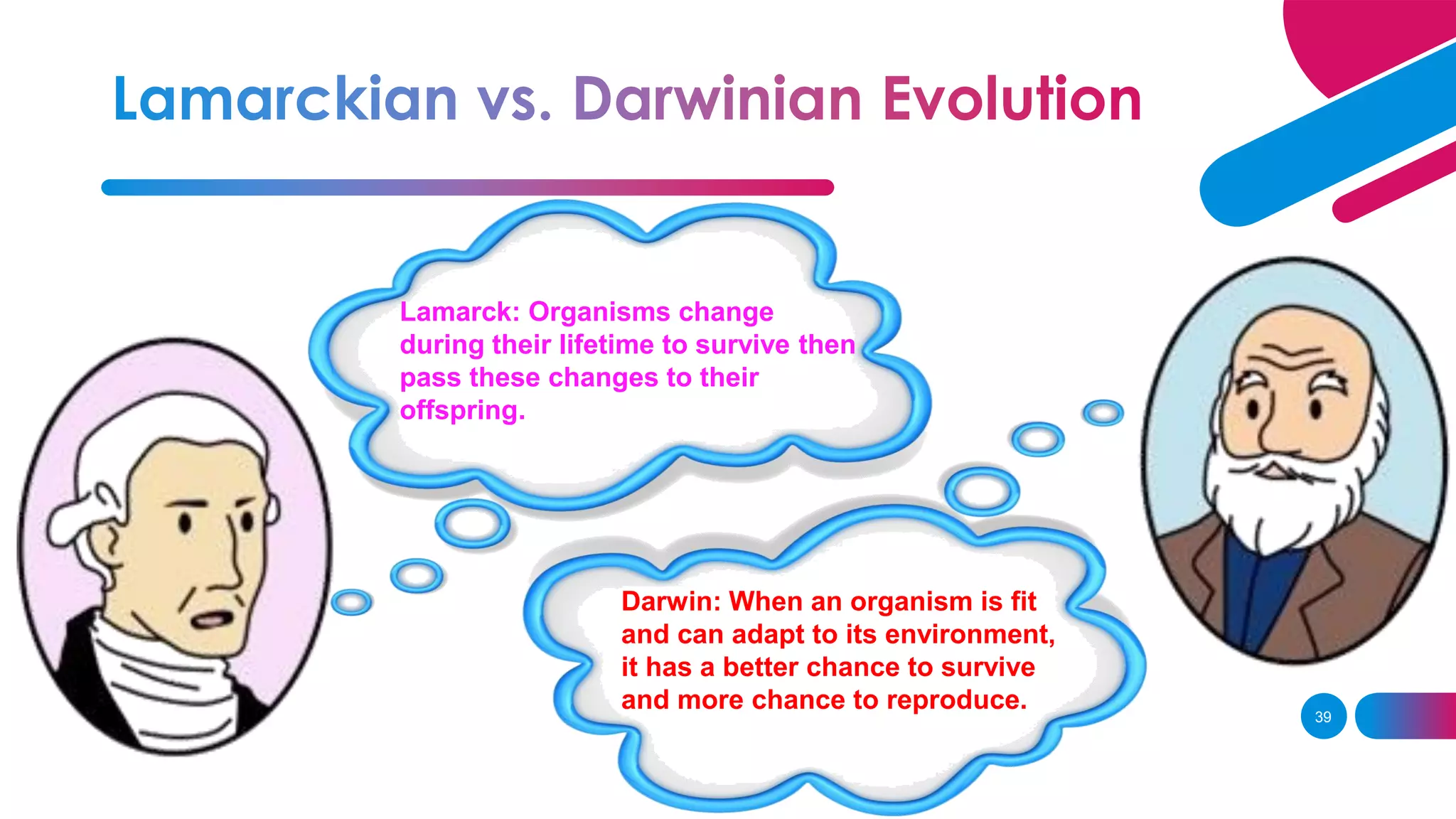
Lamarck: Organisms change
during their lifetime to survive then
pass these changes to their
offspring.
Darwin: When an organism is fit
and can adapt to its environment,
it has a better chance to survive
and more chance to reproduce.
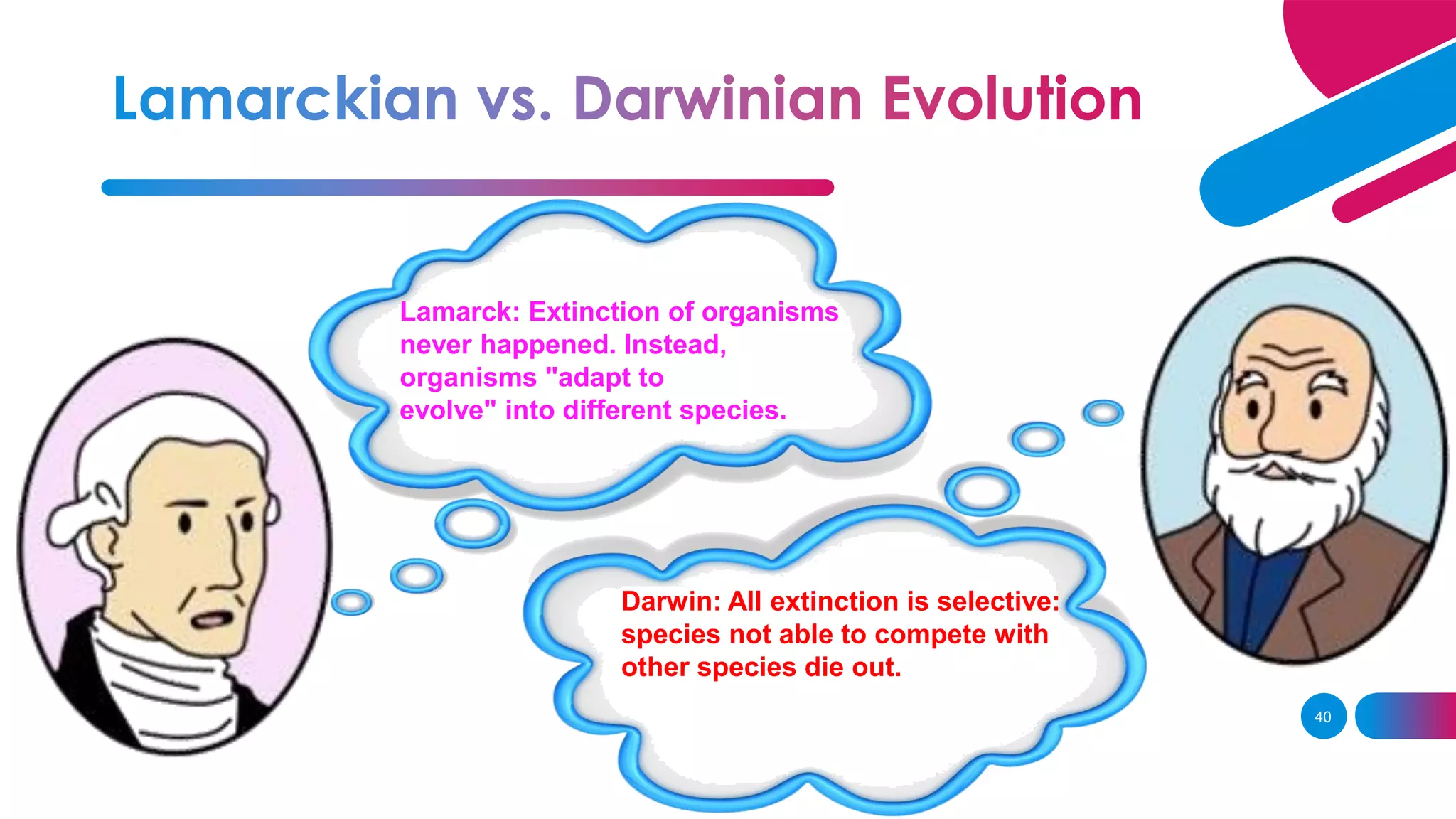
40
Lamarck: Extinction of organisms
never happened. Instead,
organisms "adapt to
evolve" into different species.
Darwin: All extinction is selective:
species not able to compete with
other species die out.
41
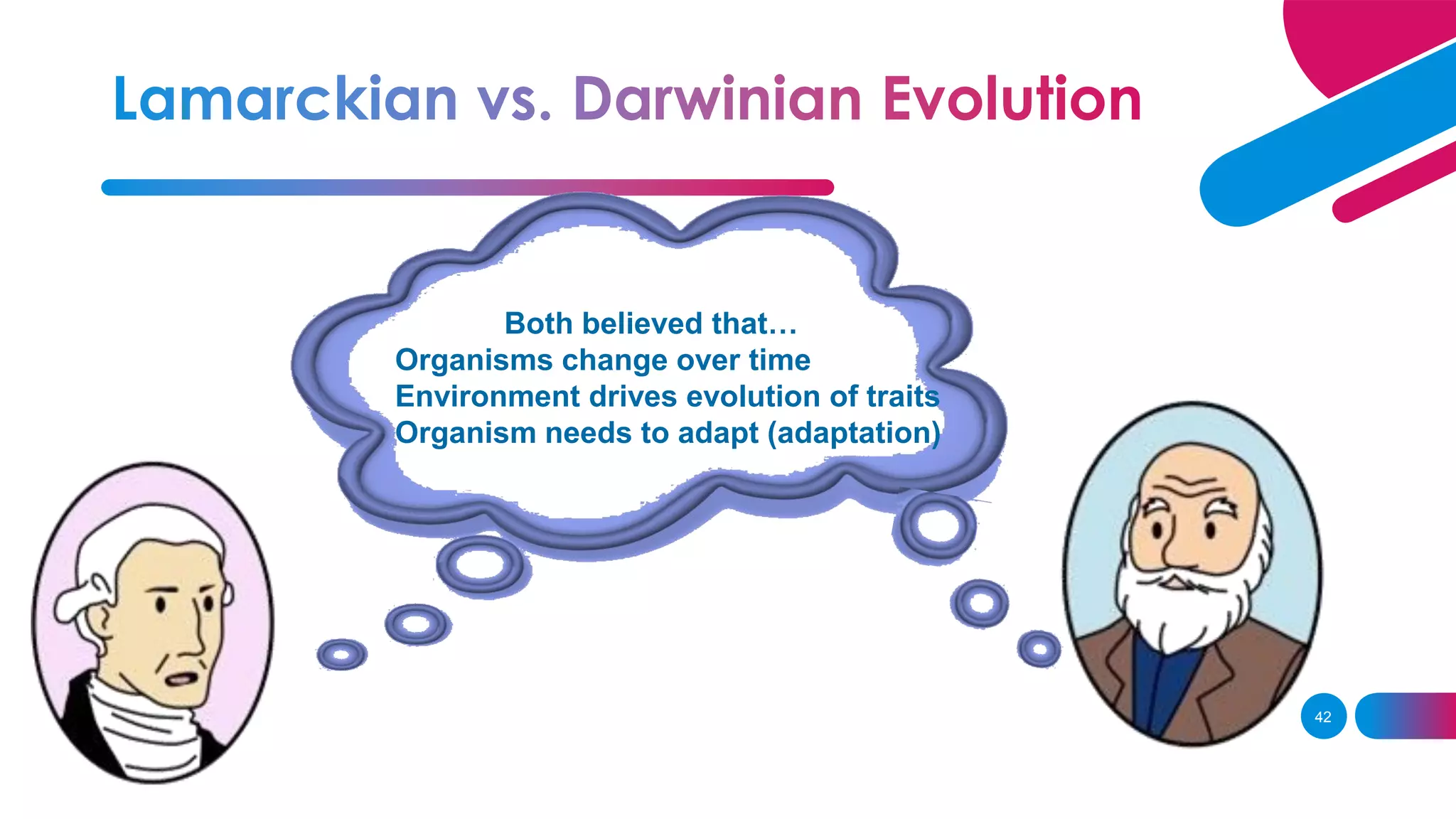
42
Both believed that…
Organisms change over time
Environment drives evolution of traits
Organism needs to adapt (adaptation)
Prepared by:
JOHN RUIZ A. DE LEON
EARTH AND LIFE SCIENCE TEACHER
• (2023). Retrieved 2 January 2023, from https://www.youtube.com/watch?v=1ShhxSQGJXI&t=1984s
• 9.2: Darwin, Wallace, and the Theory of Evolution by Natural Selection. (2019). Retrieved 2 January 2023, from
https://bio.libretexts.org/Courses/Butte_College/BC%3A_BIOL_2_-
_Introduction_to_Human_Biology_(Grewal)/Text/09%3A_Biological_Evolution/9.2%3A_Darwin%2C_Wallace%2C
_and_the_Theory_of_Evolution_by_Natural_Selection
• What Lamarck Believed — New England Complex Systems Institute. (2023). Retrieved 2 January 2023, from
https://necsi.edu/what-lamarck-
believed#:~:text=Lamarck%20is%20best%20known%20for,passed%20on%20to%20its%20offspring.
• What is the theory of acquired character?. (2023). Retrieved 2 January 2023, from https://byjus.com/question-
answer/what-is-the-theory-of-acquired-character/
• Natural Selection - Evolution - MCAT Content. (2020). Retrieved 2 January 2023, from
https://jackwestin.com/resources/mcat-content/evolution/natural-selection
• Theories of Evolution | BioNinja. (2023). Retrieved 2 January 2023, from https://ib.bioninja.com.au/standard-
level/topic-5-evolution-and-biodi/52-natural-selection/theories-of-evolution.html
44
ADD A FOOTER 45
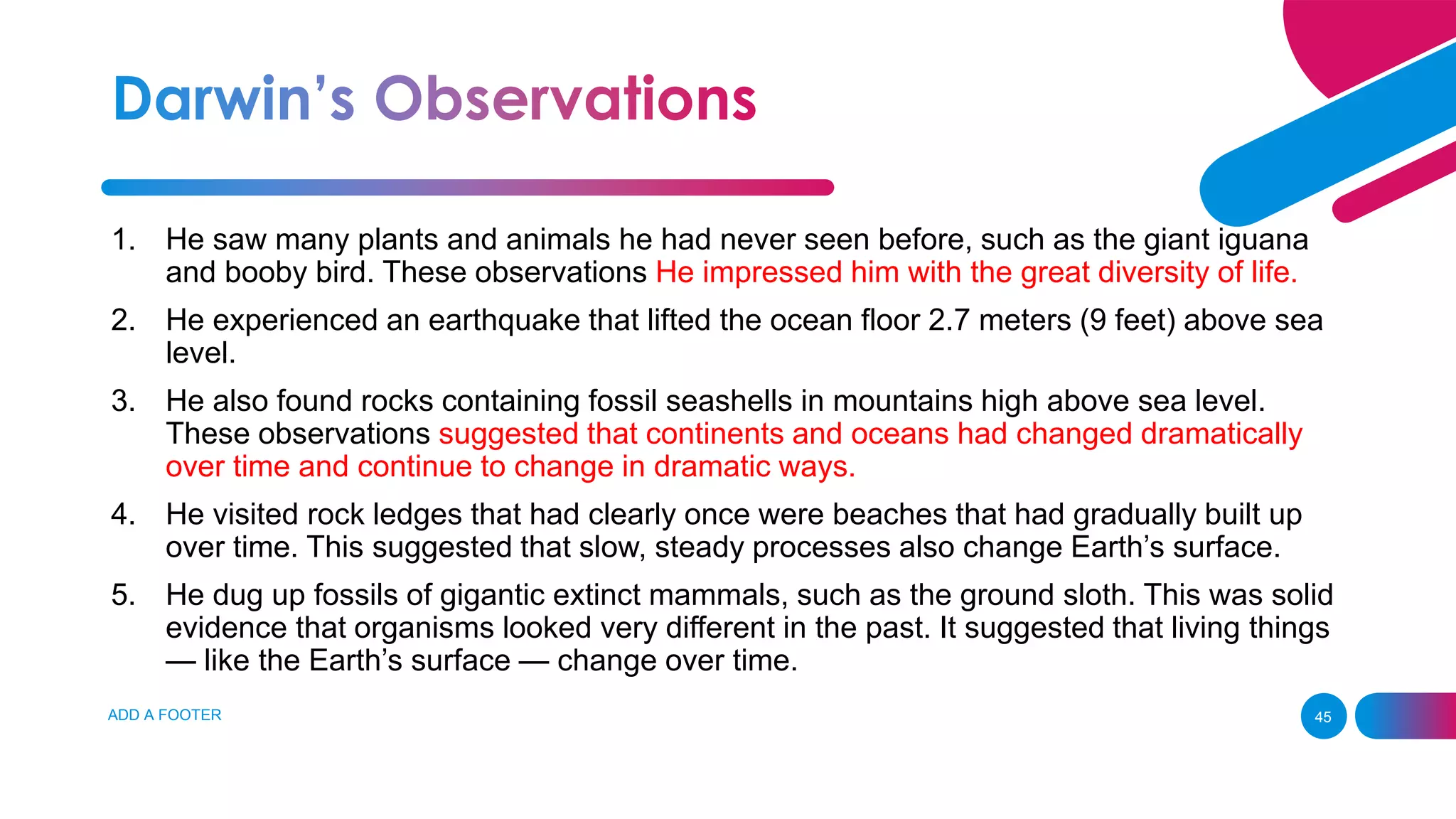
1. He saw many plants and animals he had never seen before, such as the giant iguana
and booby bird. These observations He impressed him with the great diversity of life.
2. He experienced an earthquake that lifted the ocean floor 2.7 meters (9 feet) above sea
level.
3. He also found rocks containing fossil seashells in mountains high above sea level.
These observations suggested that continents and oceans had changed dramatically
over time and continue to change in dramatic ways.
4. He visited rock ledges that had clearly once were beaches that had gradually built up
over time. This suggested that slow, steady processes also change Earth’s surface.
5. He dug up fossils of gigantic extinct mammals, such as the ground sloth. This was solid
evidence that organisms looked very different in the past. It suggested that living things
— like the Earth’s surface — change over time.

PROCESS-OF-EVOLUTION_01242023.pdf

  • 1.
    Earth & LifeScience Grade 11
  • 2.
    2 1. Explain theprocess of evolution. 2. Identify some scientists who contributed to the historical developments of evolutionary thoughts; 3. Explain how populations of organisms have changed and continue to change over time showing patterns of descent with modification from common ancestors to produce the organismal diversity observed today; and 4. Compare Lamarckian and Darwinian Evolution.
  • 3.
    Note: Populations aregroups of organisms of the same species living in the same area at the same time. 3 The way that living things or a population change over time.
  • 4.
    ADD A FOOTER4 Naturalist and Father of Evolution. Formulated the theory of evolution by natural selection in his book “On the Origin of Species” in 1859.
  • 5.
    5 • Darwin’s theoryactually contains two major ideas: 1.Evolution happens. Organisms change over time. Life on Earth has changed as descendants (offspring) differed from common ancestors in the past. 2.Natural selection drives evolution. Natural selection is the process through which advantageous qualities in living organisms create more offspring than others. This causes changes in the characteristics of living things over time.
  • 6.
    6 In Darwin’s era,most people believed that all species were created at the same time and remained unchanged thereafter. They also believed that Earth was only 6,000 years old.
  • 7.
  • 8.
    ADD A FOOTER8 The basis for the modern theory of evolution was laid during 1700s and 1800s. In 1831, Charles Darwin sets sail on the H.M.S. Beagle, a voyage that would provide him with vast amounts of evidence that led to his theory of evolution. It all started when he went on a voyage...
  • 9.
    9 He impressed him withthe great diversity of plants and animals An Earthquake Rocks containing fossil seashells in mountains Fossils of gigantic extinct mammals, such as the ground sloth
  • 10.
    ADD A FOOTER10 • The Galápagos Islands are a group of 16 small volcanic islands that are 966 kilometers (600 miles) off the west coast of South America. Individual Galápagos islands differ from one another in important ways.
  • 11.
    The Galapagos Island •The smallest, lowest islands were hot, dry, and nearly barren-Hood Island-sparse vegetation • The higher islands had greater rainfall and a different assortment of plants and animals-Isabela- Island had rich vegetation.
  • 12.
  • 13.
    13 Darwin didn’t develop histheory completely on his own. He was influenced by the ideas of earlier thinkers.
  • 14.
    14 SCIENTISTS WHO CONTRIBUTETO THE HISTORICAL DEVELOPMENT OF EVOLUTIONARY THOUGHTS
  • 15.
    French naturalist • Hepublished his hypothesis of evolution in 1809, the year Darwin was born. • He proposed two theories that were widely accepted at the time and eventually 1. Theory of Use and Disuse 2. Theory of Inheritance of Acquired Traits 15
  • 16.
    Theory of Useand Disuse • The parts of the body that are used extensively become larger and stronger, while those that are not used deteriorate. • Among many examples, he cited a giraffe stretching its neck to reach leaves on high branches. 16
  • 17.
    Theory of Inheritanceof Acquired Traits • Stated that the modified characteristics of the organism could pass to its offspring. Example: The elongated neck of the giraffe is a classical example to explain the theory of acquired characteristics. The elongated neck of the giraffe which is an acquired trait is then inherited from one generation to another. 17
  • 18.
    was a well-knownEnglish geologist. • Darwin took his book, Principles of Geology, with him on the Beagle. • In the book, Lyell argued that gradual geological processes have slowly shaped Earth’s surface over very long periods of time. From this, Lyell inferred that Earth must be far older than most people believed. 18
  • 19.
    An English economist.Believed that populations grow geometrically while resources slowly increase or not at all, leading to competition • He wrote an essay titled On Population. • In the essay, Malthus argued that human populations grow faster than the resources they depend on. When populations become too large, shortage of resources and disease break out. In the end, this keeps populations in check by killing off the weakest members. 19
  • 20.
    Swedish physician andbotanist. Who formalized the binomial nomenclature and Father of Taxonomy • His system for naming, ranking, and classifying organisms is still in wide use today. • Carl Linnaeus came up with the 'binomial' naming system, which means two names. • This method gives each species a unique, two-word Latin name consisting of the genus name and the species name. 20
  • 21.
    Realized that speciesevolved because fittest individuals survived and reproduced passing their advantageous characters. • It's Wallace’s Theory Too • Wallace sent Darwin a paper he had written explaining his evolutionary theory. Wallace's ideas served to confirm what Darwin already thought. It also pushed Darwin to finish and publish his book, On the Origin of Species in 1859. 21
  • 22.
    22 SCIENTISTS WHO CONTRIBUTETO THE HISTORICAL DEVELOPMENT OF EVOLUTIONARY THOUGHTS
  • 23.
  • 24.
  • 25.
    ADD A FOOTER25 1. NATURAL SELECTION 2. MUTATION 3. GENETIC DRIFT 4. MIGRATION 5. NONRANDOM MATING
  • 26.
    ADD A FOOTER26 A B C D
  • 27.
    27 Natural selection explainsthe difference in survival of an individual and reproduction in a particular environment.
  • 28.
    28 Natural selection explainsthe difference in survival of an individual and reproduction in a particular environment.
  • 29.
    29 Mutation occurs whenthere is a change in the genetic makeup caused by environmental stressors. This process expands the diversity of organisms.
  • 30.
  • 31.
    ADD A FOOTER31 •"drift" Tagalog: tungo o direksiyon •is a change in the gene pool of a population due to chance event. •Evolution by “luck” There are Two Examples of Genetic Drift 1. Bottleneck Effect 2. Founder Effect
  • 32.
    ADD A FOOTER32 In simple definition, A gene pool refers to the combination of all the genes (characteristics) present in a reproducing population or species.
  • 33.
    33 Bottleneck effect takesplace when population decreases due to various environmental factors such as fires, earthquakes, and floods.
  • 34.
    34 Founder effect happenswhen a small population of organisms separates from the larger group to invade a new area.
  • 35.
    35 Gene flow isdescribed as the movement of genes from one population to another. When this happens, there is a tendency to increase the gene diversity in the populations.
  • 36.
    36 Increases the frequencyof animals with desirable traits. It causes evolution because it intrudes the natural pool of gene variations.
  • 37.
  • 38.
  • 39.
    39 Lamarck: Organisms change duringtheir lifetime to survive then pass these changes to their offspring. Darwin: When an organism is fit and can adapt to its environment, it has a better chance to survive and more chance to reproduce.
  • 40.
    40 Lamarck: Extinction oforganisms never happened. Instead, organisms "adapt to evolve" into different species. Darwin: All extinction is selective: species not able to compete with other species die out.
  • 41.
  • 42.
    42 Both believed that… Organismschange over time Environment drives evolution of traits Organism needs to adapt (adaptation)
  • 43.
    Prepared by: JOHN RUIZA. DE LEON EARTH AND LIFE SCIENCE TEACHER
  • 44.
    • (2023). Retrieved2 January 2023, from https://www.youtube.com/watch?v=1ShhxSQGJXI&t=1984s • 9.2: Darwin, Wallace, and the Theory of Evolution by Natural Selection. (2019). Retrieved 2 January 2023, from https://bio.libretexts.org/Courses/Butte_College/BC%3A_BIOL_2_- _Introduction_to_Human_Biology_(Grewal)/Text/09%3A_Biological_Evolution/9.2%3A_Darwin%2C_Wallace%2C _and_the_Theory_of_Evolution_by_Natural_Selection • What Lamarck Believed — New England Complex Systems Institute. (2023). Retrieved 2 January 2023, from https://necsi.edu/what-lamarck- believed#:~:text=Lamarck%20is%20best%20known%20for,passed%20on%20to%20its%20offspring. • What is the theory of acquired character?. (2023). Retrieved 2 January 2023, from https://byjus.com/question- answer/what-is-the-theory-of-acquired-character/ • Natural Selection - Evolution - MCAT Content. (2020). Retrieved 2 January 2023, from https://jackwestin.com/resources/mcat-content/evolution/natural-selection • Theories of Evolution | BioNinja. (2023). Retrieved 2 January 2023, from https://ib.bioninja.com.au/standard- level/topic-5-evolution-and-biodi/52-natural-selection/theories-of-evolution.html 44
  • 45.
    ADD A FOOTER45 1. He saw many plants and animals he had never seen before, such as the giant iguana and booby bird. These observations He impressed him with the great diversity of life. 2. He experienced an earthquake that lifted the ocean floor 2.7 meters (9 feet) above sea level. 3. He also found rocks containing fossil seashells in mountains high above sea level. These observations suggested that continents and oceans had changed dramatically over time and continue to change in dramatic ways. 4. He visited rock ledges that had clearly once were beaches that had gradually built up over time. This suggested that slow, steady processes also change Earth’s surface. 5. He dug up fossils of gigantic extinct mammals, such as the ground sloth. This was solid evidence that organisms looked very different in the past. It suggested that living things — like the Earth’s surface — change over time.