Animal Feed
Experts in process design and material
processing for over 65 years.
Phosphates
Processing
for use in
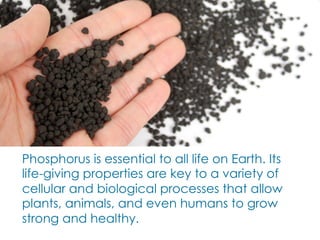
Phosphorus is essential to all life on Earth. Its
life-giving properties are key to a variety of
cellular and biological processes that allow
plants, animals, and even humans to grow
strong and healthy.
As such, phosphorus, in the form of
phosphates, is a key ingredient in animal
feeds. The phosphorus in these animal feed
products helps to build strong bones and
teeth, and contributes to a variety of other
essential processes in the body as well.
Before phosphates can be utilized in animal
feed products, however, it must first be
processed…
Processing
Phosphate Rock
Phosphorus is mined all over the world in the
form of phosphate rock.
Phosphorus is mined all over the world in the
form of phosphate rock.
Phosphate rock deposits vary greatly from
one deposit to the next, and even within the
same deposit.
For this reason, the beneficiation process
can differ greatly, with common methods
including crushing, screening, flotation,
filtration, classification, or often, a
combination of methods.
Once processed, the resulting phosphate
ore must be dried, a practice commonly
carried out in a rotary dryer. This dried ore is
then most often processed into phosphoric
acid by reacting the ore with sulfuric acid.
Once processed, the resulting phosphate
ore must be dried, a practice commonly
carried out in a rotary dryer. This dried ore is
then most often processed into phosphoric
acid by reacting the ore with sulfuric acid.
Phosphoric acid is the base of many
products, both animal feed and fertilizer.
The two most common animal feed products
produced from phosphate rock are:
The two most common animal feed products
produced from phosphate rock are:
•  Monocalcium Phosphate (MCP)
The two most common animal feed products
produced from phosphate rock are:
•  Monocalcium Phosphate (MCP)
•  Dicalcium Phosphate (DCP)
MCP & DCP
Production
To produce MCP and DCP animal
feeds, phosphoric acid is reacted with
calcium carbonate, and the resulting
material is granulated.
To produce MCP and DCP animal
feeds, phosphoric acid is reacted with
calcium carbonate, and the resulting
material is granulated.
 
These products weren’t always (and
sometimes still aren’t) granulated, but
granulation does offer many benefits to
the end product, including easier
handling, a more uniform product, and
significantly less dust.
Granulation has traditionally been
carried out in a Spinden reactor, a
horizontal mixer/reactor similar to
a pug mill.
 
Granulation has traditionally been
carried out in a Spinden reactor, a
horizontal mixer/reactor similar to
a pug mill.
 
This approach is effective, but FEECO
has improved upon the process through
the addition of a high speed mixer.
How the High Speed
Mixer Approach
Works
The FEECO approach to animal feed
granulation is as follows:
 
The FEECO approach to animal feed
granulation is as follows:
 
Phosphoric acid and limestone
(calcium carbonate) are fed into the
high speed mixer, a vertical chamber
with a paddle shaft which rotates at
around 300-400 RPMs to produce an
intense mixing action.
Here, a more homogenous mixture is
created, and the reaction is initiated. The
material then drops from the mixer into a
pug mill.
 
 
Here, a more homogenous mixture is
created, and the reaction is initiated. The
material then drops from the mixer into a
pug mill.
 
The pug mill completes the reaction and
granulates the mixture as it travels through
the mixer. Material exits the pug mill and is
carried via conveyor to a rotary dryer.
 
 
The dryer removes the necessary amount
of moisture, while further rounding and
polishing the granules.
The dryer removes the necessary amount
of moisture, while further rounding and
polishing the granules.
 
Dried material is then screened, with on-
size product moving on to shipping,
storage, or packaging, and over-size
being ground down in a hammer mill and
combined with under-size to go back into
the process as recycle.
The dryer removes the necessary amount
of moisture, while further rounding and
polishing the granules.
 
Dried material is then screened, with on-
size product moving on to shipping,
storage, or packaging, and over-size
being ground down in a hammer mill and
combined with under-size to go back into
the process as recycle.
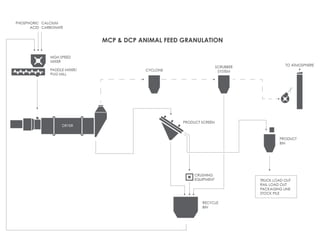
This process is illustrated on the next page.
MCP & DCP ANIMAL FEED GRANULATION
Benefits to the
High Speed Mixer
Approach
The FEECO approach to animal feed
granulation offers significant value over
the traditional method.
The FEECO approach to animal feed
granulation offers significant value over
the traditional method.
 
The high speed mixer creates a more
intimate mixture of materials and an
improved reaction, providing for a
higher quality, more uniform product.
Conclusion
Phosphatic animal feeds are a critical part
of livestock nutrient management. While the
traditional approach to MCP & DCP
production is effective, the addition of a
high speed mixer offers significant
improvements to the end product.
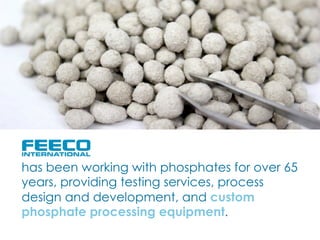
has been working with phosphates for over 65
years, providing testing services, process
design and development, and custom
phosphate processing equipment.
Want to learn more?
Download our
Phosphates Processing
Handbook.
Phosphates Processing Handbook
Processing Techniques
Equipment
Considerations
Outlook
Download Now

Processing Phosphates for use in Animal Feed

  • 1.
    Animal Feed Experts inprocess design and material processing for over 65 years. Phosphates Processing for use in
  • 2.
    Phosphorus is essentialto all life on Earth. Its life-giving properties are key to a variety of cellular and biological processes that allow plants, animals, and even humans to grow strong and healthy.
  • 3.
    As such, phosphorus,in the form of phosphates, is a key ingredient in animal feeds. The phosphorus in these animal feed products helps to build strong bones and teeth, and contributes to a variety of other essential processes in the body as well.
  • 4.
    Before phosphates canbe utilized in animal feed products, however, it must first be processed…
  • 5.
  • 6.
    Phosphorus is minedall over the world in the form of phosphate rock.
  • 7.
    Phosphorus is minedall over the world in the form of phosphate rock. Phosphate rock deposits vary greatly from one deposit to the next, and even within the same deposit.
  • 8.
    For this reason,the beneficiation process can differ greatly, with common methods including crushing, screening, flotation, filtration, classification, or often, a combination of methods.
  • 9.
    Once processed, theresulting phosphate ore must be dried, a practice commonly carried out in a rotary dryer. This dried ore is then most often processed into phosphoric acid by reacting the ore with sulfuric acid.
  • 10.
    Once processed, theresulting phosphate ore must be dried, a practice commonly carried out in a rotary dryer. This dried ore is then most often processed into phosphoric acid by reacting the ore with sulfuric acid. Phosphoric acid is the base of many products, both animal feed and fertilizer.
  • 11.
    The two mostcommon animal feed products produced from phosphate rock are:
  • 12.
    The two mostcommon animal feed products produced from phosphate rock are: •  Monocalcium Phosphate (MCP)
  • 13.
    The two mostcommon animal feed products produced from phosphate rock are: •  Monocalcium Phosphate (MCP) •  Dicalcium Phosphate (DCP)
  • 14.
  • 15.
    To produce MCPand DCP animal feeds, phosphoric acid is reacted with calcium carbonate, and the resulting material is granulated.
  • 16.
    To produce MCPand DCP animal feeds, phosphoric acid is reacted with calcium carbonate, and the resulting material is granulated.   These products weren’t always (and sometimes still aren’t) granulated, but granulation does offer many benefits to the end product, including easier handling, a more uniform product, and significantly less dust.
  • 17.
    Granulation has traditionallybeen carried out in a Spinden reactor, a horizontal mixer/reactor similar to a pug mill.  
  • 18.
    Granulation has traditionallybeen carried out in a Spinden reactor, a horizontal mixer/reactor similar to a pug mill.   This approach is effective, but FEECO has improved upon the process through the addition of a high speed mixer.
  • 19.
    How the HighSpeed Mixer Approach Works
  • 20.
    The FEECO approachto animal feed granulation is as follows:  
  • 21.
    The FEECO approachto animal feed granulation is as follows:   Phosphoric acid and limestone (calcium carbonate) are fed into the high speed mixer, a vertical chamber with a paddle shaft which rotates at around 300-400 RPMs to produce an intense mixing action.
  • 22.
    Here, a morehomogenous mixture is created, and the reaction is initiated. The material then drops from the mixer into a pug mill.    
  • 23.
    Here, a morehomogenous mixture is created, and the reaction is initiated. The material then drops from the mixer into a pug mill.   The pug mill completes the reaction and granulates the mixture as it travels through the mixer. Material exits the pug mill and is carried via conveyor to a rotary dryer.    
  • 24.
    The dryer removesthe necessary amount of moisture, while further rounding and polishing the granules.
  • 25.
    The dryer removesthe necessary amount of moisture, while further rounding and polishing the granules.   Dried material is then screened, with on- size product moving on to shipping, storage, or packaging, and over-size being ground down in a hammer mill and combined with under-size to go back into the process as recycle.
  • 26.
    The dryer removesthe necessary amount of moisture, while further rounding and polishing the granules.   Dried material is then screened, with on- size product moving on to shipping, storage, or packaging, and over-size being ground down in a hammer mill and combined with under-size to go back into the process as recycle. This process is illustrated on the next page.
  • 27.
    MCP & DCPANIMAL FEED GRANULATION
  • 28.
    Benefits to the HighSpeed Mixer Approach
  • 29.
    The FEECO approachto animal feed granulation offers significant value over the traditional method.
  • 30.
    The FEECO approachto animal feed granulation offers significant value over the traditional method.   The high speed mixer creates a more intimate mixture of materials and an improved reaction, providing for a higher quality, more uniform product.
  • 31.
    Conclusion Phosphatic animal feedsare a critical part of livestock nutrient management. While the traditional approach to MCP & DCP production is effective, the addition of a high speed mixer offers significant improvements to the end product.
  • 32.
    has been workingwith phosphates for over 65 years, providing testing services, process design and development, and custom phosphate processing equipment.
  • 33.
    Want to learnmore? Download our Phosphates Processing Handbook. Phosphates Processing Handbook Processing Techniques Equipment Considerations Outlook Download Now