Topic- Hard Gelatin Capsules
Presented by
Hariom Jaiswal
Asst. Pro. B.PH 3rd
Year
Industrial Pharmacy
Rajiv Gandhi College of Pharmacy Nautanwa
Maharajganj
UP 273164
CONTENTS
 Introduction
 Production of hard gelatin capsules
 Size of hard gelatin capsules
 Filling of capsules
 Finishing
 Special techniques of formulation of hard gelatin
capsules
 Quality control tests of hard gelatin capsules
INTRODUCTION
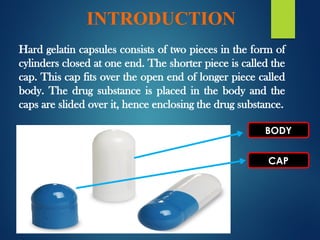
Hard gelatin capsules consists of two pieces in the form of
cylinders closed at one end. The shorter piece is called the
cap. This cap fits over the open end of longer piece called
body. The drug substance is placed in the body and the
caps are slided over it, hence enclosing the drug substance.
BODY
CAP
PRODUCTION OF HARD GELATIN
CAPSULE SHELL
 All raw materials required for the production of a
capsule shell are collected and weighed.
 A solution of gelatin with a concentration of about
45-60% is prepared by mixing of gelatin in
demineralised hot water at 60-70 in jacketed
℃
pressure vessels.
 Vacuum can be applied to remove entrapped air
bubbles. Gelatin solution is transferred to stainless
steel feed tanks. Dyes, opacifants, preservatives
and any water needed are added to the gelatin
solution.
 Finally the viscosity is adjusted according to
required thickness of the capsule shell.
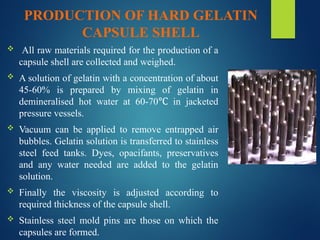
 Stainless steel mold pins are those on which the
capsules are formed.
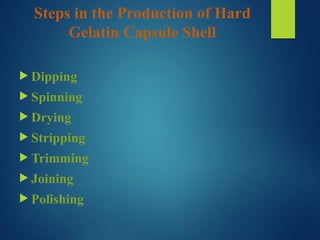
Steps in the Production of Hard
Gelatin Capsule Shell
 Dipping
 Spinning
 Drying
 Stripping
 Trimming
 Joining
 Polishing
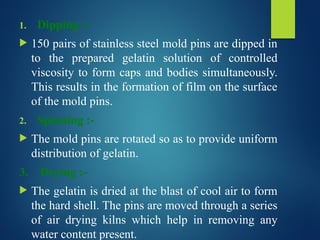
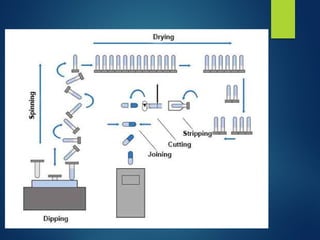
1. Dipping :-
 150 pairs of stainless steel mold pins are dipped in
to the prepared gelatin solution of controlled
viscosity to form caps and bodies simultaneously.
This results in the formation of film on the surface
of the mold pins.
2. Spinning :-
 The mold pins are rotated so as to provide uniform
distribution of gelatin.
3. Drying :-
 The gelatin is dried at the blast of cool air to form
the hard shell. The pins are moved through a series
of air drying kilns which help in removing any
water content present.
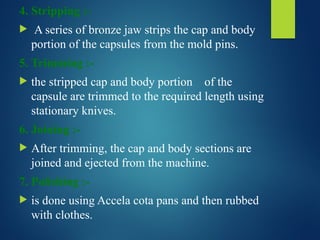
4. Stripping :-
 A series of bronze jaw strips the cap and body
portion of the capsules from the mold pins.
5. Trimming :-
 the stripped cap and body portion of the
capsule are trimmed to the required length using
stationary knives.
6. Joining :-
 After trimming, the cap and body sections are
joined and ejected from the machine.
7. Polishing :-
 is done using Accela cota pans and then rubbed
with clothes.
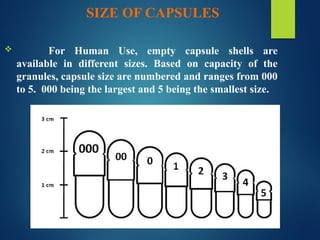
SIZE OF CAPSULES
 For Human Use, empty capsule shells are
available in different sizes. Based on capacity of the
granules, capsule size are numbered and ranges from 000
to 5. 000 being the largest and 5 being the smallest size.
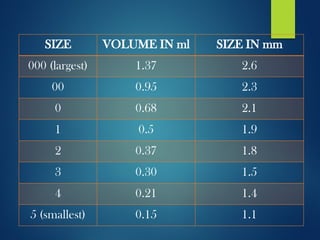
SIZE VOLUME IN ml SIZE IN mm
000 (largest) 1.37 2.6
00 0.95 2.3
0 0.68 2.1
1 0.5 1.9
2 0.37 1.8
3 0.30 1.5
4 0.21 1.4
5 (smallest) 0.15 1.1
CAPSULE FILLING
The hard two – piece capsule can be
filled with materials that have a wide range of
physical properties.
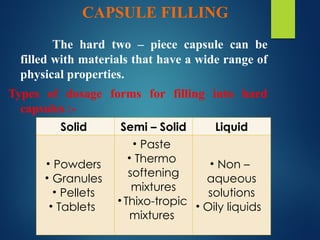
Types of dosage forms for filling into hard
capsules :-
Solid Semi – Solid Liquid
• Powders
• Granules
• Pellets
• Tablets
• Paste
• Thermo
softening
mixtures
• Thixo-tropic
mixtures
• Non –
aqueous
solutions
• Oily liquids
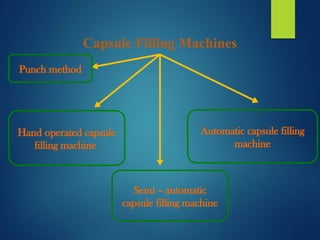
Capsule Filling Machines
Hand operated capsule
filling machine
Semi – automatic
capsule filling machine
Automatic capsule filling
machine
Punch method
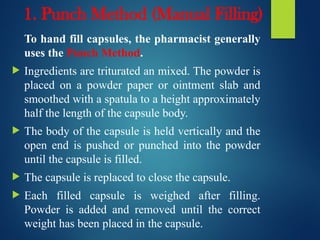
1. Punch Method (Manual Filling)
To hand fill capsules, the pharmacist generally
uses the Punch Method.
 Ingredients are triturated an mixed. The powder is
placed on a powder paper or ointment slab and
smoothed with a spatula to a height approximately
half the length of the capsule body.
 The body of the capsule is held vertically and the
open end is pushed or punched into the powder
until the capsule is filled.
 The capsule is replaced to close the capsule.
 Each filled capsule is weighed after filling.
Powder is added and removed until the correct
weight has been placed in the capsule.
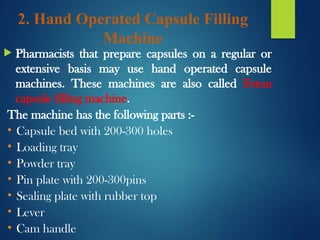
2. Hand Operated Capsule Filling
Machine
 Pharmacists that prepare capsules on a regular or
extensive basis may use hand operated capsule
machines. These machines are also called Feton
capsule filling machine.
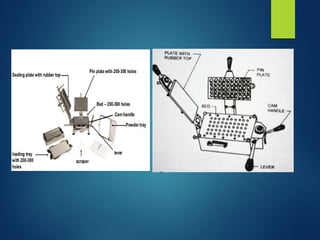
The machine has the following parts :-
• Capsule bed with 200-300 holes
• Loading tray
• Powder tray
• Pin plate with 200-300pins
• Sealing plate with rubber top
• Lever
• Cam handle
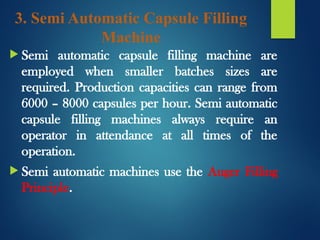
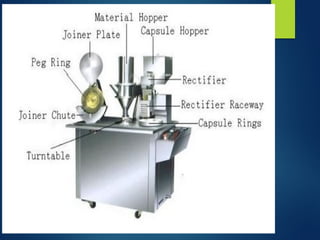
3. Semi Automatic Capsule Filling
Machine
 Semi automatic capsule filling machine are
employed when smaller batches sizes are
required. Production capacities can range from
6000 – 8000 capsules per hour. Semi automatic
capsule filling machines always require an
operator in attendance at all times of the
operation.
 Semi automatic machines use the Auger Filling
Principle.
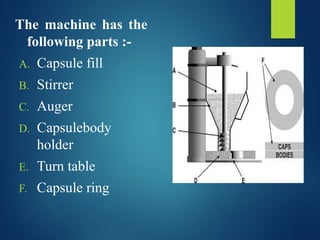
The machine has the
following parts :-
A. Capsule fill
B. Stirrer
C. Auger
D. Capsulebody
holder
E. Turn table
F. Capsule ring
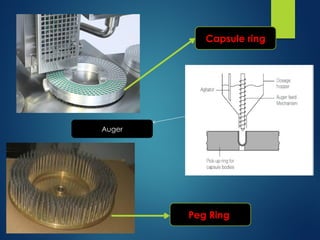
Capsule ring
Auger
Peg Ring
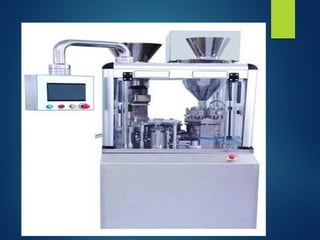
4. Automatic Capsule Filling Machine
 Automatic capsule filling machine are designed
and developed to fill hard gelatin capsules with
powders or pellets. It is an extremely durable
and reliable machine that fills dosages to the
highest accuracy. It can be applicable to the
widest range of capsules at all size
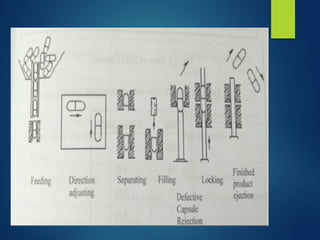
 Automatic filling machines employ
pistons, or tamping pins that lightly compress
the powder into slugs, and eject the plugs into
the empty capsule bodies.
 Automatic machines use the Dosing Disc
Principle and Dosator Principle.
CAPSULE FINISHING
 Filled capsules from the capsule
equipment require dusting or polishing
operation before the remaining
operations of inspection, bottling, and
labeling are completed.
 Dusting or polishing operations vary
according to the type of the filling
equipment used, the type of powder used
for filling, and the individual
requirements for the finished appearance
of the completed capsules.
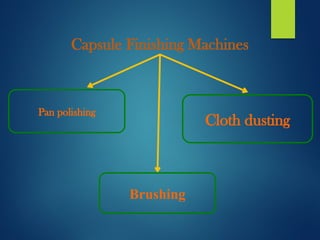
Capsule Finishing Machines
Pan polishing
Brushing
Cloth dusting
Pan Polishing
Because of the unique design, especially
primary in the area of airflow, the Accela
Cota Tablet Coating Pan is used to dust
and polish capsules.
A polyurethane or cheese cloth liner is
placed in the pan, and the liner is used to
trap the removed dust as well as impart a
gloss to the capsules.
Cloth Dusting
In this method, the filled capsules are
rubbed with a cloth that may or may
not be impregnated with an inert oil.
This procedure is a hand operation
and gives a shine to the capsules. Also
it results in a positive method for
removal of resistant materials.
Brushing
In this method, the filled capsules are
fed under rotating soft brushes, which
serve to remove the dust from the
capsule shell. This operation must be
accomplished by application of
vacuum for dust removal.
Special Techniques Of Formulation Of Hard
Gelatin Capsules
1. Decreasing Solubility
2. Formulating Incompatible Materials
3. Filling of Semisolids
4. Filling of Liquids
5. HPMC Capsules
6. Starch Capsules
7. Cross Linked Dextran Capsules
1. Decrease of Solubility
 Solubility is retarded in this technique of
formulating a special type capsule.
 Done in an attempt delay absorption of the
active ingredient or to provide enteric
properties.
 Solubility is assured in two ways here:-
a) Water resistance – failure to dissolve in
water in 15 mints at 20-30 .
℃
b) Acid solubility – dissolve in less than 5
mints in 0.5% aq. HCl at 36 - 80℃
 Two ways of formulating capsules with
decreased solubility are :-
a) Formalin treatment :-
• exposure of the gelatin film to formalin
vapours decrease the solubility of gelatin
due to the cross linking of molecules in
gelatin initiated by aldehyde.
a) Coating of the gelatin capsules with
coating materials like shellac, cellulose
acetate phthallate etc., by usual pan
coating techniques
2. Formulation of Incompatible
Materials
 Formulation of Incompatible materials is carried
out by the use of a two phase fill in the capsule
 One phase :- consists of a soft capsule, or
smaller hard capsule or a pill that is filled into the
capsule.
 Other phase :- powder fill is added in the usual
manner.
 Changes should be made to the equipment for
the machine operation to allow the two filling.
3.Filling of Semisolids
 Semisolids are melted to allow the filling
of the material in the capsules at ambient
temperature.
4.Filling of Liquids
• Liquids in the form of thermosetting or thixotropic
mixture are filled in the capsule.
• Gelatin banding is required for the sealing of the
capsules to prevent leakage.
• Two bands of gelatin solution are applied around
the centre of the filled capsules and this then dried
using air ate ambient conditions.
5. HPMC Capsules
 Developed as an alternative to hard gelatin
capsules.
 Odourless and flexible, low moisture content,
chemically inert, stable under low moisture
conditions.
 HPMC Capsules :- manufactured using 18-
28% HPMC, carrageenan (0.01 – 0,09% w/w)
and potassium or calcium ions (0.05-0.6%
w/w)
 Carrageenan and potassium or calcium ions
are used as co gelling agents to facilitate the
gelling of HPMC.
6.Cross Linked Dextran
Capsules
 Capsule shell are prepared by reacting
dextran. Magnesium chloride,
glutaraldehyde, and polyethylene glycol 400
in water.
7. Starch Capsules
• Capsule shell are prepared by starch obtained from
potato.
• Dissolution is independent of pH.
• Usually used for manufacture of enteric coated
capsules.
QUALITY CONTROL TESTS OF
HARD GELATIN CAPSULE
1. Weight variation test
2. Content uniformity test
3. Disintegration test
4. Dissolution test
5. Moisture permeation test
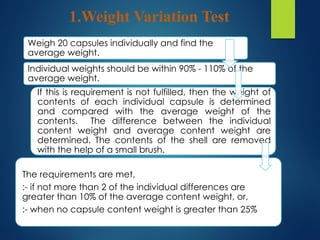
1.Weight Variation Test
Weigh 20 capsules individually and find the
average weight.
Individual weights should be within 90% - 110% of the
average weight.
If this is requirement is not fulfilled, then the weight of
contents of each individual capsule is determined
and compared with the average weight of the
contents. The difference between the individual
content weight and average content weight are
determined. The contents of the shell are removed
with the help of a small brush.
The requirements are met,
:- if not more than 2 of the individual differences are
greater than 10% of the average content weight, or,
:- when no capsule content weight is greater than 25%
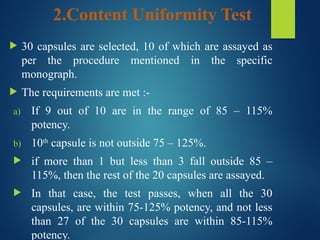
2.Content Uniformity Test
 30 capsules are selected, 10 of which are assayed as
per the procedure mentioned in the specific
monograph.
 The requirements are met :-
a) If 9 out of 10 are in the range of 85 – 115%
potency.
b) 10th
capsule is not outside 75 – 125%.
 if more than 1 but less than 3 fall outside 85 –
115%, then the rest of the 20 capsules are assayed.
 In that case, the test passes, when all the 30
capsules, are within 75-125% potency, and not less
than 27 of the 30 capsules are within 85-115%
potency.
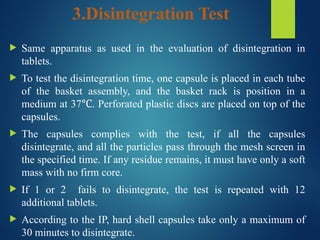
3.Disintegration Test
 Same apparatus as used in the evaluation of disintegration in
tablets.
 To test the disintegration time, one capsule is placed in each tube
of the basket assembly, and the basket rack is position in a
medium at 37 . Perforated plastic discs are placed on top of the
℃
capsules.
 The capsules complies with the test, if all the capsules
disintegrate, and all the particles pass through the mesh screen in
the specified time. If any residue remains, it must have only a soft
mass with no firm core.
 If 1 or 2 fails to disintegrate, the test is repeated with 12
additional tablets.
 According to the IP, hard shell capsules take only a maximum of
30 minutes to disintegrate.
4.Dissolution Test
 Same apparatus as used in the evaluation of dissolution in
tablets.
 To test the dissolution or drug release from the capsule, USP
Apparatus II – the rotating paddle type is used mainly.
 As the capsule comes in contact with the aqueous media at
37 , capsule shell absorb water and swell.
℃
 The rate of water penetration is inversely proportional to the
thickness of the capsule shell. The shell ruptures at the
shoulder of the cap an the body part.
 Rate of gelatin solubility is dependent on the temperature of
the solution. As the temperature decreases, the solubility of
the gelatin decreases.
Thank
you

Hard Gelatin Capsules .pptx

  • 1.
    Topic- Hard GelatinCapsules Presented by Hariom Jaiswal Asst. Pro. B.PH 3rd Year Industrial Pharmacy Rajiv Gandhi College of Pharmacy Nautanwa Maharajganj UP 273164
  • 2.
    CONTENTS  Introduction  Productionof hard gelatin capsules  Size of hard gelatin capsules  Filling of capsules  Finishing  Special techniques of formulation of hard gelatin capsules  Quality control tests of hard gelatin capsules
  • 3.
    INTRODUCTION Hard gelatin capsulesconsists of two pieces in the form of cylinders closed at one end. The shorter piece is called the cap. This cap fits over the open end of longer piece called body. The drug substance is placed in the body and the caps are slided over it, hence enclosing the drug substance. BODY CAP
  • 4.
    PRODUCTION OF HARDGELATIN CAPSULE SHELL  All raw materials required for the production of a capsule shell are collected and weighed.  A solution of gelatin with a concentration of about 45-60% is prepared by mixing of gelatin in demineralised hot water at 60-70 in jacketed ℃ pressure vessels.  Vacuum can be applied to remove entrapped air bubbles. Gelatin solution is transferred to stainless steel feed tanks. Dyes, opacifants, preservatives and any water needed are added to the gelatin solution.  Finally the viscosity is adjusted according to required thickness of the capsule shell.  Stainless steel mold pins are those on which the capsules are formed.
  • 5.
    Steps in theProduction of Hard Gelatin Capsule Shell  Dipping  Spinning  Drying  Stripping  Trimming  Joining  Polishing
  • 6.
    1. Dipping :- 150 pairs of stainless steel mold pins are dipped in to the prepared gelatin solution of controlled viscosity to form caps and bodies simultaneously. This results in the formation of film on the surface of the mold pins. 2. Spinning :-  The mold pins are rotated so as to provide uniform distribution of gelatin. 3. Drying :-  The gelatin is dried at the blast of cool air to form the hard shell. The pins are moved through a series of air drying kilns which help in removing any water content present.
  • 7.
    4. Stripping :- A series of bronze jaw strips the cap and body portion of the capsules from the mold pins. 5. Trimming :-  the stripped cap and body portion of the capsule are trimmed to the required length using stationary knives. 6. Joining :-  After trimming, the cap and body sections are joined and ejected from the machine. 7. Polishing :-  is done using Accela cota pans and then rubbed with clothes.
  • 9.
    SIZE OF CAPSULES For Human Use, empty capsule shells are available in different sizes. Based on capacity of the granules, capsule size are numbered and ranges from 000 to 5. 000 being the largest and 5 being the smallest size.
  • 10.
    SIZE VOLUME INml SIZE IN mm 000 (largest) 1.37 2.6 00 0.95 2.3 0 0.68 2.1 1 0.5 1.9 2 0.37 1.8 3 0.30 1.5 4 0.21 1.4 5 (smallest) 0.15 1.1
  • 11.
    CAPSULE FILLING The hardtwo – piece capsule can be filled with materials that have a wide range of physical properties. Types of dosage forms for filling into hard capsules :- Solid Semi – Solid Liquid • Powders • Granules • Pellets • Tablets • Paste • Thermo softening mixtures • Thixo-tropic mixtures • Non – aqueous solutions • Oily liquids
  • 12.
    Capsule Filling Machines Handoperated capsule filling machine Semi – automatic capsule filling machine Automatic capsule filling machine Punch method
  • 13.
    1. Punch Method(Manual Filling) To hand fill capsules, the pharmacist generally uses the Punch Method.  Ingredients are triturated an mixed. The powder is placed on a powder paper or ointment slab and smoothed with a spatula to a height approximately half the length of the capsule body.  The body of the capsule is held vertically and the open end is pushed or punched into the powder until the capsule is filled.  The capsule is replaced to close the capsule.  Each filled capsule is weighed after filling. Powder is added and removed until the correct weight has been placed in the capsule.
  • 14.
    2. Hand OperatedCapsule Filling Machine  Pharmacists that prepare capsules on a regular or extensive basis may use hand operated capsule machines. These machines are also called Feton capsule filling machine. The machine has the following parts :- • Capsule bed with 200-300 holes • Loading tray • Powder tray • Pin plate with 200-300pins • Sealing plate with rubber top • Lever • Cam handle
  • 16.
    3. Semi AutomaticCapsule Filling Machine  Semi automatic capsule filling machine are employed when smaller batches sizes are required. Production capacities can range from 6000 – 8000 capsules per hour. Semi automatic capsule filling machines always require an operator in attendance at all times of the operation.  Semi automatic machines use the Auger Filling Principle.
  • 17.
    The machine hasthe following parts :- A. Capsule fill B. Stirrer C. Auger D. Capsulebody holder E. Turn table F. Capsule ring
  • 18.
  • 20.
    4. Automatic CapsuleFilling Machine  Automatic capsule filling machine are designed and developed to fill hard gelatin capsules with powders or pellets. It is an extremely durable and reliable machine that fills dosages to the highest accuracy. It can be applicable to the widest range of capsules at all size  Automatic filling machines employ pistons, or tamping pins that lightly compress the powder into slugs, and eject the plugs into the empty capsule bodies.  Automatic machines use the Dosing Disc Principle and Dosator Principle.
  • 23.
    CAPSULE FINISHING  Filledcapsules from the capsule equipment require dusting or polishing operation before the remaining operations of inspection, bottling, and labeling are completed.  Dusting or polishing operations vary according to the type of the filling equipment used, the type of powder used for filling, and the individual requirements for the finished appearance of the completed capsules.
  • 24.
    Capsule Finishing Machines Panpolishing Brushing Cloth dusting
  • 25.
    Pan Polishing Because ofthe unique design, especially primary in the area of airflow, the Accela Cota Tablet Coating Pan is used to dust and polish capsules. A polyurethane or cheese cloth liner is placed in the pan, and the liner is used to trap the removed dust as well as impart a gloss to the capsules.
  • 26.
    Cloth Dusting In thismethod, the filled capsules are rubbed with a cloth that may or may not be impregnated with an inert oil. This procedure is a hand operation and gives a shine to the capsules. Also it results in a positive method for removal of resistant materials.
  • 27.
    Brushing In this method,the filled capsules are fed under rotating soft brushes, which serve to remove the dust from the capsule shell. This operation must be accomplished by application of vacuum for dust removal.
  • 28.
    Special Techniques OfFormulation Of Hard Gelatin Capsules 1. Decreasing Solubility 2. Formulating Incompatible Materials 3. Filling of Semisolids 4. Filling of Liquids 5. HPMC Capsules 6. Starch Capsules 7. Cross Linked Dextran Capsules
  • 29.
    1. Decrease ofSolubility  Solubility is retarded in this technique of formulating a special type capsule.  Done in an attempt delay absorption of the active ingredient or to provide enteric properties.  Solubility is assured in two ways here:- a) Water resistance – failure to dissolve in water in 15 mints at 20-30 . ℃ b) Acid solubility – dissolve in less than 5 mints in 0.5% aq. HCl at 36 - 80℃
  • 30.
     Two waysof formulating capsules with decreased solubility are :- a) Formalin treatment :- • exposure of the gelatin film to formalin vapours decrease the solubility of gelatin due to the cross linking of molecules in gelatin initiated by aldehyde. a) Coating of the gelatin capsules with coating materials like shellac, cellulose acetate phthallate etc., by usual pan coating techniques
  • 31.
    2. Formulation ofIncompatible Materials  Formulation of Incompatible materials is carried out by the use of a two phase fill in the capsule  One phase :- consists of a soft capsule, or smaller hard capsule or a pill that is filled into the capsule.  Other phase :- powder fill is added in the usual manner.  Changes should be made to the equipment for the machine operation to allow the two filling.
  • 32.
    3.Filling of Semisolids Semisolids are melted to allow the filling of the material in the capsules at ambient temperature. 4.Filling of Liquids • Liquids in the form of thermosetting or thixotropic mixture are filled in the capsule. • Gelatin banding is required for the sealing of the capsules to prevent leakage. • Two bands of gelatin solution are applied around the centre of the filled capsules and this then dried using air ate ambient conditions.
  • 33.
    5. HPMC Capsules Developed as an alternative to hard gelatin capsules.  Odourless and flexible, low moisture content, chemically inert, stable under low moisture conditions.  HPMC Capsules :- manufactured using 18- 28% HPMC, carrageenan (0.01 – 0,09% w/w) and potassium or calcium ions (0.05-0.6% w/w)  Carrageenan and potassium or calcium ions are used as co gelling agents to facilitate the gelling of HPMC.
  • 34.
    6.Cross Linked Dextran Capsules Capsule shell are prepared by reacting dextran. Magnesium chloride, glutaraldehyde, and polyethylene glycol 400 in water. 7. Starch Capsules • Capsule shell are prepared by starch obtained from potato. • Dissolution is independent of pH. • Usually used for manufacture of enteric coated capsules.
  • 35.
    QUALITY CONTROL TESTSOF HARD GELATIN CAPSULE 1. Weight variation test 2. Content uniformity test 3. Disintegration test 4. Dissolution test 5. Moisture permeation test
  • 36.
    1.Weight Variation Test Weigh20 capsules individually and find the average weight. Individual weights should be within 90% - 110% of the average weight. If this is requirement is not fulfilled, then the weight of contents of each individual capsule is determined and compared with the average weight of the contents. The difference between the individual content weight and average content weight are determined. The contents of the shell are removed with the help of a small brush. The requirements are met, :- if not more than 2 of the individual differences are greater than 10% of the average content weight, or, :- when no capsule content weight is greater than 25%
  • 37.
    2.Content Uniformity Test 30 capsules are selected, 10 of which are assayed as per the procedure mentioned in the specific monograph.  The requirements are met :- a) If 9 out of 10 are in the range of 85 – 115% potency. b) 10th capsule is not outside 75 – 125%.  if more than 1 but less than 3 fall outside 85 – 115%, then the rest of the 20 capsules are assayed.  In that case, the test passes, when all the 30 capsules, are within 75-125% potency, and not less than 27 of the 30 capsules are within 85-115% potency.
  • 38.
    3.Disintegration Test  Sameapparatus as used in the evaluation of disintegration in tablets.  To test the disintegration time, one capsule is placed in each tube of the basket assembly, and the basket rack is position in a medium at 37 . Perforated plastic discs are placed on top of the ℃ capsules.  The capsules complies with the test, if all the capsules disintegrate, and all the particles pass through the mesh screen in the specified time. If any residue remains, it must have only a soft mass with no firm core.  If 1 or 2 fails to disintegrate, the test is repeated with 12 additional tablets.  According to the IP, hard shell capsules take only a maximum of 30 minutes to disintegrate.
  • 39.
    4.Dissolution Test  Sameapparatus as used in the evaluation of dissolution in tablets.  To test the dissolution or drug release from the capsule, USP Apparatus II – the rotating paddle type is used mainly.  As the capsule comes in contact with the aqueous media at 37 , capsule shell absorb water and swell. ℃  The rate of water penetration is inversely proportional to the thickness of the capsule shell. The shell ruptures at the shoulder of the cap an the body part.  Rate of gelatin solubility is dependent on the temperature of the solution. As the temperature decreases, the solubility of the gelatin decreases.
  • 40.