Presented by
Sub :- Operating Systems
Topic:-Process Schedulers
Respectected:-
Dr Huma javed UOP
• Scheduling definition
• Scheduling objectives
• Types of schedulers
• Different scheduling Algorithems
Content
Scheduling is a process which allows one process to
use the CPU while the execution of another process
is on hold due to unavailability of any resources.
It is a technique that is used when there are limited
resources and many process are competing for
them.
It’s aim is to make system efficient , fast and fair .
Scheduling
CPU
Utilization
• Computer usage of memory and processing
resources or amount of work handle by a CPU
Throughput
• It is the total number of process completed per unit
time.
Efficiency
• scheduler should keep the system busy whole time, if CPU and
all i/o devices can be kept running all the time more work can be done per
second.
Criteria for best scheduling algorithm
When a new process is created ,
a decision needs to be made
whether to run the
parent process or child process.
A scheduling decision must be
made when a process exits
When I/O interrupt occurs , a
scheduling decision may be
made.
Scheduling Objectives
Make the system fast
Increasing response
time
Increasing the output
Give better service to
processes
Maximize throughput
Main objective of scheduling !!!
If only one CPU is available , a choice has to
be made which process to run next.
The part of the operating system that makes
the choice is called the scheduler
Scheduler
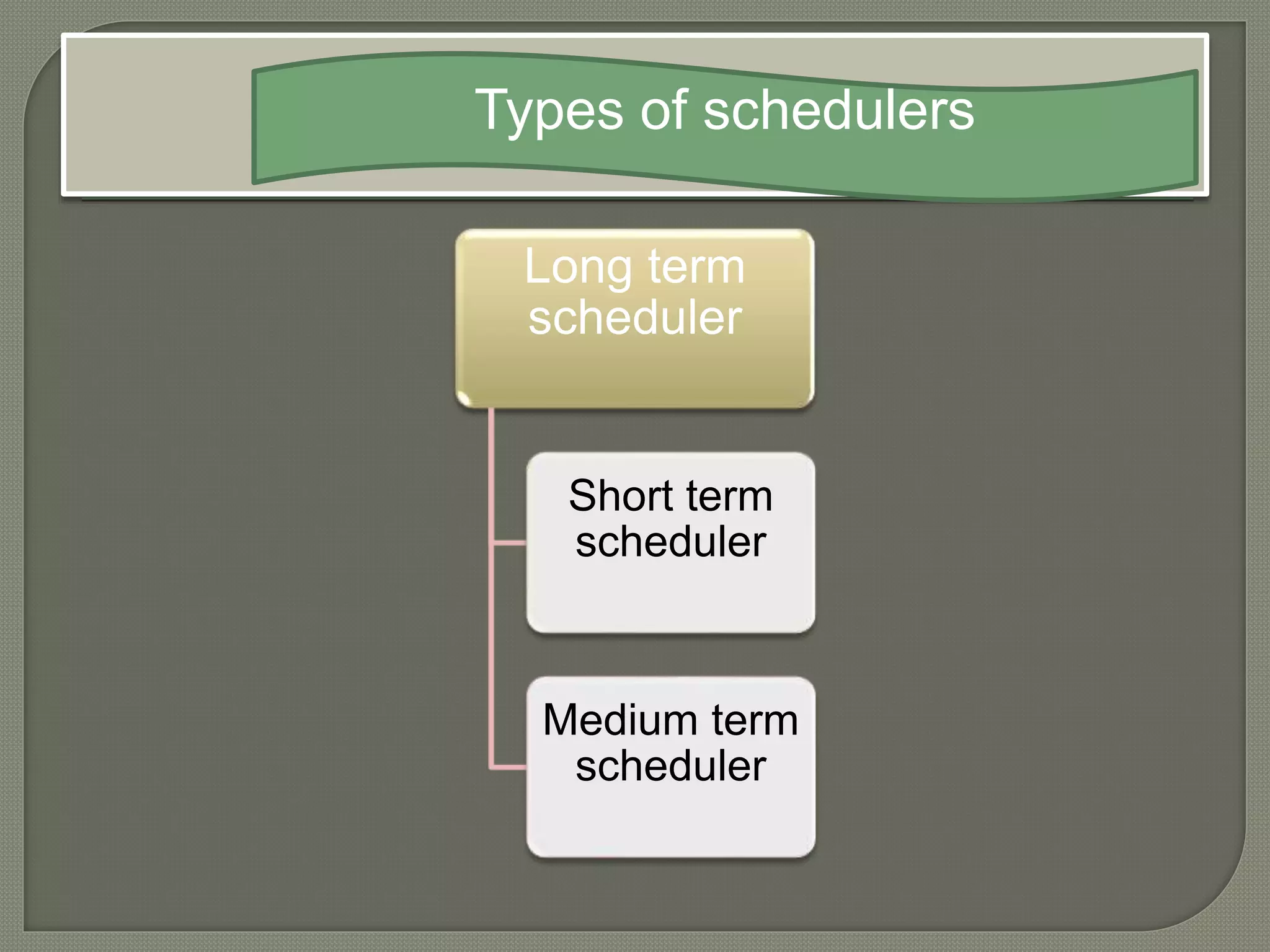
Long term
scheduler
Short term
scheduler
Medium term
scheduler
Types of schedulers
It is also called job scheduler.
It determine which program are admitted to a
system for processing .
It selects process from queue and loads them
in to memory for execution .
When process changes the state from new to
ready, then there is use of long term scheduler.
Long term schedulers
It is also called CPU scheduler.
It is also called dispatchers.
Main objective is increasing system performance in accordance with
the chosen set of criteria .
CPU scheduler selects process among the processes that are ready to
execute and allocates CPU to one of them .
Faster than long term schedulers .
A dispatcher does the following:
 Switching context.
 Switching to user mode.
 Jumping to the proper location in the newly loaded program.
Short term schedulers
It is the part of swapping .
It removes the processes from memory .
A running process may become suspended if it
does not get I/O resource needed.
In this condition the process is move to the
secondary storage until it gets the resources.
It is the part of time sharing operating system.
Medium term schedulers
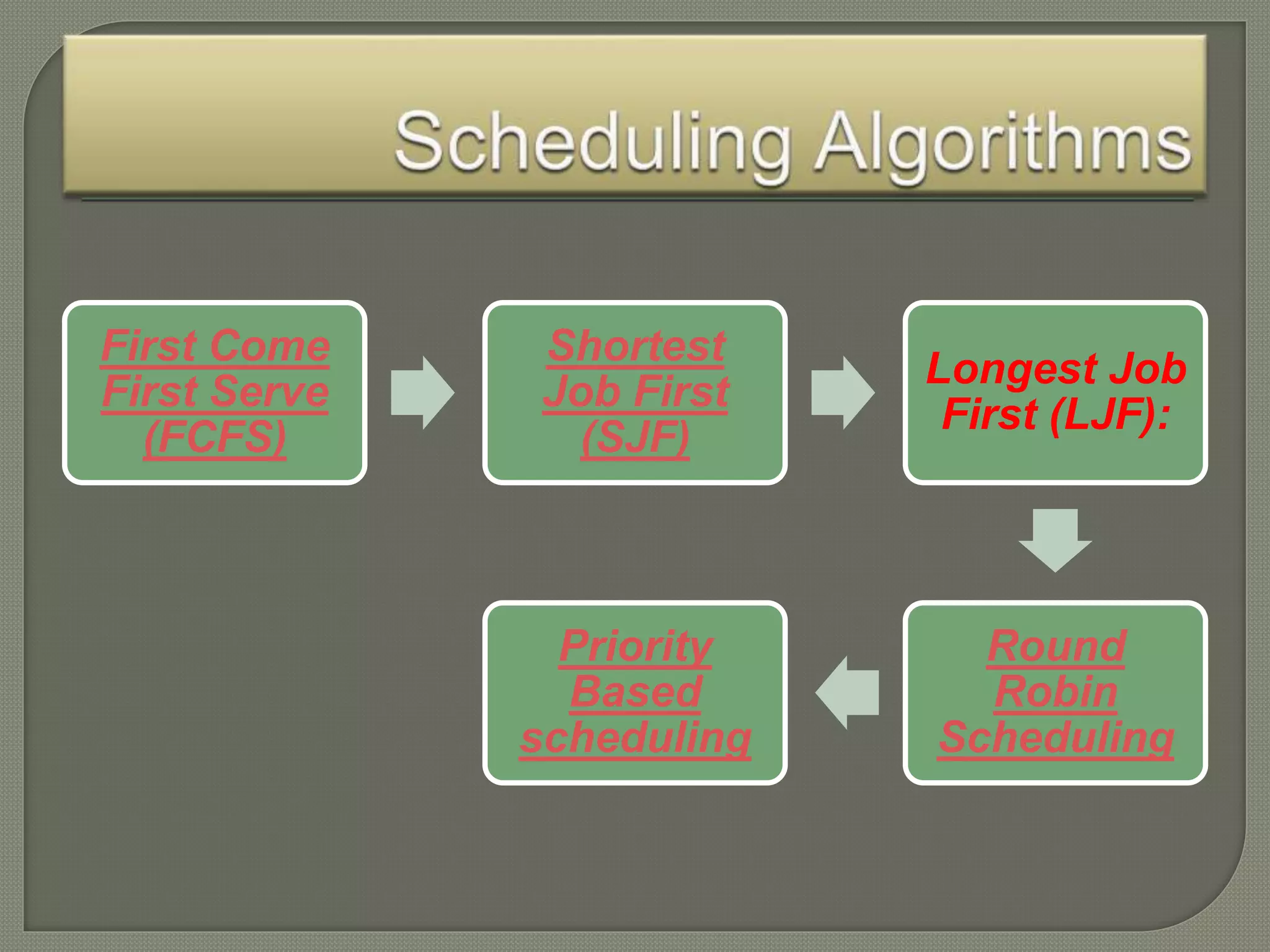
First Come
First Serve
(FCFS)
Shortest
Job First
(SJF)
Longest Job
First (LJF):
Round
Robin
Scheduling
Priority
Based
scheduling
From this topic we learn how the scheduler
works, and how scheduler allows one
process to use the CPU while the execution
of another process is on hold due to
unavailability of any resources .
Schudling os presentaion

Schudling os presentaion

  • 2.
    Presented by Sub :-Operating Systems Topic:-Process Schedulers Respectected:- Dr Huma javed UOP
  • 3.
    • Scheduling definition •Scheduling objectives • Types of schedulers • Different scheduling Algorithems Content
  • 4.
    Scheduling is aprocess which allows one process to use the CPU while the execution of another process is on hold due to unavailability of any resources. It is a technique that is used when there are limited resources and many process are competing for them. It’s aim is to make system efficient , fast and fair . Scheduling
  • 5.
    CPU Utilization • Computer usageof memory and processing resources or amount of work handle by a CPU Throughput • It is the total number of process completed per unit time. Efficiency • scheduler should keep the system busy whole time, if CPU and all i/o devices can be kept running all the time more work can be done per second. Criteria for best scheduling algorithm
  • 6.
    When a newprocess is created , a decision needs to be made whether to run the parent process or child process. A scheduling decision must be made when a process exits When I/O interrupt occurs , a scheduling decision may be made. Scheduling Objectives
  • 7.
    Make the systemfast Increasing response time Increasing the output Give better service to processes Maximize throughput Main objective of scheduling !!!
  • 8.
    If only oneCPU is available , a choice has to be made which process to run next. The part of the operating system that makes the choice is called the scheduler Scheduler
  • 9.
    Long term scheduler Short term scheduler Mediumterm scheduler Types of schedulers
  • 10.
    It is alsocalled job scheduler. It determine which program are admitted to a system for processing . It selects process from queue and loads them in to memory for execution . When process changes the state from new to ready, then there is use of long term scheduler. Long term schedulers
  • 11.
    It is alsocalled CPU scheduler. It is also called dispatchers. Main objective is increasing system performance in accordance with the chosen set of criteria . CPU scheduler selects process among the processes that are ready to execute and allocates CPU to one of them . Faster than long term schedulers . A dispatcher does the following:  Switching context.  Switching to user mode.  Jumping to the proper location in the newly loaded program. Short term schedulers
  • 12.
    It is thepart of swapping . It removes the processes from memory . A running process may become suspended if it does not get I/O resource needed. In this condition the process is move to the secondary storage until it gets the resources. It is the part of time sharing operating system. Medium term schedulers
  • 13.
    First Come First Serve (FCFS) Shortest JobFirst (SJF) Longest Job First (LJF): Round Robin Scheduling Priority Based scheduling
  • 14.
    From this topicwe learn how the scheduler works, and how scheduler allows one process to use the CPU while the execution of another process is on hold due to unavailability of any resources .