B.Ramamurthy 10/23/24 1
Process Description and Control
B.Ramamurthy
B.Ramamurthy 10/23/24 2
Introduction
 The fundamental task of any operating system is
process management.
 OS must allocate resources to processes, enable sharing
of information, protect resources, and enable
synchronization among processes.
 In many modern OS the problems of process
management is compounded by introduction of threads.
 We will process management in this chapter and
threads in the next.
B.Ramamurthy 10/23/24 3
Topics for discussion
 Requirement of process
 Process states
 Creation, termination and suspension
 Five State Model
 Process Control Block (PCB)
 Process control
 Unix System V
 Summary
B.Ramamurthy 10/23/24 4
What is a process?
 A process is simply a program in execution: an instance of a
program execution.
 Unit of work individually schedulable by an operating system.
 OS keeps track of all the active processes and allocates system
resources to them according to policies devised to meet design
performance objectives.
 To meet process requirements OS must maintain many data
structures efficiently.
 The process abstraction is a fundamental OS means for
management of concurrent program execution. Example:
instances of process co-existing.
B.Ramamurthy 10/23/24 5
Major requirements
 OS must interleave the execution of a number of
processes to maximize processor use while providing
reasonable response time.
 OS must allocate resources to processes in conformance
with a specific policy. Example: (i) higher priority, (ii)
avoid deadlock.
 Support user creation of processes and IPC both of which
may aid in the structuring of applications.
 Reading assignment: pages 101-105 including “two
state process model”
B.Ramamurthy 10/23/24 6
Process creation
 Four common events that lead to a process creation are:
1) When a new batch-job is presented for execution.
2) When an interactive user logs in.
3) When OS needs to perform an operation (usually IO)
on behalf of a user process, concurrently with that
process.
4) To exploit parallelism an user process can spawn a
number of processes.
==> concept of parent and child processes.
B.Ramamurthy 10/23/24 7
Termination of a process
 Normal completion, time limit exceeded, memory unavailable
 Bounds violation, protection error, arithmetic error, invalid
instruction
 IO failure, Operator intervention, parent termination, parent request
 A number of other conditions are possible.
 Segmentation fault : usually happens when you try write/read
into/from a non-existent array/structure/object component. Or
access a pointer to a dynamic data before creating it. (new etc.)
 Bus error: Related to function call and return. You have messed
up the stack where the return address or parameters are stored.
B.Ramamurthy 10/23/24 8
A five-state process model
 Five states: New, Ready, Running, Blocked, Exit
 New : A process has been created but has not yet been admitted to
the pool of executable processes.
 Ready : Processes that are prepared to run if given an opportunity.
That is, they are not waiting on anything except the CPU availability.
 Running: The process that is currently being executed. (Assume
single processor for simplicity.)
 Blocked : A process that cannot execute until a specified event such
as an IO completion occurs.
 Exit: A process that has been released by OS either after normal
termination or after abnormal termination (error).
B.Ramamurthy 10/23/24 9
State Transition Diagram
NEW READY RUNNING
BLOCKED
EXIT
Admit
Dispatch
Time-out
Release
Event
Wait
Event
Occurs
Think of the conditions under which state transitions may take place.
B.Ramamurthy 10/23/24 10
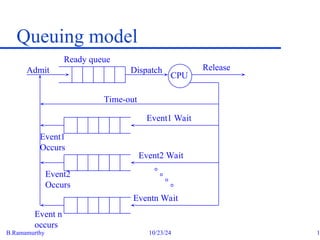
Queuing model
Event1 Wait
Admit
Ready queue
Dispatch
CPU
Release
Time-out
Event1
Occurs
Event2 Wait
Event2
Occurs
Eventn Wait
Event n
occurs
B.Ramamurthy 10/23/24 11
Process suspension
 Many OS are built around (Ready, Running,
Blocked) states. But there is one more state that may
aid in the operation of an OS - suspended state.
 When none of the processes occupying the main
memory is in a Ready state, OS swaps one of the
blocked processes out onto to the Suspend queue.
 When a Suspended process is ready to run it moves
into “Ready, Suspend” queue. Thus we have two
more state: Blocked_Suspend, Ready_Suspend.
B.Ramamurthy 10/23/24 12
Process suspension (contd.)
 Blocked_suspend : The process is in the secondary
memory and awaiting an event.
 Ready_suspend : The process is in the secondary
memory but is available for execution as soon as it is
loaded into the main memory.
 State transition diagram Fig.3.7
 Observe on what condition does a state transition take
place? What are the possible state transitions?
B.Ramamurthy 10/23/24 13
State Transition Diagram (take 2)
NEW READY RUNNING
BLOCKED
EXIT
Admit
Dispatch
Time-out
Release
Event
Wait
Event
Occurs
Think of the conditions under which state transitions may take place.
Activate
Suspend
Event occurs
Activate
Suspend
Blocked
Suspend
Ready
Suspend
B.Ramamurthy 10/23/24 14
Process description
 OS constructs and maintains tables of information
about each entity that it is managing : memory
tables, IO tables, file tables, process tables.
 Process control block: Associated with each
process are a number of attributes used by OS for
process control. This collection is known as PCB.
 Process image: Collection of program, data, stack,
and PCB together is known as Process image.
 For more details on PCB see Table 3.6
B.Ramamurthy 10/23/24 15
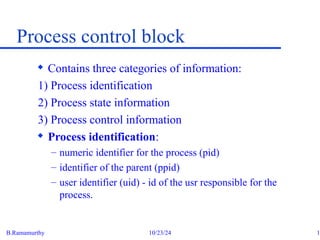
Process control block
 Contains three categories of information:
1) Process identification
2) Process state information
3) Process control information
 Process identification:
– numeric identifier for the process (pid)
– identifier of the parent (ppid)
– user identifier (uid) - id of the usr responsible for the
process.
B.Ramamurthy 10/23/24 16
Process control block (contd.)
 Process state information:
– User visible registers
– Control and status registers : PC, IR, PSW,
interrupt related bits, execution mode.
– Stack pointers
B.Ramamurthy 10/23/24 17
Process control block (contd.)
 Process control information:
– Scheduling and state information : Process state,
priority, scheduling-related info., event awaited.
– Data structuring : pointers to other processes
(PCBs): belong to the same queue, parent of
process, child of process or some other relationship.
– Interprocess comm: Various flags, signals,
messages may be maintained in PCBs.
B.Ramamurthy 10/23/24 18
Process control block (contd.)
 Process control information (contd.)
– Process privileges: access privileges to certain memory
area, critical structures etc.
– Memory management: pointer to the various memory
management data structures.
– Resource ownership : Pointer to resources such as
opened files. Info may be used by scheduler.
 PCBs need to be protected from inadvertent destruction by
any routine. So protection of PCBs is a critical issue in the
design of an OS.
B.Ramamurthy 10/23/24 19
OS Functions related to
Processes
 Process management: Process creation, termination,
scheduling, dispatching, switching, synchronization,
IPC support, management of PCBs
 Memory management: Allocation of address space to
processes, swapping, page and segment management.
 IO management: Buffer management, allocation of
IO channels and devices to processes.
 Support functions: Interrupt handling, accounting,
monitoring.
B.Ramamurthy 10/23/24 20
Modes of execution
 Two modes : user mode and a privileged mode called the
kernel mode.
 Why? It is necessary to protect the OS and key OS tables
such as PCBs from interference by user programs.
 In the kernel mode, the software has complete control of
the processor and all its hardware.
 When a user makes a system call or when an interrupt
transfers control to a system routine, an instruction to
change mode is executed. This mode change will result in
an error unless permitted by OS.
B.Ramamurthy 10/23/24 21
Creation of a process
 Assign a unique pid to the new process.
 Allocate space for all the elements of the
process image. How much?
 The process control block is initialized. Borrow
info from parent.
 The appropriate linkages are set: for
scheduling, state queues..
 Create and initialize other data structures.
B.Ramamurthy 10/23/24 22
Process Interruption
 Two kinds of process interruptions: interrupt and
trap.
 Interrupt: Caused by some event external to and
asynchronous to the currently running process,
such as completion of IO.
 Trap : Error or exception condition generated
within the currently running process. Ex: illegal
access to a file, arithmetic exception.
 (supervisor call) : explicit interruption.
B.Ramamurthy 10/23/24 23
Process and Context Switching
 Clock interrupt: The OS determines if the time slice of
the currently running process is over, then switches it to
Ready state, and dispatches another from Ready queue.
“Process switch”
 Memory fault: (Page fault) A page fault occurs when the
requested program page is not in the main memory. OS
(page fault handler) brings in the page requested,
resumes faulted process.
 IO Interrupt : OS determines what IO action occurred
and takes appropriate action.
B.Ramamurthy 10/23/24 24
Process and Context Switching
(contd.)
 Process switch: A transition between two memory-
resident processes in a multiprogramming
environment. Study the 7 steps involved in a
process switch.
 Context switch: Changing context from a executing
program to an Interrupt Service Routine (ISR). Part
of the context that will be modified by the ISR
needs to be saved. This required context is saved
and restored by hardware as specified by the ISR.
B.Ramamurthy 10/23/24 25
Process and Context Switching
(contd.)
 How many context switch occurs per process
switch?
 Typically 1Process switch : 100 context switches
 Process switch of more expensive than context
switch.
 Read more on this.
 This factor is very important for many system
design projects.
B.Ramamurthy 10/23/24 26
Unix system V
 All user processes in the system have as root ancestor a
process called init. When a new interactive user logs onto
the system, init creates a user process, subsequently this
user process can create child processes and so on. init is
created at the boot-time.
 Process states : User running , kernel running, Ready in
memory, sleeping in memory (blocked), Ready swapped
(ready-suspended), sleeping swapped (blocked-suspended),
created (new), zombie , preempted (used in real-time
scheduling).
B.Ramamurthy 10/23/24 27
Unix system V (contd.)
 Reading assignment: Fig. 3.15 and
description, Table 3.10, 3.11, 3.12and 3.13.
 What does unix process image contain?
 What does process table entry contain?
proc
 What is unix U (user) area? u area
 Function of each of these components.
B.Ramamurthy 10/23/24 28
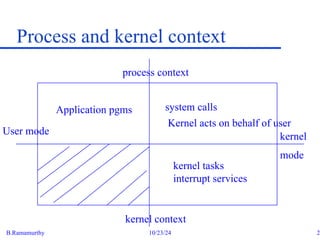
Process and kernel context
User mode
mode
kernel
process context
kernel context
Application pgms system calls
kernel tasks
interrupt services
Kernel acts on behalf of user
B.Ramamurthy 10/23/24 29
Process Context
 User address space,
 Control information : u area (accessed only
by the running process) and process table
entry (or proc area, accessed by the kernel)
 Credentials : UID, GID etc.
 Environment variables : inherited from the
parent
B.Ramamurthy 10/23/24 30
U area
 Process control block
 Pointer to proc structure
 Signal handlers related information
 Memory management information
 Open file descriptor
 Vnodes of the current directory
 CPU usage stats
 Per process kernel stack
B.Ramamurthy 10/23/24 31
Process control
 Process creation in unix is by means of the system call
fork().
 OS in response to a fork() call:
– Allocate slot in the process table for new process.
– Assigns unique pid.
– Makes a copy of the process image, except for the shared
memory.
– Move child process to Ready queue.
– it returns pid of the child to the parent, and a zero
value to the child.
B.Ramamurthy 10/23/24 32
Process control (contd.)
 All the above are done in the kernel mode in the process
context. When the kernel completes these it does one of
the following as a part of the dispatcher:
– Stay in the parent process. Control returns to the user
mode at the point of the fork call of the parent.
– Transfer control to the child process. The child process
begins executing at the same point in the code as the
parent, at the return from the fork call.
– Transfer control another process leaving both parent
and child in the Ready state.
B.Ramamurthy 10/23/24 33
Process creation - Example
main () {
int pid;
cout << “ just one process so far”<<endl;
pid = fork();
if (pid == 0)
cout <<“im the child “<< endl;
else if (pid > 0)
cout <<“im the parent”<< endl;
else
cout << “fork failed”<< endl;}
B.Ramamurthy 10/23/24 34
fork and exec
 Child process may choose to execute some other
program than the parent by using exec call.
 Exec overlays a new program on the existing
process.
 Child will not return to the old program unless exec
fails. This is an important point to remember.
 Why do we need to separate fork and exec? Why
can’t we have a single call that fork a new
program?
B.Ramamurthy 10/23/24 35
Example
if (( result = fork()) == 0 ) {
// child code
if (execv (“new program”,..) < 0)
perror (“execv failed “);
exit(1);
}
else if (result < 0 ) perror (“fork”); …}
/* parent code */
B.Ramamurthy 10/23/24 36
Version of exec
 Many versions of exec are offered by C library
 exece
 execve
 execvp
 execl, execle, execlp
 This will be explained to you with examples in
this week’s recitation.

optimizing process desciption and control in .PPT

  • 1.
    B.Ramamurthy 10/23/24 1 ProcessDescription and Control B.Ramamurthy
  • 2.
    B.Ramamurthy 10/23/24 2 Introduction The fundamental task of any operating system is process management.  OS must allocate resources to processes, enable sharing of information, protect resources, and enable synchronization among processes.  In many modern OS the problems of process management is compounded by introduction of threads.  We will process management in this chapter and threads in the next.
  • 3.
    B.Ramamurthy 10/23/24 3 Topicsfor discussion  Requirement of process  Process states  Creation, termination and suspension  Five State Model  Process Control Block (PCB)  Process control  Unix System V  Summary
  • 4.
    B.Ramamurthy 10/23/24 4 Whatis a process?  A process is simply a program in execution: an instance of a program execution.  Unit of work individually schedulable by an operating system.  OS keeps track of all the active processes and allocates system resources to them according to policies devised to meet design performance objectives.  To meet process requirements OS must maintain many data structures efficiently.  The process abstraction is a fundamental OS means for management of concurrent program execution. Example: instances of process co-existing.
  • 5.
    B.Ramamurthy 10/23/24 5 Majorrequirements  OS must interleave the execution of a number of processes to maximize processor use while providing reasonable response time.  OS must allocate resources to processes in conformance with a specific policy. Example: (i) higher priority, (ii) avoid deadlock.  Support user creation of processes and IPC both of which may aid in the structuring of applications.  Reading assignment: pages 101-105 including “two state process model”
  • 6.
    B.Ramamurthy 10/23/24 6 Processcreation  Four common events that lead to a process creation are: 1) When a new batch-job is presented for execution. 2) When an interactive user logs in. 3) When OS needs to perform an operation (usually IO) on behalf of a user process, concurrently with that process. 4) To exploit parallelism an user process can spawn a number of processes. ==> concept of parent and child processes.
  • 7.
    B.Ramamurthy 10/23/24 7 Terminationof a process  Normal completion, time limit exceeded, memory unavailable  Bounds violation, protection error, arithmetic error, invalid instruction  IO failure, Operator intervention, parent termination, parent request  A number of other conditions are possible.  Segmentation fault : usually happens when you try write/read into/from a non-existent array/structure/object component. Or access a pointer to a dynamic data before creating it. (new etc.)  Bus error: Related to function call and return. You have messed up the stack where the return address or parameters are stored.
  • 8.
    B.Ramamurthy 10/23/24 8 Afive-state process model  Five states: New, Ready, Running, Blocked, Exit  New : A process has been created but has not yet been admitted to the pool of executable processes.  Ready : Processes that are prepared to run if given an opportunity. That is, they are not waiting on anything except the CPU availability.  Running: The process that is currently being executed. (Assume single processor for simplicity.)  Blocked : A process that cannot execute until a specified event such as an IO completion occurs.  Exit: A process that has been released by OS either after normal termination or after abnormal termination (error).
  • 9.
    B.Ramamurthy 10/23/24 9 StateTransition Diagram NEW READY RUNNING BLOCKED EXIT Admit Dispatch Time-out Release Event Wait Event Occurs Think of the conditions under which state transitions may take place.
  • 10.
    B.Ramamurthy 10/23/24 10 Queuingmodel Event1 Wait Admit Ready queue Dispatch CPU Release Time-out Event1 Occurs Event2 Wait Event2 Occurs Eventn Wait Event n occurs
  • 11.
    B.Ramamurthy 10/23/24 11 Processsuspension  Many OS are built around (Ready, Running, Blocked) states. But there is one more state that may aid in the operation of an OS - suspended state.  When none of the processes occupying the main memory is in a Ready state, OS swaps one of the blocked processes out onto to the Suspend queue.  When a Suspended process is ready to run it moves into “Ready, Suspend” queue. Thus we have two more state: Blocked_Suspend, Ready_Suspend.
  • 12.
    B.Ramamurthy 10/23/24 12 Processsuspension (contd.)  Blocked_suspend : The process is in the secondary memory and awaiting an event.  Ready_suspend : The process is in the secondary memory but is available for execution as soon as it is loaded into the main memory.  State transition diagram Fig.3.7  Observe on what condition does a state transition take place? What are the possible state transitions?
  • 13.
    B.Ramamurthy 10/23/24 13 StateTransition Diagram (take 2) NEW READY RUNNING BLOCKED EXIT Admit Dispatch Time-out Release Event Wait Event Occurs Think of the conditions under which state transitions may take place. Activate Suspend Event occurs Activate Suspend Blocked Suspend Ready Suspend
  • 14.
    B.Ramamurthy 10/23/24 14 Processdescription  OS constructs and maintains tables of information about each entity that it is managing : memory tables, IO tables, file tables, process tables.  Process control block: Associated with each process are a number of attributes used by OS for process control. This collection is known as PCB.  Process image: Collection of program, data, stack, and PCB together is known as Process image.  For more details on PCB see Table 3.6
  • 15.
    B.Ramamurthy 10/23/24 15 Processcontrol block  Contains three categories of information: 1) Process identification 2) Process state information 3) Process control information  Process identification: – numeric identifier for the process (pid) – identifier of the parent (ppid) – user identifier (uid) - id of the usr responsible for the process.
  • 16.
    B.Ramamurthy 10/23/24 16 Processcontrol block (contd.)  Process state information: – User visible registers – Control and status registers : PC, IR, PSW, interrupt related bits, execution mode. – Stack pointers
  • 17.
    B.Ramamurthy 10/23/24 17 Processcontrol block (contd.)  Process control information: – Scheduling and state information : Process state, priority, scheduling-related info., event awaited. – Data structuring : pointers to other processes (PCBs): belong to the same queue, parent of process, child of process or some other relationship. – Interprocess comm: Various flags, signals, messages may be maintained in PCBs.
  • 18.
    B.Ramamurthy 10/23/24 18 Processcontrol block (contd.)  Process control information (contd.) – Process privileges: access privileges to certain memory area, critical structures etc. – Memory management: pointer to the various memory management data structures. – Resource ownership : Pointer to resources such as opened files. Info may be used by scheduler.  PCBs need to be protected from inadvertent destruction by any routine. So protection of PCBs is a critical issue in the design of an OS.
  • 19.
    B.Ramamurthy 10/23/24 19 OSFunctions related to Processes  Process management: Process creation, termination, scheduling, dispatching, switching, synchronization, IPC support, management of PCBs  Memory management: Allocation of address space to processes, swapping, page and segment management.  IO management: Buffer management, allocation of IO channels and devices to processes.  Support functions: Interrupt handling, accounting, monitoring.
  • 20.
    B.Ramamurthy 10/23/24 20 Modesof execution  Two modes : user mode and a privileged mode called the kernel mode.  Why? It is necessary to protect the OS and key OS tables such as PCBs from interference by user programs.  In the kernel mode, the software has complete control of the processor and all its hardware.  When a user makes a system call or when an interrupt transfers control to a system routine, an instruction to change mode is executed. This mode change will result in an error unless permitted by OS.
  • 21.
    B.Ramamurthy 10/23/24 21 Creationof a process  Assign a unique pid to the new process.  Allocate space for all the elements of the process image. How much?  The process control block is initialized. Borrow info from parent.  The appropriate linkages are set: for scheduling, state queues..  Create and initialize other data structures.
  • 22.
    B.Ramamurthy 10/23/24 22 ProcessInterruption  Two kinds of process interruptions: interrupt and trap.  Interrupt: Caused by some event external to and asynchronous to the currently running process, such as completion of IO.  Trap : Error or exception condition generated within the currently running process. Ex: illegal access to a file, arithmetic exception.  (supervisor call) : explicit interruption.
  • 23.
    B.Ramamurthy 10/23/24 23 Processand Context Switching  Clock interrupt: The OS determines if the time slice of the currently running process is over, then switches it to Ready state, and dispatches another from Ready queue. “Process switch”  Memory fault: (Page fault) A page fault occurs when the requested program page is not in the main memory. OS (page fault handler) brings in the page requested, resumes faulted process.  IO Interrupt : OS determines what IO action occurred and takes appropriate action.
  • 24.
    B.Ramamurthy 10/23/24 24 Processand Context Switching (contd.)  Process switch: A transition between two memory- resident processes in a multiprogramming environment. Study the 7 steps involved in a process switch.  Context switch: Changing context from a executing program to an Interrupt Service Routine (ISR). Part of the context that will be modified by the ISR needs to be saved. This required context is saved and restored by hardware as specified by the ISR.
  • 25.
    B.Ramamurthy 10/23/24 25 Processand Context Switching (contd.)  How many context switch occurs per process switch?  Typically 1Process switch : 100 context switches  Process switch of more expensive than context switch.  Read more on this.  This factor is very important for many system design projects.
  • 26.
    B.Ramamurthy 10/23/24 26 Unixsystem V  All user processes in the system have as root ancestor a process called init. When a new interactive user logs onto the system, init creates a user process, subsequently this user process can create child processes and so on. init is created at the boot-time.  Process states : User running , kernel running, Ready in memory, sleeping in memory (blocked), Ready swapped (ready-suspended), sleeping swapped (blocked-suspended), created (new), zombie , preempted (used in real-time scheduling).
  • 27.
    B.Ramamurthy 10/23/24 27 Unixsystem V (contd.)  Reading assignment: Fig. 3.15 and description, Table 3.10, 3.11, 3.12and 3.13.  What does unix process image contain?  What does process table entry contain? proc  What is unix U (user) area? u area  Function of each of these components.
  • 28.
    B.Ramamurthy 10/23/24 28 Processand kernel context User mode mode kernel process context kernel context Application pgms system calls kernel tasks interrupt services Kernel acts on behalf of user
  • 29.
    B.Ramamurthy 10/23/24 29 ProcessContext  User address space,  Control information : u area (accessed only by the running process) and process table entry (or proc area, accessed by the kernel)  Credentials : UID, GID etc.  Environment variables : inherited from the parent
  • 30.
    B.Ramamurthy 10/23/24 30 Uarea  Process control block  Pointer to proc structure  Signal handlers related information  Memory management information  Open file descriptor  Vnodes of the current directory  CPU usage stats  Per process kernel stack
  • 31.
    B.Ramamurthy 10/23/24 31 Processcontrol  Process creation in unix is by means of the system call fork().  OS in response to a fork() call: – Allocate slot in the process table for new process. – Assigns unique pid. – Makes a copy of the process image, except for the shared memory. – Move child process to Ready queue. – it returns pid of the child to the parent, and a zero value to the child.
  • 32.
    B.Ramamurthy 10/23/24 32 Processcontrol (contd.)  All the above are done in the kernel mode in the process context. When the kernel completes these it does one of the following as a part of the dispatcher: – Stay in the parent process. Control returns to the user mode at the point of the fork call of the parent. – Transfer control to the child process. The child process begins executing at the same point in the code as the parent, at the return from the fork call. – Transfer control another process leaving both parent and child in the Ready state.
  • 33.
    B.Ramamurthy 10/23/24 33 Processcreation - Example main () { int pid; cout << “ just one process so far”<<endl; pid = fork(); if (pid == 0) cout <<“im the child “<< endl; else if (pid > 0) cout <<“im the parent”<< endl; else cout << “fork failed”<< endl;}
  • 34.
    B.Ramamurthy 10/23/24 34 forkand exec  Child process may choose to execute some other program than the parent by using exec call.  Exec overlays a new program on the existing process.  Child will not return to the old program unless exec fails. This is an important point to remember.  Why do we need to separate fork and exec? Why can’t we have a single call that fork a new program?
  • 35.
    B.Ramamurthy 10/23/24 35 Example if(( result = fork()) == 0 ) { // child code if (execv (“new program”,..) < 0) perror (“execv failed “); exit(1); } else if (result < 0 ) perror (“fork”); …} /* parent code */
  • 36.
    B.Ramamurthy 10/23/24 36 Versionof exec  Many versions of exec are offered by C library  exece  execve  execvp  execl, execle, execlp  This will be explained to you with examples in this week’s recitation.