Process; Design to Validation
A Critical Journey
Faheem Lakhani
Plant Head
Platinum Pharmaceuticals
Flow of Presentation
 Introduction to Process Design/ QBD
 Quality Target Product Profile (QTPP)
 Critical Quality Attributes (CQA’s)
 Critical Process Parameters (CPP’s)
 Critical Materials Attributes (CMA’s)
 Design of Experiments (DOE)
 Design Space (DP)
 Control Strategy (CS)
 Discussion
Introduction to Process Design/ QBD
How do we fill these quality gaps in Pharmaceutical industry???
By testing???
Quality of pharmaceutical products, an
elephant in the dark
Are we grappling skewed perceptions
of GMP?
(Dr.Ijaz)
The only source of knowledge is experience.
(Albert Einstein)
The Quality Mantra
Quality cannot be tested into
PRODUCTS; it has to be built in by
DESIGN.
The Quality Mantra
Process validation on 3 batches Not appropriate
30 Batches required for 90%
reliability & 95% confidence Not Practical
Make the design of experiment strong to
demonstrate SCIENCE behind variability
• A systematic approach to development that
begins with predefined objectives and
emphasizes product and process
understanding and process control, based
on sound science and quality risk
management. (ICH Q8 R2)
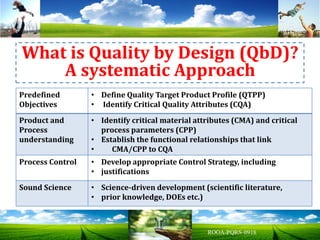
What is Quality by Design (QbD)?
A systematic Approach
Predefined
Objectives
• Define Quality Target Product Profile (QTPP)
• Identify Critical Quality Attributes (CQA)
Product and
Process
understanding
• Identify critical material attributes (CMA) and critical
process parameters (CPP)
• Establish the functional relationships that link
• CMA/CPP to CQA
Process Control • Develop appropriate Control Strategy, including
• justifications
Sound Science • Science-driven development (scientific literature,
• prior knowledge, DOEs etc.)
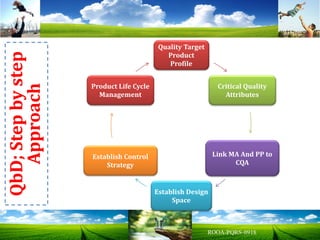
Quality Target
Product
Profile
Critical Quality
Attributes
Link MA And PP to
CQA
Establish Design
Space
Establish Control
Strategy
Product Life Cycle
Management
QbD;Stepbystep
Approach
Quality Target Product Profile (QTPP)
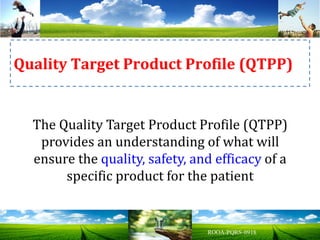
The Quality Target Product Profile (QTPP)
provides an understanding of what will
ensure the quality, safety, and efficacy of a
specific product for the patient
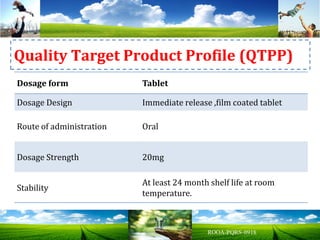
Quality Target Product Profile (QTPP)
Dosage form Tablet
Dosage Design Immediate release ,film coated tablet
Route of administration Oral
Dosage Strength 20mg
Stability
At least 24 month shelf life at room
temperature.
Quality Target Product Profile (QTPP)
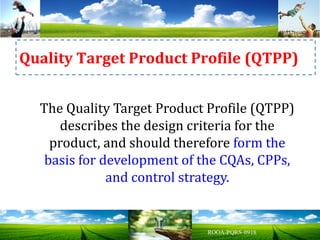
The Quality Target Product Profile (QTPP)
describes the design criteria for the
product, and should therefore form the
basis for development of the CQAs, CPPs,
and control strategy.
Quality Target Product Profile (QTPP)
Critical Quality Attributes (CQA)
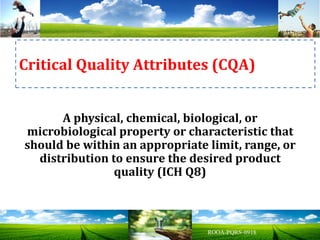
A physical, chemical, biological, or
microbiological property or characteristic that
should be within an appropriate limit, range, or
distribution to ensure the desired product
quality (ICH Q8)
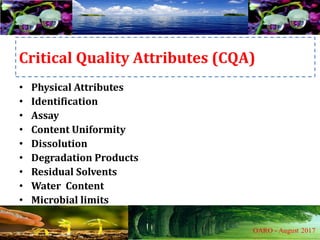
Critical Quality Attributes (CQA)
• Physical Attributes
• Identification
• Assay
• Content Uniformity
• Dissolution
• Degradation Products
• Residual Solvents
• Water Content
• Microbial limits
Critical Material Attributes (CMA)
A physical, chemical, biological or
microbiological property or characteristic of an
input material that should be within an
appropriate limit, range, or distribution to
ensure the desired quality of output material.
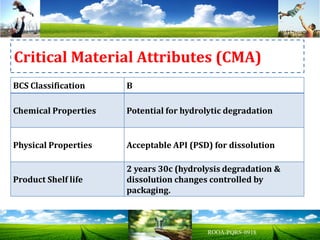
Critical Material Attributes (CMA)
BCS Classification B
Chemical Properties Potential for hydrolytic degradation
Physical Properties Acceptable API (PSD) for dissolution
Product Shelf life
2 years 30c (hydrolysis degradation &
dissolution changes controlled by
packaging.
Critical Material Attributes (CMA)
Critical Process Parameters(CPP)
A process parameter whose variability has an
impact on a CQA and therefore should be
monitored or controlled to ensure the process
produces the desired quality. (ICH Q8)
Critical Process Parameters(CPP)
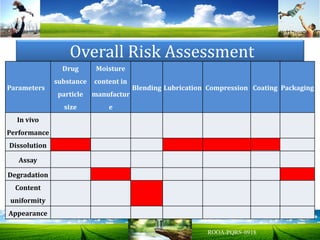
Overall Risk Assessment
Parameters
Drug
substance
particle
size
Moisture
content in
manufactur
e
Blending Lubrication Compression Coating Packaging
In vivo
Performance
Dissolution
Assay
Degradation
Content
uniformity
Appearance
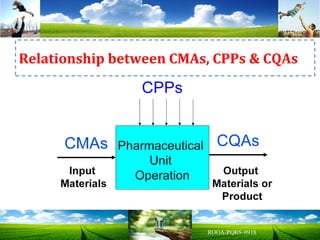
Relationship between CMAs, CPPs & CQAs
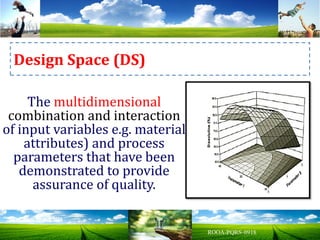
Design Space (DS)
The multidimensional
combination and interaction
of input variables e.g. material
attributes) and process
parameters that have been
demonstrated to provide
assurance of quality.
Slide 32 May 2008
Design Space (DS)
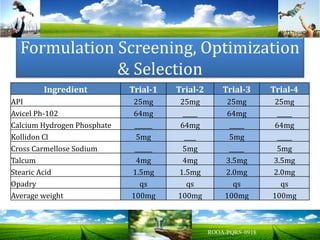
Formulation Screening, Optimization
& Selection
Ingredient Trial-1 Trial-2 Trial-3 Trial-4
API 25mg 25mg 25mg 25mg
Avicel Ph-102 64mg _____ 64mg _____
Calcium Hydrogen Phosphate ______ 64mg _____ 64mg
Kollidon Cl 5mg ____ 5mg _____
Cross Carmellose Sodium ______ 5mg _____ 5mg
Talcum 4mg 4mg 3.5mg 3.5mg
Stearic Acid 1.5mg 1.5mg 2.0mg 2.0mg
Opadry qs qs qs qs
Average weight 100mg 100mg 100mg 100mg
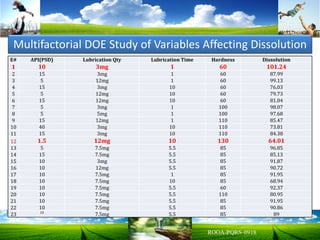
Multifactorial DOE Study of Variables Affecting Dissolution
E# API(PSD) Lubrication Qty Lubrication Time Hardness Dissolution
1 10 3mg 1 60 101.24
2 15 3mg 1 60 87.99
3 5 12mg 1 60 99.13
4 15 3mg 10 60 76.03
5 5 12mg 10 60 79.73
6 15 12mg 10 60 81.04
7 5 3mg 1 100 98.07
8 5 5mg 1 100 97.68
9 15 12mg 1 110 85.47
10 40 3mg 10 110 73.81
11 15 3mg 10 110 84.38
12 1.5 12mg 10 130 64.01
13 5 7.5mg 5.5 85 96.85
14 15 7.5mg 5.5 85 85.13
15 10 3mg 5.5 85 91.87
16 10 12mg 5.5 85 90.72
17 10 7.5mg 1 85 91.95
18 10 7.5mg 10 85 68.94
19 10 7.5mg 5.5 60 92.37
20 10 7.5mg 5.5 110 80.95
21 10 7.5mg 5.5 85 91.95
22 10 7.5mg 5.5 85 90.86
23 10
7.5mg 5.5 85 89
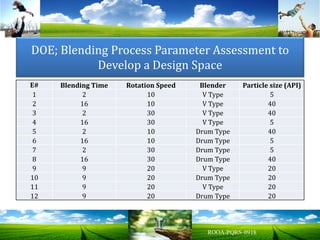
DOE; Blending Process Parameter Assessment to
Develop a Design Space
E# Blending Time Rotation Speed Blender Particle size (API)
1 2 10 V Type 5
2 16 10 V Type 40
3 2 30 V Type 40
4 16 30 V Type 5
5 2 10 Drum Type 40
6 16 10 Drum Type 5
7 2 30 Drum Type 5
8 16 30 Drum Type 40
9 9 20 V Type 20
10 9 20 Drum Type 20
11 9 20 V Type 20
12 9 20 Drum Type 20
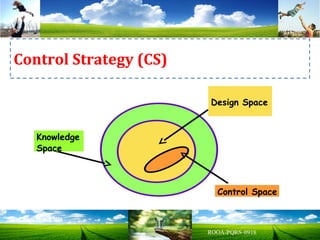
Control Strategy (CS)
Design Space
Knowledge
Space
Control Space
Slide 35 May 2008
Control Strategy (CS)
The control strategy should describe and justify
• in-process controls
• controls of input materials (drug substance and
excipients)
• container closure system
Slide 36 May 2008
Control Strategy (CS)
Contribute to the final product quality
Take Home Message…
Quality by
Testing & Inspection
Enhanced
Product knowledge
Process
understanding
Quality by Design
Quality assured by well designed Product &
Process
Process Design to Process Validation

Process Design to Process Validation

  • 1.
    Process; Design toValidation A Critical Journey Faheem Lakhani Plant Head Platinum Pharmaceuticals
  • 2.
    Flow of Presentation Introduction to Process Design/ QBD  Quality Target Product Profile (QTPP)  Critical Quality Attributes (CQA’s)  Critical Process Parameters (CPP’s)  Critical Materials Attributes (CMA’s)  Design of Experiments (DOE)  Design Space (DP)  Control Strategy (CS)  Discussion
  • 3.
  • 4.
    Introduction to ProcessDesign/ QBD How do we fill these quality gaps in Pharmaceutical industry??? By testing???
  • 5.
    Quality of pharmaceuticalproducts, an elephant in the dark
  • 6.
    Are we grapplingskewed perceptions of GMP? (Dr.Ijaz) The only source of knowledge is experience. (Albert Einstein)
  • 7.
    The Quality Mantra Qualitycannot be tested into PRODUCTS; it has to be built in by DESIGN.
  • 8.
    The Quality Mantra Processvalidation on 3 batches Not appropriate 30 Batches required for 90% reliability & 95% confidence Not Practical Make the design of experiment strong to demonstrate SCIENCE behind variability
  • 9.
    • A systematicapproach to development that begins with predefined objectives and emphasizes product and process understanding and process control, based on sound science and quality risk management. (ICH Q8 R2) What is Quality by Design (QbD)?
  • 10.
    What is Qualityby Design (QbD)? A systematic Approach Predefined Objectives • Define Quality Target Product Profile (QTPP) • Identify Critical Quality Attributes (CQA) Product and Process understanding • Identify critical material attributes (CMA) and critical process parameters (CPP) • Establish the functional relationships that link • CMA/CPP to CQA Process Control • Develop appropriate Control Strategy, including • justifications Sound Science • Science-driven development (scientific literature, • prior knowledge, DOEs etc.)
  • 11.
    Quality Target Product Profile Critical Quality Attributes LinkMA And PP to CQA Establish Design Space Establish Control Strategy Product Life Cycle Management QbD;Stepbystep Approach
  • 12.
    Quality Target ProductProfile (QTPP)
  • 13.
    The Quality TargetProduct Profile (QTPP) provides an understanding of what will ensure the quality, safety, and efficacy of a specific product for the patient Quality Target Product Profile (QTPP)
  • 14.
    Dosage form Tablet DosageDesign Immediate release ,film coated tablet Route of administration Oral Dosage Strength 20mg Stability At least 24 month shelf life at room temperature. Quality Target Product Profile (QTPP)
  • 15.
    The Quality TargetProduct Profile (QTPP) describes the design criteria for the product, and should therefore form the basis for development of the CQAs, CPPs, and control strategy. Quality Target Product Profile (QTPP)
  • 16.
  • 17.
    A physical, chemical,biological, or microbiological property or characteristic that should be within an appropriate limit, range, or distribution to ensure the desired product quality (ICH Q8) Critical Quality Attributes (CQA)
  • 18.
    Critical Quality Attributes(CQA) • Physical Attributes • Identification • Assay • Content Uniformity • Dissolution • Degradation Products • Residual Solvents • Water Content • Microbial limits
  • 19.
  • 20.
    A physical, chemical,biological or microbiological property or characteristic of an input material that should be within an appropriate limit, range, or distribution to ensure the desired quality of output material. Critical Material Attributes (CMA)
  • 21.
    BCS Classification B ChemicalProperties Potential for hydrolytic degradation Physical Properties Acceptable API (PSD) for dissolution Product Shelf life 2 years 30c (hydrolysis degradation & dissolution changes controlled by packaging. Critical Material Attributes (CMA)
  • 22.
  • 23.
    A process parameterwhose variability has an impact on a CQA and therefore should be monitored or controlled to ensure the process produces the desired quality. (ICH Q8) Critical Process Parameters(CPP)
  • 24.
    Overall Risk Assessment Parameters Drug substance particle size Moisture contentin manufactur e Blending Lubrication Compression Coating Packaging In vivo Performance Dissolution Assay Degradation Content uniformity Appearance
  • 25.
  • 26.
  • 27.
    The multidimensional combination andinteraction of input variables e.g. material attributes) and process parameters that have been demonstrated to provide assurance of quality. Slide 32 May 2008 Design Space (DS)
  • 28.
    Formulation Screening, Optimization &Selection Ingredient Trial-1 Trial-2 Trial-3 Trial-4 API 25mg 25mg 25mg 25mg Avicel Ph-102 64mg _____ 64mg _____ Calcium Hydrogen Phosphate ______ 64mg _____ 64mg Kollidon Cl 5mg ____ 5mg _____ Cross Carmellose Sodium ______ 5mg _____ 5mg Talcum 4mg 4mg 3.5mg 3.5mg Stearic Acid 1.5mg 1.5mg 2.0mg 2.0mg Opadry qs qs qs qs Average weight 100mg 100mg 100mg 100mg
  • 29.
    Multifactorial DOE Studyof Variables Affecting Dissolution E# API(PSD) Lubrication Qty Lubrication Time Hardness Dissolution 1 10 3mg 1 60 101.24 2 15 3mg 1 60 87.99 3 5 12mg 1 60 99.13 4 15 3mg 10 60 76.03 5 5 12mg 10 60 79.73 6 15 12mg 10 60 81.04 7 5 3mg 1 100 98.07 8 5 5mg 1 100 97.68 9 15 12mg 1 110 85.47 10 40 3mg 10 110 73.81 11 15 3mg 10 110 84.38 12 1.5 12mg 10 130 64.01 13 5 7.5mg 5.5 85 96.85 14 15 7.5mg 5.5 85 85.13 15 10 3mg 5.5 85 91.87 16 10 12mg 5.5 85 90.72 17 10 7.5mg 1 85 91.95 18 10 7.5mg 10 85 68.94 19 10 7.5mg 5.5 60 92.37 20 10 7.5mg 5.5 110 80.95 21 10 7.5mg 5.5 85 91.95 22 10 7.5mg 5.5 85 90.86 23 10 7.5mg 5.5 85 89
  • 30.
    DOE; Blending ProcessParameter Assessment to Develop a Design Space E# Blending Time Rotation Speed Blender Particle size (API) 1 2 10 V Type 5 2 16 10 V Type 40 3 2 30 V Type 40 4 16 30 V Type 5 5 2 10 Drum Type 40 6 16 10 Drum Type 5 7 2 30 Drum Type 5 8 16 30 Drum Type 40 9 9 20 V Type 20 10 9 20 Drum Type 20 11 9 20 V Type 20 12 9 20 Drum Type 20
  • 31.
  • 32.
    Design Space Knowledge Space Control Space Slide35 May 2008 Control Strategy (CS)
  • 33.
    The control strategyshould describe and justify • in-process controls • controls of input materials (drug substance and excipients) • container closure system Slide 36 May 2008 Control Strategy (CS) Contribute to the final product quality
  • 34.
    Take Home Message… Qualityby Testing & Inspection Enhanced Product knowledge Process understanding Quality by Design Quality assured by well designed Product & Process