total output power solutions AUTOMETIC PROCESS CONTROL Page 1
Automatic Process Control.
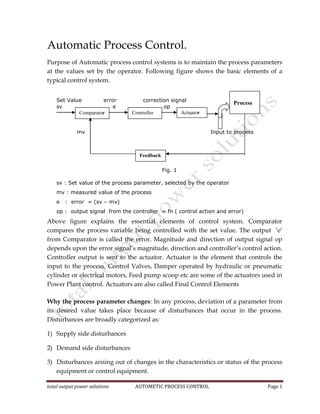
Purpose of Automatic process control systems is to maintain the process parameters
at the values set by the operator. Following figure shows the basic elements of a
typical control system.
Set Value error correction signal
sv e op
mv Input to process
Fig. 1
sv : Set value of the process parameter, selected by the operator
mv : measured value of the process
e : error = (sv – mv)
op : output signal from the controller = fn ( control action and error)
Above figure explains the essential elements of control system. Comparator
compares the process variable being controlled with the set value. The output ‘e’
from Comparator is called the error. Magnitude and direction of output signal op
depends upon the error signal’s magnitude, direction and controller’s control action.
Controller output is sent to the actuator. Actuator is the element that controls the
input to the process. Control Valves, Damper operated by hydraulic or pneumatic
cylinder or electrical motors, Feed pump scoop etc are some of the actuators used in
Power Plant control. Actuators are also called Final Control Elements
Why the process parameter changes: In any process, deviation of a parameter from
its desired value takes place because of disturbances that occur in the process.
Disturbances are broadly categorized as:
1) Supply side disturbances
2) Demand side disturbances
3) Disturbances arising out of changes in the characteristics or status of the process
equipment or control equipment.
Comparator Controller Actuator
Process
Feedback
total output power solutions AUTOMETIC PROCESS CONTROL Page 2
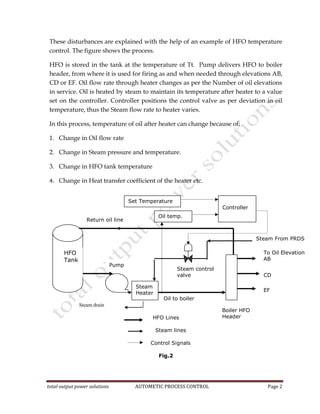
These disturbances are explained with the help of an example of HFO temperature
control. The figure shows the process.
HFO is stored in the tank at the temperature of Tt. Pump delivers HFO to boiler
header, from where it is used for firing as and when needed through elevations AB,
CD or EF. Oil flow rate through heater changes as per the Number of oil elevations
in service. Oil is heated by steam to maintain its temperature after heater to a value
set on the controller. Controller positions the control valve as per deviation in oil
temperature, thus the Steam flow rate to heater varies.
In this process, temperature of oil after heater can change because of;
1. Change in Oil flow rate
2. Change in Steam pressure and temperature.
3. Change in HFO tank temperature
4. Change in Heat transfer coefficient of the heater etc.
Oil to boiler
HFO Lines
Steam lines
Control Signals
Fig.2
HFO
Tank
Steam
Heater
Steam drain
Pump
To Oil Elevation
AB
CD
EF
Return oil line
Boiler HFO
Header
Controller
Steam From PRDS
Set Temperature
Oil temp.
Steam control
valve
total output power solutions AUTOMETIC PROCESS CONTROL Page 3
Demand side disturbance: Oil flow rate changes as per the need of the boiler. It is
called a demand side disturbance.
Supply side disturbance: Changes in Steam pressure and temperature and change
in HFO tank temperature is called supply side disturbance
Disturbance due to the change in status of process equipment: During the
operation of the process over a period of time, plant’s performance, such as heat
transfer coefficient of the heater, Pump delivery, Oil and steam line hydraulic
resistance are likely to change. All these changes shall affect the process and are
called disturbances due to changes in equipment’s status.
Any of these disturbances cause deviation of the controlled parameter from its set
value. Properly designed and maintained control system shall bring the deviation
to zero. A good quality control system shall be able control the process without the
magnitude of deviation going too large. Also, it will bring down the deviation to
zero within a short time. The third criterion of the quality is stability. A good
control system shall not cause instability in the process for small disturbances of the
order of 10% to 15%.
Process Characteristics:
Every process has certain type of response to the disturbances. For proper design
and tuning of the control system, prior knowledge of process and its response to
disturbances is necessary. In design stages, the process is analyzed for finding the
transfer functions. Further analysis is made by using mathematical techniques such
as Bode plot etc.
Simple experimental techniques are also available for studying and analyzing the
control system. In these techniques, response of the process for a step change in
disturbance is analyzed. Data used in such studies is explained below. Disturbance
is induced by making a step change in actuator position.
total output power solutions AUTOMETIC PROCESS CONTROL Page 4
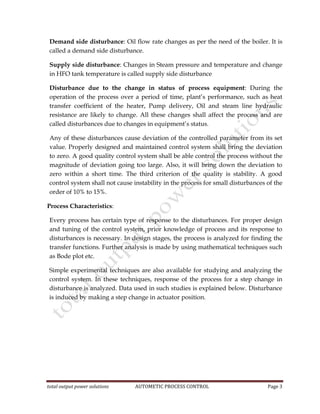
Process reaction for step change
Process dead time Td
Fig. 3
Process dead time: Time taken by the process to respond to step change in actuator.
In above diagram, Td is called the dead time.
Process Hysterisis: It is the minimum change in control signal that will cause
change in process.
Control Actions:
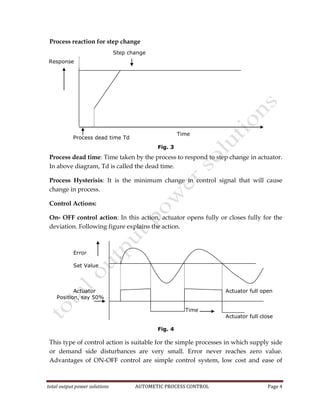
On- OFF control action: In this action, actuator opens fully or closes fully for the
deviation. Following figure explains the action.
Error
Set Value
Actuator Actuator full open
Position, say 50%
Time
Actuator full close
Fig. 4
This type of control action is suitable for the simple processes in which supply side
or demand side disturbances are very small. Error never reaches zero value.
Advantages of ON-OFF control are simple control system, low cost and ease of
Time
Response
Step change
total output power solutions AUTOMETIC PROCESS CONTROL Page 5
maintenance. In power plant process, there are large disturbances and error must
be nearly zero, hence On/ Off control is never used in Power Plant process.
Proportional Control Action:
In this control action, controller out put changes in proportion to error magnitude.
The characteristic equation for this action is:
op = Kp × e + y0 .
Where
Kp is called proportional gain
e is the error magnitude
y0 is the output from controller even when there is no error. It is also called bias.
In proportional controller, value of proportional gain is set as per the requirement
of process and can be varied from 0 to ∞. Also y0 is set to suit the particular process.
Instead of the term Proportional Gain, the term Proportional Band (PB), is often
used. A controller is always equipped with a gain setting mechanism, dial of which
is generally marked in terms of PB.
Proportional Band PB = 100 / Kp
Proportional Band PB can be defined as percentage of change in control variable
that will cause the actuator to stroke through 100%.
When PB is set to 100%, then 100% change in control variable will cause full stroke
operation of the actuator.
When PB = 0, gain is infinity and On/ Off control results
When PB = ∞, gain is zero and no control action results.
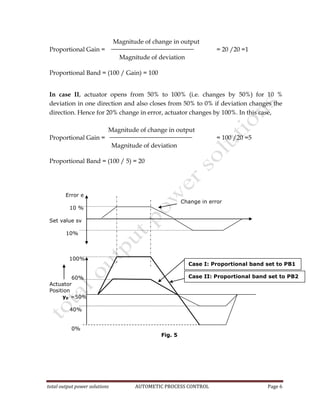
Figure 5 on next page explains the Proportional Control Action:
The actuator is 50% open when there is no error.
In case I, actuator opens from 50% to 60% (i.e. changes by 10%) for 10 % deviation
in one direction and also closes from 50% to 40% if deviation changes the direction.
Hence for 20% change in error, actuator changes by 20%. In this case,
total output power solutions AUTOMETIC PROCESS CONTROL Page 6
Magnitude of change in output
Proportional Gain = = 20 /20 =1
Magnitude of deviation
Proportional Band = (100 / Gain) = 100
In case II, actuator opens from 50% to 100% (i.e. changes by 50%) for 10 %
deviation in one direction and also closes from 50% to 0% if deviation changes the
direction. Hence for 20% change in error, actuator changes by 100%. In this case,
Magnitude of change in output
Proportional Gain = = 100 /20 =5
Magnitude of deviation
Proportional Band = (100 / 5) = 20
Error e
10 %
Set value sv
10%
100%
60%
Actuator
Position
y0 =50%
40%
0%
Fig. 5
Change in error
Case I: Proportional band set to PB1
Case II: Proportional band set to PB2
total output power solutions AUTOMETIC PROCESS CONTROL Page 7
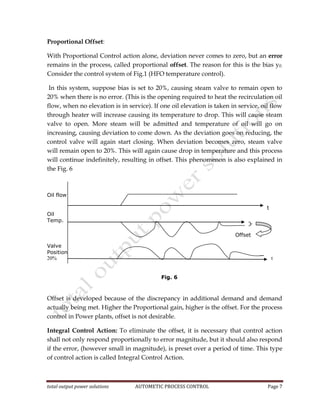
Proportional Offset:
With Proportional Control action alone, deviation never comes to zero, but an error
remains in the process, called proportional offset. The reason for this is the bias y0.
Consider the control system of Fig.1 (HFO temperature control).
In this system, suppose bias is set to 20%, causing steam valve to remain open to
20% when there is no error. (This is the opening required to heat the recirculation oil
flow, when no elevation is in service). If one oil elevation is taken in service, oil flow
through heater will increase causing its temperature to drop. This will cause steam
valve to open. More steam will be admitted and temperature of oil will go on
increasing, causing deviation to come down. As the deviation goes on reducing, the
control valve will again start closing. When deviation becomes zero, steam valve
will remain open to 20%. This will again cause drop in temperature and this process
will continue indefinitely, resulting in offset. This phenomenon is also explained in
the Fig. 6
Oil flow
t
Oil
Temp.
Valve
Position
20% t
Fig. 6
Offset is developed because of the discrepancy in additional demand and demand
actually being met. Higher the Proportional gain, higher is the offset. For the process
control in Power plants, offset is not desirable.
Integral Control Action: To eliminate the offset, it is necessary that control action
shall not only respond proportionally to error magnitude, but it should also respond
if the error, (however small in magnitude), is preset over a period of time. This type
of control action is called Integral Control Action.
Offset
total output power solutions AUTOMETIC PROCESS CONTROL Page 8
The integral action is defined mathematically as:
Output = 1/ Ti ∫ e.dt
Where
e = error
Ti = Time interval of integral action, which can be set as per the requirements
of the control system.
Integral Action is also known as reset action. Its purpose is to provide adequate
control action on varying demands from and by the process. In this type of action,
output changes as per the time integral of error. This action does not exist
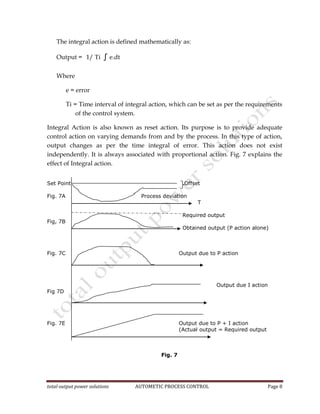
independently. It is always associated with proportional action. Fig. 7 explains the
effect of Integral action.
Set Point Offset
Fig. 7A Process deviation
T
Required output
Fig, 7B
Obtained output (P action alone)
Fig. 7C Output due to P action
Output due I action
Fig 7D
Fig. 7E Output due to P + I action
(Actual output = Required output
Fig. 7
total output power solutions AUTOMETIC PROCESS CONTROL Page 9
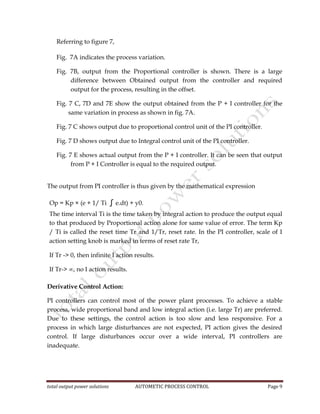
Referring to figure 7,
Fig. 7A indicates the process variation.
Fig. 7B, output from the Proportional controller is shown. There is a large
difference between Obtained output from the controller and required
output for the process, resulting in the offset.
Fig. 7 C, 7D and 7E show the output obtained from the P + I controller for the
same variation in process as shown in fig. 7A.
Fig. 7 C shows output due to proportional control unit of the PI controller.
Fig. 7 D shows output due to Integral control unit of the PI controller.
Fig. 7 E shows actual output from the P + I controller. It can be seen that output
from P + I Controller is equal to the required output.
The output from PI controller is thus given by the mathematical expression
Op = Kp × (e + 1/ Ti ∫ e.dt) + y0.
The time interval Ti is the time taken by integral action to produce the output equal
to that produced by Proportional action alone for same value of error. The term Kp
/ Ti is called the reset time Tr and 1/Tr, reset rate. In the PI controller, scale of I
action setting knob is marked in terms of reset rate Tr,
If Tr -> 0, then infinite I action results.
If Tr-> ∞, no I action results.
Derivative Control Action:
PI controllers can control most of the power plant processes. To achieve a stable
process, wide proportional band and low integral action (i.e. large Tr) are preferred.
Due to these settings, the control action is too slow and less responsive. For a
process in which large disturbances are not expected, PI action gives the desired
control. If large disturbances occur over a wide interval, PI controllers are
inadequate.
total output power solutions AUTOMETIC PROCESS CONTROL Page 10
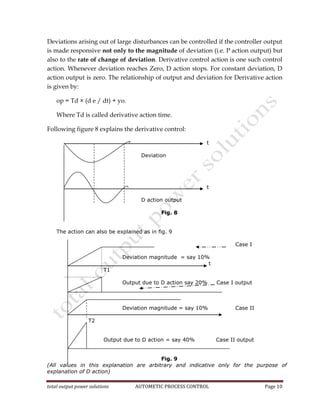
Deviations arising out of large disturbances can be controlled if the controller output
is made responsive not only to the magnitude of deviation (i.e. P action output) but
also to the rate of change of deviation. Derivative control action is one such control
action. Whenever deviation reaches Zero, D action stops. For constant deviation, D
action output is zero. The relationship of output and deviation for Derivative action
is given by:
op = Td × (d e / dt) + yo.
Where Td is called derivative action time.
Following figure 8 explains the derivative control:
t
Deviation
t
D action output
Fig. 8
The action can also be explained as in fig. 9
Case I
Deviation magnitude = say 10%
t
T1
Output due to D action say 20% Case I output
Deviation magnitude = say 10% Case II
T2
Output due to D action = say 40% Case II output
Fig. 9
(All values in this explanation are arbitrary and indicative only for the purpose of
explanation of D action)
total output power solutions AUTOMETIC PROCESS CONTROL Page 11
In the case I, deviation has reached magnitude of is 10% in time T1. The D action
output is 20%.
In second case, deviation has reached magnitude of is 10% but now in time T2,
where T2 < < T1, output is 40%.
Hence in case II, the output is much greater than that of case I, even though
magnitude of deviation is equal.
 The time Td is called derivative action time.
 If Td -> 0, no derivative action results.
 If Td -> ∞, infinite derivative action results.
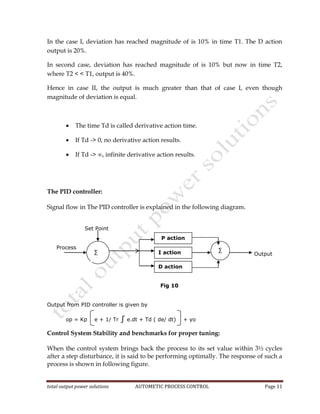
The PID controller:
Signal flow in The PID controller is explained in the following diagram.
Set Point
Process
Output
Fig 10
Output from PID controller is given by
op = Kp e + 1/ Tr ∫ e.dt + Td ( de/ dt) + yo
Control System Stability and benchmarks for proper tuning:
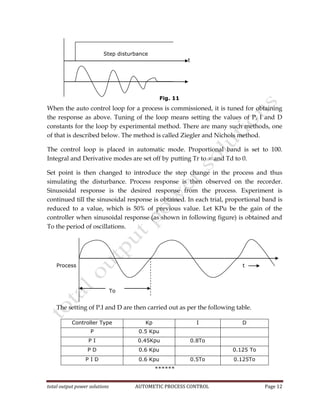
When the control system brings back the process to its set value within 3½ cycles
after a step disturbance, it is said to be performing optimally. The response of such a
process is shown in following figure.
P action
I action
D action
∑ ∑
total output power solutions AUTOMETIC PROCESS CONTROL Page 12
Step disturbance
t
Fig. 11
When the auto control loop for a process is commissioned, it is tuned for obtaining
the response as above. Tuning of the loop means setting the values of P, I and D
constants for the loop by experimental method. There are many such methods, one
of that is described below. The method is called Ziegler and Nichols method.
The control loop is placed in automatic mode. Proportional band is set to 100.
Integral and Derivative modes are set off by putting Tr to ∞ and Td to 0.
Set point is then changed to introduce the step change in the process and thus
simulating the disturbance. Process response is then observed on the recorder.
Sinusoidal response is the desired response from the process. Experiment is
continued till the sinusoidal response is obtained. In each trial, proportional band is
reduced to a value, which is 50% of previous value. Let KPu be the gain of the
controller when sinusoidal response (as shown in following figure) is obtained and
To the period of oscillations.
Process t
To
The setting of P.I and D are then carried out as per the following table.
Controller Type Kp I D
P 0.5 Kpu
P I 0.45Kpu 0.8To
P D 0.6 Kpu 0.125 To
P I D 0.6 Kpu 0.5To 0.125To
******

Automatic process controls in a Thermal Power Station

  • 1.
    total output powersolutions AUTOMETIC PROCESS CONTROL Page 1 Automatic Process Control. Purpose of Automatic process control systems is to maintain the process parameters at the values set by the operator. Following figure shows the basic elements of a typical control system. Set Value error correction signal sv e op mv Input to process Fig. 1 sv : Set value of the process parameter, selected by the operator mv : measured value of the process e : error = (sv – mv) op : output signal from the controller = fn ( control action and error) Above figure explains the essential elements of control system. Comparator compares the process variable being controlled with the set value. The output ‘e’ from Comparator is called the error. Magnitude and direction of output signal op depends upon the error signal’s magnitude, direction and controller’s control action. Controller output is sent to the actuator. Actuator is the element that controls the input to the process. Control Valves, Damper operated by hydraulic or pneumatic cylinder or electrical motors, Feed pump scoop etc are some of the actuators used in Power Plant control. Actuators are also called Final Control Elements Why the process parameter changes: In any process, deviation of a parameter from its desired value takes place because of disturbances that occur in the process. Disturbances are broadly categorized as: 1) Supply side disturbances 2) Demand side disturbances 3) Disturbances arising out of changes in the characteristics or status of the process equipment or control equipment. Comparator Controller Actuator Process Feedback
  • 2.
    total output powersolutions AUTOMETIC PROCESS CONTROL Page 2 These disturbances are explained with the help of an example of HFO temperature control. The figure shows the process. HFO is stored in the tank at the temperature of Tt. Pump delivers HFO to boiler header, from where it is used for firing as and when needed through elevations AB, CD or EF. Oil flow rate through heater changes as per the Number of oil elevations in service. Oil is heated by steam to maintain its temperature after heater to a value set on the controller. Controller positions the control valve as per deviation in oil temperature, thus the Steam flow rate to heater varies. In this process, temperature of oil after heater can change because of; 1. Change in Oil flow rate 2. Change in Steam pressure and temperature. 3. Change in HFO tank temperature 4. Change in Heat transfer coefficient of the heater etc. Oil to boiler HFO Lines Steam lines Control Signals Fig.2 HFO Tank Steam Heater Steam drain Pump To Oil Elevation AB CD EF Return oil line Boiler HFO Header Controller Steam From PRDS Set Temperature Oil temp. Steam control valve
  • 3.
    total output powersolutions AUTOMETIC PROCESS CONTROL Page 3 Demand side disturbance: Oil flow rate changes as per the need of the boiler. It is called a demand side disturbance. Supply side disturbance: Changes in Steam pressure and temperature and change in HFO tank temperature is called supply side disturbance Disturbance due to the change in status of process equipment: During the operation of the process over a period of time, plant’s performance, such as heat transfer coefficient of the heater, Pump delivery, Oil and steam line hydraulic resistance are likely to change. All these changes shall affect the process and are called disturbances due to changes in equipment’s status. Any of these disturbances cause deviation of the controlled parameter from its set value. Properly designed and maintained control system shall bring the deviation to zero. A good quality control system shall be able control the process without the magnitude of deviation going too large. Also, it will bring down the deviation to zero within a short time. The third criterion of the quality is stability. A good control system shall not cause instability in the process for small disturbances of the order of 10% to 15%. Process Characteristics: Every process has certain type of response to the disturbances. For proper design and tuning of the control system, prior knowledge of process and its response to disturbances is necessary. In design stages, the process is analyzed for finding the transfer functions. Further analysis is made by using mathematical techniques such as Bode plot etc. Simple experimental techniques are also available for studying and analyzing the control system. In these techniques, response of the process for a step change in disturbance is analyzed. Data used in such studies is explained below. Disturbance is induced by making a step change in actuator position.
  • 4.
    total output powersolutions AUTOMETIC PROCESS CONTROL Page 4 Process reaction for step change Process dead time Td Fig. 3 Process dead time: Time taken by the process to respond to step change in actuator. In above diagram, Td is called the dead time. Process Hysterisis: It is the minimum change in control signal that will cause change in process. Control Actions: On- OFF control action: In this action, actuator opens fully or closes fully for the deviation. Following figure explains the action. Error Set Value Actuator Actuator full open Position, say 50% Time Actuator full close Fig. 4 This type of control action is suitable for the simple processes in which supply side or demand side disturbances are very small. Error never reaches zero value. Advantages of ON-OFF control are simple control system, low cost and ease of Time Response Step change
  • 5.
    total output powersolutions AUTOMETIC PROCESS CONTROL Page 5 maintenance. In power plant process, there are large disturbances and error must be nearly zero, hence On/ Off control is never used in Power Plant process. Proportional Control Action: In this control action, controller out put changes in proportion to error magnitude. The characteristic equation for this action is: op = Kp × e + y0 . Where Kp is called proportional gain e is the error magnitude y0 is the output from controller even when there is no error. It is also called bias. In proportional controller, value of proportional gain is set as per the requirement of process and can be varied from 0 to ∞. Also y0 is set to suit the particular process. Instead of the term Proportional Gain, the term Proportional Band (PB), is often used. A controller is always equipped with a gain setting mechanism, dial of which is generally marked in terms of PB. Proportional Band PB = 100 / Kp Proportional Band PB can be defined as percentage of change in control variable that will cause the actuator to stroke through 100%. When PB is set to 100%, then 100% change in control variable will cause full stroke operation of the actuator. When PB = 0, gain is infinity and On/ Off control results When PB = ∞, gain is zero and no control action results. Figure 5 on next page explains the Proportional Control Action: The actuator is 50% open when there is no error. In case I, actuator opens from 50% to 60% (i.e. changes by 10%) for 10 % deviation in one direction and also closes from 50% to 40% if deviation changes the direction. Hence for 20% change in error, actuator changes by 20%. In this case,
  • 6.
    total output powersolutions AUTOMETIC PROCESS CONTROL Page 6 Magnitude of change in output Proportional Gain = = 20 /20 =1 Magnitude of deviation Proportional Band = (100 / Gain) = 100 In case II, actuator opens from 50% to 100% (i.e. changes by 50%) for 10 % deviation in one direction and also closes from 50% to 0% if deviation changes the direction. Hence for 20% change in error, actuator changes by 100%. In this case, Magnitude of change in output Proportional Gain = = 100 /20 =5 Magnitude of deviation Proportional Band = (100 / 5) = 20 Error e 10 % Set value sv 10% 100% 60% Actuator Position y0 =50% 40% 0% Fig. 5 Change in error Case I: Proportional band set to PB1 Case II: Proportional band set to PB2
  • 7.
    total output powersolutions AUTOMETIC PROCESS CONTROL Page 7 Proportional Offset: With Proportional Control action alone, deviation never comes to zero, but an error remains in the process, called proportional offset. The reason for this is the bias y0. Consider the control system of Fig.1 (HFO temperature control). In this system, suppose bias is set to 20%, causing steam valve to remain open to 20% when there is no error. (This is the opening required to heat the recirculation oil flow, when no elevation is in service). If one oil elevation is taken in service, oil flow through heater will increase causing its temperature to drop. This will cause steam valve to open. More steam will be admitted and temperature of oil will go on increasing, causing deviation to come down. As the deviation goes on reducing, the control valve will again start closing. When deviation becomes zero, steam valve will remain open to 20%. This will again cause drop in temperature and this process will continue indefinitely, resulting in offset. This phenomenon is also explained in the Fig. 6 Oil flow t Oil Temp. Valve Position 20% t Fig. 6 Offset is developed because of the discrepancy in additional demand and demand actually being met. Higher the Proportional gain, higher is the offset. For the process control in Power plants, offset is not desirable. Integral Control Action: To eliminate the offset, it is necessary that control action shall not only respond proportionally to error magnitude, but it should also respond if the error, (however small in magnitude), is preset over a period of time. This type of control action is called Integral Control Action. Offset
  • 8.
    total output powersolutions AUTOMETIC PROCESS CONTROL Page 8 The integral action is defined mathematically as: Output = 1/ Ti ∫ e.dt Where e = error Ti = Time interval of integral action, which can be set as per the requirements of the control system. Integral Action is also known as reset action. Its purpose is to provide adequate control action on varying demands from and by the process. In this type of action, output changes as per the time integral of error. This action does not exist independently. It is always associated with proportional action. Fig. 7 explains the effect of Integral action. Set Point Offset Fig. 7A Process deviation T Required output Fig, 7B Obtained output (P action alone) Fig. 7C Output due to P action Output due I action Fig 7D Fig. 7E Output due to P + I action (Actual output = Required output Fig. 7
  • 9.
    total output powersolutions AUTOMETIC PROCESS CONTROL Page 9 Referring to figure 7, Fig. 7A indicates the process variation. Fig. 7B, output from the Proportional controller is shown. There is a large difference between Obtained output from the controller and required output for the process, resulting in the offset. Fig. 7 C, 7D and 7E show the output obtained from the P + I controller for the same variation in process as shown in fig. 7A. Fig. 7 C shows output due to proportional control unit of the PI controller. Fig. 7 D shows output due to Integral control unit of the PI controller. Fig. 7 E shows actual output from the P + I controller. It can be seen that output from P + I Controller is equal to the required output. The output from PI controller is thus given by the mathematical expression Op = Kp × (e + 1/ Ti ∫ e.dt) + y0. The time interval Ti is the time taken by integral action to produce the output equal to that produced by Proportional action alone for same value of error. The term Kp / Ti is called the reset time Tr and 1/Tr, reset rate. In the PI controller, scale of I action setting knob is marked in terms of reset rate Tr, If Tr -> 0, then infinite I action results. If Tr-> ∞, no I action results. Derivative Control Action: PI controllers can control most of the power plant processes. To achieve a stable process, wide proportional band and low integral action (i.e. large Tr) are preferred. Due to these settings, the control action is too slow and less responsive. For a process in which large disturbances are not expected, PI action gives the desired control. If large disturbances occur over a wide interval, PI controllers are inadequate.
  • 10.
    total output powersolutions AUTOMETIC PROCESS CONTROL Page 10 Deviations arising out of large disturbances can be controlled if the controller output is made responsive not only to the magnitude of deviation (i.e. P action output) but also to the rate of change of deviation. Derivative control action is one such control action. Whenever deviation reaches Zero, D action stops. For constant deviation, D action output is zero. The relationship of output and deviation for Derivative action is given by: op = Td × (d e / dt) + yo. Where Td is called derivative action time. Following figure 8 explains the derivative control: t Deviation t D action output Fig. 8 The action can also be explained as in fig. 9 Case I Deviation magnitude = say 10% t T1 Output due to D action say 20% Case I output Deviation magnitude = say 10% Case II T2 Output due to D action = say 40% Case II output Fig. 9 (All values in this explanation are arbitrary and indicative only for the purpose of explanation of D action)
  • 11.
    total output powersolutions AUTOMETIC PROCESS CONTROL Page 11 In the case I, deviation has reached magnitude of is 10% in time T1. The D action output is 20%. In second case, deviation has reached magnitude of is 10% but now in time T2, where T2 < < T1, output is 40%. Hence in case II, the output is much greater than that of case I, even though magnitude of deviation is equal.  The time Td is called derivative action time.  If Td -> 0, no derivative action results.  If Td -> ∞, infinite derivative action results. The PID controller: Signal flow in The PID controller is explained in the following diagram. Set Point Process Output Fig 10 Output from PID controller is given by op = Kp e + 1/ Tr ∫ e.dt + Td ( de/ dt) + yo Control System Stability and benchmarks for proper tuning: When the control system brings back the process to its set value within 3½ cycles after a step disturbance, it is said to be performing optimally. The response of such a process is shown in following figure. P action I action D action ∑ ∑
  • 12.
    total output powersolutions AUTOMETIC PROCESS CONTROL Page 12 Step disturbance t Fig. 11 When the auto control loop for a process is commissioned, it is tuned for obtaining the response as above. Tuning of the loop means setting the values of P, I and D constants for the loop by experimental method. There are many such methods, one of that is described below. The method is called Ziegler and Nichols method. The control loop is placed in automatic mode. Proportional band is set to 100. Integral and Derivative modes are set off by putting Tr to ∞ and Td to 0. Set point is then changed to introduce the step change in the process and thus simulating the disturbance. Process response is then observed on the recorder. Sinusoidal response is the desired response from the process. Experiment is continued till the sinusoidal response is obtained. In each trial, proportional band is reduced to a value, which is 50% of previous value. Let KPu be the gain of the controller when sinusoidal response (as shown in following figure) is obtained and To the period of oscillations. Process t To The setting of P.I and D are then carried out as per the following table. Controller Type Kp I D P 0.5 Kpu P I 0.45Kpu 0.8To P D 0.6 Kpu 0.125 To P I D 0.6 Kpu 0.5To 0.125To ******